Dewayne Wise, Gamesmanship

Wise Guy: Outfielder Accepts Ill-Gotten Gains

By now, you’ve probably seen the umpiring butchery that Mike DiMuro foisted upon Cleveland, when he ruled that Dewayne Wise caught a foul ball while tumbling into the stands that the right fielder very clearly did not catch. (Watch it here.)

The real question, as it concerns the unwritten rules, is one of gamesmanship. Wise knew that he didn’t catch the ball, but was more than happy to accept the out. Did he act appropriately?

Of course he did. It’s the same reasoning used by outfielders who have trapped flyballs but act as if they caught them. (Wise was even more innocent than that—he didn’t act in any way like he made the catch.)

“Everybody thought it was pretty funny,” he told the Westchester Journal News. “They’re just laughing about it, the way I got up smiling. What was I supposed to do? I’m not going to laugh and show up the umpire right there.”

He was also not going to willingly give up one of the 27 outs necessary for his team to win the game.

“Baseball is a game where you try to get away with anything you can,” said Hall of Famer Hank Greenberg in the Saturday Evening Post. “You cut corners when you run the bases. If you trap a ball in the outfield, you swear you caught it. Everybody tries to cheat a little.”

“It’s not cheating,” said former outfielder and minor league manager Von Joshua, ” if the umpire lets you get away with it.”

Wise’s action is less like his teammate Derek Jeter acting like he was hit by a ball that struck his bat, and more like Greg Maddux, a master at throwing scuffed baseballs. Maddux didn’t scuff them himself, however—he held onto ones that had acquired abrasions through the course of regular use, taking what was legally given to him during the course of the game and using it to his fullest advantage.

Tough to fault anybody for that.

Aroldis Chapman, Don't Showboat

Stop, Drop and Roll: Chapman’s Tumble Has Folks Talking

The evolution of self-congratulation in baseball has been long and storied. Reggie Jackson lingering in the batter’s box.  Barry Bonds’s twirls and Sammy Sosa’s bunny hops en route to first base. Earlier this season we had Yoenis Cespedes, who in his third major league game took some liberties while watching a mammoth shot off of Seattle’s Jason Vargas.

It’s that last one that holds the most relevance to today’s story, which features another recent Cuban émigré, in possession of perhaps not the firmest grasp of baseball mores, celebrating his own achievement with a literally over-the-top display that was well-received by neither opponents nor teammates.

When Aroldis Chapman tumbles, people pay attention.

After closing out a 4-3 victory over Milwaukee on Tuesday, Chapman celebrated by doing a double somersault toward the plate. The guy was delighted after getting back on track following consecutive blown saves and an 11.37 ERA over his previous seven outings, and his display of exuberance was unlike any baseball had yet seen. (Watch it here.)

It’s unlikely that Chapman intended to show up the Brewers, but there’s little gray area in baseball when it comes to this sort of thing; rarely is an example of unnecessary showboating so blatant.

“It’s about professionalism . . .” Joey Votto told the Cincinnati Enquirer. “It’s just not how you do things.”

Chapman, of course, has a bit of history when it comes to making curious decisions. There’s the ticket for driving nearly 100 mph with a suspended license. There’s the stripper girlfriend who may or may not have been involved with robbing his hotel room. Both are the mark of a young guy who hasn’t yet achieved full maturity. So, for that matter, is his tumble off the mound. One difference: The first two don’t inspire opposing pitchers to drill him.

Actually, since closers rarely bat, should the Brewers opt to take his celebration the wrong way it’ll likely be one of Chapman’s teammates who ends up paying for his mistake. Which is why members of the Cincinnati clubhouse were so quick to pile on following the game.

“We don’t play like that,” said manager Dusty Baker in an MLB.com report, adding in the Enquirer that “it’ ain’t no joke,” and that “it won’t happen again, ever.”

“You can’t be doing that,” said catcher Ryan Hanigan. Votto, Jay Bruce and pitching coach Bryan Price spoke with Chapman after the game. From John Paul Morosi’s report: “By the time Chapman returned to the clubhouse, the smile he wore on the field was gone. He rested his forehead on a bat as he sat silently at his locker. He declined comment through a team official, saying he was not ‘mentally ready’ to take questions from the media.”

This was important. It told the Brewers that, regardless of how they might respond the following day, the Cincinnati organization was on top of the matter. That kind of thing can make a difference, as evidenced by the fact that Wednesday’s game featured no hit batters. That could have been due to the fact that the score was too close to chance retaliation until the ninth, or that Brewers manager Ron Roenicke spent parts of three seasons as Baker’s teammate on the Dodgers, and understands how his counterpart feels about this kind of thing. Or maybe it’s just that Milwaukee has considerable recent history with its own displays of showboating.

Still, some comfort can be taken from knowing that a situation has been handled; Baker has seen it first-hand. From The Baseball Codes:

In a game in 1996, the Giants trailed Los Angeles 11–2 in the ninth inning, and decided to station first baseman Mark Carreon at his normal depth, ignoring the runner at first, Roger Cedeno. When Cedeno, just twenty-one years old and in his first April as a big-leaguer, saw that nobody was bothering to hold him on, he headed for second—by any interpretation a horrible decision.

As the runner, safe, dusted himself off, Giants third baseman Matt Williams lit into him verbally, as did second baseman Steve Scarsone, left fielder Mel Hall, and manager Dusty Baker. Williams grew so heated that several teammates raced over to restrain him from going after the young Dodgers outfielder. . . .

At second base, Scarsone asked Cedeno if he thought it was a full count, and the outfielder responded that, no, he was just confused. “If he’s that confused, somebody ought to give him a manual on how to play baseball,” said Baker after the game. “I’ve never seen anybody that con­fused.”

In the end, it was Eric Karros [who had been up to bat when this all went down] who saved Cedeno. When he stepped out of the box, as members of the Giants harangued the bewildered baserunner, Karros didn’t simply watch idly—he turned toward the San Francisco bench and informed them that Cedeno had run without a shred of insti­tutional authority, and that Karros himself would ensure that justice was administered once the game ended. Sure enough, as Cedeno sat at his locker after the game, it was obvious to observers that he had been crying. Though the young player refused to comment, it appeared that Karros had been true to his word. “Ignorance and youth really aren’t any excuse,” said Dodgers catcher Mike Piazza, “but we were able to cool things down.”

If there’s any ongoing resentment toward Chapman among the Brewers, we likely won’t know it until July 20, shortly after the All-Star Game, when the teams meet in Cincinnati. (Then again, if rosters hold, Votto and Ryan Braun will have all kinds of time to discuss the situation as members of the National League squad.)

Unlikely as the eventuality may be, should the Brewers decide to retaliate, and they do it in appropriate fashion, it would be shocking to hear a peep of protest from Baker.

Cheating, Joel Peralta, Pine Tar

The Question is Raised: How Much Inside Information is Too Much?

Not to beat on the Maddon-Johnson pine tar affair too much (it may already be too late), but it’s given rise to at least one more interesting point. From Buster Olney’s column at ESPN.com:

When a player is traded and later faces his old teammates, his old team will change its signs, as a matter of course. It’s considered fair game to ask an incoming player for information about his previous team’s signs, or about how to pitch to batters on his old team, or about some other elements of that club. I’ve heard of teams specifically acquiring a player recently dumped by a rival largely for the information—especially catchers, who are the information highways of the sport.

But where is the line about what information you can use?

The key here, at least to me, is in a team’s ability to adjust. Catcher Bengie Molina went from the Giants to Texas in mid-season 2010, and when the teams met just over three months later in the World Series, the discussion was raised about how much advantage the Rangers might gain from his insider knowledge.

To judge by San Francisco’s five-game victory, not much. There’s a simple reason for that, at least as far as signs are concerned: They’re astoundingly simple to switch up. For all the gyrations a third-base coach goes through in delivering coded instructions to a baserunner, they typically don’t mean a thing until he hits his pre-designated indicator signal (such as, say, wiping across his belt buckle or touching his left shoulder), at which point the actual directive will follow. In this situation, changing signs can be as easy as switching the indicator.

Catchers’ signals are similar, in that many of the signs put down are subterfuge; the trick is knowing what to look for. It can be based on the count (a 3-1 count added together means the hot sign is the fourth one the catcher drops) or the number of outs or whether it’s an even- or odd-numbered inning. Sometimes the signs themselves are meaningless, and the pitcher is simply reading the number of pumps, or times the catcher flashes something. There are myriad possibilities, and for most players, changing from one to another is sufficiently simple to do multiple times during the course of a single game.

There’s also the reality that because many pitchers are particular about the signs they use, catchers have individual sets for different members of the pitching staff. This means that if a pitcher is traded, there’s a real possibility that he has little clue about what’s being used by any number of his former teammates.

This is a simplistic overview, of course, and teams can bring far more nuance to the practice—about which inside information may prove useful. Ultimately, though, I think there’s a straightforward answer to Olney’s question of whether sharing an ex-team’s signs is comparable to sharing intel about a pine tar habit: It isn’t. In Joel Peralta’s case, the fact that his pine tar was okay for the Nationals when he used it in Washington, but not okay for them once he left town, speaks to some hypocrisy. When it comes to signs, however, all teams use them, all players learn them, and they’re introduced with the understanding that, while they’re to be protected as closely as possible, they will inevitably have to be changed at some point.

If a former player hastens that inevitability, it’s simply part of the game.

Sports Illustrated.com

Now at SI.com: On Pine Tar, Propriety, and Principle

My latest is up at Sports Illustrated.com, concerning—what else?—Davey Johnson, Joe Maddon, and pine tar. More of an op-ed piece than anything, really.

If you don’t feel like clicking over, read on:

George Bamberger, the late manager of the Milwaukee Brewers and New York Mets, once said: “A guy who cheats in a friendly game of cards is a cheater. A pro who throws a spitball to support his family is a competitor.”

The quote is taken from Thomas Boswell’s book, How Life Imitates the World Series, and serves to illustrate a widely held view on the subject within the sport. Just as there are acceptable levels of cheating in life—things like driving five miles per hour over the speed limit or taking a few pens from the office—there are acceptable levels of cheating in baseball.

This was brought to the forefront last week, when Nationals manager Davey Johnson got Rays reliever Joel Peralta tossed from a game for possessing pine tar on his glove. In the action’s aftermath, even as Tampa Bay manager Joe Maddon raged about the inequity of it all, the question was raised: Did Johnson act appropriately?

In this case, the issue is one of perspective. Outsiders tend to judge baseball culture on civic terms, which only makes sense; a pitcher often bends the rules to gain a competitive advantage. Societal logic dictates that, should he be caught, he be suitably punished. (Peralta was later suspended for eight games.)

Baseball logic, however, is hardly so stark. It acknowledges that certain tactics are either sufficiently widespread to have become acceptable, or sufficiently acceptable to have become widespread. In either case, pine tar fits the bill.

It’s worth noting the distinction between pine tar and lubricants such as Vaseline and K-Y Jelly. The former is a tacky substance typically used by pitchers to improve grip in cold weather or high humidity. Vaseline does the opposite, decreasing friction as the ball rolls off a pitcher’s fingers, reducing backspin and improving movement. It’s not as nearly as benign as pine tar, but even the most noteworthy greaseballer in history, Gaylord Perry, remained beyond official reproach for the first 20 years of his career, despite an overwhelming array of damning evidence. (He was finally suspended for the first time in 1982, three weeks shy of his 44th birthday. Despite a multitude of avowed spitballers over the years, it was the first such punishment since Nelson Potter had been similarly dinged in 1944.)

For many, pine tar—a close cousin to rosin, another tacky material used to increase grip, which is so legal that a powdered supply of it is kept in a bag atop every major league mound—is merely part of the landscape. Indians closer Chris Perez estimated that “there are one or two guys on every team” who use it.

“There are probably a lot of pitchers in this game who need something at times to help them get a better grip,” Cardinals pitcher Chris Carpenter told the St. Louis Post-Dispatch. “If you’re talking about scuffing or putting Vaseline on the ball to make it move differently, that’s a separate issue. But to do something to get a better grip on the ball? With guys throwing 100 miles per hour? I don’t think that’s cheating … It’s a tool to keep [the ball] from flying out of your hands.”

This is as close to unanimity of opinion about an illegal substance as can be found in sports. Which is part of the reason so many people were disturbed by Johnson’s decision to call out Peralta. If the manager was willing to bust an opponent for an accepted practice that by consensus is used by pitchers on every staff, how could he not have recognized the can of worms he’d be opening?

Maddon tried to provide an answer following Peralta’s ejection, when he told home plate ump Tim Tschida that he’d be challenging every Nationals pitcher for the rest of the night. Tschida responded that he’d give him one, which Maddon used on reliever Ryan Mattheus in the ninth inning. (The righthander was clean.)

“Before you start throwing rocks,” said Maddon after the game, “understand where you live.”

The other factor in gauging the propriety of Johnson’s action was the fact that he used inside information to his advantage. Peralta pitched for the Nationals in 2010, presumably also with pine tar on his glove. Although Johnson wasn’t managing the team then, a number of Washington’s coaches and pitchers remain on his staff. This itself is not problematic; knowing that a guy may get some extra snap on his curveball because of extracurricular tack could prove strategically beneficial when formulating a game plan. But calling out a guy who once used said tack effectively for the hometown team may send a confusing message to Johnson’s players about what may be in store for them should they ever move on.

The real question, in light of the fact that so many pitchers use pine tar and so many managers know about it, is what kind of guy sees fit to challenge baseball convention in such a manner? With Johnson, at least, it shouldn’t be surprising; he did the same thing while managing the Mets in the 1988 National League Championship Series, when he had Dodgers pitcher Jay Howell ejected for having pine tar on his glove.

How could Johnson have handled things better? To start, he could have ignored the situation, and saved his own pitchers similar scrutiny in the future. Were he truly inspired to act, he could have approached Maddon before the game and warned him that he didn’t want to see Peralta enter a game with goop on his glove. The sentiment would not likely have been met kindly, but it certainly would have ended up better for both parties than what ultimately went down.

For an example of an appropriate response to a similar situation under the brightest possible spotlight, turn to Game 2 of the 2006 World Series, when Cardinals manager Tony La Russa faced the uncomfortable realization that not only did Tigers pitcher Kenny Rogers have a sizable clump of pine tar on his left hand, but he’d also been called out by Tim McCarver and Joe Buck on the national television broadcast.

Even under those circumstances, La Russa refrained from playing all his cards. Instead of having Rogers checked (and almost inevitably ejected) by the umpiring crew, he merely requested that Rogers wash his hand. Which he did.

La Russa’s comment at the time: “I said, ‘I don’t like this stuff, let’s get it fixed. If it gets fixed, let’s play the game.’ … I detest any b.s. that gets in the way of competition.”

Ultimately, that’s what it comes down to. Pine tar is the same as sign stealing and bat corking: All fall under the heading, proceed until you’re caught, at which point, knock it off. It’s all part of baseball’s competitive process. Unfortunately, Davey Johnson missed that memo.

Cheating, Joel Peralta

Pine Tar Discussion Moves Beyond the Boundaries of Washington

It’s one thing to listen to voices outside the clubhouse maintain or refute the propriety of Davey Johnson’s decision to have Rays reliever Joel Perralta ejected from a game last week because he had pine tar on his glove.

Tampa Bay manager Joe Maddon publicly questioned the wisdom of the move, but his is obviously a biased opinion. Now we have some clarity from an unaffiliated source: Cleveland closer Chris Perez.

“If before every game if they stopped and checked everybody’s gloves or something there would be one or two guys on every team that would just get popped,” he said in an Associated Press report.

Which is exactly the point. Washington’s No. 4 starter, Edwin Jackson, spent three seasons in Tampa Bay under Maddon. Does he have any secrets Maddon might be able to exploit? Jonny Gomes was a member of the Nationals last season, but spent six years prior to that with the Rays. If he has any dirt on Washington, he could well have passed it along to his friends in Tampa. Would it be appropriate for Maddon to use this information punitively?

Of course not.

“It’s probably sticking in their craw a little bit,” said an anonymous former manager and executive in the Washington Post. “They love the guy. He pitched on short rest for the Nationals. They grew to respect him. Then the plug gets pulled on him

“I think the Rays are more mad about somebody calling them out,” said Perez. “It had to be somebody that knew—that used to play with them. I have old teammates that I could tell (manager) Manny (Acta) to call out, but I’m not going to. It’s not bush league, but it’s still not on the up and up.”

Perez clarified that he was not speaking specifically about the habits of any of his former Cardinals teammates, who were nonetheless quizzed in the AP story. The most outspoken of them was Kyle Lohse, who mirrored Perez’s opinions. “If you’re going to start throwing guys under the bus, then you’d better be sure there’s nobody on your own team doing it,” he said. “That’s all I have to say.”

Radio appearances

On the Air in NYC

I’ll be returning Sunday morning to Ed Randall’s Talking Baseball program on WFAN 660AM in New York, 11:40 a.m. EST. Ed knows how to keep the conversation flowing, and I imagine we’ll be touching on Joel Peralta, at least in part.

Update (6-24): Too late to be useful, probably, but a half-hour before air time they called and moved it up 20 minutes. Apologies to anyone who tried to tune in.

Update (6-26): For those who missed it, the conversation is now available online.

Don't Steal with a Big Lead, Retaliation

Lack of Respect in the Windy City? De Aza Pays for Rios’ Mistake

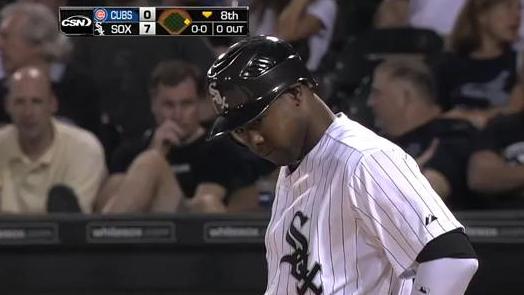
Alejandro De Aza contemplates just having been hit with a pitch.

There is a persistent debate about the point at which a team should stop playing aggressively—the lead size that constitutes a blowout, and when it begins to matter.

According the Cubs, those numbers are six runs and the seventh inning, respectively—at least if Alajandro De Aza is to be believed.

De Aza, the White Sox center fielder, was drilled by the first pitch from Cubs reliever Manny Corpas leading off the eighth inning on Wednesday. It wasn’t that he and Corpas had any beef—to the contrary, said De Aza in a CBS Chicago report, “we’re cool, we’re friends, I’ve known him for a long time.”

The inspiration for the pitch—which De Aza felt was intentional (it certainly looked that way; watch it here)—was likely White Sox right fielder Alex Rios’ decision, after he led off the seventh inning with a single, to take off for second while his club led, 6-0.

Rios never made it, getting forced out on A.J. Pierzynski’s grounder, but the action was unmistakable—as was the response. De Aza said he thought Corpas was told simply “to hit the first guy.” (Watch some of his comments here.)

After the game, Cubs manager Dale Sveum played coy. “I don’t know,” he said in an MLB.com report. “He hit him. It happens sometimes.”

Especially when somebody is paying scant attention to the score. Rios has stolen 171 bases across his nine-year career, so he should have a pretty good idea of what’s appropriate in that regard. It’s also possible that the order came from the bench, probably as a hedge against the double-play more than as a straight steal. If that’s the case, it’s less likely that Robin Ventura simply lost track of the score than that he was insufficiently comfortable with a six-run lead at that point in the game. (Why he would feel that way when facing a Cubs offense that ranks in the bottom five of the National League in hits, runs, doubles, homers, OBP, OPS and slugging is another question.)

Either way, it was the final meeting of the season for the Chicago clubs, so we won’t see a response any time soon. And if De Aza and Corpas meet up during the off-season—you know, like friends do—they’ll hopefully come to the conclusion that the incident was strictly the business of the unwritten rules.

Radio appearances

More Upcoming Radio Appearances

Taped a segment for Michael Smerconish‘s program this morning, discussing Joel Perralta, Joe Maddon, Davey Johnson, pine tar and name-calling. It’ll run at various times; his show is syndicated and can be streamed from his Web site.

I also had a great conversation with Ken Broo of WLW in Cincinnati, partly about Cleveland’s alleged sign stealing, which will air as part of the pre-game package on Saturday, prior to the Reds broadcast.

Mat Latos, Sign stealing

Sign Stealing in C-Town? Mat Latos Thinks So

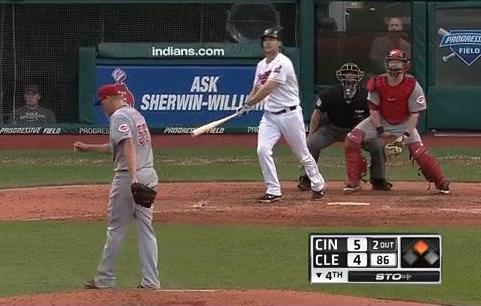
With a runner at second base in the fourth, Casey Kotchman takes Mat Latos deep.

Mat Latos thinks the Indians were stealing his signs. To judge by the evidence, he may be on to something.

After a 10-9 loss to Cleveland on Monday, Latos—who gave up seven runs on eight hits over four innings—identified what he felt were telltale signs:

  • When Cleveland had runners at second, possibly peering in to catcher Ryan Hanigan’s signs and relaying the information toward the plate, hitters were sitting on what Latos felt were good pitches.
  • After reviewing video, he said that the Indians hit the ball significantly better with runners at second base than they did otherwise.
  • With Shin Soo-Choo at second in the fourth inning, Hanigan changed things up. What had been the sign for a curveball turned into the sign for a slider; Latos said that the next hitter, Asdrubal Cabrera, was subsequently looking for a breaking pitch and got jammed.

All of this, of course, could be mere coincidence. It could also mean that Cleveland is a team that likes to know what’s coming.

Either way, it doesn’t much matter. A team’s primary recourse in such a situation is to change signs, and that’s exactly what Cincinnati did; the following day, the Reds held Cleveland to three runs over 10 innings.

Situation solved.

Even Latos, who was more outspoken about the practice than most pitchers who are similarly (allegedly) victimized, was quick to admit that his lack of sharpness prevented stolen signs from being his primary issue. And he didn’t come anywhere close to threatening retaliation.

“Stealing signs is part of the game—that’s not the problem,” said Reds manager Dusty Baker in an interview for The Baseball Codes in 2006. “The problem is, if you get caught, quit. That’s the deal. If you get caught, you have to stop. . . . That’s the truth.”

Then again, Baker also made the point Tuesday in an MLB.com report that “you don’t really have to steal signs when the ball is over the heart of the plate and up”—which it most certainly was for Cleveland on Monday.

Indians manager Manny Acta denied that anything was amiss.

“Ninety-nine-point-nine percent of the players don’t want to know what’s coming, anyway,” he said in a Cleveland.com report. “Because you really don’t want to be taking a chance of leaning out over the plate for a 78 mile-per-hour change-up and have a 95 mile-per-hour fastball in your helmet. By the time you go and complain to the runner on second base, you might be with the paramedics.”

Acta is certainly correct about the negative repercussions, but there’s no way he actually thinks that only three-quarters of a player (yep, that’s the math on 99.9 percent of 750 big leaguers) wants to know what’s coming. There are certainly some holdouts and guess hitters out there, but it’d be a safe bet to say that at least half the hitters in baseball would jump at that type of advantage.

Look no farther than one of Acta’s own players, Johnny Damon, who, while denying that he stole signs against Cincinnati, added that he’d want to know if any of his teammates were, “because I would like to know what’s coming next time.”

There is also another possibility to explain Latos’ frustration on Monday—one that could hurt the pitcher far more than the occasionally pilfered sign.

“Tell [Latos] you don’t have to steal signs when you’re tipping pitches,” said an unnamed Cleveland hitter at MLB.com. And so the intrigue begins anew.