Umpire Relations

How to Make Friends and Influence People (or Not): Umpire Edition

Things got testy for Denard Span Tuesday.

We know already that there are different ways to deal with umpires—some effective, some not so much. We know already that superstars have more leeway in this regard than the average player. And if we didn’t know already that you may as well go ahead and vent once you have nothing left to lose in a game—say, if you’ve just been rung up on three pitches out of the strike zone as your team’s final out in the ninth inning—we learned about it on Monday.

We’ve learned a lot about umpire relations since Monday, in fact. Three examples (at least), in three different situations, with three different kinds of player. Whether these examples set any sort of precedent when it comes to understanding player-umpire relations is less clear than the fact that they were all wildly entertaining, and gave some insight into the psyches of those involved, players and umpires alike.

Start with Monday’s game in San Francisco, in which Roy Halladay walked Aubrey Huff in the fifth inning on an 88 mph cutter with two outs and a runner on first. Trouble was, Halladay didn’t agree that the pitch was a ball. (To his credit, neither pitch-tracking service Brooks Baseball; thanks to Hardball Talk for the link.)  From the Philadelphia Inquirer’s Matt Gelb:

Halladay snatched the throw from Carlos Ruiz and didn’t flinch. His eyes were focused on (Marty) Foster, the home-plate umpire . . . Foster noticed the death stare. He said something to Halladay, who barked back. Then Halladay pointed to make his anger totally clear. It was a brief exchange, one Halladay later claimed was not directed at Foster. But that was the pitcher’s way of being diplomatic.

The result: Five pitches later, Halladay threw another cutter to Brandon Belt, this one well off the plate. It was called a strike, Belt’s third of the at-bat. Inning over.

“His demands had been heard,” wrote Gelb. Halladay had “conquered the umpire.”

Across the country, more balls were being called strikes, including three of Fernando Rodney’s five pitches to Cody Ross, Boston’s final batter in the final frame of a 1-0 loss to Tampa Bay.  (See them in another chart from Brooks Baseball, also via Hardball Talk.)

Ross, suffice it to say, was less than pleased, going off later in the Boston Herald about the ignominy of what had just occurred, calling the judgement of plate ump Larry Vanover “unacceptable.”

“If I’m going up there and striking out every at-bat, I’m going to get benched,” he said. “But it’s not that way with (umpires). They can go out there and make bad calls all day, and they’re not going to be held accountable for it.”

Confronting an umpire apparently made a difference for Halladay. The same might be said for Ross (who did it through the press), but not in a way that held any appeal for the player. It could be coincidence, but the following day, three Rangers pitchers struck out a total of 11 Boston hitters—a team high since opening day, when they struck out 13 White Sox—as Texas cruised, 18-3.

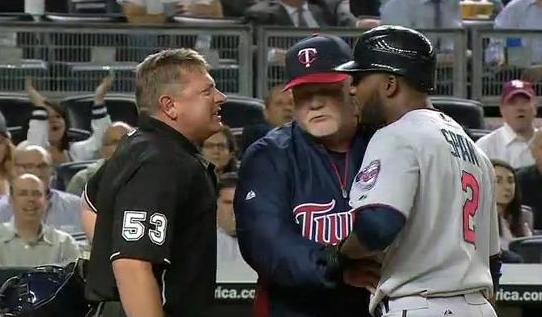
On Tuesday in New York, Minnesota’s Denard Span was tossed by plate ump Greg Gibson for arguing balls and strikes. Actually, he was tossed for the fact that he did so in an obvious fashion, swiveling his head backward as he stood in his batting stance to face the ump during the course of the conversation. (See it all here.)

It’s well-known that such a move is widely taken as disrespectful by umpires, and few are willing to tolerate much, if any, of it. This became clear when Span was caught by on-field microphones saying, “I didn’t disrespect you,” shortly before he was tossed.

Said Span in the Minneapolis Star Tribune, “It went from Level 1 to “Level 10 in like two seconds.”

“You don’t want to turn on an umpire, to show him up,” said longtime catcher Ron Hassey, discussing the general concept, not Span specifically. “If you’re going to talk, talk straight out. He knows what’s going on. He can hear you.”

Ultimately, what do all these interactions tell us? Unfortunately, not a heck of a lot. Every ump is different, as are players’ relationships with them. Halladay’s ability to stare down an umpire certainly had no bearing on Span’s inability to try to talk sense to one.

None of the three players, of course, had anything on former Yankees pitcher Ryne Duren, long noted for his combination of blazing fastball and lack of control. Jim Bouton recounted in his book, I’m Glad You Didn’t Take it Personally, the time that Duren walked three straight hitters on 12 neck-high fastballs. Wrote Bouton:

Finally he walked across a run and he stormed up to the home-plate umpire. “Goddammit, where the hell are those pitches?”

“Right up here, Ryne,” the umpire said, pointing to his neck.

“Well, goddammit,” Duren said, “I’ve got to have that pitch.”
Bobby Valentine, Kevin Youkilis, Managers Protect Their Players, Sports Illustrated.com

Now at SI.com: Bobby Valentine Sometimes Says Stupid Things

My latest is up over at Sports Illustrated.com, involving Bobby Valentine‘s recent comments about Kevin Youkilis. You can click over there to see a full-color photo of Bobby V during game action, or you can save your mouse-clicking finger and just scroll down. (Bonus points for reading it here: The original, un-edited ending!)

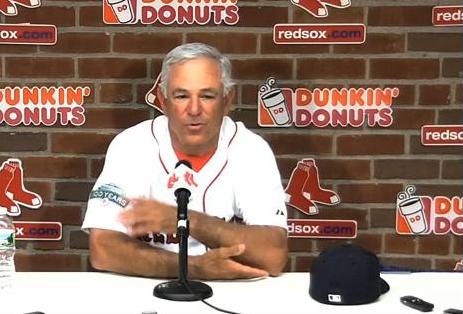
One update: Between the time I turned in the copy yesterday and this morning, video of Valentine’s press conference, in which he discusses the situation, has been posted on the Red Sox Web site. In it, the manager says that he talked to Youkilis “during the game” (this after an earlier apology did not appear to go well), and that, instead of everything being fine, “it is what it is.”

If things don’t get better in a hurry over there, it’s pretty clear they’re going to get a lot worse.

On to SI:

Bobby Valentine was brought to Boston as a knee-jerk reaction to a perfect storm of last year’s late-season collapse, wild accusations about allegedly dispassionate players, and a clubhouse culture that allowed such accusations to surface in the first place.

Blaming Terry Francona is one thing, but expecting a guy like Valentine — long on baseball acumen but short on verbal filters — to provide a calming influence to a team in turmoil was, at best, a crapshoot. Not yet two weeks into the the 2012 regular season, Valentine is embroiled in his first controversy.

It may seem innocuous, going on television as Valentine did and saying that Kevin Youkilis is not “as physically or emotionally into the game as he has been in the past.” It was a phrase amid an otherwise complementary comment; Valentine is obviously invested in Youkilis’ success, and he made sure to note that his third baseman’s slow start appears to be turning around.

None of that matters, of course. In baseball, a manager’s primary duty away from the field is to protect his players at any cost, usually from the media, at least until the point that a player leaves him no other option. If Youkilis has somehow already reached that point with Valentine, if his manager felt that calling him out in a local television interview was the only recourse left to reach him, well, that would constitute a newsworthy story. Other than his manager’s off-the-cuff banter, however, there is no indication that this is the case.

Instead, Valentine and the Red Sox are left to deal with the fallout, which serves to illustrate precisely why managers are expected to be measured in public statements about their players. Now, instead of coming to the ballpark and focusing on the game at hand, Youkilis has to answer questions about his manager’s lack of confidence, in addition to questions about his slump. Now, Dustin Pedroia has to step back from his own preparations in order, as a team leader, to defend his compatriot. Now, the rest of Boston’s players have to wonder what it might take before their manager publicly questions them, as well. Now, Valentine, the man brought in to help manage a media circus, has added a ring to the big top, and — inadvertently or not — is forcing his players to dance through hoops before they reach the field.

The unwritten rule to protect your players is why Whitey Herzog refused to admit that Keith Hernandez’s drug use (and his subsequent untruths when discussing it) were motivating factors in his being dealt to the Mets in 1983, even as the manager took considerable grief for the deal.

This rule is why Joe Torre, after Roger Clemens threw a bat shard at Mike Piazza during the 2001 World Series, refrained from storming out of his postgame interview amid a battery of leading questions. He knew Clemens was to follow him in front of the press, and wanted to absorb the difficult queries himself.

This rule is why Tony La Russa defended Jose Canseco long after steroid accusations against him became part of the public dialogue, and it is likely why he continued to defend Mark McGwire against similar charges after even many of his staunchest defenders had long since given up.

This rule is why Arizona manager Bob Brenly so vociferously attacked Ben Davis in the press following the Padres catcher’s bunt single that broke up Curt Schilling‘s perfect game in 2001. It was less because Brenly was angry at Davis, he said, and more because he wanted his pitcher to know that he “was looking out for his interests.”

For a clear comparison, consider two baseball stories, both of which involve pitchers being pulled from games in which their teams led by identical 4-2 scores. In one, A’s manager Ken Macha discussed with the press the fact that Barry Zito removed himself from the penultimate game of the 2004 season, with the division on the line against the Angels, after 114 pitches. Zito logged seven full innings, but Oakland’s bullpen gave up three quick runs, and Anaheim went on to win the game and a spot in the postseason. There was heat for pulling an effective pitcher, and Macha wanted no part of it.

In the other, Tigers manager Mayo Smith opted in 1969 to keep quiet about the fact that he pulled his own starting pitcher, Denny McLain, with one out in the sixth inning, after McLain warned him that he was tiring. Reliever Darryl Patterson came on and gave up, in order, a single, a walk, a sacrifice fly and a three-run homer; Detroit lost, 6-4.

Afterward, with media speculation raging about Smith’s decision to remove his star pitcher so early, the manager refrained from divulging the fact that McLain had effectively removed himself, not to mention that he had left the park altogether by the eighth inning. Smith kept quiet even when telling the truth would have deflected criticism. Valentine didn’t even have that for motivation.

Valentine has publicly apologized to Youkilis, but a question for players in the Boston clubhouse may soon arise—if it hasn’t already—about what kind of manager they want to play for. If the answer is less Ken Macha and more Mayo Smith—or less Bobby Valentine and more anybody—but anybody—else, then the manager has far bigger things to worry about than Kevin Youkilis’ early-season hitting woes.


Jonathan Sanchez, Retaliation, Shin-Soo Choo

Royal Rumble: Choo Revisits Old Times with Sanchez

Baseball has an early clubhouse leader in on-field sensitivity, by his own admission no less, a particularly notable event considering that we’re barely a week into the schedule. Ladies and gentlemen, Mr. Shin-Soo Choo.

Choo’s sensitivity training began on opening day, when he explained his angry steps toward the mound in response to Toronto reliever Luis Perez buzzing him with a head-high, inside fastball as being a lingering function of having his thumb broken by a pitch last season.

“Maybe that’s why I’m sensitive right now,” he said at the time. “But I know it’s part of the game.”

It came full circle on Saturday, when the pitcher who had broken his thumb, lefty Jonathan Sanchez—then with the Giants, now with the Royals—faced the Indians for the first time since the incident. In the third inning, he hit Choo again, this time above his right knee. Choo shouted at the pitcher and, he said in a Cleveland.com report, “told him to throw it over the plate.” (Watch it here.)

It was enough to empty the benches, at which point crew chief Gary Darling issued warnings to both teams.

Choo later confronted his sensitivity in the Kansas City Star, admitting that, especially as it concerns getting drilled by Sanchez, “maybe I am a little bit sensitive.”

In this case, so too were the rest of the Indians. Cleveland starter Jeanmar Gomez drilled the next member of the Royals to come to the plate, Mike Moustakas, again drawing the benches onto the field. Both Gomez and manager Manny Acta were ejected, as was third baseman Jack Hannahan, who tried to get at Moustakas in the scrum.

(Afterward, Gomez insisted that he was “trying to open the inside corner” so as to “work the outside part of the plate.” Of course he was. In the other clubhouse, Sanchez issued a similar—though more plausible—denial: “I’ve got a guy on first—why am I going to hit somebody? You’ve got to be a professional and take your base. He knew it wasn’t on purpose.”)

This is where the balance between appropriate teammate protection and game consideration comes into play. Choo was likely delighted by Gomez’s strike; Hannahan clearly was. Because Gomez chose to stand his ground with a warning hanging over him in the third inning, however, he forced his team into emergency maneuvers. “He was trying to protect his teammates, but I think he went overboard a little,” said Acta. “There was a warning in place. Once you hit a guy, you’re going to be thrown out. That early in a game, you tax the bullpen.”

Ultimately, the best retaliation came from Choo himself, when he laced a two-out, two-run double off the center-field wall in the 10th inning, providing the difference in Cleveland’s 11-9 victory. In so doing, he also proved that he is not prone to being sidetracked by extracurricular distractions.

After the game, Indians reliever Chris Perez—who earned the save on Saturday—kept things alive on Twitter, referencing Kansas City’s team slogan, “Our Time,” in a Tweet: “Huge team win tonight; time for a sweep to tell the Royals it’s not “Our Time”, it’s #TribeTime. P.S. You hit us, we hit you. Period.”

“We’re tried of watching our guys wear it,” Perez said the following day in the Kansas City Star. “It happened (too much) last year, and we’re not going to stand for it this year.”

These are fine claims for a blustery pitcher seeking to send a message, but for Cleveland’s closer—who will virtually never have the chance to follow up on his threat, based on the fact that he appears almost exclusively in close games—such claims set an unenviable precedent for his teammates to follow up on his behalf.

Cleveland won a 13-7, incident-free series finale on Sunday, but the teams face each other 15 more times this season, presenting a very good likelihood that Jonathan Sanchez starts at least one of those games. He should by now recognize the increased combustion factor should he come anywhere close to Choo; for a guy who’s built significant amounts of success on being affectively wild, it’ll be interesting to see how this reality affects him.

Related: Opening Day + Extra Innings = Baseball Drama in Cleveland.

Update (4-18): Gomez has drawn a five-game suspension for his actions. Seems that hitting a guy intentionally is one thing; doing so after an umpire specifically told you not to is something else.

Update (4-20): Perez has been fined for his tweet, .75 large.

Robert Andino, Russell Martin, Sign stealing, Willie Bloomquist

Are You Looking at Me?: Basepath Espionage Breaks Out Across the Land

Pablo Sandoval and Willie Bloomquist get acquainted.

Less than a week into the season, and we already have sign-stealing controversies breaking out on both sides of the country. The more prominent of the two came in Baltimore yesterday, when Yankees catcher Russell Martin lit into Orioles second baseman Robert Andino as the final out of New York’s victory was being recorded.

Andino had been a runner at second, which led to speculation that he was either tipping signs or location, or was doing something that looked remarkably similar to tipping signs or location.

Andino was quick to temper following Martin’s accusation, screaming toward the Yankees as they proceeded through their post-game handslaps. (Watch it here.) He later denied everything, calling it a misunderstanding, and came up with the line of the young season when, asked whether the Yankees might retaliate against him, he said, “I ain’t a future teller.”

Martin, of course, is no stranger to ferreting out this type of shenanigan. Last year, he went public with accusations that the Blue Jays were stealing signs at the Rogers Centre during the course of an eight-run first inning against Bartolo Colon. (Joe Girardi backed him up a day later by continuing to mandate the use of complex signs, even with nobody on base.)

Meanwhile, on Sunday in Phoenix, Giants third baseman Pablo Sandoval took exception to some of the movements of Diamondbacks shortstop Willie Bloomquist, at second base with one out in the seventh, as the Giants clung to a 6-5 lead. His ideas about Bloomquist’s motives appeared to closely mirror those Russell Martin held about Andino. During a mid-inning visit to the mound, Sandoval turned toward Bloomquist and let fly with some choice sentiments. (Watch it here.)

Bloomquist had a chance to argue his side of things only moments later, when a walk to Justin Upton loaded the bases, forcing him to third. Sandoval didn’t want any part of an argument and immediately waved away his previous accusation, but by that point it didn’t matter—if Bloomquist had been signaling pitches, he’d already been caught, and his approach was going to have to change.

Which is the thing about sign stealing: Were Bloomquist stealing signs, his actions mandated little more than a brief warning (and a new set of signs), which is precisely what was delivered. (Arizona did go on to score twice in the inning to take the lead, but both runs came on infield errors; if D’Backs hitters continued to be tipped off after Sandoval’s discussion with Bloomquist, they certainly didn’t do much with the information.)

Things will get particularly interesting should such accusations persist the next time these sets of teams meet, or if other clubs begin lobbing similar indictments toward the O’s or D’Backs. Until then, they’ll likely continue to take ’em as they can get ’em—just like always.

– Jason

Don't Showboat, Foreign players, Yoenes Cespedes, Yoenes Cespedes

Watch and Learn: Cespedes’ First Code Lesson

Last weekend brought us this season’s first incident of a foreign player being brought quickly up to speed with this country’s baseball mores. It also brought us the lesson that reticence doesn’t always count for a whole lot.

The student: Oakland outfielder Yoenes Cespedes, who on Friday pummeled a Jason Vargas fastball 462 feet, the ball landing above the luxury suites in left-center field at Oakland-Alameda County Coliseum—a blast impressive enough to inspire the hitter to stand and watch it fly. (Watch it here.)

The teacher: Seattle’s Felix Hernandez, who drilled Cespedes the following day. First base was open, and the Mariners led 7-0 at the time.

Deserving or not, this was a lesson that Cespedes—a recent immigrant from Cuba—did not require. The guy had played in all of three major league games when he went deep, and seemed to quickly recognize his error.

“I followed the ball, but I don’t like that to do that again,” he said in the San Francisco Chronicle, following Friday’s game. “I come from Cuba, where it’s a little less quality games, so we do that. But here I don’t want to do that.”

That didn’t seem to matter to Hernandez. Although the right-hander denied it, Cespedes said he was “100 percent for sure” that the drilling was intentional, according to the San Jose Mercury News.

In the end, it doesn’t much matter. The lesson was sent, intentional or not, and the American League’s early home run leader came away just a bit wiser.

– Jason

Retaliation, Umpires Knowing the Code

On the Importance of Umpires Knowing at Least Something About the Game they’re Purporting to Officiate

Prince Fielder connects for the first of his homers on Sunday. Phil Coke did not approve.

On Saturday, Prince Fielder launched two home runs off of Boston’s Josh Beckett within the game’s first five innings. In the bottom of the seventh, he was hit on the calf by Red Sox reliever Matt Albers.

Phil Coke came out of the Detroit bullpen a half-inning later with the perfect opportunity to exact retribution: He faced Fielder’s first-base counterpart and fellow superstar, Adrian Gonzalez, with a 10-run lead. Instead of sending a message, however, he struck Gonzalez out.

There may be great power in hindsight for Phil Coke, or he may have had the finer points of the “We’ve seen enough of this crap” method of pitching explained to him by teammates or coaches after the game. That would explain his appearance on Sunday, when, in the seventh inning, the left-hander made up for opportunities lost. With Dustin Pedroia on second and two outs in a game the Tigers trailed 9-7, Coke—a day late—went gunning for his man.

His aim was as poor as his timing, however, as Coke’s pitch sailed up near Gonzalez’s head, without any real danger of hitting him. Which is where the umpiring at Comerica Park comes into question.

At this point, plate ump Dan Iassogna should have been all over Coke. Ejection would have been justified even without the previous day’s action, based only on the location of the pitch, but Iassogna did nothing. (In his defense, even Gonzalez didn’t take the pitch too seriously, joking with Iassogna and Tigers catcher Alex Avila about whether he should start to get scared.)

It might have been a good idea. With his next offering—and two bases open, after Pedroia took third on the previous pitch—Coke hit Gonzalez in the back. Bobby Valentine raced out for a chat involving, among other things, disbelief that the pitcher had not yet been ejected. It didn’t have much effect; only after crew chief Dale Scott consulted with Iassogna were warnings even issued. Coke remained in the game.

Iassogna has some history with this type of thing, having notably erred on the reactionary side earlier in his career, much to his own detriment. In 2002, before he had even reached full-time status with MLB, Iassogna was behind the plate for a game in which the Dodgers led the Reds 4-0 going into the ninth inning. After Los Angeles closer Eric Gagne gave up a bloop single and a two-run homer, he hit Adam Dunn with his next pitch. That was all Iassogna needed to see; he tossed Gagne on the spot.

The details of this particular story matter, however. Gagne’s pitch to Dunn was clearly unintentional; it only grazed the bottom of the slugger’s jersey, failing even to hit flesh. When Gagne was ejected, Dogers manager Jim Tracy lost his mind.

“I went crazy,” he said. “I’ve been very upset a few times as a big league manager, but that was maybe the most upset I’ve been on a baseball field, because of what I perceived to be as a lack of understanding as to exactly what it was that was going on. . . . I don’t know of any pitcher in baseball, after a home run has preceded the at-bat and you’re in the ninth inning trying to win, who’s going to hit the next guy and bring the tying run to the plate.”

Gagne and Tracey were both ejected, the Reds tied the game with two more runs off three more pitchers, and Cincinnati won it in the 13th against Omar Daal, who had been scheduled to start for the Dodgers the following day.

It’s enough to make an ump gun shy, which Iassogna might be these days. That certainly appeared to be the case on Sunday.

“They should’ve given a warning after the one at (Gonzalez’s) head, the first pitch,” said Valentine in the Boston Herald.

Gonzalez, too, worried about the lasting effects of the umpire’s decision.

“You know it’s going to happen,” he said of potential future retribution, in an ESPN Boston report. “We’ve all got seven more years here. It might not happen the next series, but eventually it’s going to happen. . . . I just think it’s a bad call on their end because now it’s putting Miggy’s (Miguel Cabrera) and Prince’s careers at risk. You know it’s going to happen eventually.”

Next chance: May 28, in Boston. No word yet on the whereabouts of Dan Iassogna that week.

– Jason

Retaliation, Shin-Soo Choo

Opening Day + Extra Innnings = Beanball Drama in Cleveland

The season’s first lesson on sensitivity awareness was given yesterday in Cleveland, when benches emptied after Shin-Soo Choo was forced to duck under a head-high fastball from Toronto reliever Luis Perez in the 15th inning.

While no hitter in baseball would react well to an inside pitch above his shoulders, Choo was particularly sensitive. He missed six weeks last season after having his thumb broken by a pitch. He had been drilled earlier in Wednesday’s game by Ricky Romero. So when he was forced to the dirt by Perez in the 15th, he responded by jumping up and taking angry steps toward the mound, spurring the benches to empty. (Watch it here.)

Which is where intent comes into the equation.

Perez’s pitch arrived after warnings had already been issued by plate ump Tim Welke in the fourth, after Cleveland’s Justin Masterson came inside twice against Kelly Johnson, apparent retaliation for Choo’s HBP an inning earlier.

Perez was Toronto’s seventh pitcher of the day. That left one guy in the pen—closer Sergio Santos—to go the rest of the way, were Perez ejected, in a game that looked as if it might never end. There were two possibilities for Perez’s motivation—he’s a baseball imbecile, with no shred of insight into the appropriate time to respond to something; or the pitch simply got away from him.

The smart money’s on the latter; Welke’s certainly was. Despite the earlier warnings, Perez was not ejected, and it’s not difficult to see why.

Even Choo came around to that viewpoint, saying after the game in the Cleveland Plain Dealer, “I was hit by a pitch last year and broke my thumb. Maybe that’s why I’m sensitive right now. But I know it’s part of the game. Pitchers have to go inside. I understand it.”

And so we move on. Teams play again Saturday; we’ll see how Toronto reacts once the timing is right.

– Jason

Retaliation

Retaliatory Practices: Baseball Justice Gets Clinical

Isn’t it great when scientists give serious consideration to things they probably shouldn’t be giving serious consideration to? Case in point: the recent study from researchers out of Brown, Hofstra and Boston universities, which determined that while fans don’t think a guy drilled in retaliation necessarily deserved it, they enjoy it anyway.

The study itself is behind a paywall, but the good folks at Miller-McCune have excerpted it for our enjoyment and edification. What we learn from the surveys, conducted outside Fenway Park and Yankee Stadium, and online:

  • Fans were asked in general terms about how appropriate they felt it would be for a pitcher to drill a member of the opposing team in response to an injury suffered by one of his teammates as the result of being hit by a pitch.
  • Turns out that just short of half the fans surveyed felt it would be acceptable.
  • Somehow, 19 percent of Red Sox fans thought it was okay for a pitcher to retaliate against a third, unrelated team, despite the fact that such a scenario makes absolutely no sense.
  • More fans—70 percent—felt that retaliation is appropriate if the drilling victim was the pitcher responsible for the HBP that started it all.
  • The labspeak summary of this concept is, “Endorsement of collective punishment is widespread, but not as widespread as endorsement of individual punishment.”
  • Only 25 percent of the fans who approve of retaliation feel that the target of said retaliation is responsible for the situation. In other words, the guy getting beaned in response to a prior kerfluffle has nothing to do with it.
  • Still, more than a third want to see him drilled anyway.

Two key takeaways here. Between the four surveys, researchers interacted with only a few hundred people—not exactly a huge sample size. More importantly, the vast majority of respondents were fans of either the Yankees or Red Sox, so how representational can they be? (More knowledgeable than your average fan, sure, but also more bloodthirsty.)

Ultimately, this kind of thing is the reason that players don’t much like to talk about this section of the unwritten rulebook. Things like retaliation, that make sense to them within the context of the game, strike a large portion of the fanbase as vulgar and irresponsible. Ballplayers have known about this divide forever, without benefit of scientific studies. Maybe they’re smarter than us, after all.

(Via Baseball Musings.)

-Jason

Retaliation, The Baseball Codes

Tulo or Ubaldo? Jimenez Out to Prove the Rockies Made the Right Decision

Anybody wondering why the Colorado Rockies never considered Ubaldo Jimenez to be in the same stratosphere as Troy Tulowitzki and Carlos Gonzalez got their answer today.

Turns out the guy is hot-headed, and possibly a touch delusional.

Jimenez, who publicly steamed last week about the lack of respect shown him by the Rockies when they traded him to Cleveland rather than sign him long term, got his first chance to face his former team on Sunday. Before long, he had sent Tulowitzki to the hospital.

The right-hander’s first move was to drill Colorado’s All-Star shortstop in the elbow (test results came back negative). His second was to race toward the plate, daring an enraged Tulowitzki to come at him. After at first refusing to speak to the media after the game, Jimenez said that his post HBP histrionics were merely a reaction to Tulowitzki’s anger. “He was calling me out,” he said in a Denver Post report. “I mean, I’m a man. If somebody calls me out, I have to go.”

Tulowitzki’s drilling follows a time-tested tradition of players being punished for their teammates’ actions, be it the next hitter in the lineup dodging fastballs following a home run, or a slugger going down as part of a pitcher protesting a big inning.

Those tactics, however, are long outdated, and Jimenez knows it. Tulowitzki might have worn it because he’s the face of theRockies—not to mention the guy who got a big contract when Jimenez did not. (Tulowitzki and Gonzalez both signed monster deals after the 2010 season, the former for $134 million, the latter for $80 million, both over seven years. Jimenez signed for $10 million over four years prior to the 2009 campaign.)

Or he might have worn it for the statement he made in response to Jimenez’s initial cries of disrespect. “(Jimenez) had signed his deal and had years left on it,” the shortstop said. “Why would we give him something new when we didn’t see anything out of him?”

Jimenez said that his pitch was unintentional (it “got away,” he said), but that’s clearly not the case. Rockies pitcher Jeremy Guthrie—in his first season with Colorado—said he knew what was coming based on where the catcher was setting up.

The umps, clueless, did not issue an ejection.

Two things worth noting:

  • Jimenez was 6-9 with a 4.46 ERA when the Rockies traded him last season.
  • Jimenez is 1-4 with a 7.43 this spring.

The guy gave the Rockies scant reason to lock him up last season, let alone rework his contract long before it was set to expire. He currently appears to be working his way out of the Cleveland rotation altogether. He should focus on things other than misplaced anger directed at guys who don’t deserve it.

Colorado and Cleveland don’t face each other this season, so the two won’t meet again short of the World Series. Should Jimenez face his old mates next year, however, it’s pretty certain that today’s activities will be revisited, with vigor.

– Jason

Update: Rockies skipper Jim Tracy didn’t much care for Jimenez’ act, calling him “gutless” and calling for his suspension.

Update 2 (4-02): MLB didn’t much care for Jimenez’ act, either.

Update 3 (4-02): Watch it here.

Update 4 (4-03): Jimenez isn’t exactly reticent about the whole thing.

Update 5 (4-03): How not reticent? He’s appealing his suspension.

C.J. Wilson, Don't Call out Opponents in the Press, Mike Napoli, Retaliation, The Baseball Codes

For a Good Time, Please Don’t Call Mike Napoli

Wilson and Napoli during happier times.

Usually, pitchers can unbunch their panties via well-placed fastballs aimed at or near the player responsible for said bunching. It’s time-honored and it’s effective and, if it’s executed properly, it allows adequate venting with no long-term damage.

The long-term nature of the damage Mike Napoli suffered yesterday is up for debate, but there’s little question that he’ll be feeling this particular pinch far longer than he would a baseball to the thigh.

Napoli apparently riled pitcher and former teammate C.J. Wilson by saying, upon Wilson’s signing with Anaheim during the off-season, that he was looking forward to taking the left-hander deep.

Were Wilson truly miffed, he could have called Napolito talk it over. Were he baseball miffed, he could have drilled him the next time the two faced each other. Wilson, however, appears to have been more provoked than angry, gladly looking for an excuse to execute what can only in baseball and frat-house circles qualify as a “prank.”

He tweeted Napoli’s phone number. (That’s what Wilson considers a prank? No, this is a prank.)

Sure, there’s long been a place for off-field retaliation in baseball. Before there was Twitter, Ty Cobb and Buck Herzog fought in Cobb’s hotel room, some hours after Cobb had spiked the second baseman during a game. In this modern age of mass communication, however, it seems that one can do far worse deeds digitally than with one’s fists.

Wilson’s prank—again, we use the term loosely—may have been marginally appropriate had he and Napoli possessed a relationship strong enough to sustain such shenanigans. Napoli, however, told the Fort Worth Star-Telegram that this is not the case.

“I don’t even know why he did it,” he said. “You don’t do that. I am not taking it as a prank. You know, I haven’t even talked to him since the end of last season. We don’t have that type of relationship.”

So Napoli has to deal with the inconvenience of getting a new phone number. Wilson has to defend himself from the outraged masses. And the rest of us get to consider what may yet happen when these guys meet during the regular season (never mind the two spring training contests left between the teams, on March 24 and 25).

– Jason