Jeff Wilpon, Retaliation

Owner Gets Ornery: Wilpon Clamors for Mets Retaliation

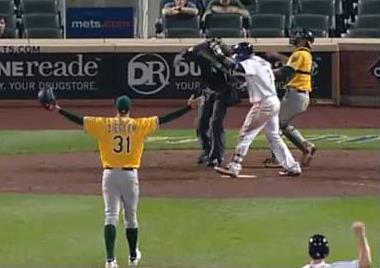
Brad Ziegler can't believe he just hit Justin Turner.

It started on Wednesday, when Mets second baseman Justin Turner was hit by a pitch with the bases loaded in the 13th inning, driving home the winning run against the A’s. The problem with the play, as far as the A’s were concerned, was that Turner made no effort to avoid the pitch, which barely grazed his jersey. (Watch it here.)

Whether this had any bearing in what happened next is uncertain,  but in Turner’s first at-bat Thursday, A’s right-hander Graham Godfrey hit him in the leg—something seen by many in the New York clubhouse as clear retaliation.

There are many problems with this scenario, primary among them being the written rules of the game. Rule 6.08(b)(2) says that a batter takes first base after being hit by a pitch unless he “makes no attempt to avoid being touched by the ball.” Turner rotated his torso—barely—which was apparently enough for plate umpire Fieldin Culbreth. And in a situation like this, if the umpire has no beef, the opposition shouldn’t, either.

Perhaps it was an attempt by new A’s manager Bob Melvin to set a tone with the team. (Unlikely.) Or maybe it was Godfrey, all of three games into his big league career, trying to establish some bona fides in the Oakland clubhouse. (He’s no stranger to hitting guys, having done so 38 times over four-plus minor league seasons.)

Or maybe it was strictly incidental, no more than a case of rookie nerves or a pitch that got away. This is how the Mets treated it, opting to ignore the incident and get on with what would be a 4-1 victory.

One guy, however, was less than pleased. According to ESPN New York, Jeff Wilpon—the team’s COO, and son of owner Fred—took to the team’s clubhouse following the game and admonished his players for their timidity. He said, according to the New York Times, that he would cover pitchers’ fines for such actions. Unlike the ominous tone set by ESPN, the Times called Wilpon’s interaction “playful.”

No matter how he meant it, this is a dangerous road to travel. There’s a reason that modern managers and coaches tend to shy away from directly ordering retaliatory action. They don’t want to be responsible for unforeseen consequences, and they—having all played the game at various professional levels—understand that most big league pitchers understand appropriate retaliatory tactics (and that if they don’t, their teammates will inevitably instruct them in such).

Jeff Wilpon primarily supervises the construction of buildings, in his role as executive vice president of his father’s real estate company. He is not a baseball man, at least to the point at which he has any business ordering his players to do anything on the field. He clearly likes the gunslinger mentality of retaliating for retaliation’s sake, but hasn’t likely considered the negative repercussions. Should the A’s respond to Wilpon’s response, the likely target would shift from Turner to somebody like Jose Reyes or David Wright.

Picture for a moment Reyes getting sidelined for six weeks due to a cracked rib suffered at the wrong end of a retaliatory fastball—disabling him straight through the trade deadline.

Leave retaliation to the pros, Mr. Wilpon. You just put a target on your team, as far as any examination the league might take when it comes to any future bad exchanges of bad blood.

Also realize that in 1998, your manager was suspended while at the helm of the Angels for his part in retaliating against Kansas City after Royals infielder Felix Martinez sucker-punched Anaheim’s Frank Bolick during a game.

Terry Collins is able to recognize retaliation-worthy offenses. Let him. Stay in the owner’s box, where you belong.

– Jason
Elvis Andrus, Hustle

Elvis Has Left the Lineup: Shortstop Pulled After Mental Error

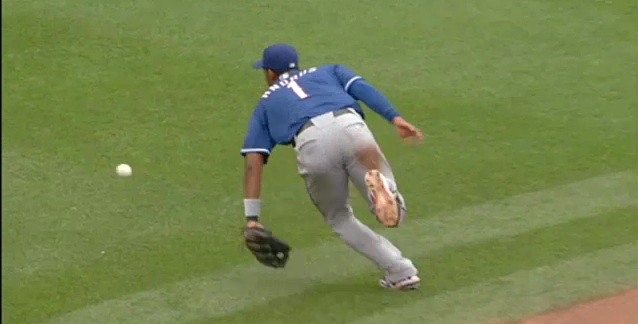
Elvis Andrus chases one of the balls that likely led to his mental lapse later in the game.

Whenever they make headlines, baseball’s unwritten rules inevitably invoke something that happened regarding some indignity and the response to it. It’s frequently the kind of stuff that stirs debate about whether this whole Code thing is worth it and why are grown men throwing baseballs at each other, anyway?

These issues are inevitably about respect.

When Elvis Andrus violated an unwritten rule last week, it was also about respect, but it had nothing to do with the the opposition. Andrus, at least in the eyes of his manager, showed insufficient consideration for his own teammates.

In the eighth inning of Sunday’s game against the Twins, Andrus fielded a grounder hit by Rene Rivera and half-heartedly flipped the ball to first, pulling Michael Young off the bag. The best guess is that the shortstop’s head was elsewhere, after he committed an error an inning earlier, and failed to convert another play that he frequently makes. Following the error, Minnesota scored five unearned runs in an eventual 6-1 victory.

Perhaps Andrus simply felt that because Rivera is a slow-footed catcher (one stolen-base attempt in parts of four major league seasons) the throw merited something less than his best effort.

The play wouldn’t have received much attention had manager Ron Washington not addressed it directly; the following inning, when it was Andrus’ turn to hit, Andres Blanco stepped to the plate instead.

“I didn’t like his attitude,” Washington told the Dallas Morning News, regarding his decision to pinch-hit for his shortstop. “The inning before there were a couple of plays he didn’t make, but he gave the effort. There are going to be plays that you can’t make. On that play, there wasn’t energy. Elvis is better than that. I didn’t chew him out, but I let him know that.”

If anything, this type of play is even less defensible than a hitter failing to run hard out of the batter’s box; the batter, at least, is expecting somebody else to make a play on him.

This was a teachable moment for Washington, but based on Andrus’ postgame comments, it’s unclear if any learning actually took place.

“I was trying to make an easy throw,” Andrus said. “I don’t throw it hard all the time. I had plenty of time. If I had thrown it hard and it got away from him, nobody would have said anything. But if you throw it like that and it gets away, they say you gave up or you’re not trying. That wasn’t it.”

He should remember that Washington showed some tact with his actions, waiting until his shortstop had already left the field to pull him. When Reggie Jackson angered Billy Martin by failing to hustle after a flyball in 1977, the Yankees’ skipper removed him in the middle of the inning (famously leading to a near-brawl in the dugout).

Ron Washington is no Billy Martin when it comes to fiery temperament—and as much as Andrus might complain privately about his treatment, as far as he’s concerned, that’s a very good thing.

– Jason

Esmerling Vasquez, Jason Marquis, Jayson Werth, Justin Upton, Retaliation, Wilson Ramos

You Talk too Much, you Trot too Slow: Wilson Ramos, Come on Down!

Wilson Ramos approaches home plate.


A lot of things happened last week between the Diamondbacks and Nationals. Jayson Werth was hit three times, and made scary eyes at pitcher Ian Kennedy after the last one. An inning later, Washington’s Jason Marquis drilled Justin Upton for the fourth time in the series, and was tossed—as was his manager, Jim Riggleman. (Watch it here.)

In the eighth, Arizona reliever Esmerling Vasquez hit Danny Espinosa with a clearly intentional fastball (watch it here), bringing Werth to the top step of the dugout with a look that said he wanted nothing more than one more provocation to charge the mound.

It’s can all be dissected down to its core. Marquis denied intent, and while it certainly seemed like he meant it, it must be noted that a 1-0 game is not the time to settle scores. Also, it would have been entirely reasonable for plate ump Rob Drake to give Marquis one shot at response (or even acknowledge that the pitcher probably didn’t want to put anybody else on base) before bringing down the hammer. Still, Marquis drew a five-game suspension.

(To Drake’s benefit, Kennedy hit Michael Morse two batters after he hit Werth, and was not tossed out because it was clearly unintentional.)

Riggleman and D-Backs skipper Kirk Gibson were also suspended. Vasquez drew a three-game ban of his own, which seems well worth it for the third-year pitcher in light of the fact that his teammates appreciate him for having done something others on the staff have shied away from.

Still, despite the drama, it was all very straightforward stuff—you-hit-me, I-hit-you. A standard retaliatory dance.

Wilson Ramos, however, raised the stakes one batter after Espinosa was hit, when he slowed down his home run trot after blasting an eighth-inning bomb, and then slowed it down some more—all the way into the realm of clownishness. (Watch it here.)

Larry Granillo’s Tater Trot Tracker pegged Ramos’ journey at 28 seconds (despite the fact that he ran hard most of the way to first)—more than 20 percent slower than his usually glacial pace.

From Granillo:

My first thought, as I watched the home run the first time, was that it looked like Ramos had slowed down into his final walk—you know how trotters tend to slow down those last 10 or 15 feet before home plate—about 250 feet too early.

But it only got worse. At both second and third base, you can see Ramos go into an even slower trot before essentially strolling the last 45 feet.

The truly crazy part? After the game, Ramos said this:

“I didn’t feel bad. I wanted to see those guys angry.”

Admitting one’s sins  is a cardinal Code violation (although even in the best circumstances it’s difficult to deny ownership over one’s own jogging pace.) Unlike a pitcher who admits to hitting a batter intentionally, this is not an actionable violation as far as the league office is concerned. It is, however, a stratospheric level of trash talk. And Ramos got his wish in seeing them angry, at least as far as Matt Williams was concerned.

Williams, Arizona’s third-base coach, is one of the premiere Code warriors of his generation. He is the standard-bearer when it comes to circling the bases properly after hitting a homer—head down and quickly.

Also, he’s never been shy about informing players—teammates and opposition alike—should they be so foolish as to violate an unwritten rule in his presence. As Ramos circled the bases, Williams visibly steamed.

(Dan Steinberg has some great screenshots of it over at the Washington Post. He also passes along this quote from TV analyst Mark Grace: “If that look is directed towards you, folks? Go home. I suggest you go home when Matt Williams looks at you like that.”)

Ramos got his reward (his trot) and then got it again (his comments), but he’ll almost certainly pay the price. The teams next meet on Aug. 22. The question now seems less about whether Ramos will be drilled, but when—and maybe even how many times.

Considering that Werth, Upton and their teammates already have a short fuse for this type of thing when it concerns this matchup, there’s plenty to look forward to.

– Jason

Don't Showboat

Hey, Pitcher: Bryce Harper Sends his Love

At this point, the minor leagues are a mixed bag for Bryce Harper. On one hand, he has to deal with long bus rides and crappy clubhouse food.

On the other hand, accounts of the firestorm he ignited yesterday by blowing a kiss to the pitcher who had just served him up a home run are inevitably concluded with a caveat along the lines of, “It’s the minor leagues; this is all part of the learning process.”

(Of course, were he in the majors, the video of his little discrepancy wouldn’t be embeddable, and thus watched across countless Web pages this morning.)

After Harper smacked his homer against Greensboro’s Zach Neal, he stood in the box, then slowly—slooooowly—walked up the line as he watched it clear the fence. That alone would have earned him a drilling at the big league level, but as he crossed the plate he upped the ante, turning his head toward Neal and puckering his lips.

It was stupid. It was juvenile. But ultimately those caveats were right: it is what the minor leagues are for. Harper is 18 years old. His actions indicated neither class nor respect, but those things are not necessarily inherent in teenaged humans.

Duane Kuiper was on the radio in San Francisco yesterday, before this story broke, talking about the MLB draft. Had he signed a pro contract straight out of high school, he said, moving from his family’s Wisconsin farm directly to the minor leagues, he would have ended up right back on that farm inside of two seasons. Some kids are ready at that age to make such leap, but by his own admission, Kuiper (who ultimately graduated from Southern Illinois University) of was not one of them.

Harper might not be one of them, either. Going back to the farm, however, is not an option. The $9.9 million contract he signed has placed him higher on the food chain than peers and coaches alike. He was on the cover of Sports Illustrated at age 16, and has had his ass kissed on a fairly consistent basis for the bulk of his teenage life. This is not his fault (nor is it even necessarily a bad thing), but it hardly encourages appropriate development of socialization skills.

He’s clearly aware that a quick ascension to the big leagues is all but assured, no matter how boorish his behavior.

Greensboro’s response—in Harper’s next at-bat he was backed up by an inside fastball—had about as much teeth as anything else the guy will face as long as he’s the biggest fish (by a wide margin) in a comparatively small pond. He will become socialized some day—when veterans whose status and contracts exceed his own put him in his place.

“At some point the game itself, the competition on the field, is going to have to figure out a way to police this young man,” said Mike Schmidt on SportsCenter. “If indeed his manager won’t, the game will end up taking care of it.”

That’s the way of the Code. Until Harper reaches the big leagues, however, let’s see him for what he is: a clueless 18-year-old who deserves a chance to figure things out.

– Jason

Update (June 8): Oh, my. Now there’s this.

Protect Teammates

Sabean Goes Off, People Freak Out

Wow. That’s pretty much the reaction du jour after Brian Sabean unleashed his verbal vengeance on Scott Cousins yesterday. Perhaps it’s that general managers don’t usually talk that way. Perhaps it’s that, more than a week after the incident in which Buster Posey was lost for the season, a guy in a position usually reserved for settling volatile situations has instead served to inflame this one.

A brief recap. In an interview on Giants flagship KNBR yesterday, Sabean said the following:

  • “He chose to be a hero in my mind, and if that’s his flash of fame, that’s as good as it’s going to get, pal. We’ll have a long memory. Believe me, we’ve talked to (former catcher Mike) Matheny about how this game works. You can’t be that out-and-out overly aggressive. I’ll put it as politically as I can state it: There’s no love lost, and there shouldn’t be.”
  • “If I never hear from Cousins again or he never plays another game in the big leagues, I think we’ll all be happy.”
  • “If you listen to the kid’s comments after the fact, he pretty much decided and it was premeditated that if he got a chance, he was going to blow up the catcher to dislodge the ball, And if you watch frame by frame from different angles, he does not take the path to the plate to try to score. He goes after Buster, right shoulder on right shoulder, and to me, that’s malicious.”

(Listen to the entire thing here.)

By referencing Matheny, Sabean was essentially promising retaliation. (Matheny, a catcher whose career was ended by a spate of concussions after too many collisions at the plate, was widely quoted as saying that situations such as this should be settled on the field.)

By calling the play malicious when it clearly was not, by wishing ill upon Cousins, by unleashing what by almost every account is an over-the-top tirade, Sabean has in the minds of most pundits gone too far.

Which may have been precisely his point.

The Giants don’t face the Marlins again until August, at which point Cousins—currently batting all of .159—might not even be on the team. Meanwhile, Sabean has sent an unequivocal message—not just a warning that one takes liberties with the Giants at one’s own risk, but that this type of play is drawing both notice and response.

Since the accident, Sabean has advocated for a reexamination of the rule that allows home plate collisions, especially those such as the one that injured Posey, in which the catcher cedes the baseline in an effort to avoid unnecessary contact. (Sabean, in fact, is not the first GM to get involved with the issue this week; Billy Beane has already instructed Kurt Suzuki to get out of the way and employ sweep tags.)

Baseball will probably opt against enacting any sort of rule change, at least in the short term, so the Giants’ GM is taking the law into his own hands. His volley was a clear message to would-be catcher stalkers: You better be damn sure that’s your only way of scoring, because if it’s not, we’ll be watching.

Sabean will likely be disciplined by MLB for his comments. Sabean likely does not care.

This issue is bigger than the Giants. In this regard, Sabean is taking one for the team—all those within baseball who share his views on the topic.

Did he go too far in his assessment? Absolutely. But did Sabean—who, while notoriously frank, is no dummy when it comes to public relations—feel that was the best way to get his message across?

Almost indisputably.

Update (June 3): The Giants just released this statement (note the explanation sans apology):

This is a very emotional time for the Giants organization and our fans. We lost for the season one of our best players to a serious injury and we are doing everything we can to support Buster Posey through this very difficult time. We appreciate Scott Cousins’ outreach to Buster Posey and to the Giants organization.

Brian Sabean’s comments yesterday were said out of frustration and out of true concern for Buster and were not meant to vilify Scott Cousins. Brian has been in contact with Florida Marlins General Manager Larry Beinfest to clarify his comments and to assure him that there is no ill-will toward the player. He has also reached out to Scott Cousins directly.

The issue of catcher safety is a complicated one. There are a number of differing opinions around the circumstances of last week’s collision and about what baseball should do to prevent serious injuries in the future. This issue goes far beyond last week’s incident as there have been a number of recent collision-involved injuries.

We have been in contact with Joe Torre, Major League Baseball’s executive vice president for baseball operations, and have asked for a thorough examination of this issue for the health and safety of all players.

We intend to move beyond conversations about last week’s incident and focus our attention on Buster’s full recovery and on defending our World Series title.

– Jason

Clint Hurdle, Dusty Baker, Gamesmanship, Jim Tracy, Kevin Towers, Tony La Russa

Lights, Rain and Radar: How to Get into your Opponent’s Head, an Introductory Course in Gamesmanship

When the lights go down in St. Louis . . .

When the lights went out in St. Louis last night, there were two outs in the 11th inning and San Francisco’s Brian Wilson was on the verge of closing out a 7-5 victory.

Instead, the teams sat for 16 minutes while the sound guy at Busch Stadium played Journey’s “Lights” and somebody tried to deal with the electrical system.

The chatter after Wilson finally returned to record the game’s final out had to do with the possibility of malfeasance on the part of Tony La Russa. Did the Cards’ manager manipulate the power grid in an effort to cool down the opposing closer?

Of course he didn’t. Or at least he probably didn’t. Still, the coincidental timing was enough for Bruce Bochy to quip afterward that it was “pretty good gamesmanship” on La Russa’s part.

The Giants’ skipper was joking, but there’s a reason La Russa’s name comes up during moments like this.

Earlier this year, for example, he was accused of selectively distributing weather information when the Cardinals were hosting Cincinnati, then pitching reliever Miguel Batista instead his scheduled starter, Kyle McClellan. Batista threw all of six pitches before rain halted the game for more than two hours.

Afterward, McClellan, fresh, took his rightful place on the mound.

Dusty Baker, meanwhile, claiming an information inequity between the teams, had his starter, Edinson Volquez, warm up from the get-go. The right-hander never got a chance to pitch, however; when play resumed, Baker had to turn to Matt Maloney rather than risk having Volquez get hot twice.

“It’s really a tough start,” Baker said in an MLB.com report. “The information that we received was probably not the same information they received, or else we wouldn’t have started [Volquez] in the first place. We were told there was going to be a window of opportunity there. That window lasted about three minutes.”

Maloney gave up three runs in three innings, and the Cardinals won, 4-2.

La Russa, of course, is hardly alone when it comes to gamesmanship. In April, Livan Hernandez accused the Pirates of doing much the same thing.

Weather reports, however, are far less interesting than the other tally on Pittsburgh’s gamesmanship scorecard. That came when Clint Hurdle appeared to dupe Rockies skipper Jim Tracy with two outs in the 14th inning of a tie game. With a runner on first, Andrew McCutchen stepped into the on-deck circle as Jose Tabata batted.

That had been McCutcheon’s spot in the order earlier in the game, but the outfielder was removed as part of a double-switch. The guy actually scheduled to hit next was relief pitcher Garrett Olson, whose last plate appearance had come in 2009, and who has collected all of one hit in his five-year career.

Had Tracy been paying better attention, he might have realized that the Pirates’ bench was empty, leaving Olson to fend for himself at the plate.

It never came to that. Seeing McCutchen, Tracy had reliever Franklin Morales pitch to Tabata—who promptly lashed a game-winning double. (Watch it here.)

From the Pittsburgh Post-Gazette: “Asked if the move was a decoy to get the Rockies to think McCutchen was up next … ‘No, come on, why would we do that,’ Hurdle said with a sly chuckle.”

* * *

Rain delays and decoys are one way for a home team to gain an advantage. Radar guns are another.

Earlier this season, Diamondbacks GM Kevin Towers admitted to the Arizona Republic that when he held the same post with San Diego, the Padres took to manipulating their ballpark’s radar gun to get into the heads of opposing pitchers.

“I know for a fact that every time Brad Penny pitched for the Dodgers in San Diego it was probably the lowest velocities he ever had,” he said. “He liked velocity. He’d stare at the board. He was throwing 95-96, but we’d have it at 91 and he’d get pissed off and throw harder and harder and start elevating.”

Hardball Talk’s Aaron Gleeman checked, and—lo and behold—Penny is 1-5 with a 6.47 ERA in 10 career games pitched in San Diego.

(The subject was initially raised when fireballing Aroldis Chapman, after topping out at 106 mph earlier in the season, dropped nearly 15 mph off his fastball in San Diego, then magically regained his velocity during Cincinnati’s next series. Towers’ comments could themselves have been a form of gamesmanship, as his new club uses the non-manipulatable Pitch-f/x system, and the Padres—and all their secrets—are now the enemy.)

The tactic works both ways. During the 2002 postseason, when Robb Nen was throwing pus with a shredded shoulder during what would be the final innings of his career, the folks at AT&T Park shut off the radar gun altogether when the Giants’ closer entered the game. It might not have fooled anyone on the opposing team, but it certainly didn’t hurt.

– Jason