Drew Hutchison, Kevin Youkilis, Retaliation

The Professor is In: Youkilis Offers Impromptu Code Lecture at Home Plate for Toronto Rookie

When it comes to the unwritten rules, the primary takeaway from Sunday’s game between the Red Sox and Toronto was not Boston starter Daniel Bard hitting two members of the Blue Jays within the span of three batters, nor Toronto pitcher Drew Hutchison drilling two Boston hitters, ostensibly in response.

Those were noteworthy events, sure, but Toronto’s 5-1 victory anointed a new king of the Code—a guy who not only knows how things are supposed to work and is willing to abide by the rules even when it’s his own hide on the line, but has the presence of mind and the strength of character to give impromptu instruction, on the field, to his opponent.

Ladies and gentlemen, Kevin Youkilis.

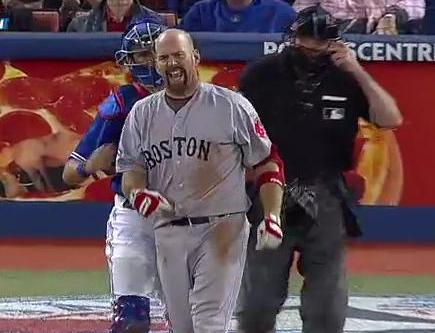
The third baseman was hit high on the shoulder during his sixth-inning at-bat, and if he didn’t know it was coming, he was at least ready for the possibility. Based on his reaction, he took no umbrage with getting drilled, but was irate over the pitch’s location, too near his head.

Youkilis spun toward the mound, pointed toward his hip, and yelled at Hutchison to “keep it down.” He then gathered his batting helmet and made his way to first base. The closest he came to rubbing the spot was when he pointed to it in response to the Boston trainer’s question about where he had been hit. (Watch it here.)

That Hutchison had a mandate to retaliate in the first place was questionable—though well within the boundaries of reason—given that Bard had never been more wild. The first batter he hit, Yunel Escobar, loaded the bases; the second, Edwin Encarnacion, drove in a run. Bard also issued five bases on balls over the course of one-and-two-thirds innings, along with five earned runs on just one hit. He managed to throw all of six fastballs for strikes. The guy was obviously not making any kind of statement short of the fact that he may well prefer working out of the bullpen, but Encarnacion was sufficiently hurt after being hit on the hand to be pulled from the game before his next turn at bat.

Hutchison saw fit to stand up for his mates—an impressive display for a guywho six weeks ago was working in Double-A. Things could have ended after he hit Kelly Shoppach—Boston’s first hitter after the dual drillings in the third. It’s likely that when Encarnacion left the game in the fifth that further action appeared merited to the pitcher.

“I was trying to go away,’’ Hutchison said after the game, denying intent. “I tried to put a little bit extra on it and I just missed. That’s it.’’

Where this all ends up is Daniel Bard. Because Youkilis expected his drilling, he no doubt pins its point of origin squarely on his teammate. Hutchison’s message was on point—Don’t hit our batters, and we won’t hit yours—and Boston heard it loud and clear. Ten more Blue Jays came to the plate after Youkilis was drilled, and they all emerged unscathed.

As if Bard wasn’t feeling enough pressure to perform, he now has this to chew on, as well.

Johan Santana, No-Hitter Etiquette, Terry Collins

Johan’s No-No Keeps Collins on Edge

Whenever a pitcher for the New York Mets throws a no-hitter, it’s inevitably vivisected in every conceivable fashion by the American sporting media.

Okay, so it’s happened all of once, now that Johan Santana turned the trick against St. Louis on Friday. The event’s rarity, especially within the context of the ballclub, put all the more pressure on manager Terry Collins, who faced some tough decisions. One of them centered on the unwritten rule that says not to change anything during a no-hitters. Not the defensive alignment behind the pitcher, not the seating order on the bench. Not anything.

Because this piece of Code is based almost entirely on superstition, logic doesn’t play much of a factor. In Collins’ case, however, he had a pair of very real considerations as the game reached the late innings. On one hand, Santana was coming as close to the deed as anyone in the 8,019-game history of the organization. On the other, the left-hander was pushing the upper limits of his pitch-count threshold (which Collins had listed at 115 prior to the game). Santana missed all of last season following shoulder surgery, and had never topped 125 pitches in a game in his career, even when fully healthy. This wasn’t a superstitious decision for Collins, but a tactical one.

When Santana hit 115 pitches in the eighth while walking Rafael Furcal, Collins visited him on the mound. Ultimately, of course, the manager opted against change, and left his star in to determine his own fate.

“I just couldn’t take him out,” Collins said in Newsday. “I just couldn’t do it.”

Ultimately, of course, Santana finished the game—in 134 pitches—and New York rejoiced. “To a man, we all agreed that he’d have to rip the ball out of our hands,” pitcher R.A. Dickey told Newsday.

“I went against just about everything I stand for, and that’s taking a chance to hurt your whole ballclub for the next four months for an instant decision of glory in one inning,” Collins said in an MLB.com report. “Is it worth it? I believe in the organization and I believe in the team, and I’m not here to destroy any of it. . . . . If this guy goes down, it would be pretty drastic for us. But also to understand there’s history in the making and in the moment, in that particular moment, he wasn’t coming out. I wasn’t taking him out.”

Even if Code adherents applaud Collins for his lack of action when it came to pitching changes, there’s no getting around his seventh-inning breach of the unwritten rule that stipulates a no-hitter in progress must never be referenced out loud, directly or otherwise. That’s when he approached Santana in the dugout and, according to the pitcher, “told me that I was his hero.” Santana responded by telling his manager he would not be coming out of the game.

Were there a jinx, needless to say that it was ineffective.

Santana’s no-hitter left just one team remaining without a no-hitter in the books: the Padres. This is relevant, because San Diego might actually have had a no-hitter by now were it not for the fact that, unlike Collins, then-Padres manager Preston Gomez changed something during the course of Clay Kirby’s masterpiece in 1970: the pitcher himself.

It was the bottom of the eighth inning, and although Kirby was coasting, a first-inning walk, followed by two stolen bases and a fielder’s choice, left him with a 1-0 deficit. When he was scheduled to hit with two outs and nobody on, Gomez pulled him for pinch-hitter Cito Gaston, who promptly struck out to end the inning.

The other detail that ties Kirby to Santana’s no-hitter: His opponent was none other than the New York Mets—Bud Harrelson broke up the no-hitter as the first batter to face reliever Jack Baldschun. (In fact, according to Baseball Reference, 13 pitchers have tossed at least seven no-hit innings without being allowed to finish the game. One pitcher who doesn’t qualify is longtime Mets stalwart Sid Fernandez, who threw five no-hit frames against the Giants in 1987, but had to exit after injuring his hamstring while legging out a triple.)

Ultimately, all’s well that ends well—or at least it will if Santana suffers no lasting repercussions from his exertion. Even if he does, David Wright hit it squarely in his manager’s defense when he said, “I don’t think anybody had the courage to go and take the ball from him.”

Sign stealing, Toronto Blue Jays

Somebody Else Has Accused the Blue Jays of Stealing Signs from the Rogers Centre

Another year, another pitcher making veiled accusations that the Blue Jays are stealing signs from the far reaches of the Rogers Centre.

Okay, that’s not entirely fair. Some of the accusations aren’t veiled at all.

The latest came from Orioles starter Jason Hammel, who gave up nine hits and four runs over 6.2 innings Wednesday in a 4-1 loss at Toronto. He entered the game with a 6-1 record and 2.78 ERA, having allowed three home runs all season. Wednesday, he gave up four.

“They’re a very potent offense and if you don’t make your pitches down they’re going to get them out,” Hammel said in a Baltimore Sun report. “They were taking some pretty big hacks on my breaking stuff too, which leads me to believe it was something else. It is what it is. I need to keep the ball down.”

Last August, ESPN ran a fairly extensive piece detailing a man in a white shirt who would signal upcoming pitches to the plate from the stands. The Yankees also had some things to say about possible shenanigans north of the border.

The rule here is simple: If a team is stealing your signs from within the field of play, it means mostly that you need better signs. (The Orioles were themselves accused of this somewhat recently.) But if the theft is being done via spyglasses or TV monitors (which is against the actual rules, not just the unwritten ones), it’s game on.

A quick look at the stats doesn’t helpToronto’s cause.

As a team, the Blue Jays are hitting .262 with a .471 slugging percentage and .803 OPS at home, where they’ve hit 42 homers in 828 at-bats. On the road, those numbers are .231/.369/.660, with 30 homers in 937 at-bats. Edwin Encarnacion has 12 homers and a .311 batting average in 25 home games, but is batting .243 with 5 homers in 26 games on the road. Last year the Blue Jays hit 10 points higher at home than on the road, with 20 more homers.

Meanwhile, Toronto’s team ERA is more than a quarter-run better at home than on the road—3.98 to 4.26—so it’s not like visiting teams are experiencing that same type of success inToronto.

Then again, Jose Bautista is playing significantly better away from the Rogers Centre. Either he’s an indicator that nothing is amiss, or he doesn’t like to receive stolen signs.

“When you’re locating your fastball, you’re going to give up some home runs there, but the swings they were taking on he breaking stuff, it was pretty amazing to me,” Hammel said. “I don’t think you can take swings like that not knowing they’re coming. I don’t know. That’s all I can say.”

In Toronto’s defense, all four of their homers Wednesday came on fastballs.

ESPN’s man in white is apparently no longer anyplace to be seen, but the methods a team can use to pilfer and relay signs via in-stadium technology is virtually limitless. From The Baseball Codes:  Indicators range from the digital clock at Kansas City’s Municipal Stadium (“You know the two vertical dots which separate the hour from the minutes?” asked groundskeeper George Toma. “One dot for a fastball, two for a curve”) to dummy TV cameras reportedly placed in center-field wells at places like Candlestick Park and Dodger Stadium that would signal hitters with phony “on air” lights.

So it’s not like teams haven’t done this before. The difference is, the others all stopped—or at least the accusations against them did. That hasn’t been the case in Toronto, and we’re left wondering how far the organization is willing to go to win a baseball game.