Don't Call out Opponents in the Press

Oakland’s One Clap is One Too Many for Some Members of the Yankees

When one plays for the Yankees, who not so long ago were cruising toward the playoffs but who suddenly find themselves desperately trying to keep the Orioles at bay, one can get touchy during the course of getting one’s butt kicked by the team with the American League’s lowest payroll.

At least Eric Chavez did. After New York’s 10-9 win in 14 innings at Yankee Stadium Saturday, he told the New York Post that, following each of Oakland’s three homers in the 13th inning, A’s players partook in some “orchestrated clapping, chanting,” which Chavez described as “high school-ish,” “pretty unprofessional” and something “that crossed the line.”

The antics were described in the San Jose Mercury News:

The routine the A’s did is based on the Randy Moss-related “One Clap” song and video clip that was all the rage on YouTube. Gomes often played that song during spring training, and he said the A’s have done the routine all season in the clubhouse and on the team bus.

Somebody yells “One Clap!” and teammates respond with a clap.

The reason it should not have troubled Chavez, said Jonny Gomes, “is it happened in our dugout. It didn’t happen between the lines.” (To judge by the TV replays, which are far from comprehensive, it’s difficult to discern anything objectionable happening in the A’s dugout on the first, second or third home runs of the inning.)

For Chavez to get riled about such a thing is a tad ironic. When he was a young player with the A’s—playing the Yankees, no less—he learned a difficult lesson about speaking out a bit too quickly about the opposing nine.

From The Baseball Codes:

Nearly as innocent were the comments made by A’s third baseman Eric Chavez before his team faced the Yankees in Game 5 of the 2000 ALDS. Responding to a press-conference question about his opponents, who had won the previous two titles, Chavez talked about how great the Yankees had been in recent years, what a terrific job they’d done, and how difficult it was to win as consistently as they had. He also added that they’d “won enough times,” and that it would be okay for somebody else to play in the World Series for a change. Chavez was twenty-two years old, wide-eyed and hopeful. There was nothing malicious in his tone.

Unfortunately for the A’s, the press conference at which Chavez was speaking was being broadcast live on the Oakland Coliseum scoreboard for early-arriving fans. Also watching were the Yankees, on the field for batting practice. “So he’s dropping the past tense on us? Did you see that?” spat third baseman Scott Brosius from the batting cage. One New York player after another—Derek Jeter, Paul O’Neill, Bernie Williams— took Chavez’s comments and blew them up further. The Yankees hardly needed additional motivation, but now they had it. Their first three hitters of the game reached base, four batters in they had the lead, and by the end of the frame it was 6–0. The A’s were in a hole from which they could not climb out before they even had a chance to bat.

How one feels about this apparently depends on the dugout in which one happens to sit. The day after Oakland’s one-clap hysteria, Nick Swisher responded by hitting a home run for New York, then lingering for a beat in the batter’s box to admire it. (Watch it here.) Asked about it in the Post, he said, “Like Jonny Gomes says, what’s the hurry?”

Don't Play Aggressively with a Big Lead

Those Pitching Changes. Oh, Those Pitching Changes

Perhaps the most obvious piece of the Code is the mandate to shut down aggressive play on offense while holding a big lead late in the game. But what about pitching?

On Wednesday, Bruce Bochy went to his bullpen three times—going righty-lefty-righty with Guillermo Mota, Javier Lopez and Sergio Romo—to face four batters in the ninth inning against the Rockies. The Giants led 8-3.

“I’ve been here a few times and I’ve seen some comebacks that are hard to stop,” Bochy said in the San Jose Mercury News. “You don’t want to get a rally started here because momentum gets going.”

There’s no indication that the Rockies were annoyed by such tactics, and perhaps they shouldn’t have been. However, were manager Jim Tracy the type to get rankled over a stolen base by a team holding a five-run, ninth inning lead, it only stands to follow that this might get under his skin, as well.


Retaliation

Delayed Gratification: Pittsburgh Strikes Back, a Month Later

The hubbub surrounding Brandon Phillipsaccusations of racism helped obscure a profound truth about baseball’s unwritten rules: Teams will wait as long as is necessary to respond to events in which they feel they’ve been significantly wronged.

Phillips getting drilled Monday was at the heart of it, but had little to do with the genesis of the situation. It began on Aug. 3, when Reds closer Aroldis Chapman drilled Andrew McCutchen with a 101-mph fastball. The following day, Reds starter Mike Leake hit Josh Harrison, then descended the mound toward him to deliver a follow-up message.

Of concern to the Pirates was the fact that umpire Brian Gorman issued warnings after the latter incident. It was, I wrote at the time, “an unfortunate development that precluded—correction, delayed—any type of Pittsburgh response.”

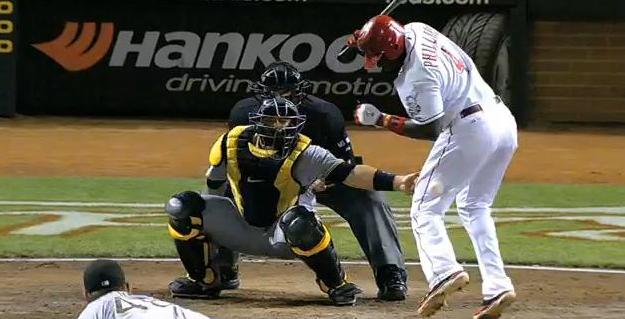
The delay is now over. In the eighth inning Monday, Pittsburgh reliever Jared Hughes placed a fastball into Phillips’ left leg. It certainly looked intentional, although the surrounding factors—a 3-3 tie with one out in the eighth is not the prototypical moment for retaliation; a hitter like Phillips, who can run, is not an ideal target, especially with Joey Votto lurking two batters later; and catcher Rod Barajas reached out as if to catch a wayward pitch—suggest otherwise.  (Watch it here.)

Phillips got in some jabs of his own, first picking up the baseball and tossing it toward Hughes—this is the act that is widely assumed to have precipitated Phillips’ post-game tweet claiming racism—then stealing second. (He did not score, and the game went 14 innings.)

As McCutchen jogged toward his dugout following the Reds’ half of the eighth, a clearly perturbed Phillips engaged him with a clear message for somebody on the Pittsburgh bench. That turned out to be Hughes, but by Tuesday the feuding participants reached an accord. Nobody was hit in last night’s game, and no fireworks are anticipated for the teams’ four meetings through the end of the season.

Don't Steal with a Big Lead, Retaliation

The Subtlest Retaliation is Sometimes the Best

Sometimes even an inconsequential on-field action can merit retaliation—which will ideally be delivered in measures commensurate with the initial transgression. Which is to say, if a team must respond to a minor Code violation, here’s hoping they do it appropriately.

On Thursday, the Diamondbacks did.

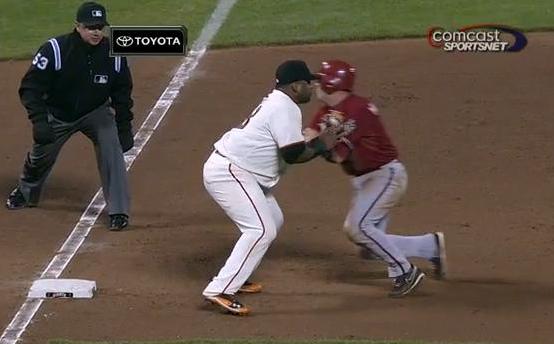
With runners at first and second and nobody out in the eighth inning of their game in San Francisco, Adam Eaton (this one, not this one) grounded a ball to first base, where Brandon Belt made a quick relay to third. The play caught Pablo Sandoval off guard; instead of backing up a step to touch the base for a force play, he turned to make a sweep tag. So too did the play surprise baserunner John McDonald, who, instead of sliding—which he almost certainly would have done had he expected it—staggered toward the base and into Sandoval.

Surprised by the contact, the husky third baseman followed McDonald into foul territory after tagging him, and was quickly restrained by umpire Greg Gibson and Arizona third base coach Matt Williams before dugouts emptied. No punches were thrown, Sandoval quickly calmed down, and everybody went back about their business. (Watch it here.)

Such a situation hardly merits a drilling (especially because umpires warned both benches immediately following the incident). More appropriate is what Arizona ended up doing: In the ninth inning, while holding a 6-2 lead, Paul Goldschmidt led off with a single and promptly stole second.

Sure, four runs in the ninth is hardly a basis for rubbing anything in, but it was clear by that point that the Giants would not be coming back: They had been no-hit into the seventh by Trevor Cahill, and Arizona had one of the league’s top closers in J.J. Putz available if needed, with only three outs to go.

The Diamondbacks made their point, and it couldn’t have been more perfect.

Don't Play Aggressively with a Big Lead, Jayson Werth, Swinging 3-0

Some Leads are Insurmountable; Others are Insurmountable Only for the Cubs

Opinions about when it is and isn’t appropriate to play aggressively—stealing bases, say, or swinging 3-0—vary widely. When you’re the Chicago Cubs and are in the midst of getting pummeled, repeatedly, by the best team in the National League, it only makes sense that sensitivities might be a bit raw.

The game in question was the capper following three straight Nationals victories over Chicago, by a cumulative score of 22-7—“one of the biggest butt-whippings” Cubs manager Dale Sveum said he’d ever received. Ultimately, it served mainly to add misery to a season which at that point had the Cubs on pace to lose 102 games.

In the series’ fourth game, on Thursday, it took only four innings for Washington to build another substantial lead, 7-2, so when Jayson Werth swung at a 3-0 pitch with the bases loaded and two outs in the fifth, it was enough to officially drive Cubs bench coach Jamie Quirk into an extreme state of annoyance.

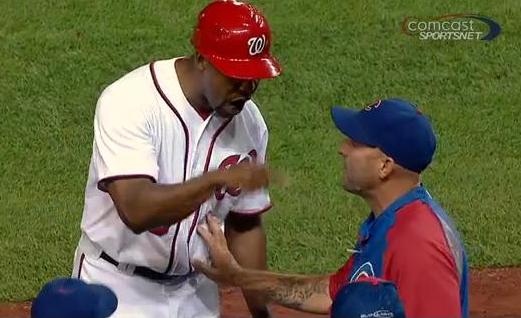
From the dugout, he started “screaming out obscenities” toward Washington third-base coach Bo Porter, according to umpire Jerry Layne in the Chicago Tribune, a situation the umpire felt “was inappropriate” and “caused everything.”

“Everything” began with Porter approaching the Chicago bench and screaming right back at Quirk. That escalated to both dugouts emptying onto the field. (Watch it here.)

“You’re up 7-2,” said Cubs catcher Steve Clevenger. “You don’t swing 3-0.”

There’s truth to the statement, but its timing is straight out of the 1960s. The last time the fifth inning was utilized as a yardstick for when to stifle an attack, it was a pitcher’s league. They were the days of Sandy Koufax and Bob Gibson, long before offenses exploded in a spate of expanded rosters and juiced balls and tiny ballparks and BALCO-fueled hitters. Today, the fifth inning sounds downright quaint.

Then again, this is the Cubs. The line for when to call off the dogs is malleable, depending on a team’s bench and bullpen, the freshness of its starting pitcher, the state of its offense. With the Cubs, for whom a two-run deficit might seem like an unbridgeable chasm, perhaps five runs, and only four innings to score them, is a  lot.

We’ve already established that their emotions are raw, which explains why reliever Lendy Castillo threw at Bryce Harper to lead off the the sixth. That set Harper off on his own shouting jag, and the dugouts emptied again. (Watch it here.)

Harper nailed it in his postgame comments, saying in the Tribune, “I’d be pretty ticked off if I was getting my teeth kicked in all week, too.”

Nationals manager Davey Johnson proved to be tone deaf earlier this season when it came to a different facet of the game’s propriety, but on this particular issue he was pretty much spot-on.

“We’re in a pennant race, we’re going to swing 3-0, we’re going to do everything,” he said in the Washington Post. “We ain’t stopping trying to score runs. Certainly a five-run lead at that time is nothing. I think it was the bench coach’s frustration in us handing it to them for a couple days. If they want to quit competing and forfeit, then fine. But we’re going to keep competing. I don’t know why they’re getting on about swinging 3-0. Their first baseman [Anthony Rizzo] swung 3-0 in the first inning. What’s the difference with the bases loaded in the fifth with only a five-run lead and two outs?”

At this point in the game’s history, not much. “Only” a five-run lead is exactly that, even against the Cubs. One would hope that next time they display a bit more pride.

Don't Bunt to Break Up a No-Hitter, Jarrod Saltalamacchia

Perfecto Broken Up by Bunt … and for Once That’s Okay

Boston, a day after getting gut-punched 20-2 by the Oakland A’s, had mustered not so much as a baserunner with two outs in the fifth inning Saturday against right-hander A.J. Griffin.

Frustration was inevitable, but was it sufficient to explain why Jarrod Saltalamacchia would bunt in the middle of a perfect game? The Red Sox catcher did, and reached base safely, which seems like a no-brainer: The guy was in clear violation of the Code. Heck, he even had a parallel with the most famous perfect game breaker-upper in history, Ben Davis—another catcher, who pulled the trick against Curt Schilling in 2001.

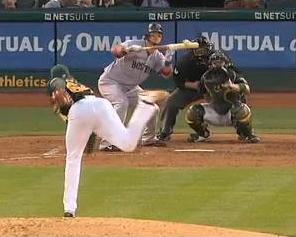
There was, however, a notable difference: For some unexplainable reason, A’s manager Bob Melvin had put on a defensive shift. With third baseman Adam Rosales positioned where the shortstop usually stands, Saltalamacchia was given the same kind of wide-open invitation all left-handed batters receive in that situation: an easy base hit with a well-placed bunt. Saltalamacchia, who has all of three sacrifice bunts in his career—all in 2007—took him up on the offer. (Watch it here, starting at the 1:03 mark.)

If the theory behind the governing rule is that a team’s first hit should be above board, with no gimmickry involved, then it should only follow that the defensive positioning of the pitcher’s team should follow suit. When Melvin opted not to play things straight up—despite holding a 5-0 lead—his opposition can hardly be faulted for acting similarly.

Melvin acknowledged as much after the game. “I probably should have had the third baseman in,” he told the San Francisco Chronicle.

To Griffin’s credit, the pitcher appeared to not hold any grudges. “It’s a good way to try to get momentum for your team,” he said. “There’s not anything I can do about it except try to get the next guy. Whatever.” (Bobby Valentine, who has far bigger controversies to consider than this one, added the sentiment, “Who cares?”)

There’s lots of blame to go around for Boston’s misery this season, but not on this play. If Griffin has a beef with anybody, it should be Bob Melvin.