Cheating, Clay Buchholz

Arm Butter Accusation Storm Builds in Toronto

buchholz arm
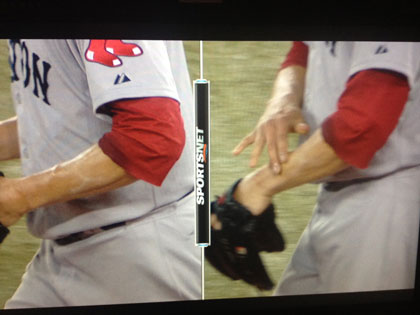
Sportsnet’s Buchholz graphic

It started last week when Dirk Hayhurst—ex-pitcher, sometimes author and current broadcast analyst for the Toronto Blue Jays—unleashed some damning suspicions on Twitter about Boston pitcher Clay Buchholz, who’s currently setting the American League afire with a 6-0 record and 1.01 ERA:

Forget the hair, I just saw video of Buchholz loading the ball with some Eddie Harris worthy slick’em painted up his left forearm. Wow.

It continued when Hayhurst’s colleague, ex-Tigers great and current Blue Jays broadcaster Jack Morris, piled on, telling ESPN Boston that “it was all over his forearm, all over the lower part of his T-shirt, it’s all in his hair,” while in the next breath stipulating that he has no actual proof of impropriety.

It really picked up steam when the video crew at the Rogers’ Centre unleashed some video from Wednesday’s Jays-Sox game, in which the right-hander allowed only two hits to Toronto over seven shutout innings, of Buchholz’s left (non-throwing) arm, glistening with what appears to be something other than sweat. (Hayhurst went on to say that it might be sunscreen mixed with rosin. The Jays’ crew added some talk about Red Sox reliever Junichi Tazawa possibly doing something similar.)

To be expected, Buchholz subsequently denied everything (“Definitely no foreign substances on my arm,” he told MassLive.com), as did Red Sox catcher David Ross (“I know when a pitcher is messing with the ball, he said. “He’s not putting anything on it”).

People came out for Buchholz. Dennis Eckersley told Morris to “zip it,” and Jerry Remy defended him on the air. Cliff Lee discussed his own innocent accumulation of sweat and rosin. Tim Hudson had some fun with the situation.

People came out against Buchholz. Sports Illustrated’s Tom Verducci discussed details about what he feels is a fishy situation, and ESPN’s David Schoenfield compared the break on Buchholz’s pitches to those on offerings nearly 30 years ago from notorious ball scuffer Mike Scott. (He also quoted from The Baseball Codes, so credit to him on that one.)

What does it all mean? Nothing, almost literally. The Blue Jays haven’t accused Buchholz of impropriety. Neither has any other team. Umpires have yet to check him. The accusations are based on TV footage that can be realistically explained any number of ways.

It appears to be a Kenny RogersTony La Russa-type situation. When  the Fox TV crew spotted Rogers with an unusual brown spot on his palm during his start in the 2006 World Series, it became national fodder—especially when video evidence showed the same brown spot during his previous postseason appearances. Instead of having the umpires check Rogers, however (knowing that if they found a foreign substance, he’d be ejected and likely suspended), Cardinals manager La Russa merely asked them to make sure he washed his hands. From The Baseball Codes:

In the face of this World Series controversy, the Gam­bler did the only thing he could reasonably do—he cleaned his hand and continued to pitch well. Fifteen postseason shutout innings with an obvi­ous foreign substance were followed by seven shutout innings without it. Alleged pine tar or no alleged pine tar, the Cardinals, who scratched out only two hits against Rogers in eight innings, fared no better than the Yan­kees or the A’s had in earlier rounds.

The primary question was, why did La Russa not come down harder? A variety of theories surfaced, one of which gained particular traction: Pitchers cheat in Major League Baseball. Not all of them, but enough to touch every clubhouse in some way. La Russa’s own pitcher, Julian Tavarez, had been busted for using pine tar only two seasons earlier, and suspended for 10 days. La Russa called it “an example of bullshit baseball.”

La Russa, the theory held, had kept quiet because he was reluctant to travel this particular road on behalf of his own pitchers, who would undoubtedly come under increased scrutiny. No less an authority than Buchholz accuser Jack Morris weighed in, telling the Detroit Free Press that “Tony’s been through a lot himself, so I don’t think he wanted to push that enve­lope.” (An entire chapter was devoted to this particular situation in The Baseball Codes.)

So even if the Blue Jays did recognize something askew about Buchholz on the mound, they may well have opted (and continue to opt) to keep it to themselves. This could be equally true for every other team in the league, regarding every other pitcher in the league. Rare is the guy like Davey Johnson, who just doesn’t give a crap.

Chances are that Buchholz will dial back whatever it is he’s doing (even if it’s legal, he’ll likely strive to make it less suspicious), and that the entire situation will blow over within the week, assuming he does not get uncharacteristically blown out of his next start.

Which is as it should be. Most folks around the big leagues view cheating as largely acceptable, so long as the cheaters knock it off (at least for a while) once they’re caught. Buchholz’s arm butter, legal or otherwise, is no exception.

A.J. Pierzynski, Addison Reed, Retaliation

Pierzynski Drilled, Indignant and Just Maybe Scheming for Future Benefit

AJP (1)It didn’t take long—one at-bat, as a pinch hitter in the ninth inning Wednesday—for the A.J. Pierzynski roadshow, Texas Rangers edition, to roar to life.

After eight seasons with the White Sox, Pierzynski signed with Texas during the off-season, and in facing his old team for the first time was plunked on the right elbow by ex-teammate Addison Reed. Pierzynski didn’t much try to avoid it (indeed, he threw his elbow into it), and was saved from significant discomfort by the pad he was wearing. Reed appeared upset with himself from the moment it became apparent that pitch would connect with batter.

None of it mattered. The catcher started barking toward the mound as he trotted to first, clearly upset with the development. (Watch it here.)

“I was mad,” Piezynski said in a Chicago Tribune account. “(Reed) threw it up and in and shoulder high. It’s fine if you’re going to pitch me in, but don’t come up and in, shoulder high.” (Reed, White Sox manager Robin Ventura and catcher Tyler Flowers all offered standard denials of intent.)

Ultimately it made no difference, coming as it did with two outs in the ninth. Pierzynski did not score, and Chicago won, 5-2. The real reason any of this is of interest is that it’s A.J. Pierzynski, the man about whom his former White Sox manager, Ozzie Guillen, famously said, “If you play against him, you hate him. If you play with him, you hate him a little less.”

In honor of A.J. being A.J., I offer a selection from the original draft of The Baseball Codes, which did not make it into the final edit. It involves Pierzynski, some of the reasons why opposing players hate him, and another pitcher named Reed.

When Pierzynski was catching for San Francisco in 2004, the Giants built a 9-2 lead in the eighth inning of a game at Colorado. With the bases loaded and two out, Pierzynski poked his elbow pad into the path of a Steve Reed fastball, taking a dubious hit-by-pitch and driving in what would be the first of six runs in the inning that turned a Giants romp into a full-fledged blowout. Reed was incensed, saying later that the pitch would have been a strike had the Giants catcher not gotten in its way. There was even some debate as to whether it hit Pierzynski at all, with Reed and Rockies catcher Charles Johnson denying there was contact, and Pierzynski himself going so far as to say he never felt it hit him.

But the only opinion that mattered was that of plate umpire Bruce Dreckman, and when Dreckman sent Pierzynski to first, Reed exploded. He was thrown out of the game during the ensuing argument.

Pierzynski knew he had done wrong—willingly getting hit by a pitch that should not have hit him, in a game in which an extra run did not matter—and that Reed had been ejected as a result. He also knew that there would be a price to pay down the road.

With the game well in hand, Giants manager Felipe Alou offered to pull Pierzynski and save him from imminent retaliatory damage. The catcher, however, understood that if he didn’t get it that day, he’d be waiting—uncomfortably—until the time that the Rockies had a chance to even the score. So he demurred, opting get it over with quickly.

Trouble was, when Pierzynski came to bat in the ninth inning, it was against right-hander Allan Simpson, pitching in just his eighth major league game. With a 7.36 ERA, Simpson was far less worried about sticking up for his teammates than he was about simply getting out of the inning with a minimum of damage. (With Reed in the clubhouse, Simpson  may not even have been briefed about Pierzynski’s lack of propriety, or the appropriate response.)

Seeing a pitch to hit, Pierzynski doubled in the Giants’ 16th and final run of the game.

The catcher didn’t start the next day, the final game of the series, and by the time he made a ninth-inning appearance as a pinch-hitter, the 7-5 score was too close for Rockies pitcher Marc Kroon to take any action. (Also, because Pierzynski hadn’t been scheduled to hit, Rockies management may not have given advance notice to Kroon about what they’d like him to do.)

When the teams faced each other a month later, however, Rockies starter Aaron Cook wasted no time. When Pierzynski stepped to the plate for his first at bat, Colorado already held a 6-0 lead, and with little potential downside to allowing an extra baserunner, Cook hit Pierzynski in the leg with his second pitch.

Pierzynski may be insufferable, but he is also among the game’s wiliest players. He knew what was happening and why in 1992, and he likely knew it again on Wednesday. He may also be the only man in baseball to feign annoyance at an incidental action on the chance that such a precedent could help him or his team in the future.

Unless Pierzynski or somebody on the White Sox cares to discuss Wednesday’s events, of course, we’ll never know. The next time he faces Addison Reed, however, it seems likely that Wednesday’s events will be somewhere in the pitcher’s mind.