Don't Showboat

Carlos Gomez was Very Angry at Paul Maholm. Brian McCann was Very Angry at Carlos Gomez. Then Things Got Weird

McCann-GomezWhen it comes to matters of messaging, it’s all in the timing. On a ball field, that means an offended team waits for the appropriate moment to respond to the player who rubbed them the wrong way. This might mean waiting for an at-bat, for a game or for a season.

Brian McCann, it seems, is not much for waiting.

Carlos Gomez, the game’s second batter, homered against Paul Maholm Wednesday, then lingered in the batter’s box. Once he began to trot, his churn rate increased with every step; he shouted with increasing fervor at first baseman Freddie Freeman and Maholm even before reaching third.

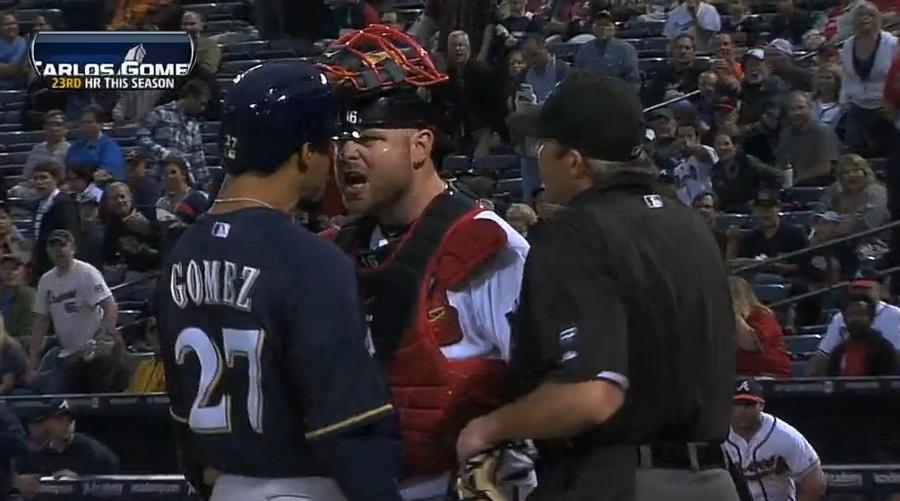
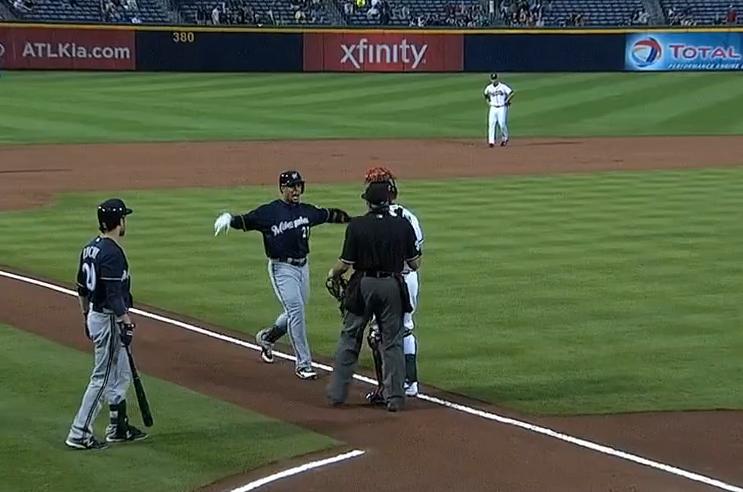
Watching this, McCann decided to unload a few of his own notions on Gomez, and made sure that his message could not be ignored. The catcher planted himself about 15 feet up the third base line, completely blocking Gomez’s path to the plate. The runner would not pass without first getting an earful.

As it turned out, he would not pass at all. McCann shouted him down without ceding the baseline, players from both teams stormed the field, Reed Johnson landed a punch to Gomez’s noggin, and the ensuing scrum carried everybody to the backstop. Gomez was ejected shortly thereafter, and left the field without ever touching the plate. (The umps invoked Rule 7.06[a], which says that an “obstructed runner shall be awarded at least one base beyond the base he had last legally touched before the obstruction,” and allowed him to score. Watch it all here.)
McCann-Gomez II
A well-blocked plate.

So what the hell happened? Start with the fact that, including the aforementioned at-bat, Gomez is hitting .450 against Maholm in 20 career at-bats. Add to that the June 23 incident in which Maholm drilled Gomez in the left knee with a fastball—a pitch that Gomez felt was deliberate. (This became clear when the outfielder pointed to his knee while yelling at Maholm as he rounded third base following his homer on Wednesday. He admitted as much after the game.)

It resulted in a pissed-off Dominican pimping his homer as an in-your-face means of taunting his antagonist.

McCann got into the act immediately, imploring Gomez, at top volume, to get his ass out of the batter’s box. It ended (for now) with the scrum at the plate. “I’ve never seen anything like it in my baseball career, whether it be the big leagues, Minor Leagues or little leagues,” said Braves manager Fredi Gonzalez.

The moment was reminiscent of catcher Carlton Fisk’s reaction during a 1989 game, when Deion Sanders lingered in the batter’s box after popping up to shortstop. From The Baseball Codes:

Fisk was forty-two years old and entrenched at the time as one of the premier members of baseball’s old guard. Watching Sanders’s lackadaisical display, the future Hall of Famer could barely contain himself. “Run the fucking ball out, you piece of shit—that’s not the way we do things up here!” he screamed at the startled hitter, two decades his junior and playing in just his twenty-fourth big-league game. By that point, of course, it was too late; the ball was already settling into the shortstop’s glove, and Sanders had nowhere to go but back to the dugout.

When Neon Deion came to the plate two innings later, he took the time to inform Fisk that “the days of slavery are over.” The catcher responded in kind, and the dugouts quickly emptied. “I just told him I thought that there was a right way and a wrong way to play the game, and he was play­ing it wrong, because it offended guys like me,” said Fisk. “And if he didn’t care to play it right, let’s go at it, right here.”

That seemed to be the basis of McCann’s point as well. Remember, he delivered a similar message just two weeks earlier, to Marlins rookie Jose Fernandez. Unlike Gomez, Fernandez took it immediately as a learning experience.

To be fair, Gomez did as well, it just took him a bit longer. And he seems to be holding on to a bit more resentment.

“I did a little bit more [than I should have], and I apologize for this,” Gomez said in an MLB.com report. “But if you see the replay [from June], they hit me for no reason, and I tried to get it back today. It’s the only opportunity that I have, and that’s what I did.

“It’s nothing against the organization, for the Braves. I respect everyone. I would do the same thing if I’m on the other side if a guy did like I did today. Defend my teammate. But they are not in my head and on my side—they hit me for no reason. If I do something to get hit, I put my head down and go to first. But I didn’t deserve to get hit by a pitch last time, [so] that’s what I did today.”

So who wins here? Maholm may well have drilled Gomez for the inadequate reason of protracted success, but comes out looking squeaky clean, relatively speaking. Gomez showed up Maholm and looked like a jerk in the process. McCann simply illustrated the fact that he may well be a crazy person. (A crazy person with deeply ingrained thoughts about propriety on a baseball diamond.)

Ultimately, it comes down to one overriding factor: Carlos Gomez just invited the Braves—and every other team in baseball—into his head for future appointments. The guy showed that he can be knocked off his game (and out of a game entirely) simply by being hit by a pitch. It’s not going to happen all the time, of course, but an underlying tenet of the Code is this: Put yourself in the best possible position to win. If all one needs to do to fracture the concentration of an opposing All-Star is hit him with a baseball, it seems only natural that, when the time is right, it will happen again … and again … and again—right up to the point that Gomez shows he can deal with it appropriately.

He has nobody to blame but himself.

Jayson Werth, Retaliation

Darling on Werth Drilling: ‘Boy, Was That Obvious’

Werth drilledWhy Frank Francisco drilled Jayson Werth on Thursday is not yet clear. That it was intentional—and stupid—was obvious to at least three people: Werth, Bryce Harper and Mets broadcaster Ron Darling.

It came with no outs in the eighth inning, on a 3-0 fastball, after Francisco had already allowed doubles to the first two batters he faced, extending Washington’s lead to 5-2. (The Nats ended up winning, 7-2. At this point, frustration is as good a guess as any when it comes to pinpointing Francisco’s motivation.)

Werth knew it was intentional when it happened. So, apparently did plate ump Anthony Recker, who, despite the fact that Werth made no move toward the mound, grabbed the barrel of his bat as he lingered near the plate, staring at Francisco.

“Boy, was that obvious,” said Darling on the broadcast. “For you folks at home—and you hear me all the time say, ‘That wasn’t intentional’—well, this one was intentional.”

Darling was then asked by broadcaster Gary Cohen why Francisco would drill a batter in that situation.

Darling’s reply: “Because he’s a fool.” (Watch it here.)

Werth wouldn’t comment after the game, but handled things in the moment, taking out shortstop Reuben Tejada moments later with an aggressive slide at second base. Harper, who reached on a fielder’s choice, did something similar to second baseman Daniel Murphy.

(The idea was summed up by Bob Brenly in The Baseball Codes: “I’ve gotten on first base when I’ve been hit by a pitch and told the first baseman, ‘If there’s a ground ball hit I’m going to fuck up one of your middle infielders, and [pointing to the mound] you can tell him that it was his fault.’ That’s a way you can get them to police themselves. A pitcher drills somebody just because he feels like it, and if one of the middle infielders gets flipped out there he’s going to tell the pitcher to knock it off. Ultimately, that’s all we want anyway—just play the game the right way.”)

“That was total B.S. what Francisco did there,” said a scout in attendance, in a Washington Post report. “Almost got his shortstop’s ankle broken.”

Sure enough, Nationals pitchers never retaliated. If Werth’s slide wasn’t enough for them, they’ll have to wait until next year to address the issue, because the teams don’t meet again this season.

Update (9/16): At least one Mets pitcher wasn’t too pleased.

(H/T BLS)

Don't Showboat, Jose Fernandez

Fernandez Ends Splendid Season with Awful Day, Ends Awful Day With Splendid Response

Fernandez homersIt’s been a long time since we’ve seen a player melt down so thoroughly in so short a time, but Jose Fernandez put on a show on Wednesday.

But for every instance that inspired reminders of the 21-year-old’s immaturity, he managed to recover as well as any player could hope to following a display such as his.

A small accounting:

  • Top of the fifth inning: Justin Upton blasts a ball to center field, which is tracked down by Justin Ruggiano. From the mound, Fernandez is all smiles.
  • Top of the sixth: Atlanta’s Evan Gattis responds after hitting a 96-mph fastball into the left field bleachers by admiring it for a moment while briefly staring down the pitcher. Fernandez notices. (Watch it here.)
  • Two hitters later, Chris Johnson and Fernandez exchange words after Johnson flies out to center field.
  • Bottom of the sixth: Fernandez blasts a nearly 400-foot drive off Braves left-hander Mike Minor for his first career homer, flips his bat away and—ostensibly in response to Gattis—stands to admire it. This is not an innocent would-be slugger in awe of his own unexpected power; the move is intended to disrespect the Braves, who take it precisely that way.
  • Fernandez begins an exceedingly slow trip around the bases—28.58 seconds, according to Tater Trot Tracker. (It would likely be among the five slowest in baseball this year if David Ortiz had taken up a profession other than baseball.) Minor stared him down much of the way.
  • As he rounds third—Johnson’s position—Fernandez spits toward the base.
  • When Fernandez crosses the plate, Braves catcher Brian McCann informs him of the ways in which he has behaved badly. “You’re a kid and you’re in the big leagues and you need to do what big leaguers do,” Fernandez recalled him saying in an MLB.com report. The players go nearly nose to nose.
  • Johnson sprints in from third (making you-talk-too-much motions with his hand), and the benches and bullpens empty.
  • In the aftermath, Fernandez paces the dugout, smiling. (Watch it all here.)

It’s easy to quibble about overreaction and the unnecessary sensitivity of ballplayers, but there’s no mistaking the fact that messages of disrespect were delivered from both parties, and received as intended—none louder than Fernandez’s. That it came from a rookie only served to amplify things.

At this point, of course, Fernandez must be given credit for attempting to pacify the situation almost as soon as it came to a head, telling McCann during their confrontation that, “I’m sorry, the game got the best of me,” he recalled after the game in an MLB.com report.

“[McCann] was talking to me as a friend, or a dad, teaching a kid,” he said. “That’s how I felt.”

Fernandez later said that he was embarrassed by his actions, saying “it’s something that can’t happen. It’s not good for baseball.”

The incident also illustrated the importance of quality leadership, particularly on the part of Marlins manager Mike Redmond.  “Tonight showed some immaturity on Jose’s part …” he said. “He got caught up in the emotions, but I’m not happy. It really ruined the night for me. I know that will never happen again. … We respect the game.”

Redmond took things a step further, making sure that Fernandez’s actions did not carry over. A meeting was set up in a hallway underneath Marlins Park, where Fernandez apologized personally to McCann and Minor.

This is unusual in baseball circles, but hardly precedent-setting. In 2006, Twins manager Ron Gardenhire led Torii Hunter across the ballpark to apologize to Red Sox brass for swinging hard at a 3-0 pitch while the Twins held an 8-1, eighth-inning lead.

Unlike the Fernandez situation, there was no disrespect intended on Hunter’s part. Precisely like the Fernandez situation, it did not matter—perception is everything. From The Baseball Codes:

After the game, Gardenhire took the outfielder to the visitors’ club­house to speak to Red Sox manager Terry Francona, trying to wipe away the potential for hard feelings. To abide by the unwritten rule that bars opposing players from the locker room, the meeting took place in a rear laundry room in the bowels of the Metrodome. There Hunter informed both managers that he had swung out of inattention, not disrespect.

“We wanted to make sure [Francona] understood,” said Gardenhire. “I went there to let him know that I know the game too. It’s a manager’s responsibility when a player swings 3-0 to make sure the player under­stands that. I wanted him to know we didn’t give a sign for him to swing away, that Torii just made a mistake. I thought that it was good for Torii to explain it to him, so I took him over.”

“You see those types of things and you know it’s being taken care of internally,” said Red Sox pitching coach Al Nipper about the Hunter incident. “You say, Hey, it’s an honest mistake, it wasn’t something intentional, where the guy’s trying to show you up. We all make mistakes in this game.”

Fernandez’s mistake was considerably more profound, but his reaction was appropriate.

“I feel I don’t deserve to be here, because this isn’t high school no more,” he said after the game. “This is a professional game, and we should be professional players. I think that never should happen. I’m embarrassed, and hopefully that will never happen again.”

Wednesday was the final start of Fernandez’s season, with his team enforcing an innings limit on his young arm. The guy will probably go on to win Rookie of the Year, but, starting with his confrontation with McCann, he’s already begun to display the maturity of a veteran.

Sign stealing

Girardi to O’s: You Can’t Hide Your Spying Eyes

ShowalterWhether Orioles third base coach Bobby Dickerson was signaling pitch location to his team’s hitters is almost beside the point. The Yankees thought he was doing it, and that’s enough.

The dispute emerged at the end of the first inning of Monday’s game, when Buck Showalter raced from his dugout to yell at Joe Girardi for giving Dickerson a hard time from the Yankees dugout. According to Dickerson, the abuse started with Baltimore’s first hitter of the game, Nick Markakis (who hit a ground-rule double).

” ‘I know what you’re doing,’ ” Girardi yelled, according to Dickerson.

This means that if Dickerson was doing something suspicious, it probably wasn’t the first time. The only way the Yankees could be on something like that so quickly is if they were already aware of it and paying particularly close attention from the game’s first pitch.

“Yelling it, body language, pointing at me,” Dickerson said in an MLB.com report. “That’s it. And I’m a grown man, that’s all. I don’t see why he was yelling at me. I just said, ‘You don’t know anything. You don’t even know me to be yelling at me.’ ”

Showalter should be commended for taking up for his guy—which he did in the most visible way possible, with sufficient animation that the benches cleared (watch it here)—but Girardi is the one on solid footing here.

If Dickerson was indicating location (Yankees catcher Austin Romine insisted that he had the signs themselves well protected), he was fulfilling a longstanding duty of base coaches throughout the history of the game. Not all of them do it, of course, but it’s expected—and accepted—that a certain number will.

Coaches may bend at the waist to indicate one type of pitch, and stand upright for another. When Leo Durocher was coaching third while managing the Brooklyn Dodgers in the mid-1940s, he’d whistle to the hitter to indicate he knew the pitch. (Not only would he take it from the catcher, but he’d also peer in to the pitcher’s grip for clues.) Giants right-hander Ace Adams made a point once of showing him a curveball grip, which Durocher dutifully relayed. Adams, however, threw a fastball right at the batter. That, he said, stopped the whistling in a hurry.

In the early 2000s, the Cardinals were convinced that Cubs first-base coach Sandy Alomar was signaling pitches to Sammy Sosa. St. Louis coach Jose Oquendo handled the situation via a face-to-face confrontation with Alomar, during which he urged (at top volume) the cessation of such activity. That said, Oquendo himself carries a reputation as an accomplished sign thief. In an interview for The Baseball Codes, he admitted to stealing signs “every day” from the first-base coach’s box, but insisted that he used the information only to inform strategy for his team’s baserunners, never passing it along to hitters.

All told, such efforts to tamp down this kind of activity are entirely expected. Which is precisely what Girardi did. As a manager, it’s his job to call out such intransigence as soon as he’s aware of it, at which point it becomes incumbent of the offender to knock off whatever it was he had been doing.

Had Showalter played by the unwritten rules and remained in his dugout while making sure Dickerson laid low for a while, the outcome would have been no different—we’d just have heard nothing about it.

Deke Appropriately

Now You See it, Now You Don’t: The Weekend of Phantom Tags

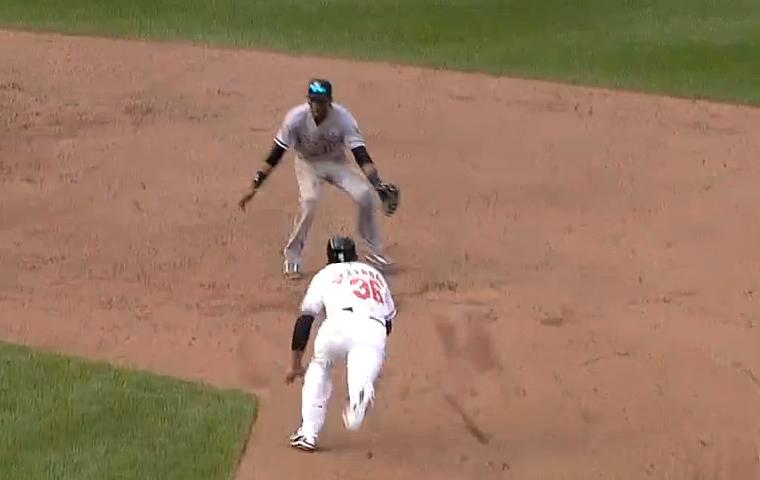
ChiSox dekeWe’ve discussed the concept of deking in this space for some time, under the auspices that improper execution by middle infielders can be dangerous. (A last-minute phantom tag, for example, delivered when a baserunner doesn’t expect it, can lead to late and awkward slides.)

Rarely, however, do we see two perfectly executed dekes in the same weekend that both lead to game-ending double plays.

On Saturday, Michael Cuddyer, representing the tying run for the Rockies, was on first base with one out in the ninth inning, and took off running. The hitter, Nolan Arenado, popped the pitch into short center field, but all Cuddyer saw was Padres second baseman Jed Gyorko acting like he was fielding a throw from the catcher. When center fielder Alexi Amarista made the catch, it took only an easy throw to double Cuddyer off first. (Watch it here.)

On Sunday in Baltimore, the Orioles had runners at the corners with one out in the ninth, down 4-2 to the White Sox. Chris Dickerson, inserted as a pinch-runner at first base, ran on an 0-2 pitch that batter Brian Roberts popped up behind first, in foul territory. Chicago shortstop Alexi Ramirez lit to the bag as if to field a throw, spurring Dickerson into a head-first slide. Second baseman Leury Garcia made the catch while Dickerson was still at second; though he probably had time to run it over himself, he flipped the ball to first baseman Jeff Keppinger for the game’s final out. (Watch it here.)

The similarity on both plays: Neither runner looked in to see where the baseball was going.

”I didn’t peek and it ended up in the one place where you’re not going to get that awareness reaction from the infielders,” Dickerson said in an AP report. ”Especially Ramirez with the deke. That pretty much got me. I assumed there was a ground ball hit behind me, and he was going to first because I was already there.”

Catchers will occasionally deke runners into easing up by acting as if no throw is coming before fielding the ball and making an unexpected tag. Outfielders have been known to act as if they have a bead on a ball that ends up landing nowhere near them, in order to keep a runner near his base. In 1958, members of the Cubs bullpen went so far as to deke Giants outfielder Leon Washington by collectively acting as if a ball hit by Tony Taylor had rolled under their bench, while it was actually some 45 feet away, in a rain gutter. (By the time Wagner realized what was happening, Taylor had circled the bases.)

Infielders, however, hold nearly absolute dominion over the tactic. (For an extended rundown on the idea, focusing primarily on Lonnie Smith’s basepath adventure in the 1991 World Series, see chapter 9 of The Baseball Codes.) Rarely, however—if ever—have we seen such wildly successful execution delivered so definitively in such a short amount of time.

Retaliation

The Fine Line Between Pimping and Confusion, Pittsburgh Edition

Morneau drilledPerception is everything.

In the fifth inning in Milwaukee on Wednesday, Andrew McCutchen hit a home run to left. He didn’t get it all—it just cleared the fence—and he managed to lose it in the lights before he knew where it was ending up.

As such, he loitered in the batter’s box to try and get a read on it.

Ignore for a moment the horrific strategy of hedging one’s bet that a ball may not have left the ballpark by failing to leave the batter’s box. The pitcher who gave up the shot, Wily Peralta, either did not know about McCutchen’s confusion, or didn’t care. With his next pitch, he drilled Justin Morneau on the hand, near head-level. (Watch it here.)

“The catcher knew I was looking for the ball, the umpire knew—everybody knew it,” said McCutchen after the game, in an MLB.com report. “You could see the guys in the infield smirking as I was going around the bases. They know I’d lost the ball.”

Peralta offered up the standard denial of intent, saying “Yeah, you know, it wasn’t on purpose,” before detailing how he missed his spot while trying to go up and in.

“I know it looks bad, because right after a homer, you don’t want to hit people,” he said.

Unless, of course, hitting people is exactly what you want to do. Morneau reacted angrily, and even though he never approached the mound, benches cleared. After the game, Pittsburgh’s first baseman wasn’t ready to level blame with any degree of certainty.

“I think usually when a guy hits a home run, and they don’t like the way he reacts, they wait until the guy comes around [again],” he said in USA Today, questioning whether a more proper approach would have seen the Brewers waiting for McCutchen’s next turn in the lineup, rather than going after Morneau so quickly afterward. “It’s one of those things in that gray area. You don’t know if it’s intentional or not.”

Not to disagree too wholeheartedly with an experienced big leaguer or anything, but it seemed pretty intentional. Add the wrinkle that Morneau’s career was derailed and diminished by concussion-related symptoms, and the idea that Peralta came anywhere near his head in a misinformed fit of retaliation is unconscionable.

That was the final meeting between the teams this season so any personal retribution will have to wait, but there are no such constraints on the commissioner’s office, which may opt to hand down some discipline of its own.

Practical Jokes

Rodney’s Bathroom Breather Hardly Breaks New Ground

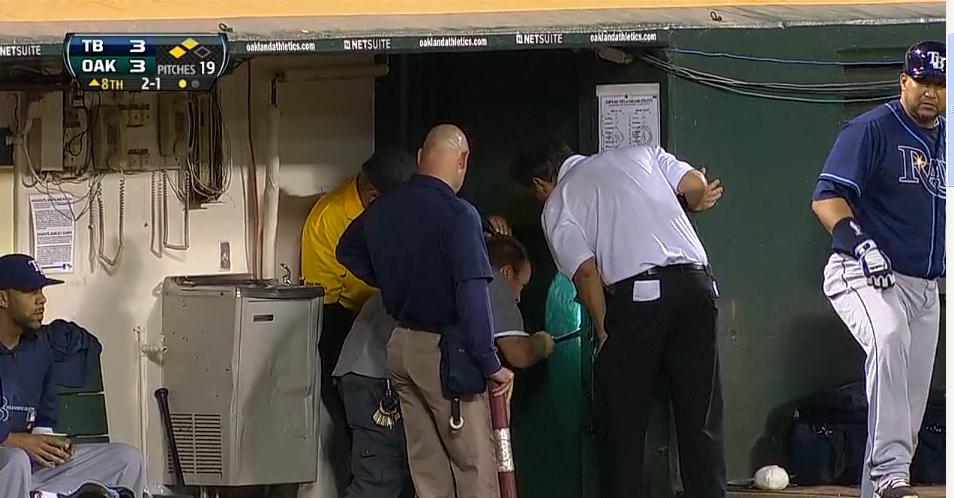
Rodney trappedRays reliever Fernando Rodney got stuck in the visitors’ dugout bathroom at Oakland’s O.co Coliseum on Sunday, and was trapped for about 15 minutes until a rescue crew could open the door.

He emerged triumphantly, met by jubilant teammates.

“They got two runs when I was locked inside,” Rodney said in an Associated Press report. “They broke the lock. It was hot inside. I can only hear the crowd but can’t see game. So I don’t know what’s going on. I let them know and tried getting a key but couldn’t. I kept yelling, ‘Get me out!’”

(Check it out at the bottom of the page, or watch the extended clip here.)

“It was a kind of a fun moment,” added Rays manager Joe Maddon. “We kind of rallied then—we should have kept him in there. A lot of the commotion in the dugout in the eighth inning and part of the rally was someone beating on the door. Finally someone broke the door knob with a bat to get him out. I don’t even know who the hero was getting him out.”

While there’s no unwritten rule to cover Rodney’s escapade, there was one involved in another locked-in-the-bathroom incident covered in The Baseball Codes. Unlike Rodney’s predicament, that one was all about practical jokes—keeping things loose in the clubhouse.

From TBC:

Bob McClure was a fun-loving reliever for the Brewers in the 1970s, some­one who proved, if nothing else, that he could take as good as he gave. The story started with his Sunday routine before day games, for which he holed up with a newspaper in the long cinderblock outhouse behind the outfield fence at Milwaukee County Stadium. It was a cool place for an American League pitcher to pass the morning in the shade of the bleach­ers, escaping the summer heat while his teammates took batting practice.

When the door slammed shut on McClure in the middle of one of these siestas, the pitcher attributed it to a gust of wind. But when he tried to exit, the door wouldn’t budge, even though it had no lock. With just a hint of panic, the pitcher pushed again . . . and again. Soon he was exert­ing so much energy in his frantic bid to escape that he had to stop for peri­odic breathers. The day was growing increasingly more sultry, and McClure worked up a sweat; eventually he kicked the air vents from the walls and stripped down to his underwear. “I bet I lost about seven or eight pounds in there,” he said. “It was hot.”

After a half-hour, the pitcher was able to wedge the door open just enough to squeeze through (“I still remember the scrapes across my chest”), whereupon he saw that someone had taken the rope from a flag­pole on the other side of the outhouse and pulled it so taut to reach the doorknob that the pole had bowed under the pressure. Once it was affixed to the handle, the rope’s tension kept the door from opening; it was only as the fibers started to give that McClure was able, finally, to free himself. (He found out later that members of the visiting Minnesota Twins, com­ing out for their own batting practice, had been told by his mystery assailant to watch the flagpole, that someone was locked in the lavatory and it would bounce every time he tried to get out.) He put on his clothes and returned directly to the clubhouse, as if nothing had ever happened. “I would say that, if someone gets you, never let them know that they got you,” he said. “I think it’s inappropriate, if someone really gets you good, to overreact. Don’t get mad, just get even.” The problem was that he had no idea upon whom to visit his revenge.

Before a game several days later, McClure got his answer. As the pitcher loitered in the outfield during BP, a fan called him over to the bleachers. “Do you want to know who locked you in that room?” she asked. His instinct was to play dumb, but when the woman told him she had pictures, he couldn’t resist. She handed them over in exchange for a ball autographed by Robin Yount, and McClure saw exactly what hap­pened: It had taken two men to pull the flagpole rope tight enough to trap him, and their uniforms were clearly visible. It was pitchers Mike Cald­well and Reggie Cleveland.

McClure immediately set to plotting his revenge. Six weeks later, when the Brew­ers had an off-day in Kansas City before a series with the Royals, he struck.

While many players, including Caldwell and Cleveland, spent the after­noon golfing, McClure opted for a hunting trip with a local friend. On the way back they stopped by a farm, where the pitcher bought a small, live— and exceptionally filthy—pig. “It had so much pig dung on it that you couldn’t even hardly tell it was a pig,” McClure said. “It was perfect. We put it in a burlap sack in the back of my buddy’s pickup.”

When the pitcher returned to the hotel, he saw that his teammates hadn’t returned, and figured they’d be out until the wee hours. McClure bribed his way into the room that Caldwell and Cleveland conveniently shared, and let the pig loose atop the bed. “When that pig hit the sheet, it looked up at me and started projectile shitting everywhere, like a shot­gun,” he said. “That pig was alive. It jumps off the bed, and it’s squealing and going nutty. There’s shit on the bed, on the floor, on the curtains. It was so loud that I had to get out of the room.”

He was staying just across the hall, and hours later was roused by the sounds of his returning teammates. Caldwell was the first to enter, and nearly as quickly lit back into the hallway, shouting, “There’s someone in there!” As McClure listened with delight, his teammates rushed the room, then spent the better part of an hour trying to corner the pig. Finally, the noise quieted and McClure went back to sleep.

The next morning, the pitcher veritably bounced across the hall to see how his victims had held up. He entered the room under the pretense of rounding up breakfast companionship, but wasn’t at all prepared for what he saw. The place was spotless. The walls, the drapes, the bedspread, and the carpet had all been cleaned. Caldwell was lying on his back in bed, shirtless. Also on its back, in the crook of Caldwell’s right arm, was a freshly washed pig. It sported a red dog collar. Caldwell was feeding it French fries dipped in ketchup.

Feigning ignorance, McClure asked why there was a pig in the room and was told the entire story, up to and including an early-morning trip to a nearby pet store, where Caldwell bought collar, leash, and industrial-grade pet shampoo. The pig joined the team at the ballpark that day, serv­ing as the Brewers’ mascot. It ended up living on Cleveland’s farm, of all places, dreaming recurrently, no doubt, of room service and burlap.