Earning respect, Umpire Relations

Rizzo Rapid to Render Respect

rizzo

Whether or not one agrees with their implementation, the underlying nature of baseball’s unwritten rules—respect each other and the game at large—is difficult to quibble with. We saw one of its most basic elements yesterday, courtesy of Anthony Rizzo.

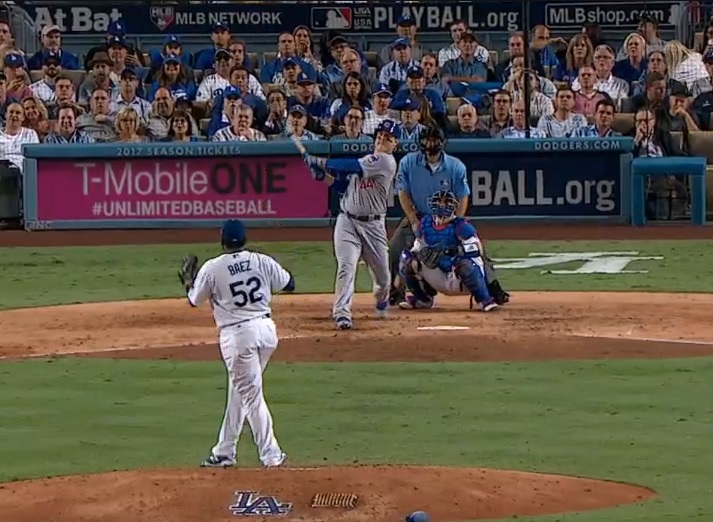
In an at-bat earlier in the game, Chicago’s first baseman had incorrectly assumed ball four from Pedro Baez, but as he was heading toward first base plate ump Angel Hernandez informed him that, no,  it was actually a strike.

There’s no indication that Hernandez was upset with Rizzo, but the hitter took it upon himself during his next at-bat, when the game paused for a mound conference, to make sure everything was square between himself and Hernandez. Watch for yourself:

On one hand, there’s self-preservation involved in the strategy. The more an umpire likes a player—or, more pertinently, the less he doesn’t like a player—the better the chances that close calls will go that player’s way. More important, however, is the basic decency of the gesture. There was a chance that Hernandez read something in Rizzo’s actions that Rizzo did not intend, so Rizzo took care of it as soon as he could.

“I don’t like showing up the umpires,” he said after the game. “They’re out here working their tails off 162 like we are. … I just let him know that, hey, my fault there. I probably should have waited a little longer and not just assumed that it was a ball.”

Turns out that a little bit of introspection suits ballplayers nicely.

[H/T Hardball Talk]

Sign stealing

Today’s Question: What to do With Spying Eyes?

spy

According to the Dodgers, the Cubs are stealing signs. Also according to the Dodgers, the Dodgers don’t like it.

As evidence, Los Angeles catcher Yasmani Grandal pointed to the eighth inning of Saturday’s Game 1 of the NLCS, when Ben Zobrist reached second base—the perfect location from which to peer in at the catcher’s hands—and Addison Russell’s at-bat changed considerably.

“All the sudden, Russell is not taking good swings at sliders, looking like he’s looking for a fastball and in a certain location,” Grandal said in a Los Angeles Times account. “Did we know Zobrist had the signs and was doing something for it? Yeah, we did. That’s why we do it.”

The “it” to which Grandal referred was a continuous loop of sign changes and mound meetings, the better to stifle would-be thieves.

“We are literally paranoid when it comes to men on second and they are trying to get signs,” he added. “We know who is getting the signs. We know what they’re doing. We know what they do to get it. In the playoffs, one relayed sign could mean the difference between winning the World Series and not getting there.”

Ignore for a moment whether there’s any difference between literal paranoia and figurative paranoia. Are the Dodgers so certain that Zobrist and the Cubs are spying on them? Zobrist assures us otherwise.

It seems likely that he’s obfuscating, if only because it doesn’t take a hardball savant—even somebody unable to decode a catcher’s signs—to signal location. Former infielder Randy Velarde once looked at me like I was half an idiot when I asked him about the ease of relaying stolen signs from second base. “It’s the easiest thing in the world,” he said. “I’m amazed that everybody doesn’t do it.”

Ultimately, of course, it doesn’t matter. The barest suspicion of such chicanery should prompt the very response the Dodgers appear to be embracing—cloaking their signs in any way possible. What said response does not include is getting angry at the Cubs … and the Dodgers seem to be fine on that front, as well.

Changing signs can be as easy as swapping out the indicator, or the sign after which the actual sign takes effect. Maybe it’s the sign following the second signal for fastball. Maybe it’s based on the count (a 2-0 pitch would trigger the second sign in a series, while a 3-2 count would trigger the fifth, etc.). It could be the number of signs a catcher puts down rather than the signs themselves. The possibilities are limitless.

The only trick is to not make things so complicated that the pitcher gets confused. (Giants pitcher Sam Jones, for example, killed the National League in 1959, going 21-12 with a 2.54 ERA everywhere but Wrigley Field. In Chicago, of course, the Cubs’ practice of stealing signs from the scoreboard led to an 0-3 mark with for Jones with an 8.53 ERA. Why didn’t the Giants just switch up their signs like the Dodgers have recently done? Jones had trouble recognizing all but the simplest signals.)

Stealing signs from beyond the field of play is illegal, of course, not to mention frowned upon from a moral standpoint, while stealing signs from the basebaths—as Zobrist is accused of doing—is widely considered acceptable practice. (At least up until one is caught, at which point an increased degree of subtlety is expected). There are red-asses through the history of the game partial to on-field accusations (one example from spring training of this year seems to reinforce the idea that the Cubs might really be into this type of thing), but the low-key approach Los Angeles is taking—calling it out in the press is a surefire way to make sure everybody’s paying attention—is the right one.

Ultimately, the Dodgers are also displaying another sort of best practice. The ultimate recourse available to a team whose signs have been pilfered is to switch ’em up, then go win ballgames. Which is exactly what Los Angeles is doing.
Unwritten-Rules

The Commissioner Weighs in on the Unwritten Rules

rob-manfredPosition yourself for a moment as an old-school curmudgeon when it comes to baseball’s unwritten rules, a defender of decorum, issuing proclamations about how it was better back before the current generation took over and started flipping bats all over the field and celebrating June victories like they’d just won the World Series.

Now imagine your head exploding when you hear that commissioner Rob Manfred, the man at the head of the food chain, tasked with shepherding baseball into its next golden era, said this in response to a question about on-field celebration:

I actually think players being more demonstrative on the field is a good thing for the game. I think it’s exciting.

It came during a media conference on Saturday and was easy to miss, being sandwiched between questions about minority representation in the sport and replay implementation. It seems, however, noteworthy. Is baseball’s head honcho actually advocating for more showboating within the sport?

Before we answer that question, take off the old-school cap I asked you to put on back in the first paragraph, and instead position yourself on the opposite end of the spectrum, as somebody who decries baseball’s unwritten rules as outdated and without function, serving mainly to suppress individuality and fun within the sport. You’re pretty happy with Manfred about now, aren’t you? So how do you feel about the very next thing that came out of his mouth?:

Overall, baseball has always had unwritten rules that kind of govern what’s appropriate and what’s not appropriate. The way I think about the changes we’ve seen in the last couple of years, is that we have a really exciting new, young generation in the game. And just like the players 20 years ago, they are going to develop a set of unwritten rules as to what’s acceptable and what’s not.

Yep, it’s possible to walk both sides of the line without being in the least bit hypocritical. Manfred is absolutely correct in leaving it up to the players to determine what is appropriate and what is not. That’s been the rule since forever, and things have seemed to work out pretty well. Once, an act like digging into the batter’s box was considered retaliation-worthy. Then times changed. Now, bat flips are all but ignored, and occasionally encouraged. Because that’s the way the players (certain among their ranks—*cough, Bumgarner, cough*—excepted) want it.

It’s the very position I’ve advocated in this space from my very first blog post. My own feelings have little sway in whatever position I happen to be examining. The issue at question is about how a player’s actions mesh with the mores established by his peer group at large. If he’s in the mainstream, there should be little problem with whatever it is he’s done. Otherwise, let’s discuss it and, if need be, discuss it again.

Manfred closed his answer thusly: “I have great faith in our players; that they will use good judgment; that they will develop a set of rules that are respectful of the game, but also are reflective of the differences between these young players and the people that may be played a generation ago. I think we should all embrace that. I think it’s a good thing for the game.”

Honestly, no answer he could give to any question would convince me of his competence more than that one. At their core, the unwritten rules are about respect, and however the current crop of players ends up getting there is far less important than their getting there at all.

Ultimately, that’s all any defender of the sport’s code should care about. Manfred is about two years into his tenure; looks like we’re in good hands, baseball fans.