Retaliation

Corey Kluber Is No Fan Of Hard Swings, and Doesn’t Care How Hard He’s Hit in Order to Prove It

Kluber

Maybe when you’re as good as Corey Kluber, you think you can get away with questionable activities.

Maybe when you’re as good as Corey Kluber, you think that your prodigious skill will help you escape any jam—even those of your own devising.

Maybe when you’re as good as Corey Kluber, it doesn’t matter to you whether or when you put opposing players on the basepaths, because you’re Corey Kluber and you’re good enough to handle your business.

Right up until the moment that you’re not.

Heading into the eighth inning of last Wednesday’s game against Boston, Kluber was pitching a gem: four hits, one run, 11 strikeouts, one walk. That Cleveland was losing 1-0 had very little to do with his performance.

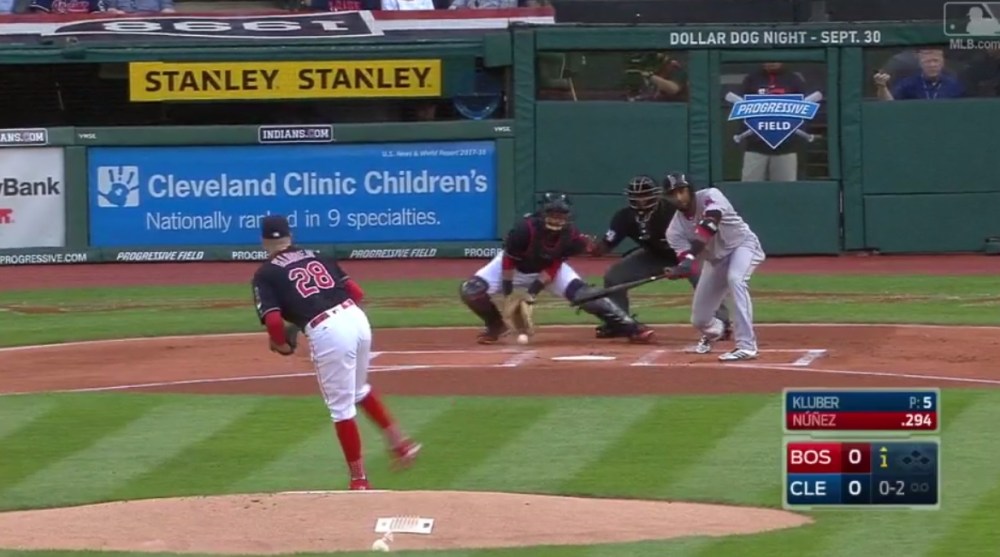
Kluber got Mitch Moreland to fly out for the first out of the eighth. He whiffed Christian Vazquez—making it an even dozen on the day for the right-hander—for the second out. After a walk to Brock Holt, Eduardo Nunez came up and, with a 2-0 count, took a mammoth swing, spinning himself into the dirt as he futilely chased a 90 mph cutter. Kluber didn’t like it. With his next pitch, he drilled Nunez.


Maybe the pitcher thought it was a safe move with two outs, but Nunez bats leadoff in a high-powered offense. The next batter, Mookie Betts, drilled a single off the glove of third baseman Giovanny Urshela, bringing home Holt and padding Boston’s lead. Out came manager Terry Francona, and that was it for Kluber. Before the game ended the Red Sox had tacked on four more runs against Cleveland’s bullpen in a 6-1 victory.

From the Boston Herald:

Asked on Thursday if there was any reaction in the dugout when Nunez got hit, Red Sox manager John Farrell said, “For (a guy with) pinpoint control, you know, I think that was fairly obvious, the message (that was sent).”

Is it against the unwritten rules of baseball to swing too hard?

“No, I don’t think so,” Farrell said.

It was a perfect example of the line between confidence and cockiness. Kluber perceived Nunez’s swing as some sort of slight—never mind that the vast majority of his colleagues would have brushed it off as being of little consequence—and felt invincible enough to act on it in the moment. Baseball has long had an unwritten rule regulating swings at 3-0 pitches (only the reddest of asses in big league history even considered 2-0), but that applies only in blowouts, which this game decidedly was not.

Perhaps it was a lesson that no pitcher, Kluber included, is as invincible as he might occasionally think. Or maybe it was just karma. Either way, it did not end well for the Indians.

[H/T WEEI.]
Appropriate Retaliation, Retaliation

Dustup In D-Town Offers a Primer on a Host of Unwritten Rules

Cabrera-Romine

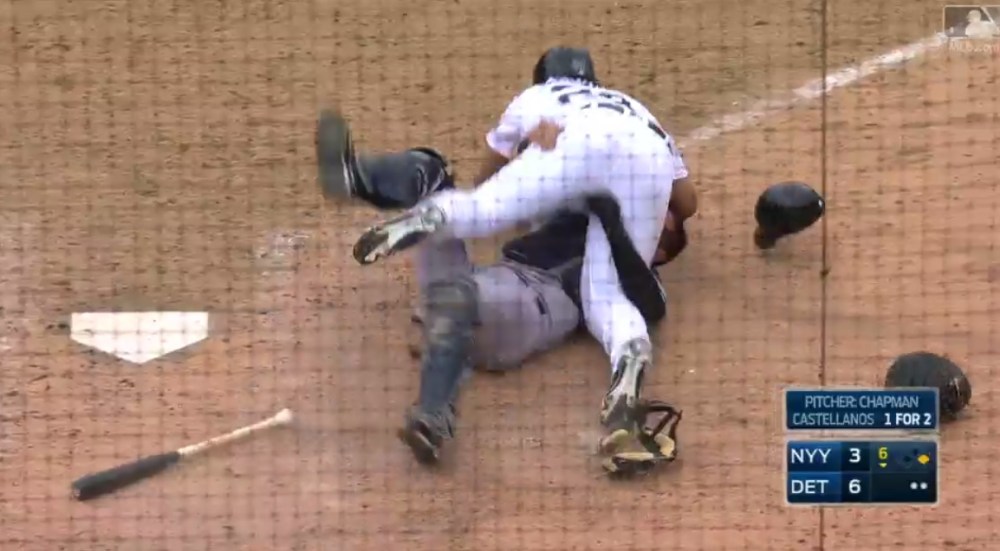
The Yankees-Tigers Brawl of the Century on Thursday presented a grab-bag for the ages of unwritten rules, some justified, some not, some executed to precision, some decidedly less so. Among the things we saw:

  • Hitting a guy in response to his success: In the fourth inning, Gary Sanchez blasted his fourth home run of the three-game series. In the fifth inning, Tigers starter Michael Fulmer drilled Sanchez with a 96-mph fastball. It’s possible, maybe even likely, that it was unintentional—Fulmer recently returned to action after recovering from ulnar neuritis that disrupted his touch, and was shaking his hand in discomfort after releasing the pitch, before the ball even connected. Sanchez did not appear inclined to give him the benefit of the doubt, glaring toward the mound on his way to first base.
  • Responding to a hit teammate: When Miguel Cabrera stepped in to face reliever Tommy Kahnle in the sixth, the right-hander had already struck out the inning’s first two hitters. Cabrera, however, is Detroit’s biggest threat, and thus the surest target for a payback pitch in response to Fulmer. Kahnle delivered, sending a fastball behind Cabrera’s back. The intent was obvious; plate ump Carlos Torres ejected Kahnle without a prior warning. Yankees manager Joe Girardi was similarly tossed when he emerged to argue the decision.
  • History matters: On July 31 at Yankee Stadium, Kahnle hit Mikie Mahtook in the helmet. Though the pitch seemed unintentional, Fulmer responded by plunking Jacoby Ellsbury. Benches were warned and tempers remained calm … for the moment.
  • As goes the aggrieved party, so goes his team: Cabrera was not immediately agitated, but soon got into an animated conversation with Tigers catcher Austin Romine, which ended up in wild punches and both teams converging onto the field in brawling clusters. Cabrera and Romine were ejected.

  • Fight honorably: Every player is expected to appear on the field during a baseball fight, filling one of three acceptable roles: active combatant, peacemaker or bystander. Two actions are patently disallowed: remaining in the dugout and cheap-shotting an opponent. New York catcher Gary Sanchez, leaping from scrum to scrum, began punching Tigers who were helplessly wedged beneath piles of players. Nothing will sully a player’s reputation around the league quicker than this, and Sanchez is certain to feel its impact in the future—both in terms of impending suspension and treatment by the opposition.

  • Teammates protect each other: During the first fight, Detroit’s Victor Martinez actually cozied up to Sanchez. Normally this type of interaction between opponents would not be an issue, but this happened after Sanchez’s below-board tactics during the fight, about which multiple Tigers were aware. Castellanos attempted to explain this to Martinez in the Detroit dugout, with an assist from Justin Verlander. The pitcher said something Martinez didn’t like, then dismissively walked away. Martinez had to be restrained from going after him. After the game, comments were forthcoming from none of them.

  • Teammates protect each other, Part II: The rule mandating that everybody join the party includes relievers, which meant that the bullpens of each team got in some decent cardio on the day.

  • Keep retaliation below the shoulders: With the game tied 6-6 in the seventh, Yankees reliever Dellin Betances drilled James McCann in the helmet with a 98-mph fastball. The batter was not seriously hurt, but the Tigers were irate, and, even given the possibility that it was unintentional, benches again cleared. Betances was ejected, as was Yankees bench coach and acting manager Rob Thomson. Somehow, New York’s replacement pitcher, David Robertson, hit the very next batter, John Hicks, in the hand.
  • Never cop to anything: In the top of the eighth, Detroit’s Alex Wilson drilled Todd Frazier in the thigh. While Fulmer had been quick to deny intent about his own hit batter (“I’m not the type of guy who’d hit a guy for hitting a home run. Especially down one run. I have more dignity than that,” he said) Wilson was different. He told reporters after the game that he didn’t believe either Betances or Robertson had drilled anybody intentionally, but that he nonetheless felt the need to respond. It was “pretty obvious what had to happen,” he said in a Detroit Free Press report, adding, “You’ve got to take care of your teammates sometimes. With me, if hitting a guy in the leg is what I have to do, then that’s what I did. Fortunately for me, I know where my pitches are going and I hit a guy in the leg today to take care of my teammates and protect them. It is what it is.” Suspensions are likely for many of the day’s participants, and certain for Wilson.

  • A manager’s role is to keep his players in line and restore order as quickly as possible: After the game, Joe Girardi accused Tigers manager Brad Ausmus of yelling “fuck you” at one of the Tigers, adding, “Come on, Brad, what is that?”

This was some ugly stuff. Whether or not Fulmer drilled Sanchez for riding a hot streak, it sure appeared that way. Cabrera appeared to accept that as Detroit’s best player, he was the one chosen to pay the price. Had either he or Romine been better able to keep their cool (oh, to know what was said that started it all), the entire affair would likely have failed to escalate.

Stuck in the middle was Andrew Romine, Austin’s brother, a bench player for the Yankees, who did his best to separate combatants on the field. (Oh, to know what was said at the family dinner after the game.)

Suspensions are certainly forthcoming, no player more deserving than Betances, for throwing all-world heat anywhere near a hitter’s head, or Sanchez, for dishonorable fighting.

The teams won’t meet again until next season. We’ll see then just how long some memories are.


Bunt appropriately, Bunting for hits, Gamesmanship, Taking Advantage of Injury

CC Sabathia Has Thoughts on Boston’s Bunting Habits

Knee

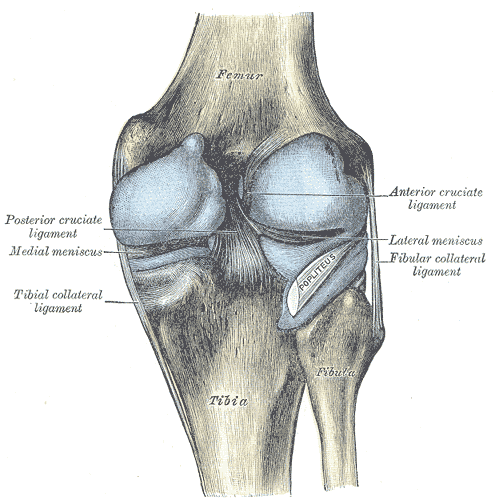
CC Sabathia is angry that the Red Sox took advantage of him. The pitcher, returning from a knee injury, tossed a splendid game against Boston over the weekend, giving up four hits and two runs over six innings to earn the win. One of his takeaways, however, concerned the opposition’s sustained insistence on making him prove that he was healthy by laying down bunt after bunt, to test the left-hander’s agility.

Boston’s very first batter, Eduardo Nunez started things off, though his attempt rolled foul and Sabathia ended up striking him out. Outfielder Andrew Benintendi did similarly, and Sabathia fielded his bunt cleanly, after which he motioned in frustration with his glove toward the Red Sox dugout.

“To come out and that’s your strategy, that got me going a little bit,” Sabathia told the New York Post after the game. “Literally, two of the hottest hitters in baseball bunting. If that was their strategy, I [handled] it.”

The pitcher’s anger is misplaced. Any player nursing an injury is a proven liability, not to mention a target for the opposition. If Sabathia was not healthy enough to help his team, he should not have been on the mound. If he was able to help his team—and boy was he ever—then the upside of his pitching had to be sufficient to protect against those who might seek to take advantage of him in other ways.

It’s why Dusty Baker played in the 1981 World Series with a sprained wrist, despite it preventing him from doing anything of consequence with the bat. The threat of Baker in the lineup was itself valuable, and by not openly discussing his injury, sustained away from the field during the NLCS, he hoped that the Yankees would continue to treat him as the dangerous hitter he’d been all season long.

It doesn’t even take an injury to fit this bill. During the 1974 World Series, Alvin Dark called in Catfish Hunter for a relief role to close out Game 1. When Dark said that the hitter, Joe Ferguson, couldn’t handle curveballs, Hunter told him that Ferguson would see nothing but fastballs. The reason: “I ain’t got no curveball today.” At that moment it was up to Hunter—as it is up to any pitcher trying to perform without his full complement of pitches—to keep that knowledge from the opposition for as long as possible. Ferguson had no idea that he’d not see a single bender, and so had to prepare for the opportunity that he might.

Five fastballs later, he went down swinging for the game’s final out. This kind of thing happens all the time.

Sabathia is obviously concerned about his health, and has every right to be. But if he’s not up for fulfilling every facet of his job description, he must at least be willing to act as if he is.


Don't Play Aggressively with a Big Lead, Retaliation

Baseball Man Steals With Eight-Run Lead; Opposing Baseball Man Confused, Miffed

ThouShaltNotSteal

Perhaps the oldest of baseball’s age-old unwritten rules concerns the point at which a team should take its foot off the gas and coast in to victory. Nearly everybody agrees that cessation of aggressive tactics—stolen bases, bunting for hits, sacrifice flies—is appropriate at some point in a blowout. Consensus on what that point is, however, in terms of either score or inning, is difficult to come by.

On Sunday, Arizona rookie reliever Braden Shipley used his mound-top pulpit to lobby for an eight-run lead in the fifth as designated markers.

How he did so represented some serious throwback attitude. With Minnesota leading the Diamondbacks, 12-4, and two outs in the fifth, Twins outfielder Byron Buxton reached first and found himself repeatedly retreating to the bag under a hail of pickoff attempts.

They didn’t work. Buxton swiped his 22nd base of the season. That he never scored did little to appease Shipley.

When Minnesota next batted, the pitcher waited to act until he’d retired the first two batters. That brought up Chris Gimenez, who had already singled, doubled and homered. A cycle may have been improbable for a man who’d accrued only one triple to that point in his nine-year big league career, but he had at least given himself a chance … until Shipley took it away. The right-hander’s first pitch fastball drilled Gimenez in the ribs.

It was classic execution. The problem with classic execution, of course, is that it is by definition outdated, and the way baseball is currently set up harbors little space for that kind of mindset. Even more egregious was that the purity of Shipley’s old-school attitude was undermined entirely by what appears to be a significant misunderstanding of the way this particular rule is supposed to work.

While it’s acceptable to decry a base stolen by a team holding an eight-run lead, mainstream thought holds that to do so before the seventh inning  is premature.

Furthermore, were Shipley truly set on traditional parameters, he had no business trying to keep Buxton close at first base. After all, if one is to decry aggressive offensive tactics during a blowout, it’s only fair to forgo aggressive defensive tactics as well. While facing a lead so insurmountable as to expect cessation of steals, a defense would ordinarily play its first baseman in the hole, even with a runner at first, with the expectation that said runner will not take advantage. (This strategy stirs up its own controversy, the heart of which involves a team giving itself a defensive advantage—better positioning for the first baseman—at absolutely no cost. But that’s a topic for another post.)

Finally, in situations like this, circumstances count. Target Field is the fourth-most homer-friendly ballpark in the big leagues this season, and Minnesota’s bullpen is surrendering more than five runs per game, fifth-worst in the American League. Closer Brandon Kintzler has been outstanding, but the rest of the bullpen has ranked between adequate and awful, presenting a decent opportunity for a comeback-seeking club.

A quick recap:

  • It was early in the game.
  • Shipley worked hard to hold Buxton close to first base.
  • The Twins’ ballpark plays small.
  • The Twins’ bullpen ain’t real good.

Gimenez was within his rights to be angry over the drilling, but chose instead to take it like a pro. “It’s baseball,” he said after the game in a 1500ESPN report. “If he had thrown at my face we might have had some issues, but he did it the right way.”

Right way or no, the pitch begat a response. In the seventh, Minnesota reliever Ryan Pressly came inside to D’Backs shortstop Adam Rosales, drawing a warning to both benches from plate ump John Tumpane. (For reasons unclear—his guy got to hit a batter, their guy did not—Arizona manager Torey Lovullo argued the point and was subsequently ejected.)

Leave it to Gimenez to put everything in perspective. “It is what it is,” he said after the game. “Hopefully it’s a learning experience for everybody involved. Obviously, it’s a younger pitcher on the mound as well, maybe not quite understanding the situation.” Gimenez pointed out that he and Shipley, both alums of the University of Nevada-Reno, are friendly. “No hard feelings at all,” he said. “That’s baseball.”

Later in the day, Shipley was optioned to Triple-A Reno. It probably had nothing to do with his response to Buxton, but that, too, is baseball.


Don't Bunt to Break Up a No-Hitter, No-Hitter Etiquette

Dee Gordon Swings Away Because of No-Bunting-During-a-No-Hitter Rule, Gets a Hit Anyway

Gordon hits

Baseball’s unwritten rules have a pervasive role in the fabric of the sport, helping to maintain a degree of respect and decorum. That part is good. But sometimes they’re just stupid.

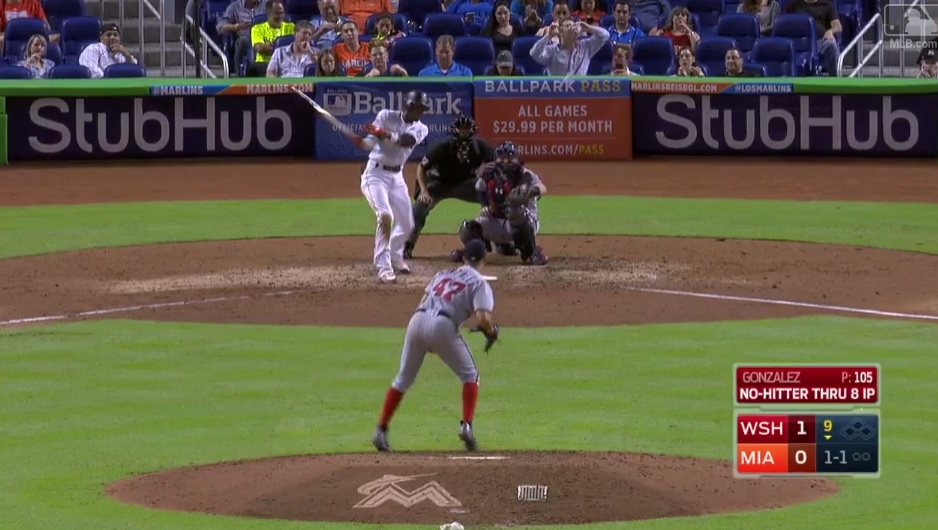
Take yesterday. In the sixth inning of the Nationals-Marlins game, with Washington’s Gio Gonzalez throwing a no-hitter, Florida’s Dee Gordon thought about trying to bunt for a hit.

Typically, this is a no-no. We’ve already looked back this season at the infamous Ben Davis bunt that broke up Curt Schilling’s perfect game in 2001.

Except that Davis was a slow-footed catcher who had never bunted for a hit in his life. Gordon is second in the National League with 38 steals, a player for whom bunting is an essential tool. Also, it was a 1-0 game and Gordon represented the tying run.

“My game is to bunt,” Gordon said in a Miami Herald report, discussing his consternation over the unwritten rules. “I didn’t know if I could bunt or not. I was kind of in a weird situation for myself.”

Gordon didn’t bunt. Instead, he struck out. When he came up again in the ninth, Gonzalez’s no-hitter was still intact. Gordon didn’t even consider bunting.

Instead, he slashed a single to left field, Code be damned.