RIP

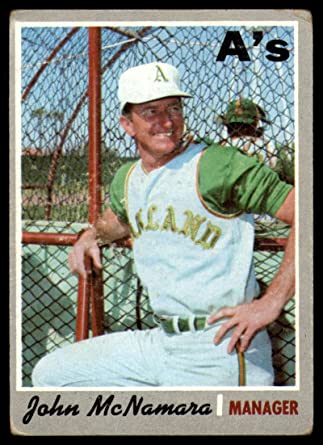
RIP John McNamara

John McNamara passed away yesterday at age 88. Remembered primarily as the skipper who led the 1986 Red Sox to their epic World Series collapse against the Mets, my own interaction with his story primarily has to do with his tenure with the A’s. McNamara’s first major league managerial job was in Oakland, working for Charlie Finley in 1970 (plus the final few games of 1969).

As a minor league manager, it was McNamara who shifted Gene Tenace from outfield to catcher. (As a former catcher himself, McNamara was well suited as a tutor.) While managing at Double-A Birmingham, McNamara earned respect for his refusal to patronize the segregated restaurants his team frequently encountered on the road. It was McNamara who brought his old Army pal, Charlie Lau, to be the hitting coach in Oakland. (Lau transformed the swings of Joe Rudi and Dave Duncan, among others.)

Despite leading the A’s to 89 wins in 1970—their most since 1932—Finley fired McNamara after the season to make way for Dick Williams. The manager wasn’t much hurt by the decision—he ended up managing in the big leagues for six teams over 19 seasons—but there was no mistaking the genuine weirdness with how the dismissal went down. I wrote about it for Dynastic, Bombastic, Fantastic, very little of which made the final edit. Today, the affair seems worth revisiting. From the cutting-room floor:

Despite the successful season, everybody braced for McNamara to become Finley’s annual managerial sacrifice. The manager himself wasn’t exactly averse to the idea. After being forced to participate in the protracted embarrassment of Reggie Jackson—going so far as to convey Finley’s threat to demote the young star to the minor leagues, not as a developmental tool but as a means of embarrassment—not to mention the daily phone calls and lineup demands, McNamara was prepared to quit even if Finley unexpectedly decided to retain him. His mistake was making this known.

Two Bay Area newspapers had reported on McNamara’s dissatisfaction during the season’s final week, and when Oakland Tribune columnist George Ross dedicated his season-ending feature to players’ opinions of the situation, some of them took the opportunity to sound off. One opinion in particular struck a chord with the Owner.

“It doesn’t matter who manages this ballclub,” Dave Duncan told Ross with surprising candor. “There’s only one man who manages this club: Charlie Finley. And we will never win as long as he manages. We had the team to win it. But because of the atmosphere he creates, there’s no spirit, no feeling of harmony. We should be close like a family, but it’s not here.” Duncan had been especially angry since the team’s annual mid-season cookout at Finley’s ranch in La Porte, where the Owner introduced him as “the best third-string catcher in the league,” and then saw his playing time cut to next to nothing. But Duncan wasn’t finished.

“Everybody’s always worried about Charlie Finley,” he continued. “You can’t say that, you can’t say this, or he’ll be mad. Nobody will speak out. But how can they with their jobs to protect?”

With that, Duncan presented the Owner with one of his favorite oratorical weapons: a scapegoat. Until Ross’ column, McNamara’s firing had been based on the manager’s inability to meet Finley’s needs. But now? Now the Owner had something else. Instead of his original plan, he instead called a press conference the day after the season ended, and got right to it. “As of two days ago at 2 o’clock, Johnny McNamara had just as much of a chance of managing this ballclub as anyone else,” said Finley to a room that didn’t believe a word he was saying, as reported in Ron Bergman’s book Mustache Gang. “But when the Dave Duncan story broke, that was the end of his chances.”

Then the Owner opened up on his catcher. The story was no longer about McNamara—had a just-fired manager ever become old news more quickly?—and was all about Finley’s spat with Duncan. Over the course of 30 minutes Finley criticized the player’s maturity, lack of perseverance and gutlessness. It was a brutal assessment by any measure, let alone a team owner talking about one of his employees. Things got truly weird when Finley said that the catcher was sleeping with Charlie Lau.

His exact words: “One day I found out that Duncan was sleeping with coach Charlie Lau.” Pause. “By that, I mean they were rooming together, sharing expenses. When I found out about this, I called it to their attention, asked them to break it up immediately, because as we all know, in the Army, troops don’t fraternize with officers.

It was a valid criticism. Duncan himself said as much later. Duncan and Lau were both going through marriage separations and decided to save money by sharing a roof. But Finley’s word selection—he was a master salesman, after all, trained to choose his verbiage carefully—left a different impression. “It was another cheap shot, typical Finley,” said Duncan, looking back. “He was a cruel guy. He had no respect for anybody. Pretty soon you got to the point with him where nothing surprised you.” The Owner went on to say that Duncan and Lau ignored his orders to de-couple, and that Lau—despite his success working with Duncan and Rudi (or maybe because of it)—would be joining McNamara on the unemployment line.

First, Finley hurt his team by cutting Reggie Jackson off at the knees. Then he fired the most successful manager his team had employed in 40 years. Now he was canning a soon-to-be-legendary hitting coach, just to prove a point. The Owner continued to injure himself atop his high horse, but, as would be the case for years to come, he didn’t care.

Finley finally brought the press conference back around to McNamara by saying that the manager could have salvaged his employment had he only denied the front office interference that so clearly existed, and paid Finley the occasional public complement when it came to the helpful things he did do. Said the Owner, “no manager can allow one of his players to criticize unfairly, knowing the facts himself, without getting pinched. John McNamara didn’t lose this job. His players took it from him.”

The final word was left to Duncan, who summed it up neatly. “It’s ridiculous to believe that the reason McNamara was fired was because of me,” he said afterward, as reported in Mustache Gang. “It was obvious to everyone a long time ago that Finley was going to fire him. In order to get off the hook, he found someone to pin it on, and that’s me.”
Retaliation

What’s A Little COVID When There’s Beef On The Field?

Yesterday I discussed the general idea of social distancing on a ballfield, and how players who want to maximize the chances of playing a full, 60-game schedule would be well served to pay better attention to the league’s safety protocols.

Today I address the unwritten rules (that’s the beat of this blog, after all), which include long-held grudges and purpose pitches and cross-field taunting. Ultimately, though, it all comes back to COVID response. Because everything in the world right now comes down to COVID response.

Fireworks were anticipated when the Dodgers traveled to Minute Maid Park in Houston for their first meeting since news came out about the Astros’ trash-can banging during their disputed championship run in 2017—a run that, coincidentally, culminated in a seven-game World Series win over the Dodgers.

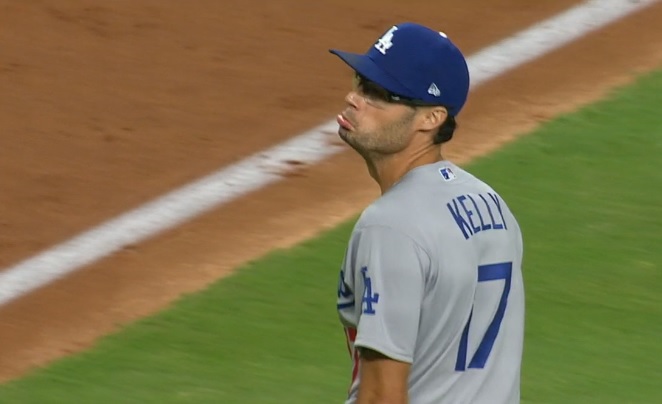
Joe Kelly was not on the Dodgers back then, but he’s on the Dodgers now, and he’s heard all the  stories, and he’s the kind of pitcher known to stand up for teammates. (He was on the Red Sox team that lost to Houston in that year’s Division Series.) So when Kelly threw a 3-0 fastball behind Alex Bregman on Tuesday, close enough to raise the hair on the back of Bregman’s neck, it was tough to mistake it for anything but a message.

Things got even stranger when Kelly had to cover first base after the next batter, Michael Brantley, hit a would-be double-play grounder. Kelly was mildly and inadvertently spiked, then hung around the base for a moment to convey his displeasure.

That’s when a voice in the Astros dugout—it appears to be manager Dusty Baker—yelled, “Just get on the mound, little fucker.”

Joe Kelley has proved to need far less provocation than that.

After walking Yuli Gurriel on four pitches to put men at first and second, he delivered a pitch at Carlos Correa’s head. On one hand, that kind of location is never okay. On the other, it was a curveball—not the greatest weapon for pitchers with malice on their minds—and men were on first and second.

Correa ducked out of the way without much trouble, then stared down both Kelly and the Dodgers dugout. He ended up striking out on another curveball—this one down and away—to end the inning. Kelly immediately started jawing (according to Baker, he said, “Nice swing, bitch”), then made faces at his opponent, literally sticking out his lower lip in a mock pout. That’s all it took. Benches emptied.

This is where we return to the intersection of baseball norms and social distancing. In the former category, old habits can be hard to shake. In the latter, if ballplayers wanna play ball, they better start paying better attention to MLB’s protrocols—one of which explicitly bans fighting. (The specific language: “Players or managers who leave their positions to argue with umpires, come within six feet of an umpire or opposing player or manager for the purpose of argument, or engage in altercations on the field are subject to immediate ejection and discipline, including fines and suspensions.”)

Still, players from both teams crowded around home plate. While there was very little contact, and while various members of both clubs actually wore masks, these players were close, and many of them were maskless.

We’re still less than a week into the season and the Marlins are triaging and sequestered, the Phillies are dormant and the Yankees, after doing nothing while waiting things out in Philadelphia are unexpectedly playing in Baltimore. If this doesn’t spur players to pay some better attention to risk mitigation, it’s likely that nothing will.

***

Nothing is as important right now as COVID mitigation, but seeing as this is an unwritten-rules blog, we should probably wrap up the situation between the Dodgers and the Astros. There’s no question that anger lingers in LA. During spring training, Cody Bellinger said that Jose Altuve “stole an MVP” from Aaron Judge, with Carlos Correa suggesting that Bellinger to get some facts or “shut the fuck up.”

Kelly denied intent on Tuesday, going so far as to illustrate his wild nature by referencing a viral video from early in the pandemic when, during a backyard bullpen session, he missed his target and broke a window in his home. (Not referenced was the fact that, since 2015, he’s struck out well over twice as many hitters as he’s walked.)

In the opposite clubhouse, Baker was livid.

“I didn’t anticipate that,” Baker said afterward. “I didn’t anticipate throwing over somebody’s head three balls and no strikes. One of our more important guys. If you’re going to throw at somebody, you don’t throw at the head. “You don’t throw at a guy’s head. That’s playing dirty baseball.”

What Baker did not do was order his pitchers to retaliate. For one thing, the Astros were three runs down and trying to keep the game close. In a truncated schedule, every loss bears extra weight. Also, all three Houston relievers who entered the game after Kelly’s shenanigans were rookies, two of them making their big league debuts. Asking a nervous kid to understand longstanding grudges, let alone execute a controversial purpose pitch, is asking for trouble in numerous ways.

The Astros may have dodged a bullet by not having to face a series of angry opponents had the 2020 season gone off as originally planned. But ballplayers, we’ve learned, are willing to wait. Joe Kelly is certainly not the only one who wants his shot at cheaters.

Meanwhile, the fan merch is out, and it’s spectacular.

Update 7/29: Kelly has been suspended for eight games, MLB citing Kelly’s history with this kind of thing as a factor in its decision. Dave Roberts has been suspended for one game, and Dusty Baker has received a sternly worded email or something.

Update 7/29: Dave Roberts has thoughts.

COVID baseball

Do We Love Baseball Enough To Make Sure We Can Keep Playing?

There are written rules and unwritten rules and sometimes they jumble together and now we’re in a pandemic and the Marlins are infected and Kevin Kiermaier is hugging up on his Rays teammates and everything is going to hell.

Man, Florida is setting a horrible example for the rest of us.

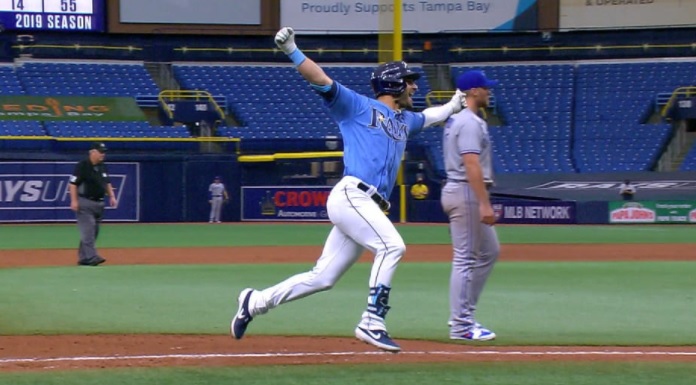
Let’s start with Kiermaier, who on Sunday offered a natural response after beating the Blue Jays with a two-run triple in the 10th, embracing teammate Jose Martinez and manager Kevin Cash, and high-fiving pretty much everybody within reach. That’s awesome. That’s baseball.

It’s also plain dumb.

“It was a heat-of-the-moment thing for me,” Kiermaier said in a Tampa Bay Times report. “I don’t regret it one bit, I really don’t. I knew what I was doing. … I’m one of those guys where I’m trying to do everything in my power to keep myself motivated and the others around me, and I want everyone to always remember how much fun winning is.”

Boy, is he right. Playing baseball is fun. Watching baseball is fun. But we—all of us—have entered into this agreement to do the right thing by our country by trying to keep COVID exposure to a minimum. MLB set up protocols as a prerequisite for returning to play for one simple reason: Arranging games and travel for large groups presents a significant risk. If those involved do everything they can to mitigate the risk, then maybe—maybe—the league can pull off a season.

But now we have reports that the Marlins entered the stadium in Philadelphia for last weekend’s series in large groups rather than incrementally, as recommended, and that their adherence to mask protocols in the dugout was significantly lacking. One can only imagine how they behaved behind closed clubhouse doors. And now we hear the barely believable news that they decided to play after they found out about their positive tests.

One thing is sure: Players in that clubhouse were either indifferent, or thought that they were immune.

They’re not. And now, for the time being, anyway, they’re not playing at all.

So when Kiermaier behaves as if his game-winner occurred in a place without a killer virus in the air, it helps him feel good about things. But here’s the catch: It’s not about him, it’s about doing all he can to insure that the season can continue, not to mention setting an example for everybody watching from the outside.

As a nation, there’s no way to fully reopen our economy until the coronavirus is under some semblance of control. Major League Baseball has leaned against this reality by manufacturing a bubble inside which it hopes its participants can coexist with something approaching normalcy. But the only way it works is if everybody agrees to the ground rules.

MLB is willing to flaunt common sense to make this season happen, but it also recognizes the fragility of the platform on which its near-future rests. Maybe the schedule can survive a bunch of Marlins coming down with COVID, while the rest of the roster decides to play games despite clear exposure. Maybe it can survive Kiermaier’s hugs and high-fives, or the fact that umpires during that game, including plate ump Vic Carapazza, opted against wearing masks.

One thing is certain, though: It can’t survive much more. We’re less than a week in, and, with the Marlins stuck in Philly and multiple games postponed, baseball is facing its first crisis.

Baseball matters to Kevin Keirmaier. A lot. And it should. But if the people on the field can’t bring themselves to give this pandemic the gravity it deserves in the service of playing as many games as possible, maybe it just doesn’t matter enough.

They Bled Blue

Dodgers’ First Rookie Opening Day Starter Since Fernando Does Not Disappoint

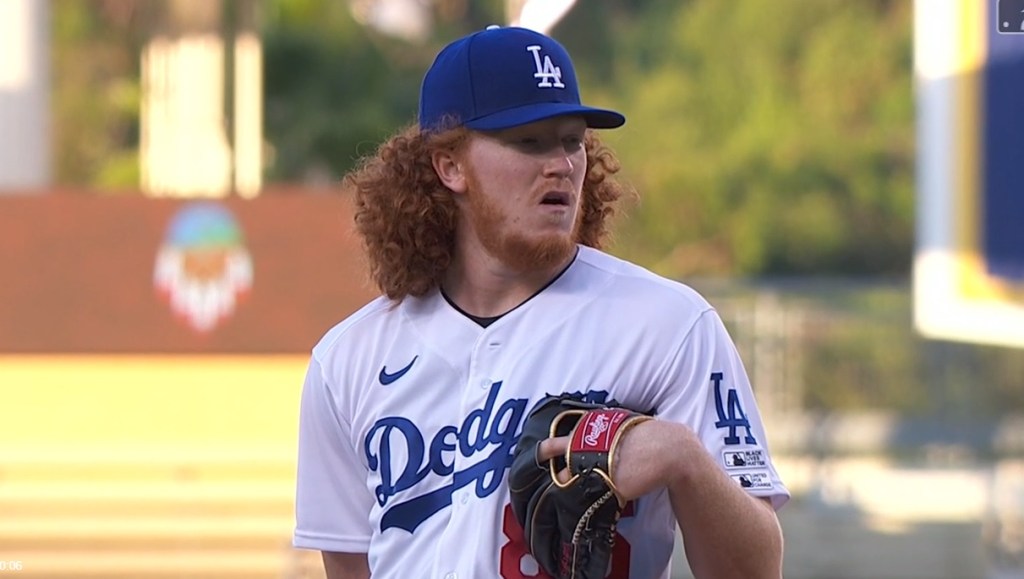
On Tuesday, Clayton Kershaw hurt his back lifting weights. On Wednesday, the possibility arose that he might not be able to start LA’s first game of the season, as planned. On Thursday, Kershaw was placed on the IL and his replacement, Dustin May, became only the second rookie to take the mound on opening day in the 137-year-history of the Dodgers franchise—and the first since Fernando Valenzuela in 1981.

There are some differences between May and Valenzuela. May, 6-foot-6 and 180 pounds, was drafted in the third round out of high school in Texas. Coming into the season, MLB.com ranked him as the Dodgers second-best prospect, and 23rd in all of baseball. He made 14 appearances for Los Angeles last year, including four starts, and struck out more than six hitters for every walk while posting a 3.63 ERA. 

Valenzuela, in contrast, was all but unknown going into 1981, even after having come up to the Dodgers as a call-up the previous September and throwing 17 scoreless innings out of the bullpen. At that point he had 30 professional appearances under his belt, none above Double-A.

They are both physically unique. In addition to his size, May’s enormous shock of bright red curls is almost reminiscent of an Irish Oscar Gamble.

Valenzuela, in turn, was notable for his utter lack of affectation. His scissor-straight, pitch-black hair, hanging in the Mayo style of his village, spilled down from under his cap. His physique was … unathletic. Fernando gave no regard to anything but pitching—which he did exceptionally well.

While May looked dominant at times yesterday, hitting 100 mph with his fastball, he gave up seven hits (including a bunt against the shift) to a woeful Giants offense, allowing runners into scoring position in three of the five innings in which he appeared while failing to last long enough to qualify for the win.

In his first Opening Day start, Fernando barely hit 90 … and threw a complete-game shutout against the defending division champs.

Really, this is all just a crutch for me—comparing two pitchers with markedly few comparison points—to excerpt Valenzuela’s introduction from They Bled Blue. After Fernando’s first eight starts, he was 8-0 with a 0.50 ERA, having pitched nine innings every time out. By that point, Fernandomania was in full bloom.

We may yet see Maymania, or Dustin Maynia, or whatever tag gets affixed to the phenom. In the meantime, it’s nice to remember some dominance of years past.

From They Bled Blue:

The guy standing on the mound at Dodger Stadium on opening day was not the guy the Dodgers wanted standing on the mound at Dodger Stadium on opening day. The home team faced pressure aplenty without having to consider an emergency starter in the very first game of the 1981 season, let alone it being a 20-year-old with all of 17 innings of big league experience under his belt, every one of them out of the bullpen.

At that point, LA’s pitching concerns were more akin to triage than anything resembling strategy. This was the Dodgers, for crying out loud, the closest thing to a pitching factory that baseball had known since way back in the Brooklyn days of Drysdale and Newcombe and Sandy Freaking Koufax. One might assume immunity to this sort of dilemma. Nope. Their previous game—the one-and-out playoff against Houston that closed the 1980 campaign—had hinged on just this kind of drama. Hell, it even included the same opponent currently in town to christen the new season, almost as if baseball’s schedulers wanted to help Los Angelinos clear their palates as expediently as possible. Whether that was achievable remained to be seen.

The Dodgers were already without Don Sutton, now pitching for Houston. Left-hander Jerry Reuss, coming off an All-Star campaign, was ready to slide into Sutton’s slot atop the rotation, but in the final workout before opening day pulled a calf muscle so severely that he ended up sidelined for the first 10 games of the season.

Lasorda would have bumped up the next guy, but Burt Hooton, thinking he had an additional day to recover, had undergone a procedure to remove an ingrown toenail and was forced to sit. Number 3 starter Bob Welch was tending a bone spur in his elbow that would cost him three games. Dave Goltz and third-year pitcher Rick Sutcliffe had just closed the exhibition schedule with Freeway Series starts against the Angels.

This is how Fernando Valenzuela came to be pulled aside by team brass shortly after reaching the ballpark and told that he was about to become the first rookie pitcher to start on opening day in the 98-year history of the franchise.

Valenzuela’s ascent the previous autumn had been the main reason Lasorda’s decision about who to start in the playoff against the Astros was anything but pro forma. The left-hander had debuted only three weeks earlier, on September 15, jumping from Double-A straight to the majors, and failing to yield an earned run over 17⅔ innings of relief work covering 10 appearances. It was impressive, but the kid was fresh out of Mexico and still a teenager, for crying out loud. More importantly, the last time he started a game the opponent had been the Amarillo Gold Sox. An elimination contest against the class of the National League would be a hell of a spot for Valenzuela’s premiere. So Goltz was tabbed, it ended badly, and now Lasorda had a chance to see what he’d missed out on six months earlier.

Valenzuela was a physical curiosity, with chubby cheeks and rotund belly, his Mayan features accentuated by bushy black hair spilling straight down from his cap. Wrote Jim Murray in the following day’s Los Angeles Times: “He is, how shall we say it—he is—well, he’s fat, is what he is.” Fernando did not disappoint. The guy who ended the 1980 campaign without ceding an earned run over his final 52⅔ innings, majors and minors combined, began 1981 precisely the same way. In a performance that belied his carriage, the left-hander tantalized Houston’s roster inning after inning, giving up assorted singles and not much else. By the time he struck out Dave Roberts in the ninth—with a screwball of all things—Valenzuela had thrown 106 pitches, and also a complete-game, five-hit, 2–0 shutout. The 50,511 fans crowding Dodger Stadium could hardly believe what they’d seen. A day earlier the pitcher had been so in the dark about the possibility of drawing this assignment that he threw batting practice. Now he spun gold. Fernando, too young to legally buy a beer, was seemingly beyond distraction.

“We don’t know what’s going on inside him,” marveled Dodgers second baseman Davey Lopes after the game, an understandable sentiment given his new teammate’s language barrier. “All he does is smile.”

“He wasn’t one bit nervous,” catcher Mike Scioscia informed the press. “He’s so cool out there, I don’t think he even broke a sweat.”

The thing about Valenzuela wasn’t that he was an unknown pitcher making his first major league start on the early season’s biggest stage. It wasn’t that he spoke virtually no English, necessitating Spanish-language broadcaster Jaime Jarrín to translate for him at nearly every turn. It wasn’t that as a kid from the dusty plains of Mexico he had not yet adapted to life in Los Angeles. It was not his pudgy cheeks, or his stomach bulging over his belt, or the unique hitch in his delivery in which, with his lead leg lifted, he gazed skyward while clasping his hands above his head. It was not his habit of constantly blowing chewing-gum bubbles, sometimes in the middle of his windup. It was not that he was a 20-year-old who looked to be in his middle thirties. It was not even that he was left-handed, or that his out-pitch was a flippin’ screwball.

It was all of it together, a full package containing mystery (The guy barely talks!), comedy (That belly! That haircut! That form!) and straight-up befuddlement (How does he do nothing but win?). Baseball had seen its share of flashing mound talent over recent years—Mark Fidrych in 1976, Vida Blue in ’71—but nobody quite captured the collective imagination like Fernando. The guy had been so anonymous that in a baseball card industry recently flush with competition, only Fleer saw fit to include him in its 1981 set . . . and misspelled his name.

Valenzuela seemed imperturbable—Pedazo de pastel, he said when asked how he felt about starting the season opener, Piece of cake—so composed through what should have been a fraught-filled start that the Los Angeles Times was compelled to report that “if he had been 100 years old and in the majors for 90 of them, he couldn’t have looked more in control.”

As if limiting Houston to five hits in a 2–0 opening day victory wasn’t enough, two of those hits came off of broken bats, and a third didn’t breach the infield. Said Fernando with such unassuming ease that it was impossible to confuse the sentiment for bravado: “When I get on the mound I don’t know what afraid is.”

“Hell,” shrugged outfielder Jay Johnstone, looking back, “you’ve got to break him in somewhere.”