Gamesmanship has always had a role in baseball. With a sport so deliberate, psychological ploys can find space to breathe, and those that work go down in lore. I devoted an entire chapter to the topic in The Baseball Codes, covering everything from deking runners to the hidden-ball trick.
A favorite story that didn’t make the book involved Pete Rose showing up to the 1978 All-Star Game with a batch of Japanese baseballs provided by his sponsor, Mizuno. The foreign balls were slightly smaller and more tightly wound than their North American counterparts, and traveled farther when hit. Rose convinced his NL teammates to use them during batting practice, and to keep it a secret. He then talked a number of American League players into watching their opponents take some cuts.
Using the smaller balls, the National Leaguers put on a show, blasting drive after drive over the spacious outfield in San Diego. When they were done, they took care to collect all the balls and return them to their clubhouse. Using standard major league baseballs for their own batting practice, the American Leaguers had a much rougher go of things.
How much impact the psyche job had is unknown, but one thing is definite: Rose and his NL teammates won their seventh All-Star Game in a row, 7-3.
***
Today, we are in a new era of gamesmanship based around baseball’s recent obsession with sticky stuff. Not long ago—like, even a week—managers hewed strongly to a tradition that prevented them from asking umpires to inspect the opposing pitcher for hidden substances like pine tar. Because umps did not possess the power to initiate such examinations on their own, this was the only way that pitchers could be checked.
Because every team had players who utilized similar tactics, checking the opponent was a surefire way to have your own pitcher tossed from the game at some point in the future. Restraint from the practice was a matter of self-preservation.
No longer.
Now that umpires are required to examine every pitcher, sometimes at multiple points during a game, managers seem to have eased up when it comes to their own approach to the issue. At least Phillies skipper Joe Girardi has.
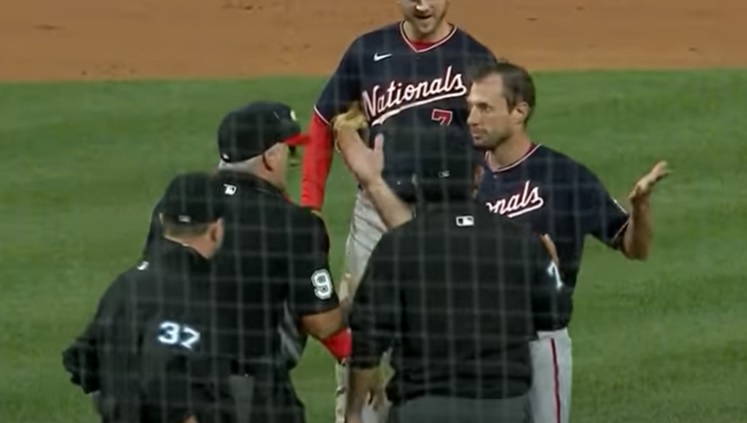
On Tuesday, after Washington’s Max Scherzer had already been checked twice by umpires, per league mandate, Girardi stepped up the attention in the fourth inning after he noticed the pitcher run his hand through his hair while on the mound. The manager’s postgame explanation involved the suspicion that Scherzer was hiding some sort of substance there, based in part on Girardi never having noticed Scherzer self-toussle like that.
In many corners, however, people suggested that Girardi was merely trying to rattle the pitcher, who had been visibly annoyed during his previous searches.
Gamesmanship.
***
Grover Cleveland Alexander’s strikeout of Tony Lazzeri to snuff out a bases-loaded rally in Game 7 of the 1926 World Series is an iconic baseball moment. Less remembered is the detail that when Alexander—39 years old and having pitched a complete-game victory over the Yankees only a day earlier—was called in from the bullpen, he took his time getting to the mound. Like, he really took his time.
By that point in his career, Alexander was unflappable. He also knew that Lazzeri, while coming off of an excellent season, was a 22-year-old rookie who had never before faced such pressure. As Les Bell said in Peter Golenbock’s Spirit of St. Louis, “At that moment, [Lazzeri] was a youngster up against a master.”
Alexander’s extra-languorous stroll to the mound very intentionally gave Lazzeri extra time to think. And as we all learned from Bull Durham, thinking is not a ballplayer’s ally. It was pure gamesmanship, intended to get an opponent off of his mark, and it worked. Lazzeri fanned, rally snuffed and lead maintained, Alexander pitched two more shutout innings to clinch the title for St. Louis.
***
For Scherzer, the reality was that he had just inadvertently thrown a 1-2 pitch toward the head of Nationals hitter Alec Bohm, which Bohm had only narrowly managed to avoid, and was desperate to find some extra tack to help him grip the ball. Rosin is legal on a big league mound, but without a mixing agent Scherzer was stuck. It was a cool night, and the right-hander wasn’t sweating much. In fact, the only place he could find some accumulated moisture was under his cap. So he ran his hand through his hair.
After the right-hander threw two straight strikes to whiff Bohm, Girardi pounced.
Here’s the thing about gamesmanship: It works best when an opponent has a weakness to exploit. For Scherzer, it was twofold. One is that he’s an avowed supporter of tack, and has already been named in an ongoing drama that involves Angeles clubhouse man Bubba Harkins providing sticky substances for players around the league. The other part has to do with a groin injury that cost the pitcher nearly two weeks, during which time MLB announced its no-tolerance policy. Monday’s start was Scherzer’s first since June 11, and he’d had only one bullpen session to prepare for his new, tack-free reality.
Was Girardi pointedly trying to exploit these details? He vehemently denied it, but the Nationals don’t seem to believe him.
***
On May 29, 1974, Minnesota’s Jerry Terrell came to the plate at Fenway Park with runners at the corners and one out in the top of the 13th inning. The score was 4-4. As Red Sox pitcher Diego Segui went into his windup, Terrell bent down to grab some dirt from the batter’s box—a trick he’d learned as an amateur to lure a pitcher into halting his delivery. Such a tactic isn’t legal in the big leagues, with rule 4.06(a)—falling under the Unsportsmanlike Conduct category—specifically prohibiting the calling of time while a ball is in play “for the obvious purpose of trying to make the pitcher commit a balk.”
On that day, umpires didn’t catch it. Segui paused, the balk was called, and what would be the winning run crossed the plate.
Gamesmanship won again.
***
As Scherzer finished the inning, Nationals coaches—clearly unimpressed with Girardi’s strategy, be it gamesmanship or a genuine suspicion that Scherzer was cheating—unloaded on the manager. So too did Scherzer, who stared daggers into the Phillies dugout as he walked off of the field. Upon reaching his bench, he repeatedly showed Girardi his cap and glove, shouting, “They’re clean! They’re clean!” as he mockingly ran his hand through his hair.
When Washington hitting coach Kevin Long—formerly on Girardi’s staff with the Yankees—continued the verbal assault, Girardi stormed the field ready to fight, and ended up ejected. Later, Nationals GM Mike Rizzo called Girardi “a con artist.”
There is an old story from the early part of the 20th century involving a fastball pitcher for the St. Louis Cardinals who was giving the Pirates fits. Pittsburgh shortstop Honus Wagner’s solution was, while batting, to catch one of those fastballs barehanded and insouciantly toss it back to the mound. With two strikes in the count the umpire called Wagner out, but the tactic worked. According to legend, anyway, the pitcher walked the next five hitters.
Girardi’s ploy, whatever its motivations, did not have a similar effect. Scherzer walked the next batter following his mound inspection, but retired five straight after that to earn his sixth win of the year in a 3-2 Nationals victory.
The main question we’re faced with now is whether Girardi’s con (if it actually was a con) will take root. Max Scherzer is too stout a pitcher, both mentally and physically, to be trapped by such shenanigans (if they actually were shenanigans), but other pitchers—especially in a league dominated by 20-something-year-old relievers—are more suspect.
Just as MLB rules prohibit a hitter from calling time in order to discombobulate a pitcher, so too do they prohibit a manager from executing a substance check for similar reasons. The umpire’s in Tuesday’s game, in fact, conferred before checking Scherzer, to confirm the validity of Girardi’s point.
That alone is an endorsement for the purity of the manager’s motivation. Whether he should have done what he did is a different story, however, as is the fact that such a tactic has now been inexorably planted into the heads of every coaching staff in baseball. If Billy Martin can wait until the right moment to have the umpires check George Brett’s bat, you can bet that there’s somebody out there right now anticipating a key spot in an upcoming pennant race to pull this particular card from his back pocket.
We can only sit back and watch the fireworks explode when he does.
 The Baseball Codes