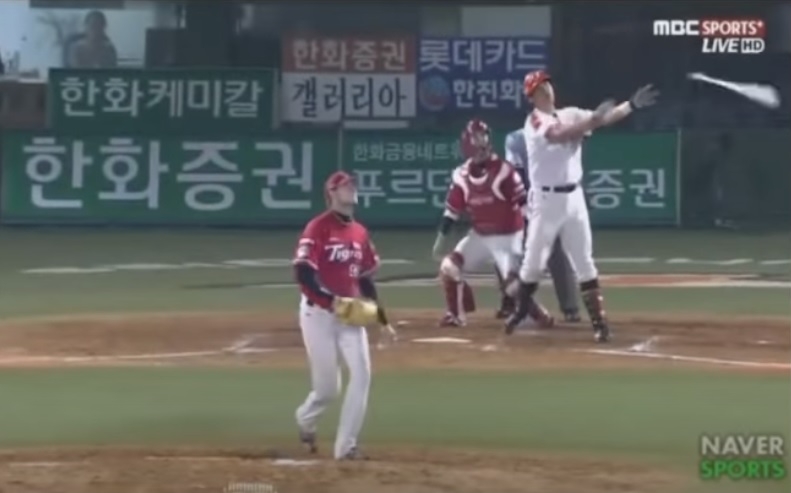
Bat Flipping, Korean Baseball Organization

Baseball Is Back (Sort Of) And Bat Flips Are Upon Us

Now that we have KBO baseball and only KBO baseball, the conversation has naturally come around to bat flipping. Koreans are wild for the practice.

This isn’t exactly news. We’ve turned to the Korean Baseball Organization for bat-flip grandeur for years now. Even as Major League Baseball has taken a more lenient—some might even say encouraging—attitude toward the practice, Americans are still light years behind the KBO curve.

In Korea, they’re called ppa-dun, a word combining the first syllables of the words “bat” and “throw.” We know about them to such a degree thanks to Dan Kurtz, whose name has come up frequently in recent days as the American voice of experience on the subject. Korean by birth and adopted to America when he was four months old, Kurtz went to school in Seoul, and started the website MyKBO.net back in 2003. He helped bring Korean bat flipping to the domestic fore in 2013 when he introduced us to a video of Jeon Jun-woo celebrating a blast that was ultimately caught on the warning track. “It was,” reported The New York Times, “Korean bat flipping’s first viral moment. It didn’t take long before there were more.

Kurtz has been repeatedly asked to address the bat-flipping phenomenon over recent days. Here’s what he told the Atlanta Journal-Constitution:

“Flipping your bat on a home run (or even a long fly ball) won’t get you beaned the next time up. But the benches will empty if you are a younger pitcher who unintentionally hits a veteran batter with a pitch and don’t immediately take off your hat and bow to show remorse.”

Guys flip ‘em for homers. They flip ‘em for flyball outs. They flip ‘em for singles and sometimes even grounders to short. Pitcher Josh Lindblom, who spent five seasons in the big leagues and now plays in Korea, described his introduction to the practice for ESPN.com. “I saw somebody do it and I was like: ‘What was that?’ Somebody told us it might happen. ‘Don’t freak out. Don’t get mad. It’s just what they do.’ ”

Lindblom also said: “I don’t even notice it anymore. It happens so much, I’m like, whatever.”

That same story explained some of the unwritten rules in Korea:

Most of [them] reflect the values of Korean society. … Takeout slides, recently banned in MLB, never existed here. Bench-clearing brawls are rare. Jee-ho Yoo, a sports writer with Yonhap News, says there are only a few dozen competitive high school baseball teams in Seoul, so “pretty much everyone knows everyone” in the KBO. “They don’t want to hurt each other,” he says. Yoo remembers an incident a few years ago when a foreign player on the Lotte Giants tore down the third-base line and slammed into the catcher. Fans were appalled.

Some of the country’s other unwritten rules have been covered in this very space right here.

It’s a different brand of baseball, but anybody watching games into the wee hours in the U.S. can attest that it can be wildly entertaining. Until Major League Baseball returns, this is the product we get to enjoy, bat flips and all.
RIP

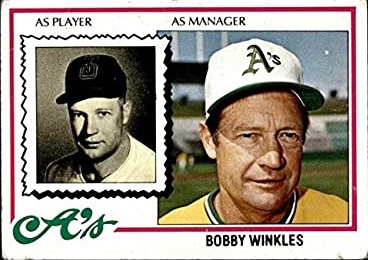
RIP Bobby Winkles

Longtime Arizona State manager Bobby Winkles—who coached on Alvin Dark’s A’s staff in 1974 and 1975, and managed the team for Charlie Finley in 1977 and 1978, passed away last week at age 90.

Winkles’ impact on the A’s stretched far beyond his stints as coach or even as manager. It was at his collegiate position, in which he won three national championships over 13 seasons in Tempe, where he made the most impact. That’s because it was at ASU that Winkles shepherded Rick Monday, Sal Bando and Reggie Jackson toward the big leagues. (Monday and Bando were on the 1965 championship team.) In fact, Winkles planned to convert Bando to catcher for his senior season, but the player ended up signing with Finley’s Kansas City Athletics instead.

Winkles went 24-15 in 1978 with an A’s club that had lost 98 games the previous season and made no marked improvements while trading Vida Blue. Unable to stomach the requisite interference from Finley, however, he quit that May and never managed in the big leagues again. “Winkles was going nuts, and one day during the season he quit,” wrote his predecessor and successor as A’s manager, Jack McKeon, in his book Jack of All Trades, “We all tried to talk him out of it, but he wouldn’t budge.” (After Winkles departed, the A’s went 45-78.)

One player who especially appreciated Winkles was Oakland second baseman Dick Green, whose defense during the 1974 World Series was so spectacular that many said he would have won Series MVP had he gotten even a single hit. (He went 0-for-13.) Green attributes much of that success to Winkles.

“About middle of September, Bobby says to me, ‘Dick, the World Series is coming up and you’re going to have to start taking some infield practice,’ ” Green said in an interview for Dynastic, Bombastic, Fantastic. “I say, ‘I haven’t taken infield practice for months.’ He says, ‘I know you can catch the ball, but most people can’t turn it on and off and on again.’ So I started taking infield practice the last couple of weeks. Well, of course, I didn’t make any errors in that World Series, and that extra infield helped me.”

Leave the last word on Winkles to Reggie Jackson, who described him in his book, Reggie:

Bobby Winkles was an Army type guy, a tough little southerner from Arkansas with a crew cut who’d spit tobacco on your shoe if you didn’t watch yourself. He was very regimented. He was the boss, and he let you know that from the get-go. There was no swearing when Winkles was around. You didn’t give him any lip. Ever. And he worked us. If you played for Bobby Winkles, you had to run everywhere, run like an animal. Before we ever took the bat and ball at practice, we would run for 45 minutes every day. His favorite was something called the Floor Drill. Run. Stop. Put your arms straight up over your head and jump straight up into the air. Sprint now. Stop. Jump.”

And, of course he won. Three titles with ASU. One as an A’s coach. Unexpected success with a stripped-down roster several seasons later.

Bobby Winkles may have been wildly underappreciated by outsiders, but those who knew him—and especially those who played for him—are deeply feeling this loss.

RIP

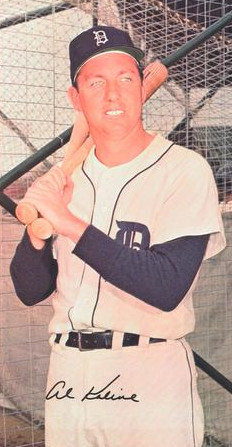
RIP Al Kaline

I didn’t like pitching to (Al) Kaline. Nothing against Al. He was a hell of a guy. I just hated the way umpires gave him the benefit of the doubt on almost every close pitch late in his career. I once threw him five straight strikes and walked him. He took a three-and-two slider that started on the outside corner and finished down the middle of the plate. The ump gave it to him. As Kaline made his way to first, I yelled at him, ‘Swing the bat, for Christ’s sake. You’re not a statue until you have pigeon shit on your shoulders.’ Al laughed at me. After the game I complained about the call to the home-plate umpire. He said, ‘Son, Mr. Kaline will let you know it’s a strike by doubling off the wall.’
—Bill Lee, The Wrong Stuff

Hall of Famer Al Kaline, the man who came to define the Detroit Tigers in the 1950s and ’60s, passed away today at age 85. He was noteworthy for being esteemed within the game as much for his personality as for his ability, which is saying something given that he was one of the best players ever.

For me, the power of Kaline’s mystique was distilled in a story told to me by former pitcher Dick Bosman for The Baseball Codes. It took place in 1974, Kaline’s last year, when Bosman pitched for Cleveland. During the game in question, the pitcher’s Indians teammate, Oscar Gamble, got into a little bit of trouble.

“Oscar hit three home runs in Tiger Stadium,” Bosman said. “He hit them upstairs pretty good, and stood and watched them a little bit. I had a 7-0 shutout going in the eighth inning. Ralph Houk’s managing over there, and he brings in Freddy Scherman, who puts his first pitch right into Oscar’s ribcage. Oscar, he’s a little guy, and it hurt him, boy.”

Bosman, of course — as was the way in baseball those days, felt the need to retaliate.

“The inning gets over with, and I get back out there on the mound,” he said. “And guess who the first hitter is? Al Kaline. The thing was, Al was about three hits from 3,000 at the time. So I’m thinking, where am I going to drill him? I don’t want to break his hand or anything like that. If I hit him in the ribs, that might put him out. The guy was a legend. So I figured I’d hit him in the ass. That’s the way it was supposed to be done.”*

Bosman was duty-bound, but determined to execute his task as gently as possible owing to Kaline’s standing. He ended up merely brushing Kaline back.

Baseball has lost a legend.

* As with many baseball stories from the distant past, the details for this one are somewhat different than memory might suggest. Gamble hit only one homer that day, Sept. 9, 1974, the opener of a two-game series. When the teams had met for a three-game set less than a week earlier, however, Gamble homered twice in one game and once in another, so Detroit’s patience may have been tried. Also, it wasn’t Scherman who drilled Gamble, but Vern Ruhle, in his fourth inning of work. Scherman, who had spent the previous five seasons in Detroit, had been traded to Houston the previous winter. At the point Bosman brushed him back, Kaline was 15 hits from 3,000. He would finish the year, and his career, with 3,007.

Criticizing temamates, Pandemic Baseball

When You Have A Hall Of Famer In Left Field, You Want To See Him Out There

In lieu of actual baseball, I’ll be posting snippets that were cut from The Baseball Codes as a way of amusing myself and, hopefully, you. Today’s theme: Criticizing teammates.

Perhaps the most noteworthy example of a pitcher blaming one of his teammates for a defeat he suffered came when A’s Hall of Famer Lefty Grove was kept from winning his 17th consecutive game in 1931. Grove took the loss when left fielder Jimmy Moore, a second-year player, charged in for a ball that ended up sailing over his head, and allowed the winning run to score for the Browns with two outs in the seventh inning of a game that would end 1-0.

When Grove stormed into the post-game clubhouse he was ready to rip someone’s head off—but his target wasn’t Moore. Instead, Grove was steamed at Al Simmons, Philadelphia’s regular left fielder, who missed the game to go to Milwaukee for medical treatment on his infected left ankle. Simmons, a future Hall of Famer, would likely have easily made the catch.

“I didn’t say anything to Jim Moore, ’cause he was just a young guy just come to the team and he never played in St. Louis before,” said Grove in Baseball When the Grass Was Real. “It was Simmons’ fault. He’s the one I blame for it.”

“The sparks were flying off Grove . . .” said A’s outfielder Doc Cramer. “He was about three lockers down from me. I saw him stand up and take hold of the top of his shirt with both hands—we had buttons on our shirts in those days—stand like that for a second, and then rrrip! He tore that shirt apart so fast and so hard that I saw the buttons go flying past me, three lockers away. Then everything went flying—bats, balls, gloves, shoes, benches. He broke up a couple of chairs. He kicked in a couple of lockers. Nobody said a word.”

Criticizing teammates, Pandemic Baseball

‘If Someone Made An Error, Gaylord Would Stare Him Down’

In lieu of actual baseball, I’ll be posting snippets that were cut from The Baseball Codes as a way of amusing myself and, hopefully, you. Today’s theme: Criticizing teammates.

One guy who made no effort to hide displeasure with teammates—and got away with it because he was so good—was pitcher Gaylord Perry, who, for eight teams over 22 seasons, got demonstrably upset when his fielders made mistakes behind him.

“If someone made an error, Gaylord would stare him down,” said pitcher Dick Bosman, who played with Perry in Cleveland. “It was just his persona. I’m not sure that [his teammates] cared for it very much, frankly.”

“They did not like it,” said Larry Andersen, who played with Perry in Seattle. “I know there were guys who were not happy. It was tough to play behind him.”

When Perry’s Indians were playing in Milwaukee once, a batter hit a drive to deep right field. “Gaylord wanted you to play shallow because he had a lot of balls being dumped in front of you,” said Oscar Gamble, the Indians’ right fielder that day. “I ran about a mile—it seemed like I ran forever. I almost got to the ball, but if I’d caught it I’d have gone straight into this brick wall. I ended up pulling up because I couldn’t catch it.”

On the mound, Perry threw up his hands in frustration, an almost unheard of response for any other pitcher. For Gamble, the moment helped crystallize who Gaylord Perry was. “He just loved to win so much,” he said. “He was one of those guys who, if you slacked on a ball, he would let you know it. He was hard-nosed. He wanted every ball caught when he was pitching, and I had so much respect for that. If you don’t do right, if you miss a ball you should have caught, you expect the fans to boo you. And this fan—Gaylord—was a player. That’s the way I looked at it.”

Criticizing teammates, Pandemic Baseball

‘Sure As Hell, Mr. Umpire, We’re Going To Lose This Game’

In lieu of actual baseball, I’ll be posting snippets that were cut from The Baseball Codes as a way of amusing myself and, hopefully, you. Today’s theme: Criticizing teammates.

Goose Gossage had a rough initiation with the New York Yankees in 1978, losing three games and blowing two saves in his first seven appearances after signing a rich free-agent contract to take over the closer’s duties from defending Cy Young Award-winner Sparky Lyle.

Things got so bad that as Gossage was being ferried to the mound in the Yankee Stadium bullpen cart before one of his appearances, center fielder Mickey Rivers threw himself across the hood of the vehicle, impeding its progress. Gossage screamed at the outfielder to get off the hood, to no avail. “No, don’t bring him in again, don’t bring him in!” wailed Rivers, as recounted in Bob Cairns’ Pen Men. When an umpire ordered him off the vehicle, all Rivers could say was, “We’re gonna lose. Sure as hell, Mr. Umpire, we’re going to lose this game.”

Ever the competitor, Gossage wasn’t about to take it passively. “Get your ass off of this car and get ready to chase down line drives!” he yelled, with a surprising amount of self-deprecation as possible for somebody being shown up in front of a stadium full of people.

True to form, a line drive was hit into the right-center-field gap, with the batter kept from extra bases only by a spectacular, diving catch by Rivers. When the team returned to the dugout after the inning, recalled Gossage in his book, The Goose is Loose, Rivers stopped at the top step and, loud enough for the entire bench to hear, announced, “Hey, where’s the Goose? You know, he told me to be ready to run one down. That motherfucker wasn’t kidding, was he?”
Even Gossage saw the humor, and used the moment to help turn his season around, finishing the year with 10 wins, 27 saves and a 2.01 ERA.

Don't Peek, Pandemic Baseball

Don’t Ever Peek. And Don’t Ever Look Like You’re Peeking

In lieu of actual baseball, I’ll be posting snippets that were cut from The Baseball Codes as a way of amusing myself and, hopefully, you. Today’s theme: Peeking (batters subtly glancing backward in an effort to pick up the catcher’s signs or location).

For Omar Vizquel it was turning toward the umpire to call time because the scoreboard was playing video that he found distracting. For Von Joshua it was that he swiveled his head to scratch his chin with his back shoulder. Neither player peeked, or had intentions of peeking, but both were perceived to have done so. And each is convinced that what happened next—for Vizquel it was a first-pitch fastball from Roger Clemens into his ribs; for Joshua it was a Jim Bibby heater aimed at his head—was a direct result.

Don't Peek, Pandemic Baseball

Say Hey, What Was That Pitch?

In lieu of actual baseball, I’ll be posting snippets that were cut from The Baseball Codes as a way of amusing myself and, hopefully, you. Today’s theme: Peeking (batters subtly glancing backward in an effort to pick up the catcher’s signs or location).

Some notable names have been named as possible peekers. In 2003, an anonymous coach told the Seattle Times that Ken Griffey Jr. had a curious habit of calling time once the pitcher came set, at which point he’d look down to see the catcher’s location. Bob Gibson said that Hank Aaron used to do it, and that Willie Mays was “one of the great peekers of all time.”

“Mays was peeking at [Cardinals catcher Tim] McCarver and saw something he didn’t understand,” wrote Gibson in Stranger to the Game. “So he stopped his warm-up swings, stepped out of the box, and said to McCarver, ‘Now, what was that pitch? What in the hell are you doing back there?’ I couldn’t believe the guy.”

Don't Peek, Pandemic Baseball

Crime Dog Did Some Digging Of His Own

In lieu of actual baseball, I’ll be posting snippets that were cut from The Baseball Codes as a way of amusing myself and, hopefully, you. Today’s theme: Peeking (batters subtly glancing backward in an effort to pick up the catcher’s signs or location).

In 2001, Members of the Red Sox claimed that videotape proved Tampa Bay first baseman Fred McGriff peeked backward prior to hitting a home run … in a game that didn’t even involve Boston.

McGriff’s homer came off a pitch from Toronto closer Billy Koch, and the Red Sox-based allegations ended up in Peter Gammons’ notebook on ESPN.com. One member of the Blue Jays said in the Toronto Globe and Mail that the complaint came from pitching coach Joe Kerrigan, “who is paranoid as hell. He’s the same guy who thought we had a camera over the outfield fence (at the SkyDome) to steal signs.”

Toronto catcher Darrin Fletcher offered a more reasoned take on the matter, saying that it can be difficult to discern peeking from innocent head movements. “A lot of guys, if you watch them, they’re usually just glancing back at the position of their hands and bat,” he said. “You might think they’re peeking, but they’re not.”

Don't Peek, Pandemic Baseball

‘If It’s Really That Blatant, You Have To Say Something’

In lieu of actual baseball, I’ll be posting snippets that were cut from The Baseball Codes as a way of amusing myself and, hopefully, you. Today’s theme: Peeking (batters subtly glancing backward in an effort to pick up the catcher’s signs or location).

Television cameras have caught the likes of Eddie Murray, Cal Ripken Jr. and Alex Rodriguez, among others, casting backward glances during at-bats. After Game 1 of the 2000 NLCS, Jerry Grote, who had been a catcher for the Mets more than two decades earlier, informed team personnel that, while watching the game on television at home in San Antonio, he came to the conclusion that Cardinals first baseman Will Clark had been peeking at catcher Mike Piazza. (Clark went 1-for-3 in a 6-2 defeat.) Clark had already once been accused by the Mets of peeking, as a member of the Giants in 1993.

Whatever Grote saw, however, managed to escape Piazza. “I think I would notice,” said the Mets backstop in a Newsday report. “Some guys try to mix it into their routine. You just have to try to disguise it. And if it’s really that blatant, you have to say something.”

Perhaps in response, the Cardinals leveled accusations of their own, asserting that Mets third baseman Todd Zeile was tipped to pitch location by whistling from the New York bench.