Don't Play Aggressively with a Big Lead

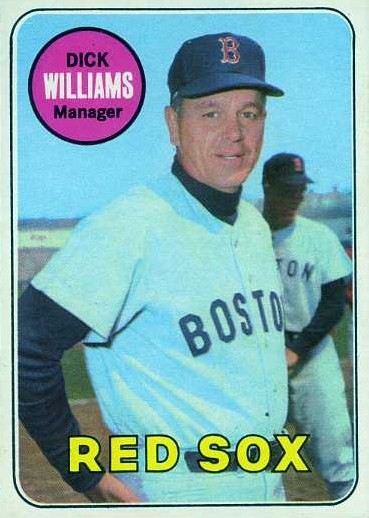
Dick Williams, RIP

Dick Williams, who passed away yesterday at age 82. In addition to being a Hall of Fame manager, he was also a stickler for the Code, and never afraid to retaliate when he felt it appropriate. He was at the helm of the San Diego Padres for their one-game war with the Braves in 1984, which Kurt Bevaqua called “the Desert Storm of baseball fights.”

That episode is detailed in The Baseball Codes. The following passage, however, was cut from the final edition. It details Williams’ understanding of the unwritten rules, even if his use of it was not always by the book. In honor of Williams, we present it here.

Dick Williams took over the Red Sox in 1967 as a 38-year-old rookie skipper, and guided a club that was coming off of back-to-back ninth-place finishes to the World Series. Still, amid acrimony and injuries to two key starting pitchers, Williams was fired before he could complete his third season—something about which he harbored resentment for years. Once Williams assumed managerial duties for other teams, he didn’t just want to beat the Red Sox, he wanted to destroy them.

Williams bunted whenever he could to advance runners into scoring position, even when games were well in hand. His baserunners tagged up from second on fly balls, even when leads relegated such tactics as unnecessary. And he squeezed.

If stealing second base with a big lead is enough to make an opponent’s head spin, squeezing is enough to blow it clean off his neck. There is no surer statement of we’re-going-to-pull-out-every-last-calculated-measure-in-our-playbook-to-push-another-run-across.

Williams took over the Angels in 1974, and during a game against Boston the following season his club used a hit, a walk and an error to extend its lead to 6-2 in the eighth inning. The manager knew just what to do. With runners on second and third and second baseman Jerry Remy at the plate, Williams called for a squeeze that extended the Angels’ lead.

“You do what the manager says,” said Remy, “but I knew it was the wrong thing to do.”

The next day, Boston pitcher Roger Moret threw at Remy with his first pitch of every at-bat, a subtle message that the squeeze was not appreciated. Fortunately for Remy, he missed all four times. “After the game, (Williams) said to me, ‘I guess I got you thrown at,’ ” said Remy. “I said, ‘I guess you did.’ ”
Bunting for hits, Don't Play Aggressively with a Big Lead

Bunt on the Giants? Not These Days

Props to Henry Schulman of the San Francisco Chronicle, who invoked the Code to describe the offensive woes of the Giants, losers of eight of their last 11—a span during which they’ve scored two or fewer runs eight times. Also, they’ve been shut out in three of their last six games by some very ordinary pitchers.

From the Chronicle:

The Giants need to send Nationals rookie Danny Espinosa a message pitch next time they meet. He tried to bunt for a hit late in Monday night’s game, and baseball etiquette says you don’t do that when your team has an insurmountable lead.

It was the eighth inning and the score was 2-0.

Classic.

– Jason

Don't Play Aggressively with a Big Lead, Swinging 3-0

The Differences Between Spring Training and the Regular Season Sometimes aren’t so Different After All

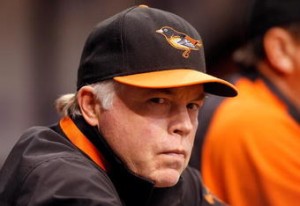
Buck Showalter: Not a fan of the 3-0 swing.

As March draws to a close, it’s a good time to ponder the meaning of spring training games.

They exist to help players prepare for the season, that much is obvious. But what of their actual function? Because they don’t count, they’re handled differently than other contests.

Managers regularly empty their benches with steady streams of substitutions. Pitchers don’t fret about poor outings—at least early on—under the hypothesis that they’re working out winter kinks; if they feel like throwing 10 curveballs in a row then by gorum that’s what they’ll do, regardless of what hitters are doing to those curveballs.

But still, they are games. And games are played with certain elemental consistencies.

The last two weeks have seen separate incidents that bring to the fore the question “What’s appropriate in spring training and what’s not?” Both, coincidentally, involved catchers for the Orioles.

On March 15, Pittsburgh’s Andrew McCutchen tried to score from first on a hit by Baltimore’s Matt Diaz, but was tagged out when Matt Wieters blocked the plate, forcing McCuthen into his shin guards.

“I don’t know what (Wieters) was thinking,” McCutchen said afterward in the Pittsburgh Tribune-Review. “It’s spring training. We’re not trying to get hurt. I wasn’t expecting that much contact. I’m OK, though.”

It harkens back to Pete Rose bowling over Ray Fosse in the 1970 All-Star Game. How much is too much when it comes to hard-nosed baseball during the course of an exhibition?

In this case, however, it was McCutchen himself initiating the contact; Weiters did nothing more than react precisely as a catcher should—protecting both himself and the baseball.

As Yahoo’s Kevin Kaduk observed, “Why did McCutchen slide if he was uninterested in making contact? There’s two bangs in a bang-bang play and McCutchen could have easily withheld one by simply peeling off if he felt the run wasn’t that important in the whole scheme of things.”

On Monday, another Baltimore catcher, Jake Fox—who leads the Grapefruit League with 10 home runs—showed that he’s not much afraid to take his hacks, regardless of the circumstances. With runners on second and third and nobody out in the eighth inning—and his team holding a 13-3 lead against the Tigers—Fox swung 3-0.

One of the clearest-cut sections of baseball’s unwritten rulebook mandates that when one’s team holds a big lead late in a game, one does not, as a hitter, swing at a 3-0 pitch. We’ve gone over it in this space before, but the prevailing notion holds that any pitcher in the wrong end of a blowout game is not on the most solid of footing to begin with. With that in mind, and because the last thing a manger wants to see with his team down by double digits (or something close to it) is a bubble reliever trying to get fine, the next pitch is almost certain to be a fastball down the heart of the plate.

Because of this, hitters are expected to back off and give the pitcher sufficient leeway with which to regain his footing.

Were this the regular season, Fox’s actions would have drawn unequivocal ire, but did the fact that they came in a spring training game affect things? Jake Fox is a journeyman, has played for three teams since 2007, and last year was the first in which he logged no time in the minors. While his prodigious display of power this March has all but locked up a roster spot, one can never be too careful, right? The more numbers he puts up, the better his chances of earning a real payday.

Then again, he was facing a minor leaguer in Chance Ruffin. And regardless of circumstance, proper etiquette is proper etiquette. Ruffin was wearing a big league uniform and facing a big league hitter, and deserves an according level of respect. As does the game itself.

Two people who agree were Jim Leyland and Buck Showalter. Once Fox walked, Leyland raced to the top step of the dugout and berated him for his transgression.

Showalter took things a step farther, yanking off his hat and enumerating at high volume to those in the dugout the ways in which Fox had soiled the reputation of the game. He then sent in a pinch-runner, and made sure to meet Fox in the dugout, where he then unloaded on him. Wrote Jeff Zrebiec of the Baltimore Sun, “It apparently wasn’t the first time this spring where Fox ignored a clear take situation.”

If Leyland feels that there’s a lesson to be taught here, it shouldn’t take long—Baltimore and Detroit meet in the teams’ second series of the season, starting April 4.

– Jason