World Baseball Classic

Bernie Williams on the WBC: ‘Clash of Cultures’

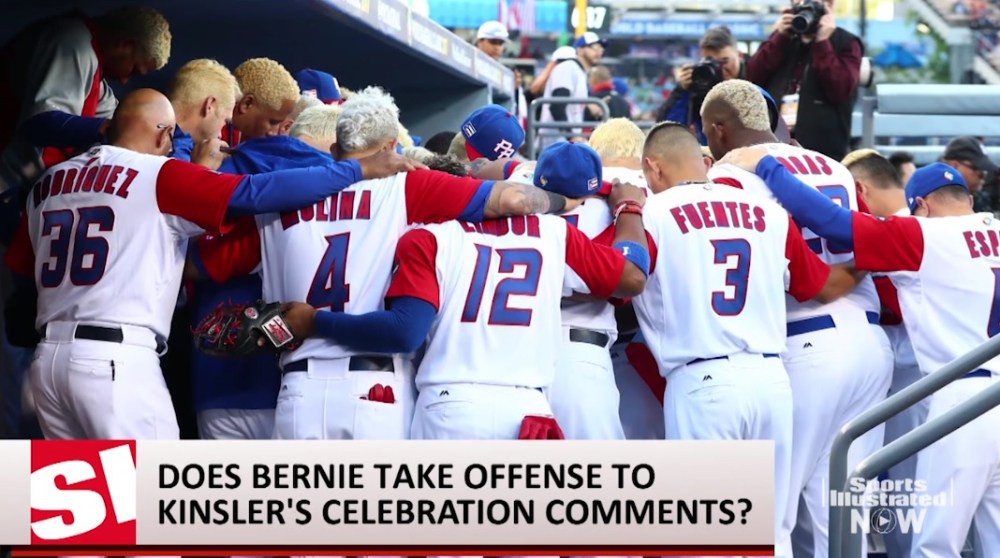
SI WBCWith all the recent talk about the differences between the United States and elsewhere in the world when it comes to baseball behavior, it’s worth pointing out Bernie Williams’ recent conversation with SI’s Maggie Gray.

Williams is Puerto Rican, and fully in tune with the celebratory nature of his countrymen. He’s also a lifelong Yankee, well versed in the ways of putting one’s head down and keeping one’s hair short. When asked about Ian Kinsler’s comments about Latin countries and playing the game “the right way,” Williams pointed out the obvious—that the World Baseball Classic is not Major League Baseball, and that there’s space for both mindsets. [Emphasis mine.]

Latin people, especially Puerto Ricans and Dominicans, have always been very passionate. And baseball has always been characterized, at least in the United States, as ‘You don’t showboat. You don’t show up the opposition. You hit a home run and you shut up and you run the bases hard and you keep playing the game.’ Obviously, that’s not the way they play the games in these Latin countries. Everybody gets involved. Everybody’s brash and passionate and intense about it. They were showing part of what their culture is to them.

This is what the WBC is all about. To have the different cultures come into a tournament and express themselves the way their culture allows them to do. That’s what makes this game great and that, to me, was the purpose of this tournament—to have this clash of cultures and different attitudes about the game, to go in and see who is the best.

Latin players have been slowly integrating such a mindset into the big leagues for years now. If enough players actively agree with Kinsler about open celebration, such integration will be more slowly adopted. From the looks of things, however, such is not the case.

Those in the “right way” camp are still correct in their opinions—they just need to realize that the term is, like the sport itself, evolving.

Showboating, World Baseball Classic

There’s A Party Goin’ On Right Here/Just Watch Out For a Fastball In Your Ear

celebrationFollowing up yesterday’s post about the joy embraced by players from various countries in the World Baseball Classic (and how such embrace is frequently at odds with their big league counterparts), today I bring you a quote from Eric Thames.

Thames, of course, is the new Brewers first baseman, having spent the last three seasons playing in South Korea. (South Korea, you might recall, is known for some outlandish behavior by its ballplayers.)

While in Asia, Thames stepped up his pimp game. From Sports Illustrated’s baseball preview issue:

Thames wore metallic gold arm and leg guards and celebrated home runs with a choreographed two-man skit that ended with a teammate tugging his beard and the two of them spinning on their heels to give a military-style salute to the home fans.

“Uh, not here,” says Thames, who this spring wore white body armor. “You want me to get hit in the ribs?”

Yesterday, I pointed out that the joyful celebration shown internationally is having an effect upon the staid response to success in the majors. So why is Thames toning it down?

Because there is a difference. Because somebody responding to success openly and without filters is celebratory, but somebody pantomiming pre-planned shtick is more boastful than joyous. (Recall, if you will, another bit of home-plate soft-shoe perpetrated by these selfsame Brewers a number of years back.)

The line between those approaches dissects even bat flips. The ones from Korea seem to be self-indulgent ways of garnering attention. The South Korean players who make their way to the U.S. acknowledge as much. The flip by Jose Bautista following his ALDS-clinching homer against Texas in 2015, however, was none of that. They are distinct entities.

Baseball diamonds contain plenty of space for joy. There is far less leeway, however, for acts masquerading as joy. As Eric Thames noted, ballplayers can tell the difference.

Evolution of the Unwritten Rules

The Unwritten Rules at the World Baseball Classic: A Lesson in Two Parts

In many ways, the World Baseball Classic gave us baseball as it ought to be (and maybe once was)—a sport in which pride outstripped other motivating factors by a fairly wide margin, where the simple act of participation was its own reward. Strip away salaries, endorsements, public relations and other outside influences on modern players, and that’s what remains.

How that pride manifests, of course, differs from culture to culture, and it offered two prime lessons in the unwritten rules of the modern game.

Lesson 1: “The Right Way”

Ian Kinsler, who now plays for the Detroit Tigers but a week ago played for the United States in the WBC, made a proclamation in the New York Times that garnered some attention despite coming 19 paragraphs into a 20-paragraph story:

“I hope kids watching the WBC can watch the way we play the game and appreciate the way we play the game as opposed to the way Puerto Rico plays or the Dominican plays. That’s not taking anything away from them. That just wasn’t the way we were raised. They were raised differently and to show emotion and passion when you play. We do show emotion; we do show passion. But we just do it in a different way.”

Those on one side of the discussion openly yearned for the return to a time in which players put their heads down in response to moments of athletic triumph so as to avoid showing up those they’d bested. Those on the other propped up Kinsler as the face of an outdated code of conduct, a no-fun zone where excitement is stifled in the name of propriety.

As is frequently the case in these types of debates, they’re both right. At least to a degree.

So is Kinsler. He and many of his US-born colleagues were raised differently than players from Latin America. They were taught that solemnity on a ballfield equals respect, and that respect is paramount. The catch is that many of the Latin-born players to whom he referred agree entirely with the latter part of that equation. Respect is everything—it’s the unwritten rule upon which everyone eventually settles. The difference is that guys from the Caribbean and Central America cast a narrower net when it comes to interpretation of potentially impertinent acts. Which doesn’t make their celebrations disrespectful. After all, like Kinsler said, they were raised differently.

So when players in the Puerto Rico dugout hop around like little kids after one of their countrymen performs a feat of baseball heroism, it’s hardly a stretch to think that it has nothing to do with their opponents and everything to do with each other. This is how the game is played in their home country. While the big leaguers among them might tone it down a notch for their primary employers during the regular season, it’s difficult to fault the players for ramping it right back up when surrounded by their own. “We do a great job playing and having fun out there, said Javier Baez, he of The Tag. “That’s what it’s all about. This is a game. It’s not as serious as a lot of people take it, but, you know, everybody’s got their style and their talent. I have a lot of fun.”

The major leagues have adapted to the increasing influx of foreign players, largely though adoption of their habits. South Korea-quality bat flips might still elicit some anger, but the garden-variety toss has long since become status quo—brought to the fore by Cuba native Yasiel Puig. Puig’s habits have gained traction because they’re fun—and because the only ones taking it personally are those too curmudgeonly to see things any other way. Hell, four of my last five posts have been on that topic alone.

Playing the game “the right way” has long been a rallying cry for baseball traditionalists. But as players across the WBC continued to show us, their game is, more and more, what “the right way” is beginning to look like.

Lesson 2: Don’t Read Too Much Into Backstory Unless You’re Confident That You Know What You’re Talking About

After beating Puerto Rico in the WBC final, multiple U.S. players spoke out about being motivated by a perceived slight from their opposition. Said Andrew McCutchen in an ESPN report: “We heard and we saw T-shirts were made and printed out for the Puerto Rican team. We even heard a flight was made for them for that parade because they said they were going to win. That ignited us, we were ready to go.”

Added Adam Jones: “That didn’t sit well with us, so we did what we had to do.”

There is a long history of this type of bulletin-board motivation. One example, from The Baseball Codes:

In the victorious vis­itors’ clubhouse after the Indians won the 2007 American League Divi­sion Series at Yankee Stadium, Cleveland’s Ryan Garko told the press that celebratory champagne tasted just as good on the road as it did at home. A week later, however, when the Indians raced out to a three-games-to-one lead over the Red Sox in the ALCS, Boston players mistakenly—or perhaps intentionally—advanced the notion that Garko’s statement was not in reference to the Indians’ previous series, but to clinching the pennant at Fenway Park. With the quote posted on the inside of Boston’s clubhouse door as inspiration before Game 6, the Red Sox went on to win en route to the world championship.

Just as Garko intended no disrespect—indeed, his comment had to be skewed significantly to locate anything improper therein—the Puerto Rico team planned their parade independent of victory in the final game. They wanted to celebrate, win or lose, a detail that they did not attempt to hide. Drawing conclusions from the story’s bare bones was a fine way to motivate the American clubhouse—frequently, one needs little more than the ability to twist details to serve one’s own purposes—but the reality was that Puerto Rico’s parade was cast in the same vein as Puerto Rico’s approach to baseball itself. It had nothing to do with superiority or braggadocio or, heaven forbid, disrespect—and everything to do with embracing the fact that the country’s best ballplayers had gotten together and had themselves a time.

And what in the world is wrong with that?
Dynastic, Bombastic, Fantastic, Retaliation

When Getting Knocked Down Works Out In Your Favor

Fosse cardGoing through old A’s interviews while prepping for an upcoming presentation about my new book, Dynastic, Bombastic, Fantastic, I found this unwritten-rules nugget from catcher Ray Fosse, who told me about an incident on July 31, 1971, before he joined the A’s:
I’m with the Indians, playing Oakland in Cleveland. [Bert] Campaneris is at first, another runner [Dick Green] is at third, and a squeeze bunt is put on—a busted squeeze. Graig Nettles is playing third for us. I caught the ball and started running down the line to force the rundown. Out of the corner of my eye I see Campy rounding second, so I threw the ball to Nettles, then went to third and called, “Graig, Graig!” So he tagged [Green] and threw it back to me.

I crushed Campy with the tag. Crushed him. It was unintentional, but my momentum took me as he came to the bag and I went down and just fell on him. He was safe. I didn’t think anything about it, but [A’s pitcher] Chuck Dobson comes to bat the next inning and tells me, “You gotta go down.” I said, “What?” He said, “Yep, I got instructions. I got to throw at you.” Here’s the pitcher who’s actually going to be doing it, at the plate saying, “You got to go down.”

I said, “Are you kidding me? Because of what I did at third base with Campy?” He said, “Mm-hm.” So I come up to hit, Dobber threw a ball over my head and knocked me to the ground. I got up pissed off, and hit a double. When I got to second base, I looked at A’s dugout and said, “Stick that up your …” I was so pissed, I said it right to [A’s manager] Dick Williams. The last thing I ever thought was that I would be traded to Oakland.

So after I was traded, we’re sitting in Cleveland, getting ready to catch a commercial flight—to Cleveland, of all places. We’re at the airport, and Dick’s in the restaurant, by himself, and I walk up to him and say, “Skip, this has been on my mind. Do you remember the play?”

He said, “I remember it.” I said, “The last place I thought I would ever be traded was here.” He says, “I remember that play, and that’s why we want guys like you.” Because I was willing to do that to one of his players, unintentionally as it was, and then  responded by looking into the dugout after they decked me. He said, “I like that.”

After four seasons in Cleveland, of course, Fosse experienced his first-ever  winning record with the A’s, followed in short order by back-to-back championships. If you’re not already following it, check out @DynasticBook for a day-by-day account of Oakland’s 1972, 1973 and 1974 championship seasons.

Bat Flipping, Retaliation

This Kid Better Hope he Never Faces Jake Arrieta

There’s this kid in Texas who’s pretty good at hitting baseballs. He does things like this …

… and this …

We already know Arrieta’s thoughts on the topic. Young players who flip their bats, he said, “might wear the next one in the ribs.”

While it’s unlikely that Arrieta was referencing amateur teenagers, DJ might want to keep his head on a swivel while walking to the team bus. Wrigley Field is only 1,100 miles away.


Bat Flipping, Retaliation, Veteran Status

Arrieta Already in Midseason Form, Calls Out Bat-Flippers Across the Land

That’s Jake Arrieta Tuesday, on Chicago’s ESPN 1000.

We’ve heard so much recently about bat flipping and showboating and personal expression—just two days ago Yasiel Puig modeled his latest flip for a spring training crowd …

Puig flip

… that it’s nice to hear something from the other side.

Forget for a moment that intentionally planting a fastball into a young player’s ribs is no longer a viable means of response, or that Arrieta himself has bristled at such treatment. The pitcher’s point is as much about veteran status as anything.

Which is valid. For as long as baseball’s had unwritten rules, one of them has been You earn what you get. Players who have walked the walk get more leeway than fresh-faced rookies, and justifiably so. Back in 1972, Mudcat Grant summed up the sport’s salary structure by saying, “Baseball underpays you when you’re young, and overpays you when you’re old.” The same holds true for respect. In the eyes of many veterans, those who haven’t earned their big league stripes have no business acting as if they run the place.

For a guy like Arrieta, this includes showboating at the plate.

While I disagree with the sentiment of visiting physical peril on the opposition, I love that somebody is willing to recognize a merit-based hierarchy within the sport’s structure. No participation trophies here. You earn what you get.

If Arrieta and like-minded pitchers come off as stodgy in the process of voicing their opinions, so be it. All players shouldn’t be treated the same, just as people in any workplace environment in any industry shouldn’t be treated the same. In an ideal world, those who deserve promotion get promoted. And those who make too much noise with insufficient accomplishments to their name merit their own response.

What that response looks like is up for interpretation, but in this instance I’m kind of wild about that aspect of baseball’s old guard.


Retaliation

Never Too Foggy For Retaliation

ken-holtzmanIn support of my latest book, Dynastic, Bombastic, Fantastic: Reggie, Rollie, Catfish, and Charlie Finley’s Swingin’ A’s — available March 7 at fine bookstores everywhere — I’ve been re-poring over old Oakland Tribunes and tweeting this-date-in updates for each of the team’s three championship seasons. Sign up at @DynasticBook to relive those magical seasons, one day at a time.

If you do, May 22 will bring you the bones of the following tale of retaliation, told in significantly more complete form here. From that day’s issue of the Oakland Tribune, 1972:

Ken Holtzman was sailing along with a 2-0 lead in the second inning when he grounded to Royals first baseman John Mayberry, 6-foot-3 and 220 pounds.

Mayberry took the ball, ambled over to the bag to make the third out, but stopped instead of crossing over toward the dugout. The 165-pound Holtzman, running full speed, crashed into Mayberry and went down as if knocked out by Joe Frazier.

When Lou Piniella led off the next inning, the still-shaken Holtzman threw the first ball over his hat.

“I don’t know where I was,” Holtzman said. “I was so dizzy and so mad, I thought Piniella was Mayberry so I threw the ball over his head. When I got back to the dugout they told me what I’d done.”

Piniella is shorter and doesn’t weigh as much as Mayberry. And not only is Piniella white and Mayberry black, but Piniella bats right and Mayberry left.

By the time Mayberry came up again, Holtzman’s head had cleared. He threw a ball over HIS head and then struck him out.

There’s nothing funny about concussions, of course, but Holtzman threw five more innings of one-run ball, then pitched complete games in five of his next seven starts without missing a turn. Seems like he was okay. And dedicated to sending a message.

Boy, was that a different time.


Don't Play Aggressively with a Big Lead, Retaliation

Chase Utley and New Levels of Dedication to Code Adherence

Dodgers second baseman Chase Utley takes batting practice before NLCS Game 6.So Peter Gammons relayed an anecdote involving a team stealing a base with a big lead, and the opposition sending a message. This tale, however, has a twist:

Coaches tell the story of a game in which the Dodgers had a big lead in the top of the eighth inning when one younger, enthusiastic teammate stole second base, which ticked off the opposition. When [Chase] Utley got to the plate in the ninth, he told the opposing catcher to have the pitcher drill him. Then his teammate would understand there are consequences for showing up the opposition.

This is a terrific tale—a hard-nosed veteran insisting on propriety at his own expense in order to teach a lesson to a young teammate.

The problem is, it doesn’t appear to have happened—at least not according to the details provided. Utley’s been hit by 17 pitches as a member of the Dodgers, and never after an ill-timed stolen base while Los Angeles held a big lead.

The closest match I could find happened last Sept. 12, when Los Angeles led the Yankees Yankees 5-1. With two outs and men at first and third, Howie Kendrick—the runner at first—took off for second. The throw from catcher Brian McCann was wild, allowing Josh Reddick to score from third, making the score 6-1. Andrew Toles then struck out looking.

Utley led off the following frame. Reliever Richard Bleier drilled him.

There are two primary problems here. One is that in the modern era, a four-run lead is hardly considered safe. The other is that the action went down in the third inning. No problem there.

So what happened? Gammons said that Utley asked to be drilled, not that he was drilled. Or, it could have happened in a spring training game. It might even have been while Utley was with the Phillies, the details twisted in the retelling.

But that’s the thing about baseball—tall tales have a way of sticking. Hell, legacies are built upon them. Whether or not Utley’s story actually happened, it could have happened, and that’s enough to bring a smile to one’s face over morning coffee.