Don't Bunt to Break Up a No-Hitter

When Unwritten Rules Collide: Proper Shift Etiquette During a No-No

You don’t break up a no-hitter with a bunt. It’s a cornerstone of baseball’s unwritten rules. I’m giving you my best as a pitcher, and I expect your best as a hitter, the theory goes, and with this much on the line, ticky-tack small-ball tricks hardly count as anyone’s best.

Except for one caveat: If it’s a close game, everything’s in bounds. If your team needs a baserunner, then by golly you go out and become that baserunner the most effective way you know how.

On Monday, the Padres added another caveat to the list. With Andrew Cashner working a no-no one out into the fifth, Dominic Brown pushed a bunt down the left field line. Nobody came close to making a play, and Brown was on with a single. It was only a 1-0 game, and as the possible tying run Brown had every right to do what he did.

Especially when the Padres put on the freaking shift.

Which brings us to No-Hitter Etiquette Exception No. 2: If You Don’t Want a Guy to Get a Hit, Try to Avoid Making the Process Unduly Easy for Him.  That this is the Padres—at this point known primarily as the only franchise never to throw a no-no—makes it all the worse. Since the Padres came on the scene in 1969, they’ve been at the wrong end of nine of them. The Dodgers have thrown two this season.  The St. Louis Terriers, who played in the Federal League in 1914-15, have a no-hitter to their name. But not the Padres.

And still, manager Bud Black put on the shift. When Brown bunted the ball down the third base line, it was fait accompli.  Alexi Amarista was the closest guy to it as it rolled down the line, and he was playing shortstop. At the very least, Black was defying the baseball gods by ignoring another no-hitter rule: Don’t change anything up—not a spot on the bench between innings, not a guy warming up in the pen, and especially not an overt defensive assignment.

Which brings us to the third rule the Padres broke. That would be, Don’t Complain When Somebody Exploits your Shift During a No-Hitter. Especially When it’s 1-0. Cashner was visibly displeased on the mound, but settled down to end the inning. (He eventually gave up a second hit, to Marlon Byrd.) There was some dugout grumbling and the fans booed wildly. (Which is not to say that everybody in the home clubhouse was crying. “This is baseball,” said catcher Rene Rivera in an MLB.com report. “If you’re going to give a guy that side of the infield, why not take your hit?”)

It brings to mind that only two seasons ago, Jarrod Saltalamacchia also bunted against a shift to break up a no-hitter, which, like this one, was a fine thing to do. It also brings to mind that earlier this season, Colby Lewis got upset when somebody bunted to break up his no-hitter in the fifth inning, despite it being a perfectly acceptable thing to do. What it really brings to mind, though, is the most famous no-hitter-destroying bunt in history, which also involved the Padres, though in 2001 it was one of their own doing the bunting. And Ben Davis didn’t even bunt into a shift when he did it.

As for Brown, he said afterward that he wouldn’t have bunted had it been the ninth inning, but in the fifth all bets are on the table. It showed good awareness of the rules, though it probably won’t buy him any goodwill from the Padres fans who were ignorant enough to boo him in the first place.

 

Retaliation

Things Get Real in Baltimore: Jays Rookie Hunts Heads, Draws Ire

Marcus Stroman needs to sit down for a while. A long while, probably.

The Blue Jays right-hander took a noble idea—standing up for one’s teammates, the mark of any good team player—and turned it ugly in a hurry on Monday. After Orioles catcher Caleb Joseph apparently stepped on Jose Reyes’ fingers during a bang-bang play at the plate in the fifth inning, Stroman responded during Joseph’s next at-bat, spinning a 92-MPH fastball just behind the hitter’s helmet.  (Watch it all here.)

Plate ump Ted Barrett immediately warned both benches. It was the wrong decision. On one hand, the warning removed Baltimore’s option to respond (in what would hopefully be a more reasoned manner). More importantly, tossing Stroman immediately might have obviated the need for any response at all. (O’s manager Buck Showalter came out to vociferously argue the latter point, as far as Stroman’s lack of ejection.)

“You let your emotions take over and all of a sudden someone’s lying at home plate in a pool of blood with a blow to the head,” said a disgusted Showalter after the game in a Baltimore Sun report. “How really manly do you feel? Was it really worth it?”

Even within baseball there is widespread disagreement over what constitutes a retaliation-worthy offense, and what shape retaliation should take when it’s in the offing. One thing everybody agrees on is that any liberties taken above the shoulders are squarely out of bounds. As former outfielder Dave Henderson said in The Baseball Codes: “I have a rule: You can drill me all you want. But if you throw at my face, it gets personal. I kill you first, then your grandpa, your grandma—I just go on down the list. It gets personal. Batters should get mad. The guys who get hit on the elbow and all that, I have no sympathy for them. Big deal, you got hit. I got hit in the head twice in my career; the other stuff didn’t count.”

Stroman is 23 and having a splendid rookie season for Toronto. As such, he probably feels the need earn his stripes with the veterans on his team, showing them that he has the convictions necessary to protect their collective flank. It’s been the dance of big league pitchers forever; what Stroman lacks is nuance. Never mind that Joseph did nothing wrong; there were still a dozen ways for Stroman to send a message about Reyes’ hurt fingers without putting anybody in harm’s way.

Whether the ball ended up where the pitcher wanted it to, or if it was a message pitch that came a little closer than intended is irrelevant. Showalter nailed it after the game when he said, “If you don’t have the command to throw the ball where you’re supposed to to deliver a message, then you shouldn’t be throwing at all there. It really pushed the hot button with all of us because it certainly wasn’t called for. That was obvious. It was borderline professionally embarrassing.”

Joseph himself clairified the complete disconnect between Stroman’s actions and the mores of the game when he said, “Yeah, there’s a code. Every baseball player knows there’s a code. I’m not the judge here to judge intent or any of that stuff. I’m just glad it didn’t hit me.”

In that, Joseph wasn’t just acting like a ballplayer. He was acting like a human being, which is something to which Marcus Stroman needs to pay some very close attention.

Update (9-17): MLB has ruled: Stroman will sit for six games, pending appeal.

Showboating

Mets Finally Come Down With Mejia Fatigue

Baseball is more of a look-at-me game than ever before, with players finding constantly seeking new ways to thump their chests on television. After a season of Puig and Gomez and Fernando Freaking Rodney, somebody with some pull finally decided to say something about it.

On Friday night, Mets closer Jenrry Mejia increased the amplification on his postgame histrionics that were already writ large (dude moowalked off the mound to celebrate an eighth-inning strikeout against the Yankees) to the degree that his manager, Terry Collins, finally had to say something.

On his best days Mejia’s act is overblown, but it wasn’t until he pulled out a new move against the Nationals—pantomiming a fishing rod, casting a line toward Washington’s Ian Desmond, who had just struck out to end the game, then reeling him in—that he crossed his manager’s line.

Those who defend such displays intone that it’s just boys being boys and what’s wrong with showing a little emotion. Fair enough. This is why Puig, with his bat flips and his insouciance, has skated thus far. Those flips are just a thing he does almost mechanically, and the opponent (at least so far) appears to be strictly incidental to his histrionics.

But it’s easy to see how things could get personal after Mejia cast his line. This wasn’t an unrestrained display of emotion following a hard-fought victory. This was a calculated display aimed at drawing attention to himself at the expense of the guy he had just beaten. Most big leaguers would like to think they’re above that kind of thing. And most of them are. Desmond claimed not to have seen it, and good for him for taking the high road, although Denard Span told the Washington Post that “it wasn’t called for.”

Collins himself stepped in, telling the closer to back off the shtick. According to various Twitter feeds, the closer agreed. The Nats won on Saturday and Sunday, so we haven’t seen whether Collins’ words got through, or what toning it down looks like to Mejia.


Retaliation

At Some Point, Everybody Wants Theirs

As a concept, eye-for-an-eye hasn’t ruled baseball’s landscape for a number of years, laid victim to the evolution of the sport’s unwritten rules, which has seen them become significantly more lenient. Thursday, however, we saw just how prevalent the notion actually remains, as a response both for the severity of an act, and for the frequency. It’s out there—all it needs is a trigger.

The incident that got the most play, of course, was Giancarlo Stanton taking a Mike Fiers fastball off his face. The impact was severe, both literally and symbolically, as one of the game’s best hitters suffered extensive damage that will sideline him indefinitely. Adding to Miami’s, it was ruled that he swung at the pitch (negating the HBP), just as it was ruled moments later that Stanton’s mid-at-bat replacement, Reed Johnson, finished the sequence by striking out swinging at a pitch that ended up hitting him, too.

Never mind that Fiers seemed genuinely anguished over the incident, both in the clubhouse and on Twitter. (We’ve now come to the age of the virtual hospital visit.) Miami responded an inning later, reliever Anthony DeSclafani hitting Carlos Gomez in his left elbow.

In Arlington, Mike Trout was hit twice by the Rangers, and three times over a two-game span. All were likely accidental, but at some point response becomes mandatory. When the victim is one of the game’s best players, response time increases.

Angels reliever Joe Smith opened the ninth by hitting rookie Rangers catcher Tomas Telis in the waist.

There is no question that modern hair triggers are less hairy than ever, and that the game is a softer, gentler place than it ever has been, but even the most mild-mannered ballplayer or manager has a line someplace. Intentions can be irrelevant. Hit a star player too hard or too often, and you’re bound to find out exactly where it is.


Unwritten-Rules

Kevin Towers, We Hardly Knew Thee …

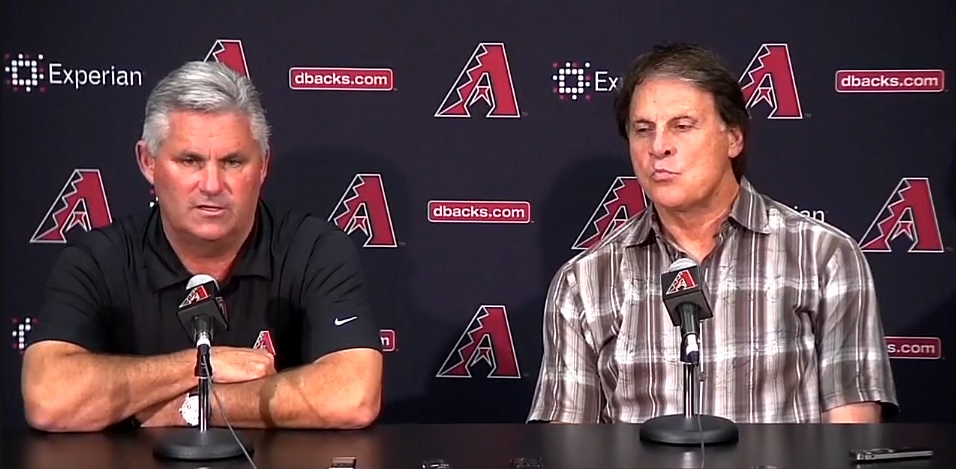
Towers-La RussaIf we’re gonna remember Bo Porter when he’s canned, seems only right to do the same for Kevin Towers. The GM who brought a lot of toughness and not too many victories to the desert as of late was canned Thursday by new boss Tony La Russa.

Towers’ grit-based organizational structure came to prominence last month when the D’Backs drilled Andrew McCutchen, because Pirates closer Ernesto Frieri accidentally hit Arizona first baseman Paul Goldschmidt on the hand a day earlier, breaking a bone. It led to a protracted discussion about how, while an eye-for-an-eye mentality once played well on baseball’s landscape—and despite Towers’ own overt statements to the contrary—things have kind of changed.

That said, La Russa has never been one to shy from grit. He thrives on it, in fact, with an entire book—Buzz Bissinger’s 3 Nights in August—being more or less dedicated to dissecting La Russa’s strategy of drilling other players in response to stuff they or their teammates did.

No, La Russa probably cared more about Towers’ record than his team’s treatment of Andrew McCutchen. The problem for Towers: That hasn’t been strong, either. After two straight .500 seasons, Arizona is 59-81 this year. Towers has traded away Trevor Bauer, Ian Kennedy, Jarrod Parker and Juston Upton, among many others, without getting a whole lot in return. His handling of free-agent signee Brandon McCarthy—who struggled after being instructed against throwing his cutter—drew particular notice once McCarthy joined the Yankees, kickstarted his best pitch and began to dominate again.

(Lest anyone think that La Russa and Towers are pure opposites, check out this story from 2011, in which each man is separately accused of gamesmanship practices that fall someplace between evil-genius and good-for-a-chuckle.)

Now on the hot seat: Gritty Kirk Gibson.


Bunting for hits, Don't Play Aggressively with a Big Lead

Bo Porter, We Hardly Knew Thee …

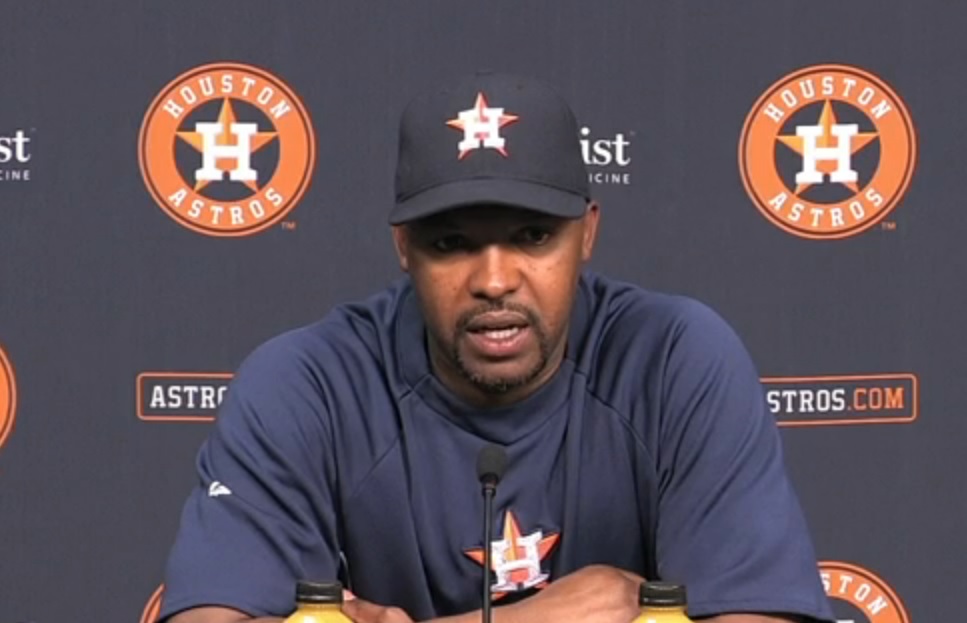
Bo PorterSo Bo Porter has been fired by the Astros amid reports of tension and disagreements about how to handle an exceedingly young roster. There’s no indication that it had anything to do with Porter’s April meltdown over a first-inning bunt by the A’s … but that phrase—”meltdown over a first-inning bunt by the A’s”—merits revisitation. In addition to another incident in which he should not have lost his cool, Porter quickly became the wackiest new manager in the major leagues as far as the unwritten rules were concerned. We’re sorry to see him go.

From the original reason we fell in love with the guy, back in April:

What’s up, Bo Porter?

Because baseball’s unwritten rules are built upon the concept of respect, the first rule among them is usually don’t run up the score.

What this means, practically speaking, is shutting down aggressive play late in blowout games—things like stealing bases and hustling into a base that is not otherwise conceded to you. People differ on the point at which such a code comes into play, but in nearly 10 years of covering this very topic, one thing has become abundantly clear to me:

The first inning of a game can never, ever, under any circumstances, be described as “late in the game.”

So when Houston manager Porter—and by extension, Astros pitcher Paul Clemens—took exception to Oakland’s Jed Lowrie laying down a bunt (against an accomodating defensive shift, no less) in the first inning on Friday, it was nothing short of ludicrous.

Houston’s fuse had burned short: The A’s had already scored seven runs in the frame, and Lowrie was batting for the second time. Also, they’re the Astros.

When Clemens faced Lowrie in his next-at bat, in the third, there was no mistaking his intentions. The right-hander’s first pitch was aimed at Lowrie’s knee, and ended up going between his legs. (Watch it here.) His second pitch was also inside.

After Lowrie flied out to end the inning, he asked former teammate Jose Altuve what was going on. At this point, Porter stormed out of the dugout and began shouting at Lowrie to “go back to shortstop.”

Porter’s rage would have been understandable if it was even the sixth or seventh inning, let alone the eighth or the ninth. Sure, his team is the AL-worst Astros, who boast six sub-.200 hitters in the starting lineup, and whose best hitter, Jason Castro, is batting .216. Yes, Porter was already into his bullpen.

His is probably the perfect team to lend credence to the point that, in the face of the Astros’ own inability to score runs, Lowrie was, in some way, rubbing it in.

But still: IT WAS THE FIRST INNING.

Lowrie hit it on the screws in his postgame comments.

“If we’re talking about the eighth inning, of course I’m not going to bunt,” he said in an MLB.com report. “But they’re giving me that by playing the shift and, as a competitive guy, I’m trying to help my team win. We’re talking about the first inning of a Major League game.”

Yes, we are. Yes, we are.


Retaliation

The Fine Art of Negotiation, Baseball Edition: How to Keep Your Hitters From Getting Drilled

win-winBaseball retaliation is generally considered to be a you-hit-my-guy-so-I’ll-hit-your-guy proposition, designed either to curtail unwanted activity from the other team or to make some sort of macho statement. Many decry it as unnecessary, and say that the game would be better if it didn’t exist.

Sunday we saw a story of what it takes for a pitcher—an old-school pitcher with retaliation on his mind—to not only acknowledge that point of view, but to agree with it. The story comes from FanGraphs’  David Laurila, who got it from Astros bench coach and former Orioles manager Dave Trembley.

It dates back to September 2007, and a game in which Baltimore pitcher Daniel Cabrera found himself distracted by Coco Crisp, dancing back and forth while taking his lead from third base. Distracted, Cabrera ended up balking the run home, then grew angry. The right-hander’s next pitch, to Dustin Pedroia, came in head high. This infuriated the Red Sox, and served to clear the dugouts.

When no retaliation occurred the next day under the watch of Red Sox starter Daisuke Matsuzaka (or the string of relievers who followed after he was knocked out in the third), Josh Beckett—Boston’s starter for the series finale—decided to take matters into his own hands.

“[Beckett] is old-school, and Cabrera popped Pedroia for no reason, so I knew one of our guys was going to get it,” said Trembley in Laurila’s account. “[Nick] Markakis, [Brian] Roberts … somebody was going to get it.”

Instead, Trembley approached Red Sox manager Terry Francona with a proposition. From FanGraphs:

“I called Tito,” he said. “I said, ‘If I tell you that I’m going to suspend Cabrera, will you tell me none of my guys are going to get thrown at?’ He said he’d get back to me. When he called back, he said, ‘Are you sure you’re going to suspend Cabrera?’ I said that I was. I’d talked to [general manager] Andy MacPhail and Cabrera was going to miss a start—we were going to take his money.

“Beckett pitched the next day and didn’t hit anybody. If I hadn’t called Tito, one of our guys would have gotten drilled, and deservedly so. Cabrera had a reputation and a problem with Boston and New York. Whenever they hit home runs against him, he’d hit somebody. To this day he’ll tell you he wasn’t throwing at Pedroia, but everybody on the team knew he did. An incident like that can get ugly.”

For somebody to work within the system as Trembley did is both remarkable and honorable, not to mention pragmatic. It leads one to wonder why more managers don’t take that tack.

Then again, maybe some of them do, but we just don’t hear about it. Trembley’s story is not so dissimilar from another incident involving Francona and the Red Sox, which was featured in The Baseball Codes. Pick up the action in a 2006 game between Boston and the Twins, which Minnesota led 8-1 in the bottom of the eighth. With two outs and nobody on base, the batter was Torii Hunter, who worked the count against Red Sox reliever Rudy Seanez to 3-0:

The last thing a pitcher wants to do with his team down by a wide margin late in the game is walk batters, which not only suggests unnecessary nibbling but extends a game that players want to end quickly. When a count gets to 3-0, as it did with Hunter, it’s a near-certainty that the ensuing pitch will be a fastball down the middle.

The unwritten rulebook does not equivocate at this moment, prohibit­ing hitters in such situations not just from swinging hard, but from swing­ing at all. Hunter did both, and his cut drew appropriate notice on the Minnesota bench. “After he swung I said to him, ‘Torii, you know, with a seven-run lead like that, we’ve got to be taking 3-0,’ ” said Twins manager Ron Gardenhire. “He honestly had not even thought about it.”

“I wasn’t thinking,” admitted Hunter. “I just wanted to do something. I knew a fastball was coming, and if I hit a double or whatever, we could get something going. I was just playing the game. I got caught up in it.” The incident serves to illustrate the depth of the Code’s influence. Hunter was generally aware of the unwritten rules, and except for rare instances of absentmindedness abided by them—while simultaneously disdaining much about their very existence. “Man on second, base hit, and you’re winning by eight runs, you hold him up at third,” he said. “You play soft, and I hate that part of the game. I hate that you don’t keep playing the way you’re supposed to, but you have these unwritten rules that you don’t run the score up on guys. Well, okay, what if they come back? The runs we didn’t score, now we look bad. We don’t think about that. At the same time, those rules have been around a long time, and if you don’t fly by them, you’ll probably take a ball to the head, or near it.

“You don’t want to embarrass anybody, but what’s embarrassment when you’re trying to compete? There’s no such thing as embarrassment. You’re out there to try to win, no matter what the score looks like. Whether it’s 4–3 or 14–3, you’re trying to win. I’ve seen guys come back from 14–3 and win the game 15–14. If I go out there and try not to embar­rass you and you come back and win, I look like the dummy.”

It’s a powerful system that forces an All-Star to override his competi­tive instincts for a code in which he does not believe. If one wants to avoid retribution, one must embrace the unwritten rules; barring that, Hunter learned, an act of contrition can suffice.

After the game, Gardenhire took the outfielder to the visitors’ club­house to speak to Red Sox manager Terry Francona, trying to wipe away the potential for hard feelings. To abide by the unwritten rule that bars opposing players from the locker room, the meeting took place in a rear laundry room in the bowels of the Metrodome. There Hunter informed both managers that he had swung out of inattention, not disrespect.

“We wanted to make sure [Francona] understood,” said Gardenhire. “I went there to let him know that I know the game too. It’s a manager’s responsibility when a player swings 3-0 to make sure the player under­stands that. I wanted him to know we didn’t give a sign for him to swing away, that Torii just made a mistake. I thought that it was good for Torii to explain it to him, so I took him over.”

Francona brushed it off as no big deal, saying that his mind had been wrapped around devising ways for the Red Sox to come back in the final frame and that he hadn’t even noticed. He did, however, express his appreciation for the visit. And the rationale worked. It appeased the mem­bers of the Red Sox who had noticed—there were several—and no bean­balls were thrown the following day.

“You see those types of things and you know it’s being taken care of internally,” said Red Sox pitching coach Al Nipper. “You say, hey, it’s an honest mistake, it wasn’t something intentional where the guy’s trying to show you up. We all make mistakes in this game. Ron Gardenhire is a class manager, and that was a true coaching moment for him. . . . I guarantee you, that was a moment he probably didn’t relish to have to do with a vet­eran, but he had to do it.”

[Thanks to reader Shawn Y. for the heads-up.]

Mound Conference Etiquette

The Waiting Game: or What to Do When Approached on the Mound by a Manager, in One Easy Step

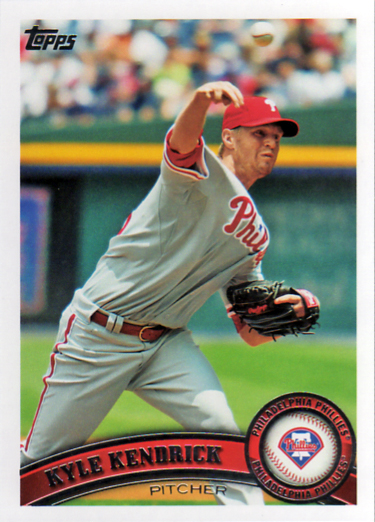
Kendrick cardKyle Kendrick was frustrated on Saturday. He was pitching well right into the sixth, had helped his team to a 5-1 lead. Then, after a Buster Posey leadoff single, Pablo Sandoval popped up for what should have been the inning’s first out. But the ball fell between Ryan Howard and Chase Utley, at which point Utley tried to flip the ball to second for the force … which would have worked, had his throw not pulled Jimmy Rollins off the bag.

The next batter, Michael Morse, doubled home a run, and Ryne Sandberg came out to the mound for a chat. Kendrick, with little interest in conversation, did not wait for his manager, storming off to the dugout while Sandberg was en route, handing him the ball as they passed.

If the basis of the Code is respect, waiting for one’s manager to reach the mound is a baseball bedrock, even if the pitcher doesn’t agree with the decision to make a change. Especially if a pitcher doesn’t agree with his decision to make a change. Put differently: a red-assed pitcher irked by a hitter digging into the batter’s box is following a narrow band of his precedent-setting forebears, but a manager angry at being abandoned by his pitcher in front of a stadium full of people is directly in line with every guy who’s ever managed in the big leagues.

Seems like a decent segue into the A’s. As some of you know, I’m under contract to write a book about Oakland’s teams of the early 1970s (somewhat breaking news: the story is so large, with so many pieces, that the publication has been moved back to 2016 so I have the space to tell the story in the way it deserves to be told), and this story falls right in line with an incident from 40 years ago.

In 1974, Alvin Dark took over as manager of the two-time defending champions, and in the early going, his methodology was not well received by his players. In particular, Dark had a problem with pitcher management, frequently giving his starters early hooks that ended up backfiring when the bullpen blew some sizeable leads. The most egregious of these instances came in the season’s third game, when Dark was still trying to figure out his roster. He yanked Vida Blue two batters into the fifth inning, with Oakland leading Texas, 5-1. Rollie Fingers allowed both runners to score, and Blue became ineligible for the victory since he had not gone the requisite five frames. From that moment on, Blue held some pretty serious antipathy against Dark.

Fast forward to mid-July. Blue was pitching well enough, entering the fifth inning in New York with a 3-1 lead. But even as the pitcher began to struggle, Dark wanted to let him finish the inning, to become the pitcher of record. But Vida imploded, with four hits and two walks turning Oakland’s lead into a 6-4 deficit. Dark had to pull him with two outs in the frame to stem further damage. When he approached the mound, however, Blue walked straight past him and tossed the ball backward. Dark let it drop onto the ground. It was as insolent a move as could be imagined from a player who had just coughed up a lead. Not only that, but it was the second time in recent history that an A’s pitcher had done it; after the first time, by Ken Holtzman, the manger threatened a $250 fine for any subsequent miscreants.

When the team arrived at Shea Stadium for a doubleheader the following day (New York was a one-ballpark town while Yankee Stadium was undergoing renovations), the manager called them together. It had been precisely 100 days since the season opener, and Dark finally had had enough. They sat in a semicircle in the locker room, while the manager stood in the middle. He usually liked to pace when he addressed a group like this, but this time he stayed in one spot. He did not shout and he did not curse. More impactfully, for the first time that anyone could remember, the uber-religious Dark did not quote the bible even once.

“I’ve never been more disappointed in a group of young men in my life,” he said, according to his book, When in Doubt, Fire the Manager. “I’ve never been more disappointed in a team of world champions. If being a world champion makes you act the way some of you are acting, no thank you. I don’t care to be one.”

“Vida, you and I are even now,” he said. “I screwed you out of a game your first start of the season, and I was never more sorry in my life. But we’re even now. I left you out there yesterday, trying to get you a win, and I’m the one who suffers. You degraded the position of manager. Not me, the position, by acting like a bush kid.” Dark confirmed the $250 fine, and said that it would cost $500 if it happened again. He didn’t want to play catch with his pitchers when he removed them from games, he said.

The Phillies don’t have quite as much drama in their clubhouse as those A’s did—nobody has quite as much drama in their clubhouse as those A’s—but the lesson holds. Afterward, Sandberg labeled Kendricks’ action as no big deal (although he did see fit to talk to the pitcher about it on Sunday), and Kendrick confessed to letting the pressure get to him. “I didn’t handle it right,” he said in a CSN Philadelphia report.

Kendrick is barely hanging on with a 5-11 record and 4.90 ERA, and has plenty of reason to be frustrated. All in all, however, this seems like a decent learning experience for the eight-year vet and the rookie manager, both in the nature of comportment, and how to handle oneself should things break down.

For another example of the concept, this one featuring Frank Robinson and discussed in The Baseball Codes, click here.

[H/T Hardball Talk.]