Retaliation, Tag Appropriately

Is That Your Glove in my Gut, or Are You Just Happy to See Me?

Machado tagOpponent of baseball’s unwritten rules: The Code exists as a means of allowing overly sensitive players to exact nonsensical macho bullying on each other under institutional cover.

Counter to that argument: Friday evening at Camden yards.

A generation ago, infielders—primarily first basemen, in the process of fielding throws to first while trying to keep baserunners close to the bag—utilized hard tags as a weapon, a means of relaying to an opponent that issues were afoot. Runners, familiar with the framework, understood this and took it accordingly. Should the message skew out of line, they had their own means of response.

Today, nobody seems to know anything. This is the only explanation for a play in which a baserunner goes ballistic after having been put out by an entirely ordinary tag. In the third inning on Friday, Manny Machado, on second base following a single and fielder’s choice, tried to take third on Adam Jones’ groundball to Oakland third baseman Josh Donaldson. Machado clearly did not expect the play; there were two outs and Donaldson could easily have thrown to first to end the inning. Instead, seeing Machado crossing his path, Donaldson stayed close to home.

In his surprise, Machado tried to jackknife out of the way. Donaldson thrust his glove at the evasive runner, his only intention being to make sure he did not miss.

The off-balance Oriole angrily spiked his helmet to the ground even as he was tumbling backward. Donaldson offered only a confused smile, wondering why the hell his opponent was upset in the first place. (Watch it here.)

“I was actually walking over there to pick his helmet up for him, and then he jumps up and starts yelling at me,” said Donaldson in an MLB.com report. “I have nothing against the kid. I don’t understand where it came from.”

Which brings us to the point at which we offer a rebuttal to the sentiment in the first sentence of this post. Pick apart the Code all you want, but it’s impossible to see one of Machado’s forebears so much as blinking at this kind of play. It’s easy to criticize those who take things too far in the name of some imagined construct that dictates propriety on a ballfield, but that construct also serves to give players a baseline for knowing what is and isn’t appropriate. Had Machado been aware of this in the first place, he never would have reacted like he did.

As if to double down on the lunacy, the Orioles then backed Machado’s hissy fit as a team. In the seventh inning, pitcher Wei-Yin Chen first brushed Donaldson back with a pitch near his head, then hit him on his left forearm.

This, then, is the dark side of the unwritten rules (critics, cue the echo chamber): rogue justice meted out without regard for merit. But even in this (an act—hitting a batter out of anger—that is patently ridiculous) we can see some greater purpose. Chen was doing his duty as a teammate, backing backing one of his own, even if he did not agree with him, because that’s what teammates do. There’s no quicker way for a pitcher to build respect in his clubhouse. Still, the the Orioles would have been better served had a player with some seniority pulled the 21-year-old Machado aside and, rather than taking it out on the A’s, suggested forcefully that he check himself. And it’s possible that happened.

Warnings were not issued (perhaps to give Oakland a chance to retaliate for a lunatic outburst), and Donaldson had words for the Orioles dugout as he made his way to first base. The game was too close from that point for things to progress from there, and no response of note was seen on Saturday. If the A’s are smart, they’ll leave this one alone, knowing they have nothing to gain by prolonging hostilities. If the Orioles are smart, they’ll have already dealt with Machado themselves.


Unwritten-Rules

Why all the Hate?: On the Nature of the Unwritten Rules

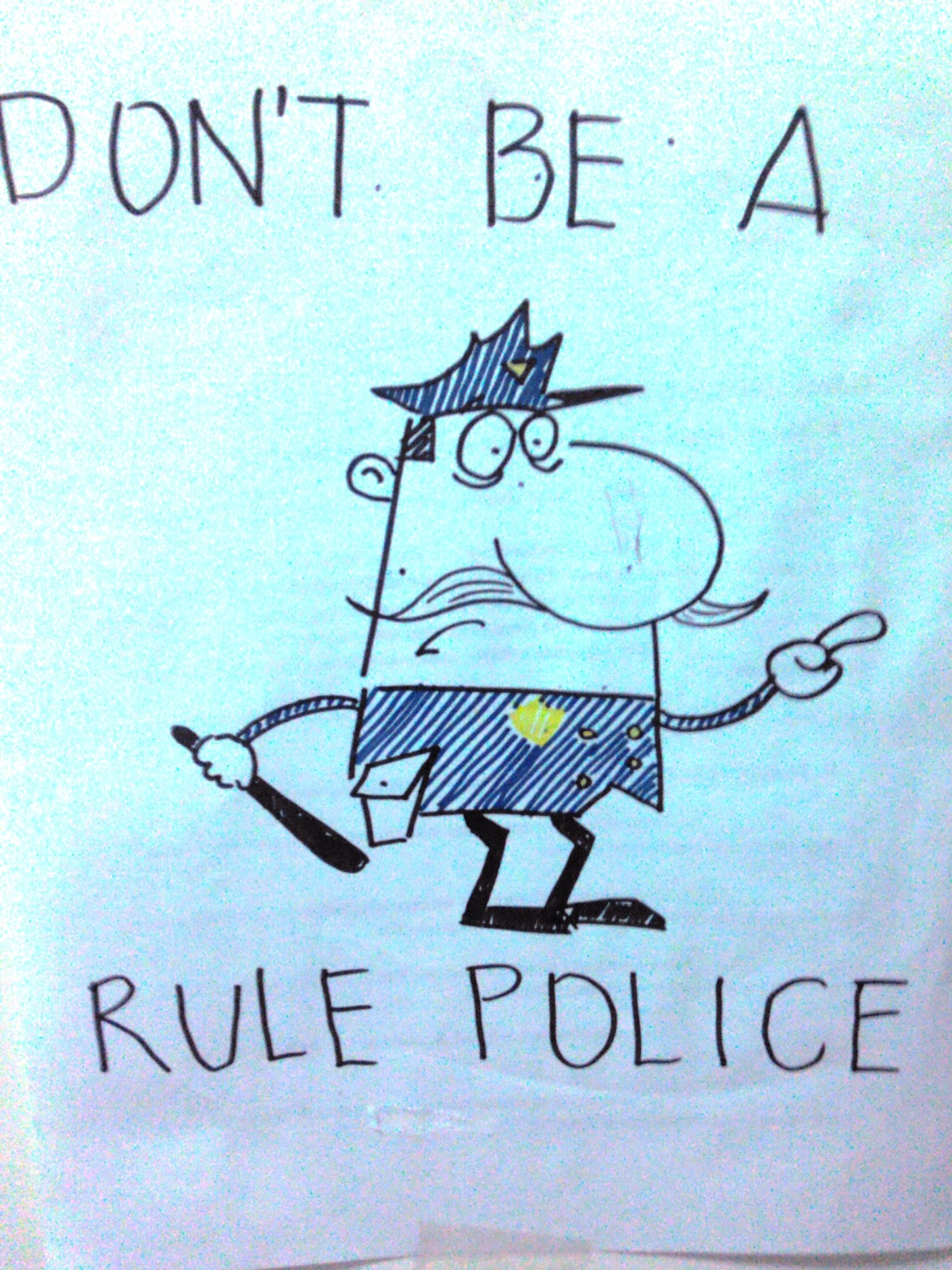
Rule policeYesterday over at Deadspin, former big league pitcher Dirk Hayhurst took aim at a recent ESPN feature, written by Tim Kurkjian, about the unwritten rules. Hayhurst savages both article and topic, calling it “piles of oblivious, hypocritical, contradictory bullshit.”

The man is clearly is not a fan of the unwritten rules. I am. Thing is, I agree with almost everything he says.

Kurkjian’s piece is well-reported and informative. It hits on many of the points laid out in The Baseball Codes, identifying actions forbidden on a baseball diamond for reasons that have nothing to do with the actual rulebook. Its points are supported through interviews and anecdotes. So far, so good.

What Kurkjian does not do, by and large, is account for the changing nature of the Code. This vital facet is referenced throughout The Baseball Codes, but even more so has been documented on this website over the four years since the book was published. As society changes, baseball changes. And as baseball changes, the attitudes within it change. And make no mistake—the sport’s unwritten rules are propped up by attitude.

I’ll take it a step farther: The fact that baseball’s unwritten rules are so malleable—flexible not just over time, but from league to league, team to team and even player to player—is what has kept them vital. The discussion never stops, not just about how they’re executed, but why. What motivates players to take offense to something somebody else does on a baseball diamond? When that discussion results in a critical mass agreeing that a rule is outdated or in some way wrong, that rule inevitably changes.

Step away from the ballpark for a moment and you’ll find little difference between the guy who gets upset at being inadvertently bumped in the supermarket and the pitcher who gets upset when an opponent digs in against him in the batter’s box. They’re both assholes; it’s just that one of them has a professional outlet with which to deliver his assholery.

But that guy is an outlier—a reason not to love the Code. He seizes on an institutional framework to further his own emotionally fragile goals, and becomes an easy target for critics.  Some players enforce things the wrong way, and some players get upset over things that should not realistically upset them, but that’s not so different than the rest of the world. The mainstream of players who abide by the Code do it properly, and with reservation. We are, after all, a society of reasonable people.

There are plenty of reasons to appreciate the unwritten rules—reasons that have to do with respect, and putting a check on players who are out of line (including the asshole above). Arguments are bound to ensue over the correct definition of “out of line,” but in the meantime, baseball is the last major sport to devolve into the chest-beating mentality that has all but consumed the NFL and NBA.

Among the points of his rant, Hayhurst bemoans the arbitrary nature of the sport’s unwritten rules:

It would be one thing if there were consistency across baseball—if everybody followed the same rules, then there’d be some de facto weight behind them. Instead it’s 30 different teams with 30 different unwritten rulebooks.

He’s correct. It’s the why of it with which I quibble. This is a moral code we’re dealing with, standards of behavior that govern the micro-society of the major leagues. As with any societal structure, the further one gets from the mainstream, the more arbitrary morals become. And many of the unwritten rules are not arbitrary: Anybody who throws at an opponents’ head will be roundly shunned, even by those who believe in similar forms of retaliation below the shoulders. Low-bridging a baserunner—wherein a middle infielder intentionally aims his double-play relay at the forehead of an incoming baserunner to force a premature slide—is similarly taboo. A couple generations ago, both these things were common practice.

Again: things change.

Those examples, of course, have to do directly with player safety. Annoyances—things like flipping a bat or crossing the pitcher’s mound—are viewed somewhat differently. (At which point I must point out Kurkjian’s error in stating that this latter rule was established only when Dallas Braden took offense at Alex Rodriguez doing that very thing; as has been discussed at some length within these pages, the rule is far older than that.)

As acceptance of these lesser violations has softened over time (anybody who does not yet believe that Yasiel Puig is at the heart of a hang-loose revolution has their eyes completely closed), they have also become fertile ground on which the cranks among us can plant their flags. The unwritten rules offer the cranks a platform, too, which is sort of the point. Those voices screaming about Puig’s bat flips have been thoroughly drowned out by applause for the guy. Soon, the cranks will be quiet on this topic, too, and the Code will have shifted again.

The fringe that wants to hurt their opponents is low-hanging fruit for critics, but it is also an endangered species. A focus on those who want to make the game a better, more respectful place may draw fewer headlines, but to avoid the latter in favor of the former is to do the topic a disservice. We may disagree about methodology, but in that, at least, we can hopefully concur.


Hidden Ball Trick

Hidden-Ball Trick!

Hidden ball trick!

(Background info: The NCAA’s No. 2 seed Florida Gators on Friday against the College of Charlston. Despite being both underdog and badly fooled on this play, however, C of C won, 3-2.)

(More important than that, though: hidden ball trick!)

For additional background info on recent iterations of the play, go here, here and, most prominently, here. HBT!

Retaliation

Red Sox vs. Rays, Because of Course Red Sox vs. Rays

Papi pops

Would David Price have had such a long memory had it been anybody but the Red Sox? We’ll never know unless he tells us, of course, but the answer is, of course not.

In last year’s ALCS, Ortiz hit two long homers off of Price (who gave up seven runs in a Game 2 loss), watching the second for a beat longer than the pitcher would have liked. Afterward, Price complained to the Boston Globe about the possibility that Ortiz was just watching to see if the ball went fair. “I saw it and I knew it was fair,” he said. “Run.”

He faced Ortiz for the first time since then on Friday, and wasted little time making a statement, planting a first-pitch fastball into the slugger’s back. It was enough for plate ump Dan Bellino to issue a warning, but not—contentiously—for Price to be ejected. Umpires are known to delay warnings until the other team has a chance to respond (especially under questionable circumstances such as these), but in a series as combative as this one—which saw benches empty less than a week earlier—Bellino was taking no chances.

Neither was John Farrell, who argued his position to the point of ejection.

Already upset by unrequited aggrievence, the Red Sox grew further agitated when Price hit Mike Carp in the right forearm three innings later. That this one appeared to be less intentional did little to slow the rampage; benches emptied, with Ortiz animatedly pointing toward Price, who for the second time in the game managed to avoid ejection. (Watch it here.)

Not so for backup Red Sox manager Torey Lovullo, who began his conversation with the umpires by spiking his cap, and ended it by trudging off to the showers. Boston’s third manager of the evening, Brian Butterfield, was tossed in the sixth, along with Brandon Workman, when the Red Sox starter threw a pitch behind Evan Longoria.

(Why wait until then? Well, Longoria is Tampa’s biggest gun, and Workman was not long for the game, anyway—the pitch to Longoria was his 89th, the most he’s thrown since last August. As if there would be any other way.)

After the game, Ortiz pulled no punches.  “That’s means it’s a war. It’s on,” he said in a Tampa Bay Times report. “This guy that hit me better bring the gloves on. I have no respect for him no more.”

Fueling his rage was the fact that the Red Sox absorbed four ejections while hitting nobody with a pitch, while Tampa Bay emerged unscathed, despite hitting two.

At least one player in the Rays clubhouse, however, wishes things were handled differently.

“I wish he would have hit me so it could have been done and over right there,” Longoria said. I just don’t want to get hit in the head, just make sure it’s down below the neck. Hopefully we’re beyond it.”

If the Red Sox are playing by the unwritten rules, it should be over. Butterfield had his shot, and he missed (with the possibility that he threw it intentionally wide with the score 2-1, to avoid unnecessary baserunners).

At this point, however, in the self-sustaining biodome of animosity that is Boston-Tampa Bay, all reactions seem to be on the table. These teams have disliked each other so intensely, for so long, that every slight is magnified and the need for response set in stone. While the rest of baseball seems more content than ever to not sweat the small stuff when it comes to the Code, that’s all these two clubs seem to do.

Update (5-31): Ortiz: Price is “a little girl.” Price: “This is not a war.

Don't Steal with a Big Lead

Tropocolipse 2014: Red Sox Anoint Themselves Baseball’s New Code Police

Yuni points

Every day we see new evidence of the degradation of baseball’s unwritten rules, how past forms of moral governance have been swept away in favor of the far simpler ideal of simply letting boys be boys. The game’s few remaining old-school souls periodically remind us of this development, primarily through bursts of outrage at acts that, while once roundly condemnable, are barely even blip-worthy on the modern game’s radar.

Put another way: Baseball has its share of crotchety old men, sitting on the proverbial front porch and grousing about the way things used to be—and they will not be ignored.

Ladies and gentlemen, we give you David Ross.

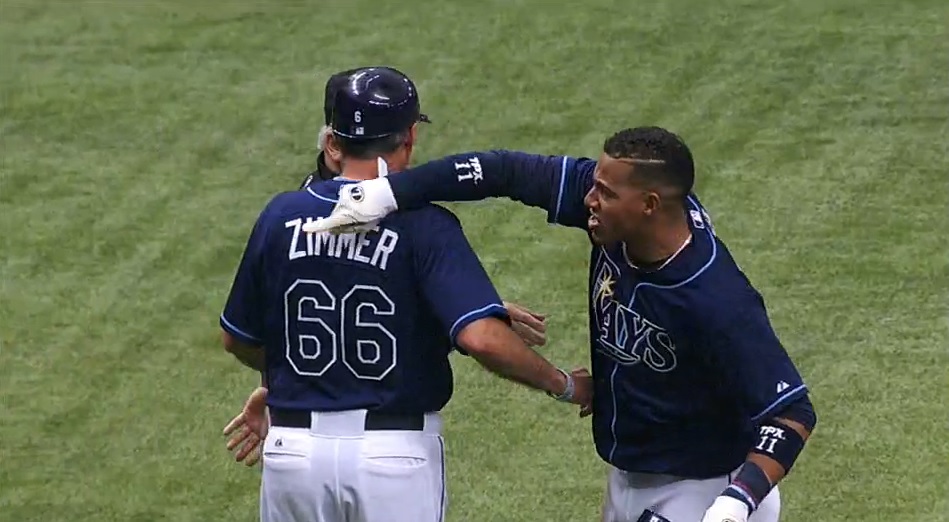
Sunday at Tampa Bay’s Tropicana Field, Rays shortstop Yunel Ecobar stole third while his team held an 8-3 lead in the seventh inning. Five runs at that moderately late point in the game was once considered punishable with fines up to and including fastballs aimed at the noggin of the next hitter, or Escobar himself, or both.

The game, however, has changed considerably, as has its moral code. There is still gray area when it comes to running up the score, of course—questions about how much of a lead is enough, and when—but the last time anybody so much as blinked at something along the lines of Escobar’s steal, the Rays had “Devil” in front of their name … unless they hadn’t even come into existence yet.

That said, we’ll always have crotchety old men hanging desperately to outmoded morals as places upon which to park their high horses. As Escobar led off third, Ross started barking. Escobar responded in kind, at first with stunned confusion, then anger and finger pointing toward the Red Sox bench. A moment later Jonny Gomes raced in from right field, swings were swung and the scrum became official. (Watch it here.)

It is easy for one side of the confrontation to decry the other: Ross for being too high strung, or, if it’s crotchety old men doing the decrying, Escobar for rubbing Boston’s noses in a sizeable lead. The argument that put it all to rest, however, was delivered by Tampa Bay manager Joe Maddon after the game:

“They took umbrage with the fact that Escobar had stolen third base with a five-run lead in the seventh. So that’s not nearly as egregious as last year in the playoffs, correct? Last year in the playoffs, when they had an 8-2 lead in the eighth inning, when Ellsbury led off with a single and stole second base and they ended up winning 12-2. I think that was a little more egregious than their interpretation of tonight. … I didn’t take any exception when they stole on us last year in the eighth inning in the division series. … Our goal is to prevent them from scoring runs, their goal is to score runs—the whole game. That’s always been the goal within the game of baseball. Apparently some of the guys on their bench did not like that. I really wish they would roll back the tape and look at that more specifically. You have to keep your personal vendettas, your personal prejudices, your personal judgmental components in your back pocket. So before you start screaming regarding any of that, understand what happened just last year, and also understand that in this ballpark five-run leads can evaporate very quickly.

Indeed, in Game 1 of last year’s ALDS, then-Red Sox center fielder Jacoby Ellsbury led off the seventh inning with a single, and stole second while his team held a six-run lead. David Ross was a member of that team. If he ever came out publicly against his teammate’s actions, those comments have not been widely circulated.

Then again, last year the Red Sox were on their way to hoisting the World Series trophy. On Sunday they were nothing more than a club with championship aspirations in last place and on its way to losing its 10th straight. Things that slide when one is winning tend not to in the darker hours.

Nothing feeds hypocrisy, it seems, like a healthy dose of frustration.

Of course, Escobar broke an unwritten rule himself by doing the one thing that could trip him up most: He responded. Had he kept to himself and put up with the bench jockeying for just a few moments, all would likely have ended well. Instead he was tossed, Boston is even angrier than it was before, and bad blood between two teams with a considerable history of the stuff is built anew.

Boston manager John Farrell did what he was had to in protecting his player, saying afterward in an MLB.com report: “We’re down five in the seventh so it’s somewhat of a gray area when you shut down the running game.”

Which is completely accurate, except for the part about the gray area. Ross had no business getting involved with Escobar over that particular action; he’s a 13-year big leaguer and should know better.

Take away the punches and the insults and the misplaced claims of moral outrage, however, and we’re left with one thing: a stark example of the degree to which baseball’s Code has changed. Argue all you want whether that’s for better or for worse—just don’t deny that it exists.


Unwritten-Rules

Take Cover Kids, Wild Thing’s in Town

BeanballSo it turns out that Mitch Williams is a horrible human being after all, if one is to believe the report out today on Deadspin.

The former closer and current MLB Network analyst reportedly spent some of his time at a baseball tournament in Aberdeen, Md., last weekend trying to get his kids to act like big leaguers … in all the worst ways.

After calling the opposing pitcher a pussy, according to witnesses, he instructed a 10-year-old on his team to drill the opposing pitcher.

There are discussions to be had about why actions like this may or may not be acceptable at the major league level, but there’s near unanimity of opinion on how baseball’s unwritten rules translate to youth and amateur leagues: they don’t. At least as far as things like retaliation and beanballs are concerned.

From The Baseball Codes:

A case in point can be taken from the angry response Giants broad­caster Mike Krukow received from a number of Bay Area parents after praising pitcher Tyler Walker on the air for launching a retaliatory strike against Mark Mulder after the A’s ace hit two Giants, including Barry Bonds. “They’re pissed off that they have Little Leaguers and I’m teach­ing them the wrong baseball,” Krukow said. “But I’m not teaching Little League baseball. Their fathers teach them Little League baseball. I’m explaining what goes on here at the major-league level.”

Mitch Williams has no such filter, apparently. He’s doing as much harm to the Code as those who decry its very existence. When one swings so a blunt mallet—pro or con, makes no difference—nuance is lost. And the sport’s unwritten rules are all about nuance.

If this is an example of the guy’s understanding of baseball, not only do I not want him within 500 yards of my kids’ ballfield, I’m not so sure I want him explaining it to me on TV, either.


Bat flips, Showboating

Flipping Out: The Response to What is now Officially a Common Occurrence

Puig-MadBum

So baseball has come to this: the Puig vs. the anti-Puig, forces within the game tugging in opposite directions of what is considered to be acceptable behavior. Puig need not even be present, representing as he does the New World Order of celebration for celebration’s sake, in the face of the game’s long tradition of shunning such displays.

On Friday, in a game at Dodger Stadium, Puig played himself, flipping his bat with no small degree of nonchalance following a sixth-inning home run. The role of anti-Puig was played by Giants lefty Madison Bumgarner, the man who had pitched the baseball.

Mad Bum did not like Puig’s act. Even as the ball flew toward the left field bleachers, Bumgarner strolled down the mound toward the third base line, and waited. When Puig passed, he gave him a piece of his mind. Puig responded accordingly. (Watch it here.)

Bumgarner, it appears, is late to the game on the whole New World Order thing. On the Puig Scale, the bat flip barely registered. The flip didn’t say “I’m so great for hitting that home run against you” so much as simply “I’m so great.” Whether you’re a new-school proponent saying that Puig and his ilk are exactly what baseball needs, or an old-school curmudgeon saying that the likes of Puig will be the ruination of Cartwright’s game, there’s no denying one thing: Whatever he did had nothing to do with Madison Bumgarner.

Puig flips because Puig flips. In the current landscape of home-plate scrums following interleague victories in June, this is simply the way things are. Puig’s actions have not been corrected, because the groundswell to correct them simply does not exist. The Baseball Gods have spoken.

The unwritten rules exist in flux, after all, and adapt to the times. This has always been the case. Once, Don Drysdale could knock down Willie Mays for digging into the batter’s box, and Mays would respond with nothing more severe than, “I better not do that next time.”

A pitcher with Drysdale’s mentality would not survive long in today’s game, shunned for his actions not just by fellow players but by the league itself. Not so Puig.

I am a fan of neither his bat flips, nor his attitude in general. But I am cognizant enough to recognize a shifting tide, and what Puig is doing now falls within baseball’s mainstream. He himself has pushed it there.

So when Madison Bumgarner gets upset with that sort of action, as if that sort of action was somehow directed toward him, he’s simply wrong. It’s Puig being Puig, and, like it or not, it’s now baseball being baseball.

Bumgarner, for his part, already had the best possible response at his disposal. He and the Giants beat Los Angeles, 3-1.

Progress.  

Sign stealing

Undercover in Miami? Braves Hint at Sign Stealing in Marlins Park

Marlins sculpture

They’re getting squirrely in Miami—or so the Braves would have us believe.

As the Marlins touched Aaron Harang for nine runs on 10 hits Wednesday night, folks in the Atlanta dugout grew suspicious that something afoul might be afoot. Just a week earlier, after all, Harang struck out 11 of those same Marlins at Turner Field in six innings of one-run pitching.

The suspicion was that Miami players were being tipped to Harang’s repertoire by some sort of relay system within the stadium.

After the game, Braves manager Fredi Gonzalez told the tale in an Atlanta Journal-Constitution report: “If you would have taken a look at our dugout at one point in the game, it was like the fourth or fifth inning, they were hitting balls everywhere, we got three guys looking at the scoreboard. You got two guys looking at their bullpen. I’m calling (bullpen coach) Eddie (Perez), ‘Eddie do you see anything?’ I’m looking at (catcher Evan) Gattis, thinking he’s maybe tipping his pitches. Carlos (Tosca) is looking in the bench over there, maybe somebody is whistling or something.”

This wasn’t just nervous energy from a manager whose team was getting hammered. Generally speaking, pitchers accept being beaten when things go poorly, and can live with the fact that even good pitches are occasionally hit well. But when everything’s working—good velocity and bite to one’s pitches, outstanding control—eyebrows tend to shoot up if the opposition begins consistently teeing off.

Gonzalez even laughingly referenced Mick Billmeyer, the former bullpen coach in Philadelphia who, four years ago, offered a sign-stealing lesson straight out of the Michael Pineda Subtlety in Cheating handbook.

Added to Gonzalez’s suspicions was the fact that left-hander Alex Wood brought a 1.54 ERA into Tuesday’s start, then gave up seven earned runs in five innings (more than in his previous five starts, combined). For what it’s worth, the Marlins are hitting .307 at home this year, but just .215 on the road. (Giancarlo Santon’s home/road split: .323/.200. Marcel Ozuna: .375/.208. Casey McGehee: .362/.234.  Jarrod Saltalamacchia: .360/.194.)

None of this necessarily means anything, of course. Teams tend to do better at home than on the road. And Aaron Harang is, at the end of any given game, still Aaron Harang.

Even if something is afoot, sign stealing is generally accepted as a baseball practice … right up to the point that a team leaves the field of play to do it. Spyglasses and TV cameras are verboten by the Code (let alone the actual rulebook), and teams don’t take it lightly when suspicions are aroused.

(Most recently, the Blue Jays were accused of nabbing signs from the Rogers Centre in 2011. Then again in 2012.)

Still, the Braves bench was able to find nothing amiss, going so far as to have their eyes on a guy in the bleachers wearing a red hat and orange shirt—an easily identifiable outfit for somebody signaling hitters—right up until he got up to visit a concession stand.

Regardless, Gonzalez has done his Code-related duty. By talking about the issue without leveling specific charges, he let the Marlins know that if anything is going on, the Braves are on to it and expect the practice to stop.

You can bet that the Dodgers, in town tonight for a three-game set, will be paying some attention of their own.

Update (5-3): Saltalamacchia laughed it all off.


Retaliation, Unwritten-Rules

A’s Push Back on Porter, Houston Pilot Pops


Porter tossed

Leave it to Bo Porter to show us how closely the Code can be  linked both to perspective and perception.

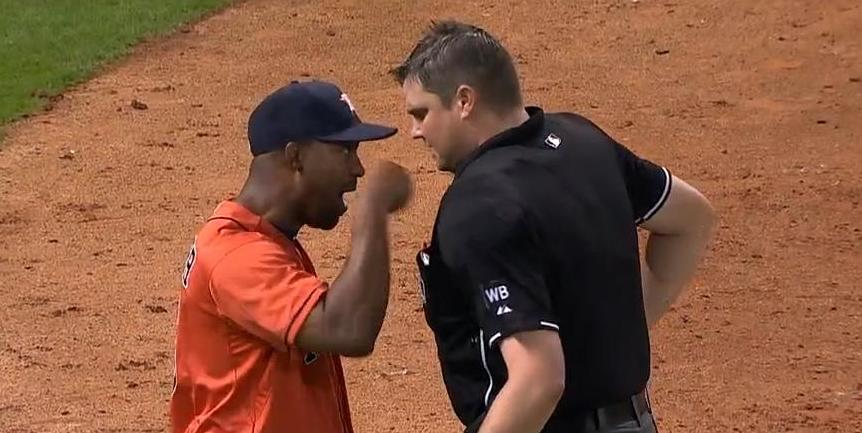
On Thursday, his pitcher, Paul Clemens, was ejected for drilling Oakland’s Jed Lowrie. The following night, he grew upset when A’s pitcher Fernando Abad received only a warning for hitting Houston’s Jason Castro. Both pitches were likely intentional. When Porter argued that point, he was tossed. (Watch it here.)

Those details, in a vacuum, place Porter pretty squarely in the role of aggrieved victim. Mix in a few pertinent facts, however, and it’s remarkable how much things change.

Lowrie was drilled because … well, it’s still not clear. Porter was obviously angry that the A’s shortstop bunted against the shift in the first inning of a game on April 18. Why he was angry is a point of some contention, which the manager has yet to explain with any sort of clarity. Still, he responded by apparently having Clemens throw at Lowry later in the game, and then had him drilled (again apparently, and again with Clemens on the mound) when the teams met again six days later. Plate ump Toby Basner knew the history, and tossed the pitcher for his actions.

On Friday, Oakland’s Brandon Moss bookended the ninth—another huge inning against the Astros in a season full of them—by getting hit twice. Neither appeared intentional: The first, from right-hander Josh Fields, barely grazed him. The second was a sailing cutter that had Anthony Bass, Houston’s sixth pitcher of the night, staring skyward in frustration after it found its mark.

No matter—after a time, enough is enough. It’s been said all week that Porter’s reckless behavior surrounding the Lowrie incident would eventually make targets out of his players, and on Friday it happened. Innocent as things may have been surrounding Moss, the tipping point had been reached. Castro was drilled, and Porter was irate.

Houston’s skipper has displayed no talent for instrospection to this point in the proceedings, but if he honestly assesses his role in this string of events, and wonders if he could have changed the outcome along the way with an even slightly cooler head, answers would be pretty easy to find.

Of course, chances are that—based on his exiting body of work, anyway—none of those answers would make him happy.

Porter’s go-to phrase through this entire affair has been “Baseball takes care of itself,” and in that, anyway, he is correct. On Friday, Oakland rolled a course correction into action. Here’s hoping that Porter views it with some clarity.