Contrary to Brandon Phillips’ actions, no ball was headed his way.
Starlin Castro has for the duration of his career been criticized for an ongoing failure to pay requisite attention during the course of a baseball game. From forgetting the number of outs in an inning (which kept him from attempting to turn what would have been an inning-ending double-play against the Giants), to failing to slide into second on a stolen-base attempt, to facing the wrong way as his pitcher was delivering the baseball, the guy’s career has been a laundry list of mental lapses that temper an exceptional skill set.
The latest came on Friday—though to be fair, this time the All-Star had some help in botching things up.
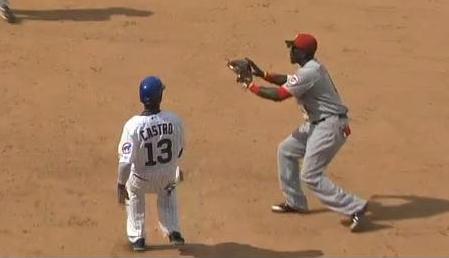
That assistance came courtesy of Reds second baseman Brandon Phillips. Castro, at first base, took off on a stolen-base attempt—itself a questionable move, what with the Cubs down five runs—as Josh Vitters singled to right. Phillips acted as if he were about to receive a throw from the shortstop for a play at second; despite Castro having the entire left side of the field in his direct line of sight, he somehow fell for it. (Watch here, at the 1:16 mark.)
Castro was deked into a full stop, and by the time he figured out what was happening and tried to motor to third, it was far too late. Xavier Paul threw the ball in to Phillips, who relayed it to third baseman Wilson Valdez, who tagged Castro for an easy out.
After the game, Alfonso Soriano said in an ESPN Chicago report that Castro “needs to concentrate more on the game.” This is undoubtedly true, but it also helps to understand the basics of Phillips’ misdirection.
“You know not to trust middle infielders—it’s their job to deke,” said longtime middle infielder Bip Roberts.
If Castro (a middle infielder himself) lost track of the ball between the plate and the spot in right field where it eventually landed, he always had third base coach Pat Listach (a former middle infielder) to clue him in. Then again, if a guy can’t be reliably counted on to face the game when fielding his position, it’s probably too much to ask that he pay attention to coaches when running the bases.
“A ball is hit, and I’m supposed to know where that ball falls at all times,” said Rangers manager Ron Washington. “If I run blind and get deked out, whose fault is that? Is that the infielder who deked me out, or is that my fault for not knowing what’s going on?”
Lonnie Smith, of course, was deked by Twins second baseman Chuck Knoblauch in the seventh game of the 1991 World Series—a play that likely cost Atlanta a vital run in a game they ended up losing, 1-0, in 10 innings. Smith, however, was 35 years old, a 14-year veteran and on the game’s biggest stage. Castro is only 22, and, one would hope, is still at the early end of his learning curve.
Still, said Cubs manager Dale Sveum after the game, according to MLB.com, “If you’re going to steal a base five runs down, you better [darn] well know where the ball’s hit.”
This was to be the year of Trout and Harper, Harper and Trout, wonderkind rookies primed to change the face of baseball—and in late spring and early summer, it was.
It’s still the year of Mike Trout, of course. Bryce Harper, though: not so much. His high-water mark was a .307 batting average on June 12; three games later he went 0-for-7 against the Yankees, with five strikeouts, and has hit .210 over the 49 games since, with only three homers. Since the All-Star break, he’s batting .176.
Harper has been baseball’s most touted prospect since he was 16 years old, and now, for what may be the first time in his life, he’s scuffling in a significant way.
In the fourth inning of Wednesday’s game against the Astros, he took a two-strike pitch, low and outside from Armando Galarraga—“catcher Carlos Corporan’s mitt nearly scraped the dirt,” reported the Washington Post—so certain it was a ball that he stepped back into the box. Plate ump Angel Hernandez called it strike three.
Harper got into Hernandez’s face, shouting and pointing, and had to be physically removed by first base coach Trent Jewett.
It was a reaction borne of frustration, likely as much about Harper’s own struggles as Hernandez’s strike zone. The ump didn’t come close to ejecting the rookie (“Let him have his say—nothing wrong with that,” Hernandez told a pool reporter after the game) but it’s possible that the display affected his outlook toward Harper’s ensuing at-bats.
Umpires vociferously reject the notion that they ever test rookies in creative ways—denying them close calls as a means of putting them into their place, letting them know from the get-go who holds the power on a baseball diamond—but their ranks have long been accused of doing exactly that.
Former catcher Randy Knorr tells a story about Wade Miller’s first major league start, with the Houston Astros in 1999. He was struggling against the Arizona Diamondbacks, and plate umpire Rich Rieker wasn’t giving him any close calls. Miller was 22 years old, and was becoming increasingly frustrated at his inability to get a break from Rieker.
“[Miller] throws one pitch right down the middle and it’s called a ball,” said Knorr. “I throw the ball back out there and he’s looking in at the umpire. I say, ‘Hold on,’ and I call time out and run out to the mound. I said, ‘Wade, man, just get through today. If you get through today, you’ll be fine. Just don’t show up the umpire. He’s testing you. I’m trying to work him back there, so don’t be snapping the ball on him or anything like that.’ ”
Miller did as instructed, and though his day didn’t go well—he gave up seven runs in three innings and took the loss—when he walked past Rieker on his way off the field, the arbiter said, “Good job, Wade.”
In the sixth inning Wednesday, when Hernandez called a strike against Harper on another low, outside pitch—which would have been ball four from reliever Xavier Cedeno—it smacked of a similar type of rookie baiting. Harper had showed up the ump in the fourth by so publicly questioning his strike zone. This time the bases were loaded, and Harper had already started jogging to first; when he heard Hernandez’s strike call, he was sufficiently disbelieving as to take a few more steps.
Now the count was full, and Cedeno’s next pitch was again low and away. Again Harper watched it. Again it was called a strike. From the Post:
Harper cocked his bat with one hand, as if he was going to throw it, then restrained himself. He chucked his helmet and tossed his bat, and as he ripped his batting gloves off in the middle of the diamond he shook his head.
The calls were so questionable, and Harper so visibly upset, that Nationals first baseman Adam LaRoche checked in with Hernandez after the inning, the obvious on his mind. “I said, ‘What’s going on? From where I’m at, those balls are down.’ ” he said. “[Hernandez] assured me that they were good pitches. He said he would never do that to Bryce, he loves him, he loves the way he plays and that there’s no kind of initiation there. He called it the way he would call it to anybody.”
La Roche, a 9-year vet, has seen this kind of thing before. Without saying as much, he made it obvious that he felt like he recognized exactly what was going on.
“I’ve been in that position,” he said after the game. “I’ve talked to Bryce a lot about it. I said, ‘You’ve got to keep your mouth shut, but at some point, if it gets really bad, you’ve got to stand up for yourself and not sit there and take it.’ ”
Harper is still trying to figure that one out. Speaking the following day about Hernandez’s expanded zone, he said, “When you have to chase a 2-1 fastball two inches off, it’s not fun.”
The Post cited FanGraphs.com stats showing that only 40 percent of the pitches Harper has seen since the All-Star break have been in the strike zone (27th lowest in the majors), and he’s swung and missed at fewer than 30 percent of those (and at 8.5 percent of his pitches overall). These are good numbers, not usually aligned with a guy who’s striking out more than 22 percent of the time.
An umpiring conspiracy to deliver some humility to the guy who wore gold cleats in the All-Star Game as a teenager? A longshot, at best. But the notion that individual umps view Harper just a bit differently than they do other players around the league is not so far-fetched, especially considering the media hype that followed him through the first half of the season. Knowing one’s place in the baseball hierarchy has always been of vital importance to many of those involved in the game, and umpires are no exception.
If such calls are indeed intentional, each is only a small factor in putting Harper in his place. Cumulatively, however, they’re having an effect. Whether or not they’re just, there’s little doubt that the lessons Harper is learning today will be of use later in his career.
Friday, Reds closer Aroldis Chapman drilled Andrew McCutchen with a 101-mph fastball. (Watch it here. Note: No rubbing.) On Saturday, Reds starter Mike Leake hit Josh Harrison, then walked toward him to deliver a follow-up message. (Watch it here.)
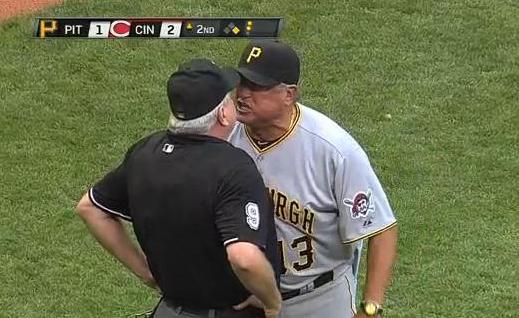
Umpire Brian Gorman warned both benches after the latter incident, an unfortunate development that precluded—correction, delayed—any type of Pittsburgh response. (When Pirates manager Clint Hurdle questioned the decision, Gorman promptly tossed him.) It was enough to lead Sunday’s starter, A.J. Burnett to point toward various Reds players from the dugout, the message being that accountability can sometimes be a painful thing, and he was willing to wait to enforce it.
Warnings may have been issued prior to Burnett’s Sunday start, or perhaps it was because it ended up being a close game until the ninth, or maybe it was because the Pirates had already dropped the first two games of the series to their NL Central rivals and were desperate for a victory, but the right-hander went 8 2/3, giving up only three hits and two runs in a 6-2 victory without hitting anybody (and despite two more Pirates, Rod Barajas and Starling Marte, getting hit themselves).
“No one in here has forgotten about what happened to ‘Cutch,” Burnett said in the Pittsburgh Post-Gazette. “We needed a big ‘W’ today.”
“There is a time and a place for [retaliation],” added Barajas. “Today was the time to win. We got that done.”
Pittsburgh did figure out one warning-proof way to make a statement, however. On Saturday, 6-foot-7, 245-pound reliever Jared Hughes tagged out baserunner Dioner Navarro (all 5-foot-9 of him) with a marked shove—a move that Dusty Baker later called “a bully move” in the Cincinnati Enquirer.
The notion of bullying is prominent in these teams’ shared history. It was raised Saturday by Pittsburgh bench coach Jeff Banister, who took over as manager after Hurdle’s ejection. “This is their turf, and they’re trying to bully us,” he said in an MLB.com report.
We’ve heard this story before. From The Baseball Codes:
[Dock Ellis] possessed a clear understanding of the power of intimidation, having seen it in action as his Pittsburgh Pirates teams terrorized the rest of the National League, bullying their way to three division titles and one World Series between 1970 and 1972. In ’73, though, things began to change—the Pirates inexplicably lost their bravado and many more games than expected, finishing below .500 and in third place in the National League East. When they opened 1974 by lurching into last place with a 6-12 record, Ellis took it upon himself to spur a roster-wide attitude adjustment.
He chose as his victims the Cincinnati Reds, themselves coming off two straight division titles and on their way to ninety-eight wins. If Pittsburgh’s new timidity tipped the balance of swagger in the National League against them, the prime beneficiary was Cincinnati. Ellis wanted to reverse that trend.
“[Other teams used to] say, ‘Here come the big bad Pirates. They’re going to kick our ass.’ Like they give up,” said Ellis in Donald Hall’s book, Dock Ellis in the Country of Baseball. “That’s what our team was starting to do. When Cincinnati showed up in spring training, I saw all the ballplayers doing the same thing. They were running over, talking, laughing and hee-haw this and that. Cincinnati will bullshit with us and kick our ass and laugh at us. They’re the only team that talk about us like a dog.”
When Ellis took the mound against Cincinnati on May 1, 1974, he had only one strategy in mind: to drill every batter that stepped in against him. The first was Pete Rose, who ducked out of the way when a first-pitch fastball sailed toward his head, then jumped forward to avoid the second pitch, which flew behind him. The third pitch, aimed at his rib cage, found its mark. Man on first, nobody out.
The second batter, Joe Morgan, caught Ellis’s first pitch with his kidney. First and second, nobody out. Third up: Dan Driessen. Ellis’s opening shot sailed high and inside for a ball. The second pitch found the middle of Driessen’s back.
The bases were now loaded, but the pitcher was hardly deterred. Cincinnati’s cleanup hitter, Tony Perez, took stock of the carnage and realized his only possible salvation was to stay light on his feet. He proceeded to dance around four straight offerings—including a near wild pitch that flew behind him and over his head—to draw a walk and force in the game’s first run. When Ellis went 2-0 to Johnny Bench, Pirates manager Danny Murtaugh couldn’t take any more and removed the pitcher from the game.
“[Ellis’s] point was not to hit batters,” wrote Hall. “His point was to kick Cincinnati ass.” His point was also to inspire his teammates, to instill a measure of toughness in a languor-prone Pittsburgh squad. It might be coincidence, but after that game—which the Reds won, 5–3—the Pirates went 82-62 and won the National League East for the fourth time in five years.
Trying to intimidate an upstart is hardly new in the pantheon of baseball—just ask Cole Hamels. How the upstart responds is what really matters.
The teams meet again for three in Cincinnati starting Sept. 10, and three more in Pittsburg two-and-a-half weeks later for the season’s final game. Mark your calendars.
For all the modernity in today’s game; for the allowances teams make when the opposition mobs one of their own after a game-winning hit; for the inter-team chatter around the batting cage; for pitchers willing to permit batters to crowd the plate and dig in; for the definition of “blowout” that has gone from five runs to six runs to eight runs or more—there is still something sacrosanct about the silent rookie.
This is the player who enters a big league clubhouse wide-eyed and ready to learn, partly because he’s willing, and partly because it’s expected. It’s the guy who keeps his mouth shut, the better to watch, the better to absorb.
“In my day, rookies didn’t speak unless spoken to,” said George Brett. “Nobody paid attention to you. You just kind of kept your mouth shut and did what was expected of you. You listened, observed and learned.”
Jim Davenport estimated that one needed 400 at-bats before he could speak up. Lefty Grove had already won four games for the A’s by the time team veterans so much as acknowledged his presence.
“As rookies coming up in Detroit, we were told to be seen not heard, and that’s what we did,” said former Mets manager Jerry Manuel. “We kept our place.”
The sentiment is no longer enforced with quite so much vigor as it was even a generation ago, but it still exists. Which is why veterans notice when a guy like Jordany Valdespin hits a clubhouse.
Valdespin has made quite the impression on his teammates since the Mets called him up in late April, not all of it good.
Reported the New York Times: “In this, his rookie season, [Valdespin] has become an unusual wild card, a player equally capable of providing an instant spark or a head-slapping blunder . . . whose judgment and maturity may still be a work in progress.”
Mets manager Terry Collins has expressed his own concerns, specifically addressing the value in rookies being “very, very quiet” as they earn their position. There’s a reason for this: Valdespin’s behavior, while not necessarily outlandish, has not exactly been rookie-like. His is an outsized personality, the kind that takes over the clubhouse stereo, and by multiple accounts he has not made much of an effort to fit into his expected role. His teammates, needless to say, have noticed.
They responded last week with a not-so-subtle reminder, in the way that veterans have long been not-so-subtly reminding rookies of things. Valdespin had worn a white T-shirt on the bus from the team hotel in San Francisco to AT&T Park, despite the dress code requiring collared shirts.
Following that night’s game, Valdespin arrived at his locker to find the sleeves of his T-shirt shredded, and colorful messages—“NY Loves Valdy” (complete with a heart in place of “loves”) on the front, and “El Hombre” (a reference to him referring to himself as “The Man,” after pinch-hitting a homer off Jonathan Papelbon in May) on the back .
El Hombre was not pleased. Angry, he began yelling in the crowded clubhouse about the inequity of it all.
This was the moment at which Valdespin could either have earned points with his teammates, or alienated himself further. During Chan Ho Park’s rookie season in 1996, his Dodgers teammates shredded his suit (which they later found out had been given to him by his mother), then watched, befuddled, as he threw food across the room, tossed his chair into a row of lockers and wept openly.
When rookie Armando Benitez found the clothing in his locker replaced by a dress, he pinned down a number of veterans against the far wall of the shower room with a steady barrage of baseballs picked out of a nearby bucket. (In the end, the pitcher refused to capitulate, even after being told that his clothes had been packed and were already en route to the airport. “He wore a T-shirt and a pair of shorts on the frickin’ plane,” said one team member. “That didn’t sit too well with the veterans, I can tell you that.”)
Valdespin, however, appears to have learned an important lesson. He stormed to the back of the clubhouse after seeing his shirt in tatters, but—apparently after being talked to by some veterans, including David Wright—returned before long with a grin on his face, and proceeded to model the shirt, going so far as to pose for his teammates’ cell phone pictures.
“I got mad at that moment, but it’s funny now,” Valdespin said the following day, while wearing the shirt again. “It’s a process. I need to keep learning.”
Based on that statement alone, there’s hope for the kid yet.
Rex Hudler is a throwback. Well, not actually a throwback, since he was drafted in 1978 and retired 20 years later, but he’s long harbored an old-school ethos that mandates ballplayers play hard, rookies keep quiet and, among other things, one doesn’t get friendly with one’s opponents.
That he’s now a broadcaster for the Kansas City Royals has not dimmed his moral compass as far as baseball is concerned. Calling games for the Angels in 1999, his first season behind the mic, he responded to an on-field fracas with the Indians by looking into the booth next door and deciding that he should uphold his team’s honor by brawling with Cleveland broadcaster Rick Manning. (He was eventually talked down by partner Steve Physioc.)
Hudler has since learned the limits of his role (fighting with colleagues = bad), but he’s not shy about explaining what the Code should look like on the field. It helps that his partner in the Kansas City booth, Ryan Lefebvre, shares many of his ideals. A pet peeve of theirs that recently garnered attention is the aforementioned fraternization between players on competing teams.
Last Monday, Anaheim’s Kendrys Morales stroked a three-run, eighth-inning single to break a 3-3 tie, and when he advanced to second quickly fell into conversation with Kansas City’s middle infielders, Alcides Escobar and Yunieski Betancourt.
Lefebvre: “I don’t want to get on my soapbox again, but if I’m a pitcher, I think it would really burn me to see my middle infielders laughing and joking with a guy who just hit a three-run double off me as he stands on second base. I don’t get it. And I’m not saying the Royals are the only team that does it. You see it a lot more these days. If I’m a pitcher, I wouldn’t want to see my guys doing it. I mean, what could be so urgent that you’d have to talk to the guy on the other team who just hit a potentially game-winning hit? Maybe it’s just me. Maybe I’m getting old.”
Hudler: “You’re not old. Age has nothing to do with it. It’s something I see as well. But it’s a culture that’s not going to change unless some of the veteran guys see to it. Or management says something about it.”
This was not the first time the topic has come up during a game. Hudler later went on Kansas City radio station WHB and said, “You can stand 10 feet away from a player and smooth out the dirt and still talk to a player without giving the appearance that you’re in his back pocket. When you’re in uniform out there, respect the game of baseball and respect your teammates. And stay out of the back pockets of opponents when people are watching. It makes me want to vomit. Escobar is as guilty as any of them. But I don’t think he knows. It’s up to the veterans on the Royals or even Ned (Yost) to cut some of that stuff out.”
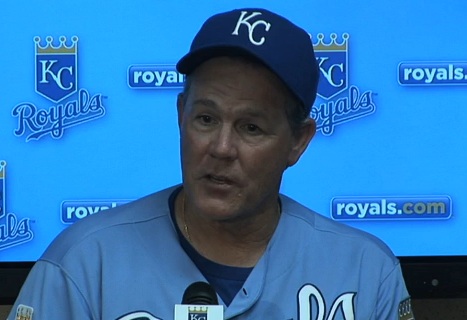
To this point, this story is barely newsworthy beyond a couple of old-school broadcasters having opinions. It’s what happened next that proved revelatory: Royals manager Ned Yost seemingly pivoted, and agreed with them.
According to Fox Sports, Yost called a clubhouse meeting during which he addressed the issue. According to team spokesman Mike Swanson, “we’ve seen the last of [fraternizing on the bases.]”
There are a few things going on here. Foremost are the attempts by Hudler and Lefebvre (who is the son of former big leaguer Jim Lefebvre) not just to describe an old-school baseball mentality, but to criticize current players for failing to embrace it. That’s their job, if they see it that way, and the fact that the repeat offenders in Fox’s account hail from Venezuela and Cuba, respectively, could speak to the fact that the game they learned contains no such tenets, and it would take an old-school clubhouse leader to inform them of same.
Much more interesting, however, is Yost’s apparent willingness to bend to the broadcaster’s wishes. Yost spent six seasons in the big leagues, and is in his ninth campaign as a major league manager. He knows baseball, he knows the Code and he’s seen every Royals game this year. If the chattiness of his infielders hadn’t gotten on his nerves before now, he has no business changing course simply because team broadcasters called for it.
Had Yost been leaning that way anyway, and the broadcast team simply pushed him over the edge, it merits questioning just how dialed in he is to what’s going on with his team.
There’s a place in baseball for the old-school. It seems to be shrinking by the day, but it’s there, and guys like Hudler and Lefebvre should be commended for doing what they feel they must to uphold it.
That said, it’s 2012, and the game is different than it was in 1992 or 1972 or 1952. That’s the nature and the beauty of the unwritten rules—they’re malleable to their era, and change with every generation. If Ned Yost is willing to allow some in-game chatter between his players and their opponents, that’s his right. Last week’s episode illustrates mainly that he needs to figure out on which side of the Code he comes down.
Sometimes, a pitcher has to do what a pitcher has to do. When things aren’t going well for him, of course, those things he does don’t always turn out like he might otherwise expect.
During the course of the first three innings against the Royals yesterday, Jered Weaver threw pitches up and in, above the shoulders to both Alcides Escobar and Jeff Francoeur, and drilled Lorenzo Cain twice. Neither of the balls that hit Cain appeared to be intentional, but Weaver is a guy who has been known to get squirrely with the opposition, and a response was in order.
It came from Royals starter Luke Hochevar in the fourth. This being Luke Hochevar, of course, he had already given up eight runs, including a home run by Bobby Wilson to open the frame.
So when the right-hander drilled the next hitter, Mike Trout, on the left hand with a 3-0 fastball (the pitch was aimed at his thigh, but Trout dropped his arm before it could connect) it left little question about intent—especially for plate ump Bob Davidson, who ejected the pitcher on the spot. (Watch it here.)
Had Hochevar opted for pure retaliation rather than waiting until just after somebody took him deep, would he have gotten away with it? It seems likely, based on his comments after the game.
“I just asked [Davidson] why I was run and he said, ‘Because the guy before hit a home run, and then you hit the next guy,’ ” Hochevar said in the Los Angeles Times.
It just goes to show that when things go wrong, they go really wrong—pitch selection, pitch location, and when to execute a well-deserved retaliatory pitch that everybody in the stadium expects you to make.
By almost every account, Vicente Padilla’s beaning of Adrian Beltre yesterday was an accident. (Watch it here.) It came in the eighth inning of a 1-1 game, with an 0-2 count and a runner at third. But when a guy has made a career not just of drilling batters—he’s now hit 108 over his 14-year career, third-most of any active pitcher and tied for 64th all-time—but hitting them in the head, one can’t help but think negative thoughts.
Padilla was suspended in 2005 after drilling Vlad Guerrero, then brushing him back in a later at-bat, then drilling Juan Rivera after warnings had been issued—all within a span of two innings. He was suspended again in 2007 for throwing at Nick Swisher. He broke Aaron Rowand’s face with a pitch in 2010.
“I’ve seen him hit people that aren’t even a threat,” said one opponent in 2010. “You get a small, scrawny guy up at the plate and he’ll throw at him just for the hell of it. That’s how he pitches. That’s how he is.”
This is the guy who earned applause from Marlon Byrd when he was released by the Rangers in 2009—and Byrd was his teammate. The release, in fact, came about largely because of Texas players’ demands that Padilla hit fewer opponents, as the tactic frequently ended up members of the Rangers being drilled in response.
Case in point: That June, Padilla hit former teammate Mark Teixeira twice. The first response was Teixeira (cleanly) wiping out Elvis Andrus at second base (“setting off a celebration in the Yankee dugout” according to the New York Daily News). The second was A.J. Burnett coming very up and very in on Nelson Cruz.
Said Teixeria after that game:
The first two at-bats of my career [against Padilla in 2005, when the right-hander was with Philadelphia], I hit home runs. Third at-bat, I got hit. And every time I’ve faced him since there have been balls near my head, near my body. We were teammates for two years. I remember getting hit a lot because he was hitting other players.
Teixera went so far as to ask the pitcher to knock off that kind of behavior. Padilla’s response, according to the first baseman: “Nothing.”
That August, following an intervention by Rangers brass along those same lines, Padilla, facing the A’s, responded to a Scott Hairston homer by hitting Kurt Suzuki. After the A’s retaliated by drilling Michael Young, Padilla was seen laughing on the bench. He was designated for assignment within days.
It’s hardly a stretch to think that no pitcher has been universally less-liked since Padilla came into the league in 1999. All of which is a long way of saying that when it comes to the Code, retaliation is sometimes called for even in response to unintentional actions—but when it comes to Vicente Padilla, it seems merely to be a matter of course.
That Beltre appears to be in fine shape is good news, but probably has no bearing on whatever is to follow. Red Sox and Rangers meet again tonight. Stay tuned.
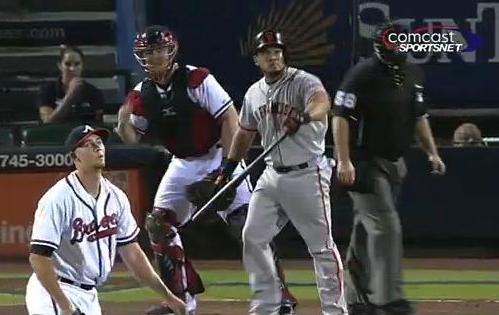
Memories can be long when it comes to failures of the past, and old bitterness sometimes dies hard. There’s little question after Wednesday night’s Giants-Braves game that Melky Cabrera harbors some old bitterness.
He never found his groove during his lone season in Atlanta, in 2010, receiving scant affection from fans, media and the organization itself. Of course, much of it was deserved—he showed up out of shape, hit only four home runs, finished eighth among team regulars with a .255 batting average, and dead last in OBP, slugging and OPS. He feuded with manager Bobby Cox, and the team released him after the season.
When Cabrera returned to Atlanta for the first time since then this week, he wasted few opportunities to make his feelings known. On Tuesday, he gestured (some say rudely) toward fans in the left field bleachers after catching a fly ball, and acted as if he would toss balls to the stands before reversing course and holding on to them. He spent some time admiring his home run off of Mike Minor on Wednesday. (Tater Trot Tracker listed it as the day’s fifth slowest circuit, out of 39.) With Jason Heyward at second on Wednesday, Cabrera caught a flyball and waved at him with his glove as if urging him to test the outfielder’s arm. When Brandon Crawford hit what turned out to be the game-winning homer in the 11th inning on Wednesday, Cabrera left the dugout and skipped up the warning track.
Things had built to such a degree that after he and Gregor Blanco scored on Blanco’s 11th-inning home run Wednesday (shortly following Crawford’s), their standard pelvis-thrusting celebration was taken by many to be inflammatory.
The Braves noticed all of it.
In the eighth inning Wednesday, reliever Eric O’Flaherty threw a high, inside fastball to Carbrera, knocking him to the ground. The gesture elicited a smile from the outfielder.
“That’s Melky, and that’s why he’s not here anymore,” Chipper Jones told the Atlanta Journal Contstitution after the game. “He got a little happy when Blanco hit the home run. It won’t be forgotten.”
(Jones got his own measure of revenge when, after homering in the 11th, he took even longer than Cabrera to round the bases.)
Speculation had Tim Hudson, starting Thursday for the Braves, offering further retaliation, but the score was close throughout, and Cabrera ended up going 2-for-3 with a walk without being hit.
For his part, Cabrera claimed to CSN Bay Area (through interpreter Angel Pagan) that it was all in good fun.
“Just trying to play hard baseball,” he said. “Sometimes when the adrenaline is really high, something might happen. It’s not trying to embarrass anybody. It’s just trying to play hard and competitive.”
Difficult as that may be to believe, Giants manager Bruce Bochy defended his player—although some of it was clearly lip service.
“I don’t think Melky means to [taunt],” he told the San Jose Mercury News. “I’m not into trying to show up other clubs and the guys know it. If you know Melky, he’s quiet and goes about his business. It was more about having fun.”
It’s true that Cabrera has been nothing but quiet and professional to this point in his San Francisco tenure, but it’s tough to mistake much of what he did at Turner Field as anything to do with “having fun.”
Atlanta visits the Giants in late August. Mark your calendars.
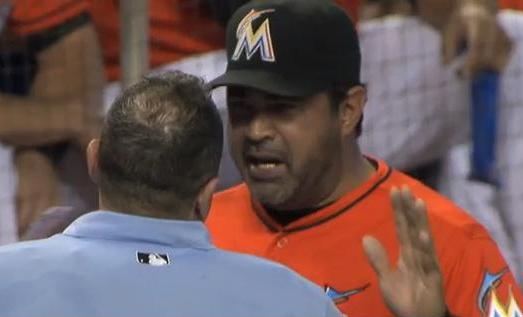
After Sunday’s Ozzie Guillen–Bryce Harper Hey, Are You Showing Me Up? staredown, some members of the Nationals brought a touch of levity to the situation.
On Monday, Edwin Jackson and Adam LaRoche had Harper sign a bat (not an unusual request in a big league clubhouse), then, without his knowledge, added the phrase “To my hero, Ozzie. Love you.” After slathering it with pine tar, and also without Harper’s knowledge, they sent it down the hall to the Marlins clubhouse as a sort of twisted peace offering.
(Why those two players? Jackson played under Guillen with the White Sox, and LaRoche—whose father, Dave, was a White Sox coach when Guillen played for them—has known the Miami manager since childhood. Both obviously harbor some fondness for the guy.)
Guillen received the bat with a laugh. The incident had already started to fade, but this was as happy a bow as one could have put on it. Still, not every such gesture is taken so lightly.
In 1987, after Mets slugger Howard Johnson had homered twice against St. Louis in two days, Cardinals manager Whitey Herzog suggested that corked bats might be involved. Johnson was in the midst of a breakout year—he had never hit more than 12 homers in any of his five major league seasons to that point, but his second blast against the Cardinals, on July 31, was his 26th in about four months. Herzog had the umpires check Johnson’s bat, which they determined to be clean.
It took just three days before Johnson found the perfect opportunity to respond. The Mets had wrapped up a series in Montreal, leaving town on Aug. 2. The next team to visit Olympic Stadium was none other than the Cardinals.
Knowing this, Johnson conspicuously left a bat in the visitors’ clubhouse, adorned with 20 wine corks dangling from strings. St. Louis pitcher Bill Dawley, who had served up one of Johnson’s home runs the previous week, wasn’t laughing.
“Very funny,” he said when the bat was discovered. “He’s going to get drilled.”
When Ozzie Guillen is positioned as a paragon of tact, it’s usually because one of two things has happened: we’ve entered bizarro world, or he’s being compared to somebody completely off the rails.
Sunday, it was the latter. Guillen’s managerial opponent was Davey Johnson of the Nationals, and the issue of the day was pine tar.
Apparently, Bryce Harper likes to use a lot of the stuff on his bats—more than the legal, 18-inch limit. The eyeball test puts that mark at about the bat’s logo, which makes the infraction relatively easy to spot from a distance.
Guillen noticed. Unlike Johnson, however—who just under a month ago got Rays pitcher Joel Perralta kicked out of a game and subsequently suspended for using the stuff—Guillen showed some restraint. After Harper’s first-inning at-bat, he quietly requested that the umpires make sure the problem was taken care of, in a way that nobody in the viewing audience would even notice. (Short of embarrassing Harper, it’s largely a moot point; unlike Perralta’s situation, the worst penalty Harper could have incurred had he been officially checked was being forced to get a new bat, which is ultimately what he did, anyway. This is partly because pine tar on a bat has less effect than it does on a ball, the theory being that the extra tack could add backspin, leading to extra distance on flyballs.)
The umpires followed through, much to the disgruntlement of Washington’s young superstar. When the left-handed-hitting Harper came to the plate in the fourth inning, he pointed his new bat toward the third-base dugout—something he does as a matter of course when settling into his stance—which happened to be where Guillen and his team were sitting. This time, though, Harper stared daggers as he did it. It was a clear message, and Guillen took it as such, although because nobody’s really talking, the context remains muddled.
Guillen, clearly feeling disrespected after having gone out of his way to keep his initial criticism low-key, spent the next few moments informing Harper about new ways he could violate his own anatomy, while waving a bat of his own. Johnson shouted right back from Washington’s bench. (Watch Guillen taking his grievances to the umps here.)
“Ozzie complained that the pine tar was too high up on Harper’s bat, so we changed it,” said Johnson after the game in an MLB.com report. “Then, he was still chirping about it. It got on the umpire’s nerves. It got on my nerves.”
Davey Johnson as the voice of well-intentioned reason. Bizarro world, indeed.
Johnson guessed that Guillen was trying to intimidate Harper, which could well have been the case. Of course, he’d have to have willfully ignored the 19-year-old’s history with such tactics, lest he consider that Harper tends to respond to bullying by taking extra bases as a runner, then stealing home.
After the game, Harper rose above the fray. “Yeah, I switched bats,” he said, “but I just didn’t feel comfortable with the first one, so I moved to the second one.” (Also, this: “[Guillen] is a great manager to play for, and he’s going to battle for you no matter what. That’s a manager you want to play for.”)
Guillen, for perhaps the first time, kept some of the details to himself. “I was just telling him how cute he was,” he said.
Left to break it all down was Marlins outfielder Logan Morrison.
“Ozzie did it the right way,” he said. “He said, ‘I don’t want to make a big deal about it,’ and he told him to watch out about that pine tar. . . . [Ozzie] did him a favor by not going out there and saying, ‘Hey, your pine tar is too high,’ to the umpire. . . . He did it in a way that wouldn’t show Harper up, and Harper showing him up was kind of a slap in the face, I guess.”
Ultimately, Morrison’s right. Fault Guillen for his response to Harper’s bat pointing, a display that seemed benign and would have been a simple matter to ignore, but when it came to handling the initial situation, he was the antithesis of Billy Martin having George Brett’s bat checked, or Johnson with Perralta’s glove. In other words, tone perfect.
Update (7-16):Guillen says that if Harper keeps this kind of thing up, “he might not make it.” I love Ozzie Guillen—love him—but from where I sit, however, Harper doesn’t have much to worry about in that regard, having consistently taken the high road through the course of whatever big league tests have come his way. Except for maybe his All-Star spikes. Not much humble-rookie about those.





 The Baseball Codes
