Sports Illustrated.com

Now at SI.com: On Pine Tar, Propriety, and Principle

My latest is up at Sports Illustrated.com, concerning—what else?—Davey Johnson, Joe Maddon, and pine tar. More of an op-ed piece than anything, really.

If you don’t feel like clicking over, read on:

George Bamberger, the late manager of the Milwaukee Brewers and New York Mets, once said: “A guy who cheats in a friendly game of cards is a cheater. A pro who throws a spitball to support his family is a competitor.”

The quote is taken from Thomas Boswell’s book, How Life Imitates the World Series, and serves to illustrate a widely held view on the subject within the sport. Just as there are acceptable levels of cheating in life—things like driving five miles per hour over the speed limit or taking a few pens from the office—there are acceptable levels of cheating in baseball.

This was brought to the forefront last week, when Nationals manager Davey Johnson got Rays reliever Joel Peralta tossed from a game for possessing pine tar on his glove. In the action’s aftermath, even as Tampa Bay manager Joe Maddon raged about the inequity of it all, the question was raised: Did Johnson act appropriately?

In this case, the issue is one of perspective. Outsiders tend to judge baseball culture on civic terms, which only makes sense; a pitcher often bends the rules to gain a competitive advantage. Societal logic dictates that, should he be caught, he be suitably punished. (Peralta was later suspended for eight games.)

Baseball logic, however, is hardly so stark. It acknowledges that certain tactics are either sufficiently widespread to have become acceptable, or sufficiently acceptable to have become widespread. In either case, pine tar fits the bill.

It’s worth noting the distinction between pine tar and lubricants such as Vaseline and K-Y Jelly. The former is a tacky substance typically used by pitchers to improve grip in cold weather or high humidity. Vaseline does the opposite, decreasing friction as the ball rolls off a pitcher’s fingers, reducing backspin and improving movement. It’s not as nearly as benign as pine tar, but even the most noteworthy greaseballer in history, Gaylord Perry, remained beyond official reproach for the first 20 years of his career, despite an overwhelming array of damning evidence. (He was finally suspended for the first time in 1982, three weeks shy of his 44th birthday. Despite a multitude of avowed spitballers over the years, it was the first such punishment since Nelson Potter had been similarly dinged in 1944.)

For many, pine tar—a close cousin to rosin, another tacky material used to increase grip, which is so legal that a powdered supply of it is kept in a bag atop every major league mound—is merely part of the landscape. Indians closer Chris Perez estimated that “there are one or two guys on every team” who use it.

“There are probably a lot of pitchers in this game who need something at times to help them get a better grip,” Cardinals pitcher Chris Carpenter told the St. Louis Post-Dispatch. “If you’re talking about scuffing or putting Vaseline on the ball to make it move differently, that’s a separate issue. But to do something to get a better grip on the ball? With guys throwing 100 miles per hour? I don’t think that’s cheating … It’s a tool to keep [the ball] from flying out of your hands.”

This is as close to unanimity of opinion about an illegal substance as can be found in sports. Which is part of the reason so many people were disturbed by Johnson’s decision to call out Peralta. If the manager was willing to bust an opponent for an accepted practice that by consensus is used by pitchers on every staff, how could he not have recognized the can of worms he’d be opening?

Maddon tried to provide an answer following Peralta’s ejection, when he told home plate ump Tim Tschida that he’d be challenging every Nationals pitcher for the rest of the night. Tschida responded that he’d give him one, which Maddon used on reliever Ryan Mattheus in the ninth inning. (The righthander was clean.)

“Before you start throwing rocks,” said Maddon after the game, “understand where you live.”

The other factor in gauging the propriety of Johnson’s action was the fact that he used inside information to his advantage. Peralta pitched for the Nationals in 2010, presumably also with pine tar on his glove. Although Johnson wasn’t managing the team then, a number of Washington’s coaches and pitchers remain on his staff. This itself is not problematic; knowing that a guy may get some extra snap on his curveball because of extracurricular tack could prove strategically beneficial when formulating a game plan. But calling out a guy who once used said tack effectively for the hometown team may send a confusing message to Johnson’s players about what may be in store for them should they ever move on.

The real question, in light of the fact that so many pitchers use pine tar and so many managers know about it, is what kind of guy sees fit to challenge baseball convention in such a manner? With Johnson, at least, it shouldn’t be surprising; he did the same thing while managing the Mets in the 1988 National League Championship Series, when he had Dodgers pitcher Jay Howell ejected for having pine tar on his glove.

How could Johnson have handled things better? To start, he could have ignored the situation, and saved his own pitchers similar scrutiny in the future. Were he truly inspired to act, he could have approached Maddon before the game and warned him that he didn’t want to see Peralta enter a game with goop on his glove. The sentiment would not likely have been met kindly, but it certainly would have ended up better for both parties than what ultimately went down.

For an example of an appropriate response to a similar situation under the brightest possible spotlight, turn to Game 2 of the 2006 World Series, when Cardinals manager Tony La Russa faced the uncomfortable realization that not only did Tigers pitcher Kenny Rogers have a sizable clump of pine tar on his left hand, but he’d also been called out by Tim McCarver and Joe Buck on the national television broadcast.

Even under those circumstances, La Russa refrained from playing all his cards. Instead of having Rogers checked (and almost inevitably ejected) by the umpiring crew, he merely requested that Rogers wash his hand. Which he did.

La Russa’s comment at the time: “I said, ‘I don’t like this stuff, let’s get it fixed. If it gets fixed, let’s play the game.’ … I detest any b.s. that gets in the way of competition.”

Ultimately, that’s what it comes down to. Pine tar is the same as sign stealing and bat corking: All fall under the heading, proceed until you’re caught, at which point, knock it off. It’s all part of baseball’s competitive process. Unfortunately, Davey Johnson missed that memo.

Cheating, Joel Peralta

Pine Tar Discussion Moves Beyond the Boundaries of Washington

It’s one thing to listen to voices outside the clubhouse maintain or refute the propriety of Davey Johnson’s decision to have Rays reliever Joel Perralta ejected from a game last week because he had pine tar on his glove.

Tampa Bay manager Joe Maddon publicly questioned the wisdom of the move, but his is obviously a biased opinion. Now we have some clarity from an unaffiliated source: Cleveland closer Chris Perez.

“If before every game if they stopped and checked everybody’s gloves or something there would be one or two guys on every team that would just get popped,” he said in an Associated Press report.

Which is exactly the point. Washington’s No. 4 starter, Edwin Jackson, spent three seasons in Tampa Bay under Maddon. Does he have any secrets Maddon might be able to exploit? Jonny Gomes was a member of the Nationals last season, but spent six years prior to that with the Rays. If he has any dirt on Washington, he could well have passed it along to his friends in Tampa. Would it be appropriate for Maddon to use this information punitively?

Of course not.

“It’s probably sticking in their craw a little bit,” said an anonymous former manager and executive in the Washington Post. “They love the guy. He pitched on short rest for the Nationals. They grew to respect him. Then the plug gets pulled on him

“I think the Rays are more mad about somebody calling them out,” said Perez. “It had to be somebody that knew—that used to play with them. I have old teammates that I could tell (manager) Manny (Acta) to call out, but I’m not going to. It’s not bush league, but it’s still not on the up and up.”

Perez clarified that he was not speaking specifically about the habits of any of his former Cardinals teammates, who were nonetheless quizzed in the AP story. The most outspoken of them was Kyle Lohse, who mirrored Perez’s opinions. “If you’re going to start throwing guys under the bus, then you’d better be sure there’s nobody on your own team doing it,” he said. “That’s all I have to say.”

Radio appearances

On the Air in NYC

I’ll be returning Sunday morning to Ed Randall’s Talking Baseball program on WFAN 660AM in New York, 11:40 a.m. EST. Ed knows how to keep the conversation flowing, and I imagine we’ll be touching on Joel Peralta, at least in part.

Update (6-24): Too late to be useful, probably, but a half-hour before air time they called and moved it up 20 minutes. Apologies to anyone who tried to tune in.

Update (6-26): For those who missed it, the conversation is now available online.

Don't Steal with a Big Lead, Retaliation

Lack of Respect in the Windy City? De Aza Pays for Rios’ Mistake

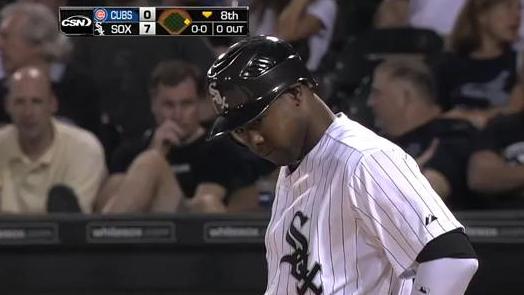
Alejandro De Aza contemplates just having been hit with a pitch.

There is a persistent debate about the point at which a team should stop playing aggressively—the lead size that constitutes a blowout, and when it begins to matter.

According the Cubs, those numbers are six runs and the seventh inning, respectively—at least if Alajandro De Aza is to be believed.

De Aza, the White Sox center fielder, was drilled by the first pitch from Cubs reliever Manny Corpas leading off the eighth inning on Wednesday. It wasn’t that he and Corpas had any beef—to the contrary, said De Aza in a CBS Chicago report, “we’re cool, we’re friends, I’ve known him for a long time.”

The inspiration for the pitch—which De Aza felt was intentional (it certainly looked that way; watch it here)—was likely White Sox right fielder Alex Rios’ decision, after he led off the seventh inning with a single, to take off for second while his club led, 6-0.

Rios never made it, getting forced out on A.J. Pierzynski’s grounder, but the action was unmistakable—as was the response. De Aza said he thought Corpas was told simply “to hit the first guy.” (Watch some of his comments here.)

After the game, Cubs manager Dale Sveum played coy. “I don’t know,” he said in an MLB.com report. “He hit him. It happens sometimes.”

Especially when somebody is paying scant attention to the score. Rios has stolen 171 bases across his nine-year career, so he should have a pretty good idea of what’s appropriate in that regard. It’s also possible that the order came from the bench, probably as a hedge against the double-play more than as a straight steal. If that’s the case, it’s less likely that Robin Ventura simply lost track of the score than that he was insufficiently comfortable with a six-run lead at that point in the game. (Why he would feel that way when facing a Cubs offense that ranks in the bottom five of the National League in hits, runs, doubles, homers, OBP, OPS and slugging is another question.)

Either way, it was the final meeting of the season for the Chicago clubs, so we won’t see a response any time soon. And if De Aza and Corpas meet up during the off-season—you know, like friends do—they’ll hopefully come to the conclusion that the incident was strictly the business of the unwritten rules.

Radio appearances

More Upcoming Radio Appearances

Taped a segment for Michael Smerconish‘s program this morning, discussing Joel Perralta, Joe Maddon, Davey Johnson, pine tar and name-calling. It’ll run at various times; his show is syndicated and can be streamed from his Web site.

I also had a great conversation with Ken Broo of WLW in Cincinnati, partly about Cleveland’s alleged sign stealing, which will air as part of the pre-game package on Saturday, prior to the Reds broadcast.

Mat Latos, Sign stealing

Sign Stealing in C-Town? Mat Latos Thinks So

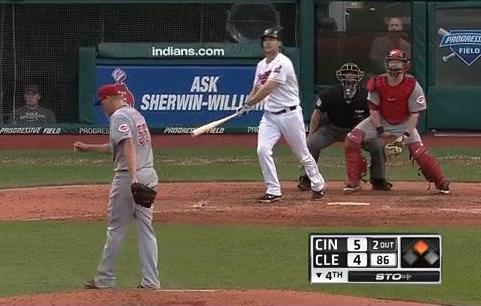
With a runner at second base in the fourth, Casey Kotchman takes Mat Latos deep.

Mat Latos thinks the Indians were stealing his signs. To judge by the evidence, he may be on to something.

After a 10-9 loss to Cleveland on Monday, Latos—who gave up seven runs on eight hits over four innings—identified what he felt were telltale signs:

  • When Cleveland had runners at second, possibly peering in to catcher Ryan Hanigan’s signs and relaying the information toward the plate, hitters were sitting on what Latos felt were good pitches.
  • After reviewing video, he said that the Indians hit the ball significantly better with runners at second base than they did otherwise.
  • With Shin Soo-Choo at second in the fourth inning, Hanigan changed things up. What had been the sign for a curveball turned into the sign for a slider; Latos said that the next hitter, Asdrubal Cabrera, was subsequently looking for a breaking pitch and got jammed.

All of this, of course, could be mere coincidence. It could also mean that Cleveland is a team that likes to know what’s coming.

Either way, it doesn’t much matter. A team’s primary recourse in such a situation is to change signs, and that’s exactly what Cincinnati did; the following day, the Reds held Cleveland to three runs over 10 innings.

Situation solved.

Even Latos, who was more outspoken about the practice than most pitchers who are similarly (allegedly) victimized, was quick to admit that his lack of sharpness prevented stolen signs from being his primary issue. And he didn’t come anywhere close to threatening retaliation.

“Stealing signs is part of the game—that’s not the problem,” said Reds manager Dusty Baker in an interview for The Baseball Codes in 2006. “The problem is, if you get caught, quit. That’s the deal. If you get caught, you have to stop. . . . That’s the truth.”

Then again, Baker also made the point Tuesday in an MLB.com report that “you don’t really have to steal signs when the ball is over the heart of the plate and up”—which it most certainly was for Cleveland on Monday.

Indians manager Manny Acta denied that anything was amiss.

“Ninety-nine-point-nine percent of the players don’t want to know what’s coming, anyway,” he said in a Cleveland.com report. “Because you really don’t want to be taking a chance of leaning out over the plate for a 78 mile-per-hour change-up and have a 95 mile-per-hour fastball in your helmet. By the time you go and complain to the runner on second base, you might be with the paramedics.”

Acta is certainly correct about the negative repercussions, but there’s no way he actually thinks that only three-quarters of a player (yep, that’s the math on 99.9 percent of 750 big leaguers) wants to know what’s coming. There are certainly some holdouts and guess hitters out there, but it’d be a safe bet to say that at least half the hitters in baseball would jump at that type of advantage.

Look no farther than one of Acta’s own players, Johnny Damon, who, while denying that he stole signs against Cincinnati, added that he’d want to know if any of his teammates were, “because I would like to know what’s coming next time.”

There is also another possibility to explain Latos’ frustration on Monday—one that could hurt the pitcher far more than the occasionally pilfered sign.

“Tell [Latos] you don’t have to steal signs when you’re tipping pitches,” said an unnamed Cleveland hitter at MLB.com. And so the intrigue begins anew.

Radio appearances

On the Air in Honolulu

In the spirit of more robust self-promotion (by which I mean any self-promotion), I’ll be listing my occasional radio appearances for anybody in the appropriate local markets. I’ll be on ESPN 1420 Honolulu tomorrow with Bobby Curran at 9:33 a.m. PST. Sadly, it will be on the phone and not in studio. Those also unfortunate enough to be on the mainland can listen live here.

Cheating, Joel Peralta, Pine Tar

Pine Tar Madness Grips Nation’s Capital!

What more fitting place than our nation’s capital for baseball’s latest incident involving high crimes and espionage, which we might as well call Pine Tar-gate right from the start because, well, somebody had to do it.

At one end of last night’s shenanigans was Rays reliever Joel Perralta, supplier of pine tar; at the other was Nationals manager Davey Johnson, who didn’t much care for the extra edge the substance may have afforded the opposing pitcher.

When Peralta came in to pitch the bottom of the eighth, Johnson asked plate ump Tim Tschida to check his glove. And with that, the right-hander was ejected before he even threw a pitch, for what Tschida later said was a “significant amount” of pine tar—a prelude to a likely 10-game suspension. On his way off the field, Peralta tipped his cap toward the visitors’ dugout, a sarcastic display that he later phrased in a Washington Post report as “Good for them.” (Watch it here.)

The moment held intrigue on several levels. One is the fact that the pitcher not only played for the Nationals, but absolutely blossomed for them, as well. At age 34, Peralta went from ERAs of 5.98 (with Kansas City in 2008) and 6.20 (with Colorado in ’09) to a splendid 2.02 mark for Washington in 2010. That season he led the team in WHIP, hits-allowed-per-nine-innings and strikeout-to-walk ratio.

We may now know the reason. Somebody in the Nationals organization obviously had inside information they were willing to share about Peralta’s extracurricular habits; on the coaching staff alone, Nationals bench coach Randy Knorr served as the team’s bullpen coach in 2010, and first base coach Trent Jewett managed Peralta in the minor leagues that same season.

Were either of these people—the Nationals insider who dropped a dime on Peralta, or the manager who was willing to exploit it—playing within the boundaries of the unwritten rules? The short answer is no, but comes with the caveat that Johnson clearly doesn’t care.

Davey Johnson

For proof of this, look no further than Game 3 of the 1988 National League Championship Series, when Johnson—then managing the Mets—asked the umps to check Dodgers reliever Jay Howell. Like Peralta 24 years later, pine tar was found on the laces of the right-hander’s glove. (Darryl Strawberry said that the extreme break on Howell’s pitches tipped Johnson off, but other sources fingered Mets minor league manager Tucker Ashford, who had played against Howell some years earlier.)

Unlike Tuesday’s game, that move appeared to be tactical; Johnson waited until Howell was trying to protect a 4-3, eighth-inning lead, with a full count on leadoff hitter Kevin McReynolds. Howell was summarily ejected, and his replacement, Alejandro Pena, quickly served up ball four, helping ignite a five-run Mets rally.

The Nationals organization also has a history with the topic. In 2005, then-manager Frank Robinson had umpires—oddly, Tschida was behind the plate in that game, as well—check Angels reliever Brendan Donnelly. He was tipped off by his outfielder, Jose Guillen, who had recently left Anaheim under acrimonious terms.

“There’s etiquette and there’s lack of etiquette,” said Donnely at the time, in a Washington Post report. Robinson’s behavior, he said, was “the latter.” Angels manager Mike Scioscia was furious, and threatened to “undress” Nationals pitchers in response. His reaction was not so far removed from that of Rays skipper Joe Maddon—who happened to be Scioscia’s bench coach at the time.

Maddon was peeved enough yesterday to order a retaliatory examination of his own; at the manager’s request, Tschida checked Washington pitcher Ryan Mattheus a half-inning after tossing Peralta, and found nothing amiss.

“Heads up,” Maddon sarcastically told reporters after the game, according to a MASN report, as he wiped his unblemished desktop with a paper towel. “The desk is a little sticky right there.”

His follow-up comments were pointed.

“Insider trading right there,” he said. “It’s bush. It’s bogus, man. That’s way too easy right there. If you had done some really good police work and noticed something, that’s different. But that’s way too easy. That was set up on a tee for them.”

Much of Madden’s disconcert concerns the substance in question. Pine tar is as benign a material as can be illegally found on a ballfield; it is so common that a bag of its powdered form, rosin, is kept atop every major league mound.

Unlike lubricants such as Vaseline or K-Y Jelly, which increase a pitch’s movement by decreasing friction as the ball rolls off a pitcher’s fingers—in effect, allowing it to squirt out rather than roll, with minimal backspin—pine tar adds tack. It’s primarily used by pitchers to get a feel for the ball on cold, wet nights, but—as may have been the case with Peralta, who was pitching in near-70-degree swelter—it can also add snap to a breaking ball.

Said 1997 AL Cy Young Award winner Jack McDowell: “The only [illegal substance] I ever saw was pine tar, and I guarantee 80 percent of the pitchers still use it.”

Apparently, Maddon agrees.

“You’re going to see brand new gloves throughout the major leagues, starting tomorrow—pitchers on every Major League ballclub,” he said after the game, suggesting that pitchers everywhere will be inspired by Tuesday’s events to lay low for a while.

“It’s kind of a common practice—people have done this for years,” he said. “To point one guy out because he had pitched here a couple of years ago, there was some common knowledge based on that. I thought it was cowardly. . . . It was kind of a (expletive) move. I like that word. (Expletive) move right there.”

Ultimately, Maddon is right: If Johnson wanted to play by the unwritten rules, he would either have ignored the pine tar on Peralta’s glove or handled the situation in a far less obvious manner. It’s a stretch to think that having the pitcher tossed even served to level the playing field, because it’s likely that both teams have one or more pitchers who search beyond the rulebook for a similar edge. (“Before you start throwing rocks,” said Maddon to Johnson, through the press, “understand where you live.”)

The standard bearer for Code-based reactions in this category is Tony La Russa, who, when confronted with the fact that Tigers pitcher Kenny Rogers clearly had a clump of pine tar on his left palm during the 2006 World Series, opted against having the pitcher checked—which would have almost certainly led to ejection and suspension—instead requesting only that the umpires make the pitcher wash his hands.

La Russa’s comment at the time: “I said, ‘I don’t like this stuff, let’s get it fixed. If it gets fixed, let’s play the game.’ . . . I detest any B.S. that gets in the way of competition.”

Johnson nailed his man on Tuesday, but it’s easy to feel like a touch too much of La Russa’s B.S. got in the way of Tampa Bay’s 5-4 victory. Then again, it is Washington D.C., a city whose political culture appears to have been built on the stuff.

Update (6-18): Johnson thinks Maddon is a “weird wuss.”

Update (6-20): Peralta got eight games.

Dealing With Records

The Pros and Cons of Putting History First

Jay Schreiber of the New York Times raised an interesting question yesterday: Did Mets manager Terry Collins do the game a service by keeping his infield back with a runner on third and one out in a game New York led, 9-0, in the ninth inning over Tampa Bay?

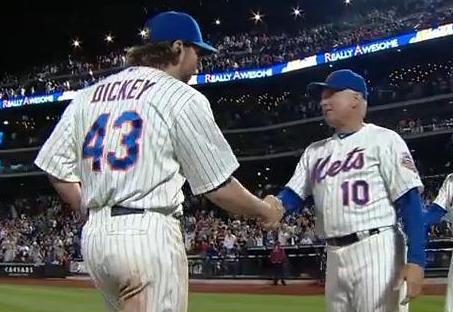
The mitigating detail: R.A. Dickey hadn’t allowed a run in 32 2/3 innings, and while the knuckleballer wasn’t exactly approaching Orel Hersheiser’s record 59 consecutive scoreless frames, it was at least close enought to contemplate the possibilities.

Collins, however, was adhering to the Code—he claimed as much after the game—playing specifically not to stifle the opponent during a blowout with an unnecessary display of superiority, and happy to give up a run for a chance at an out. Sure enough, an infield out led to a run and the end of the streak.

Schreiber’s question: “Would Collins have kept the infield back in that situation and allowed Dickey’s streak to end on a simple grounder to short [had Dickey been at 52 or 53 innings instead of 32 2/3?]

The answer is, probably not, and justifiably so; in many situations through history, a player’s chance at greatness has trumped the unwritten rules. From The Baseball Codes:

Properly dealing with records—either one’s own or someone else’s— has long been a part of the Code. It’s why Yankees outfielder Tommy Henrich laid down a curiously timed ninth-inning bunt to avoid a possible double play, assuring Joe DiMaggio another chance to extend his hitting streak in 1941. (DiMaggio did.)

It’s also why, when Yankees second baseman Bobby Richardson went into the final day of the 1959 season needing a hit in his first at-bat to push his average to .300, manager Casey Stengel informed him that since the Yankees didn’t have a single .300 hitter on the roster he’d be immediately removed from the game should it happen, to avoid falling below the mark in ensuing at-bats. It’s also why members of that day’s opponent, the Bal­timore Orioles, took up the cause: Brooks Robinson informed Richardson that he’d be playing deep in case the hitter found appeal in bunting; pitcher Billy O’Dell offered to groove pitches; and catcher Joe Ginsberg verbally called for pitches instead of dropping down signs. Umpire Ed Hurley even got in on the act, offering that, if Richardson could “just make it close,” things would go his way. Said Richardson, “There couldn’t have been a more complete fix on.” (The fix might have been on, but it wasn’t complete. Richardson doubled in his first at-bat, refused Stengel’s entreaties to leave the game, went 2-for-3, and ended up at .301.)

There are also some examples regarding Hersheiser’s record, the one Dickey was not allowed to approach, and Don Drydale’s mark prior to Hersheiser breaking it. The Code adherents in these cases weren’t players, however, but umpires:

When Drysdale was on the precipice of breaking Carl Hubbell’s National League record for consecutive scoreless innings in 1968, he loaded the bases against the Giants with nobody out in the ninth inning. When he hit the next batter, Dick Dietz, it forced in a run and killed his streak at forty-four innings, four outs short of Hubbell’s mark. Plate umpire Harry Wendelstedt, however, ruled that Dietz made no effort to get out of the way of the pitch, and ordered him back to the plate with a full count, whereupon he flied out to shallow left field. Drysdale got out of the inning unscathed, in the process tying Doc White’s 1904 record with his fifth straight shutout, and eventually ran his streak to fifty-eight and two-thirds innings.

If Drysdale needed assistance from an umpire while playing the Giants to set his mark, so too did the successor to his record. In 1988, Orel Her­shiser compiled forty-two consecutive shutout innings in pursuit of Drysdale’s standard before finally allowing a run on, of all things, a fielder’s choice—against the Giants, of course. Umpire Paul Runge, how­ever, belatedly called hitter Ernie Riles out at first, ruling that baserunner Brett Butler went out of his way to interfere with Dodgers shortstop Alfredo Griffin on the play at second, ending the inning and wiping the run off the board. (“That slide was just like every other time I slid,” said an indignant Butler, who had indeed advanced directly into the bag.) Her­shiser went on to run his scoreless-innings streak to fifty-nine. “It was a slow chopper, and there was no way they were going to get him at first no matter what I did, so what incentive did I have to try to take [Griffin] out?” said Butler. “A lot of times when records are in the balance like that, there’s no explaining some of the things that happen. People react in dif­ferent ways.”

Ultimately, it would have been difficult to protest against Collins looking out for the interests of his pitcher in such a situation. His strategy would have had nothing to do with disrespecting the Rays, and everything to do with propping up R.A. Dickey.

Not much fault to find with that.

Derek Lowe, Dusty Baker, Retaliation

Baker-Lowe Feud Exposes Long-Seated Rift, Hints at Wild Accusations, Spurs Mutomboeque Finger Wag

While people are fixating on Dusty Baker‘s explosive charge that Derek Lowe may have been drinking at the ballpark four years ago, the first thing that jumped out at me from the newly rekindled feud between the two, which has just now grabbed headlines some four years after it allegedly started, was this: Managers still order their pitchers to retaliate?

Apparently, yes.

Sure, most expect to see it when appropriate and applaud when it happens, but from the hundreds of interviews I’ve done on the subject, the overwhelming sentiment is that direct orders in that regard are a thing of bygone eras.

Not according to Baker.

“I told [Reds starter Mat] Latos to buzz [Lowe] and make him feel uncomfortable,” he said to the Cleveland Plain Dealer about a moment in Wednesday’s game.

Come again?

Baker said specifically that while he didn’t order a drilling, he did instruct his pitcher to send an obvious message. Suffice it to say, that message was received. Following Latos’ brushback, Lowe pointed his bat toward the Reds dugout, where he saw Baker wagging his finger at him. (Lowe initially thought it was a signal of denial; Baker corrected him by telling the Plain Dealer that “[Dikembe] Mutombo didn’t shake his finger to say, ‘I didn’t have anything to do with it.’ That means, ‘Don’t mess with me or my team.’ That’s what that means. So he better learn the sign lanugage.”)

Brandon Phillips reacts to drilling.

A half-inning later, Lowe drilled Brandon Phillips in response. (Watch it here.) As an apparently amused Phillips grinned toward his dugout, plate ump Paul Nauert responded by warning both benches.

The origins of this feud are, at this point, pure speculation. Lowe offered only vague details.

“This goes back to my last year with the Dodgers [in 2008],” he said in a Cincinnati Enquirer report. “[Baker] made up some story. A lot of people got involved. People almost got fired over it. You can go ask him right now and he’ll say he has no idea what you’re talking about.”

Baker suggested that Lowe’s drilling of Joey Votto in 2009 was motivated by the mystery circumstance. In response to the pitcher saying he had no respect for him, Baker said this, again from the Enquirer: “Man, I don’t care. A lot of people don’t respect me. He don’t respect himself. The word was whatever he did and said probably there was a good chance he was drinking at the ballpark and he don’t remember what he said or what he did. OK.”

Baker and his team had a chance to retaliate for Votto’s drilling in ’09—Lowe, then with Atlanta, faced the Reds once more that season, and emerged unscathed. (The final score of that follow-up game was 3-1, Cincinnati, a margin perhaps too thin for Baker to be settling scores. Then again, a brushback like Latos ultimately delivered hardly matters in that regard.)

Either because it’s personal and not team-related, or because Lowe handled things sufficiently on his own, there was no follow-up action from the Indians when the teams played on Thursday.

Baker has been known to possess a long memory when it comes to this type of thing; in an interview for The Baseball Codes, he said, “You can’t carry stuff over unless you’ve got a long history with a guy.” This certainly qualifies as long history, but without details there’s little point even in speculating about the cause.

In the end, I keep coming back to the same question: Managers really order retaliation from their pitchers in 2012? Like many of the details in this particular drama, it merits further exploration. Ultimately, of course, we’re only going to find out as much as people are willing to talk about, which has already been more than we’re used to. Stay tuned.