My most recent piece is up at Sports Illustrated.com. No need to read it if you’re a regular of this blog; it’s essentially the same as the David Ortiz-Kevin Gregg piece I posted yesterday. (Baseballcodes.com: Now a source for sneak previews!)
David Ortiz charged the mound on Friday. What he thought he was doing was putting an end to some half-baked intimidation tactics from Orioles pitcher Kevin Gregg. What he actually did, however, held significantly more interest. With one inspired charge the guy tore open baseball’s unwritten rulebook, giving us a good look inside; before the game was done, the Red Sox and Orioles touched on no fewer than five distinct sections of the Code.
To recap: Boston hammered the O’s for eight first-inning runs, highlighted by Ortiz’s three-run homer. By the time Ortiz batted in the eighth, the score was 10-3. Gregg—Baltimore’s closer, in the game to get some reps—threw three inside fastballs to him, two of which forced Ortiz to jump backward.
After the third, Ortiz took a few steps toward the mound, pointing and shouting. Dugouts emptied, but no punches were thrown. Once order was restored and the at-bat resumed, Ortiz popped up Gregg’s next pitch to right field. As he ambled toward first, Gregg lit into him verbally, inspiring Papi to cut short his trot in favor of a sprint toward the mound. (Watch it here.)
Enter the unwritten rules.
• When your pitching staff can’t seem to slow down the opposition, make things uncomfortable. Boston had abused Baltimore pitchers to that point, scoring 20 runs over two games. (It was part of a five-game streak in which the Orioles gave up 10 or more runs four times.) A pitcher can hardly be blamed for trying to gum up a roll like that.
What’s unknown is whether Gregg requested entry into the game specifically for this purpose. As it was, the right-hander did everything by the book. Drilling a hitter for his team’s success is usually unnecessary. The pitcher’s job in such a situation is to move a hitter’s feet, make him uncomfortable, get him out of his groove. Gregg wanted Ortiz to think about something other than hitting another homer, and in that regard he was wildly successful.
“I take offense to every run scored off every one of our pitchers . . .” Gregg said after the game, in an AP report. “You get tired of getting your butt kicked every night when you come in here, and I’m going to stick up for what’s ours and try to get the plate back.”
This leads to a corollary rule, exhibited here on a purely theoretical basis owing to the fact that Gregg probably wasn’t trying to hit Ortiz (but presented in case he was):
• Hitting a guy intentionally is harder than it looks. “As a pitcher, your preparation and your mechanics all prepare you to throw the ball to a spot, usually to the catcher’s glove, and that’s where your focus is,” said former pitcher Shawn Estes, who famously missed Roger Clemens while trying to retaliate for the Rocket’s shenanigans against Mike Piazza in the 2000 World Series. “Well, it’s tough to take your focus off that and try to hit a moving object. . . . It’s not as easy as it looks.”
If Gregg missed his target—three times—he wouldn’t have been the first to do so.
Other pieces of the Code in question on Friday:
• Don’t swing at a 3-0 pitch with a big lead late in the game. The fastball that Ortiz popped up came on a 3-0 count, with his team holding a seven-run in the eighth. That’s domain in which a pitcher unequivocally expects a freebie. (With such a lead, say the baseball Gods and Kevin Gregg, it’s the least a hitter can do.) “It’s 3-0, they’re up seven, and I think there are some ethics to this game and guidelines that you have to stay within,” Gregg said in the Boston Herald.
There’s little question that the pitcher was sending a message with his inside fastballs. With that swing, Ortiz sent one of his own.
• Run to first base like you care. This is where things got sticky. Ortiz, clearly unhappy to have hit a short fly ball, took a few sad steps toward first before starting to trot. Had Gregg not been predisposed to friskiness, it’s unlikely he would have taken umbrage. But keyed up as he was after Ortiz’s 3-0 swing, the slight delay provided all the provocation necessary for the right-hander to profanely urge Papi to step it up.
Plate ump Mike Estabrook tossed Gregg immediately, but it wasn’t enough to keep Ortiz from turning and charging. He ended up throwing several punches (none of which connected), and benches again cleared. Ejections (primarily Ortiz and Gregg) followed.
• Everybody joins a fight. This is a no-brainer. From The Baseball Codes: “Most of the Code is about respect for the opponent, but this rule is about respecting teammates. It’s the most basic of sacrifices, and the fact that the majority of baseball fights don’t involve much actual fighting is almost incidental; it’s a matter of loyalty that can’t be ignored. Hall of Famer Ernie Banks called a player’s failure to join a fight ‘the ultimate violation of being a teammate.’ ”
On Friday, Boston’s Josh Reddick took this rule to an extreme. He was on third base when Ortiz hit the ball, and tagged up. Once hostilities erupted, however, he headed for the mound rather than the plate. That was enough for the umpires to declare him to be the third out of the inning.
As if to take things a step further, Red Sox infielder Marco Scutaro—all 5-foot-10 of him—was the first guy to reach Gregg (6-foot-6, 230 pounds), and as such was tasked with trying to slow the big fella down. It can only be seen for a moment in the game footage, but Gregg offers an inadvertently impressive show of strength, tossing around a clinging Scutaro basically by waving his arm.
We could also get into the concept of waiting for retribution, as Sunday’s series finale featured three HBPs and one near-HBP, most of which were likely unintentional. (It was Red Sox pitcher Kyle Weiland’s first big league start, and neither of his hit batsmen bore any hallmarks of intention; also fitting that bill was Orioles pitcher Jeremy Guthrie, who hit Kevin Youkilis with a changeup.) If there was a message pitch, it came from Mike Gonzalez, who in the sixth threw a fastball behind Ortiz.
After that, though, all remained quiet. Gregg had his say, Ortiz had his own, each club followed up and everybody moved on. Wildness has its time, but so too does order. It’s the Code at work, and it’s a beautiful thing.
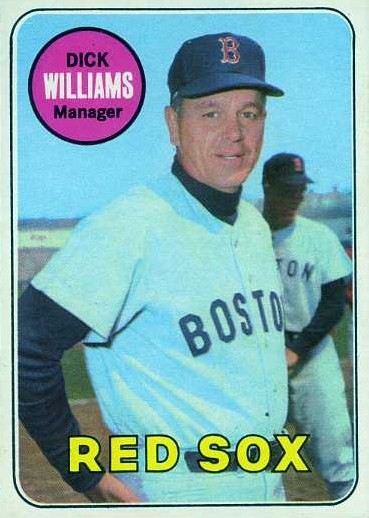
Dick Williams, who passed away yesterday at age 82. In addition to being a Hall of Fame manager, he was also a stickler for the Code, and never afraid to retaliate when he felt it appropriate. He was at the helm of the San Diego Padres for their one-game war with the Braves in 1984, which Kurt Bevaqua called “the Desert Storm of baseball fights.”
That episode is detailed in The Baseball Codes. The following passage, however, was cut from the final edition. It details Williams’ understanding of the unwritten rules, even if his use of it was not always by the book. In honor of Williams, we present it here.
Dick Williams took over the Red Sox in 1967 as a 38-year-old rookie skipper, and guided a club that was coming off of back-to-back ninth-place finishes to the World Series. Still, amid acrimony and injuries to two key starting pitchers, Williams was fired before he could complete his third season—something about which he harbored resentment for years. Once Williams assumed managerial duties for other teams, he didn’t just want to beat the Red Sox, he wanted to destroy them.
Williams bunted whenever he could to advance runners into scoring position, even when games were well in hand. His baserunners tagged up from second on fly balls, even when leads relegated such tactics as unnecessary. And he squeezed.
If stealing second base with a big lead is enough to make an opponent’s head spin, squeezing is enough to blow it clean off his neck. There is no surer statement of we’re-going-to-pull-out-every-last-calculated-measure-in-our-playbook-to-push-another-run-across.
Williams took over the Angels in 1974, and during a game against Boston the following season his club used a hit, a walk and an error to extend its lead to 6-2 in the eighth inning. The manager knew just what to do. With runners on second and third and second baseman Jerry Remy at the plate, Williams called for a squeeze that extended the Angels’ lead.
“You do what the manager says,” said Remy, “but I knew it was the wrong thing to do.”
The next day, Boston pitcher Roger Moret threw at Remy with his first pitch of every at-bat, a subtle message that the squeeze was not appreciated. Fortunately for Remy, he missed all four times. “After the game, (Williams) said to me, ‘I guess I got you thrown at,’ ” said Remy. “I said, ‘I guess you did.’ ”
There’s a reason that baseball doesn’t have the chest-thumping of the NBA, or the equivalent of a football player leaping up after a two-yard carry with a first-down signal.
Baseball doesn’t have much tolerance for that kind of thing. Save for game-winning plays, look-at-me moments are nearly universally frowned upon.
Which is part of the reason that Andres Torres and the Giants aren’t looking at Chad Qualls in a friendly light today.
With the Giants trailing 5-3 in the seventh, Torres won his first battle with Qualls, working back from a 1-2 count to see 16 pitches—fouling off 11 of them in an at-bat that took more than eight minutes—before drawing a base on balls. He then stole second, and advanced to third on an infield grounder.
That’s where he was when a Qualls pitch squirted away from catcher Nick Hundley; after delaying to assess the situation, Torres belatedly broke for home.
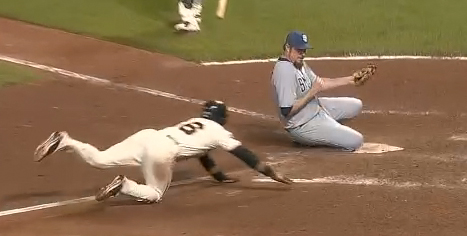
Hundley’s toss to Qualls, covering the plate, was in plenty of time. Qualls went into a bit of a slide while making the tag and essentially sat on the plate to keep Torres from touching it; the putout ended the inning with San Francisco’s best hitter, Pablo Sandoval, up to bat and the tying run at second. (Watch it here.)
It’s understandable that Qualls was pleased with the development, especially in light of the frustration he must have felt after Torres’ marathon at-bat. Which doesn’t diminish the fact that he spiked the baseball and yelled at Torres on his way back to the dugout.
“That’s not professional,” Torres told reporters after the game. “I don’t believe in making a show on the field.”
Torres talked about respect, both for the game itself and for one’s opponents. He got passionate when discussing his own protracted path to the big leagues, intoning that he’s come to far, at too great a price, to be disrespected like that on the field. (Watch the entire exchange here.)
Direct payback for Qualls is unlikely, since, as a reliever, it’s a longshot that he’ll come to bat against the Giants. Retaliation against one of the Padres’ hitters isn’t out of the question but is similarly unlikely unless San Francisco breaks through with a passel of early runs today, giving their pitchers a bit of leeway when it comes to things like settling scores.
Then again, these teams face each other 14 more times this year. There is, as the saying goes, a lot of baseball yet to be played.
Update:This just in from Dan Brown of the San Jose Mercury News, who tracked down Qualls before today’s game: The reliever doesn’t feel good about what he did. “I’m sorry that it happened,” he said. “I meant no disrespect. That’s not what I intended. I play this game with passion and to, me, that situation was as elevated as it gets for my type of inning.”
Joe Mauer's pitch selection didn't do much for one of his relievers.
To judge by the accusations flying around the major leagues, this is the summer of our discontent.
Players just can’t seem to keep their frustrations to themselves. Despite baseball’s unwritten rules mandating a strict moratorium on talking to the media about interpersonal gripes, there has been a steady stream recently of big league vituperation leaking through the seams.
Last week, Twins southpaw Jose Mijares became the latest in a string of pitchers to call out teammates, venting about the pitch selection offered to him by catcher Joe Mauer after Prince Fielder hit one of his fastballs — the sixth straight one he threw — for a game-winning double.
“I don’t know what was going on with Mauer,” Mijares told the Minneapolis Star Tribune. “He never put down the sign for a breaking ball. Never.”
Never mind that manager Ron Gardenhire expected a steady stream of sliders thrown to the Brewers’ slugger; Mijares’ lack of public discretion with his comments was stunning.
Or it would have been had it not been so entirely within this season’s norm.
The year’s most discussed outburst came courtesy of A’s reliever Brian Fuentes, who in late May used the press to question his manager, Bob Geren, about, among other things, “zero” communication with his bullpen. This was less an emotional outburst than a calculated maneuver intended to undermine Geren — and it worked. Soon other players were piling on.
Rockies closer Huston Street, who played under Geren in 2007-08, told the San Francisco Chronicle that the manager was the “least favorite person I have ever encountered in sports.” Geren was fired a less than two weeks later.
Mijares and Fuentes, of course, are only the beginning when it comes to this season’s loose-lipped pitchers. Take the Blue Jays’ Rickey Romero, who recently vented about the lack of run support he’s received.
Or Carlos Zambrano, who called the Cubs “a Triple-A team” and criticized closer Carlos Marmol‘s pitch selection in a game-tying, ninth-inning St. Louis rally that cost Zambrano the victory.
Or Cincinnati’s Edinson Volquez, who ripped the Reds’ offense for its lack of production.
And it hasn’t been limited to pitchers. Florida outfielder Logan Morrison questioned Hanley Ramirez‘s commitment following the shortstop’s belated appearance at Jack McKeon‘s first meeting as Marlins manager.
Elsewhere in the NL East, Chipper Jones publicly questioned teammate Jason Hayward for his stance that he wanted to be entirely healthy before taking the field following a shoulder injury. Jones told The Atlanta Journal-Constitution that “there are a bunch of his teammates that are out there playing with discomfort and not healthy, and still going at it.”
Then there’s Mets owner Fred Wilpon, who got in some digs on Jose Reyes, Carlos Beltran and David Wright in what was otherwise an expansive and sympathetic piece in The New Yorker.
This is an awful lot of pot stirring from guys who should know better.
*****
“All I can do is just pitch,” Romero told the Toronto Star after giving up a two-run homer to Tim Hudson in a 2-0 loss on June 20. “I can’t worry about the offense and what they do. I’ve always said this at one point we can’t rely on [Jose] Bautista, we can’t rely on [Adam] Lind. We’ve got to get somebody else to step up and get on base and drive them in. These guys are getting pitched around. Everyone’s got to step it up or else we’re not going to be winning ballgames.”
Romero is only 7-7, despite a 2.74 ERA and 96 strikeouts (12th in the AL), largely because Blue Jays hitters have given him 3.6 runs per game, as opposed to 4.75 in starts by everyone else on the staff. Remove his two starts in which Toronto scored a combined 26 runs, and the Jays have averaged 2.3 runs per game for the righthander.
This is reasonable cause for frustration, and the pitcher could have easily unloaded with far more force than he did. He even went on to clarify that his teammates are “all trying.” These are hardly incendiary statements.
None of which matters a bit. Whenever a player — particularly a pitcher — publicly pins blame on his teammates (no matter how gently or justifiably), it rarely ends well.
In 1999, the Chicago Sun Times devoted an entire story to a comparison of the finger-pointing by Cubs pitcher Steve Trachsel and White Sox pitcher Jamie Navarro, who both pitched on Aug. 22 of that year, both lost, and both deflected at least some of the blame. The opinion: Navarro won, by a landslide. “I don’t think I’ve pitched that badly this year,” the righthander said following his 9-4 loss to the Baltimore Orioles. “I can only pitch. I can’t hit for the guys.” What he failed to mention was that he gave up all nine runs, had surrendered seven runs in two of his previous three starts, and sported a 6.19 ERA.
It’s reminiscent of Volquez, whose recent statements about his teammates — “In the last five games, how many runs have we scored?” he asked. “Like 13?” — came immediately after he gave up seven runs (six earned) in 2.2 innings against Cleveland to increase his ERA to 6.35. The Reds were so enamored with his act that they shipped him to Louisville the following day.
*****
Morrison violated an unwritten rule of his own when he called out Ramirez, a player of significantly more stature than himself in terms of tenure, accomplishments and paycheck. According to the Miami Herald, Morrison “ripped” into the Marlins star after Ramirez showed up nearly an hour late to McKeon’s 3:30 p.m. pregame meeting, going so far as to finger the shortstop’s perpetual tardiness as a reason for his .200 batting average. (McKeon responded by benching Ramirez, sending a somewhat less verbose message of his own.)
It’s not the first time that members of the Marlins have grown fed up with Ramirez’s act. Last year, then-manager Fredi Gonzalez and teammate Wes Helms criticized him publicly following an incident in which Ramirez kicked a ball into the corner, then loafed after it as two runners came around to score. Their recriminations had little effect, at least at first.
Things had clearly reached a breaking point for a second-year player like Morrison to strive for clubhouse order at the expense of the team’s most prominent player. Ramirez’s clueless response to the criticism offered echoes of last year, when he told reporters that he “wasn’t late yesterday” because he arrived before the team’s 4:30 stretch, and that he comes in “at 3:30 every day,” despite the fact that he obviously did not. “Everybody knows it wasn’t my fault, so I wasn’t late,” he said cryptically.
Handling the situation with significantly more aplomb was Morrison, who kept his sentiments from the press, refusing to discuss them after they were leaked. “I’d rather have what happened in the clubhouse stay in the clubhouse,” he said, and left it at that. Which is exactly as it should be.
*****
Zambrano got personal with his comments, chiding Marmol for throwing a slider that Ryan Theriot hit for a game-tying double, ignoring the fact that, as Zambrano told Chicago reporters, “Ryan Theriot is not a good fastball hitter.” It was the second straight game in which Marmol coughed up Zambrano’s lead.
Cubs manager Mike Quade did not discipline his pitcher for the remarks, and Marmol has said that he is not perturbed. Still, Zambrano apologized to the closer.
Romero also apologized. Even Fuentes, who got what he wanted in his manager’s dismissal, apologized to Geren for his statements — not the sentiment, but the public nature of their dispersal.
As for Minnesota’s Mijares, prevailing wisdom holds that a middle reliever has little business calling out a league MVP like Mauer, let alone the Twins’ most important player since Kirby Puckett. That fact made Mauer’s follow-up comment, that he called for a fastball — just not a fastball “right down the middle” — all the more amusing.
Then again, Gardenhire wasn’t laughing.
“A lefthander’s got to come in and hopefully spin some pitches …” he said. ” I could leave a right-hander in to throw fastballs.”
If it sounds like he was taking his pitcher’s side, that wasn’t necessarily the case. Gardenhire called pitcher and catcher together for a meeting, during which Mijares apologized to Mauer for his outburst. And in so doing, the skipper cut to the heart of many of the above problems.
“The one thing the manager can do is second-guess the heck out of it because I get second-guessed myself by [the media],” he told the Star-Tribune. “So I can say those things — I would like to see a breaking ball — but the pitcher can’t. If he doesn’t want to throw something, don’t throw it.”
Last month I wrote in this space about the spate of verbal indiscretions committed by people around baseball who should really know better. Since that time, it’s only gotten worse. A natural topic to start with.
The SI pieces will be coming roughly ever couple weeks, and I’ll republish them here. I’ll still be writing regularly for this blog, as well. Enjoy.
Brad Ziegler can't believe he just hit Justin Turner.
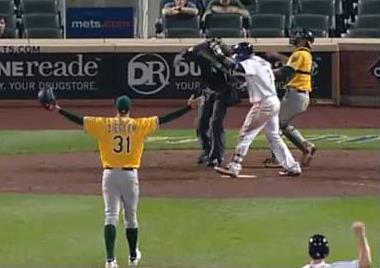
It started on Wednesday, when Mets second baseman Justin Turner was hit by a pitch with the bases loaded in the 13th inning, driving home the winning run against the A’s. The problem with the play, as far as the A’s were concerned, was that Turner made no effort to avoid the pitch, which barely grazed his jersey. (Watch it here.)
Whether this had any bearing in what happened next is uncertain, but in Turner’s first at-bat Thursday, A’s right-hander Graham Godfrey hit him in the leg—something seen by many in the New York clubhouse as clear retaliation.
There are many problems with this scenario, primary among them being the written rules of the game. Rule 6.08(b)(2) says that a batter takes first base after being hit by a pitch unless he “makes no attempt to avoid being touched by the ball.” Turner rotated his torso—barely—which was apparently enough for plate umpire Fieldin Culbreth. And in a situation like this, if the umpire has no beef, the opposition shouldn’t, either.
Perhaps it was an attempt by new A’s manager Bob Melvin to set a tone with the team. (Unlikely.) Or maybe it was Godfrey, all of three games into his big league career, trying to establish some bona fides in the Oakland clubhouse. (He’s no stranger to hitting guys, having done so 38 times over four-plus minor league seasons.)
Or maybe it was strictly incidental, no more than a case of rookie nerves or a pitch that got away. This is how the Mets treated it, opting to ignore the incident and get on with what would be a 4-1 victory.
One guy, however, was less than pleased. According to ESPN New York, Jeff Wilpon—the team’s COO, and son of owner Fred—took to the team’s clubhouse following the game and admonished his players for their timidity. He said, according to the New York Times, that he would cover pitchers’ fines for such actions. Unlike the ominous tone set by ESPN, the Times called Wilpon’s interaction “playful.”
No matter how he meant it, this is a dangerous road to travel. There’s a reason that modern managers and coaches tend to shy away from directly ordering retaliatory action. They don’t want to be responsible for unforeseen consequences, and they—having all played the game at various professional levels—understand that most big league pitchers understand appropriate retaliatory tactics (and that if they don’t, their teammates will inevitably instruct them in such).
Jeff Wilpon primarily supervises the construction of buildings, in his role as executive vice president of his father’s real estate company. He is not a baseball man, at least to the point at which he has any business ordering his players to do anything on the field. He clearly likes the gunslinger mentality of retaliating for retaliation’s sake, but hasn’t likely considered the negative repercussions. Should the A’s respond to Wilpon’s response, the likely target would shift from Turner to somebody like Jose Reyes or David Wright.
Picture for a moment Reyes getting sidelined for six weeks due to a cracked rib suffered at the wrong end of a retaliatory fastball—disabling him straight through the trade deadline.
Leave retaliation to the pros, Mr. Wilpon. You just put a target on your team, as far as any examination the league might take when it comes to any future bad exchanges of bad blood.
Also realize that in 1998, your manager was suspended while at the helm of the Angels for his part in retaliating against Kansas City after Royals infielder Felix Martinez sucker-punched Anaheim’s Frank Bolick during a game.
Terry Collins is able to recognize retaliation-worthy offenses. Let him. Stay in the owner’s box, where you belong.
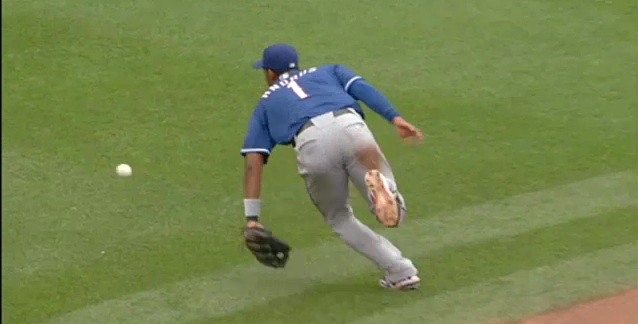
Elvis Andrus chases one of the balls that likely led to his mental lapse later in the game.
Whenever they make headlines, baseball’s unwritten rules inevitably invoke something that happened regarding some indignity and the response to it. It’s frequently the kind of stuff that stirs debate about whether this whole Code thing is worth it and why are grown men throwing baseballs at each other, anyway?
These issues are inevitably about respect.
When Elvis Andrus violated an unwritten rule last week, it was also about respect, but it had nothing to do with the the opposition. Andrus, at least in the eyes of his manager, showed insufficient consideration for his own teammates.
In the eighth inning of Sunday’s game against the Twins, Andrus fielded a grounder hit by Rene Rivera and half-heartedly flipped the ball to first, pulling Michael Young off the bag. The best guess is that the shortstop’s head was elsewhere, after he committed an error an inning earlier, and failed to convert another play that he frequently makes. Following the error, Minnesota scored five unearned runs in an eventual 6-1 victory.
Perhaps Andrus simply felt that because Rivera is a slow-footed catcher (one stolen-base attempt in parts of four major league seasons) the throw merited something less than his best effort.
The play wouldn’t have received much attention had manager Ron Washington not addressed it directly; the following inning, when it was Andrus’ turn to hit, Andres Blanco stepped to the plate instead.
“I didn’t like his attitude,” Washington told the Dallas Morning News, regarding his decision to pinch-hit for his shortstop. “The inning before there were a couple of plays he didn’t make, but he gave the effort. There are going to be plays that you can’t make. On that play, there wasn’t energy. Elvis is better than that. I didn’t chew him out, but I let him know that.”
If anything, this type of play is even less defensible than a hitter failing to run hard out of the batter’s box; the batter, at least, is expecting somebody else to make a play on him.
This was a teachable moment for Washington, but based on Andrus’ postgame comments, it’s unclear if any learning actually took place.
“I was trying to make an easy throw,” Andrus said. “I don’t throw it hard all the time. I had plenty of time. If I had thrown it hard and it got away from him, nobody would have said anything. But if you throw it like that and it gets away, they say you gave up or you’re not trying. That wasn’t it.”
He should remember that Washington showed some tact with his actions, waiting until his shortstop had already left the field to pull him. When Reggie Jackson angered Billy Martin by failing to hustle after a flyball in 1977, the Yankees’ skipper removed him in the middle of the inning (famously leading to a near-brawl in the dugout).
Ron Washington is no Billy Martin when it comes to fiery temperament—and as much as Andrus might complain privately about his treatment, as far as he’s concerned, that’s a very good thing.
A lot of things happened last week between the Diamondbacks and Nationals. Jayson Werth was hit three times, and made scary eyes at pitcher Ian Kennedy after the last one. An inning later, Washington’s Jason Marquis drilled Justin Upton for the fourth time in the series, and was tossed—as was his manager, Jim Riggleman. (Watch it here.)
In the eighth, Arizona reliever Esmerling Vasquez hit Danny Espinosa with a clearly intentional fastball (watch it here), bringing Werth to the top step of the dugout with a look that said he wanted nothing more than one more provocation to charge the mound.
It’s can all be dissected down to its core. Marquis denied intent, and while it certainly seemed like he meant it, it must be noted that a 1-0 game is not the time to settle scores. Also, it would have been entirely reasonable for plate ump Rob Drake to give Marquis one shot at response (or even acknowledge that the pitcher probably didn’t want to put anybody else on base) before bringing down the hammer. Still, Marquis drew a five-game suspension.
(To Drake’s benefit, Kennedy hit Michael Morse two batters after he hit Werth, and was not tossed out because it was clearly unintentional.)
Riggleman and D-Backs skipper Kirk Gibson were also suspended. Vasquez drew a three-game ban of his own, which seems well worth it for the third-year pitcher in light of the fact that his teammates appreciate him for having done something others on the staff have shied away from.
Still, despite the drama, it was all very straightforward stuff—you-hit-me, I-hit-you. A standard retaliatory dance.
Wilson Ramos, however, raised the stakes one batter after Espinosa was hit, when he slowed down his home run trot after blasting an eighth-inning bomb, and then slowed it down some more—all the way into the realm of clownishness. (Watch it here.)
Larry Granillo’s Tater Trot Tracker pegged Ramos’ journey at 28 seconds (despite the fact that he ran hard most of the way to first)—more than 20 percent slower than his usually glacial pace.
My first thought, as I watched the home run the first time, was that it looked like Ramos had slowed down into his final walk—you know how trotters tend to slow down those last 10 or 15 feet before home plate—about 250 feet too early.
But it only got worse. At both second and third base, you can see Ramos go into an even slower trot before essentially strolling the last 45 feet.
The truly crazy part? After the game, Ramos said this:
“I didn’t feel bad. I wanted to see those guys angry.”
Admitting one’s sins is a cardinal Code violation (although even in the best circumstances it’s difficult to deny ownership over one’s own jogging pace.) Unlike a pitcher who admits to hitting a batter intentionally, this is not an actionable violation as far as the league office is concerned. It is, however, a stratospheric level of trash talk. And Ramos got his wish in seeing them angry, at least as far as Matt Williams was concerned.
Williams, Arizona’s third-base coach, is one of the premiere Code warriors of his generation. He is the standard-bearer when it comes to circling the bases properly after hitting a homer—head down and quickly.
Also, he’s never been shy about informing players—teammates and opposition alike—should they be so foolish as to violate an unwritten rule in his presence. As Ramos circled the bases, Williams visibly steamed.
(Dan Steinberg has some great screenshots of it over at the Washington Post. He also passes along this quote from TV analyst Mark Grace: “If that look is directed towards you, folks? Go home. I suggest you go home when Matt Williams looks at you like that.”)
Ramos got his reward (his trot) and then got it again (his comments), but he’ll almost certainly pay the price. The teams next meet on Aug. 22. The question now seems less about whether Ramos will be drilled, but when—and maybe even how many times.
Considering that Werth, Upton and their teammates already have a short fuse for this type of thing when it concerns this matchup, there’s plenty to look forward to.
At this point, the minor leagues are a mixed bag for Bryce Harper. On one hand, he has to deal with long bus rides and crappy clubhouse food.
On the other hand, accounts of the firestorm he ignited yesterday by blowing a kiss to the pitcher who had just served him up a home run are inevitably concluded with a caveat along the lines of, “It’s the minor leagues; this is all part of the learning process.”
(Of course, were he in the majors, the video of his little discrepancy wouldn’t be embeddable, and thus watched across countless Web pages this morning.)
After Harper smacked his homer against Greensboro’s Zach Neal, he stood in the box, then slowly—slooooowly—walked up the line as he watched it clear the fence. That alone would have earned him a drilling at the big league level, but as he crossed the plate he upped the ante, turning his head toward Neal and puckering his lips.
It was stupid. It was juvenile. But ultimately those caveats were right: it is what the minor leagues are for. Harper is 18 years old. His actions indicated neither class nor respect, but those things are not necessarily inherent in teenaged humans.
Duane Kuiper was on the radio in San Francisco yesterday, before this story broke, talking about the MLB draft. Had he signed a pro contract straight out of high school, he said, moving from his family’s Wisconsin farm directly to the minor leagues, he would have ended up right back on that farm inside of two seasons. Some kids are ready at that age to make such leap, but by his own admission, Kuiper (who ultimately graduated from Southern Illinois University) of was not one of them.
Harper might not be one of them, either. Going back to the farm, however, is not an option. The $9.9 million contract he signed has placed him higher on the food chain than peers and coaches alike. He was on the cover of Sports Illustrated at age 16, and has had his ass kissed on a fairly consistent basis for the bulk of his teenage life. This is not his fault (nor is it even necessarily a bad thing), but it hardly encourages appropriate development of socialization skills.
He’s clearly aware that a quick ascension to the big leagues is all but assured, no matter how boorish his behavior.
Greensboro’s response—in Harper’s next at-bat he was backed up by an inside fastball—had about as much teeth as anything else the guy will face as long as he’s the biggest fish (by a wide margin) in a comparatively small pond. He will become socialized some day—when veterans whose status and contracts exceed his own put him in his place.
“At some point the game itself, the competition on the field, is going to have to figure out a way to police this young man,” said Mike Schmidt on SportsCenter. “If indeed his manager won’t, the game will end up taking care of it.”
That’s the way of the Code. Until Harper reaches the big leagues, however, let’s see him for what he is: a clueless 18-year-old who deserves a chance to figure things out.





 The Baseball Codes
