Sales

Amazon Sales Continue to Climb

It’s difficult to know what Amazon rankings really mean, but I’m happy to hang my hat on whatever will support it. As of today, The Baseball Codes is the No. 1-selling baseball book on Amazon, the No. 3 overall sports book (non-Kindle edition) and hit No. 111 105 overall. Placement in the New York Times Sunday Book Review certainly didn’t hurt.

Thanks to everyone for the ongoing support.

– Jason

The Baseball Codes

Michael Talks about the Codes

Lowell Cohn is not your ordinary newspaper writer – he has a PhD. in English Literature and has been an instructor at the world-famous Stanford Creative Writing Program, and he has won numerous national awards for his work.

So, when Lowell says nice things about the book, we proudly blush — and encourage you to read his kind words. He liked it so much, he not only wrote his Sunday column on the subject, he also posted an interview with Michael in his blog, The Cohn Zone.

The article can be found here: Sunday Column

The blog can be found here: The Cohn Zone

The book can be found everywhere — on line, or at your local bookseller. Support local folks if you can.

-Michael-

Excerpts

Codes Excerpt in the New York Times

For what it’s worth, the Times has also excerpted the beginning of Chapter 7 (Don’t Show Players Up).

It starts with the story about Mickey Mantle unintentionally mocking Willie Mays during the 1961 All-Star Game at Candlestick Park in San Francisco by clapping like a madman after Whitey Ford struck out the Giants slugger on a spitball. (His delight stemmed from the fact that it won the Yankees’ duo a lucrative bet with Giants owner Horace Stoneham).

Happy reading.

– Jason

Review

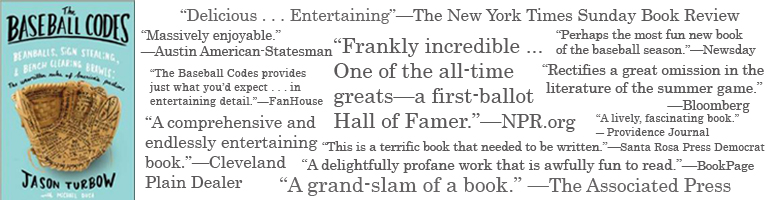
New York Times Sunday Book Review: The Baseball Codes ‘Delicious’

On Sunday, the New York Times’ Sunday Book Review will weigh in on The Baseball Codes, but those who can’t wait to read it can already find it online.

The piece’s overall tone is positive, including this: “The stories the authors have unearthed to illustrate ballpark justice and morality are often delicious.”

Still, the author, Bruce Weber, while clearly knowledgeable about the game, does not appear to be a proponent of the unwritten rules as a whole. (Sample sentiment: “How players follow this principle takes some interesting forms, and in many places ‘The Baseball Codes’ reads like a lab report by a psychologist who has been observing hostile toddlers whack one another with plastic shovels in a sandbox.”)

This bias clearly does not work in our favor.

Still, the book is referred to as casual sociology, which was intended, and Weber takes the time to recount four stories from within its pages (not bad for a review of fewer than 900 words).

Also, he manages to call us “obvious baseball obsessives,” which is nice.

– Jason

TV appearances

The Baseball Codes Hits Bay Area Airwaves

The first TV appearance of the season happened Monday night, on with Gary Radnich on the set of KRON’s evening news.

As is his way, Gary blew into the studio approximately 60 seconds before he went on, just enough time for a quick hello before he launched into his sportscast. I was on in the second segment. We had a quick chat during the commercial break about what to cover, ended up talking about other things entirely, and spent time with a studio fly.

It’s tough to get into much detail over the course of four minutes, but that doesn’t preclude the possibility of having some fun. Mr. Radnich could not have been more accommodating.

All in all, a success.

– Jason

Don't Showboat

Kendry Morales: ‘I Didn’t Know how the System Here Works’

In this week’s Sports Illustrated, a profile of Angels first baseman Kendry Morales describes the player’s reaction after hitting a long home run in A-ball, on his first professional swing after defecting from Cuba.

The ball cleared the scoreboard before Morales made a move toward first base. “He threw the bat down on top of home plate and watched it go, did a real circus trip around the bases,” says (Angels Scouting Director Eddie) Bane. “I remember Bruce Hines, our minor league coordinator at the time, said, ‘Uh-oh, we’re in trouble here.’ ”

In Cuba, Morales explains, fans expect a slugger to put on a show. But in the U.S. such displays tend to get someone beaned. “Well, not me, but the guy behind me,” Morales says with a chuckle. “I was adjusting. I didn’t know how the system here works.”

Looking at the Code through an international lens can be fascinating. In Latin America, ballplayers are allowed far more leeway when it comes to on-field self-expression than they are in the U.S. In Japan, the Code is so firm — and so stacked against foreigners — that many Americans who play there experience a significant degree of culture shock. (For the ultimate look at the subject, check out “You Gotta Have Wa,” by Robert Whiting.)

During the process of researching The Baseball Codes, we pursued the question of whether the recent influx of Asian players to the major leagues, on top of the already established population of players from Latin America, could serve to alter the unwritten rules.

Aside from the occasional flashy Dominican who points to his heritage as explanation for his unbridled on-field enthusiasm (Carlos Perez, anybody?), the answer is resounding: It hasn’t changed a thing. We interviewed any number of players who made the jump from foreign leagues to America (as well as several Americans who made the reverse trip), and to a man they said it was a struggle to adapt to Code-based expectations.

(Most interesting for me in this regard was Mac Suzuki, who was born and raised in Japan but who learned baseball in the U.S. He returned to Japan after his six-year big league career, and struggled with their rigid set of expectations. Despite knowing as little about Japanese clubhouse customs as any of his American counterparts, he was granted none of the leeway they received, because he looked and talked just like his teammates. It was trying, and he eventually returned to the U.S. for a comeback attempt.)

Kendry Morales learned. They all learn, if they’re here long enough. Bud Selig and Co. might want to make baseball more of an international game, but the unwritten rules of the major leagues are purely American.

– Jason

Review

BookPage: ‘A Delightfully Profane Work that is Awfully Fun to Read’

The Baseball Codes was included in the recent baseball book roundup done by BookPage, and they seem to have jumped on the bandwagon.

The codes are “depicted with verve,” and, as the headline to this post proclaims, the book is “a delightfully profane work that is awfully fun to read.”

Read a formatted version of the review here.

In the course of his critique, John C. Williams asks the question: “Is there any difference between a chickenshit play, a horseshit play and a bullshit play?”

The answer, of course, is a resounding Yes. Despite the citations of all three terms within the pages of the book, should a substandard act occur on a baseball diamond, it’s horseshit. Always horseshit.

It’s one of the quaint reminders of baseball’s unique place in American culture: While nearly never used away from a ballpark, the word “horseshit” is almost exclusively the go-to term any ballplayer or ex-ballplayer will use to describe dissatisfaction.

It’s not actually an unwritten rule, but maybe it should be.

– Jason

Importance of the Code

A Retort to Will Leitch

Last week, Deadspin’s Will Leitch got one wrong. Shockingly wrong.

Leitch, the founding edtor of Deadspin, is chock full of solid opinions, and is frequently right on the money. He’s recently been previewing the upcoming baseball season, one team at a time, but when he got to the Brewers, he whiffed. Badly.

The story in question starts with praise for Prince Fielder’s “bowling ball” routine after his game-ending homer against the Giants last September. This, by itself, is nothing to get worked up over. Heck, I’ll give it a pass based only on the image of the entire roster going through a clubhouse dress rehearsal of the maneuver before the game.

Leitch, however, goes on to refute baseball’s unwritten rules as “pretty dumb” and a “vague macho code.”

As the author of a book propping up the very thing that Leitch is so casually dismissing, I bear a degree of obligation to refute his claims. The thing is, “vague macho code” is actually a fairly accurate description, at least in part. What Leitch doesn’t seem to get is that aside from being vauge and macho, the Code is also a highly effective technique by which players avoid escalating trouble, not something they utilize to find it. It’s a release valve for animosity that builds up over the course of a game, series or season—a method by which both teams can act, react and move on.

From Deadspin:

The whole idea of some sort of secret code that the players and managers use to police themselves seems based on the fundamental problem that baseball is not a contact sport.

If this is Leitch’s fundamental problem, he clearly has little clue about the unwritten rules. It isn’t contact within a sport that mandates an appropriate level of respect across the playing field (although the catcher or middle infielder at the business end of a barreling baserunner might pose a differing opinion); it’s the sport itself.

Baseball’s pace and deliberation make it unique among major American sports in that much of its action is planned: the aforementioned takeout slide against a middle infielder; a substantial hack at a 3-0 pitch while one’s team holds a huge lead late in a game; dalliances outside the batter’s box between pitches. Sometimes these acts are innocent. Frequently, they’re not.

This idea of players being thrown at by the opposing pitcher as the ultimate retribution for disrespecting the game is ridiculous. It’s all part of this vague macho code that those who play baseball have invented so that it might seem they are playing a man’s game, rather than a boy’s.

Come on, Will. Is there a professional sport in America that doesn’t have “macho” at its core? These are type-A athletes competing against other type-A athletes to establish superiority on a ballfield. Baseball is largely one-on-one, pitcher against batter. Do you really think that over the course of 40-odd such showdows per side, per game, feelings of athletic supremacy fail to rise in one side or the other? Of course it’s macho.

The point of the Code is to keep these levels of macho in check, to prevent the biggest kid on the block from acting like it. (While Barry Bonds and a handful of others have been afforded superstar leeway for things like preening after a homer, similar tenets are generally embraced throughout the sports landscape, and Bonds was the exception, not the norm.)

There’s no need to take it off the field and into the parking lot, as you suggest might be more effective, but which in reality would serve only to turn sportsmen into mere ruffians. You call it “pretend retribution” and “ascot justice,” but the goal is to enforce respect within the boundaries of the sport. No amount of parking lot muggings will further that endeavor on the field.

The Code must be carried out within the game to affect the game. Without it, intentional plunkings such as the one you cite against Roger Clemens (which, by the way, is closely examined in the book) would be nothing more than the result of angry pitchers acting like bullies. Instead, these pitches convey a variety of messages, all of which boil down to one prevailing notion: play the game right.

If you have a problem with that, we really have something to discuss.

– Jason