Josh Rupe, Retaliation, Russell Martin

Martin Drilled; Yankees Cry Retaliation, O’s Say, ‘Who, Me?’

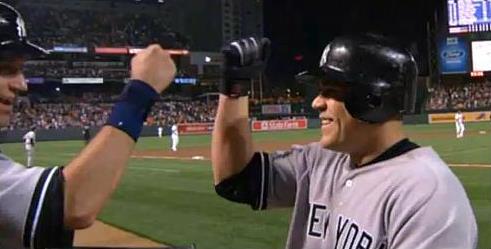
Russell Martin during his sweet spot—after his second homer and before he was drilled.

The plunking of Russell Martin on Saturday, April 23, by Baltimore pitcher Josh Rupe was enough to fire up the usually stoic Joe Girardi, who was seen pumping his fist in the dugout in response to Brett Gardner’s revenge homer a batter later.

Why so impassioned? Martin was drilled high between the shoulder blades, just below his head, after hitting two home runs in what would end up a 15-3 laugher for the Yankees.

“What happened last night, it’s ugly, it’s unfortunate,” said Girardi in the New Jersey Star-Ledger.

O’s skipper Buck Showalter agreed, though he stuck by his pitcher’s claim of innocent intent. Of course he did. That’s his job.

More interestingly, when asked how he might respond should the Yankees retaliate, he told the Baltimore Sun, “We’ll deal with it. It’s self-inflicted.”

That’s a big statement from a manager—a tacit admission to the opposing club that, should they handle their business appropriately, they will have an uncontested free shot available to them the next time the teams meet.

Rupe issued the requisite denial in which he insisted he was attempting nothing more than to pitch inside. Then he took it a step further.

“I know how it looked, and for me and a lot of these guys on this team, I pitch in,” he said in an MLB.com report. “That’s what I do when I’m coming out of the ‘pen. I’ve already given up a home run, and yeah, I was really [ticked] off. But I’m not going to resort to possibly hurting a guy and end his career or anything like that. There’s no reason for me to do that.”

There might even be some truth to the sentiment. Rupe came in with the bases loaded in the eighth, and promptly gave up a grand slam to Alex Rodriguez. He later hit Martin with two outs in the ninth. Any fastball fueled by frustration is bound to get wild, regardless of its intended target. This doesn’t excuse the pitch, of course, or get the Orioles off the hook. And it certainly didn’t change the Yankees’ collective opinion.

Martin, on Rupe’s intent: “Yes—there’s no doubt about it. I want to stay in the lineup, so I’m not going to do anything stupid, but I wouldn’t recommend him doing that again.”

Girardi: “It was right at his head.”

Mark Teixeira: “That’s a heck of a coincidence if it wasn’t intentional. . . . There’s no place for it.”

Teixeira’s opinion holds extra merit, as he went in spikes high against Baltimore infielder Robert Andino in the seventh inning. Andino immediately got up and had words for the baserunner.

It was not Teixeira who was targeted, however, despite coming to bat the following inning with the Yankees ahead, 9-3. (He walked, loading the bases.)

In the series finale the following day, no batters from either team were hit. Perhaps the Yankees’ blowout victory the previous day allowed them to move on. More likely, the combination of a close score on Sunday (the game was tied, 3-3, going into the 11th inning) and proximity to the initial incident was enough to put Girardi off … for the time being.

Still, he made sure to say, “I think it’s important that your players have each others’ backs during a long season. As a team, you have to take care of each other.”

The Yankees visit Baltimore on May 18.

– Jason
Don't Play Aggressively with a Big Lead, Swinging 3-0

The Differences Between Spring Training and the Regular Season Sometimes aren’t so Different After All

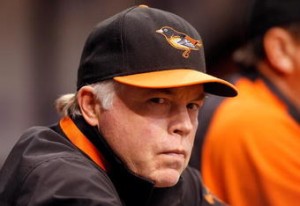
Buck Showalter: Not a fan of the 3-0 swing.

As March draws to a close, it’s a good time to ponder the meaning of spring training games.

They exist to help players prepare for the season, that much is obvious. But what of their actual function? Because they don’t count, they’re handled differently than other contests.

Managers regularly empty their benches with steady streams of substitutions. Pitchers don’t fret about poor outings—at least early on—under the hypothesis that they’re working out winter kinks; if they feel like throwing 10 curveballs in a row then by gorum that’s what they’ll do, regardless of what hitters are doing to those curveballs.

But still, they are games. And games are played with certain elemental consistencies.

The last two weeks have seen separate incidents that bring to the fore the question “What’s appropriate in spring training and what’s not?” Both, coincidentally, involved catchers for the Orioles.

On March 15, Pittsburgh’s Andrew McCutchen tried to score from first on a hit by Baltimore’s Matt Diaz, but was tagged out when Matt Wieters blocked the plate, forcing McCuthen into his shin guards.

“I don’t know what (Wieters) was thinking,” McCutchen said afterward in the Pittsburgh Tribune-Review. “It’s spring training. We’re not trying to get hurt. I wasn’t expecting that much contact. I’m OK, though.”

It harkens back to Pete Rose bowling over Ray Fosse in the 1970 All-Star Game. How much is too much when it comes to hard-nosed baseball during the course of an exhibition?

In this case, however, it was McCutchen himself initiating the contact; Weiters did nothing more than react precisely as a catcher should—protecting both himself and the baseball.

As Yahoo’s Kevin Kaduk observed, “Why did McCutchen slide if he was uninterested in making contact? There’s two bangs in a bang-bang play and McCutchen could have easily withheld one by simply peeling off if he felt the run wasn’t that important in the whole scheme of things.”

On Monday, another Baltimore catcher, Jake Fox—who leads the Grapefruit League with 10 home runs—showed that he’s not much afraid to take his hacks, regardless of the circumstances. With runners on second and third and nobody out in the eighth inning—and his team holding a 13-3 lead against the Tigers—Fox swung 3-0.

One of the clearest-cut sections of baseball’s unwritten rulebook mandates that when one’s team holds a big lead late in a game, one does not, as a hitter, swing at a 3-0 pitch. We’ve gone over it in this space before, but the prevailing notion holds that any pitcher in the wrong end of a blowout game is not on the most solid of footing to begin with. With that in mind, and because the last thing a manger wants to see with his team down by double digits (or something close to it) is a bubble reliever trying to get fine, the next pitch is almost certain to be a fastball down the heart of the plate.

Because of this, hitters are expected to back off and give the pitcher sufficient leeway with which to regain his footing.

Were this the regular season, Fox’s actions would have drawn unequivocal ire, but did the fact that they came in a spring training game affect things? Jake Fox is a journeyman, has played for three teams since 2007, and last year was the first in which he logged no time in the minors. While his prodigious display of power this March has all but locked up a roster spot, one can never be too careful, right? The more numbers he puts up, the better his chances of earning a real payday.

Then again, he was facing a minor leaguer in Chance Ruffin. And regardless of circumstance, proper etiquette is proper etiquette. Ruffin was wearing a big league uniform and facing a big league hitter, and deserves an according level of respect. As does the game itself.

Two people who agree were Jim Leyland and Buck Showalter. Once Fox walked, Leyland raced to the top step of the dugout and berated him for his transgression.

Showalter took things a step farther, yanking off his hat and enumerating at high volume to those in the dugout the ways in which Fox had soiled the reputation of the game. He then sent in a pinch-runner, and made sure to meet Fox in the dugout, where he then unloaded on him. Wrote Jeff Zrebiec of the Baltimore Sun, “It apparently wasn’t the first time this spring where Fox ignored a clear take situation.”

If Leyland feels that there’s a lesson to be taught here, it shouldn’t take long—Baltimore and Detroit meet in the teams’ second series of the season, starting April 4.

– Jason

Keeping Teammates Honest

Pie, Chewed Out, Improves Status to Cherry

Sometimes, it takes pointed criticism to spur necessary action. It’s one thing for a player to be berated by his manager over things such as lackadaisical play or a standoffish attitude, but it can truly sting to hear it from teammates, an indicator that his act has worn thin even within his peer group.

This was the case when Baltimore’s Luke Scott called out teammate Felix Pie early last season, the result of a nearly complete alienation of his teammates by Pie. Scott, reported the Baltimore Sun, “chastised (Pie’s) work ethic, assailed his character, questioned his discipline and labeled him a bad teammate.”

The meeting took place at the team’s indoor batting cage, and was necessary, according to Scott, because although Pie “was just this big ball of talent,” “there was no character, no discipline, no hard work, no dedication. There was laziness and an attitude that somebody owes him something.”

Pie began 2009 as Baltimore’s primary left fielder, but a .157 batting average in April, combined with inattentive mistakes in the field and on the basepaths, altered things in a hurry. Pie’s attitude was hindering his personal productivity, and it was costing his team chances at victory in multiple ways.

This is where the unwritten rules regarding team leadership come into play. “Challenge” meetings such as this, in which one or more players air out grievances about another, happen far more frequently than is reported (partly because the press doesn’t hear about most of them), and serve as one of the primary methods for quickly improving the tenor of a clubhouse.

In 1990, for example, a firestorm ripped through the roster of the San Diego Padres, when third baseman Mike Pagliarulo told a reporter for the New York Daily News that an unnamed teammate cared far more about his stats than team victories. “He doesn’t give a damn about this team,” he said, “and that’s weak.”

Although Pagliarulo later denied it, widespread speculation fingered Tony Gwynn as his target, and a clubhouse meeting was quickly called, in which Jack Clark and Gary Templeton joined in on ripping Gwynn (as well as pitcher Eric Show).

“Tempy said there were some things in the paper that he didn’t like, and he wanted to know where I was coming from,” said Gwynn in Sports Illustrated. “We started yelling back and forth. So Jack is sitting there with a Coke in his hands. He slams it across the room, it breaks open and shoots all over the place, and he says, ‘Hey, everyone in here knows why we’re having this meeting — because we got some selfish — — in this room, and they’re Eric Show and Tony Gwynn.’ Eric was shocked. I was shocked. . . .

“After that meeting I was lost. I spent many nights asking myself, ‘Is it me?’ In other people’s minds, maybe they were right in thinking some things I did were selfish. But face it, this is a selfish game. You get up to the plate, there’s no one to help you but yourself.”

Ultimately, said Gwynn, he devoted more effort to becoming a leader, and the team as a whole grew more focused. The Padres, 18-21 before the meeting, won six of their next seven games, and two weeks later were five games over .500.

The lesson being that if it can happen to Tony Gwynn, it can happen to anyone. And Felix Pie is no Tony Gwynn.

Scott concluded his 2009 intervention with a question, asking Pie if he really even wanted to be in the big leagues, and telling him that if he was unwilling to make the effort he should step aside in favor of someone who was.

“The whole time, his head was down,” said Scott. “Finally, he just said, ‘OK, I’ll work.’ ”

The result: Pie raised his 2009 average to .266, and on Aug. 25 of this year was batting .304, before a recent slump dropped it to .278. He’ll probably never be a superstar, but, thanks in part to Scott, at least he has a chance to reach his potential, whatever that may be.

– Jason

Felix Pie, Mark Buehrle, Sign stealing

Sign Stealing on the South Side?

As White Sox pitcher Mark Buehrle headed to the mound for the sixth inning against Baltimore Wednesday, he had more than just pitching on his mind.

Perhaps it’s that he’d given up two runs to the Orioles in the previous frame. Maybe it was because outfielder Felix Pie was 5-for-7 with a walk to that point over the series’ two games, and Buehrle was fed up.

Or maybe he doesn’t like players stealing his team’s signs.

The Baltimore Sun reported that Buehrle started yelling at Pie (and, by proximity, it appears, Corey Patterson, as well) as he was heading back to the dugout—an exchange that several Orioles players confirmed had to do with the stealing of signs, and the ramifications therein.

How Pie was stealing them was more difficult to discern. He had walked in the fifth, then scored on Matt Wieters’ double, but was never stationed at second base to get a good look at the catcher or the pitcher’s grip on the ball. (While it’s possible to steal signs from first base, it happens far less frequently. Pie could conceivably have been signaling location from there based on the catcher’s setup.)

Prior to that moment, Pie had been all over the basepaths for Baltimore, but the only time he he had been stationed at second, Wieters followed with an inning-ending fly ball.)

Sign stealing from the field of play is an inextricable part of baseball, and occurs with both frequency and consistency throughout the season. The unwritten rules do nothing to prevent somebody from trying to gain this particular edge.

“Stealing signs is part of the game—that’s not the problem,” said Dusty Baker. “The problem is, if you get caught, quit. That’s the deal. If you get caught you have to stop.”

In Buehrle’s case, he or his teammates had clearly seen something amiss, and he took it upon himself to inform the opposition that it was time to put a stop to whatever it was they were doing. It was likely a repeat offense that spurred him to act.

Pie was lucky that it was Buehrle’s barbs that stung him, not his fastball.

“I’d just go up to them and say, ‘Come on, now, you’ve got to be a little bit more discreet—it’s too obvious,’ ” said shortstop Shawon Dunston, discussing his own methods of operation during his playing career. “They just give you a dumb look, but the next time the behavior changes. You’ve got to get every edge and I don’t have a problem with that, but don’t be too obvious. And be prepared to get drilled if you get caught. Period. That’s how it is.”

Jack Morris once took things a step further. Rather than waiting until an inning ended to deliver his message, he simply spun on his heel and, taking steps toward second, informed the started runner that he did not appreciate what was going on.

Then he said, “I’m throwing a fastball and it’s going at him. Make sure you tell him that.”

After doing precisely that, knocking the hitter down, Morris made a second trip toward the runner. “Did you tell him?” he yelled. “Did you?”

– Jason