This Week in the Unwritten Rules

This Week in the Unwritten Rules

May 10
Dallas Braden’s perfect game would have been markedly less perfect had Evan Longoria gotten his bunt down in the fifth inning. Should he have tried it in the first place?

May 11
Josh Beckett went nuts against the Yankees, throwing fastball after fastball at or near multiple players. Was it unintentional? Does it matter?

May 12
The Phillies own both a pair of binoculars and an allegedly powerful hunger to see what the other team is up to behind the plate.

May 12
Nap-gate hit the Mariners clubhouse hard. The real issue, however, isn’t Ken Griffey Jr.’s sleep habits, it’s who’s leaking sensitive information to the media.

May 13
It’s not like the Phillies haven’t been accused of sign stealing before. Like, last October, by Yankees fans.

May 14
Chris Carpenter is proving to have a weak spot when it comes to perceived disrespect. Turns out there is such thing as too much devotion to the unwritten rules.

– Jason

Carlos Lee, Chris Carpenter, Houston Astros, Showing Players Up, St. Louis Cardinals

The Best Way to Beat Chris Carpenter: Disrespect Him

Chris Carpenter is proving to have thin skin, and it’s costing him.

In the third inning of yesterday’s game, Carlos Lee popped up a pitch to shortstop with runners at first and second base, and responded by slamming his bat to the ground and yelling at himself in frustration. It took less than two seconds, and his gaze was fixed nowhere near the mound. (Watch it here.)

Still, Carpenter took it personally.

The St. Louis pitcher started into a surprised Lee, who slowly approached the mound to continue the conversation. Benches and bullpens emptied, although nobody came close to throwing a punch.

Did Carpenter have reason to be annoyed? Absolutely.

Should he have reacted as he did? No way.

There’s such thing as overkill when it comes to the respect afforded by baseball’s unwritten rules, and Carpenter offered up a clear example. Immediately following the incident, the right-hander gave up a three-run homer to Hunter Pence, as part of a four-run inning. In the seven other frames that Carpenter completed, he gave up three hits and no runs.

St. Louis lost, 4-1.

Up to that point, Pence was 0-for-9 lifetime against Carpenter. To judge by the box score, the pitcher effectively psyched himself out.

(St. Louis manager Tony La Russa did have Carpenter’s back, saying, “Routinely now, hitters pop up a pitch they think they should do [something] with, and they start making noises, and that really is disrespectful to the pitcher.” With any other manager, this would clearly be an effort to deflect attention from the pitcher. La Russa, however, probably believes it.)

This is the second time this season that the Cardinals might have paid a price for Carpenter’s sensitivities.

On April 21, he was hit by a pitch from Arizona’s Edwin Jackson, and then took the unusual tack of seeking retribution from the basepaths, not the mound, going out of his way to take out second baseman Kelly Johnson on an ensuing double-play grounder. (He ultimately rattled cages but did no damage, and after the game called it “an unprofessional move.” “I shouldn’t have done it . . .” he said. “I was in a position where I didn’t control my emotions enough to not do something stupid.”)

Carpenter threw shutout ball that day, save for the two runs he gave up two innings after his basepath meltdown. It’s impossible to say that one led to the other, but the possibility exists.

Carpenter, of course, is hardly alone in demonstrating the downside to being a stickler for the unwritten rules. Take an example from 2006, in which Toronto’s Ted Lilly hit A’s DH Frank Thomas in retaliation for Oakland pitcher Joe Blanton’s plunking of Troy Glaus an inning earlier.

Lilly got Thomas with the first pitch, his intentions clear. And Thomas took it like a pro, trotting to first base without emotion, as if he’d merely drawn a walk.

Lilly, however, was thrown off his game. Six of the next eleven batters reached base, including a Jay Payton home run.

“When he hit Big Frank, he wasn’t so sure that Big Frank wasn’t coming out to get him,” said a member of the A’s. “He thinks he helped his team by hitting Big Frank, but I’ll tell you what—his heart was pumping a mile a minute until he realized that Frank was just going to take first base. And after that, Lilly couldn’t find the strike zone. He was all over the place.”

A pitcher as good as Chris Carpenter is rarely all over the place, but the emotions that accompany perceived disrespect have managed to expose a chink in his armor.

He’d be well served to cover that up.

– Jason

Binoculars, Charlie Manuel, Mick Billmeyer, Philadelphia Phillies, Shane Victorino, Sign stealing

Accusations Against Phillies Nothing New

Even as the Phillies were denying efforts to steal signs against the Colorado Rockies on Monday, people started to dig back a bit to look at their history with the subject.

They didn’t have to dig far.

Just last October, rumors of Philadelphia’s extra-curricular sign stealing swirled during the World Series, when, during Game 4 of the World Series, Yankees catcher Jorge Posada visited pitcher CC Sabathia six times in the first inning, then eight more times in the fifth. This didn’t do much to improve the quality of the product for those watching at home, but it might have been enough to thwart would-be sign thieves.

During the game, Posada also went into dexterous sign gymnastics with nobody on base, throwing down complex sequences normally utilized to stymie a runner on second.

Those rumors hit a head when Dodgers coach Larry Bowa went on ESPN950 radio in Philadelphia, and said this:

There’s rumors going around that when you play the Phillies, there’s a camera somewhere or bullpen people are giving signs, and catchers are constantly changing signs. That’s the rumor. Now is it [proved]? No. I’ve had three people come up to me, ‘Watch center field, they’ve got a camera. Some guys stand up by the fence and if their arms are up it’s a breaking ball.’ I didn’t see it, but other teams swear by it.

So I’m sure the Yankees personnel said, ‘Heads up, these guys like to give signs from second, they’ve got people in center field. So they were constantly changing signs. Posada was paranoid about it. CC was paranoid about it so they kept going out. They might have changed signs four times on one hitter. That’s the reason he went out. It wasn’t to say to him, ‘Settle down.’ It was, ‘Go to this sign.’

Bowa, a Philadelphia icon for his years with the team during his playing days, had no direct inside knowledge of the system (that he admitted to, anyway), but his speculation was enough to send Shane Victorino into a tizzy.

“I guess he knows something that I don’t know about, obviously,” Victorino said shortly after Bowa’s comments aired. “We play between the lines, and that’s what it’s about. For Bowa to come out and say something like that, if he doesn’t know what he’s talking about, if he doesn’t have cold, hard facts, he shouldn’t say something like that. It’s just not something that should be said. For you to pop off like that, I’m not happy.”

Victorino, of course, has been fingered as complicit in the most recent allegations against his team, largely because he was seen on the dugout telephone in conjunction with Mick Billmeyer’s spyglass proclivities from the Philadelphia bullpen.

Last October, Victorino backed up his statement by pointing to the fact that Philadelphia lost the first two of the first three Series games, saying, “Obviously if we’re stealing signs we would be doing better than what we’re doing right now.”

Well, okay. Except that sign stealing doesn’t guarantee victory, especially against a team as good as the Yankees; it merely massages the odds. One of the most notorious sign-stealing-from-beyond-the-outfield-wall teams of the 1960s was the Chicago Cubs—and look where it got them.

Another statement that didn’t hold much water came yesterday, when Phillies manager Charlie Manuel opted to go on the offensive and accuse the Mets of vague improprieties.

“Somebody maybe ought to check the Mets if they did that,” he told the New York Daily News, possibly in retaliation for the Mets leveling similar accusations against the Phillies in 2007. “Their (—-ing) home record is out of this world (14-8), and they’re losing on the road (4-8). Sometimes that’s a good indicator of getting signs and (crap). I’m not accusing them, but you look at that and—damn. We’re about the same home and road. I’m just saying their record is much better at home and they hit better.”

It’s nice that the Phillies are equally dominant at home (10-6) and on the road (10-7), but it must be pointed out that the recent controversy came on the road. It takes a special kind of chutzpah to pull that off, no matter what the Phillies’ actual intentions might have been.

Between Colorado, last year’s World Series and the 2007 Mets, it might be time for the Phillies to give it a rest.

You know, just in case they’re doing anything improper.

– Jason

Ken Griffey Jr., Omerta Code

Griffey Junior Naps (or Not); the Real Story is, Why Do We Know About it?

Much has been made during the last few days of a nap that Ken Griffey Jr. may or may not have taken in the clubhouse during the eighth inning of a recent game. If it happened as alleged by a source to the Tacoma News Tribune, it kept Griffey from being available to his team as a pinch-hitter.

Griffey and Mariners manager Don Wakamatsu deny that was the case, although Griffey has yet to unequivocally shoot down questions about whether he might have been sleeping in the clubhouse at any other point during the game.

Clearly, this is not the way he wanted what are likely his last months as a professional ballplayer to play out.

The prevailing unwritten rule in this case can be summed up by a sign, some version of which has shown up in big-league clubhouses for decades:

What you see here, what you do here, what you say here, let it stay here.

It’s a code of omerta, a concept popularized by the Italian mafia to highlight the tradition of silence when it comes to conversation with outsiders. Ballplayers are expected to honor that silence when it concerns things that happen behind clubhouse doors.

Which is why it’s so shocking that “two younger players” filled News Tribune writer Larry LaRue in on Junior’s sleeping habits. The reaction of the rest of the team is no different than that of the Yankees after Jim Bouton came out with his groundbreaking Ball Four account of their daily activities while they were still active players.

Wrote Mickey Mantle in All My Octobers: “If the players resented the press for digging into our private lives, how were we supposed to feel when a teammate did it?”

Unless a teammate didn’t do it.

There are grumblings that it wasn’t “two younger players” at all, but somebody in the front office who spread the rumor, in a deliberately mis-attributed fashion.

The motivation would be clear: at age 40, Junior is hitting .200 for the M’s, with only two extra-base hits—both doubles—in 80 at-bats on the season. The same story that broke the news of his napping habits suggested that he was days away from losing his position as the team’s left-handed DH, if not his roster spot entirely.

The trouble is, the guy is so iconic in Seattle that the prospect of negative fan reaction should the team cut him can’t be easy to stomach for General Manager Jack Zduriencik.

This isn’t to suggest that it was Zduriencik who got into LaRue’s ear, or a member of his staff, or anyone other than the young players as claimed—only that a little PR hit like this for Junior, with no lasting repercussions to his reputation, might grease the skids just a touch, and make an eventual parting a skosh more painless for the guys doing the cutting.

This, of course, is sheer speculation, and completely unfounded. ESPN’s Tim Kurkjian reported that the responsible players were admonished during a team meeting “for taking it outside of the clubhouse.” (Ironically, somebody had to tell Kurkjian about the goings-on of the clubhouse meeting for that news to break.)

That the front-office rumor is even able to exist, however, speaks to the insidiousness that can permeate a ballclub when confidences are compromised.

No matter which way it happened, one thing is certain. “People talk far too much,” said Dusty Baker, speaking in general terms about clubhouse leaks, although he could well have been talking specifically about this situation. “There’s always a leak, there’s always a Judas. Always. Judas is more alive now than ever.”

– Jason

Binoculars, Mick Billmeyer, Philadelphia Phillies, Sign tipping

Break Out the Binocs—There’s Thieving to be Done

The thing about the overwhelming majority of unwritten rules is their nebulous nature—the gray area in which acceptable behavior becomes entangled with less palatable fare, essentially creating a murky stew in which bad blood can reasonably fester on both sides.

Today’s news is much more clear-cut. Tracy Ringolsby reports for Fox Sports that the Philadelphia Phillies have been warned by Major League Baseball about their alleged tendency to steal signs from other clubs.

But wait a minute—this blog has consistently touted the propriety of sign stealing, with the caveat that once caught, the activity is halted. So why the big deal?

The Phillies, if one believes the rumors, were using binoculars to aid their cause. According to the unwritten rules, this is never okay. (It’s also prohibited by the written rules, which is why the league stepped in.)

The specific accusation points at bullpen coach Mick Billmeyer, alleging that he trained his lenses on Rockies catcher Miguel Olivo; Phillies center fielder Shane Victorino was subsequently seen on the bullpen phone, ostensibly receiving stolen signs to relay to the Phillies hitters.

Ringolsby reported that the New York Mets might have made a similar accusation after the Phillies battered Johan Santana for 10 runs in 3.2 innings on May 2.

The league called the evidence “inconclusive,” but has warned the Phillies and alerted the umpiring crew to pay close attention to the situation.

Billmeyer seems a perfect choice to run such a scheme. He knows catchers and their signs, having worked as Philadelphia’s minor league catching coordinator from 2000-03, and as the major league catching instructor from 2004-08.

Philadelphia’s excuse: Billmeyer wasn’t looking at Olivo, but at his own catcher, Carlos Ruiz. The only problem with that reasoning is that the Phillies were up to bat when the situation was brought to light on the game telecast, and Ruiz was in the dugout.

Assuming that the allegations are correct—that Billmeyer was picking off signals and relaying them via telephone to the Philadelphia dugout—how difficult would it be to then get word to the hitter?

Not very.

In the 1960s, New York Yankee Bob Turley would whistle from the bench when the upcoming pitch was different from the one that preceded it. (Had the previous pitch been a fastball, for example, Turley would whistle if the next pitch was to be a curve.)

Tigers manager Del Baker signaled Hank Greenberg with a system of “all right”s and “come on”s. (“All right, Hank, you can do it” indicated that a fastball was on the way, whereas “Come on, Hank” meant curve.)

The possibilities are limitless.

Similarly, it’s hardly the first time that a team has used foreign assistance to peek in on the opposition. In the late 1950s, the Milwaukee Braves stationed pitchers Joey Jay and Bob Buhl in the Wrigley Field bleachers, shirts off and dressed like fans. They’d train binoculars on the catcher, and signal the pitch with a rolled-up program.

In the 1970s, Cubs manager Herman Franks once stationed himself inside the WGN television truck outside the ballpark, using their feed to relay signals to coach Harry Lowrey via the dugout phone. (The experiment lasted all of one game, after Franks’ instructions interfered with the WGN producer’s instructions for his crew, and vice versa, serving mostly to screw everybody up. It was, after all, the Cubs.)

During the 1976 World Series, three scouts for the Yankees were spotted in the ABC-TV booth, huddled around a television and talking into walkie-talkies. Although no formal charges were filed, they were quickly removed from the premises.

If the Phillies are to accede to any piece of the Code now, it’s clear which part they should heed: They’ve been caught, and it’s time to stop.

Update: Watch the video as part of an MLB Network panel discussion here.

Update II: The accusations against Philadelphia were nothing new.

– Jason

Alex Rodriguez, Dallas Braden, Don't Cross the Pitcher's Mound

A-Rod to Braden: ‘You Talkin’ to Me?’

In the substrata of yesterday’s blowup between Alex Rodriguez and A’s pitcher Dallas Braden—spurred when A-Rod crossed over the mound on his way back to first base after a foul ball—is the question about whether Braden even has the stature to challenge Rodriguez. (It’s been spurred in part by Rodriguez’s own comments: “I’ve never quite heard that, especially from a guy that has a handful of wins in his career. I thought he was talking to somebody else.”)

A reader of this blog commented, “Regardless of whether there is some unwritten rule . . . Braden’s reaction was over the top. Besides, doesn’t it break the unwritten rule that young players give deference to veterans superstars(?)”

There’s a valid point to this. Baseball is a game of hierarchy, from locker assignments to seating charts on team transportation to what a guy can get away with on the field. Without question, a lesser player trying to replicate the self-glorifying admiration provided by Barry Bonds for his own home runs would quickly be beaten down, be it physically or psychically—likely from the opposition and his own teammates.

And when a star’s path crosses that of a lesser player, Darwinism almost inevitably wins out: the big fish eats the little one.

Except here. I’ve been exchanging e-mail about the topic with FanHouse’s Jeff Fletcher (who’s been giving this incident a good deal ofquality attention); I wrote this to him last night:

In general, there is a hierarchical structure to this type of thing. It’s partly what made Dickie Noles‘ flipping of George Brett in the ’80 World Series (remember that?) so brazen—unless a pitcher is a superstar himself, he has no business intentionally knocking down one of the five best third basemen of all time . . . and Noles wasn’t even a veteran, let alone a star.

But that standard doesn’t really apply here.

Noles’ move was all about intimidation and striking a tone. Braden’s motivation was strictly territorial. He made the point himself after the game, saying, “I don’t care if I’m Cy Young or the 25th man on a roster; if I’ve got the ball in my hand and I’m out there on that mound, that’s not your mound.”

And he’s right. The stature of those who hold real estate is less important than the fact that they hold it at all. That Braden went so far as to equate A-Rod’s move not just with personal disrespect, but disrespect for the entire A’s organization, also says a lot. It probably wasn’t even intentional, but Braden just gave his team the best pep talk it could ever hope for: We’re every bit as good as the Yankees, and they will not walk over us, literally or figuratively.

I might have a problem with a young hothead trying to intimidate a star, but that isn’t this. Braden wants only what’s rightfully his, and he has every right to do so.

Some across the blogosphere have portrayed Braden as an insolent punk, but as someone who has had many conversations with the guy, I can say that he’s one of the most thoughtful people in the game—a player who gets it in a sport where many people don’t.

Just because A-Rod didn’t know the rule doesn’t wipe it out of existence. Braden does know the rule, and is holding A-Rod to no less exacting a standard than he holds himself.

– Jason

Alex Rodriguez, Dallas Braden, Don't Cross the Pitcher's Mound

A-Rod Crosses Braden – Literally – and Gets an Earful in Response

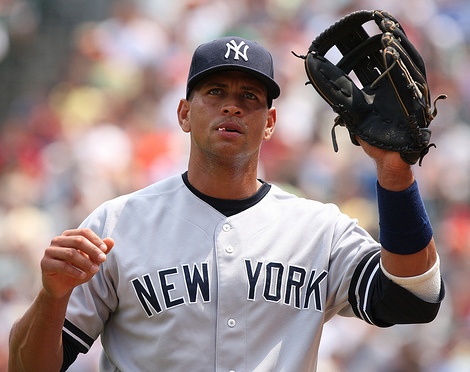
Alex Rodriguez is one of two types of player: A guy who’s profoundly ignorant of much of the Code, or a guy who actively disdains it.

This is someone who has been caught peeking at catchers’ signs, and who, as a baserunner, tries to distract fielders when they’re camped under fly balls.

Today in Oakland, with Rodriguez on first base, Robinson Cano hit a foul ball so high that A-Rod had time to round second and get partway to third before it landed. Rather than going back the way he came, however, Rodriguez cut straight across the diamond and directly across the pitcher’s mound.

It’s a direct violation of one of the lesser unwritten rules, and A’s pitcher Dallas Braden noticed.

After the inning ended, Braden lit into A-Rod on the field, eventually being greeted by a dismissive wave from the superstar. “I was dumbfounded that someone of his status would let that slip his mind,” Braden told Jeff Fletcher of FanHouse after the game. “He understands that. I was just trying to convey to him that I’m still out there. The ball is in my hand. That’s my pitcher’s mound. If he wants to run across the pitcher’s mound, tell him to do laps in the bullpen.”

It’s a rule that’s been around a long time.

“That mound is the pitcher’s home, his office, and he doesn’t want anyone trampling over it,” said longtime outfielder Dave Collins. Luis Gonzalez called the mound “the Twilight Zone,” describing it as something to stay away from.

Like any rule, a small handful of guys go out of their way to crap on it, if only to be annoying. It shouldn’t surprise anybody that A.J. Pierzynski is one of those players. According to multiple sources, he makes a habit of the practice, coming close enough to the pitcher to brush him on his way back to the base or the dugout.

“He’s gotten hit a few times because of it,” said Tim Raines, Pierzynski’s former coach with the White Sox. “He’s been hit more than once.”

“You’re always going to run across some guy who will fly out, round first, and cut as close as he can to you, just to either mutter something under his breath, just to piss you off as a pitcher,” said Jamie Quirk. “He’s gonna get as close as he can to you; he won’t bump you, but he’ll try to piss you off.”

Is Rodriguez that kind of guy? It’s difficult to tell. The evidence against him, however, certainly does nothing to help his case.

Update: There has also been some controversy about whether Braden even has the stature to challenge A-Rod. That issue is addressed here.

Update II: Here’s the video:

Update III: To hear audio of both players’ interviews, go here.

Update IV: Author Allen Barra took issue with some of the points presented herein. In this post, I attempt to set him straight.

Update V: I discussed some of these issues in a Q&A with the New York Times.

Update VI: Turns out this issue is garnering some attention for the unwritten rules.

Update VII: Braden hardly set the standard for young players speaking out of turn (if, in fact, that’s what he did).

Update VIII: Catch video of Braden’s opinions on the affairs here.

– Jason