Retaliation

Bad Blood Between the Rays and Red Sox? Say it Ain’t So

Rays-SoxAs soon as John Lackey drilled Matt Joyce in the back with a 90-mph fastball in the sixth inning of Monday night’s game, people were already speculating how far back the antagonism ran.

Did it date back to the second inning, when Joyce connected for a mammoth foul ball to right, then dropped his bat—“styled,” in the words of MassLive writer Evan Drellich—as if he’d just homered?

Did it date back to the first inning, when Joyce actually did homer?

Lackey did some yelling toward the Rays dugout after Joyce’s second-inning pimp show. After being hit, Joyce pointed toward Lackey amid a slurry of what is safe to assume was epithets, then got into a pushing match with Jarrod Saltalamacchia when the catcher cut off his path to the mound. That was when benches emptied, although no punches were thrown. (Watch it discussed on MLB Tonight, complete with clips.)

Joyce actually thought that it was none of the above.

“As far as I understood, he was pretty upset that I dropped my bat on that 3-0 swing,” Joyce said in a Tampa Tribune report, describing the count when he pulled his second-inning ball foul.  There is indeed an unwritten rule about restraint from swinging at 3-0 pitches, but it only applies late in blowout games—never in the second inning.

In case there was doubt about Joyce’s personal view of possible impropriety, it was cleared up by what he said next: “I was actually pretty upset myself I had such a good pitch to hit and missed it. I usually never drop the bat.”

In a close game (the Red Sox would win, 10-8, in 14 innings), Tampa Bay settled for a low-impact response—in the seventh inning, reliever Joel Peralta threw his first pitch, to Dustin Pedroia, high and tight. (Even that is up for interpretation; it was a 79 mph curveball.)

Beyond that, Lackey denied intent and was alternately defended by one manager (his own) and criticized by the other.

While the easy answer is that hostilities started with Joyce’s second-inning swing, the reality is that whenever something happens between these teams it’s almost expected. Their relationship over the last decade-plus has been testy enough to have inspired an entire section in The Baseball Codes; between 2000 and 2008, it seemed like every one of their meetings added another chapter to their collective book of spite, and things have hardly slowed from there. A condensed excerpt:

* August 2000: Boston’s Pedro Martinez hits Ger­ald Williams on the hand with his fourth pitch of the game. Williams charges the mound, shoving the much smaller Martinez to the ground and lands a glancing blow to his face. Benches empty, during which Boston’s Brian Daubach dives into the scrum, where Tampa players accuse him of taking cheap shots. The commissioner’s office eventually rules that Daubach acted appropriately, but by the time the game ends, Daubach has been thrown at by a succession of Devil Rays pitch­ers, starting with Dave Eiland—who wants to hit him so badly that, with two on and nobody out in the third inning, he sends his first pitch spinning toward Daubach’s head. The hitter manages to avoid that one, but can’t get out of the way of Eiland’s next pitch, which drills him in the body. Shortly therafter Eiland hits Nomar Garciaparra and is tossed from the game. His replacement, Cory Lidle, is himself ejected after throwing a pitch behind Daubach. Lidle’s replacement, Tony Fiore, lasts all of two pitches before finishing the job, drilling Daubach with his third offering and spurring another confrontation between the teams.

* September 29, 2000: Tampa Bay eliminates the Red Sox from the AL East race with an 8–6 victory. From the mound, Rays closer Roberto Hernandez waves a sarcastic bye-bye to the Tropicana Field visitors’ dugout.

* 2001: Over the course of the season, Devil Rays pitchers hit eleven Boston batters; Red Sox pitchers tag nine Tampa hitters.

* May 5, 2002: Devil Rays pitcher Ryan Rupe hits both Garciaparra and Shea Hillenbrand in the first inning, a day after each was instrumental in helping Boston overcome a 5–2, ninth-inning deficit. Boston’s Trot Nixon lets go of his bat on a swing, sending it flying toward the mound. Red Sox pitcher Frank Castillo responds by hitting Tampa’s Randy Winn. Both Castillo and Nixon are suspended.

* July 18, 2002: The day after Manny Ramirez scorches the Devil Rays with a home run and a double, he’s hit by Tampa starter Tanyon Sturtze. Boston’s Frank Castillo hits Tampa Bay second baseman Brent Abernathy in the third, and reliever Tim Wakefield hits him again in the fifth. In the ninth, Devil Rays reliever Esteban Yan just misses Ramirez’s head as the slugger ducks, and the ball glances off his shoulder. “You can’t act like what happened never happened,” says Derek Lowe in the Boston Herald. He also says, “Every year, why is it always this team?”

* September 9, 2002: Lowe keeps wondering after being ejected for hitting Devil Rays shortstop Felix Escalona with a pitch. The follow­ing night, Tampa Bay reliever Lee Gardner, pitching in the eighth inning of an 11–1 Boston runaway, is ejected for hitting second base­man Lou Merloni.

* September 27, 2004: Red Sox starter Bronson Arroyo keeps relations testy by hitting both Aubrey Huff and Tino Martinez in the third inning. Devil Rays pitcher Scott Kazmir retaliates by hitting Manny Ramirez and Kevin Millar in consecutive at-bats an inning later, emptying the benches. Kazmir is ejected.

* April 22–24, 2005: Five batters are hit in the first two games of a three-game series between the teams. In the third game, Arroyo hits Huff—7-for-10 lifetime against him—for the second time in as many seasons. An inning later, Devil Rays reliever Lance Carter throws a pitch behind Ramirez’s head, eliciting warnings for both benches. One pitch later, Ramirez belts a home run. Carter then throws at the head of the next hitter, David Ortiz, who has to be restrained by catcher Toby Hall. Dugouts empty, and Carter, Trot Nixon, Tampa Bay manager Lou Piniella and pitcher Dewon Brazelton are ejected. In the sev­enth, Arroyo hits leadoff batter Chris Singleton on the thigh, earning his own ejection. In a radio interview on WEEI after the game, Boston pitcher Curt Schilling blames Piniella: “Play­ers on that team are saying, ‘This is why we lose a hundred games a year, because this idiot makes us do stuff like this.’ ” A day later, also on the radio, Piniella says, “I have forgot more baseball than this guy knows.”

* March 27, 2006: After tagging out Tampa’s Joey Gathright at the plate during a spring-training game, Boston reliever Julian Tavarez stands on the baserunner’s arm, he says, so that Gathright couldn’t “throw a punch at me right away.” Tavarez then hits Gathright in the jaw while the outfielder is down on one knee. Gathright later says that Tavarez “hits like a woman.” Devil Rays outfielder Carl Crawford subsequently chal­lenges the pitcher to a post-game fight in the parking lot.

* June 5, 2008: The highlight of five hit batters on the night is Boston outfielder Coco Crisp’s charge of the mound after being drilled by right-hander James Shields of the Rays, who by this time have dropped the “Devil” from their name if not their attitude. Shields is responding to Crisp’s hard slide into second baseman Akinori Iwa­mura the previous night, which was itself a response to Tampa Bay shortstop Jason Bartlett using his leg to block Crisp’s headfirst slide into second. Shields misses with a roundhouse right, and Crisp— with 17 knockouts to his credit in 17 amateur boxing matches as a youth—is able to land one shot of his own before being overwhelmed by a scrum of Rays, primary among them Crawford and Johnny Gomes, who shower blows upon him. (After the game, Crisp says that the Rays were like “little girls, trying to scratch out my eyes.” Shields had already hit Dustin Pedroia in the first inning, and Boston’s Jon Lester responds by hitting Crawford, then Iwamura. Tampa Bay reliever Al Reyes closes the festivities by drilling Kevin Youkilis in Boston’s final at-bat.

* October 10, 2008: In Game 1 of the ALCS, Rays reliever Grant Bal­four sends a fastball toward the face of Boston outfielder J. D. Drew, which catches the slugger’s shoulder as he spins to avoid it. Barking ensues, and the seven-game series is so tight that even four more hit batters (two from each team) over the remaining games do little to raise the tension.

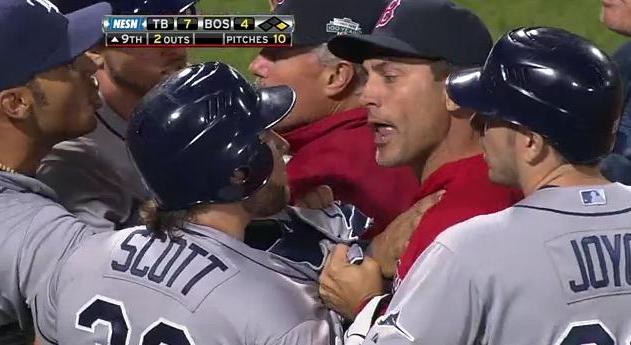
Things hardly ended there. There were the three times Tampa Bay’s Luke Scott was hit by Boston pitchers over a three-game span in 2012—the last of which ended up in a brawl. (Red Sox reliever Franklin Morales threw a fastball behind Scott’s back, then two inside, then finally drilled him in the leg. Earlier, Pedroia had been drilled, and a pitch thrown over Daniel Nava’s head.)

There were words last March, when Alfredo Aceves drilled Sean Rodriguez in the shoulder, one at-bat after he had homered.

All of which gives some context to Monday night’s dustup. Just another day at the office, it seems.

Update (6-12-13): The Rays still have opinions.
Cheating, Clay Buchholz

Arm Butter Accusation Storm Builds in Toronto

buchholz arm
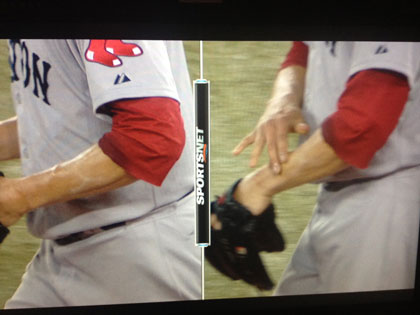
Sportsnet’s Buchholz graphic

It started last week when Dirk Hayhurst—ex-pitcher, sometimes author and current broadcast analyst for the Toronto Blue Jays—unleashed some damning suspicions on Twitter about Boston pitcher Clay Buchholz, who’s currently setting the American League afire with a 6-0 record and 1.01 ERA:

Forget the hair, I just saw video of Buchholz loading the ball with some Eddie Harris worthy slick’em painted up his left forearm. Wow.

It continued when Hayhurst’s colleague, ex-Tigers great and current Blue Jays broadcaster Jack Morris, piled on, telling ESPN Boston that “it was all over his forearm, all over the lower part of his T-shirt, it’s all in his hair,” while in the next breath stipulating that he has no actual proof of impropriety.

It really picked up steam when the video crew at the Rogers’ Centre unleashed some video from Wednesday’s Jays-Sox game, in which the right-hander allowed only two hits to Toronto over seven shutout innings, of Buchholz’s left (non-throwing) arm, glistening with what appears to be something other than sweat. (Hayhurst went on to say that it might be sunscreen mixed with rosin. The Jays’ crew added some talk about Red Sox reliever Junichi Tazawa possibly doing something similar.)

To be expected, Buchholz subsequently denied everything (“Definitely no foreign substances on my arm,” he told MassLive.com), as did Red Sox catcher David Ross (“I know when a pitcher is messing with the ball, he said. “He’s not putting anything on it”).

People came out for Buchholz. Dennis Eckersley told Morris to “zip it,” and Jerry Remy defended him on the air. Cliff Lee discussed his own innocent accumulation of sweat and rosin. Tim Hudson had some fun with the situation.

People came out against Buchholz. Sports Illustrated’s Tom Verducci discussed details about what he feels is a fishy situation, and ESPN’s David Schoenfield compared the break on Buchholz’s pitches to those on offerings nearly 30 years ago from notorious ball scuffer Mike Scott. (He also quoted from The Baseball Codes, so credit to him on that one.)

What does it all mean? Nothing, almost literally. The Blue Jays haven’t accused Buchholz of impropriety. Neither has any other team. Umpires have yet to check him. The accusations are based on TV footage that can be realistically explained any number of ways.

It appears to be a Kenny RogersTony La Russa-type situation. When  the Fox TV crew spotted Rogers with an unusual brown spot on his palm during his start in the 2006 World Series, it became national fodder—especially when video evidence showed the same brown spot during his previous postseason appearances. Instead of having the umpires check Rogers, however (knowing that if they found a foreign substance, he’d be ejected and likely suspended), Cardinals manager La Russa merely asked them to make sure he washed his hands. From The Baseball Codes:

In the face of this World Series controversy, the Gam­bler did the only thing he could reasonably do—he cleaned his hand and continued to pitch well. Fifteen postseason shutout innings with an obvi­ous foreign substance were followed by seven shutout innings without it. Alleged pine tar or no alleged pine tar, the Cardinals, who scratched out only two hits against Rogers in eight innings, fared no better than the Yan­kees or the A’s had in earlier rounds.

The primary question was, why did La Russa not come down harder? A variety of theories surfaced, one of which gained particular traction: Pitchers cheat in Major League Baseball. Not all of them, but enough to touch every clubhouse in some way. La Russa’s own pitcher, Julian Tavarez, had been busted for using pine tar only two seasons earlier, and suspended for 10 days. La Russa called it “an example of bullshit baseball.”

La Russa, the theory held, had kept quiet because he was reluctant to travel this particular road on behalf of his own pitchers, who would undoubtedly come under increased scrutiny. No less an authority than Buchholz accuser Jack Morris weighed in, telling the Detroit Free Press that “Tony’s been through a lot himself, so I don’t think he wanted to push that enve­lope.” (An entire chapter was devoted to this particular situation in The Baseball Codes.)

So even if the Blue Jays did recognize something askew about Buchholz on the mound, they may well have opted (and continue to opt) to keep it to themselves. This could be equally true for every other team in the league, regarding every other pitcher in the league. Rare is the guy like Davey Johnson, who just doesn’t give a crap.

Chances are that Buchholz will dial back whatever it is he’s doing (even if it’s legal, he’ll likely strive to make it less suspicious), and that the entire situation will blow over within the week, assuming he does not get uncharacteristically blown out of his next start.

Which is as it should be. Most folks around the big leagues view cheating as largely acceptable, so long as the cheaters knock it off (at least for a while) once they’re caught. Buchholz’s arm butter, legal or otherwise, is no exception.

Intimidation, Pedro Martinez

Et Tu, Pedro? Well, Yeah, of Course Et Tu.

First, Lance Armstrong admitting to doping, and now this. Remember all those guys Pedro Martinez intimidated with inside fastballs over the years? (He hit 141 hit batters over 18 seasons, finishing in the top three in the category five times; only one man ahead of him on the career HBP list from the modern era, Jamey Wright, hit more batters per nine innings.)

Turns out that he meant almost every one of them.

Pedro Martinez

Yesterday, Peter Abraham of the Boston Globe tweeted that “Pedro just admitted that 90 percent of the guys he hit were on purpose.”

Well, of course they were. During Martinez’s heyday, no American League pitcher was close to him in terms of command. He complemented a darting fastball with the game’s best changeup and an array of devastating breaking pitches—and didn’t stop there. He also took a page from Nolan Ryan’s playbook, turning the brushback, the knockdown and the hit batter into valid parts of his repertoire. As if trying to adjust from a low-90s fastball to a changeup in the mid-70s wasn’t tough enough, hitters also had to deal with the idea of staying light on their feet.

Sometimes, of course, this reputation was detrimental—Martinez engendered no shortage of opponents who much didn’t care for him, as this excerpt from The Baseball Codes will attest:

Take Reggie Sanders, who charged the mound in 1994 after being hit by Pedro Martinez. That the pitcher was trying to protect a 2–0 lead in the eighth inning was one clue it might have been unintentional; that it was an 0-2 count was another. That Martinez was in the middle of throw­ing a perfect game should have put to rest any lingering doubts. Without a shred of hyperbole, Sanders was the most obviously unintentionally hit batsman in the history of the game.

Still, it wasn’t enough to keep him in the batter’s box. Martinez had been brushing back Cincinnati batters, including Sanders, all afternoon. After one such pitch in the fifth inning, Sanders gave the pitcher a long, angry glare, which Martinez returned in kind. After he plunked Sanders three innings later, Martinez even went so far as to raise his arms in frus­tration before realizing that it would be a good idea to defend himself.

It takes a special kind of pitcher to pull off something like that. Martinez has just rejoined the Red Sox as a special assistant to General Manager Ben Cherington, where he will hopefully continue to lend insight into the machinations that made him such a force of nature. Welcome back to the big leagues, Pedro.

(Via Yahoo.)

Bobby Valentine, Play Your Best Lineup

Bitter Bobby: Valentine Slaps BoSox, Fans on his Way Out the Door

For anyone who might have, against all reason, been maintaining even a modicum of hope for the tenure of Bobby Valentine in Boston, the soon-to-be ex-manager effectively flipped the bird to the entire Red Sox organization on his way out of town. He used as his weapon Boston’s lineup against the Yankees:

Pedro Ciriaco, 2B; Daniel Nava LF; Cody Ross RF; Mauro Gomez 1B; Ryan Lavarnway DH; Jarrod Saltalamacchia C; Danny Valencia 3B; Che-Hsuan Lin CF; Jose Iglesias SS.

Yep, six of his nine hitters were in their first or second seasons, five of them with fewer than 150 at-bats on the year.

The pertinent unwritten rule here, of course, is that late in the season, teams with nothing to play for nonetheless offer their best effort down the stretch when facing teams still in a pennant race. And thanks to its 10-2 victory over Pawtucket North, the Yankees opened up a one-game lead over Baltimore, which lost at Tampa Bay.

That it’s New York, of course—Boston’s arch-nemesis—makes it all the more fitting for Valentine to completely throw in the towel. Why not? He has no vested interest in his team, and it’s just one more way to piss off ownership.

None of this makes him a bad manager—just a man with a mean streak and a deficiency of morals. Difficult to say which is worse.

Don't Bunt to Break Up a No-Hitter, Jarrod Saltalamacchia

Perfecto Broken Up by Bunt … and for Once That’s Okay

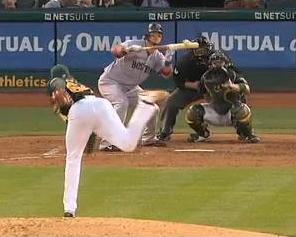
Boston, a day after getting gut-punched 20-2 by the Oakland A’s, had mustered not so much as a baserunner with two outs in the fifth inning Saturday against right-hander A.J. Griffin.

Frustration was inevitable, but was it sufficient to explain why Jarrod Saltalamacchia would bunt in the middle of a perfect game? The Red Sox catcher did, and reached base safely, which seems like a no-brainer: The guy was in clear violation of the Code. Heck, he even had a parallel with the most famous perfect game breaker-upper in history, Ben Davis—another catcher, who pulled the trick against Curt Schilling in 2001.

There was, however, a notable difference: For some unexplainable reason, A’s manager Bob Melvin had put on a defensive shift. With third baseman Adam Rosales positioned where the shortstop usually stands, Saltalamacchia was given the same kind of wide-open invitation all left-handed batters receive in that situation: an easy base hit with a well-placed bunt. Saltalamacchia, who has all of three sacrifice bunts in his career—all in 2007—took him up on the offer. (Watch it here, starting at the 1:03 mark.)

If the theory behind the governing rule is that a team’s first hit should be above board, with no gimmickry involved, then it should only follow that the defensive positioning of the pitcher’s team should follow suit. When Melvin opted not to play things straight up—despite holding a 5-0 lead—his opposition can hardly be faulted for acting similarly.

Melvin acknowledged as much after the game. “I probably should have had the third baseman in,” he told the San Francisco Chronicle.

To Griffin’s credit, the pitcher appeared to not hold any grudges. “It’s a good way to try to get momentum for your team,” he said. “There’s not anything I can do about it except try to get the next guy. Whatever.” (Bobby Valentine, who has far bigger controversies to consider than this one, added the sentiment, “Who cares?”)

There’s lots of blame to go around for Boston’s misery this season, but not on this play. If Griffin has a beef with anybody, it should be Bob Melvin.

Retaliation, Vicente Padilla

Bringing New Meaning to ‘Beantown’: Padilla’s Drilling of Beltre Nothing New

Click for GIF

This is what happens when one earns a reputation.

By almost every account, Vicente Padilla’s beaning of Adrian Beltre yesterday was an accident. (Watch it here.) It came in the eighth inning of a 1-1 game, with an 0-2 count and a runner at third. But when a guy has made a career not just of drilling batters—he’s now hit 108 over his 14-year career, third-most of any active pitcher and tied for 64th all-time—but hitting them in the head, one can’t help but think negative thoughts.

Padilla was suspended in 2005 after drilling Vlad Guerrero, then brushing him back in a later at-bat, then drilling Juan Rivera after warnings had been issued—all within a span of two innings. He was suspended again in 2007 for throwing at Nick Swisher. He broke Aaron Rowand’s face with a pitch in 2010.

“I’ve seen him hit people that aren’t even a threat,” said one opponent in 2010. “You get a small, scrawny guy up at the plate and he’ll throw at him just for the hell of it. That’s how he pitches. That’s how he is.”

This is the guy who earned applause from Marlon Byrd when he was released by the Rangers in 2009—and Byrd was his teammate. The release, in fact, came about largely because of Texas players’ demands that Padilla hit fewer opponents, as the tactic frequently ended up members of the Rangers being drilled in response.

Case in point: That June, Padilla hit former teammate Mark Teixeira twice. The first response was Teixeira (cleanly) wiping out Elvis Andrus at second base (“setting off a celebration in the Yankee dugout” according to the New York Daily News). The second was A.J. Burnett coming very up and very in on Nelson Cruz.

Said Teixeria after that game:

The first two at-bats of my career [against Padilla in 2005, when the right-hander was with Philadelphia], I hit home runs. Third at-bat, I got hit. And every time I’ve faced him since there have been balls near my head, near my body. We were teammates for two years. I remember getting hit a lot because he was hitting other players.

Teixera went so far as to ask the pitcher to knock off that kind of behavior. Padilla’s response, according to the first baseman: “Nothing.”

That August, following an intervention by Rangers brass along those same lines, Padilla, facing the A’s, responded to a Scott Hairston homer by hitting Kurt Suzuki. After the A’s retaliated by drilling Michael Young, Padilla was seen laughing on the bench. He was designated for assignment within days.

It’s hardly a stretch to think that no pitcher has been universally less-liked since Padilla came into the league in 1999. All of which is a long way of saying that when it comes to the Code, retaliation is sometimes called for even in response to unintentional actions—but when it comes to Vicente Padilla, it seems merely to be a matter of course.

That Beltre appears to be in fine shape is good news, but probably has no bearing on whatever is to follow. Red Sox and Rangers meet again tonight. Stay tuned.

(Gif via Chad Moriyama.)

Drew Hutchison, Kevin Youkilis, Retaliation

The Professor is In: Youkilis Offers Impromptu Code Lecture at Home Plate for Toronto Rookie

When it comes to the unwritten rules, the primary takeaway from Sunday’s game between the Red Sox and Toronto was not Boston starter Daniel Bard hitting two members of the Blue Jays within the span of three batters, nor Toronto pitcher Drew Hutchison drilling two Boston hitters, ostensibly in response.

Those were noteworthy events, sure, but Toronto’s 5-1 victory anointed a new king of the Code—a guy who not only knows how things are supposed to work and is willing to abide by the rules even when it’s his own hide on the line, but has the presence of mind and the strength of character to give impromptu instruction, on the field, to his opponent.

Ladies and gentlemen, Kevin Youkilis.

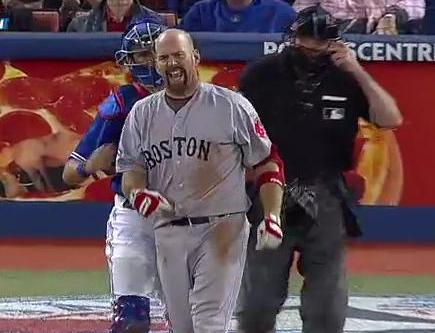
The third baseman was hit high on the shoulder during his sixth-inning at-bat, and if he didn’t know it was coming, he was at least ready for the possibility. Based on his reaction, he took no umbrage with getting drilled, but was irate over the pitch’s location, too near his head.

Youkilis spun toward the mound, pointed toward his hip, and yelled at Hutchison to “keep it down.” He then gathered his batting helmet and made his way to first base. The closest he came to rubbing the spot was when he pointed to it in response to the Boston trainer’s question about where he had been hit. (Watch it here.)

That Hutchison had a mandate to retaliate in the first place was questionable—though well within the boundaries of reason—given that Bard had never been more wild. The first batter he hit, Yunel Escobar, loaded the bases; the second, Edwin Encarnacion, drove in a run. Bard also issued five bases on balls over the course of one-and-two-thirds innings, along with five earned runs on just one hit. He managed to throw all of six fastballs for strikes. The guy was obviously not making any kind of statement short of the fact that he may well prefer working out of the bullpen, but Encarnacion was sufficiently hurt after being hit on the hand to be pulled from the game before his next turn at bat.

Hutchison saw fit to stand up for his mates—an impressive display for a guywho six weeks ago was working in Double-A. Things could have ended after he hit Kelly Shoppach—Boston’s first hitter after the dual drillings in the third. It’s likely that when Encarnacion left the game in the fifth that further action appeared merited to the pitcher.

“I was trying to go away,’’ Hutchison said after the game, denying intent. “I tried to put a little bit extra on it and I just missed. That’s it.’’

Where this all ends up is Daniel Bard. Because Youkilis expected his drilling, he no doubt pins its point of origin squarely on his teammate. Hutchison’s message was on point—Don’t hit our batters, and we won’t hit yours—and Boston heard it loud and clear. Ten more Blue Jays came to the plate after Youkilis was drilled, and they all emerged unscathed.

As if Bard wasn’t feeling enough pressure to perform, he now has this to chew on, as well.

Franklin Morales, Luke Scott, Retaliation

Great Scott! Red Sox, Rays Continue Decades-Long Dustup

Jeez. You go away for a long Memorial Day weekend, and all heck breaks loose. The nice thing about looking at situations like this in retrospect is the clarity afforded by the long view, in which the reactions to a given kerfluffle end up being more entertaining than the kerfluffle itself.

If there was smart money laid down on a weekend eruption, it would have been on the Rays and the Red Sox, two teams with no love lost, who just last week seized headlines when Adrian Gonzalez promised to hit a homer, and was by appearances drilled for it, by Rays rookie Matt Moore. (Retaliation was collected by Boston’s Felix Doubront, who drilled Luke Scott—a player whose name will be featured again prominently in this report, only two sentences from now.)

This latest round came in the sixth inning Friday, when Rays righty Burke Badenhop hit Dustin Pedroia. It was a stretch to consider it intentional, given that it brought David Ortiz to the plate as the tying run, but that didn’t keep Sox pitcher Franklin Morales from hitting Scott in the knee three innings later, two pitches after putting an offering behind his head. It might merely have been the spot in the order—Morales waited until there were two outs in the ninth, with nobody on—or it could have been Scott’s comments last month in which he called Fenway Park “a dump.” (Heck, maybe it’s that Morales, despite being from someplace other than the United States, is an Obama supporter.)

Or perhaps good fortune handed Morales the guy he wanted, precisely when he wanted him.

Players streamed from the dugouts, did a bit of shoving and tugging—Boston coaches Bob McClure and Tim Bogar, as well as manager Bobby Valentine, appeared to be more agitated than most players—and went on their ways. (Watch it here.) The Red Sox held on to win, 7-4.

Afterward, each manager had choice words for the other.

Rays skipper Joe Maddon, in addition to calling it a really weak, cowardly effort on the part of the Red Sox:

I’m kind of curious regarding who put out the hit, because I know it wasn’t one of their players. By the way their players reacted to the entire situation, I knew it did not come from them. It’s kind of incompetent behavior, it’s the kind of behavior that gets people hurt on your own side by choosing to do something so ridiculous.

Pedroia gets hit, not because we’re trying to hit him, he just got hit. We don’t want Papi coming up there with two guys on, are you kidding me? I don’t care who’s pitching for us. That’s truly somebody flexing their muscles on the other side that really needs to put them in their back pocket and understand that they can’t hurt their own team by doing something like that. . . .

To be really carelessly incompetent on their side, to truly, intentionally hit somebody, throwing behind somebody, then hitting them in the leg, for all the wrong reasons, whereas eventually they can get their own guys hurt with that kind of behavior . . .  I think it’s ridiculous, I think it’s absurd, idiotic, I’ll use all those different words.

Maddon later tweeted, “Very proud of our effort 2nite. What occurred in the 9th reeked of intent. Was ridiculous, absurd, idiotic, incompetent, cowardly behavior.’’

Valentine, in addition to suggesting the culprit to blame for Morales’ fastball was the Ghost of Fenway, guiding the ball in response to Scott’s “dump” comment:

I thought their coaches were really aggressive; as a matter of fact, I took offense to the aggressiveness of their coaches. I thought it was really unprofessional. . . . [Rays coaches] seemed very immature and out of control. Coaches are supposed to stop those things from happening and their coaches were aggravating, agitating, and instigating the situation.

Given all of this—plus the fact that Scott offered the warning, “At the end of the day, you reap what you sow”—it was a bit surprising that umpire Ed Rapuano declined to issue warnings prior to Saturday’s game. Turns out he didn’t need it; nothing incendiary happened. On Sunday, in fact, Matt Joyce wiped out Mike Aviles on a double play, and received a pat on the back for his efforts as he got up.

The Rays-Red Sox rivalry dates back to 2000, when Pedro Martinez hit Gerald Williams, and has since been fierce enough and consistent enough to merit its own section in The Baseball Codes. The teams meet again in July; we’ll see if we can’t add another chapter then.

Umpire Relations

How to Make Friends and Influence People (or Not): Umpire Edition

Things got testy for Denard Span Tuesday.

We know already that there are different ways to deal with umpires—some effective, some not so much. We know already that superstars have more leeway in this regard than the average player. And if we didn’t know already that you may as well go ahead and vent once you have nothing left to lose in a game—say, if you’ve just been rung up on three pitches out of the strike zone as your team’s final out in the ninth inning—we learned about it on Monday.

We’ve learned a lot about umpire relations since Monday, in fact. Three examples (at least), in three different situations, with three different kinds of player. Whether these examples set any sort of precedent when it comes to understanding player-umpire relations is less clear than the fact that they were all wildly entertaining, and gave some insight into the psyches of those involved, players and umpires alike.

Start with Monday’s game in San Francisco, in which Roy Halladay walked Aubrey Huff in the fifth inning on an 88 mph cutter with two outs and a runner on first. Trouble was, Halladay didn’t agree that the pitch was a ball. (To his credit, neither pitch-tracking service Brooks Baseball; thanks to Hardball Talk for the link.)  From the Philadelphia Inquirer’s Matt Gelb:

Halladay snatched the throw from Carlos Ruiz and didn’t flinch. His eyes were focused on (Marty) Foster, the home-plate umpire . . . Foster noticed the death stare. He said something to Halladay, who barked back. Then Halladay pointed to make his anger totally clear. It was a brief exchange, one Halladay later claimed was not directed at Foster. But that was the pitcher’s way of being diplomatic.

The result: Five pitches later, Halladay threw another cutter to Brandon Belt, this one well off the plate. It was called a strike, Belt’s third of the at-bat. Inning over.

“His demands had been heard,” wrote Gelb. Halladay had “conquered the umpire.”

Across the country, more balls were being called strikes, including three of Fernando Rodney’s five pitches to Cody Ross, Boston’s final batter in the final frame of a 1-0 loss to Tampa Bay.  (See them in another chart from Brooks Baseball, also via Hardball Talk.)

Ross, suffice it to say, was less than pleased, going off later in the Boston Herald about the ignominy of what had just occurred, calling the judgement of plate ump Larry Vanover “unacceptable.”

“If I’m going up there and striking out every at-bat, I’m going to get benched,” he said. “But it’s not that way with (umpires). They can go out there and make bad calls all day, and they’re not going to be held accountable for it.”

Confronting an umpire apparently made a difference for Halladay. The same might be said for Ross (who did it through the press), but not in a way that held any appeal for the player. It could be coincidence, but the following day, three Rangers pitchers struck out a total of 11 Boston hitters—a team high since opening day, when they struck out 13 White Sox—as Texas cruised, 18-3.

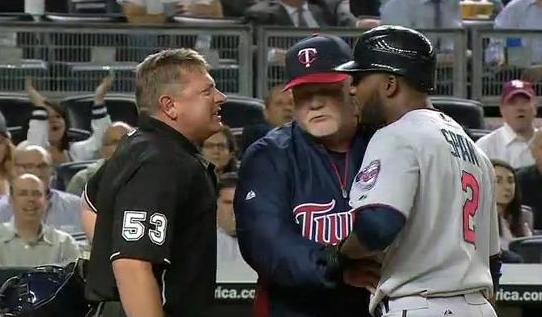
On Tuesday in New York, Minnesota’s Denard Span was tossed by plate ump Greg Gibson for arguing balls and strikes. Actually, he was tossed for the fact that he did so in an obvious fashion, swiveling his head backward as he stood in his batting stance to face the ump during the course of the conversation. (See it all here.)

It’s well-known that such a move is widely taken as disrespectful by umpires, and few are willing to tolerate much, if any, of it. This became clear when Span was caught by on-field microphones saying, “I didn’t disrespect you,” shortly before he was tossed.

Said Span in the Minneapolis Star Tribune, “It went from Level 1 to “Level 10 in like two seconds.”

“You don’t want to turn on an umpire, to show him up,” said longtime catcher Ron Hassey, discussing the general concept, not Span specifically. “If you’re going to talk, talk straight out. He knows what’s going on. He can hear you.”

Ultimately, what do all these interactions tell us? Unfortunately, not a heck of a lot. Every ump is different, as are players’ relationships with them. Halladay’s ability to stare down an umpire certainly had no bearing on Span’s inability to try to talk sense to one.

None of the three players, of course, had anything on former Yankees pitcher Ryne Duren, long noted for his combination of blazing fastball and lack of control. Jim Bouton recounted in his book, I’m Glad You Didn’t Take it Personally, the time that Duren walked three straight hitters on 12 neck-high fastballs. Wrote Bouton:

Finally he walked across a run and he stormed up to the home-plate umpire. “Goddammit, where the hell are those pitches?”

“Right up here, Ryne,” the umpire said, pointing to his neck.

“Well, goddammit,” Duren said, “I’ve got to have that pitch.”

Bobby Valentine, Kevin Youkilis, Managers Protect Their Players, Sports Illustrated.com

Now at SI.com: Bobby Valentine Sometimes Says Stupid Things

My latest is up over at Sports Illustrated.com, involving Bobby Valentine‘s recent comments about Kevin Youkilis. You can click over there to see a full-color photo of Bobby V during game action, or you can save your mouse-clicking finger and just scroll down. (Bonus points for reading it here: The original, un-edited ending!)

One update: Between the time I turned in the copy yesterday and this morning, video of Valentine’s press conference, in which he discusses the situation, has been posted on the Red Sox Web site. In it, the manager says that he talked to Youkilis “during the game” (this after an earlier apology did not appear to go well), and that, instead of everything being fine, “it is what it is.”

If things don’t get better in a hurry over there, it’s pretty clear they’re going to get a lot worse.

On to SI:

Bobby Valentine was brought to Boston as a knee-jerk reaction to a perfect storm of last year’s late-season collapse, wild accusations about allegedly dispassionate players, and a clubhouse culture that allowed such accusations to surface in the first place.

Blaming Terry Francona is one thing, but expecting a guy like Valentine — long on baseball acumen but short on verbal filters — to provide a calming influence to a team in turmoil was, at best, a crapshoot. Not yet two weeks into the the 2012 regular season, Valentine is embroiled in his first controversy.

It may seem innocuous, going on television as Valentine did and saying that Kevin Youkilis is not “as physically or emotionally into the game as he has been in the past.” It was a phrase amid an otherwise complementary comment; Valentine is obviously invested in Youkilis’ success, and he made sure to note that his third baseman’s slow start appears to be turning around.

None of that matters, of course. In baseball, a manager’s primary duty away from the field is to protect his players at any cost, usually from the media, at least until the point that a player leaves him no other option. If Youkilis has somehow already reached that point with Valentine, if his manager felt that calling him out in a local television interview was the only recourse left to reach him, well, that would constitute a newsworthy story. Other than his manager’s off-the-cuff banter, however, there is no indication that this is the case.

Instead, Valentine and the Red Sox are left to deal with the fallout, which serves to illustrate precisely why managers are expected to be measured in public statements about their players. Now, instead of coming to the ballpark and focusing on the game at hand, Youkilis has to answer questions about his manager’s lack of confidence, in addition to questions about his slump. Now, Dustin Pedroia has to step back from his own preparations in order, as a team leader, to defend his compatriot. Now, the rest of Boston’s players have to wonder what it might take before their manager publicly questions them, as well. Now, Valentine, the man brought in to help manage a media circus, has added a ring to the big top, and — inadvertently or not — is forcing his players to dance through hoops before they reach the field.

The unwritten rule to protect your players is why Whitey Herzog refused to admit that Keith Hernandez’s drug use (and his subsequent untruths when discussing it) were motivating factors in his being dealt to the Mets in 1983, even as the manager took considerable grief for the deal.

This rule is why Joe Torre, after Roger Clemens threw a bat shard at Mike Piazza during the 2001 World Series, refrained from storming out of his postgame interview amid a battery of leading questions. He knew Clemens was to follow him in front of the press, and wanted to absorb the difficult queries himself.

This rule is why Tony La Russa defended Jose Canseco long after steroid accusations against him became part of the public dialogue, and it is likely why he continued to defend Mark McGwire against similar charges after even many of his staunchest defenders had long since given up.

This rule is why Arizona manager Bob Brenly so vociferously attacked Ben Davis in the press following the Padres catcher’s bunt single that broke up Curt Schilling‘s perfect game in 2001. It was less because Brenly was angry at Davis, he said, and more because he wanted his pitcher to know that he “was looking out for his interests.”

For a clear comparison, consider two baseball stories, both of which involve pitchers being pulled from games in which their teams led by identical 4-2 scores. In one, A’s manager Ken Macha discussed with the press the fact that Barry Zito removed himself from the penultimate game of the 2004 season, with the division on the line against the Angels, after 114 pitches. Zito logged seven full innings, but Oakland’s bullpen gave up three quick runs, and Anaheim went on to win the game and a spot in the postseason. There was heat for pulling an effective pitcher, and Macha wanted no part of it.

In the other, Tigers manager Mayo Smith opted in 1969 to keep quiet about the fact that he pulled his own starting pitcher, Denny McLain, with one out in the sixth inning, after McLain warned him that he was tiring. Reliever Darryl Patterson came on and gave up, in order, a single, a walk, a sacrifice fly and a three-run homer; Detroit lost, 6-4.

Afterward, with media speculation raging about Smith’s decision to remove his star pitcher so early, the manager refrained from divulging the fact that McLain had effectively removed himself, not to mention that he had left the park altogether by the eighth inning. Smith kept quiet even when telling the truth would have deflected criticism. Valentine didn’t even have that for motivation.

Valentine has publicly apologized to Youkilis, but a question for players in the Boston clubhouse may soon arise—if it hasn’t already—about what kind of manager they want to play for. If the answer is less Ken Macha and more Mayo Smith—or less Bobby Valentine and more anybody—but anybody—else, then the manager has far bigger things to worry about than Kevin Youkilis’ early-season hitting woes.