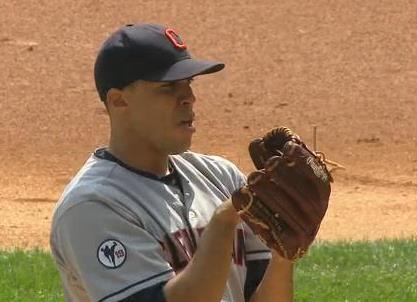
Jonathan Sanchez, Retaliation, Shin-Soo Choo

Royal Rumble: Choo Revisits Old Times with Sanchez

Baseball has an early clubhouse leader in on-field sensitivity, by his own admission no less, a particularly notable event considering that we’re barely a week into the schedule. Ladies and gentlemen, Mr. Shin-Soo Choo.

Choo’s sensitivity training began on opening day, when he explained his angry steps toward the mound in response to Toronto reliever Luis Perez buzzing him with a head-high, inside fastball as being a lingering function of having his thumb broken by a pitch last season.

“Maybe that’s why I’m sensitive right now,” he said at the time. “But I know it’s part of the game.”

It came full circle on Saturday, when the pitcher who had broken his thumb, lefty Jonathan Sanchez—then with the Giants, now with the Royals—faced the Indians for the first time since the incident. In the third inning, he hit Choo again, this time above his right knee. Choo shouted at the pitcher and, he said in a Cleveland.com report, “told him to throw it over the plate.” (Watch it here.)

It was enough to empty the benches, at which point crew chief Gary Darling issued warnings to both teams.

Choo later confronted his sensitivity in the Kansas City Star, admitting that, especially as it concerns getting drilled by Sanchez, “maybe I am a little bit sensitive.”

In this case, so too were the rest of the Indians. Cleveland starter Jeanmar Gomez drilled the next member of the Royals to come to the plate, Mike Moustakas, again drawing the benches onto the field. Both Gomez and manager Manny Acta were ejected, as was third baseman Jack Hannahan, who tried to get at Moustakas in the scrum.

(Afterward, Gomez insisted that he was “trying to open the inside corner” so as to “work the outside part of the plate.” Of course he was. In the other clubhouse, Sanchez issued a similar—though more plausible—denial: “I’ve got a guy on first—why am I going to hit somebody? You’ve got to be a professional and take your base. He knew it wasn’t on purpose.”)

This is where the balance between appropriate teammate protection and game consideration comes into play. Choo was likely delighted by Gomez’s strike; Hannahan clearly was. Because Gomez chose to stand his ground with a warning hanging over him in the third inning, however, he forced his team into emergency maneuvers. “He was trying to protect his teammates, but I think he went overboard a little,” said Acta. “There was a warning in place. Once you hit a guy, you’re going to be thrown out. That early in a game, you tax the bullpen.”

Ultimately, the best retaliation came from Choo himself, when he laced a two-out, two-run double off the center-field wall in the 10th inning, providing the difference in Cleveland’s 11-9 victory. In so doing, he also proved that he is not prone to being sidetracked by extracurricular distractions.

After the game, Indians reliever Chris Perez—who earned the save on Saturday—kept things alive on Twitter, referencing Kansas City’s team slogan, “Our Time,” in a Tweet: “Huge team win tonight; time for a sweep to tell the Royals it’s not “Our Time”, it’s #TribeTime. P.S. You hit us, we hit you. Period.”

“We’re tried of watching our guys wear it,” Perez said the following day in the Kansas City Star. “It happened (too much) last year, and we’re not going to stand for it this year.”

These are fine claims for a blustery pitcher seeking to send a message, but for Cleveland’s closer—who will virtually never have the chance to follow up on his threat, based on the fact that he appears almost exclusively in close games—such claims set an unenviable precedent for his teammates to follow up on his behalf.

Cleveland won a 13-7, incident-free series finale on Sunday, but the teams face each other 15 more times this season, presenting a very good likelihood that Jonathan Sanchez starts at least one of those games. He should by now recognize the increased combustion factor should he come anywhere close to Choo; for a guy who’s built significant amounts of success on being affectively wild, it’ll be interesting to see how this reality affects him.

Related: Opening Day + Extra Innings = Baseball Drama in Cleveland.

Update (4-18): Gomez has drawn a five-game suspension for his actions. Seems that hitting a guy intentionally is one thing; doing so after an umpire specifically told you not to is something else.

Update (4-20): Perez has been fined for his tweet, .75 large.

Retaliation, Shin-Soo Choo

Opening Day + Extra Innnings = Beanball Drama in Cleveland

The season’s first lesson on sensitivity awareness was given yesterday in Cleveland, when benches emptied after Shin-Soo Choo was forced to duck under a head-high fastball from Toronto reliever Luis Perez in the 15th inning.

While no hitter in baseball would react well to an inside pitch above his shoulders, Choo was particularly sensitive. He missed six weeks last season after having his thumb broken by a pitch. He had been drilled earlier in Wednesday’s game by Ricky Romero. So when he was forced to the dirt by Perez in the 15th, he responded by jumping up and taking angry steps toward the mound, spurring the benches to empty. (Watch it here.)

Which is where intent comes into the equation.

Perez’s pitch arrived after warnings had already been issued by plate ump Tim Welke in the fourth, after Cleveland’s Justin Masterson came inside twice against Kelly Johnson, apparent retaliation for Choo’s HBP an inning earlier.

Perez was Toronto’s seventh pitcher of the day. That left one guy in the pen—closer Sergio Santos—to go the rest of the way, were Perez ejected, in a game that looked as if it might never end. There were two possibilities for Perez’s motivation—he’s a baseball imbecile, with no shred of insight into the appropriate time to respond to something; or the pitch simply got away from him.

The smart money’s on the latter; Welke’s certainly was. Despite the earlier warnings, Perez was not ejected, and it’s not difficult to see why.

Even Choo came around to that viewpoint, saying after the game in the Cleveland Plain Dealer, “I was hit by a pitch last year and broke my thumb. Maybe that’s why I’m sensitive right now. But I know it’s part of the game. Pitchers have to go inside. I understand it.”

And so we move on. Teams play again Saturday; we’ll see how Toronto reacts once the timing is right.

– Jason

Retaliation, The Baseball Codes

Tulo or Ubaldo? Jimenez Out to Prove the Rockies Made the Right Decision

Anybody wondering why the Colorado Rockies never considered Ubaldo Jimenez to be in the same stratosphere as Troy Tulowitzki and Carlos Gonzalez got their answer today.

Turns out the guy is hot-headed, and possibly a touch delusional.

Jimenez, who publicly steamed last week about the lack of respect shown him by the Rockies when they traded him to Cleveland rather than sign him long term, got his first chance to face his former team on Sunday. Before long, he had sent Tulowitzki to the hospital.

The right-hander’s first move was to drill Colorado’s All-Star shortstop in the elbow (test results came back negative). His second was to race toward the plate, daring an enraged Tulowitzki to come at him. After at first refusing to speak to the media after the game, Jimenez said that his post HBP histrionics were merely a reaction to Tulowitzki’s anger. “He was calling me out,” he said in a Denver Post report. “I mean, I’m a man. If somebody calls me out, I have to go.”

Tulowitzki’s drilling follows a time-tested tradition of players being punished for their teammates’ actions, be it the next hitter in the lineup dodging fastballs following a home run, or a slugger going down as part of a pitcher protesting a big inning.

Those tactics, however, are long outdated, and Jimenez knows it. Tulowitzki might have worn it because he’s the face of theRockies—not to mention the guy who got a big contract when Jimenez did not. (Tulowitzki and Gonzalez both signed monster deals after the 2010 season, the former for $134 million, the latter for $80 million, both over seven years. Jimenez signed for $10 million over four years prior to the 2009 campaign.)

Or he might have worn it for the statement he made in response to Jimenez’s initial cries of disrespect. “(Jimenez) had signed his deal and had years left on it,” the shortstop said. “Why would we give him something new when we didn’t see anything out of him?”

Jimenez said that his pitch was unintentional (it “got away,” he said), but that’s clearly not the case. Rockies pitcher Jeremy Guthrie—in his first season with Colorado—said he knew what was coming based on where the catcher was setting up.

The umps, clueless, did not issue an ejection.

Two things worth noting:

  • Jimenez was 6-9 with a 4.46 ERA when the Rockies traded him last season.
  • Jimenez is 1-4 with a 7.43 this spring.

The guy gave the Rockies scant reason to lock him up last season, let alone rework his contract long before it was set to expire. He currently appears to be working his way out of the Cleveland rotation altogether. He should focus on things other than misplaced anger directed at guys who don’t deserve it.

Colorado and Cleveland don’t face each other this season, so the two won’t meet again short of the World Series. Should Jimenez face his old mates next year, however, it’s pretty certain that today’s activities will be revisited, with vigor.

– Jason

Update: Rockies skipper Jim Tracy didn’t much care for Jimenez’ act, calling him “gutless” and calling for his suspension.

Update 2 (4-02): MLB didn’t much care for Jimenez’ act, either.

Update 3 (4-02): Watch it here.

Update 4 (4-03): Jimenez isn’t exactly reticent about the whole thing.

Update 5 (4-03): How not reticent? He’s appealing his suspension.

Rick Porcello, Umpire Warnings

When Umpires Strike, Blatant-Retaliation-for-Questionable-Offenses Division

There are two directions an umpire can go in instances of retaliation that occur under his watch.

He can let the situation play out, offering the other team a chance to respond before bringing down the hammer with warnings.

Or he can go quick-draw in an effort to immediately tamp down further inflammatory actions.

In the latter scenario, the offended party will inevitably be displeased about being handcuffed in its response. Which is exactly what happened to the Indians over the weekend.

It started with Asdrubal Cabrera mashing a ball down the line, an an all-or-nothing shot certain to clear the fence. He watched it fly, to see whether it went fair or foul.

It went foul. As did Tigers pitcher Rick Porcello, who by appearances felt shown up by Cabrera’s lingering presence in the batter’s box. He put his next pitch behind Cabrera’s back.

The Cleveland shortstop glared toward the mound, but his progress in that direction was stopped by plate ump Paul Schrieber, who issued quick warnings to both benches. Indians manager Manny Acta was not pleased. (Watch it here.)

“When that happens, you don’t need a warning to throw the guy out of the game,” he said in a Fox Sports report. “If you do not throw the guy out of the game then you should not issue a warning because then we’re not getting our shot.”

If only everyone was so clear, concise and correct. The manager has every right to expect a chance to respond to such a blatant Code violation—or, alternatively, have the ump collect a pound of flesh on his behalf. This doesn’t happen every time, of course; ever since umpires were instructed to tighten their trigger fingers, countless players and managers have been upset at lost retaliatory opportunities.

Acta, however, verbalizes his frustration better (read: more candidly) than most.

He was forced to specifically instruct pitcher Ubaldo Jimenez to avoid responding; it was still early in the game and he didn’t want to burn his bullpen. (His message was effective—Jimenez refrained from taking action, but that’s not always the case. Joe Torre recalls a time when he managed the Braves, in which he told pitcher Ray King Donnie Moore to leave well enough alone at the tail end of a volatile situation—before recognizing the situation for what it was. “‘I have no chance. I’m talking to a deaf man,” he said of the conversation. “I walked back to the dugout and he hit Graig Nettles. You can talk until you’re blue in the face, but it’s guys defending each other. That’s what it’s about.”)

Acta also talked about the nature of Cabrera’s blast (“The guy was just standing there looking at a foul ball. It was a foul ball. That was all”) and the blatant nature of the drilling (“Everybody, including the vendors in the stadium, knew that he threw at him”), but it was his touchstone summary of the Code and some of its modern interpretations that was truly impressive. The gems included:

  • A mini-treatise on the relative safety of retaliation for AL pitchers, as well as the inherent risks: “Guys who do that in the American League, all they’re doing is putting their team in jeopardy because they don’t hit. Guys in the National League who hit guys are the guys that show me something because they have to get up to the plate.”
  • A polemic on the inter-team chumminess of modern players: “None of these guys want to fight. The game has changed so much, it’s a joke. All we’ve got to do is watch BP (batting practice). They’re all hugging and laughing (with opponents). Look on the bases, how you’ve got three, four guys (on opposite sides) talking to each other.”
  • A sidebar on players’ softness (directed toward Porcello), pointing out one player who did not fit that bill—Francisco Rodriguez. While with the Mets, the closer took exception to comments made by Yankees pitcher Brian Bruney about his animated nature, and confronted him before a game. Acta: “You want to know who’s tough? Frankie Rodriguez is tough. He didn’t like what some guy did a couple years ago, he went out at stretch time. . . . That’s being tough, not throwing a ball at a guy and not even facing the guy. If you have to get up to the plate (to hit), then maybe I can see you being tough.”

Porcello offered standard denials about the pitch getting away from him, but if even the vendors could read his intent it doesn’t hold much water.  The teams meet again on Sept. 5. Hold onto your hats.

– Jason

Appropriate Retaliation, Carlos Carrasco, Retaliation

How Not to Retaliate When Getting Your Ass Kicked, Cleveland Edition

Duck, Billy, duck!

In baseball, retaliation is expected. Ill-timed stolen bases, drilled teammates, questionable slides: They all qualify for reciprocal strikes.

In the case of Melky Cabrera, showboating fits this particular bill. The Royals outfielder hit a grand slam against the Indians on Friday, then admired it in a manner battle-tested to effectively get under the skin of opposing pitchers. (Watch a little bit of hit here.)

At this point in the story, Indians pitcher Carlos Carrasco had three options: wait for the next time he faced Cabrera, when he could teach him a lesson; drill the following hitter, Billy Butler, because pissed-off teammates are frequently even more effective than direct retribution; or ignore the matter entirely.

Carrasco chose none of the above. What he did sort of resembled the second option, but although he threw at Butler, in so doing he violated an unwritten rule that holds far more weight than Cabrera’s theatrics.

The Cleveland right-hander threw at Butler’s head. It was a reaction borne of clear frustration: Cabrera’s blast served as the fourth, fifth, sixth and seventh runs Carrasco had given up in 3.1 innings. Two of those runs had come in the first, courtesy of a Butler home run.

That the pitch didn’t connect—Butler ducked underneath it—saved Carrasco even more trouble than he’d just earned, but not much. (Watch it here.)

Plate umpire Scott Barry immediately ejected the pitcher. Indians catcher Lou Marson cut off Butler in case he had thoughts of settling things then and there, and the benches quickly emptied. No punches were thrown, but as players filtered back to their dugouts, Carrasco got into a shouting match with Jeff Francoeur, who angrily pointed toward his hip, indicating where the pitch should have gone.

“I understand the game,” said Francoeur afterward in the Cleveland Plain Dealer. “If he thought [Cabrera] pimped the home run, fine. Hit [Butler] in the side. Don’t hit him in the head. That’s why I was yelling at him.”

Francoeur’s opinion was spot on. Several Royals indicated that an appropriate drilling of Butler—in the hip or thigh, well below the shoulders—would have been readily accepted. (“Be a man—throw at his back, not his head,” said Alex Gordon in the Kansas City Star.)

Even more importantly, just as such an action could have served to set Cabrera straight by angering his own teammate, Carrasco’s stupidity has put a similar onus on the Indians. Kansas City has every right to retaliate, but because of the DH it’ll be another member of the Indians who wears one on Carrasco’s behalf. There will likely never be a mention of it in the press, but when it happens it won’t be met kindly within Cleveland’s clubhouse.

After Carrasco’s display, Indians pitching coach Tim Belcher cornered him and elucidated the repercussions of what he’d done.

“We don’t condone those types of things,” said Cleveland manager Manny Acta after the game, in the Plain Dealer. “Whether the ball got away from him or not, we don’t condone throwing at people’s heads. That’s a dangerous situation.”

For his part, Butler responded in the best way he could; five innings later, he hit his second homer of the day. (The poor guy seems to be a magnet for this kind of thing; earlier in the week Butler was drilled by Red Sox reliever Alfredo Aceves, possibly in response to a brushback pitch thrown earlier to Dustin Pedroia.)

“I barely got out of the way,” he said after the game in the Star. “It was right at my head, and there was no way around it. I usually don’t react that way. If I get hit, I get hit. I don’t have anything to say. But in that situation, I’m going to open my mouth.”

The Indians, shockingly, perhaps felt further need to respond to Cabrera; when he came up with the bases loaded in the fifth, reliever Chad Durbin greeted him with a high, inside fastball. Even in the Royals clubhouse, players acknowledged that the center fielder will be instructed to speed up future home run trots.

Both the initial parties issued standard denials, with Carrasco saying the fastball got away from him (although he did admit to having noticed Cabrera’s pimp work), and Cabrera insisting that disrespecting the pitcher was the furthest thing from his mind.

That, of course, is hogwash. The Royals will almost certainly notify him of that at the next available opportunity.

– Jason