Intimidation, Umpires Knowing the Code

Homer, Homer, Homer, Plunk: What Else can an Ump Assume?

Hamels homer collageSometimes, intent doesn’t matter.

When Orioles starter Jason Hammel drilled Detroit’s Matt Tuiasosopo on Saturday, nobody on either team felt strongly that he did it on purpose. The fact that there is no such thing as an 82-mph purpose pitch—which is where Hammel’s fateful offering clocked in—did not dissuade plate ump Hunter Wendelstedt from ejecting the right-hander on the spot.

It being the first pitch after back-to-back-to-back home runs, not to mention its location up near the batter’s head, will put a ballpark in that kind of mindframe. After all, the reasoning goes, even if Hammel didn’t mean to drill Tuiasosopo, perhaps he should have—especially after Victor Martinez, Jhonny Peralta and Alex Avila just went deep. When one’s strategy as a pitcher isn’t working out quite as one had hoped—and make no mistake, three straight bombs under any circumstance will make a pitcher question his strategy—the only prudent plan is to change things up.

Put another way: If a team is getting far too comfortable at the plate, make them less comfortable. Starting immediately. (Watch the drilling here. Watch the homers here.)

So when Hammel’s actions followed the script—even if, in retrospect, his intention appears to have been elsewhere—an umpire can hardly be faulted for ignoring the finer points of the situation. After all, there is plenty of historical precedent on which to build. A small sampling, culled from a long-ago post detailing four straight homers hit by the Diamondbacks (which focused more on the outdated unwritten rule of restraint from swinging at the first pitch after back-to-back—or more—home runs):

  • In 1944 Cardinals Walker Cooper, Whitey Kurowski and Marty Marion hit consecutive homers against Reds pitcher Clyde Shoun. The next hitter, Marty Marion, was knocked down.
  • In 1991,Angels pitcher Scott Bailes hit Randy Velarde of the Yankees after giving up consecutive home runs.
  • In 1996, after the Red Sox connected for three home runs against the Angels, reliever Shawn Boskie threw a pitch behind Jose Canseco’s back.
  • In 2003, Astros pitcher Shane Reynolds gave up three home runs to the Pirates, then put a pitch under the chin of Brian Giles.
  • Mike Hegan, addressing the mindframe if not the actual scenario: “In April of 1974, I hit behind Graig Nettles the whole month. Graig hit 11 home runs, and I was on my back 11 times. That’s the kind of thing that happened.”

Former reliever and longtime pitching coach Bob McClure put it this way, in an interview for The Baseball Codes:

We were in Yankee Stadium one time, and I gave up back-to-back home runs to two left-handers. I’d given up back-to-back home runs before, but not to two lefties. Dave Kingman was up next, and I remember [catcher] Charlie Moore calling for a fastball away. He knew better—he was just going through them all. He called fastball away. No. Curveball. No. Changeup. No. Fastball in. No. And then he goes [flip sign—thumb swiped upward across index finger, indicating a knockdown] and I nod. So I threw it and it was one of those real good ones—it went right underneath him and almost flipped him.

He was all dusty and his helmet was over here and his bat was over there and he grabbed them and got right back in there. I threw him a changeup and he popped up to first base. And as he made the out, he rounds first and is coming toward the mound, and I’m trying to get my glove off because I’m figuring to myself, if I’m going to die, I’m getting the first punch in. [Kingman, one of the game’s premier power hitters, stood 6-foot-6, 210 pounds. McClure was 5-foot-10, 170.]

He came right up to the dirt, then went around it, pointed at me and said, “There’ll be another day, young man.” And he just kept on going. I saw him about 10 or 12 years later and asked him if he remembered that incident. He looked me right in the eye and said, no. Just like that.

All of which is a long way of saying that back then, we were taught the 0-2 up and in. Home run, next guy: boom! Knock him down.

All of which goes toward the near certainty that Wendelstedt knew what he was going to do with Hammels in the case of a hit batter before the ball even left the pitcher’s hand.

“[Hammel] had probably 10 to 12 balls slip out of his hand today,” said Orioles manager Buck Showalter, defending his pitcher in the Baltimore Sun. [With a] breaking ball, it’s tough on umpires trying to judge intent, but they get a lot of pressure from the major league offices. … I understand what the umpire’s trying to do, but it’s very tough for them to judge intent.”

“They claim there was no intent,” responded crew chief Jerry Layne. “Three home runs and a guy gets hit. You’re an umpire, what do you do?”

In many ways, the Code is not nearly as prevalent as it once was. But there are times when people—sometimes even against their better intentions—make sure that it stays at the forefront of people’s minds. Welcome to the milieu, Jason Hammels, even if you didn’t mean to be here.
Al Alburquerque, Showing Players Up

Kiss Me, Al: Tigers Pitcher Turns Baseball into Blarney Stone, Sparks Minor Uproar

A kiss is just a kiss—unless it happens in the ninth inning of a playoff game. Then, all hell breaks loose.

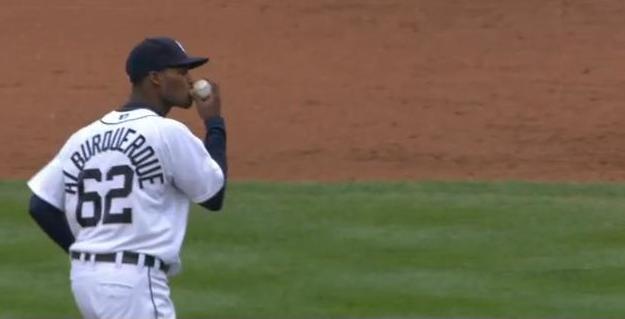
Tigers reliever Al Alburquerque put it to the test on Sunday. With the game tied, runners at the corners and two outs, the right-hander was called upon to face A’s slugger Yoenis Cespedes, who he retired on a comebacker to the mound. Before tossing the ball to first, however, Alburquerque planted a wet one on the horsehide. (Watch it here.)

“Did I see what I just saw?” Tigers catcher Gerald Laird, who had been removed for a pinch-hitter a half-inning earlier, recalled thinking. “Obviously,” he said later, “I did.”

So did the A’s. After the game, outfielder Josh Reddick told reporters that he “didn’t appreciate it,” that he “thought that was immature” and “not very professional.” Cespedes said that he may kiss his bat the next time he connects against Alburquerque.

By Monday afternoon, however, during an off-day at Oakland’s O.co Coliseum, the A’s were downplaying the incident as a non-story.

“What am I going to do, yell at them?” asked Jonny Gomes. “That doesn’t take care of anything. Bash them in the media? That doesn’t take care of anything. Just let the baseball gods take care of it. That’s why the baseball gods are there.”

For his part, Alburquerque, 26, said Monday that he intended no disrespect to Cespedes or the A’s, and that his actions were colored by “the emotion of the game.” Regardless, the second-year pitcher, a native of the Dominican Republic, was pulled aside after the game by Miguel Cabrera, Alex Avila and Octavio Dotel, who explained to him the reality of the situation.

“We just talked common sense,” said Avila. “First, you don’t want to kiss a baseball that you’re about to throw to first base, because if he does that and throws it over Prince [Fielder]’s head, it doesn’t look so good. Also, the last thing you want to do is fire the other team up.” (The rest of the Tigers later took to jibing Alburquerque fairly relentlessly, including asking the flummoxed pitcher if the ball kissed him back.)

While this particular antic isn’t exactly commonplace, it does have some historical precedent when it comes to similar showmanship. Perhaps the most prominent example occurred during Game 7 of the 1982 World Series, when St. Louis Cardinals pitcher Joaquin Andujar fielded a grounder by Milwaukee’s Jim Gantner, then held the ball while watching watch Gantner run until the final possible moment, firing the ball to first base just in time.

Gantner turned and called the pitcher a hot dog (among other things), Andujar responded with a parade of his own curse words at high volume, and the pair had to be separated.

Closer to the tenor of Alburquerque’s display was Sammy Sosa, who in a spring training game in 1999 hit two home runs against Arizona’s Todd Stottlemyre, and bowed to the crowd, Japanese-style, after each. Sosa said afterward that his intent was to show respect to the fans.  Stottlemyre didn’t buy it.

“I sure don’t remember Mickey Mantle bowing after home runs,” he told the Associated Press. “I guarantee Joe DiMaggio didn’t bow.”

In neither case did the pitcher retaliate. In fact, the most appropriate form of retaliation is the one utilized by Philadelphia in 1993 against Bryan Hickerson, after the Giants reliever snared a line drive by Wes Chamberlain to end the sixth inning and spiked the ball into the turf.

“That infuriated us,” said Phillies outfielder Milt Thompson. Dusty Baker, then the Giants manager, said that Hickerson’s display was not directed at the opposing dugout, and that if the Phillies wanted to take it personally, it was up to them. They did, and it was; Philadelphia, down 8-3 at the time, came back to win, 9-8, in 10 innings.

This is exactly the type of thing that the A’s, down two games to none, have in mind. “Our best retaliation,” said Brandon Inge,” is to win three in a row.”

Ultimately, Avila had the most concise take on the subject.

“It’s baseball, not a soap opera,” he said. “It’s probably not the best thing to do in a playoff game, but at the same time there are much more important things going on.”

Cheating, Jose Valverde

Spit-Gate Underway: Did Valverde Hock? More Importantly: Does it Matter?

Well, it sure looked like Jose Valverde spat onto the ball—or at least into his glove, which contained the ball—in Sunday’s game against Cincinnati. A clip distributed (over and over again via Twitter) by a Reds fan named Justin Tooley shows Valverde, on the mound facing Devin Mesoraco, pursing his lips and doing something that looks an awful lot like spitting into his glove.

Chatter around the Internet concerns the possibility of Major League Baseball taking action against him. The quick response: No chance.

The first reason for this is plausible deniability. Implausible as it might seem, Valverde might simply have been sneezing. There’s also the fact that his ensuing pitch was a high-and-tight four-seam fastball, not the typical diver that pitchers look for from spitters. As Yahoo’s Kevin Kaduk noted, “Valverde is well known for throwing a split-fingered fastball, which makes you wonder why he passed on throwing that pitch if he did indeed spit on the ball.”

Writer/pitcher Dirk Hayhurst (who’s graced these pages before) weighed in on his blog with the notion that spitting on the baseball is, in the pantheon of ball-doctoring methodology, “like trying to kill an antelope with a sharp stick.” He also ran down the assortment of goops found in bullpen bags across the land:

Sun screen combined with rosin make for on the fly finger Fixodent. Firm Grip, found in every training room, makes the ball hang from your finger tips. Well rubbed in shaving gel gives a little extra tack, but no to so much that your hands suck up dirt and dust like chicken getting battered for deep fry.

Vasilene does the opposite. The ball slides out of your hand like a splitter and drops significantly more. If Vaseline is to advanced for you, try Skin Lube, it’s the gunk trainers stick under tape wraps so players don’t chafe while playing. It doesn’t gleam like Vasilene so you can smear it under your hat bill with out worry.

Umps really watching you? Try Kramergesic or Red Hot. Burns a little, but it also leaves a nice slime in it’s wake. If you get asked about it, you can say it’s medicinal. Plus, a mixture of lube and sweat works far better than spit or snot . . . Unless you prefer snot, in which case, rub a little Red Hot in your nose and get it running good. Just don’t get it in your eyes or you’ll leave the game in tears regardless of your performance.

Heck, in the case of Ted Lilly, it wasn’t even about substances he used, but where he (allegedly) stood atop the mound. With all this stuff at his disposal, it doesn’t make a lot of sense for a pitcher to expectorate in obvious ways as the center of attention on a baseball diamond. (Then again, very little about Jose Valverde actually does make sense.)

If you’re wondering whether any of the pitchers who utilize those methods have been caught, the answer is a resounding yes—a lot of them do it, and it’s impossible that they could all avoid detection. Their collective penalty, outside of the rogue moundsman every decade or so whose viscous  pursuits are so obvious as to leave no choice but punishment once they’re discovered : virtually nothing. Baseball has avoided punitive action with far more damning evidence in hand than Valverde just offered up. Take Red Munger, a pitcher for the Cardinals in the 1940s. From The Baseball Codes:

Munger was known by opponents and umpires alike to load up balls with tobacco juice. After umpire Larry Goetz called the second strike of an at-bat on one of Munger’s doctored pitches, the hitter complained that the pitch had been a spitter. “Yes it was,” Cardinals catcher Joe Garagiola recalled Goetz saying. “Strike two.”

A cheating pitcher may simply be a hornets’ nest that most umpires don’t appear inclined to poke. For something more recent, there’s this, also from The Baseball Codes:

In April 1973, Yankees outfielder Bobby Murcer exploded to the press after facing Cleveland’s greaseball king Gaylord Perry in the pitcher’s second start of the season, yelling: “Just about everything he throws is a spitter. . . . The more he knows you’re bothered by him throw­ing it the better he is against you. He’s got the stuff behind his ear and on his arm and on his chest. He puts it on each inning. I picked up the balls and they’re so greasy you can’t throw them.” Murcer went so far as to call commissioner Bowie Kuhn “gutless” for refusing to respond—and this was after the outfielder had recorded a three-hit game against Perry. When the pitcher was confronted with Murcer’s accusations, however, he said that Murcer hit “fastballs and sliders,” not spitballs. It would have been a more credible excuse had Perry been on the same page as his catcher, Dave Duncan, who in a separate contrived denial said that Murcer had hit “off-speed stuff.”

To further the argument, The New York Times hired an unnamed Yan­kees pitcher to chart Perry’s every pitch throughout the game, marking those he thought to be spitballs. When the resulting pitch chart was com­pared with a replay of the game, the Times noted that, before every pitch identified as a spitter by the Yankees operative, Perry tugged at the inside of his left sleeve with his right (pitching) hand—an action he did not take for the rest of his repertoire. Yankees second baseman Horace Clarke, according to the chart, struck out on a spitter that, on replay, was seen to drop at least a foot. In the fourth inning, Thurman Munson asked to see the ball twice during his at-bat—during which, said the chart, Perry threw four spitters. . . .

Partly in reaction to the uproar Perry caused, a rule was implemented in 1974 that removed the mandate for hard proof in an umpire’s spitball warning, saying that peculiar movement on a pitch provided ample evi­dence. It didn’t take long—all of six innings into the season—before Perry earned his first warning under the new rule. Not that it mattered; by the end of the season he had won twenty-one games, was voted onto the All-Star team, finished fourth in the Cy Young balloting, and was thrown out of exactly zero games for doctoring baseballs.

In fact, Perry wasn’t docked for throwing a spitter until 1982, when he was 43 years old and in his 21st big league season—eight years after his autobiography, Me and the Spitter, was published.

Hayhurst made the excellent point that some of the greatest pitchers of all time cheated. Greg Maddux’s name has come up repeatedly during the course of this particular conversation. Nolan Ryan, Don Drysdale and Whitey Ford either admitted to or were regularly accused of scuffing balls or loading them up. When Commissioner Ford Frick lobbied to have the spitball re-legalized in 1955, Pee Wee Reese responded with the classic comment, “Restore the spitter? When did they stop throwing it?”

So even if you don’t afford Valverde the benefit of the doubt; even if you’re outraged that a pitcher would resort to such underhanded tactics; try to get over it. You’ll be receiving no satisfaction from baseball’s response—if baseball responds at all.

Update (7-12-12): Valverde says he was just wiping sweat from his face.

Update (7-13-12): MLB has spoken with the Tigers, with no apparent ramifications.

Retaliation, Umpires Knowing the Code

On the Importance of Umpires Knowing at Least Something About the Game they’re Purporting to Officiate

Prince Fielder connects for the first of his homers on Sunday. Phil Coke did not approve.

On Saturday, Prince Fielder launched two home runs off of Boston’s Josh Beckett within the game’s first five innings. In the bottom of the seventh, he was hit on the calf by Red Sox reliever Matt Albers.

Phil Coke came out of the Detroit bullpen a half-inning later with the perfect opportunity to exact retribution: He faced Fielder’s first-base counterpart and fellow superstar, Adrian Gonzalez, with a 10-run lead. Instead of sending a message, however, he struck Gonzalez out.

There may be great power in hindsight for Phil Coke, or he may have had the finer points of the “We’ve seen enough of this crap” method of pitching explained to him by teammates or coaches after the game. That would explain his appearance on Sunday, when, in the seventh inning, the left-hander made up for opportunities lost. With Dustin Pedroia on second and two outs in a game the Tigers trailed 9-7, Coke—a day late—went gunning for his man.

His aim was as poor as his timing, however, as Coke’s pitch sailed up near Gonzalez’s head, without any real danger of hitting him. Which is where the umpiring at Comerica Park comes into question.

At this point, plate ump Dan Iassogna should have been all over Coke. Ejection would have been justified even without the previous day’s action, based only on the location of the pitch, but Iassogna did nothing. (In his defense, even Gonzalez didn’t take the pitch too seriously, joking with Iassogna and Tigers catcher Alex Avila about whether he should start to get scared.)

It might have been a good idea. With his next offering—and two bases open, after Pedroia took third on the previous pitch—Coke hit Gonzalez in the back. Bobby Valentine raced out for a chat involving, among other things, disbelief that the pitcher had not yet been ejected. It didn’t have much effect; only after crew chief Dale Scott consulted with Iassogna were warnings even issued. Coke remained in the game.

Iassogna has some history with this type of thing, having notably erred on the reactionary side earlier in his career, much to his own detriment. In 2002, before he had even reached full-time status with MLB, Iassogna was behind the plate for a game in which the Dodgers led the Reds 4-0 going into the ninth inning. After Los Angeles closer Eric Gagne gave up a bloop single and a two-run homer, he hit Adam Dunn with his next pitch. That was all Iassogna needed to see; he tossed Gagne on the spot.

The details of this particular story matter, however. Gagne’s pitch to Dunn was clearly unintentional; it only grazed the bottom of the slugger’s jersey, failing even to hit flesh. When Gagne was ejected, Dogers manager Jim Tracy lost his mind.

“I went crazy,” he said. “I’ve been very upset a few times as a big league manager, but that was maybe the most upset I’ve been on a baseball field, because of what I perceived to be as a lack of understanding as to exactly what it was that was going on. . . . I don’t know of any pitcher in baseball, after a home run has preceded the at-bat and you’re in the ninth inning trying to win, who’s going to hit the next guy and bring the tying run to the plate.”

Gagne and Tracey were both ejected, the Reds tied the game with two more runs off three more pitchers, and Cincinnati won it in the 13th against Omar Daal, who had been scheduled to start for the Dodgers the following day.

It’s enough to make an ump gun shy, which Iassogna might be these days. That certainly appeared to be the case on Sunday.

“They should’ve given a warning after the one at (Gonzalez’s) head, the first pitch,” said Valentine in the Boston Herald.

Gonzalez, too, worried about the lasting effects of the umpire’s decision.

“You know it’s going to happen,” he said of potential future retribution, in an ESPN Boston report. “We’ve all got seven more years here. It might not happen the next series, but eventually it’s going to happen. . . . I just think it’s a bad call on their end because now it’s putting Miggy’s (Miguel Cabrera) and Prince’s careers at risk. You know it’s going to happen eventually.”

Next chance: May 28, in Boston. No word yet on the whereabouts of Dan Iassogna that week.

– Jason

Brad Penny, Thin Skin

Brad Penny Demonstrates his Love of Yelling. Again

Gif via Rays Index.

Being a known red-ass will occasionally work in a player’s favor. That’s because displays of jerkitude, should they fit a pattern of self-involved outbursts, are difficult to mistake for disrespect. “It’s just Bill being Bill,” an opponent might say, should such a red-ass be named Bill.

Tuesday, it was Brad being Brad.

Brad Penny, of course, is one of the most temperamental bastards in the game—and that’s not necessarily an insult. Fire has fueled him through a mostly successful 12-year career, but so too has it put him on the periphery of acceptable behavior.

As he pitched against the Rays, Penny drew attention for his response to Sean Rodriguez, Tampa’s second baseman who, on a seventh-inning popup, ran so hard he nearly reached second by the time left fielder Delmon Young caught the ball.

Penny, apparently upset at the audacity of hustle, first scowled at Rodriguez, then yelled at him. Rodriguez, sufficiently affronted, yelled right back. Rays manager Joe Maddon saw fit to call it out the following night, after another bit of Rodriguez hustle—he beat a two-out force play at second as the winning run crossed the plate in the 10th—was the difference in a Tampa Bay victory.

“For anybody to bark at another player for . . . hustling is absolutely insane, ludicrous,” said the manager, in a St. Petersburg Times report. “And if Sean had just charged the mound, I’d have been fine with that at that particular moment.”

Penny was being ridiculous, of course. Only a special kind of maniac can fault a guy for playing too hard—especially on a non-impact play. The thing is, according to Penny, he’s not that kind of maniac. He was getting on Rodriguez for yelling and cursing, of all things. “To me, that’s a sign of disrespect if you’re screaming that loud,” he said a day later in the Times. “All these kids can hear you; it’s not too loud in here. So to me, that’s not really professional.”

Really.

The problem with this logic is that a concern for the potential corruption of western Florida’s youth does not equal disrespect. And if Penny did feel disrespected, trying to justify his actions by hiding behind an it’s-all-about-the-children excuse is just sad.

But that’s the thing about Brad Penny. It was just last month that he got into an argument with his own catcher, Victor Martinez, about pitch selection, visibly berating him on the mound before a stadium full of people. (Watch it here.) He’s also been known to enforce legitimate tracts of Code when the mood strikes. (With the Marlins in 2001, for example, he drilled New York’s Tsuyoshi Shinjo for having swung at a 3-0 pitch while the Mets held an 11-3 lead a day earlier. While denying intent, he said afterward that Shinjo “did deserve to get hit.”)

Even if Penny was offended by Rodriguez’s choice of language—offered as it was toward nobody in particular, likely out of the hitter’s frustration at his own inability to execute—that’s okay because he seems to be offended by most of the things the people around him do on a regular basis.

It is, after all, just Brad being Brad.

– Jason

Rick Porcello, Umpire Warnings

When Umpires Strike, Blatant-Retaliation-for-Questionable-Offenses Division

There are two directions an umpire can go in instances of retaliation that occur under his watch.

He can let the situation play out, offering the other team a chance to respond before bringing down the hammer with warnings.

Or he can go quick-draw in an effort to immediately tamp down further inflammatory actions.

In the latter scenario, the offended party will inevitably be displeased about being handcuffed in its response. Which is exactly what happened to the Indians over the weekend.

It started with Asdrubal Cabrera mashing a ball down the line, an an all-or-nothing shot certain to clear the fence. He watched it fly, to see whether it went fair or foul.

It went foul. As did Tigers pitcher Rick Porcello, who by appearances felt shown up by Cabrera’s lingering presence in the batter’s box. He put his next pitch behind Cabrera’s back.

The Cleveland shortstop glared toward the mound, but his progress in that direction was stopped by plate ump Paul Schrieber, who issued quick warnings to both benches. Indians manager Manny Acta was not pleased. (Watch it here.)

“When that happens, you don’t need a warning to throw the guy out of the game,” he said in a Fox Sports report. “If you do not throw the guy out of the game then you should not issue a warning because then we’re not getting our shot.”

If only everyone was so clear, concise and correct. The manager has every right to expect a chance to respond to such a blatant Code violation—or, alternatively, have the ump collect a pound of flesh on his behalf. This doesn’t happen every time, of course; ever since umpires were instructed to tighten their trigger fingers, countless players and managers have been upset at lost retaliatory opportunities.

Acta, however, verbalizes his frustration better (read: more candidly) than most.

He was forced to specifically instruct pitcher Ubaldo Jimenez to avoid responding; it was still early in the game and he didn’t want to burn his bullpen. (His message was effective—Jimenez refrained from taking action, but that’s not always the case. Joe Torre recalls a time when he managed the Braves, in which he told pitcher Ray King Donnie Moore to leave well enough alone at the tail end of a volatile situation—before recognizing the situation for what it was. “‘I have no chance. I’m talking to a deaf man,” he said of the conversation. “I walked back to the dugout and he hit Graig Nettles. You can talk until you’re blue in the face, but it’s guys defending each other. That’s what it’s about.”)

Acta also talked about the nature of Cabrera’s blast (“The guy was just standing there looking at a foul ball. It was a foul ball. That was all”) and the blatant nature of the drilling (“Everybody, including the vendors in the stadium, knew that he threw at him”), but it was his touchstone summary of the Code and some of its modern interpretations that was truly impressive. The gems included:

  • A mini-treatise on the relative safety of retaliation for AL pitchers, as well as the inherent risks: “Guys who do that in the American League, all they’re doing is putting their team in jeopardy because they don’t hit. Guys in the National League who hit guys are the guys that show me something because they have to get up to the plate.”
  • A polemic on the inter-team chumminess of modern players: “None of these guys want to fight. The game has changed so much, it’s a joke. All we’ve got to do is watch BP (batting practice). They’re all hugging and laughing (with opponents). Look on the bases, how you’ve got three, four guys (on opposite sides) talking to each other.”
  • A sidebar on players’ softness (directed toward Porcello), pointing out one player who did not fit that bill—Francisco Rodriguez. While with the Mets, the closer took exception to comments made by Yankees pitcher Brian Bruney about his animated nature, and confronted him before a game. Acta: “You want to know who’s tough? Frankie Rodriguez is tough. He didn’t like what some guy did a couple years ago, he went out at stretch time. . . . That’s being tough, not throwing a ball at a guy and not even facing the guy. If you have to get up to the plate (to hit), then maybe I can see you being tough.”

Porcello offered standard denials about the pitch getting away from him, but if even the vendors could read his intent it doesn’t hold much water.  The teams meet again on Sept. 5. Hold onto your hats.

– Jason

Appropriate Retaliation, Carlos Guillen, Jered Weaver, Retaliation

How Not to Retaliate, No Matter How Much a Guy Deserves it, Anaheim Edition

Yesterday’s Jered WeaverCarlos Guillen histrionics seemed to mesmerize the nation. I wrote about it for Sports Illustrated.com, tying it in to last week’s Carlos CarrascoBilly Butler fiasco. Both had the same trigger—a player watching a home run longer than the pitcher would have liked—and wildly inappropriate retaliation: head-high fastballs. (Watch Weaver-Guillen here.)

Also included: A quick roundup of other Code violations recently in the news.

Click over to SI for a nicely formatted version and a full-color photograph of Weaver and Guillen. Or, if you’re lazy, just scroll down.

– Jason

Jered, meet Carlos. Carlos, Jered.

Insult me once, shame on you. Insult me twice, duck and cover.

In Detroit on Sunday, Angels pitcher Jered Weaver took matters into his own hands after two incidents of Tigers showboating after hitting home runs. Weaver stewed after Magglio Ordoñez paused to admire his two-run homer in the third, going so far as to say something to Miguel Cabrera about it after retiring him for the inning’s third out.

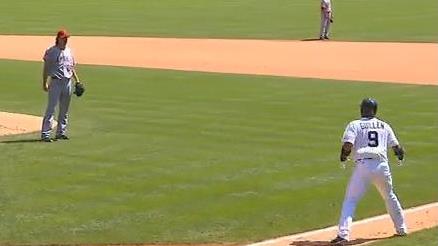
Whatever message Cabrera relayed in the Detroit dugout did not earn Weaver the respect to which he felt entitled. In fact, it had the opposite effect. In the seventh inning, Carlos Guillen watched his blast for several beats, flipped his bat, then made glaring eye contact with Weaver as he took five slow steps toward first followed by two sideways hops. Only then did he start his trot — by which point he was already halfway up the line.

“I’ve never done that before like that,” Guillen said in an MLB.com report. “The way he reacted to Magglio, he’s my teammate. We’re a team.”

Weaver immediately began shouting at Guillen and home plate umpire Hunter Wendelstedt quickly stepped in and warned both benches against retaliation.

Weaver wasted little time ignoring him. The guy can’t be faulted much for wanting to take care of things quickly; he had already thrown 110 pitches and wasn’t going to be in the game much longer no matter what happened. The message he sent with his very next pitch, however, was anything but perfect. If Ordoñez and Guillen violated baseball’s unwritten rules with their increasingly provocative displays of showmanship, Weaver one-upped them with a 92-mph fastball aimed at the head of Alex Avila.

That Avila ducked under it was beneficial not just for himself, but for Weaver as well. Had the pitch connected, one of the AL’s top Cy Young candidates would now be bearing a label he might never be able to shed.

The move was all the more quizzical considering that just two days earlier, nearly identical circumstances precipitated nearly identical results — and a similar outcry against the pitcher.

The hitter was Kansas City’s Melky Cabrera, who after launching a grand slam off Indians starter Carlos Carrasco, watched it sail before he ran. Carrasco, already on the line for seven runs in 3 1/3 innings, threw his next pitch at — and over — the head of Billy Butler.

Carrasco was ejected and benches emptied. Royals outfielder Jeff Francoeur could be seen gesturing angrily toward his hip as he yelled at Carrasco, indicating where the pitch should have gone.

“I understand the game,” Francoeur told the Cleveland Plain-Dealer. “If he thought [Cabrera] pimped the home run, fine. Hit [Butler] in the side. Don’t hit him in the head. That’s why I was yelling at him.”

Francoeur was spot on. Several Royals, including Butler himself, said that an appropriately placed retaliatory pitch would have raised nary a hackle on their bench. Instead, Carrasco is now a marked man.

The same can be said for Weaver. The Angels and Tigers won’t see each other again this season unless they meet in the playoffs. The next time they do, however, Weaver will have to do some explaining to his teammates should Detroit pitchers decide that his action merits further response.

*****

Weaver and the Tigers’ twin showmen weren’t the only ones taking a run at the unwritten rulebook during the course of Sunday’s game. Justin Verlander was in the middle of a no-hitter when Erick Aybar led off the eighth inning with a bunt.

There are situations in which the unwritten rules forbid such a display. Had the Tigers’ 3-0 lead been a few runs greater, Aybar’s endeavor would have been universally assailed by Code adherents. As it was, even as he brought the tying run into the on-deck circle, he still surprised many.

The concept holds that a no-hitter deserves nothing less than a hitter’s best effort to break it up. In many cases, bunting does not qualify.

The best-known instance of this came in 2001, when Padres catcher Ben Davis ruined Curt Schilling’s perfect game with a bunt single in the eighth inning. Part of the reason Diamondbacks manager Bob Brenly was so vocally upset about the play is that bunting for hits was not part of Davis’ offensive repertoire; the one against Schilling was the first of his career.

Aybar, however, has 41 bunt hits since the beginning of the 2009 season. Not to mention the fact that he didn’t actually break up the no-hitter, as Verlander was charged with a throwing error on the play. Three batters later, Macier Itzuris punctured Verlander’s balloon by singling — on a full swing.

If Verlander is upset with anybody, it should be Guillen. The Code stipulates that nothing should change when a pitcher is racing toward perfection. There are many ways to view this rule, but one of the pitcher’s own teammates intentionally initiating bad blood with the opposition and disrupting the flow of the game is inexcusable.

Guillen likely hasn’t heard the last of this from the Angels. If he’s lucky, he won’t hear it from within his own clubhouse, as well.

Elsewhere in the unwritten rules:

• In Boston, John Lackey continues to lead the league in on-field gesticulations made in response to mistakes by his fielders. Spurred primarily by two miscues from shortstop Marco Scutaro — one of which was charged an error — Lackey alternately pounded his glove and threw his hands into the air as he gave up three first-inning runs to Tampa Bay on July 16.

• Also in Boston, Red Sox reliever Alfredo Aceves hit Kansas City’s Billy Butler on July 26 — possibly in response to a brushback pitch thrown to Dustin Pedroia earlier in the game; or possibly because Butler had homered, doubled and singled in the game. It also could have been unintentional. No matter; Blake Wood then drilled Adrian Gonzalez in apparent retaliation, both benches were warned and everybody went on their merry way. (Well, Boston went on its merry way in a 13-9 victory, in which Royals outfielder Mitch Maier was forced to take the mound.)

• In Florida, Mr. Marlin himself, Jeff Conine (currently a special assistant to the team president) said on the radio that Hanley Ramirez doesn’t play as hard as he should, and if it was up to Conine he’d probably trade the shortstop. Five days later Ramirez shot back in the Miami Herald, calling Conine “chicken” for not saying it to his face, and proclaiming that he would “make it to the Hall of Fame being in a Marlins uniform.”

• In Kansas City, Royals shortstop Alcides Escobar was on the business end of a hard slide by Tampa Bay’s Sam Fuld, and ended up taking spikes to the shin. “That’s a dirty slide, man,” he told the Kansas City Star.

• In Atlanta, Journal-Constitution columnist Mark Bradley recalled the time the retired former Braves ace Greg Maddux waited through parts of two seasons before he could retaliate against then-Diamondbacks pitcher Andy Benes.

No-Hitter Etiquette

No-Hitter Etiquette Picks Up Steam in Spate of May Games

Justin Verlander, enjoying the fruits of his accomplishment.

Last week we heard about the superstitious behavior of the Twins as Francisco Liriano worked through his no-hitter against the White Sox.

This week: An additional spate of such behavior as pitchers around the league flirted with their own no-no’s—and in the case of Justin Verlander, actually completed it.

Which seems like a good place to start.

A primary piece of no-hitter etiquette has to do with avoiding the pitcher in any way possible and under no circumstances mentioning the fact of the no-hitter. This happened during Liriano’s feat, but not in Verlander’s—at least as far as the pitcher was concerned.

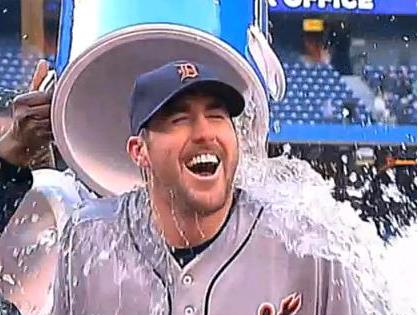
This is where already having a no-hitter on his resume came in handy. As evidenced by Verlander’s post-game calm, the right-hander felt little of the pressure normally associated with such feats. He went so far as to dissipate dugout nerves himself, seeking out teammates with whom to interact. (No report yet about how those teammates handled it.)

A secondary rule holds that those in the dugout maintain whatever it is they’re doing—sitting in the same seats, flipping a ball up and down, & etc.—since that action is clearly responsible for the events on the field. (In The Baseball Codes, Bob Brenly talks about spending innings on end rapping on the knob of Matt Kata’s bat during Randy Johnson’s perfect game, despite the increasing rawness of his knuckles.)

In Toronto, Verlander’s teammate, Alex Avila, took things a step further, refraining from using the restroom despite an increasing need from the sixth inning on. “I was too afraid to go,” he told the Detroit Free Press.

Even after Verlander completed his feat, Avila was compelled to take part in the celebration, both on the mound and in the clubhouse. It wasn’t until 10 minutes afterward that he was finally able to hit the head.

On the air, Tigers broadcasters Mario Impemba and Rod Allen refused to reference the feat during the game. This is a contentious point, as many in the business feel that a broadcaster’s primary job is to inform the audience about what is going on.

The Detroit duo had at least one defender—Free Press columnist Terry Foster, who wrote about being “stunned” when a fellow parent at his kid’s soccer game told him of Verlander’s feat, in progress. Ultimately, though, he did come around. A little. “I forgive those parents . . . only because it worked out,” he wrote. “We know who to blame if Toronto managed a cheap hit at the end.”

A quick rundown of other would-be no-hitters that didn’t quite reach completion:

  • Jamie Garcia vs. Milwaukee, May 6 (broken up in the eighth): The left-hander was alone by the sixth inning. “What are you going to say? ‘Ain’t this great?’ ” said Tony La Russa in the St. Louis Post-Dispatch. “We all had our thoughts.”
  • Yovani Gallardo vs. St. Louis, May 7 (broken up in the eighth): Same teams as Garcia’s game, different outcome one day later. Gallardo had thrown 104 pitches through seven innings, raising substantial concerns that Brewers manager Ron Roenicke might remove him. In response, fellow starters Randy Wolf and Shaun Marcum stood guard in the dugout. “The other starting pitchers wouldn’t let me take him out,” said Roenicke in the Milwaukee Journal-Sentinel. “They put a block on me. I really didn’t have a choice.”
  • Anibal Sanchez vs. Washington, May 8 (broken up in the seventh): Sanchez was over 100 pitches in the seventh, putting Marlins manager Edwin Rodriguez in much the same position as Roenicke. “We were paying a lot of attention to the pitch count,” Rodriguez said in the Miami Herald.

Save for Verlander, of course, none of these pitchers was able to finish what he started—developments that had nothing to do with the perpetuation of superstition in their own vigilant dugouts.

Then again, it’s not like it would have mattered.

“If a pitcher tells you he’s not thinking about it, it’s not true,” said Gallardo in reference to people trying to avoid the subject with him. Which is entirely the point.

– Jason

Rookie Hazing, Will Rhymes

Rhymes’ Homer Earns Cold Shoulder

Reader Greg points out in response to the earlier post about Chris Carter, that Will Rhymes hit his first big league home run last night for the Tigers.

That it had to be determined by review was interesting; even better was the time for planning the delay allowed players on the Tigers bench. TV cameras captured it perfectly: Rhymes enters a stone-silent dugout, and begins walking by his teammates, slightly stunned.

You’ll rarely see a more genuine baseball moment, however, than the Tigers simultaneously jumping up and mobbing their young teammate. (Watch it here.)

Baseball customs—like any traditions—are meant to be passed on, and in that instant, the Tigers passed along a great one.

– Jason