Trevor Bauer seemed to have it all figured out. He spent years haranguing Major League Baseball about its substance-abuse problem—the substance in question being pine tar and other, more powerful tack—that enables pitchers to increase spin rate to astronomical degrees. He went so far as to write about it in the Players’ Tribune.
When baseball effectively ignored him, Bauer announced publicly that he would try the tactic himself, for an inning in April 2018, and found immediate success.
When baseball continued to not give a shit, the right-hander adopted the practice whole hog last year, winning a Cy Young Award and $100 million over three seasons from the Dodgers.
Bauer’s stated plan: Continue to tack up for as long as baseball ignores it, and stop once effective policing begins. Which is what he wanted in the first place.
Accordingly, details came down over the weekend about MLB’s new stance toward pitcher tack, and the policy, if reports are accurate, seems to have teeth.
According to ESPN’s Buster Olney, proposals include eight-to-10 random checks of pitchers per game, with starters being checked at least twice as they depart the field so as to minimize disruption. Position players might also be checked, though not in so prevalent a fashion. Current penalties involve 10-game suspensions, which are still on the table.
Those who pay attention to such things could see this coming. Earlier this season MLB confiscated a number of balls from one of Bauer’s starts. In May, umpire Joe West took Giovanny Gallegos’ cap due to a discoloration on the brim. This week, Sports Illustrated published a cover story calling sticky stuff “The new steroids,” and hittersacrosstheleague have been speaking out on the topic.
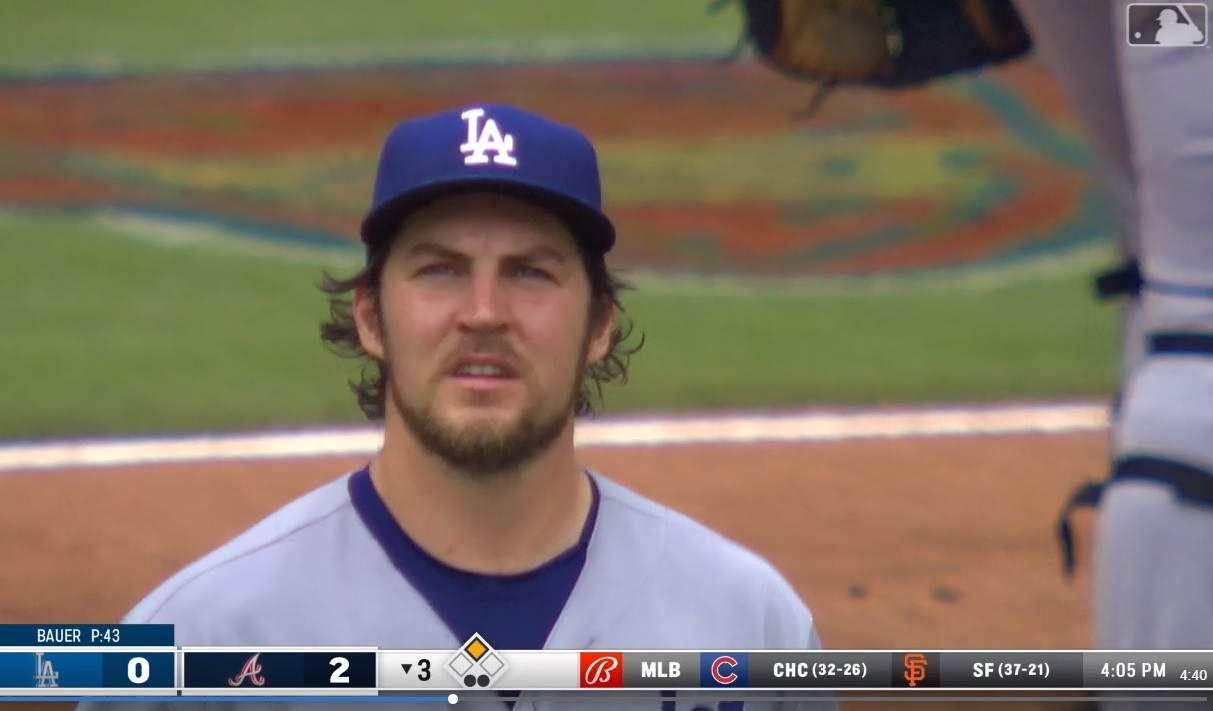
Are pitchers paying attention? Let’s turn back to Bauer, who yesterday faced Atlanta with what we can assume to be a diminished supply of sticky stuff on his person. The tell: Entering the game, the average spin rate of Bauer’s four-seam fastball was 2,835 RPM; yesterday he averaged only 2,612 RPM.
Between 2017 and 2019—the seasons prior to what appears to be to be Bauer’s headfirst dive into stickiness—his spin rate climbed from 2,227 to 2,410. Yesterday’s diminished numbers were still significantly higher than that. Does this indicate the right-hander is still using tack, only not as heavily or as frequently as before? Could be. Also noteworthy: Since 2019, Bauer has all but abandoned his changeup, which spins the least of any of his pitches, and which he once considered a useful tool against left-handed batters.
This was all in evidence yesterday, when Bauer yielded three runs on six hits over six innings. It was the most hits he’s allowed this year, and tied for the most earned runs. Notably, Bauer also issued four walks, double his season average, while striking out seven, less than his season average. Opponents had hit .150 against him on the year; yesterday, Atlanta batters hit .250.
Also, Bauer had at least occasional trouble finding the zone.
Afterward, reporters brought up the topic of sticky stuff with the pitcher. “I’ve made a lot of public comments,” Bauer replied. “If you want to go research it and make your own decision, go for it.” When asked about the cause for the RPM drop, the pitcher was cagey in his response: “I don’t know. Hot, humid day in Atlanta.”
This is the reason most pitchers give for adding illegal tack. In humidity, as well as in cold weather, gripping a baseball becomes more difficult, and pitchers—those who admit to it, anyway—say that an extra dollop of pine tar or the like can help bring them back to normal. For a guy like Bauer, it can help transform a 4.48 ERA in 2019 to a 1.73 ERA in 2020.
Bauer’s hardly alone. On Thursday, Gerritt Cole—who appears to be a personal target of Bauer, and who has been named in court about this stuff—allowed five runs over five innings against the Rays. His spin rate was down across the board, especially on his fastball, which dropped from 2,552 RPM on the season to 2,436. (In 2017, Cole’s last year in Pittsburgh, his four-seam spin averaged 2,164. His first season with Houston he improved that by about 200 RPM. The following year he improved it again by a similar amount.)
Bauer and Cole, of course, are merely two prominent representatives of a widespread practice that has driven offense into a hole. This season, major leaguers are hitting a collective .237, a development that nobody apart from active pitchers can fully embrace.
“I just want to compete on a fair playing field,” Bauer said yesterday, in an Orange County Register report that contains a host of vibrant quotes. “I’ll say it again. That’s been the point this entire time.”
Should Trevor Bauer become human again, that’d be just fine—so long as the rest of baseball’s superman pitchers do, too.
This weekend, the Padres and Dodgers showed us exactly how baseball is changing, and also exactly how it is not. On both counts, they’re right on the money.
Traditionally, baseball has frowned on showmanship, viewing it—particularly as pertains to batter’s box theatrics—as a personal affront to the pitcher. As a result, home run pimping has inspired its share of beanball responses over the years. Those who persisted tended to maintain that their celebrations were entirely about themselves and their teammates, and that lack of respect played no part.
It wasn’t until recent years that pitchers started to believe it.
The first-ever home run pimp may have been Harmon Killebrew, who is counted by many as the pioneer of watching one’s own fly balls leave the yard. No less than Reggie Jackson has pointed toward Killebrew as inspiration in that regard. Still, it took a truly free spirit like Yasiel Puig, who after coming up in 2013 consistently busted barriers around this topic, for the movement to gain its first semblance of legitimacy. During the World Baseball Classic in 2017, when the U.S. got a gander at teams like Puerto Rico and the Dominican Republic, with rosters stocked with big leaguers having the times of their lives, it finally started to settle in that this might be the shape of baseball to come.
Which brings us to Fernando Tatis and Trevor Bauer.
On Saturday, Tatis drilled two homers against the Dodgers star and leveraged both moments to the hilt, sending messages in direct response to prior theatrics Bauer had visited upon the Padres. Irresistible force, meet immovable object.
After Tatis’ first homer, he covered his right eye with his hand while rounding the bases, in reference to a gimmick Bauer pulled during spring training in which he pitched the better part of three shutout innings against San Diego with one eye closed, then made sure that everybody knew it.
The Padres did not take major issue with this, but you better believe they noticed. Thus, on Saturday we got this:
Five innings later, Tatis did it again, hitting a quality 3-2 pitch from Bauer over the center field fence. This time, in addition to a bat flip and his standard backward shuffle while approaching third base, he included an imitation of the Bauer strut, which is actually the Connor McGregor strut, which the pitcher pulls out on occasion after a big strikeout.
FERNANDO TATIS JR. HIT ANOTHER BOMB OFF BAUER AND HIT HIM WITH HIS MCGREGOR STRUT
Only a few years ago, the frequency of these displays, and their volume, would have elicited an on-field response. Now, however, we’re Letting the Kids Play, and Trevor Bauer is unlike other pitchers in oh so many ways. To his credit, he encourages this kind of stuff, going so far after the game as to use the word “soft” in reference to pitchers who retaliate for such things. “If you give up a homer, a guy should celebrate it,” he said. “It’s hard to hit in the big leagues.”
Bauer went even further on his YouTube channel, breaking down Tatis’ actions in a complimentary way. “It makes me feel good because they’re aware of my one-eye celebration,” he said. “My clip went viral, his clip can go viral—it’s good for baseball.” Bauer called Tatis’ bat flip on the second homer “tasteful,” and noted that the entire shtick was directed toward the San Diego dugout, not at Bauer or other Dodgers, “so, highest of high marks on that.”
Which brings us to the second part of the story. The part about which Bauer is less zen.
On the pitch that Tatis hit for his second homer, he appeared to look backward as catcher Will Smith was giving his signs. Tatis’ peek came too late to see Smith’s fingers, which he’d already folded back into his palm, but just in time to see the catcher lean to his right, a subtle clue that he was preparing to receive an outside pitch. This might be how the hitter was able to lean into a cutter that ended up well into the opposite batter’s box, and still managed to pull it over the wall in left field.
If you need to know what pitch is coming that badly, just ask daddy nicely next time @tatis_jr . You know I ain’t scared homie. https://t.co/dVbRDjH4Tx
— Trevor Bauer (トレバー・バウアー) (@BauerOutage) April 25, 2021
There are lots of ways to explain this. Bauer had been living on the outer edge against Tatis throughout the at-bat, placing four of his six pitches wide of the strike zone, so it didn’t necessarily take a magician—or a cheater—to discern what was happening. During his look back, it’s possible that Tatis was just scratching his nose and didn’t see a thing.
But the hitter’s body language—stepping toward the pitch even as Bauer was releasing it, and easily handling what should have been ball four by a considerable margin—said plenty. We’ve addressed the issue of peeking on a number of occasions in this space, like that time in 2017 when the Angels suspected various Oakland players of looking backward. Early in the pandemic, we also offered a host of examples from throughouthistory.
Whether Bauer noticed Tatis doing this in the moment is unclear, but he certainly did after the game. In the same YouTube clip, Bauer addressed the issue directly:
“If you start looking at signs, if you start pulling this bush-league stuff, that’s when people get pissed off. …. That’s the type of stuff that would get you hit in other games. Now, I’m mild-mannered about it. I’m going to send a message this way [via video] and say, hey, that’s not okay, and if you keep doing it something will have to happen.”
Bauer said that while “there’s no rule anywhere that says [Tatis] can’t look back,” there’s also “no rule that says I can’t stick a fastball in your ribs.”
This is classic unwritten-rules policing, albeit via video and not with a message pitch. You got caught, the other team let you know about it, and now you have to knock it off. It’s next-level code enforcement, and while many people have thoughts about Trevor Bauer, pro and con, he comes off as entirely reasonable in the above clip.
How Bauer reacts the next time Tatis (or any Padre, probably) does something similar will be something to see. Having publicly threatened to drill a guy, even obliquely, the pitcher is certain to draw notice from the league office should he ever decide to act on that impulse. The Padres, knowing this, might be further inspired to elicit such a response. And ever does the gamesmanship spiral continue.
In summary: Bat flipping and crazy trots around the bases are, for most people—and certainly for Bauer and Tatis—part of baseball’s mainstream. Peeking at a catcher’s signs is certainly not.
Both developments have been logged and noted, to be built upon the next time something like this goes down. We’re counting the days.
Don Sutton, who passed away yesterday at age 75, has a unique place in each of my three books. In Dynastic, Bombastic, Fantastic, he faced the A’s as a member of the Dodgers. In They Bled Blue, he faced the Dodgers as a member of the Astros. And in The Baseball Codes, he appeared as a ball scuffer par excellence.
Sutton spent 16 of his 23 big league seasons with the Dodgers—his first 15 and his last one—and his time in LA came not only to define him as a pitcher, but to materially influence the players he left upon his departure, who would win the World Series the following season.
LA is where Sutton enjoyed the six-year stretch from 1972 to 1977 that opened the doors to the Hall of Fame to him. During those seasons, the right-hander made his only four All-Star teams and posted five top-5 Cy Young finishes (one third, one fourth and three fifths).
“If I had to pitch one guy in a game seven, it would be Don Sutton,” Tommy Lasorda wrote in his autobiography, I Live for This. “I loved him. But sometimes I was one of the only ones.”
Sure enough, Sutton was not known for cozy relationships with his teammates, a detail noteworthy in his 1978 clubhouse fistfight with Steve Garvey. He frequently extend a similar mindframe to his manager. Sutton was the rare star on those late-1970s Dodgers to not have played for Lasorda in the minor leagues, a detail that helps explain why the two were frequently at odds. After 11 years playing for the staid Walter Alston in Los Angeles, Sutton bristled when Lasorda was installed.
“With Walt, there wasn’t a whole lot of rah-rah,” the pitcher explained to the Los Angeles Times in 1981. “I wasn’t mentally equipped to make the adjustment.” (Sutton once told a reporter who was furiously scribbling to keep up with one of Lasorda’s Great Dodger in the Sky monologues: “You know what you can do with those notes you’re making? Shred ’em and put ’em around your shrubbery at home and watch it grow.”)
From They Bled Blue:
When the Astros snatched Sutton up [in December 1980] with a four-year, $3.1 million offer, it was impossible for Lasorda not to take it personally. The right-hander had been an Alston man, publicly lobbying for coach Jeff Torborg to replace the storied manager in 1976, even when Lasorda was all but a lock for the position. “I just don’t believe that I could play for a manager who’s a headline grabber, who isn’t honest,” Sutton said at the time, later refusing to become “one of [Lasorda’s] bobos.” Things grew so heated that Lasorda challenged Sutton to settle their differences with fists. The pitcher declined. Their differences remained.
Sure enough, Sutton never garnered a single Cy Young vote in four years under Lasorda during his prime, though the two reached enough of a détente for Sutton to return to LA for his final season, in 1988.
More than that—during that—was a fascinating aspect of Sutton’s success: an ability to scuff baseballs that lent his pitches the type of movement that few of his peers possessed. He was said to adhere a piece of sandpaper on a finger of his glove hand, which he would use to mar the ball to wondrous effect.
No less than Nolan Ryan confirmed as much after hitting a home run off of Sutton during the first week of the 1980 season. It was the first of Ryan’s career, and he managed to get the ball returned to him … at which point, he said later, “that thing was all scuffed up.”
Don Sutton gets down and ties his shoe, looks around to see if anyone is looking, and then scuffs the ball on the rubber when he gets up.
When Sutton joined the Astros, a chorus of opinions held that Lasorda, who knew all of his secrets, would have him all but undressed on the mound. Sutton’s pitch-perfect response was to question the source. What else would Lasorda say he wondered in the Los Angeles Times: “Those other years I lied?” (Lasorda never did have him checked.)
From They Bled Blue:
During the 1981 season, Sutton agreed to secretly film an instructional video for NBC-TV about how to cheat in baseball, wearing a ski mask to protect his identity, with the film reversed to make him look like a southpaw. (He ended up scrapping the project when a newspaper reporter and photographer showed up at the shoot.) “I keep telling you guys, I don’t use sandpaper,” he informed reporters before the season opener in Los Angeles. “Sandpaper gets wet and crumbles. [I use a] sanding wheel. I already checked to see if there was an outlet there on the mound, but they removed it.” Once, when an umpire searched Sutton for abrasive surfaces, he instead found a note reading, “It’s not here, but you’re getting warm.”
I recounted my favorite story about Sutton’s scuffing in The Baseball Codes. It involves a game from 1987, in which Sutton, by that point pitching for the Angels, was carving up the Yankees:
George Steinbrenner was watching the game on television, and was shocked when the camera zoomed in to show close-ups of what appeared to be a small patch, or even a bandage, on the palm of Sutton’s left hand. The WPIX broadcasters brought it up whenever the pitcher appeared to grind the ball into his palm between pitches. It was, they said, probably why Sutton’s pitches possessed such extraordinary movement that day. He was in all likelihood scuffing the baseball.
Outraged, Steinbrenner called the visitors’ dugout at Anaheim Stadium and lit into Yankees manager Lou Piniella. Was he aware, asked the owner, that Sutton was cheating? “Our television announcers are aware of it,” yelled Steinbrenner. “I’m sure the Angels are aware of it. You’re probably the only guy there who doesn’t know it. Now, I want you to go out there and make the umpires check Don Sutton!”
“George,” Piniella responded, “do you know who taught him how to cheat?”
Steinbrenner confessed that, in fact, he did not.
“The guy who taught Don Sutton everything he knows about cheating is the guy pitching for us tonight,” Piniella said. “Do you want me to go out there and get Tommy John thrown out, too?”
Don Sutton pitched 23 seasons and won 324 games while striking out 3,574 batters, seventh all-time. He was elected to the Hall of Fame in 1998. He passed away less than two weeks after his former manager, Lasorda, in much less expected fashion, another Hall of Famer felled in a string that has seen too many pass too soon.
Tommy Lasorda’s passing wasn’t much of a surprise—he’s been in failing health for years now—but it was nonetheless shocking. Knowing that the baseball world is without one of its longstanding, premiere personalities will do that. Lasorda died Friday at age 93.
Lasorda was a gigantic figure, in bulk and presence alike. He reveled in his rotundity, to the point that his pasta-borne figure seemed almost necessary to constrain the force of his personality—that if he’d somehow been a slender man, he might have exploded from the pressure of his own id.
It’s not overstatement to say that Tommy Lasorda was the most important figure in the Dodgers organization since the time of Branch Rickey and Jackie Robinson and the heyday of Walter O’Malley. He gave his life to that team, spoke endlessly about bleeding Dodger blue and talking to the Big Dodger in the Sky. He wanted to live no place but LA, work for no team but the one for which he worked.
So significant was Lasorda that when I set out to write a book about the Dodgers’ 1981 championship season—They Bled Blue was published in 2019—I came to realize that no part of the story could be told without a full understanding of the man. That’s why Chapter 1 is titled The Manager, and why it tells Lasorda’s story starting from the moment he joined the franchise as a 21-year-old left-handed pitcher in 1949. The man set the tone for everything to come, especially once he gained some power, and demanded requisite attention. There was simply no other way for me to approach this story. It had to be Lasorda.
The chapter begins like this:
Tommy Lasorda was always a shill. Long before he became a fount of managerial enthusiasm and brand fealty, he was a shill. Back when he was a career minor league pitcher, and then a scout, and then off to manage in remote minor league outposts like Pocatello and Ogden, in the employ of the Dodgers nearly every step of the way, even then he was a shill. The guy loved his team and wasn’t shy about letting the world know it.
I have heard from some people who take offense to the word “shill” in this context, who view it as a pejorative. Not me, not here. To me, the word shill is a complete sentiment, describing somebody wholly given to whatever he may be selling, and Tommy Lasorda never stopped selling the Dodgers. I could think of no more apt term to describe the genuine fervor behind Lasorda’s love for his ballclub, which came to define him in so many ways.
Lasorda is remembered for being a rotund ball of energy whose embrace of LA’s celebrity culture brought new levels of glitz to the Dodgers’ clubhouse. This is fine, but it also helps obscure the fact that he won two World Series and four National League pennants and two Manager of the Year Awards and helmed four All-Star teams. More even than that, to me, was the depth with which he cared about the players in his charge. This passage, from They Bled Blue, describes a period during the 1976 off-season, shortly after Lasorda was hired to manage the team:
To make sure his players knew precisely where he stood, Lasorda wrote each of them a letter explaining the privilege he felt in having a team like the Dodgers under his direction. The players had never seen anything like it. He followed the letters with phone calls to discuss his expectations for the season. He spoke to Bill Russell about stealing more bases. He told Garvey that he wanted to see more power. He suggested to Davey Lopes that an uptick in walks could make him the game’s best leadoff hitter. He informed Dusty Baker that a poor 1976 season—Baker’s first with the Dodgers, in which, hampered by a knee injury, he batted only .242 with four homers—had no bearing on 1977, and that the left field job would be his for the duration. He even telephoned reserve players, reminding them that any club with championship aspirations needed contributions from across the roster, and that players without starting roles had to become the best backups they could be. The guy long known for surface enthusiasm showed just how deep he could run. Lasorda wanted to reach his players at gut level, and this was an effective first step.
As a chapter, The Manager runs more than 6,000 words, far too long to excerpt here, so I will instead offer select passages, many of them taken from footnotes, that illustrate Tommy Lasorda in an economy of words:
During his playing days, when Lasorda protested the decision to send him to the minors, GM Buzzy Bavasi asked who should be cut instead. In what would become one of the manager’s favorite stories, Lasorda named a fellow rookie. “If I was in charge,” he proclaimed, “I’d cut that Sandy Koufax kid.”
As a player, Lasorda fought so much that in 1956 he received a telegram from American Association president Ed Doherty, reading: “Dear Tom, the exhibition you put on last night was a disgrace to baseball. You’re hereby fined $100 and, furthermore, my advice to you is, if you want to fight, join the International Boxing Congress.”
The brawls sparked by Lasorda’s relentless hail of knockdown pitches raised such cumulative furor within the Dodgers organization that in 1960, Bavasi effectively excommunicated the pitcher, kicking him off the Montreal roster with instructions to never return. Lasorda was devastated. Entirely unprepared to do anything else with his life, he pled for another chance. He could reform, he said. He would pitch nicely, toe the company line, do whatever it took. It wasn’t enough. When Bavasi refuted his entreaties cold, the almost-ex-pitcher fired the lone arrow remaining in his quiver and urged his boss to read a letter he’d sent to then-scout Al Campanis years earlier in which he proclaimed undying loyalty to the organization, long before such loyalty was a prerequisite for sustained employment. The GM may have been exasperated, but he knew a good thing when he saw it. Bavasi still wasn’t prepared to tolerate any more of Lasorda’s shenanigans as a pitcher, but he was sufficiently swayed to hire him on as a scout. At age 33, Lasorda’s pitching career was finished.
There really was no end to Lasorda’s shtick. He taught Bill Russell’s infant daughter Amy her first word: “Dodgers.” After a physical examination, Lasorda mentioned that doctors thought they found a spot on his heart, but soon realized it was actually a Dodgers logo. Sample ramble from the manager: “You’ve heard about the ‘Blue Fever,’ ‘Great Dodger in the Sky,’ ‘Dodger Blue,’ and how Dodger Stadium is Blue Heaven? Well, when nine people died in LA last year, their last words were, ‘Did the Dodgers win?’” Lasorda then labeled the fact that the Dodgers had in fact won “a great Blue coincidence.”
When Lasorda was a coach under Walter Alston, the Expos made him a lucrative offer to become their manager. He turned them down, saying, “I just couldn’t see myself telling people about the big Expo in the sky.” When Alston finally retired, Lasorda signed a one-year pact for $50,000, called it “the greatest day of my life,” and noted that the Dodgers had botched the negotiations. “If you’d have waited just a little longer,” he told Walter O’Malley, “I would have paid you to let me manage.”
When Lasorda finally became manager in LA, someone noted that he had already received more ink than Alston had in 23 years on the job.
I’ll close with a quote from longtime Dodgers trainer Herb Vike, who worked with Lasorda in Spokane and Albuquerque before joining him in Los Angeles. “Tommy believed,” Vike told me. “He believed all the time. He went around the clubhouse and all over the field, saying, ‘I believe, and you gotta believe.’ Everything was Dodger blue. He said his blood was Dodger blue. He would preach to the ballplayers and he would preach to the crowd. He had everybody believing in the Dodgers.”
He most certainly did. Here’s to Lasorda getting to see one last championship before he departed.
To judge by yesterday’s game, Manny Machado, a guy known for overt displays of showmanship, is less tolerant when the other team does it. Or maybe it’s that he approves of bat flips—even the excessive kind, the kind where regular bat flippers go, “Hoooo, that sure was something”—but not when a pitcher gets into the act. Or maybe Machado thinks celebrating his own feat is cool, but Dodgers pitcher Brusdar Graterol celebrating teammate Cody Bellinger is not.
So what’a a little hypocrisy between ex-teammates?
All of which to say is that Machado, a guy with maybe the worst reputation of any big leaguer—in a players’ poll last year, referenced in one of the links above, 65 percent of his colleagues rated him as the dirtiest player in the sport, with the runner-up garnering less than 10 percent—doesn’t have much in the way of moral authority when it comes to this kind of stuff.
* With the Padres trailing 4-3 in the seventh, two outs and a runner on second, Fernando Tatis Jr. smoked Graterol’s first pitch—a 99-mph sinker—407 feet to center field. Unfortunately for the Padres, center field at Globe Life Field is precisely 407 feet from the plate, and Bellinger made one of the great catches in playoff history.
* In that moment, Graterol went from goat to hero. Tatis was the first hitter he’d faced. He’d already balked the tying run into scoring position. Now he was facing the prospect of surrendering the lead altogether.
When Bellinger came up with the ball, Graterol lost his damn mind.
Let’s give it to the guy. Sure, we haven’t seen anything like this from a pitcher pretty much ever, but the fellow was excited. When Machado was excited earlier in the game, he had a bat to throw. From the mound, Graterol threw the only things available: his cap and his glove.
This was a series-winning celebration, not an I-just-escaped-the-seventh-inning-of-Game-2-by-the-width-of-a-nose-hair celebration. It was more Little League than Major League. It was the kind of thing that you can easily see an opponent getting ticked off over.
Just not Manny Machado. Maybe if it was Eric Hosmer—Tatis’ Code-whisperer back in August—Graterol would have responded differently. But Machado has no right, now or ever, to lecture a fellow player about on-field comportment. Hell, he likely inspired Graterol with his own actions earlier in the game. When Machado, on hand in the on-deck circle, started yelling at the pitcher—a triple “fuck you” followed by “I’ll be waiting for you”—Graterol offered a perfect response: He waved and blew kisses.
Various Dodgers, primarily Max Muncy, emerged to shout Machado back to his dugout, and the confrontation more or less ended there … for the time being. Maybe Machado will be waiting. Maybe some of his teammates are willing to take up the cause. If anything does happen, it’ll probably go down next season, when every inning isn’t quite so fraught.
If so, it’ll be the dumbest fight in baseball history, two guys overreacting to each other’s overreaction on the field. Let the kids play.
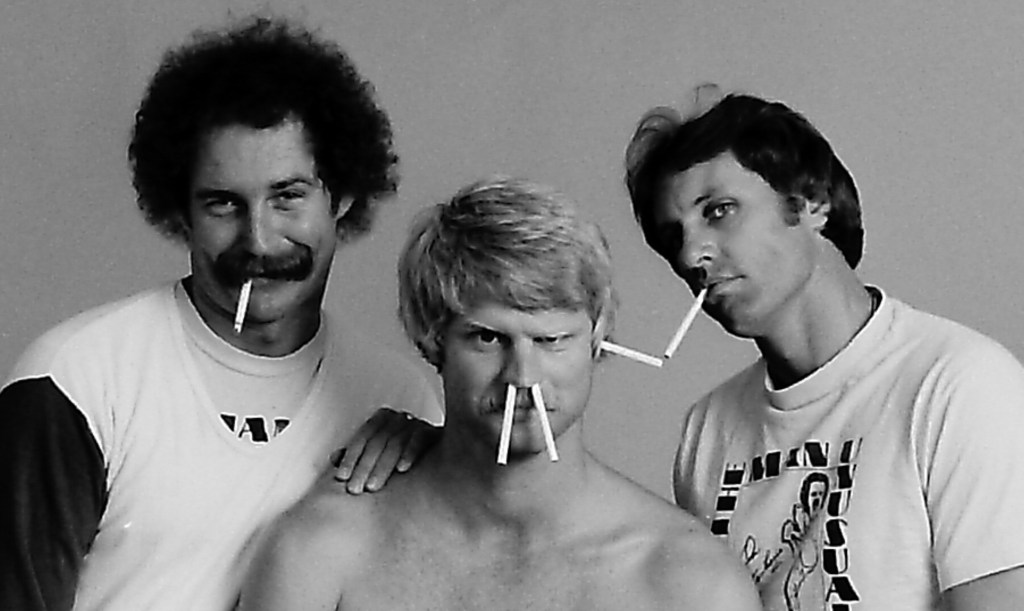
“There are a lot of people in asylums who are saner then Jay Johnstone.” — Tommy Lasorda
Photo by Rich Kee
Jay Johnstone passed away Saturday from COVID-19, contracted while living in a Granada Hills, CA, nursing home while suffering from dementia. He was 74 years old.
I covered Johnstone in all three of my books (he’s the only member of a Swingin’ A’s championship squad to have played for the 1981 Dodgers), and while reporting They Bled Blue I got to spend a glorious afternoon with him in Los Angeles, during which I learned precisely how committed the man was to his prankster persona.
My goal for the meeting had been to talk about Johnstone’s Dodgers, of course, and we did that, but the subject he returned to repeatedly was the pranks he was known for playing. Johnstone’s oddball reputation was hard earned, through 20 years of terrorizing teammates on eight clubs by doing things like building a mini locker inside of Ron Cey’s actual locker to emphasize the third baseman’s diminutive stature. So what if it took a trip to the lumber yard and two hours of construction before Cey arrived at the ballpark? To Johnstone, the payoff was worth it.
When it came to the 1981 Dodgers, Johnstone helped even the mood on a club with plenty of natural tension. His take-no-prisoners approach to clubhouse levity—doing things like shoving brownies into Steve Garvey’s glove and nailing teammates’ equipment to the clubhouse floor—involved neither politics nor malice, and was thus one of the unifying forces on a roster prone to division.
Johnstone’s most impactful moment came during the World Series against the Yankees. LA had lost the first two games, and found themselves in a 6-3 hole in Game 4, on the precipice of a 3-games-to-1 deficit. Johnstone helped turn the tables. I used the moment in They Bled Blue to illustrate not only Johnstone’s impact on that game, but on the club as a whole:
With one out in the sixth, Ron Davis walked Mike Scioscia, at which point Lasorda sent up Jay Johnstone to pinch-hit for Tom Niedenfuer. Johnstone was 35 years old and over the course of his career been sold once, released twice, and traded three times. He was a 16-year vet but had collected as many as 500 at-bats in a season only once. By the time he reached Los Angeles as a free agent in 1980—he accepted a $20,000 pay cut to move closer to his hometown of West Covina, about 20 miles from Chavez Ravine, the first free agent ever, it was said, to lose money on his new deal—he’d settled into something of a Svengali-like pinch-hitter role. (“Svengali” in this instance being defined as “crazy person put on the planet to drive Tommy Lasorda batty.”) The guy was an inveterate prankster, unable to stop himself when it came to stirring the Dodgers’ pot.
Johnstone once enlisted Jerry Reuss and Don Stanhouse to help him replace the desk in Lasorda’s office with a makeup table bearing a mirror ringed by white lightbulbs, to better suit the TV-friendly manager. In another prank, he removed every one of the dozens of photos from the wood-paneled walls of Lasorda’s office—even those of Frank Sinatra—and replaced them with publicity shots of himself, Reuss, and Stanhouse.* At Vero Beach one year, Johnstone broke into Lasorda’s room while the skipper was out and removed the mouthpiece receivers from the telephones. Later that night, when everyone was asleep, he and Yeager cinched a rope as tightly as possible between Lasorda’s doorknob and a nearby palm tree, preventing the manager from pulling his door open. Unable to escape or call for help, things truly hit home for Lasorda when he realized that he might have to miss breakfast. The manager knew exactly who to blame. During that day’s game in Orlando he stole Johnstone’s street clothes and forced him to ride home in his underwear.
The prank for which Johnstone is best known occurred in September 1981, a month before the World Series. Back in 1979, Reuss and then-Dodgers pitcher Ken Brett donned groundskeeper outfits and helped drag the infield during a game. Ever since, Johnstone had desperately wanted some of that action for himself. So before a game against the Pirates at Dodger Stadium—Los Angeles had long since clinched a playoff spot—he convinced Reuss to revisit the stunt. The players copped some coveralls and proceeded to serve as members of the four-man infield crew that went to work in the fifth inning. Because it was Reuss’s off-day and Johnstone rarely started, nobody missed them.
That’s not the same as going undetected, of course. Rick Monday made sure that scoreboard cameras were trained upon the duo so that everybody in the stadium could see what was happening. Upon finishing their dragging, the ballplayers received a full ovation. The only man in the building who didn’t seem to appreciate the gesture was Tommy Lasorda, who issued $250 fines before the players had even returned to the dugout. Johnstone was still in a side room, pulling on his uniform pants, when he heard the manager bellow, “Where the fuck is Johnstone?” As comeuppance for his childish behavior, Lasorda wanted him to pinch-hit for pitcher Terry Forster, posthaste. Johnstone was still buckling his belt as he made his way to the plate—and proceeded to bash a home run.
By the time Lasorda called upon him to bat for Niedenfuer in Game 4 of the World Series, Johnstone was in the throes of a deep tailspin, having hit .095 over the last three weeks of the regular season and .205 overall. He’d collected only three at-bats through LA’s first two playoff series and was still looking for his first postseason hit. That pinch homer against the Pirates had been his only longball since May.
Facing Davis with one out and one on and his team trailing by three, Johnstone—whose entire persona seemed to revolve around doing the unexpected—pulled his grandest trick to date: he homered. The Dodgers’ bench, which had to that point resembled the LA County morgue, came suddenly to life. “Here we are,” thought Johnstone as he rounded the bases. “That changes the whole game.” The two-run blast pulled the Dodgers to within one, at 6–5.
LA tied the game two batters later, and took the lead for good in the seventh, holding on to win, 8-7, and won the series in six. Wrote Jim Murray in the next day’s Los Angeles Times: “Jay Johnstone is not supposed to be winning World Series games, he’s supposed to be pouring cayenne pepper in the coffee.”
When I met with Johnstone at an LA diner, he brought with him all three of the books he’d authored, each centered around baseball pranks (primarily his own). He paged through them with me, one by one, to make sure he didn’t miss anything while recounting the havoc he’d wrought. I’d already read them, of course—the first, Temporary Insanity, was a staple of my teenage years—and had long appreciated the lengths Johnstone would go to to mix things up. When he told me those stories, I was like a kid again. Take this one, in Johnstone’s own words from that day:
“[Dodgers publicity man] Steve Brenner would let me, Jerry Reuss and Don Stanhouse know when Lasorda had a speech. So we’d call up and say, ‘Hi, I understand our skipper is coming out there. Would you like us to come out and say a few words?’ They’d say, ‘Yeah, we’d love to have you!’ So we’d show up and would be sitting in the audience. Well, Brenner gave us scripts of all Tommy’s jokes. So Jerry Reuss would get up to the dais and tell one of Tommy’s jokes. Tommy would look at him funny, and cross it off his list. Stanhouse would get up and tell another one of his jokes, and Tommy would cross that one off his list. Then I’d get up and tell one of his jokes. We told all his fuckin’ jokes. He was pissed. He was laughing, but he was pissed.”
The prank that stuck with me as a kid, and which made my own kids giggle when I recounted it for them yesterday, was recounted in that first book:
My favorite medical gag came one day at the Dodgertown dispensary during spring training. Instead of a urine sample, I had filled my vial with apple juice from the Dodgertown cafeteria. Then I walked into the dispensary and placed in front of the nurse.
“Gee, that’s awfully cloudy,” she said.
“Yeah, it sure is,” I answered.” Here, let me run it through again.”
With that, I chug-a-lugged the apple juice, and the nurse started screaming.
“Wait right here,” I said. “I’ll run out and bring another sample back. Should just take a second.”
By now, she had lost her glasses. I was afraid she might have a heart attack. The doctor got really mad at me because she was elderly. In fact, she retired soon after that.
Another moment for which Johnstone is remembered is being caught by Dodgers general manger Fred Claire in a concession line at Dodger Stadium in full uniform, waiting to buy a hot dog. I’d heard the story many times, including from Claire himself, but it wasn’t until I spoke with Johnstone that I was able to gain some context. From our discussion:
“The reason behind that is that Lasorda brought a Little League team from where he lives out to Dodger Stadium at 10:30 a.m., and we had them on the field till 4 o’clock. We had them on that field for what seemed like eight hours, and there was no freaking food. None. And when the game started, I was hungry. So I walk upstairs, get right in the hot dog line, and who walks by but the general manager, Fred Claire. I didn’t expect that one. I said, ‘Hey, Fred! How you doing, buddy?’ So he calls Lasorda and says, ‘Dammit, your guy’s up in the hot dog line.’ ”
To make matters worse, Johnstone said, in the middle of the clinic somebody brought Lasorda a plate of pasta, which he ate in the dugout, in front of his starving players.
Jay Johnstone was 71 years old when I interviewed him for They Bled Blue, and was as vibrant as a teenager when it came to discussing his career. He’s gone far too early, and will be sorely missed.
* Bonus material, from my interview with Johnstone, regarding the purloined celebrity photos from Lasorda’s office walls: ‘We hid them in the locker room. Now he comes into his office, he has Frank Sinatra, he has Jilly [Rizzo, Sinatra’s body man], all these people—there may have been 15 or 16 people in the room, maybe more, and he’s screaming, ‘Get them fucking guys in here!’ He’s just ranting and raving. Don Rickles was there, and he said, ‘Now wait just one minute. How many games have those other guys ever won for you?’ ‘Shut up, Rickles!’ We just broke out laughing. It took us a while to get the pictures back up, but we got ‘em up.”
For what it’s worth, to this day Reuss denies any involvement in the scheme.
Stanhouse, Reuss and Johnstone. Photo by Rich Kee.
Occasionally, Let the Kids Play can be as simple as actually letting the kids play. Fernando Tatis Jr. doing heroics for the Padres is a perfect example of this. Who among mainstream viewers cares what the count was when he swung?
Yesterday gave us another homer-hitting Padre with his own dose of controversy, and in so doing presented reason to explore some depths of baseball’s unwritten rules.
The Padre in question is Trent Grisham, and the homer in question came off of LA’s Clayton Kershaw, and tied the game in the sixth inning. The behavior in question was a pretty profound pimp job, which led to significant jawing between Grisham and the Dodgers bench while Grisham was still rounding the bases.
First, some scene setting. The Padres are chasing LA in the National League West, having won 11 of their last 13 to reduce a six-game deficit to 2.5 going into last night. Also, the Dodgers are really good. While they’ve been winning the last seven NL West titles, the Padres have finished last three times and next-to-last twice over the past five years, finishing an average of 27 games back.
So yeah, they’re excited.
And yeah, when they tie a game with a huge homer against a future Hall of Famer, they’re excited.
And yeah, when it’s a 23-year-old who has never in his life had so monumental a hit, he’s excited.
And he’s allowed to be.
Based on how Grisham exhibited that excitement, however, the Dodgers thought otherwise.
After his swing, Grisham stood near the batter’s box (as home run hitters will do), but instead of admiring his handiwork he turned toward the home dugout and exulted with his teammates. It took him nearly 10 seconds to reach first base.
Some Dodgers took exception to this, raising enough ruckus in their own dugout that Grisham acknowledged it as he rounded third. Perhaps in response, he bounded atop home plate with both feet, raising the temperature to the point that plate ump Mark Ripperger warned the Dodgers to remain in their dugout.
”They wanted me to run and that was really about it,” Grisham said after the game in the San Diego Union-Tribune. “They told me to get going a little sooner. That was it.”
Except that wasn’t it.
After the game, Dodgers manager Dave Roberts said this: ”I don’t mind guys admiring a homer. Certainly it’s a big game, big hit. Really like the player. But I just felt that to kind of overstay at home, certainly against a guy like Clayton, who’s got the respect of everyone in the big leagues and what he’s done in this game, I just took exception to that. I think there’s a certain respect you give a guy if you homer against him.”
Once again, we’re faced with dissonance from an old-school sport being forced into a new-school box. Roberts has plenty of ground on which to base his argument. Throughout baseball history, respect is an earned commodity, achieved over time through one’s play, behavior and character. By that measure, there’s nobody more respected in the modern game than Kershaw. For a second-year player—who was 12 years old when Kershaw made his big league debut, it should be pointed out—to style in the batter’s box after besting so venerated an opponent is, in many eyes, wrong.
An example of this mentality was recounted in The Baseball Codes:
Admiring one’s own longball isn’t all that sets pitchers off. When Phillies rookie Jimmy Rollins flipped his bat after hitting a home run off St. Louis reliever Steve Kline in 2001, the Cardinals pitcher went ballistic, screaming as he followed Rollins around the bases. “I called him every name in the book, tried to get him to fight,” said Kline. The pitcher stopped only upon reaching Philadelphia third baseman Scott Rolen, who was moving into the on-deck circle and alleviated the situation by assuring him that members of the Phillies would take care of it internally.
“That’s fucking Little League shit,” said Kline after the game. “If you’re going to flip the bat, I’m going to flip your helmet next time. You’re a rookie, you respect this game for a while. . . . There’s a code. He should know better than that.”
Hell, it can even happen within the fabric of one’s own team. Take a story former AL MVP Al Rosen told me:
“I played behind Kenny Keltner, and when I went to spring training, the only time in the batting cage I got good pitches to hit was if there were other rookies there. The older guys were protecting Keltner. You had 10 swings or five swings—set by whoever was head cheese on the ballclub—and if you had five swings you didn’t get a good ball to hit. None of those older pitchers were going to get the ball in there so you could hit one hard. So you would struggle. All of a sudden a guy decides he’s going to start working on a split-finger or he’s going to start working on his slider. …
“You’d have to ask one of the coaches to hit you ground balls, and every time I walked out there, Keltner would show up and he would want to take ground balls. So I would go to the outfield and shag. It was a message: “Don’t mess with my position.”
Rosen’s solution was not to knock Keltner down a notch, but to show up hours early with other young players and run their own BP sessions.
For his part, Kershaw held no public animosity against Grisham, saying in an MLB.com report: “I’m not going to worry about their team. Let him do what he wants.”
This is what it’s come down to, then. In civil society, we expect youngsters to defer to their elders. The intern in an office does not speak to the CEO as if he or she were a peer. Baseball once hewed tightly to this norm, but, as with many areas of the American landscape, norms are falling away in increasingly rapid fashion.
Baseball, though, has long held itself as different than other sports—slower, more deliberate. Behavior that would fly elsewhere had no place on a ballfield.
That, though, is changing, spurred no doubt by the rapidity with which baseball’s popularity has been surpassed by the NFL and NBA. Let the Kids Play is a direct result, and there’s nothing wrong with that.
But for those like Dave Roberts—hardly a hard-liner about anything, but with a firm sense of right and wrong—yielding their position is a difficult task. They’re going to have to, though, and soon. This is the new face of baseball—hopefully, say the folks in the marketing department, for the better.
Yesterday I discussed the general idea of social distancing on a ballfield, and how players who want to maximize the chances of playing a full, 60-game schedule would be well served to pay better attention to the league’s safety protocols.
Today I address the unwritten rules (that’s the beat of this blog, after all), which include long-held grudges and purpose pitches and cross-field taunting. Ultimately, though, it all comes back to COVID response. Because everything in the world right now comes down to COVID response.
Fireworks were anticipated when the Dodgers traveled to Minute Maid Park in Houston for their first meeting since news came out about the Astros’ trash-can banging during their disputed championship run in 2017—a run that, coincidentally, culminated in a seven-game World Series win over the Dodgers.
Joe Kelly was not on the Dodgers back then, but he’s on the Dodgers now, and he’s heard all the stories, and he’s the kind of pitcher known to stand up for teammates. (He was on the Red Sox team that lost to Houston in that year’s Division Series.) So when Kelly threw a 3-0 fastball behind Alex Bregman on Tuesday, close enough to raise the hair on the back of Bregman’s neck, it was tough to mistake it for anything but a message.
Things got even stranger when Kelly had to cover first base after the next batter, Michael Brantley, hit a would-be double-play grounder. Kelly was mildly and inadvertently spiked, then hung around the base for a moment to convey his displeasure.
That’s when a voice in the Astros dugout—it appears to be manager Dusty Baker—yelled, “Just get on the mound, little fucker.”
It was NOT Michael Brantley who told Joe Kelly to "get on the mound motherf*****." Sounds like it was Dusty to me. https://t.co/NDhRtPe5TG
Joe Kelley has proved to need far less provocation than that.
After walking Yuli Gurriel on four pitches to put men at first and second, he delivered a pitch at Carlos Correa’s head. On one hand, that kind of location is never okay. On the other, it was a curveball—not the greatest weapon for pitchers with malice on their minds—and men were on first and second.
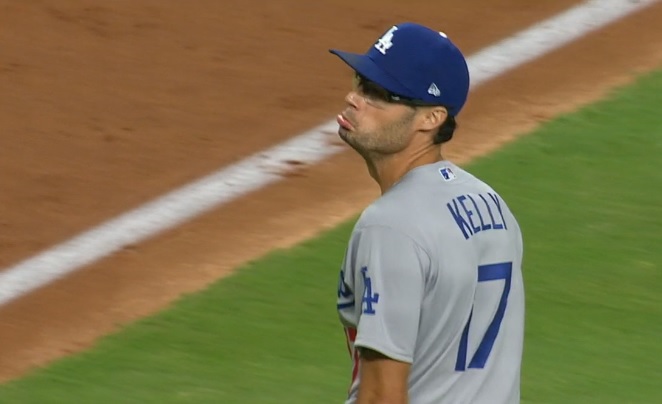
Correa ducked out of the way without much trouble, then stared down both Kelly and the Dodgers dugout. He ended up striking out on another curveball—this one down and away—to end the inning. Kelly immediately started jawing (according to Baker, he said, “Nice swing, bitch”), then made faces at his opponent, literally sticking out his lower lip in a mock pout. That’s all it took. Benches emptied.
Carlos Correa and Joe Kelly exchanged words after Kelly struck out Correa. Benches cleared following the exchange. pic.twitter.com/sVHaibpN2y
This is where we return to the intersection of baseball norms and social distancing. In the former category, old habits can be hard to shake. In the latter, if ballplayers wanna play ball, they better start paying better attention to MLB’s protrocols—one of which explicitly bans fighting. (The specific language: “Players or managers who leave their positions to argue with umpires, come within six feet of an umpire or opposing player or manager for the purpose of argument, or engage in altercations on the field are subject to immediate ejection and discipline, including fines and suspensions.”)
Still, players from both teams crowded around home plate. While there was very little contact, and while various members of both clubs actually wore masks, these players were close, and many of them were maskless.
We’re still less than a week into the season and the Marlins are triaging and sequestered, the Phillies are dormant and the Yankees, after doing nothing while waiting things out in Philadelphia are unexpectedly playing in Baltimore. If this doesn’t spur players to pay some better attention to risk mitigation, it’s likely that nothing will.
***
Nothing is as important right now as COVID mitigation, but seeing as this is an unwritten-rules blog, we should probably wrap up the situation between the Dodgers and the Astros. There’s no question that anger lingers in LA. During spring training, Cody Bellinger said that Jose Altuve “stole an MVP” from Aaron Judge, with Carlos Correa suggesting that Bellinger to get some facts or “shut the fuck up.”
Kelly denied intent on Tuesday, going so far as to illustrate his wild nature by referencing a viral video from early in the pandemic when, during a backyard bullpen session, he missed his target and broke a window in his home. (Not referenced was the fact that, since 2015, he’s struck out well over twice as many hitters as he’s walked.)
Joe Kelly shows that even big leaguers break windows 😳
“I didn’t anticipate that,” Baker said afterward. “I didn’t anticipate throwing over somebody’s head three balls and no strikes. One of our more important guys. If you’re going to throw at somebody, you don’t throw at the head. “You don’t throw at a guy’s head. That’s playing dirty baseball.”
What Baker did not do was order his pitchers to retaliate. For one thing, the Astros were three runs down and trying to keep the game close. In a truncated schedule, every loss bears extra weight. Also, all three Houston relievers who entered the game after Kelly’s shenanigans were rookies, two of them making their big league debuts. Asking a nervous kid to understand longstanding grudges, let alone execute a controversial purpose pitch, is asking for trouble in numerous ways.
The Astros may have dodged a bullet by not having to face a series of angry opponents had the 2020 season gone off as originally planned. But ballplayers, we’ve learned, are willing to wait. Joe Kelly is certainly not the only one who wants his shot at cheaters.
Meanwhile, the fan merch is out, and it’s spectacular.
Update 7/29: Kelly has been suspended for eight games, MLB citing Kelly’s history with this kind of thing as a factor in its decision. Dave Roberts has been suspended for one game, and Dusty Baker has received a sternly worded email or something.
Update 7/29: Dave Roberts has thoughts.
Dave Roberts plans to address his #Dodgers team before game: "I'm going to talk to the guys today briefly about leaving the bench. MLB is really serious about this, as well as they should be. I have to reiterate it to guys, at any cost, to stay on the bench.''
On Tuesday, Clayton Kershaw hurt his back lifting weights. On Wednesday, the possibility arose that he might not be able to start LA’s first game of the season, as planned. On Thursday, Kershaw was placed on the IL and his replacement, Dustin May, became only the second rookie to take the mound on opening day in the 137-year-history of the Dodgers franchise—and the first since Fernando Valenzuela in 1981.
There are some differences between May and Valenzuela. May, 6-foot-6 and 180 pounds, was drafted in the third round out of high school in Texas. Coming into the season, MLB.com ranked him as the Dodgers second-best prospect, and 23rd in all of baseball. He made 14 appearances for Los Angeles last year, including four starts, and struck out more than six hitters for every walk while posting a 3.63 ERA.
Valenzuela, in contrast, was all but unknown going into 1981, even after having come up to the Dodgers as a call-up the previous September and throwing 17 scoreless innings out of the bullpen. At that point he had 30 professional appearances under his belt, none above Double-A.
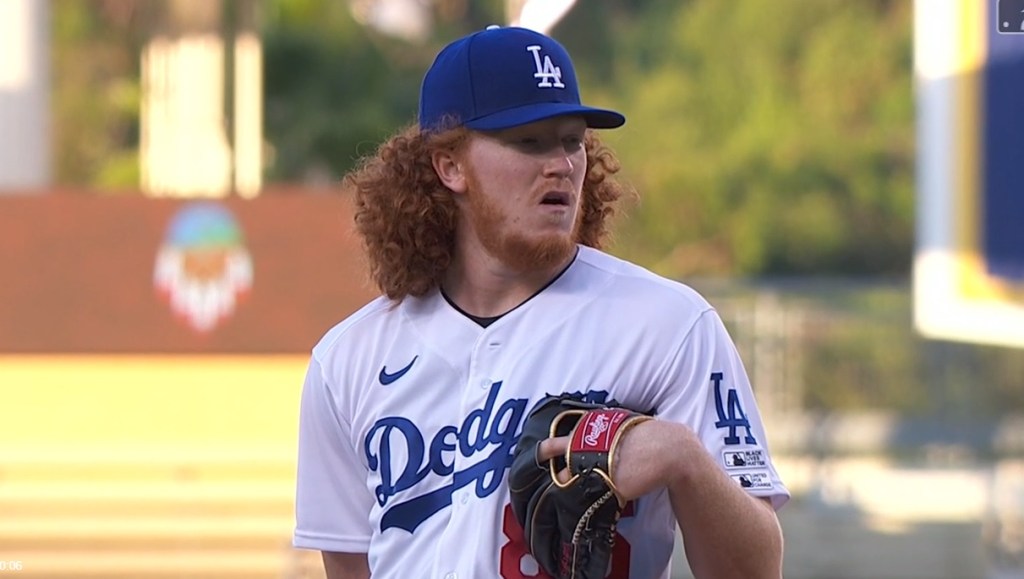
They are both physically unique. In addition to his size, May’s enormous shock of bright red curls is almost reminiscent of an Irish Oscar Gamble.
Valenzuela, in turn, was notable for his utter lack of affectation. His scissor-straight, pitch-black hair, hanging in the Mayo style of his village, spilled down from under his cap. His physique was … unathletic. Fernando gave no regard to anything but pitching—which he did exceptionally well.
While May looked dominant at times yesterday, hitting 100 mph with his fastball, he gave up seven hits (including a bunt against the shift) to a woeful Giants offense, allowing runners into scoring position in three of the five innings in which he appeared while failing to last long enough to qualify for the win.
In his first Opening Day start, Fernando barely hit 90 … and threw a complete-game shutout against the defending division champs.
Really, this is all just a crutch for me—comparing two pitchers with markedly few comparison points—to excerpt Valenzuela’s introduction from They Bled Blue. After Fernando’s first eight starts, he was 8-0 with a 0.50 ERA, having pitched nine innings every time out. By that point, Fernandomania was in full bloom.
We may yet see Maymania, or Dustin Maynia, or whatever tag gets affixed to the phenom. In the meantime, it’s nice to remember some dominance of years past.
From They Bled Blue:
The guy standing on the mound at Dodger Stadium on opening day was not the guy the Dodgers wanted standing on the mound at Dodger Stadium on opening day. The home team faced pressure aplenty without having to consider an emergency starter in the very first game of the 1981 season, let alone it being a 20-year-old with all of 17 innings of big league experience under his belt, every one of them out of the bullpen.
At that point, LA’s pitching concerns were more akin to triage than anything resembling strategy. This was the Dodgers, for crying out loud, the closest thing to a pitching factory that baseball had known since way back in the Brooklyn days of Drysdale and Newcombe and Sandy Freaking Koufax. One might assume immunity to this sort of dilemma. Nope. Their previous game—the one-and-out playoff against Houston that closed the 1980 campaign—had hinged on just this kind of drama. Hell, it even included the same opponent currently in town to christen the new season, almost as if baseball’s schedulers wanted to help Los Angelinos clear their palates as expediently as possible. Whether that was achievable remained to be seen.
The Dodgers were already without Don Sutton, now pitching for Houston. Left-hander Jerry Reuss, coming off an All-Star campaign, was ready to slide into Sutton’s slot atop the rotation, but in the final workout before opening day pulled a calf muscle so severely that he ended up sidelined for the first 10 games of the season.
Lasorda would have bumped up the next guy, but Burt Hooton, thinking he had an additional day to recover, had undergone a procedure to remove an ingrown toenail and was forced to sit. Number 3 starter Bob Welch was tending a bone spur in his elbow that would cost him three games. Dave Goltz and third-year pitcher Rick Sutcliffe had just closed the exhibition schedule with Freeway Series starts against the Angels.
This is how Fernando Valenzuela came to be pulled aside by team brass shortly after reaching the ballpark and told that he was about to become the first rookie pitcher to start on opening day in the 98-year history of the franchise.
Valenzuela’s ascent the previous autumn had been the main reason Lasorda’s decision about who to start in the playoff against the Astros was anything but pro forma. The left-hander had debuted only three weeks earlier, on September 15, jumping from Double-A straight to the majors, and failing to yield an earned run over 17⅔ innings of relief work covering 10 appearances. It was impressive, but the kid was fresh out of Mexico and still a teenager, for crying out loud. More importantly, the last time he started a game the opponent had been the Amarillo Gold Sox. An elimination contest against the class of the National League would be a hell of a spot for Valenzuela’s premiere. So Goltz was tabbed, it ended badly, and now Lasorda had a chance to see what he’d missed out on six months earlier.
Valenzuela was a physical curiosity, with chubby cheeks and rotund belly, his Mayan features accentuated by bushy black hair spilling straight down from his cap. Wrote Jim Murray in the following day’s Los Angeles Times: “He is, how shall we say it—he is—well, he’s fat, is what he is.” Fernando did not disappoint. The guy who ended the 1980 campaign without ceding an earned run over his final 52⅔ innings, majors and minors combined, began 1981 precisely the same way. In a performance that belied his carriage, the left-hander tantalized Houston’s roster inning after inning, giving up assorted singles and not much else. By the time he struck out Dave Roberts in the ninth—with a screwball of all things—Valenzuela had thrown 106 pitches, and also a complete-game, five-hit, 2–0 shutout. The 50,511 fans crowding Dodger Stadium could hardly believe what they’d seen. A day earlier the pitcher had been so in the dark about the possibility of drawing this assignment that he threw batting practice. Now he spun gold. Fernando, too young to legally buy a beer, was seemingly beyond distraction.
“We don’t know what’s going on inside him,” marveled Dodgers second baseman Davey Lopes after the game, an understandable sentiment given his new teammate’s language barrier. “All he does is smile.”
“He wasn’t one bit nervous,” catcher Mike Scioscia informed the press. “He’s so cool out there, I don’t think he even broke a sweat.”
The thing about Valenzuela wasn’t that he was an unknown pitcher making his first major league start on the early season’s biggest stage. It wasn’t that he spoke virtually no English, necessitating Spanish-language broadcaster Jaime Jarrín to translate for him at nearly every turn. It wasn’t that as a kid from the dusty plains of Mexico he had not yet adapted to life in Los Angeles. It was not his pudgy cheeks, or his stomach bulging over his belt, or the unique hitch in his delivery in which, with his lead leg lifted, he gazed skyward while clasping his hands above his head. It was not his habit of constantly blowing chewing-gum bubbles, sometimes in the middle of his windup. It was not that he was a 20-year-old who looked to be in his middle thirties. It was not even that he was left-handed, or that his out-pitch was a flippin’ screwball.
It was all of it together, a full package containing mystery (The guy barely talks!), comedy (That belly! That haircut! That form!) and straight-up befuddlement (How does he do nothing but win?). Baseball had seen its share of flashing mound talent over recent years—Mark Fidrych in 1976, Vida Blue in ’71—but nobody quite captured the collective imagination like Fernando. The guy had been so anonymous that in a baseball card industry recently flush with competition, only Fleer saw fit to include him in its 1981 set . . . and misspelled his name.
Valenzuela seemed imperturbable—Pedazo de pastel, he said when asked how he felt about starting the season opener, Piece of cake—so composed through what should have been a fraught-filled start that the Los Angeles Times was compelled to report that “if he had been 100 years old and in the majors for 90 of them, he couldn’t have looked more in control.”
As if limiting Houston to five hits in a 2–0 opening day victory wasn’t enough, two of those hits came off of broken bats, and a third didn’t breach the infield. Said Fernando with such unassuming ease that it was impossible to confuse the sentiment for bravado: “When I get on the mound I don’t know what afraid is.”
“Hell,” shrugged outfielder Jay Johnstone, looking back, “you’ve got to break him in somewhere.”
As a community, Los Angeles hasn’t seemed particularly happy about baseball this year. Sure, they have the best team in the sport—which was true even before Mookie rolled into town. And yeah, championship aspirations leave a nice tingle in the back of one’s esophagus. However, for a good long while this off-season seemed to be mostly about the championships of 2017 and 2018, which, given the unseemly proclivities of the Astros and Red Sox, many Southlanders feel should be retroactively awarded to their hometown nine.
It’s enough to put a ballclub on edge.
Or at least it makes for a decent introduction to what happened yesterday, when Justin Turner, LA’s third hitter of the game, was drilled by Johnny Cueto. (Okay, maybe “drill” isn’t the right word. The pitch hit Turner in the hand, near his knuckles.) Never mind that Cueto is still coming back from Tommy John surgery in 2018; of all the guys in the Dodgers’ lineup, Turner is the one about whom they are most sensitive when it comes to this type of thing, given that he broke his wrist on an HBP in a spring training game in 2018.
So when Clayton Kershaw plunked Rob Brantley the very next inning—after striking out the frame’s first two hitters, no less—it looked bad.
San Francisco Chronicle beat writer Henry Schulman wrote that neither pitch looked intentional, but whatever Kershaw’s purpose, there’s no denying that a pitcher’s perfect revenge scenario involves getting two quick outs before dotting a guy, ideally with a low-in-the-order hitter to follow. Which is exactly what happened.
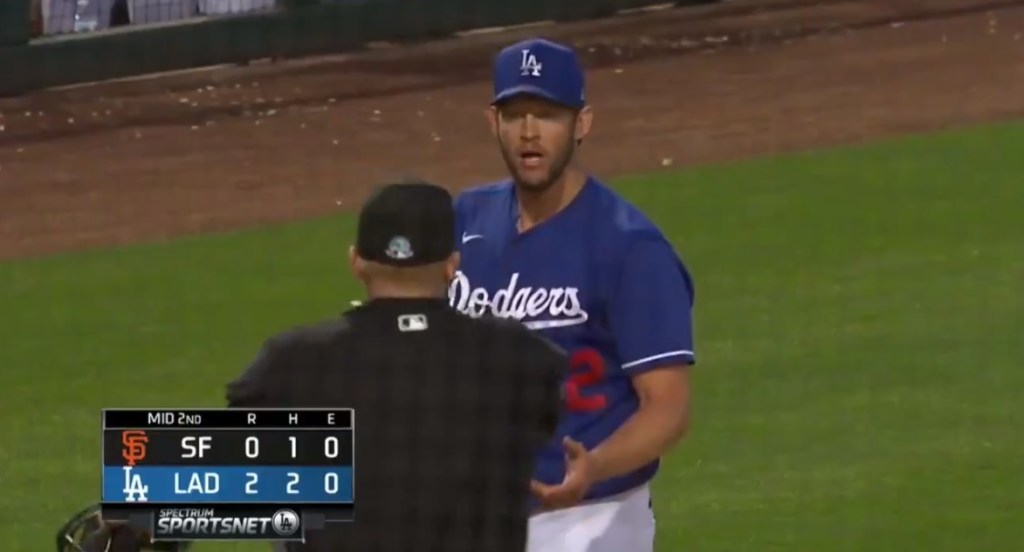
Giants third base coach Ron Wotus noticed. As Kershaw returned to the dugout after whiffing No. 8 hitter Yolmer Sanchez to end the frame, Wotus lit into him, and the pair engaged in a brief shouting match. Umpires quickly warned both benches—something Cueto later said he’d never seen in a spring training game.
Clayton Kershaw with the crazy curve, and then exchanges words with the Giants dugout 👀 pic.twitter.com/UeiWXHnmDK
Ultimately, Kershaw’s revenge—intentional or not—paled in comparison to Turner’s response.
In the third inning, Turner pummeled the first pitch he saw from Cueto into the left field pavilion to give the Dodgers a 4-0 lead, which they never relinquished. (Kershaw did okay for himself as well, giving up two hits over three shutout innings.)
Just because the Giants no longer have Madison Bumgarner doesn’t mean they can’t get into it with their rivals to the south. It portends to be a long season in San Francisco, but at the very least, this kind of thing will help keep things lively.



 The Baseball Codes