No-Hitter Etiquette

Don’t Mess With My No-No: Speier’s Meddling Works Out in the End

Remember when A’s manager Bob Melvin put the shift on earlier this month against Jarrod Saltalamacchia as pitcher A.J. Griffin took a no-hitter into the fifth inning? How Saltalamacchia took advantage, bunting for his team’s first hit? How Melvin bore ultimate responsibility with his ill-timed strategy?

Seems that he’s not alone.

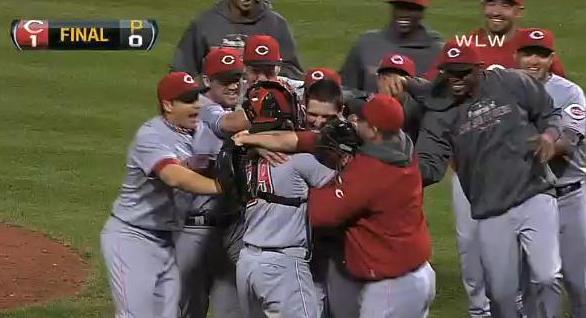
Friday, interim Reds manager Chris Speier did precisely the same thing, shifting his infield to the right for lefty hitter Pedro Alvarez in the eighth inning of Cincinnati’s game against Pittsburgh, even as pitcher Homer Bailey worked on a no-hitter.

Unlike Saltalamacchia, however, Alvarez failed to appreciate the fact that, with a simple willingness to poke a ball down the third base line, he’d not only have achieved his team’s first hit, but he’d have brought the winning run to the plate in a 1-0 game. Instead, he swung away and hit a line drive toward the shortstop position, manned by third baseman Scott Rolen.

“If [Rolen]’s not there that goes right between short and third,” said Bailey in the Pittsburgh Post-Gazette. “I thought that was it.”

Speier’s maneuver was the same as Melvin’s, save for the fact that it worked. Perhaps he had intel saying that Alvarez doesn’t bunt under any circumstances, and he took advantage. Barring that, though, it’s difficult to criticize Melvin without laying down a similar dose right here.


Dave Righetti, No-Hitter Etiquette

Yankee Doodle Dandy: Looking Back at Rags’ July 4 No-No

On Independence Day, it seems pertinent to reference the anniversary of one of the great feats to take place on this day, baseball-wise: Dave Righetti’s no-hitter, on July 4, 1983.

It’s pertinent to the unwritten rules, of course, in that Yankees broadcaster Mel Allen refused to mention the feat directly on the air.

“There have been five hits in this ballgame, for those who have turned in late, and the Yankees have had ’em all,” he said in the top of the sixth, conspicuously avoiding a certain two-word combination. As Wade Boggs settled in as the game’s final batter, Allen said, “Wade Boggs, standing between Dave Righetti and a pitcher’s dream.” (Watch it here.)

As it turned out, Allen was far more cognizant of the Code than at least one member of the Yankees. Righetti and Graig Nettles had been planning a trip to Atlantic City for the All-Star break, and Nettles wasn’t about to let some silly superstition get between him and his planning.

“In the sixth or seventh inning he came up and asked me who was driving,” said Righetti, who was a bit surprised to find any of his teammates willing to converse with him at that point. “He volunteered, even though he had pinkeye.”

He also had good sense. At ease talking about driving assignments, the third baseman never mentioned the no-hitter.

Happy July 4, everybody.

Matt Cain, No-Hitter Etiquette

Cain Conquers Code, Overcomes Slew of Jinxes to Reach Perfection

There are some lines Bruce Bochy is willing to cross, and some that he’s not.

Case in point: Matt Cain’s perfect game Wednesday night. Bochy was willing to make some small changes: Emmanuel Burriss replaced Ryan Theriot at second base in the sixth, and in the seventh, Joaquin Arias slid from shortstop to third base, replacing Pablo Sandoval, with Brandon Crawford inserted at shortstop.

The Burriss substitution, said Bochy after the game, was aimed at giving playing time to one player and rest to another during a 10-0 blowout. The seventh-inning switches, however, were made with perfection in mind, Bochy putting the best defense possible behind Cain. Sure enough, the first batter of the eighth, J.D. Martinez, hit a slow roller to third, which Arias charged, gloved cleanly, and threw on a line to nip the runner. And with two outs in the ninth, Arias fielded a sharply hit ball down the line and made the long throw in plenty of time to preserve Cain’s perfection. (Watch it here. Full highlights here.)

“We went against every unwritten rule in the book, I know, but Boch and I just thought we had to have our best defense in there at the end, and it worked out,” said Giants bench coach Ron Wotus. “Panda [Sandoval] would have a tough time making those two plays as easily as Arias made them.”

When it came to warming up a pitcher, however, Bochy was significantly more sly. With a comfortable lead, he wanted a reliever ready should Cain—whose pitch count through seven was 103—give up a hit. The manager was cognizant, however, of the emotional toll the sight of bullpen activity can take on a nerve-wracked starter, so he had reliever Shane Loux warming up “down underneath,” either in the batting cage or in the tunnel below the stands.

“We had somebody ready,” he said. “You couldn’t see him, but he was there.”

Far less tactful was first baseman Brandon Belt, who looked up from his seat in the dugout in the seventh inning, and was startled to see Cain in front of him.

“I sat down and Cainer just stopped and stared at me,” Belt told CSN Bay Area‘s Andrew Baggarly, referencing the superstition that nothing in the dugout order can change under such circumstances. “Yeah, I guess everything was OK until I sat in his seat.”

As if to follow suit, not only was the Giants television broadcast crew more than happy to reference the no-hitter, but prior to the ninth inning showed a “Giants No-Hit History” graphic, featuring each of San Francisco’s five previous no-hitters.

Just goes to show that dominant pitching trumps jinxes every time.

Update (6-15-12): Cain’s family is full of Code adherents.

C.J. Wilson, No-Hitter Etiquette

Wilson ‘Bummed’ by CarGo’s Bunt

Just a few days back, Dee Gordon tried to bunt for what would have been his team’s first hit against the Mariners.

Because it was only the fourth inning, and because speed is such an integral part to Gordon’s game, and because Seattle led only 1-0, none of the Mariners gave it much thought.

The same couldn’t be said regarding Carlos Gonzalez, who last Friday—the same day as Gordon’s effort—bunted for Colorado’s first hit against the Angels. The circumstances were remarkably similar: It was the fourth inning, it was a tack he regularly uses (he’d already had one bunt single this year, and tallied six last season), and his team trailed only 2-0.

The primary difference: The attitude of the pitcher he was facing.

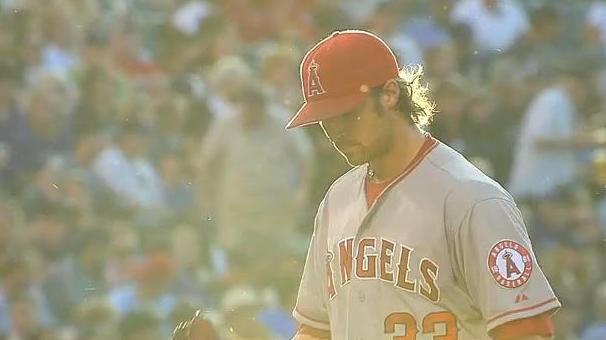
“Anytime a guy like him drops a bunt down, it’s a little shocking,” said Angels starter C.J. Wilson in an MLB.com report. “I was bummed about that from a competitive standpoint. I guess he just wanted to get on base.”

Sure, Gonzalez is known for his power more than his speed, which in turn causes third basemen to play deeper than they might for somebody like Gordon. Ultimately, however, if there’s a defensive hole to exploit, one can hardly fault a hitter for trying.

“He was throwing nasty pitches, so why would you take that away from me?” Gonzalez said. “That’s part of my game. . . . We were only down by two runs. Maybe in a different situation, I would try to swing the bat because I know how hard it is for pitchers to give up the first hit with a bunt. But I wanted to get my team going and he was dominating.”

The Angels won, 7-2, and there was no retaliation against Gonzalez. Using Wilson’s own vernacular, “bummed” doesn’t necessarily mean “angry,” which may have had to do with the fact that Gonzalez didn’t exactly break up a game for the ages—CarGo’s was one of five hits Wilson gave up on the day.

Then again, the pitcher did see fit to address the matter after the game, even while he should have been basking in an outstanding (one run over eight innings) performance.

Seems there’s just no pleasing some people.

No-Hitter Etiquette

No-No-No-No-No-No in Seattle Leaves at Least a Couple People Confused

Remember all those conversations people were having just last week about whether one could justifiably pull a pitcher in the middle of his own no-hitter? Sometimes it’s a moot point.

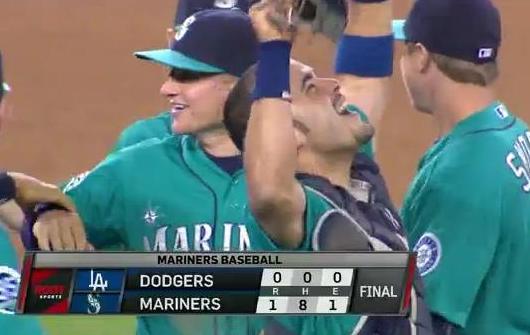
On Friday, Seattle’s Kevin Milwood tossed six no-hit innings against the Dodgers, then strained his groin while warming up prior to the seventh. Five Mariners relievers followed with three more innings of no-hit ball. (It was the 10th combined no-hitter in big league history; the latest—Houston’s defeat of the Yankees in 2003—also had six, and also had a starter, Roy Oswalt, depart early after an injury.)

Several noteworthy slices of Code cropped up in the process. One of the most popular refrains from those decrying the dreaded no-hitter jinx stipulation, which mandates that the feat must not be spoken about until it is completed, is that there’s no way a pitcher in the middle of a no-hitter has somehow failed to realize that he’s in the middle of a no-hitter.

Improbably, though, Seattle reliever Tom Wilhelmsen failed to realize exactly that. Wilhelmsen, who closed out the game for the Mariners, was eventually informed of the circumstances by his catcher.

“I told him, ‘Man, you threw a no-hitter!'” said Jesus Montero, in an ESPN report. “And he didn’t know! Unbelievable.”

Wilhelmsen tried to add some nuance to the claim. “Well, I mean, I knew what was going on,” he said. “But no, I have a brain fart every so often and just focused so hard on getting one thing done. It’s not like you forget, but it’s like you put it off to the side. And then it’s like, ‘Holy cow, we just did it,’ and Montero is in my arms.”

To be fair, five pitching changes can distract from the execution of a fairly unique feat; Wilhelmsen wasn’t the only one who lost track of things.

“Coming into the ninth, it wasn’t really on my mind . . .” said Seattle shortstop Brendan Ryan, who entered in the ninth as a defensive replacement. “It kind of took five seconds or so to sink in. ‘Wait a minute. Wait a minute. There were no hits. That’s a no-hitter!'”

That said, not everybody was so clueless. Reliever Stephen Pryor (who was credited with the victory after pitching to all of one batter recording all of one out), told the Seattle Times that, Wilhelmsen apparently aside, they were aware of it in the bullpen. “We knew, but we weren’t talking about it,” he said. “We didn’t want to jinx it.”

Someone who very clearly didn’t mind jinxing it was Dodgers shortstop Dee Gordon, who tried to bunt for a hit in the fourth inning. While some take this topic—breaking up a no-hitter with a bunt—very seriously, Gordon has facts on his side. For one, it was only the fourth inning—far to early to consider the deed sacrosanct, even for the likes of Bob Brenly. For another, speed makes up nearly the entirety of Gordon’s offensive game; beating out bunts is what he does, so to assume he’d suddenly table one of his strengths in a close game is far from reasonable. The score was only 1-0, so even if Gordon had tried it in the eighth, he would likely have not drawn much protest from the Mariners.

No word yet about whether Seattle players took it upon themselves to avoid all six pitchers in the dugout for fear of the mighty jinx. Seems like a tall order.
No-Hitter Etiquette, Philip Humber

Man, There are a Lot of Things One is Supposed to do During the Course of a No-Hitter

In the wake of Philip Humber’s perfect game on Saturday, the Code-chronicling community (we’re small, but mighty) was left to look for peculiarities in the action. While there have so far been no earth-shattering revelations, assorted items have been mentioned in passing in various accounts of the action:

  • White Sox players did indeed give the pitcher some space on the bench as the game unfolded, moving “farther and farther away from Humber as he approached history, leaving him alone,” according to the Associated Press.
  • Some on the bench, however, did mention the deed, though not to Humber directly. From the Chicago Sun-Times: After the eighth inning, A.J. Pierzynski turned to Sox pitcher Jake Peavy and said, ‘Man, I’m nervous.’ ” (The man already had some history with no-hitter etiquette.)
  • Humber’s not one to buy into the silence-is-golden rule. From his post-game press conference: “I don’t believe in superstitions or anything like that, so when guys were getting hits or scoring runs, I was shaking their hands, and when they’d make plays in the field I was telling them, great job. I don’t like to be isolated like that. I like to stay in the game, and be relaxed, and be a teammate.”
  • White Sox manager Robin Ventura does not necessarily agree. Also from the post-game presser: “I still haven’t talked to him—I still have that superstition. I was staying away from him.”
  • Which doesn’t mean that superstition rules all of Ventura’s decisions. While some feel that nothing should be changed during the course of a no-hitter, Ventura inserted Brent Lillibridge in left field in the bottom of the eighth as a defensive replacement for Dayan Viciedo. With one out, Kyle Seager laced a drive down the line, which Lillibridge—significantly speedier than Viciedo—caught up to without much effort.
  • At which point it should be noted that the White Sox’s previous perfecto—tossed by Mark Buehrle in 2009—was saved by a ninth-inning circus catch by Dewayne Wise against the center field wall. Wise had been inserted for defensive purposes in the top of the inning.
  • Munenori Kawasaki tried to bunt his way on with two outs in the sixth and a 3-0 score. Kawasaki is in his first season in the big leagues after a lengthy career in Japan. I am unclear about how this type of thing is viewed over there.
  • Finally, Mariners broadcaster Dave Sims was hardly shy about mentioning the words “no-hitter” and “perfect game” through the later innings. Granted, Sims doesn’t work for the White Sox, but he has precedent on his side when it comes to his stance in such situations. (Funny how broadcasters take heat if a pitcher blows a no-hitter after they’ve talked about it, but the broadcast jinx is rarely mentioned if the pitcher completes his gem under similar circumstances.)

If more arises from this in coming days, I’ll tack it on here.

Update (4-24): Larry Stone has a column up over at the Seattle Times, in which he speaks with five people who were at the game. No real new information, just another measure of awe from one of the best in the business.

No-Hitter Etiquette

No-Hitter Etiquette Picks Up Steam in Spate of May Games

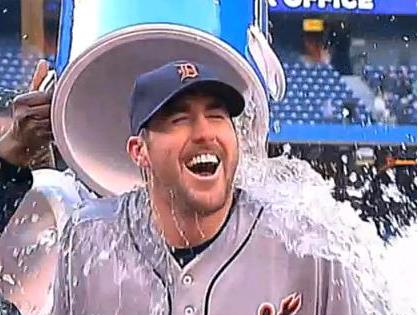
Justin Verlander, enjoying the fruits of his accomplishment.

Last week we heard about the superstitious behavior of the Twins as Francisco Liriano worked through his no-hitter against the White Sox.

This week: An additional spate of such behavior as pitchers around the league flirted with their own no-no’s—and in the case of Justin Verlander, actually completed it.

Which seems like a good place to start.

A primary piece of no-hitter etiquette has to do with avoiding the pitcher in any way possible and under no circumstances mentioning the fact of the no-hitter. This happened during Liriano’s feat, but not in Verlander’s—at least as far as the pitcher was concerned.

This is where already having a no-hitter on his resume came in handy. As evidenced by Verlander’s post-game calm, the right-hander felt little of the pressure normally associated with such feats. He went so far as to dissipate dugout nerves himself, seeking out teammates with whom to interact. (No report yet about how those teammates handled it.)

A secondary rule holds that those in the dugout maintain whatever it is they’re doing—sitting in the same seats, flipping a ball up and down, & etc.—since that action is clearly responsible for the events on the field. (In The Baseball Codes, Bob Brenly talks about spending innings on end rapping on the knob of Matt Kata’s bat during Randy Johnson’s perfect game, despite the increasing rawness of his knuckles.)

In Toronto, Verlander’s teammate, Alex Avila, took things a step further, refraining from using the restroom despite an increasing need from the sixth inning on. “I was too afraid to go,” he told the Detroit Free Press.

Even after Verlander completed his feat, Avila was compelled to take part in the celebration, both on the mound and in the clubhouse. It wasn’t until 10 minutes afterward that he was finally able to hit the head.

On the air, Tigers broadcasters Mario Impemba and Rod Allen refused to reference the feat during the game. This is a contentious point, as many in the business feel that a broadcaster’s primary job is to inform the audience about what is going on.

The Detroit duo had at least one defender—Free Press columnist Terry Foster, who wrote about being “stunned” when a fellow parent at his kid’s soccer game told him of Verlander’s feat, in progress. Ultimately, though, he did come around. A little. “I forgive those parents . . . only because it worked out,” he wrote. “We know who to blame if Toronto managed a cheap hit at the end.”

A quick rundown of other would-be no-hitters that didn’t quite reach completion:

  • Jamie Garcia vs. Milwaukee, May 6 (broken up in the eighth): The left-hander was alone by the sixth inning. “What are you going to say? ‘Ain’t this great?’ ” said Tony La Russa in the St. Louis Post-Dispatch. “We all had our thoughts.”
  • Yovani Gallardo vs. St. Louis, May 7 (broken up in the eighth): Same teams as Garcia’s game, different outcome one day later. Gallardo had thrown 104 pitches through seven innings, raising substantial concerns that Brewers manager Ron Roenicke might remove him. In response, fellow starters Randy Wolf and Shaun Marcum stood guard in the dugout. “The other starting pitchers wouldn’t let me take him out,” said Roenicke in the Milwaukee Journal-Sentinel. “They put a block on me. I really didn’t have a choice.”
  • Anibal Sanchez vs. Washington, May 8 (broken up in the seventh): Sanchez was over 100 pitches in the seventh, putting Marlins manager Edwin Rodriguez in much the same position as Roenicke. “We were paying a lot of attention to the pitch count,” Rodriguez said in the Miami Herald.

Save for Verlander, of course, none of these pitchers was able to finish what he started—developments that had nothing to do with the perpetuation of superstition in their own vigilant dugouts.

Then again, it’s not like it would have mattered.

“If a pitcher tells you he’s not thinking about it, it’s not true,” said Gallardo in reference to people trying to avoid the subject with him. Which is entirely the point.

– Jason