Retaliation

Tension in Texas: Tempers Flare When They Didn’t Have To. Again.

Napoli steps

Just last week we discussed the importance of understanding baseball’s unwritten rules, regardless of how one feels about them. Minnesota’s Miguel Sano had been thrown at, and missed, yet still made a stink of things and got tossed out of the game.

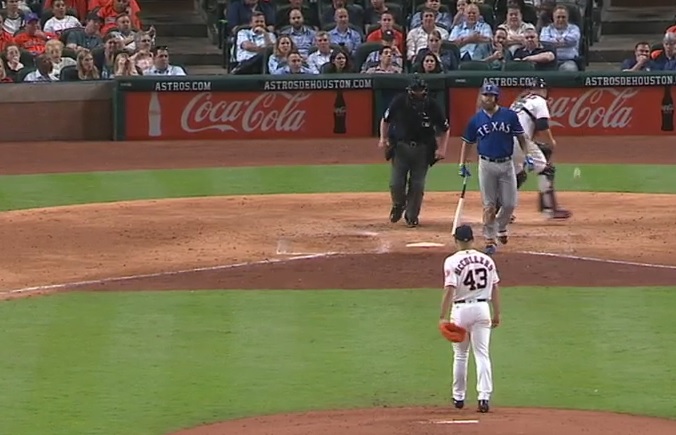
Yesterday, it happened again. With two outs and nobody on base in the sixth inning, Astros pitcher Lance McCullers Jr. threw a pitch behind Rangers first baseman Mike Napoli. Houston trailed 2-1 at the time, not a great moment for retaliation, but a purpose pitch that sails wide of its mark cedes only one ball in the count, not a free baserunner. And if the pitch had somehow connected, well, Napoli had already homered and singled against McCullers. Not having to face Texas’ No. 5 hitter wasn’t too big a price to pay.

McCullers’ motivation was clear: Rangers starter Andrew Cashner had drilled Jose Altuve in the first inning and Yuli Gurriel in the second. After the pitch sailed behind Napoli, the batter took several angry steps toward the mound, and benches quickly cleared. (Watch it here.)

This is where we get into the importance of knowing what’s actually going on.

In the modern game, it’s a stretch to think that two unintentionally hit batters, guys who took first base without incident and, in Altuve’s case, came around to score, merit response. But McCullers, the son of a former big league pitcher, may have learned to view such things a bit more dogmatically.

So personal was the decision behind his pitch that his catcher, Brian McCann, didn’t give a thought to stopping Napoli’s advance on the mound, which is every catcher’s prime responsibility in such situations. Instead, he turned around to retrieve the wild pitch from the backstop, because it never occurred to him that Napoli might be angry.

McCullers’ was the softest response possible for a teammate being hit, a no-impact nod signifying that the Astros were paying attention. It shouldn’t have elicited a raised eyebrow in the Rangers dugout. Instead, we got statements like these, via MLB.com:

  • “They threw at Napoli on purpose. … They threw behind Napoli’s head.” (Cashner)
  • “I think anytime somebody throws behind a hitter’s head it’s going to create some tension.” (Rangers manager Jeff Banister)

As it turned out, McCullers did not throw behind Napoli’s head. His pitch came in across the lower portion of Napoli’s uniform number, closer to his belt than his shoulders. It was so far behind him that Napoli did not have to move to avoid it.

The craziest statement came from Napoli himself: “I understand how things work. Two of their guys get hit, but all he has to do is put it in my hip and I run down to first base. No one likes 95 [mph] behind their back.”

It seems nuts, but he’s arguing that a guy should have hit him rather than missed him.

Folks get caught up in the heat of a moment, but situations like these continue to prove that the dissolution of baseball’s unwritten rules—the fact that each successive generation of ballplayers understands the Code less thoroughly than its predecessors—is playing out poorly. Because there will always be somebody like Lance McCullers Jr., who learned the game the old-fashioned way, willing to make old-fashioned statements. Instead of seeing them for what they are, many younger ballplayers—and sometimes even a 12-year vet like Napoli—will react poorly and inflame tensions where no inflammation is necessary.

Even if Napoli is innocent of his own intent—a step toward the mound with a word of warning for McCullers, followed by an uneventful trip to first base would not be unheard of—he’s surrounded by far younger players who lack the requisite understanding of what had just happened.

That’s what truly raised the temperature in Houston: Even as Napoli stood near the plate, a bevy of his younger teammates streamed from the dugout and, rather than following the veteran’s lead, escalated the proceedings. (Even some older teammates got in on the act, Shin-Soo Choo leading the charge.)

It could be that the Rangers—11-15 and in last place in the AL West, with five members of the starting lineup (including Napoli himself) hitting  below .205—are at a point where baseball is frustrating enough without guys like McCullers nudging the process along.

Then again, after the game Napoli addressed the rivalry between the teams from Texas. “That’s how it should be,” he said. “There’s too much, people that are friends, and talking before the game, buddy-buddy. I remember coming up, if we were playing that night, it was time to get down and play a tough game and do what you have to do to win. It’s what it should be.”

Maybe he gets it after all.
Retaliation

Rays’ Reaction to HBP: Isolated Incident, or is This What Baseball Looks Like?

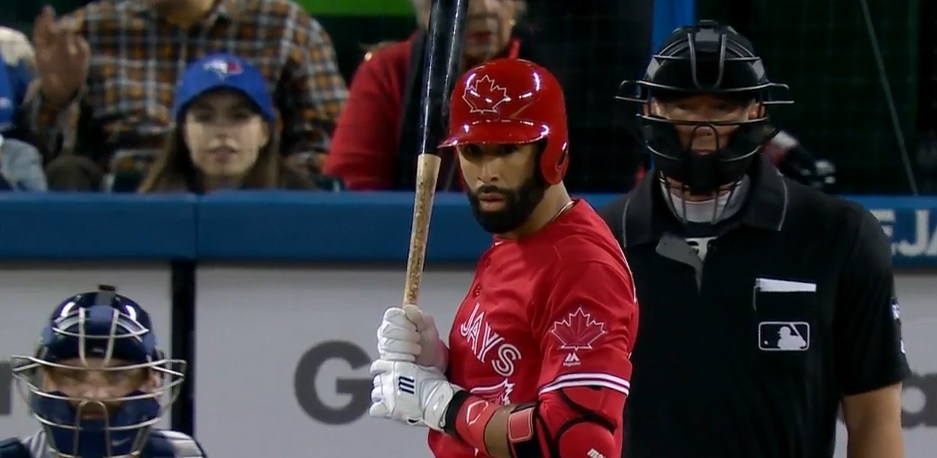
Bautista stares

Aaaaaand we’re back. After a flurry of retaliation talk surrounding the Red Sox and Orioles last week, we got some fireworks north of the border yesterday. Or at least a sparkler or two.

It started on Saturday, when Toronto’s Joe Miangini hit Rays outfielder Steven Souza in the hand with a pitch. It was almost certainly unintentional—a running, letter-high fastball that Souza failed to spin away from. The pitch was tight, but not egregiously so. Not to mention that the Jays led by only three, and with one out and the heart of Tampa Bay’s order coming up, it was no time to cede free baserunners.

That Souza had to be removed from the game on Saturday and then, despite X-rays coming back negative, sat out on Sunday, might have provided Archer’s motivation to respond. On Sunday,  the right-hander threw a fastball behind Jose Bautista, hip high. From the looks of it, he could well have been aiming at the batter but missed his spot. (Watch it here.)

As retaliation is concerned, below the waist is the way to go … but was it remotely necessary? Miangini’s pitch was accidental and in no way reckless. He wasn’t taking unnecessary liberties with Tampa Bay players. His behavior did not merit addressing.

Which is the point of purpose pitches, even those that intentionally miss their targets. If Archer was trying to show teammates that he’s looking out for their well-being, a response to something actually nefarious, or at least willfully negligent, would be in order. What he gave us on Sunday was not that.

Bautista gave Archer a long staredown at the plate, then had some words for him after flying out to right field. Plate ump Jim Wolf issued a warning after the pitch, curtailing further such liberties.

Perhaps that was the end of it. Because Archer didn’t actually hit Bautista, that should be the end of it. But maybe we’re sliding into a new world order in baseball—which is actually an old world order in baseball—where retaliation for offenses that shouldn’t even register, a pendulum swing away from the influx of free-wheeling bat flippers, is the new way of doing business.

Maybe that’s the case, but hopefully not.


Retaliation

Actions and Consequences: The Importance Of Understanding What—And What Not—To Do

WarningOver at ESPN, Doug Glanville writes about baseball’s unwritten rules, and tells a story of charging the mound as a minor leaguer. He spells it out clearly: His actions toward the pitcher in question had little to do with anger or violence, and much to do with setting tone. Glanville wanted to send a message about what happens when one takes too many liberties with an opponent.

The story is a good one, but its upshot comes with the aftermath:

The next time I played the Greenville Braves at home, the team that I charged the mound against, they hit me in the back with the first pitch of the game. I walked to first and told the first baseman that I wanted to move on, so we could just play baseball again. I offered my olive branch. He seemed to accept, but neither of us had any say in what came next. My pitcher declared that he would get the opposing pitcher back, so he threw at him. Then the opposing pitcher threw back at him. My pitcher threw the bat at the pitcher, the managers got into a fight on the field and in between doubleheader games while exchanging lineup cards. It kept going well after I had accepted getting hit.

In many ways, baseball’s unwritten rules are fading from focus, and that’s just fine. The sport will be no less robust without many of the tenets that make little sense anyway (including the kind of ad nauseam tit-for-tat that Glanville describes). But such ignorance comes with a downside.

It was evident last week in Minnesota, when Miguel Sano could have simply gone to first base after being missed by a retaliatory pitch. Had he understood the system—that a cooler response would have effectively closed the book on the situation—all would have ended well. Instead, he argued, he fought and he ended up ejected and suspended.

It was evident in Baltimore, when, instead of neatly wrapping up a string of events with an appropriate purpose pitch, Matt Barnes inflamed tensions by putting a fastball near Manny Machado’s head. (To be clear: A purpose pitch does not have to hit a batter. It is simply a way for a pitcher to indicate that he noticed what the opposition did, that he does not approve, and that some actions have consequences. It is also a way for a pitcher to show his teammates that he’s overtly willing to guard their best interests. The latter detail is frequently far more important than the former. The stupidity of throwing at a guy’s head, though, negates whatever legitimate motivation the pitcher might have had.)

Had Glanville’s minor league teammates understood that as goes the victim, so go they, all would have been fine. Glanville was calm, so they should have been calm. Had Glanville started swinging his fists, they should have been right behind him, offering backup. The Code dictates as much.

Those were just kids, though, playing Double-A baseball, in a league where everything is a learning experience. By the time those players reached the big leagues, one would hope such lessons had settled.

As evidenced by last week’s mayhem, however, that’s not always the case. Decrying the unwritten rules as archaic and unnecessary is one thing, but failure to understand them can bear some unfortunate consequences.

Retaliation

Message Delivered: Detroit Baits Sano Into Disastrous Reaction

Sano-Boyd

It was obscured over the weekend by the Baltimore Slide Affair, but a moment in Saturday’s Twins-Tigers game slots into the same category. It also offers some lessons for whatever Red Sox player ends up wearing a retaliatory pitch from the Orioles, should such a thing be coming.

Whether or not one agrees with the concept of retaliatory pitches in baseball, one must accept the fact that such things exist, and understand that an appropriate response will go a long way toward maintaining general sanity on the premises. On Saturday, Miguel Sano did not offer an appropriate response, and ended up ejected, then suspended.

It began in the third inning, when Twins reliever Justin Haley drilled Detroit’s JaCoby Jones in the face, knocking him from the game. Jones was subsequently placed on the 10-day disabled list with a lip laceration.

Unlike the pitch in Baltimore, there was no noticeable intent, but—as will likely influence Boston when the Orioles next come to town—conventional tactics mandate a response to HBPs above the shoulders. Prevailing notion holds that even innocent pitchers who can’t control their stuff shouldn’t be throwing up and in. Should they do so, plunking a teammate in response issues a powerful deterrent for similar pursuits in the future.

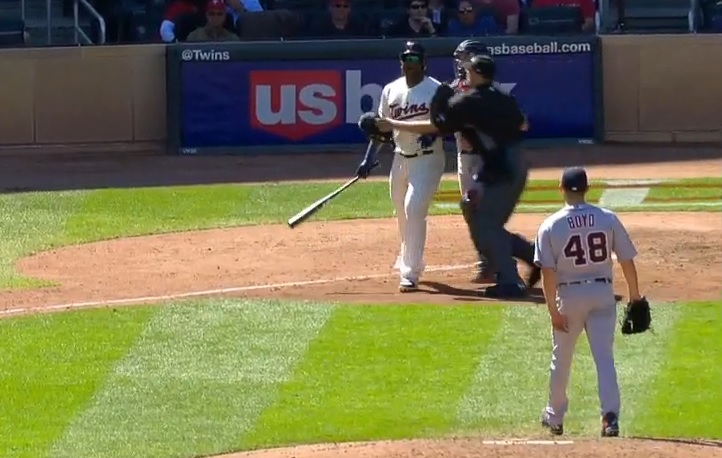
Which is precisely what happened in Minnesota. Two frames after Jones went down, Twins starter Matthew Boyd threw a fastball behind Sano—below the waist, as deterrent pitches are supposed to be. Had the hitter kept his wits, he would have recognized and accepted the nature of the message: a no-harm-done warning shot indicating the Twins’ displeasure with how things had gone down. Had the hitter kept his wits, he could have kept on hitting.

Instead, Sano took several steps toward the mound, pointing and shouting. When Twins catcher James McCann put him in a protective bear hug, Sano took a swing. (Watch it here.)

Never mind the lack of strategy behind throwing a punch at a guy wearing a catcher’s mask—Sano was quickly tossed. So, strangely, was Boyd, who hadn’t actually hit anyone with a pitch, who hadn’t received a warning to that point, and who likely wouldn’t have gone anywhere had Sano recognized the situation for what it was and calmly allowed the game to proceed.

“[McCann] touched me with his glove and I reacted,” Sano said after the game, in an MLB.com report. “It was a glove to the face. They were supposed to eject McCann, too, but I saw they didn’t eject him.”

Sure enough, McCann’s glove rose toward Sano’s face as the catcher drew him close. It wasn’t a swing though, and should hardly have been enough to spur Sano into the action he took.

Sano doesn’t need to like the concept of baseball retaliation. It is, in many instances, a brutal process. But the logic is impossible to miss: A pitch thrown at a team’s star in response to something one of his teammates did might inspire a conversation with said teammate about knocking it the hell off in the future. Had Sano recognized as much, he’d have saved himself a bunch of trouble.

The word “rules” is right there in the term “unwritten rules.” This weekend showed us the importance of players understanding them, if only for their own long-term benefit.


Retaliation

Boston Puts the ‘Harm’ in Charm City: Head-High Retaliation Draws O’s Ire

Machado headball

Baseball’s unwritten rules are pretty straightforward. When Manny Machado took out Dustin Pedroia with what many felt was a reckless slide on Friday, it seemed likely that the Red Sox would respond. A pitched ball into the ribcage or thigh, with Machado its probable target, would send a clear message to Baltimore and others around the league that taking liberties with Boston players comes at a price.

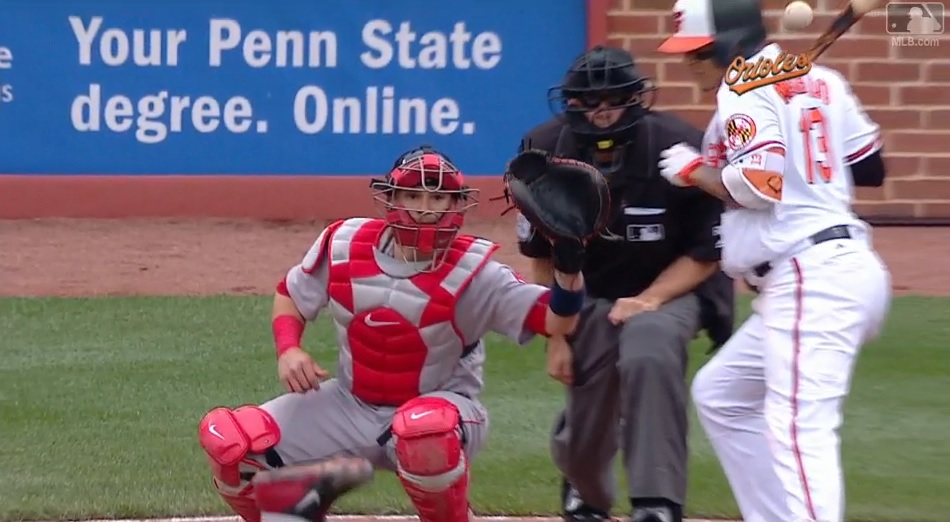
Then Matt Barnes threw at Machado’s head and sent the entire framework spinning on its axis.

Instead of closing the book on the incident, Barnes further inflamed some already raw feelings.

Instead of avenging Pedroia, Barnes forced his teammate into the uncomfortable position of having to shout across the field to Machado that the idea wasn’t his.

Instead of showing a unified clubhouse in which mutual accountability is paramount, where everyone has everyone else’s back, the Red Sox appear disjointed, unsure of what’s expected, who wants what, and how to execute when the time comes.

Orioles pitcher Zach Britton nailed it after the game when he told BaltimoreBaseballcom: “[Pedroia] is the leader of that clubhouse, and if he can’t control his own teammates, then there’s a bigger issue over there.”

The Red Sox actually tried to nail Machado earlier in the game, when in the sixth inning starter Eduardo Rodriguez threw three pitches toward Machado’s knees, all of which failed to connect. So two innings later, Barnes took things into his own hands. His head-high pitch just missed its mark, sailing across Machado’s shoulder blades, and ricocheted off his bat for a foul ball. (Watch it all here.)

The egregiousness of the pitch lent undue credence to those suggesting that the time for retaliation had already passed—never mind that in the two games between Machado’s slide and Rodriguez’s aborted response, neither team led by more than two runs, thus diminishing the Boston’s ability to freely cede baserunners to the opposition.

After the game, Pedroia went so far as to completely disavow his role. “That’s not how you do that, man,” he told reporters. “I’m sorry to [Machado] and his team. If you’re going to protect guys, you do it right away.” He then clarified: “It’s definitely a mishandled situation. There was zero intention of [Machado] trying to hurt me. He just made a bad slide. He did hurt me. It’s baseball, man. I’m not mad at him. I love Manny Machado.”

Boston manager John Farrell called it a dangerous pitch, but was it ordered? Possibly. Because Pedroia steered as clear as possible from the result doesn’t mean he wouldn’t have appreciated—or didn’t ask for—a better-placed retaliatory strike. Still, when he shouted across the field to Machado, Pedroia could clearly be seen saying, “It’s not me, it’s them.”

Who them are is of some interest, be it Farrell, a coach or a veteran pitcher offering guidance to Rodriguez and Barnes. Farrell’s statement in an MLB.com report—“Make no mistake, the ball got away from him. My comments are what they are”—leave open the possibility that he approved the message, if not the delivery.

It all serves as background in the face of a rapidly swinging pendulum. On Friday, it was Manny Machado playing the bad-guy role. To judge by his comments on Sunday—“I thought I did a good slide [on Friday]. Everyone knows. Everyone saw the replay on that side. That’s on them”—he has little interest in correcting the record.

Yet with one pitch, Barnes flipped the script for both clubhouses. It’s the Red Sox now wearing the black hats, and the Orioles with leeway to exact some retaliation of their own. (Machado got a measure of revenge after Barnes was kicked out of the game, tagging an RBI double off of the first offering from replacement pitcher Joe Kelly.)

What remains to be seen is how the Orioles respond. If they handle their business correctly, maybe everybody can put this affair behind them. If they do things like Matt Barnes and the Red Sox, however, we can count on things being dragged out even further.

The teams start a four-game series in Boston on May 1.

***

In  a related note, Zach Britton was unusually forthright in his description of how things work in this regard. As related to Rodriguez (in his third year in the league) and Barnes (in his fourth), Britton said this:

“As a player that doesn’t have the most service time in this room, when a guy like Adam Jones tells me to do something or not to do something, I’m going to do [what he says]. Same with Chris Davis or Darren O’Day, the guys in my bullpen. If they tell me, ‘Don’t do this or that,’ I’m going to listen to them because they’ve been around the game and they’ve seen things I haven’t seen. And you respect their leadership.”

As an institution, baseball has been drifting away from unwritten rules like these largely because the leadership Britton referenced features fewer old-school opinions with every year that passes. That doesn’t mean those opinions don’t still exist, however, more strongly in some clubhouses than others. It’s highly unlikely that anybody on the Red Sox suggested that Barnes go head-hunting, but given Pedroia’s response it’s a near-certainty that somebody suggested that a response to Machado was necessary.

Retaliation

Scratch Those Premature Obituaries, Baseball’s Unwritten Rules Are Alive and Well


RamosII

We’ve spent a long time—years now—wondering whether baseball’s unwritten rules, the sport’s code of conduct, were slowly meeting an inexorable irrelevance. Bats are flipped, celebrations are celebrated, and teams mostly go about their merry ways, unperturbed by the spectacle.

Fair enough. If that’s how big leaguers are playing it, that’s how things are. This blog isn’t bent on prescription of the sport’s unwritten rules so much as documentation of how they’re enacted by those who matter.

Then Monday happened. Fastballs flew at batters, some intentional, some not, some difficult to ascertain. But they elicited response. Oh, did they elicit.

In San Francisco, Diamondbacks starter Taijuan Walker drilled Buster Posey in the helmet. It was the first inning, there was a runner on second and Walker had already faced the Giants once this season without incident. So unless something happened back on April 5 that irked Walker something fierce while going entirely unnoticed by the media on hand, the pitch was clearly a mistake.

Still, it was a 94 mph fastball that knocked the Giants’ best player from the game and landed him on the 7-day disabled list.

Until recently, this would have unquestionably merited response, be it a pain-inducer (fastball to the ribs) or a warning shot (brushback). In the current version of Major League Baseball, of course, nothing is typical as regards the unwritten rules. Things are calmer, more relaxed. Vendettas are strictly an old-school affair.

So it seemed only normal when Walker escaped unscathed. Neither of his subsequent at-bats were ideal for retribution—with one out and nobody on in the third, he hit a fly ball to right field; in the fifth, with two outs, a runner on second and the Giants leading 3-0, he whiffed—but neither were they unacceptable.

From there, though, things grew interesting. In the eighth inning, Giants starter Matt Moore plunked David Peralta in the back. Then, in the first inning of yesterday’s game, Giants pitcher Jeff Samardzija plunked Arizona’s cleanup hitter, Paul Goldschmidt, in the backside—the ages-old response of “your best hitter for our best hitter.”

Bochy refused to discuss Samardzija’s pitch, and offered up an interestingly vague comment about Moore’s, saying in a San Jose Mercury-News report that “a pitch got away from him—I’ll leave it at that.”

Despite a pro forma post-game denial about wanting to pitch Goldschmidt inside, Samardzija had clear intentions for his target. Because the pitch was professionally delivered—into the posterior, nowhere near the head—the slugger took it without complaint. He knew the drill.

Why hadn’t it been Walker? Could be many reasons, though none resonate so firmly in a close game as not wanting to forgo an easy out by drilling the pitcher when one can send as firm a message against a far more dangerous hitter. Why Samardzija and not Moore? Might be a matter of personality, or the fact that the severity of Posey’s injury wasn’t known until after Moore’s game had ended.

***

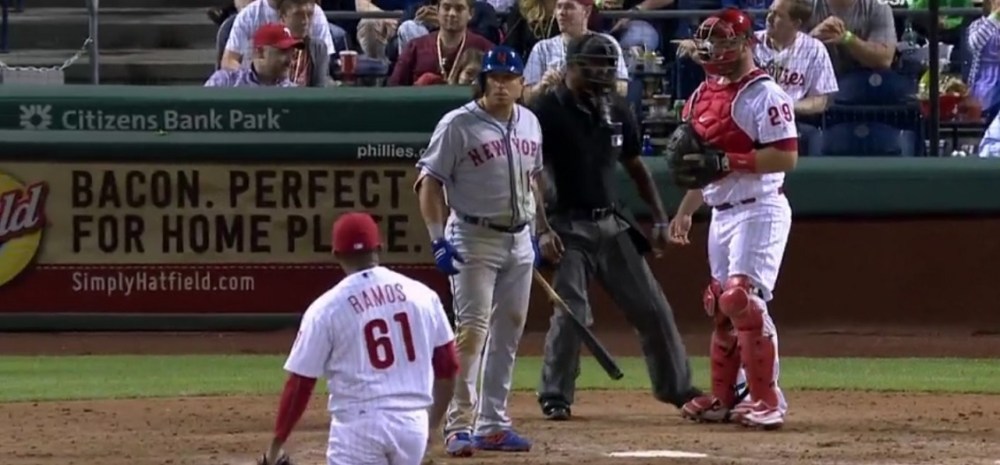
Across the country, Phillies pitcher Edubray Ramos entered a tie game in the eighth inning and threw a one-out fastball well over the head of Asdrubal Cabrera. It didn’t come close to making contact, but was enough to elicit warnings from plate ump Alan Porter, and the subsequent ejection of Phillies manager Pete Mackanin for arguing a hair too vociferously. (Watch it here.)

The backstory seems pretty obvious. Ramos last faced Cabrera in September while gunning for his first big league save. Cabrera wrecked it, then did this:

Retaliating for a game-winning celebration is some old-school mentality. And here’s the thing: for all the noise coming out of the World Baseball Classic about how Latin players like to celebrate their achievements on the field, Ramos—a native Venezuelan—was having none of the exuberance of one of his fellow countrymen. Or maybe that latter detail offers another wrinkle to their relationship about which we aren’t yet aware. Whatever it was, it stuck in the pitcher’s craw.

So there it is: On the West Coast, a passel of Americans participated in all-American retaliatory daisy chain; on the East Coast, two Venezuelans did the same. (Worth noting is that Ramos’s teammate, Odubel Herrera—another Venezuelan—is a bat-flipping savant, while Mackanin, Ramos’ manager, is himself no fan of the flips.)

The unwritten rules may be inexorably changing, but it all serves to show that one should never place too big a bet on who their champion might be.

Dynastic, Bombastic, Fantastic, Retaliation

When Getting Knocked Down Works Out In Your Favor

Fosse cardGoing through old A’s interviews while prepping for an upcoming presentation about my new book, Dynastic, Bombastic, Fantastic, I found this unwritten-rules nugget from catcher Ray Fosse, who told me about an incident on July 31, 1971, before he joined the A’s:
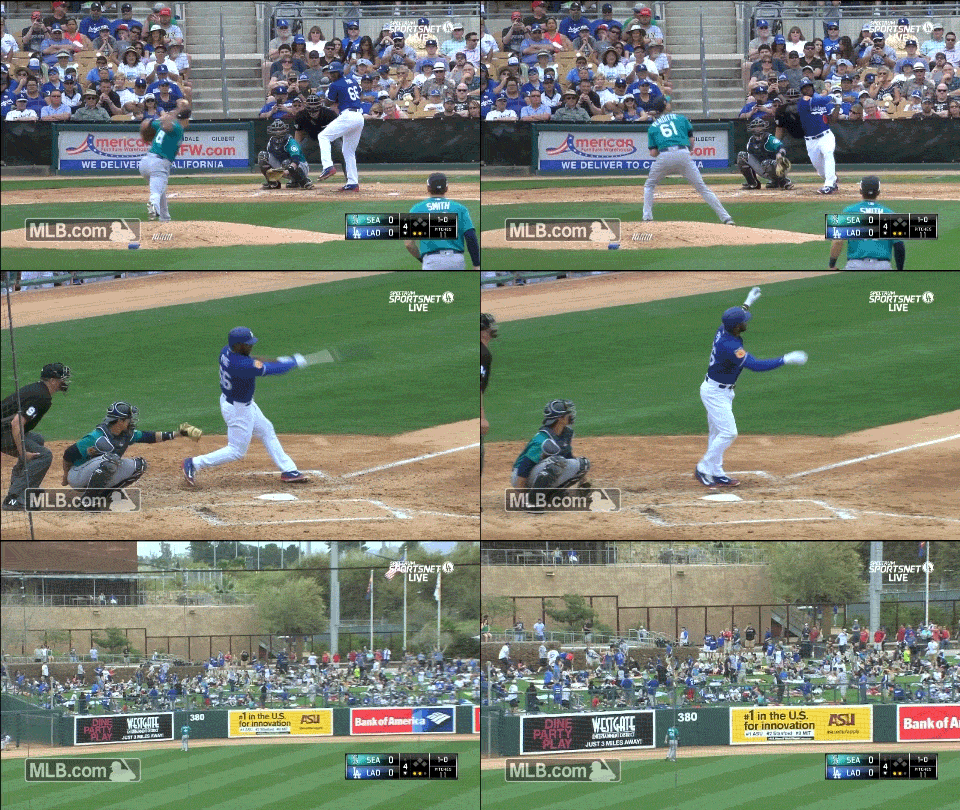
I’m with the Indians, playing Oakland in Cleveland. [Bert] Campaneris is at first, another runner [Dick Green] is at third, and a squeeze bunt is put on—a busted squeeze. Graig Nettles is playing third for us. I caught the ball and started running down the line to force the rundown. Out of the corner of my eye I see Campy rounding second, so I threw the ball to Nettles, then went to third and called, “Graig, Graig!” So he tagged [Green] and threw it back to me.

I crushed Campy with the tag. Crushed him. It was unintentional, but my momentum took me as he came to the bag and I went down and just fell on him. He was safe. I didn’t think anything about it, but [A’s pitcher] Chuck Dobson comes to bat the next inning and tells me, “You gotta go down.” I said, “What?” He said, “Yep, I got instructions. I got to throw at you.” Here’s the pitcher who’s actually going to be doing it, at the plate saying, “You got to go down.”

I said, “Are you kidding me? Because of what I did at third base with Campy?” He said, “Mm-hm.” So I come up to hit, Dobber threw a ball over my head and knocked me to the ground. I got up pissed off, and hit a double. When I got to second base, I looked at A’s dugout and said, “Stick that up your …” I was so pissed, I said it right to [A’s manager] Dick Williams. The last thing I ever thought was that I would be traded to Oakland.

So after I was traded, we’re sitting in Cleveland, getting ready to catch a commercial flight—to Cleveland, of all places. We’re at the airport, and Dick’s in the restaurant, by himself, and I walk up to him and say, “Skip, this has been on my mind. Do you remember the play?”

He said, “I remember it.” I said, “The last place I thought I would ever be traded was here.” He says, “I remember that play, and that’s why we want guys like you.” Because I was willing to do that to one of his players, unintentionally as it was, and then  responded by looking into the dugout after they decked me. He said, “I like that.”

After four seasons in Cleveland, of course, Fosse experienced his first-ever  winning record with the A’s, followed in short order by back-to-back championships. If you’re not already following it, check out @DynasticBook for a day-by-day account of Oakland’s 1972, 1973 and 1974 championship seasons.

Bat Flipping, Retaliation

This Kid Better Hope he Never Faces Jake Arrieta

There’s this kid in Texas who’s pretty good at hitting baseballs. He does things like this …

… and this …

We already know Arrieta’s thoughts on the topic. Young players who flip their bats, he said, “might wear the next one in the ribs.”

While it’s unlikely that Arrieta was referencing amateur teenagers, DJ might want to keep his head on a swivel while walking to the team bus. Wrigley Field is only 1,100 miles away.


Bat Flipping, Retaliation, Veteran Status

Arrieta Already in Midseason Form, Calls Out Bat-Flippers Across the Land

That’s Jake Arrieta Tuesday, on Chicago’s ESPN 1000.

We’ve heard so much recently about bat flipping and showboating and personal expression—just two days ago Yasiel Puig modeled his latest flip for a spring training crowd …

Puig flip

… that it’s nice to hear something from the other side.

Forget for a moment that intentionally planting a fastball into a young player’s ribs is no longer a viable means of response, or that Arrieta himself has bristled at such treatment. The pitcher’s point is as much about veteran status as anything.

Which is valid. For as long as baseball’s had unwritten rules, one of them has been You earn what you get. Players who have walked the walk get more leeway than fresh-faced rookies, and justifiably so. Back in 1972, Mudcat Grant summed up the sport’s salary structure by saying, “Baseball underpays you when you’re young, and overpays you when you’re old.” The same holds true for respect. In the eyes of many veterans, those who haven’t earned their big league stripes have no business acting as if they run the place.

For a guy like Arrieta, this includes showboating at the plate.

While I disagree with the sentiment of visiting physical peril on the opposition, I love that somebody is willing to recognize a merit-based hierarchy within the sport’s structure. No participation trophies here. You earn what you get.

If Arrieta and like-minded pitchers come off as stodgy in the process of voicing their opinions, so be it. All players shouldn’t be treated the same, just as people in any workplace environment in any industry shouldn’t be treated the same. In an ideal world, those who deserve promotion get promoted. And those who make too much noise with insufficient accomplishments to their name merit their own response.

What that response looks like is up for interpretation, but in this instance I’m kind of wild about that aspect of baseball’s old guard.


Retaliation

Never Too Foggy For Retaliation

ken-holtzmanIn support of my latest book, Dynastic, Bombastic, Fantastic: Reggie, Rollie, Catfish, and Charlie Finley’s Swingin’ A’s — available March 7 at fine bookstores everywhere — I’ve been re-poring over old Oakland Tribunes and tweeting this-date-in updates for each of the team’s three championship seasons. Sign up at @DynasticBook to relive those magical seasons, one day at a time.

If you do, May 22 will bring you the bones of the following tale of retaliation, told in significantly more complete form here. From that day’s issue of the Oakland Tribune, 1972:

Ken Holtzman was sailing along with a 2-0 lead in the second inning when he grounded to Royals first baseman John Mayberry, 6-foot-3 and 220 pounds.

Mayberry took the ball, ambled over to the bag to make the third out, but stopped instead of crossing over toward the dugout. The 165-pound Holtzman, running full speed, crashed into Mayberry and went down as if knocked out by Joe Frazier.

When Lou Piniella led off the next inning, the still-shaken Holtzman threw the first ball over his hat.

“I don’t know where I was,” Holtzman said. “I was so dizzy and so mad, I thought Piniella was Mayberry so I threw the ball over his head. When I got back to the dugout they told me what I’d done.”

Piniella is shorter and doesn’t weigh as much as Mayberry. And not only is Piniella white and Mayberry black, but Piniella bats right and Mayberry left.

By the time Mayberry came up again, Holtzman’s head had cleared. He threw a ball over HIS head and then struck him out.

There’s nothing funny about concussions, of course, but Holtzman threw five more innings of one-run ball, then pitched complete games in five of his next seven starts without missing a turn. Seems like he was okay. And dedicated to sending a message.

Boy, was that a different time.