Passing Rules Down, Rookie Etiquette, The Baseball Codes

Archer Sets Tone in Rays Camp

Those who thought that the Chris Archer’s outstanding 2015 season—in which he made the All-Star team and finished fifth in the American League Cy Young voting—might be taken as an excuse to ease off the gas pedal are sorely mistaken.

On the very first day of workouts in Port Charlotte, Fla., Archer pulled aside two young pitchers, Jacob Faria and Blake Snell, for showing up late to a team meeting. How late were they? It was 8:28 a.m. The meeting started at 9.

For Archer, it was all about tone.

“You guys are the last two pitchers here,” he scolded in front of reporters, according to a Tampa Bay Times report. “You guys have zero service time. You got no right to be coming in after me, really. I get here super early. I wouldn’t expect you to be here at 6:30, but 8:30?”

With that gesture, Archer provided a baseline expectation about accountability—an especially important measure considering the youth of Tampa Bay’s staff. This is the basis for winning clubhouse atmospheres.

Dusty Baker tells a story about showing up one minute late to the hotel lobby during his rookie season, to catch a ride to the ballpark with some teammates. It was 4:01 p.m., and he had been in his room, catching the end of Gunsmoke on TV. The group he was to meet waited for him to arrive, and as soon as he saw them sped off. “I had to run behind the truck all the way to the ballpark,” Baker said. Lesson learned. The incident helped to inform an approach to the game that he carries with him to this day.

“What you learn in this game is not yours to pos­sess, but yours to pass on,” Baker said in The Baseball Codes. “I believe that, whether it’s equipment, knowledge, or philosophy, that’s the only way the game shall carry on. I believe that you have to talk, communicate, and pass on what was given to you. You can’t harbor it. You can’t run off to the woods and keep it for yourself, because it isn’t yours to keep. And what you teach other guys is the torch you pass. I don’t make this up—it was passed to me.”

Archer seems to be right on board. “I remember being in some of these younger guys’ shoes,” he said in the Rays spring training clubhouse last week. “Hopefully I can have the same impact that James Shields and D.P. [David Price] had on me.”

If his recent actions are any indication, the Rays are in good shape in that regard.

The Baseball Codes

Spring is for Lovers: David Price rolls in to Red Sox Camp

The Red Sox have a storied history of hating the Rays, and vice versa. We know this by now. How we know that much of it isn’t personal, however—that it’s pretty much been a loathing of laundry—is when a member of one team joins the other.

Welcome, David Price, to the welcoming arms of the Fens.


A couple of years ago saw a different tenor. During the 2013 ALCS, David Ortiz homered twice against Price, and failed to run the second one out to the pitcher’s satisfaction. (Had Price paid any attention to Ortiz’s career, he would know that, too, was not personal.) Price responded the following May with a fastball spree against Boston, drilling Ortiz as the opening salvo of what became an increasingly contentious game.

Afterward, Ortiz referred to his rivalry with Price as “a war.”

“It’s on,” he said in a Tampa Bay Times report. “This guy that hit me better bring the gloves on. I have no respect for him no more.”

Oh, how things change. In December, Boston signed Price to a seven-year deal worth $217 million. Turns out that money goes a long way toward letting bygones be bygones. “I needed that,” Price said of his welcome, in an ESPN.com report.

There is copious precedent for this type of thing. In but one example, in 1976, Cubs third baseman Bill Madlock responded to a knockdown pitch from Giants starter Jim Barr (who hadn’t even knocked down Madlock, but the preceding hitter, Jose Cardenal) by letting go his bat on a follow-through, and sending it flying toward the mound.

Barr, among the game’s most noteworthy red-asses, drilled Madlock almost immediately.

Matthews-Mitterwald
Via the Chicago Tribune.

The hitter, furious, ended up reaching over plate umpire Paul Runge to punch at the pitcher, setting off a 20-minute melee highlighted by Gary Matthews’ blind-side attack on George Mitterwald, which bloodied the Chicago utilityman’s nose and cut his cheek. After the game, a posse of Cubs, led by outfielder Champ Summers, waited in the clubhouse runway for Matthews. A full-scale riot was averted only by an alert Wrigley Field security detail.

Nine months later, Madlock was traded to the Giants. He precluded potential tension shortly after the deal by proclaiming that he was looking forward to becoming friends with Barr. It was enough to soften the pitcher, who welcomed him warmly to spring training.

“[Madlock] came over to me and said, ‘We friends now?’ ” said Barr. “I said, ‘You bet.’ There was no animosity after that. We were friends for the three years that he played for us.”

Hopefully things work out as well for Price and Ortiz.

Unwritten-Rules

Knee-gate Revisited

Rosy's knee

Last week we examined Adam Rosales’ knee plant atop second base, which was called out by Rays shortstop Asdrubal Cabrera as violating some sort of unwritten rule pertaining to middle infielders. Never having heard of it, I took an unofficial survey of as many infielders as I could find when I was at the Oakland Coliseum last weekend.

Okay, it was only two. And one of them plays third base. Still.

“If his knee’s not in the way and he’s not trying to do it, then he’s not trying to do it,” said A’s third baseman Brett Lawrie (who’s had his own dose of slide-related drama this year). “If you’re on top of the bag but there’s still room to slide, that’s okay. Everything’s fine.”

A’s coach and longtime middle infielder Mike Gallego offered a different—though not contradictory—perspective. The difference between tags today and those of previous generations, he said, is replay.

“Back in the day with the old sweep tag, if the ball beats the runner the umpire is calling him out, no question,” he said. “Now, you have to literally put the tag on the play, so you might see guys blocking the base a little bit more to make sure they get the tag on the runner. It’s changing.”

It’s true. Prior to replay, runners never complained about being called out if the ball beat them to the base, even if the tag had already come and gone. Now, the necessity to position themselves not just to make a tag, but to hold it, is paramount. It only follows that they’ll have to at least occasionally brace themselves in ways about which previous generations would have been less tolerant. Not a direct correlation to Rosales’ situation, but worth mentioning.

The early verdict: Both Lawrie and Gallego mentioned that planting a knee next to the bag is preferable than doing so on top of it, for reasons that Cabrera enumerated after jamming his fingers. They also said that things happen in a bang-bang play, and what Rosales did was hardly objectionable. (Hell, first basemen like Willie McCovey and Willie Stargell were known for applying pile-driving tags on pickoff throws as a means of reminding the runner about the cost of doing business. Tag etiquette can be a complex affair.)

I’ll continue to ask around as the season progresses. Updates as events warrant.

Unwritten-Rules

Knee, Meet Fingers. Fingers, Knee. Chat Amongst Yourselves

Rosy's kneeAfter having paid particular attention to baseball’s unwritten rules since I started researching The Baseball Codes in 2005, I’ve compiled what seems like a pretty comprehensive set. On Saturday, Asdrubal Cabrera may have informed me of a new one.

Diving back into second base on a pickoff attempt, Cabrera jammed his fingers into the knee of Rangers second baseman Adam Rosales, and got up shoving. (At first blush it appeared to be because Rosales inadvertently leaned on him with an off-balance elbow, but that had nothing to do with it. Watch the play here.)

After the game, Cabrera said, in an MLB.com report: “He put a knee onto second base. I’ve played both sides, second and short, and I know that’s not fair to put a knee on the base.”

At the very least, Cabrera was correct in his assessment that, had Rosales’ knee not been planted atop the base, his fingers would have remained blissfully unjammed.

Rosales’ general demeanor is among the best in all of baseball, and there’s no question that whatever he did was done unintentionally. Still, it begs the question—especially with the accusation flying from one infielder to another—was he out of line?

More to follow …

Don't Showboat

Whether ’tis Nobler in the Mind to Suffer the Slings and Arrows of Outrageous Fortune, or Just to Act Like an A-Hole Closer

Pujols arrowAt his very best, Fernando Rodney is ludicrous. His pre-scripted bow-and-arrow routine following saves—during which he pulls an imaginary arrow from an imaginary quiver and shoots it with his imaginary bow—is one of the sorriest sights in the sport. He says he does it for the fans, but is there a bigger cry for attention in the big leagues? More pertinently, is anybody short of those who would be cheering for him anyway entertained by his hack act?

Still, it’s easy enough to ignore. He does it after games have ended, when people are either celebrating or walking somberly off the field. On Sunday, however, Rodney took things a step farther, bow-and-arrowing not toward his usual spot in center field, but toward the Angels dugout (or, he said, the fans sitting above) … and not at the end of the ninth inning, but after protecting a one-run lead at the end of the eighth. In so doing, he broke new ground in the art of closer show-boatery.

Suffice it to say that the Angels weren’t pleased. “He woke up our dugout,” said Grant Green in an MLB.com report.

When Rodney came back out for the ninth, Mike Trout greeted him by drawing a walk, then scored the tying run on Albert Pujols’ follow-up double. Pujols responded by shooting an imaginary arrow at Trout, and Trout returned fire right back at Pujols. It was as fine an in-your-face moment as can be found on a big league diamond short of actual game play. (Two singles and two intentional walks later, the Angels took care of that, too, with a walk-off, 6-5 victory, courtesy of Green’s game-ending single. Rodney did not reach for his quiver again at that point.)

It must be accepted that closers have their shtick. Sergio Romo does a little dance. Rafael Soriano untucks his shirt. Jose Valverde just kind of loses his mind. One time, Aroldis Chapman even rolled. It goes all the way back to Brad “The Animal” Leslie’s crazed yelps following saves in the early 1980s.

Closer to the Rodney situation was when Brian Wilson did his typical arms-crossed-point-to-the-sky move against the Dodgers in 2009, after which Los Angeles third baseman Casey Blake mocked him for it in the dugout … then took it back when he found out it was a tribute to Wilson’s late father. If you’re going to do it on the field, however, it’s gonna be in play.

All of which is a leadup to some simple advice: If as a closer you’re going to act like a goon, save it until the game’s actually finished.


Retaliation

Red Sox vs. Rays, Because of Course Red Sox vs. Rays

Papi pops

Would David Price have had such a long memory had it been anybody but the Red Sox? We’ll never know unless he tells us, of course, but the answer is, of course not.

In last year’s ALCS, Ortiz hit two long homers off of Price (who gave up seven runs in a Game 2 loss), watching the second for a beat longer than the pitcher would have liked. Afterward, Price complained to the Boston Globe about the possibility that Ortiz was just watching to see if the ball went fair. “I saw it and I knew it was fair,” he said. “Run.”

He faced Ortiz for the first time since then on Friday, and wasted little time making a statement, planting a first-pitch fastball into the slugger’s back. It was enough for plate ump Dan Bellino to issue a warning, but not—contentiously—for Price to be ejected. Umpires are known to delay warnings until the other team has a chance to respond (especially under questionable circumstances such as these), but in a series as combative as this one—which saw benches empty less than a week earlier—Bellino was taking no chances.

Neither was John Farrell, who argued his position to the point of ejection.

Already upset by unrequited aggrievence, the Red Sox grew further agitated when Price hit Mike Carp in the right forearm three innings later. That this one appeared to be less intentional did little to slow the rampage; benches emptied, with Ortiz animatedly pointing toward Price, who for the second time in the game managed to avoid ejection. (Watch it here.)

Not so for backup Red Sox manager Torey Lovullo, who began his conversation with the umpires by spiking his cap, and ended it by trudging off to the showers. Boston’s third manager of the evening, Brian Butterfield, was tossed in the sixth, along with Brandon Workman, when the Red Sox starter threw a pitch behind Evan Longoria.

(Why wait until then? Well, Longoria is Tampa’s biggest gun, and Workman was not long for the game, anyway—the pitch to Longoria was his 89th, the most he’s thrown since last August. As if there would be any other way.)

After the game, Ortiz pulled no punches.  “That’s means it’s a war. It’s on,” he said in a Tampa Bay Times report. “This guy that hit me better bring the gloves on. I have no respect for him no more.”

Fueling his rage was the fact that the Red Sox absorbed four ejections while hitting nobody with a pitch, while Tampa Bay emerged unscathed, despite hitting two.

At least one player in the Rays clubhouse, however, wishes things were handled differently.

“I wish he would have hit me so it could have been done and over right there,” Longoria said. I just don’t want to get hit in the head, just make sure it’s down below the neck. Hopefully we’re beyond it.”

If the Red Sox are playing by the unwritten rules, it should be over. Butterfield had his shot, and he missed (with the possibility that he threw it intentionally wide with the score 2-1, to avoid unnecessary baserunners).

At this point, however, in the self-sustaining biodome of animosity that is Boston-Tampa Bay, all reactions seem to be on the table. These teams have disliked each other so intensely, for so long, that every slight is magnified and the need for response set in stone. While the rest of baseball seems more content than ever to not sweat the small stuff when it comes to the Code, that’s all these two clubs seem to do.

Update (5-31): Ortiz: Price is “a little girl.” Price: “This is not a war.

Don't Steal with a Big Lead

Tropocolipse 2014: Red Sox Anoint Themselves Baseball’s New Code Police

Yuni points

Every day we see new evidence of the degradation of baseball’s unwritten rules, how past forms of moral governance have been swept away in favor of the far simpler ideal of simply letting boys be boys. The game’s few remaining old-school souls periodically remind us of this development, primarily through bursts of outrage at acts that, while once roundly condemnable, are barely even blip-worthy on the modern game’s radar.

Put another way: Baseball has its share of crotchety old men, sitting on the proverbial front porch and grousing about the way things used to be—and they will not be ignored.

Ladies and gentlemen, we give you David Ross.

Sunday at Tampa Bay’s Tropicana Field, Rays shortstop Yunel Ecobar stole third while his team held an 8-3 lead in the seventh inning. Five runs at that moderately late point in the game was once considered punishable with fines up to and including fastballs aimed at the noggin of the next hitter, or Escobar himself, or both.

The game, however, has changed considerably, as has its moral code. There is still gray area when it comes to running up the score, of course—questions about how much of a lead is enough, and when—but the last time anybody so much as blinked at something along the lines of Escobar’s steal, the Rays had “Devil” in front of their name … unless they hadn’t even come into existence yet.

That said, we’ll always have crotchety old men hanging desperately to outmoded morals as places upon which to park their high horses. As Escobar led off third, Ross started barking. Escobar responded in kind, at first with stunned confusion, then anger and finger pointing toward the Red Sox bench. A moment later Jonny Gomes raced in from right field, swings were swung and the scrum became official. (Watch it here.)

It is easy for one side of the confrontation to decry the other: Ross for being too high strung, or, if it’s crotchety old men doing the decrying, Escobar for rubbing Boston’s noses in a sizeable lead. The argument that put it all to rest, however, was delivered by Tampa Bay manager Joe Maddon after the game:

“They took umbrage with the fact that Escobar had stolen third base with a five-run lead in the seventh. So that’s not nearly as egregious as last year in the playoffs, correct? Last year in the playoffs, when they had an 8-2 lead in the eighth inning, when Ellsbury led off with a single and stole second base and they ended up winning 12-2. I think that was a little more egregious than their interpretation of tonight. … I didn’t take any exception when they stole on us last year in the eighth inning in the division series. … Our goal is to prevent them from scoring runs, their goal is to score runs—the whole game. That’s always been the goal within the game of baseball. Apparently some of the guys on their bench did not like that. I really wish they would roll back the tape and look at that more specifically. You have to keep your personal vendettas, your personal prejudices, your personal judgmental components in your back pocket. So before you start screaming regarding any of that, understand what happened just last year, and also understand that in this ballpark five-run leads can evaporate very quickly.

Indeed, in Game 1 of last year’s ALDS, then-Red Sox center fielder Jacoby Ellsbury led off the seventh inning with a single, and stole second while his team held a six-run lead. David Ross was a member of that team. If he ever came out publicly against his teammate’s actions, those comments have not been widely circulated.

Then again, last year the Red Sox were on their way to hoisting the World Series trophy. On Sunday they were nothing more than a club with championship aspirations in last place and on its way to losing its 10th straight. Things that slide when one is winning tend not to in the darker hours.

Nothing feeds hypocrisy, it seems, like a healthy dose of frustration.

Of course, Escobar broke an unwritten rule himself by doing the one thing that could trip him up most: He responded. Had he kept to himself and put up with the bench jockeying for just a few moments, all would likely have ended well. Instead he was tossed, Boston is even angrier than it was before, and bad blood between two teams with a considerable history of the stuff is built anew.

Boston manager John Farrell did what he was had to in protecting his player, saying afterward in an MLB.com report: “We’re down five in the seventh so it’s somewhat of a gray area when you shut down the running game.”

Which is completely accurate, except for the part about the gray area. Ross had no business getting involved with Escobar over that particular action; he’s a 13-year big leaguer and should know better.

Take away the punches and the insults and the misplaced claims of moral outrage, however, and we’re left with one thing: a stark example of the degree to which baseball’s Code has changed. Argue all you want whether that’s for better or for worse—just don’t deny that it exists.


Practical Jokes

Rodney’s Bathroom Breather Hardly Breaks New Ground

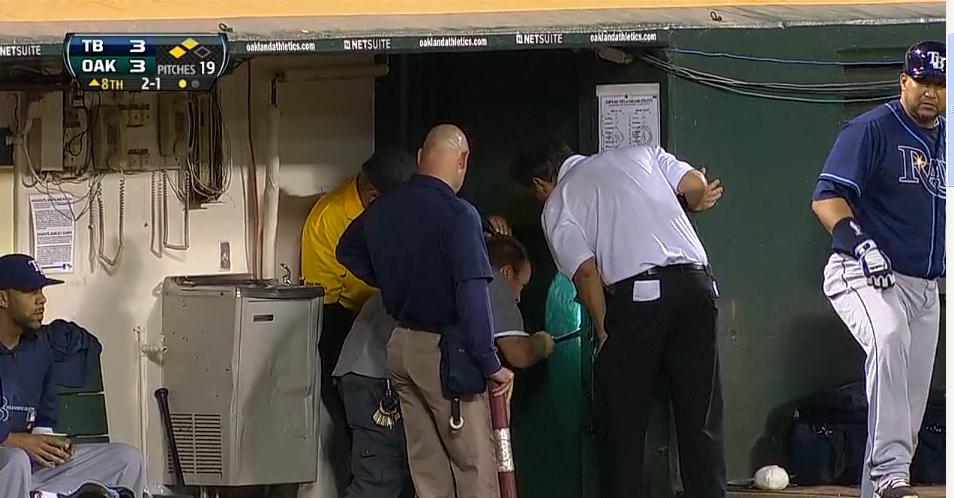
Rodney trappedRays reliever Fernando Rodney got stuck in the visitors’ dugout bathroom at Oakland’s O.co Coliseum on Sunday, and was trapped for about 15 minutes until a rescue crew could open the door.

He emerged triumphantly, met by jubilant teammates.

“They got two runs when I was locked inside,” Rodney said in an Associated Press report. “They broke the lock. It was hot inside. I can only hear the crowd but can’t see game. So I don’t know what’s going on. I let them know and tried getting a key but couldn’t. I kept yelling, ‘Get me out!’”

(Check it out at the bottom of the page, or watch the extended clip here.)

“It was a kind of a fun moment,” added Rays manager Joe Maddon. “We kind of rallied then—we should have kept him in there. A lot of the commotion in the dugout in the eighth inning and part of the rally was someone beating on the door. Finally someone broke the door knob with a bat to get him out. I don’t even know who the hero was getting him out.”

While there’s no unwritten rule to cover Rodney’s escapade, there was one involved in another locked-in-the-bathroom incident covered in The Baseball Codes. Unlike Rodney’s predicament, that one was all about practical jokes—keeping things loose in the clubhouse.

From TBC:

Bob McClure was a fun-loving reliever for the Brewers in the 1970s, some­one who proved, if nothing else, that he could take as good as he gave. The story started with his Sunday routine before day games, for which he holed up with a newspaper in the long cinderblock outhouse behind the outfield fence at Milwaukee County Stadium. It was a cool place for an American League pitcher to pass the morning in the shade of the bleach­ers, escaping the summer heat while his teammates took batting practice.

When the door slammed shut on McClure in the middle of one of these siestas, the pitcher attributed it to a gust of wind. But when he tried to exit, the door wouldn’t budge, even though it had no lock. With just a hint of panic, the pitcher pushed again . . . and again. Soon he was exert­ing so much energy in his frantic bid to escape that he had to stop for peri­odic breathers. The day was growing increasingly more sultry, and McClure worked up a sweat; eventually he kicked the air vents from the walls and stripped down to his underwear. “I bet I lost about seven or eight pounds in there,” he said. “It was hot.”

After a half-hour, the pitcher was able to wedge the door open just enough to squeeze through (“I still remember the scrapes across my chest”), whereupon he saw that someone had taken the rope from a flag­pole on the other side of the outhouse and pulled it so taut to reach the doorknob that the pole had bowed under the pressure. Once it was affixed to the handle, the rope’s tension kept the door from opening; it was only as the fibers started to give that McClure was able, finally, to free himself. (He found out later that members of the visiting Minnesota Twins, com­ing out for their own batting practice, had been told by his mystery assailant to watch the flagpole, that someone was locked in the lavatory and it would bounce every time he tried to get out.) He put on his clothes and returned directly to the clubhouse, as if nothing had ever happened. “I would say that, if someone gets you, never let them know that they got you,” he said. “I think it’s inappropriate, if someone really gets you good, to overreact. Don’t get mad, just get even.” The problem was that he had no idea upon whom to visit his revenge.

Before a game several days later, McClure got his answer. As the pitcher loitered in the outfield during BP, a fan called him over to the bleachers. “Do you want to know who locked you in that room?” she asked. His instinct was to play dumb, but when the woman told him she had pictures, he couldn’t resist. She handed them over in exchange for a ball autographed by Robin Yount, and McClure saw exactly what hap­pened: It had taken two men to pull the flagpole rope tight enough to trap him, and their uniforms were clearly visible. It was pitchers Mike Cald­well and Reggie Cleveland.

McClure immediately set to plotting his revenge. Six weeks later, when the Brew­ers had an off-day in Kansas City before a series with the Royals, he struck.

While many players, including Caldwell and Cleveland, spent the after­noon golfing, McClure opted for a hunting trip with a local friend. On the way back they stopped by a farm, where the pitcher bought a small, live— and exceptionally filthy—pig. “It had so much pig dung on it that you couldn’t even hardly tell it was a pig,” McClure said. “It was perfect. We put it in a burlap sack in the back of my buddy’s pickup.”

When the pitcher returned to the hotel, he saw that his teammates hadn’t returned, and figured they’d be out until the wee hours. McClure bribed his way into the room that Caldwell and Cleveland conveniently shared, and let the pig loose atop the bed. “When that pig hit the sheet, it looked up at me and started projectile shitting everywhere, like a shot­gun,” he said. “That pig was alive. It jumps off the bed, and it’s squealing and going nutty. There’s shit on the bed, on the floor, on the curtains. It was so loud that I had to get out of the room.”

He was staying just across the hall, and hours later was roused by the sounds of his returning teammates. Caldwell was the first to enter, and nearly as quickly lit back into the hallway, shouting, “There’s someone in there!” As McClure listened with delight, his teammates rushed the room, then spent the better part of an hour trying to corner the pig. Finally, the noise quieted and McClure went back to sleep.

The next morning, the pitcher veritably bounced across the hall to see how his victims had held up. He entered the room under the pretense of rounding up breakfast companionship, but wasn’t at all prepared for what he saw. The place was spotless. The walls, the drapes, the bedspread, and the carpet had all been cleaned. Caldwell was lying on his back in bed, shirtless. Also on its back, in the crook of Caldwell’s right arm, was a freshly washed pig. It sported a red dog collar. Caldwell was feeding it French fries dipped in ketchup.

Feigning ignorance, McClure asked why there was a pig in the room and was told the entire story, up to and including an early-morning trip to a nearby pet store, where Caldwell bought collar, leash, and industrial-grade pet shampoo. The pig joined the team at the ballpark that day, serv­ing as the Brewers’ mascot. It ended up living on Cleveland’s farm, of all places, dreaming recurrently, no doubt, of room service and burlap.

Hidden Ball Trick

The High Cost of Not Paying Attention, Juan Uribe Edition

Uribe picked offThe last time we saw two hidden ball tricks in a season was … well, who really knows? Evreth Cabrera tried it against the Giants in July, but was stymied by a lack of execution from his teammates and an ill-placed timeout call.

On Saturday, Tampa Bay was far less subtle in its efforts against the Dodgers—and far more effective.

Shortstop Yunel Escobar, noting that Juan Uribe—who had just pulled up at third following a sacrifice fly—wasn’t paying attention, called for first baseman James Loney to throw him the ball. He then tossed it to third baseman Evan Longoria, who was standing behind the bag.

Longoria watched Uribe quietly, and waited, ball in hand. Despite warnings hollered from Zack Greinke in the on-deck circle, the moment Uribe pulled his foot off the base, Longoria pounced. Third-base ump Angel Hernandez was right on it, and a disbelieving Uribe was out. (Watch it here.)

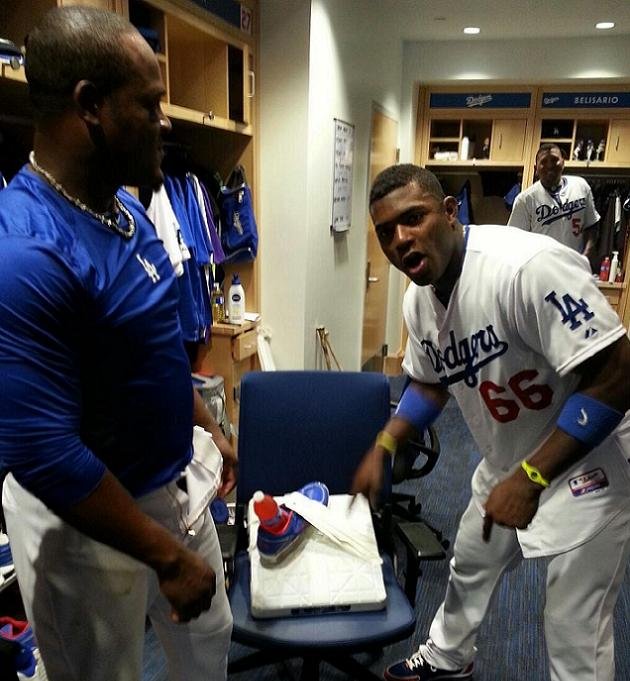
Thanks to a 5-0 victory, the Dodgers were able to have fun with it, Adrian Gonzalez presenting Uribe with third base—complete with a taped-on cleat—after the game. (See image below, courtesty of @yasielpuig.)

Escobar told reporters that he’d already tried the play four or five times this season, but that this was the first time in his seven-year career it’s actually worked.

No wonder we don’t see it more frequently.

Update (8-14): Even Los Angeles-area youth are getting in on the action.

UribeFoot