Don't Rub

The Night the Lights Went out in Tampa: Rhymes Collapses After Drilling

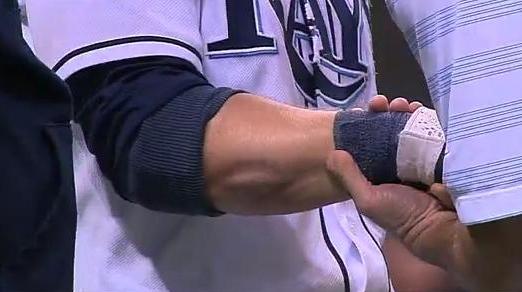
The baseball’s imprint can be clearly seen on Will Rhymes’ arm, moments after impact.

Will Rhymes was hit by a pitch Wednesday, in the forearm. Although there appears to be no lasting damage, the pain was sufficient for Rhymes to remove himself from the game while standing at first base, then pass out into the arms of first-base coach George Hendrick before he could reach the dugout. (Watch it here.)

“I got to first and started getting real dizzy, nauseous,” Rhymes said. “That’s when I started walking off. And then, apparently, I didn’t get real far.”

This is obviously a fairly unique situation, but it is a perfect entre into the unwritten rule stipulating that players who have been drilled refrain from rubbing the mark. It has nothing to do with superstition and everything to do with public displays of macho. It’s the hitter telling the pitcher, you can’t hurt me.

The prototypical player for this rule was Don Baylor, who crowded the plate to such a degree that he was hit by 267 pitches over the course of his career—and, reported the Washington Post, never once rubbed. “Of course,” the article went on to say, “several of the balls had to be hospitalized.”

The notion was summed up perfectly by Hall of Fame owner Bill Veeck, in his book, Veeck as in Wreck, published in 1962:

In baseball, let me say, there is a code that says, “Big-leaguers don’t rub.” You may have noticed that after a batter is hit by a pitch he may flex his shoulder or twist his neck a little but he will never rub the spot where he has been hit. If you ask any of them about it, they will always say, “Why should I give him the satisfaction of showing he hurt me?” This may sound rather naïve, since a pitcher who has just hit a batter behind the ear with a baseball traveling 80 mph has a mighty strong suspicion that it might have stung a little. What the players really mean is that there has somehow developed a code of honor which forbids them to make a display of any physical injury caused by an opponent. There are those, I’m sure, who would call it nothing more than the code of adolescence. I’m not among them. I would even dignify it, I think, by calling it not so much a code but a tradition—for any profession worth the name develops its own traditions. Courage and honor are not such commonplace commodities, now or ever, that they should be scorned.

Pete Rose made a habit of sprinting to first base after being hit, to show the pitcher—and everyone else in the ballpark—that he could not be slowed. In a 2006 interview, former Brewers first base coach Dave Nelson talked about a moment just days earlier, when outfielder Geoff Jenkins was drilled in the elbow, hard enough so that Nelson could clearly make out the imprint of the ball on his arm: “I said, ‘Jeff, you okay?’ He said, ‘Oh man, that hurt,’ but he never rubbed it one time. Not one time. I said, ‘Boy, you’re a better man than me.’ He never even shook out his arm.”

That said, pain levels can occasionally supersede bravado.

“What if I caught you in your neck with something—you ain’t gonna rub it?” asked Rangers manager Ron Washington. “What if I caught you right in your darn elbow? In the elbow. I ain’t talking about the fat part above or below, I’m talking about in the elbow. You telling me you’re going to walk down to first base and not touch it? No, I’m going to be all over the ground. I’m giving in to that pain. Not to you. To the pain. You catch me in the thigh, in the hip—okay, I can take that. I might just run my butt on down there. But catch me somewhere where it hurts, then I’m giving in to that pain.”

Which brings us back to Rhymes, who can hardly be faulted for a reaction over which he very clearly had no control. The lack of actual severity—the second baseman sat out Thursday’s game, but is not expected to miss much time—may open him up to some ribbing from his teammates, but it’s pretty certain that none of them will hold this against him.

After all, it could happen to anybody.

Matt Moore, Pitch Tipping

Big Tipper: Rays Worry About Moore Giving Away Too Much Information

In Tampa, hopes are high for pitcher Matt Moore. The 22-year-old is one of the top prospects in all of baseball, and a rotation anchor—they hope—for years to come.

Which is why when things started to go wrong for him early this season, especially after Sunday’s 6-4 loss to Boston, in which Moore gave up six runs and eight hits in 6.1 innings. Even as that game unfolded, team brass tried to figure out what was going wrong.

Their first thought: Tipping. As in, Moore was telegraphing the type of pitch he was about to throw, just before he threw it. From the Tampa Bay Times:

In acknowledging how “locked-in” [the Red Sox] were, Rays manager Joe Maddon mentioned, open-endedly, that “it’s like they know what’s coming almost.” He noted how “they’re on everything right now,” no matter what type of pitch it was, and how they were “spitting on”—taking—certain borderline pitches.

What raised the specific pitch-tipping concerns about Moore were the aggressive swings the Red Sox were taking, particularly unexpected given their limited previous exposure to him.

By the fifth inning, pitching coach Jim Hickey was meeting with Moore and catcher Chris Gimenez to try to figure things out. Gimenez said they thought that Moore might be “tapping his glove on his fastball.”

To guard against the possibility that it was something else entirely—like Boston hitters peeking at signs—Gimenez began setting up as late as possible, just before Moore was ready to pitch.

Their concerns were assuaged after reviewing video of the game, which showed that the hammered pitches were all out over the plate—hittable because they were bad, not tipped. Moore seemed all too relieved to eliminate tipping as a cause of his woes.

“Maybe [I tipped some pitches] years ago when I was in rookie ball or something like that,” he said in the Times. “But not as far as I can remember.”

The thing is, such frailties can manifest even in veteran pitchers with no such history. In the last couple of seasons alone, we’ve seen similar issues with Tim Lincecum (who quickly corrected things), Johan Santana and Ben Sheets. From The Baseball Codes:

Tells can be as simple as a pitcher keeping his glove snapped tight when throwing a fastball but flaring it out for a breaking ball, or coming set with his glove at his belt for one type of pitch but at his chest for another. Matt Morris, for example, was lit up by the Braves during his rookie season in St. Louis after they noticed that the exposed index finger on his glove hand pointed upward whenever he threw a fastball, but lay flat for curves. Once he pinpointed the trouble, Morris quickly fixed it by attaching a flap to his glove that covered the finger.

Examples like this litter the game’s history. When Babe Ruth first came to the American League as a pitcher with the Red Sox, he curled his tongue in the corner of his mouth whenever he threw a curveball—a habit he was forced to break once enough hitters became aware of it. Kansas City’s Mark Gubicza was cured of his tendency to stick out his tongue when throwing a breaking ball under similar circumstances. Ty Cobb reg­ularly stole bases against Cy Young, abetted, said the outfielder, by the fact that Young’s arms drifted away from his body when he came set before throwing to first; when he was preparing to pitch, he pulled his arms in.

Pitcher Todd Jones dished similar dirt on several competitors in an article he wrote for Sporting News in 2004: “When Andy Benes pitched, he always would grind his teeth when throwing a slider. In Hideo Nomo’s first stint inL.A., he’d grip his split-finger fastball differently than his fastball. Randy Johnson would angle his glove differently on his slider than on his fastball. I’ve been guilty of looking at the third-base coach as I come set when gripping my curveball. When hitters see this, word gets around the league. In fact, my old teammate Larry Walker was the one who told me what I was doing. He said he could call my pitches from the outfield.”

We’ll see tonight if all this deliberation has made a difference, when Moore makes his first start since Boston, against the Twins.

Managers Play their Best Lineups

Joe Girardi Mostly Ignores Roster Games; Yankees Still Kick Red Sox in the Teeth

Mark Teixeira started -- and homered (twice) -- before everything fell apart for New York.

Prior to Wednesday’s game against Tampa Bay, Yankees manager Joe Girardi found himself in a terrifically sweet position. The Yankees had little to play for; they would finish with the American League’s best record regardless of the outcome.

A loss, however, would give the Rays a leg up on the American League wild card. More pertinently, it would provide a possible knockout shot to the Red Sox—and what Yankee wouldn’t enjoy that?

With so much on the line for his opponent, however, Girardi was, under the auspices of baseball’s unwritten rules, obligated to utilize his best players. So the question became, Would it be okay if he didn’t?

The answer: Of course. Winning, or putting your team in a position to win, trumps nearly every facet of the Code. It’s safe to assume that Girardi—a Yankees catcher for four years before taking over as manager in 2008—takes joy in any opportunity to stick it to Boston. On Wednesday, he could do so under cover of getting his own team ready for the postseason. The skipper had a playoff series to prepare for, and resting his players may well be vital to that preparation.

In fact, Girardi did exactly that against the Rays on Sept. 22, resting Curtis Granderson, Alex Rodriguez, Robinson Cano, Russell Martin and Brett Gardner in a game New York would lose, 15-8.

But with the season on the line for Tampa Bay on Wednesday, Girardi started what’s essentially been his regular lineup, and stuck with it until rain delayed the game in the seventh.

With New York holding a 7-0 lead, the skipper went to his bench: Eric Chavez replaced Mark Teixeira in the lineup, and took over at third base. Brandon Laird moved from third to first. Chris Dickerson took over for Nick Swisher in right field. Heck, A.J. BurnettA.J. Burnett!—saw action in the seventh.

That strategy, of course, is covered by its own set of unwritten rules. With the game comfortably in hand, Girardi could have been accused of running up the score had he continued to play aggressively. Such a full utilization of his role players was definitely not that.

As it was, of course, we all realized exactly how far behind us the days in which a 4-0 lead was considered safe actually are. Tampa Bay tied the game with six in the eighth and one in the ninth, and won it—and the wild card—on Evan Longoria’s 12th-inning homer.

Boston fans might bemoan Girardi for his late-game lineup manipulations, but their manager didn’t. “They can do whatever they want,” said Terry Francona in a MassLive.com article published Monday. “They have played themselves into that position; they’ve earned the luxury. I have never had a problem with that.”

* * *

The piece of Code mandating that managers utilize their best lineups when playing contenders late in the season really comes into play when an also-ran rests its regulars against a club with playoff hopes—”to get a look at the kids,” or some such. Few issues will be taken should the occasional prospect be utilized for evaluation purposes, but generally speaking the rule is firm: Play the rookies against Pittsburgh; sit ’em against St. Louis.

Take 2004, for example. Going into the season’s final series, the Giants and Houston were tied for the wild card lead with 89-70 records. The Astros closed with three home games against Colorado, while the Giants visited Los Angeles.

Suffice it to say that members of the San Francisco clubhouse took note when Rockies manager Clint Hurdle trotted out a series-opening lineup featuring six rookies—Aaron Miles, Clint Barmes, Garrett Atkins, Jorge Piedra, Brad Hawpe and JD Closser.

The Giants managed to take two of three from the Dodgers, but it wasn’t enough; the Astros swept punchless Colorado.

“All we needed was for Houston to lose one game,” said then-Giants reliever Matt Herges. “We were watching that, yelling, ‘This is a joke.’ We couldn’t stand Clint Hurdle after that.”

“If we’re in that position, it means we stunk all year,” said Hall of Fame manager Sparky Anderson. “Well, let’s stink a little more if we have to, but we’re going to give them the best shot we’ve got.”

That, however, is not a universal view. For the flip side of the argument, we turn to Tigers manager Jim Leyland.

“Goddammit, if I’m that far out of the pennant race, the players I was playing weren’t worth a shit, anyway,” he said. “You might as well take a chance and look at some new players for next year.”

Which brings us back to Joe Girardi, who doesn’t have to worry about any of that. His players don’t stink, he could have gotten away with virtually anything he wanted in this regard during yesterday’s game and, as a bonus, he helped kill Boston’s season.

Not bad for a day’s work.

– Jason

Brad Penny, Thin Skin

Brad Penny Demonstrates his Love of Yelling. Again

Gif via Rays Index.

Being a known red-ass will occasionally work in a player’s favor. That’s because displays of jerkitude, should they fit a pattern of self-involved outbursts, are difficult to mistake for disrespect. “It’s just Bill being Bill,” an opponent might say, should such a red-ass be named Bill.

Tuesday, it was Brad being Brad.

Brad Penny, of course, is one of the most temperamental bastards in the game—and that’s not necessarily an insult. Fire has fueled him through a mostly successful 12-year career, but so too has it put him on the periphery of acceptable behavior.

As he pitched against the Rays, Penny drew attention for his response to Sean Rodriguez, Tampa’s second baseman who, on a seventh-inning popup, ran so hard he nearly reached second by the time left fielder Delmon Young caught the ball.

Penny, apparently upset at the audacity of hustle, first scowled at Rodriguez, then yelled at him. Rodriguez, sufficiently affronted, yelled right back. Rays manager Joe Maddon saw fit to call it out the following night, after another bit of Rodriguez hustle—he beat a two-out force play at second as the winning run crossed the plate in the 10th—was the difference in a Tampa Bay victory.

“For anybody to bark at another player for . . . hustling is absolutely insane, ludicrous,” said the manager, in a St. Petersburg Times report. “And if Sean had just charged the mound, I’d have been fine with that at that particular moment.”

Penny was being ridiculous, of course. Only a special kind of maniac can fault a guy for playing too hard—especially on a non-impact play. The thing is, according to Penny, he’s not that kind of maniac. He was getting on Rodriguez for yelling and cursing, of all things. “To me, that’s a sign of disrespect if you’re screaming that loud,” he said a day later in the Times. “All these kids can hear you; it’s not too loud in here. So to me, that’s not really professional.”

Really.

The problem with this logic is that a concern for the potential corruption of western Florida’s youth does not equal disrespect. And if Penny did feel disrespected, trying to justify his actions by hiding behind an it’s-all-about-the-children excuse is just sad.

But that’s the thing about Brad Penny. It was just last month that he got into an argument with his own catcher, Victor Martinez, about pitch selection, visibly berating him on the mound before a stadium full of people. (Watch it here.) He’s also been known to enforce legitimate tracts of Code when the mood strikes. (With the Marlins in 2001, for example, he drilled New York’s Tsuyoshi Shinjo for having swung at a 3-0 pitch while the Mets held an 11-3 lead a day earlier. While denying intent, he said afterward that Shinjo “did deserve to get hit.”)

Even if Penny was offended by Rodriguez’s choice of language—offered as it was toward nobody in particular, likely out of the hitter’s frustration at his own inability to execute—that’s okay because he seems to be offended by most of the things the people around him do on a regular basis.

It is, after all, just Brad being Brad.

– Jason

Felipe Lopez, Hustle

Lopez, Not Content to Anger his Teammates Simply by Throwing Bats, also Angers them with Lack of Hustle

Perhaps Felipe Lopez felt that he had skated altogether too freely after flipping his bat at White Sox pitcher Chris Sale on April 9.

He apologized after the game, which apparently went a long way. Thursday, the final meeting between the teams this season featured five hit batters—none of them Lopez. He did not, in fact, get hit at all by a White Sox staff led by Ozzie Guillen, a man notorious for ordering his pitchers to retaliate for various violations of the unwritten rules.

Less forgiving was Lopez’s own manager, Joe Maddon, who said after the game that the bat flip “is not who we are,” and that “we don’t do that here.”

One might think that Lopez, new to the Rays, would at this point take great pains to please his manager. But no. Friday he broke a cornerstone of the unwritten rules—one that falls under the headings of both “respect your teammates” and “respect the game”: He failed to hustle.

With one out in the 11th inning of a game against Toronto, Lopez made no real effort toward first base as shortstop Jason McDonald bobbled a grounder; Lopez would have easily beat the throw had he been running. When the next hitter, Sean Rodriguez, followed with a walk, Tampa Bay could sense a potential rally wasted. One hitter later, the inning was over.

Maddon responded by pulling Lopez from the game. Lopez also sat the next day.

Lopez has a history of running afoul with team management, getting booted from the Cardinals last season for perennial tardiness. He wasn’t even on the Rays roster coming out of spring training, but was called up to replace the injured Evan Longoria.

Tampa is his eighth team in an 11-year career. One can imagine that his time there is quickly drawing to a close.

– Jason

Felipe Lopez, Retaliation

ChiSox Refrain from Retaliation, Lopez Exceedingly Happy About It

It may be over; it may be just beginning.

After the White Sox took notable and on-field exception to the blatant bat flip by Tampa Bay’s Felipe Lopez last week, the teams squared off yesterday for the first time since the incident.

Most of the game was too close to reasonably expect retaliation, were it forthcoming. Through Lopez’s first three at-bats the Rays led by three or fewer runs—not nearly enough for the Sox to give them free opportunities to pad their lead.

When Lopez came to the plate in the eighth inning, however, it was 4-0. And with an 0-2 count, he blasted a pitch from Matt Thornton over the wall in left. (In all he went 3-for-4 with a double and the home run, the stat line of a clearly unmarked man.)

Perhaps 4-0 was too close for Ozzie Guillen’s tastes, or perhaps Thornton opted against furthering the confrontation, especially once he got two quick strikes on the batter. It’s possible that Lopez’s apology after the initial act diffused the situation entirely.

Still, there’s enough gray area here to merit keeping an eye on the situation through the rest of the series.

– Jason

A.J. Pierzynski, Felipe Lopez, Joe Maddon, Ozzie Guillen, Retaliation

Lopez Bat Toss Sparks Quick Confrontation, String of Ludicrous Denials and, Ultimately, an Apology

A.J. Pierzynski is less than appreciative of Felipe Lopez's bat toss Saturday.

Most baseball retaliation looks the same: a pitcher throwing a ball as hard as he can at the backside, legs or ribs of an opposing batter.

Sometimes, though, batters get theirs, too. Unfortunately for them, their actions rarely hold the same weight; whereas a vengeance-minded pitcher can be seen as sticking up for his teammates, his counterpart at the plate is often looking out only for himself. Such displays frequently resemble hot-headed reaction far more than they do retaliation.

Case in point: Felipe Lopez. On Saturday, the Rays’ third baseman took an inside pitch in the ninth inning from White Sox reliever Chris Sale that apparently didn’t meet his liking.

Lopez hit the next pitch out of the park, and as part of his follow-through whipped his bat toward the mound. (Watch it here.)

Needless to say, this was not taken well by pretty much anybody on the field. Chicago catcher A.J. Pierzynski was waiting for him when he crossed the plate, delivering a sternly worded message while gesturing toward the mound. Lopez’s body language looked as if he was trying to deny intent; had he been aggressive, it’s not difficult to picture a fight breaking out.

The Sox weren’t the only ones upset.

“That’s not who we are. That’s not how we play,” Rays manager Joe Maddon said Sunday in the St. Petersburg Times . “I’m not into the end zone demonstration that much. I think we’ve really morphed into this, I believe, very classy group over the last several years and I want to maintain that kind of thought about us. I don’t even want to say image—you think about the Rays, you think these guys handle themselves in a certain way. So we don’t do that here.”

It’s a point that Maddon had to make. Forget the image he’s trying to maintain—outbursts like Lopez’s can lead not just to his own potential peril, but can put his teammates in danger, as well.

It’s difficult to believe that Lopez, who’s in his 11th season, didn’t understand the potential repercussions of his actions. Then again he’s with his eighth team (not counting two stints with St. Louis), and was cut by the Cardinals last year after ongoing bouts of unprofessionalism. With that in mind, selfish behavior shouldn’t come as too much of a shock. (He couldn’t have had much of an issue with Sale, who’s in just his second season and who has now faced Lopez all of twice.)

Such is the power of Joe Maddon that Lopez took the surest available path to absolution, calling Ozzie Guillen after the game to apologize. (Maddon even went also recalled that Roy Halladay once called him to apologize after some inflammatory comments he inadvertently made, and that the gesture was appreciated.)

If any part of this affair went according to the Code, it was the entire array of responses. As in, outside of Maddon decrying the general spectacle of it all, everybody denied pretty much everything.

“It was unfortunate, but I wasn’t trying to do that,” Lopez said in the St. Petersburg Times. “I wasn’t mad at anything. The bat, it slipped, and it went over there. I think if I tried to do that, it wouldn’t happen.”

Pierzynski denied there was a confrontation at the plate, saying, “I don’t know what you are talking about. I just said hi. He lives down the street from me in Orlando, and I was asking how his house was.”

Guillen, after receiving Lopez’s call: “I don’t think he meant to throw (the bat) to the pitcher.”

Still, in order to give heads some time to cool, Maddon held Lopez out of yesterday’s game. It only buys about a week; the Rays visit Chicago on April 18.

– Jason

Thanks to reader Russ Buker in St. Petersburg for the heads up.