Basepath Retaliation, Jose Bautista, Retaliation, The Baseball Codes

Does Anybody Even Know What Baseball’s Unwritten Rules Are, Anymore?

We’ll get to questions about propriety and merit and the very nature of baseball’s unwritten rules in good time.

First, though, why’d the Rangers wait so long to do it?

Before the season started, the enduring questions regarding the rivalry between Texas and the Blue Jays had to do with the Rangers’ response to Jose Bautista’s world-beating bat flip during the teams’ ALDS showdown last October, and whether retaliation was imminent.

Matters seemed to be settled after the teams went an entire series at Toronto’s Rogers Centre in early May without so much as a peep. In the series finale, Bautista came to bat—twice—with his team leading 11-1. Let sit for a moment whether retaliation was even merited; if ever there was a place to enact it, it was right there, with no concern about an extra baserunner affecting the game’s outcome.

Bautista emerged unscathed. That should have closed the book on the incident. Should have, but didn’t.

On Sunday, Rangers reliever Matt Bush—making only his second big league appearance after a decade-long career nosedive—may have been trying to earn credibility points with his new teammates when he planted a fastball into Bautista’s ribcage.

It makes little sense why that pitch would bear any degree of intent. Texas had its chances back in Toronto. Bush was not with the Rangers at the time of Bautista’s perceived slight. The score was 7-6, and Bautista, leading off the top of the eighth, represented the tying run. And yet.

It was the final meeting of the season between the teams, and likely Bautista’s final at-bat of the game. Drilling him then left virtually no chance for recourse. “To me, it was gutless,” said Jays manager John Gibbons afterward, in an ESPN report. “The other 29 teams, they come at you right away, but to wait until the end, it just sort of tells you something.”

At that point, Bautista’s primary tool was the one he ended up using: a message-laden slide.

Forced to run by Justin Smoak’s grounder, Bautista launched himself late, at the legs of second baseman Rougned Odor. It was textbook, Bautista landing on the base instead of in front of it, undercutting Odor’s feet. According to the Code, it was clean—spikes down and centered. A million guys have made a million similar retaliatory slides over the years, the vast majority of which have been accepted by the opposition as nothing more than the price of doing business.

We are, however, in a new era, even beyond the rise of the Let’s Make Baseball Fun Again generation. It is a time of basepath sanity, where fielders’ safety is the subject of rulebook legislation. Bautista’s slide had nothing to do with fielders’ safety.

It probably didn’t matter either way to Odor, who would likely have come up swinging, regardless.

The rest of the story involves details, mostly:

  • Bautista absorbed a solid right hook from Odor, definitely in the 99th percentile of effective baseball punches, but still managed to keep his feet.
  • It turns out that Odor is quietly (or not so quietly) one of the premiere red-asses in the game.
  • Ejections for Bautista, Odor, Josh Donaldson, and Rangers coach Steve Bueschele.
  • Bush was allowed to remain in the game, but when asked afterward about the pitch in question, offered a telling no-comment.
  • Toronto exacted retaliation of its own in the bottom half of the inning with the time-tested tactic of drilling Bautista’s counterpart on the Rangers, Prince Fielder. Again the benches emptied, though no punches were thrown.
  • Subsequent ejections for Toronto pitcher Jesse Chavez and coach DeMarlo Hale.

In the aftermath of it all, we’re left with numerous questions. Most pertinent to this space has to do with the unwritten rules themselves. Although Bautista’s slide fell well within the boundaries of traditional Code tactics, it’s difficult to tell anymore whether traditional Code tactics—especially as they pertain to takeout slides—are even viable. Before, it was primarily middle infielders who didn’t appreciate them. Now, the league office has officially taken steps to legislate them out of the game. This likely means that baserunners are going to have to find new methods of conveying their grievances … or, more pragmatically, will have to learn to get over their grievances more quietly.

There’s also a bit of hypocrisy at hand. In the game’s aftermath, Bautista unloaded with both barrels at Rangers management, saying in the Toronto Star that “It shows a little bit of the apparent lack of leadership that they have over there when it comes to playing baseball the right way.”

Only last October, Bautista himself sparked a play-the-right-way controversy, only then he was on the other side of the debate, baseball traditionalists decrying his bat flip and its ensuing acclaim. To play both sides like that—to demand propriety only when it suits you—seems disingenuous.

There is, however, more to it. “Baseball plays are supposed to be taken care of by baseball plays,” Bautista also said yesterday. And he’s correct. A bat flip is not a baseball play. Drilling a batter is. So is taking out a fielder. The latest version of the Code mandates that non-baseball plays are largely exempt from retaliation. This is not what happened on Sunday.

Perhaps we’re facing another sea change with all of this, which is something we won’t know until we see players’ responses to coming contentions. Water has a way of finding its level.

Ultimately, amid the philosophical hand-wringing, we’re left with one primary concrete question: Why’d the Rangers wait so long to do it?

Update (5/17): Odor’s been clipped for eight games and outed as a hypocrite.

Sign stealing

Signing Off: Were the Jays’ Eyes Pryin’, or Was Cueto Battered Into Paranoia?

Cueto stares

They say that a poor workman blames his equipment after something goes wrong. On Tuesday, Johnny Cueto was as poor a workman as he has ever been, allowing six hits, four walks and eight earned runs over just two innings pitched. Afterward, he did the baseball equivalent of blaming his equipment.

As relayed by teammate Edinson Volquez, Cueto’s rationale for his meltdown had something to do with Toronto stealing signs, both from the basepaths and from the furthest reaches of the Rogers Centre. It’s convenient, anyway, because there’s some history there.

In 2011, the Yankees openly accused Toronto of hustling signs from beyond the outfield fence, going so far as to have their catcher flash complex, highly coded signals to the pitcher, even with the bases empty (a situation that, with no chance of a baserunner peering in, teams usually keep things simple). New York’s aggrieved catcher at the time was none other than Russell Martin, who is, of course, the current Blue Jays catcher, and who has not said anything about it of late.

About a month after that, ESPN’s Amy Nelson dropped a bombshell article in which various opposing players detailed what they suspected was a complex system to relay signs within the Rogers Centre. It hinged on a guy in a white shirt, who, from the center field bleachers, would put his arms over his head for any pitch but a fastball, tipping hitters off.

The following year, Baltimore’s Jason Hammel made similar insinuations.

Baseball’s Code, of course, stipulates that while any potential sign filching from within the field of play is acceptable (provided that a player knocks it off once he’s caught), any advantage gained from a telescopic lens beyond the outfield fence is strictly verboten. (This is also against baseball’s actual rules.) The accusations against Toronto have lain dormant for a while, although to go by Cueto, ballplayers have continued to be vigilant about the possibility when traveling north of the border. (For what it’s worth, Royals manager Ned Yost and MLB Commissioner Rob Manfred both dismissed the likelihood of such shenanigans.)

Just as hitters swear the ability to discern when a pitcher has thrown at them intentionally, many pitchers claim to sense when things aren’t adding up during a given inning. “When you’re throwing a bas­tard breaking ball down and away, and that guy hasn’t been touching that pitch but all of a sudden he’s wearing you out and hanging in on that pitch and driving it to right-center, something’s wrong with the picture,” said former Red Sox pitcher Al Nipper in The Baseball Codes.

Of course, when a pitcher struggles as much as Cueto did, he’ll seek to rationalize it almost by default. It’s the paradox of the battered pitcher: If one is going well, there’s no need to call out possible sign stealing, but when one gets one’s teeth kicked in, it looks like nothing so much as a desperate hunt for excuses.

Maybe Cueto was on to something. Then again, none of the Royals were complaining of stolen signs a day later, after winning, 14-2.

Bat flips, Toronto Blue Jays

On the Benefits of Embracing the Moment, or: Not All Bat Flips Are Created Equal

Bautista goes yard II

Jose Bautista’s bat flip yesterday was so powerful as to obscure the wildest game many of us have ever seen. It has drawn endless opinions, many of which consisted of little more than the notion, “Wow, wasn’t that something?”—the hallmark of any sporting act powerful enough to draw the attention of the non-sporting public. Pure, visceral response to a pure, visceral moment.

It was something. And it was magnificent.

It was an all-world player at the peak of his powers, unleashing as violent a swing as you will see from a man entirely under control, against a fastball approaching 100 mph, in an inning that had already yielded so much drama as to leave fans emotionally drained, in a game upon which the season hinged, for a team that had not played for anything so meaningful in nearly a quarter-century.

It was all that. It was more.

There are those who feel that such displays—a hitter staring at his handiwork until after the ball has settled into the seats, then tossing his lumber with intensity approaching that of his swing—are beneath the sanctity of the game. They claim it shows up an opponent, that it offers disrespect, that in a world where self-aggrandizement has taken over the sporting landscape, humility is a necessary attribute for our heroes. Yesterday, many of those voices resided in the Rangers’ postgame clubhouse.

They’re not entirely wrong. But they’re not entirely right, either.

The moment would have carried no less gravity had Bautista simply laid down his bat and trotted around the bases. The hit would have been no less important. But the moment Bautista gave us was enduring, as physical a manifestation of pure emotion as will ever be seen on a baseball diamond. It was in every way a gift.

Sports fandom, at its essence, is about embracing the weightiest moments, win or lose. About being fully invested in the outcome of a given play, able to devote one’s emotional energy toward joy or despair, depending upon whether things break your way. Those who criticize things like bat flipping and chest pounding and hand-signs to the dugout after hitting innocuous doubles, who decry them for subjugating key moments at the expense of stoking egos, are correct. Let the moments breathe. A player’s initial actions are inevitably more powerful than his ensuing reactions.

Most of the time.

Sometimes, however, someone transcends it all. Bautista’s display didn’t distract from the moment, or even highlight it—it was the moment, part of it, anyway, as inexorably intertwined with our collective memory as the pitch or the swing or the baserunners or the fans. More so, in many ways. What do we remember of the last greatest Blue Jays moment? Was it the swing Joe Carter put on that ball in Game 6 of the 1993 World Series? Or was it his joyous reaction as he literally leaped around the bases? Do we recall Dennis Eckersley’s backdoor slider, or Kirk Gibson’s fist pump after he deposited it in the bleachers? Would Carlton Fisk’s homer in 1975 mean half of what it does today had he simply rounded the bases instead of physically willing it fair?

This wasn’t some preplanned shtick in some minor moment, no pulling Sharpie from sock following a midseason touchdown. This was one of the game’s great players coming through as profoundly as possible in literally the biggest moment of his career, and responding as such. It was so powerful that Adrian Beltre simply could not keep his feet, taking a seat on the turf as Bautista rounded the bases.

Bautista deserved it. We deserved it. Save the indignation for the .220 hitter who tosses his bat some Tuesday in July. I may well join you. For now, though, I’m going to savor this for as long as I can.

Retaliation

Baseball in August: Same as in April, it Seems

Jays-RoyalsCheez. A fella heads out of the country for a few weeks, and everything goes straight to hell. A little distance can lend a lot of perspective, however, and coming home to a slew of drama pretty much confirms the points I’ve always made: In baseball, respect is paramount, safety is vital and red-assery is growing thinner—and more noteworthy—than ever.

Some takeaways:

  • Run-of-the-mill bat flips no longer count as showboating, which leaves no space for pitchers to get peeved in response. Although his behavior was marginally acceptable for sixth-graders, San Diego’s Dale Thayer was out of line in tossing his gum at Giants catcher Hector Sanchez following a pimp-heavy grand slam, and Padres reliever Shawn Kelly went full nutter by coming inside twice—with intention—to Sanchez three innings later in further response. (This wasn’t even the first gum-related incident between the teams this season.) Mainstream behavior can not, by definition, be taken personally. Get over it, pitchers.
  • This works in both directions for the Giants, as Madison Bumgarner—owner of perhaps the reddest ass in the big leagues—hollered at Delino Deshields for hollering at himself after he popped out against the lefthander. MadBum has a bit of history with this kind of thing. Fabricated drama is the worst kind of drama.
  • Style points count when it comes to retaliation. Under appropriate circumstances, there is a place for pitchers to retaliate on behalf of drilled teammates, but how they do it counts as much as anything. Rockies reliever Christian Friederich hitting Kolten Wong near his head in response to teammate D.J. LeMahieu being drilled by St. Louis starter Carlos Martinez was patently unacceptable. Like all pitchers, Friederich has some leeway in letting teammates know he has their welfare in mind, but doing it with such little regard for the opposition paints him as a goon. (At least when Arizona’s Dominic Leone drilled Christian Yellich in response for David Peralta being unintentionally hit in the head by Jose Fernandez, he did it appropriately, hitting him—however unnecessarily—in the posterior.)

All of this pales, of course, to Royals-Blue Jays. Because Royals-Blue Jays never disappoints. There was tit-for-tat retaliation, starting when Royals pitchers drilled Josh Donaldson and Troy Tulowitzki, and brushed back Donaldson in two different at-bats for good measure. Aaron Sanchez hit Alcides Escobar in response, and was summarily ejected. (Watch it all here.) The Royals spent the early part of the season picking fights with seemingly everybody in the American League, but the particulars of the skirmish were far less interesting than the extracurriculars.

First was the back-and forth chirping. Donaldson said afterward that he was happy Volquez was not tossed, what with him being “pretty good hittin’.” Volquez said that Donaldson was “Crying like a baby.” It continued on Twitter, where Jose Bautista said he “lost a lot of respect” for Ned Yost, at which Yordano Ventura called Bautista “a nobody” in a since-deleted Tweet.

The most intriguing part of the action came from plate ump Jim Wolf, who issued warnings after Donaldson was hit. Thing was, he opted not to eject anybody either time Donaldson was brushed back, or when Tulowitzki was hit—with the Blue Jays in the cross-hairs every time—but tossed Sanchez in the only instance of a Toronto pitcher coming too far inside all day. The Blue Jays went to lengths to elucidate that imbalance, but ultimately it was a matter of judgement calls, which, when it comes to the unwritten rules, is a key to quality umpiring. Grant Brisbee broke it down over at SBNation:

* Was Volquez really so mad at Donaldson that he was going to risk ejection in the third inning of a close game? If so, why didn’t he actually hit him after buzzing him around the head, if he had already committed to it? Probably not intentional, unless it he meant it in a move-him-off-the-plate kind of way, not a die-die-die kind of way.

* Why would Ryan Madson wait until the seventh pitch of an at-bat, with a two-strike count and a runner on second in a close game, to hit someone who was never involved? Probably not intentional.

* Madson’s 2-2 pitch to Donaldson in the next at-bat was timed poorly, to say the least. It buzzed his face again, but the situation again suggests it was a pitch that got away. Two runners already on, in a game the Royals still thought they could win? That’s not the place where pitchers want additional runners, especially if there’s a risk of ejection behind it. Especially considering the Blue Jays never retaliated to that point. Probably not intentional.

* Aaron Sanchez came in, waited until there were two outs and no one on, and plunked a Royal. Probably intentional, and he was tossed.

There’s value in umpires having the leeway to judge the merit of baseball actions. Viable strategy exists in making a hot hitter like Donaldson less comfortable in the box, and if a pitch thrown intentionally inside misses a bit and hits a guy, that’s a justifiable cost of doing business. Wolf deserves credit for recognizing this. The rest of his decisions can be similarly defended.

That said, tossing Volquez at the first incident after warnings were issued would have circumvented a lot of the ensuing drama—and there’s value in that, too. Hell, with the abundance of judgement calls going Kansas City’s way in this one, it may have been a preferable tactic from the outset. That’s only in retrospect, of course. In a vacuum,  ejecting a player for an unintentional (if poorly timed) pitch is of little benefit to anybody.

At the very least, it all made for entertaining reading once I returned to the home office. If the Royals and Blue Jays play each other again this season, it’ll be in the playoffs. But there are still nearly two months to go—plenty of time for some quality drama.

Bat tossing, Retaliation, Showboating

Bautista Proves that Grudge Homers are the Best Kind of Homers

With Yasiel Puig’s renunciation of bat flipping dominating the early-season talk about the subject, there’s another function of the tactic that has been largely overlooked—one that is less Look at me and more Look at yourself. It was illustrated to perfection on Tuesday by Jose Bautista.

With the Blue Jays leading 11-4 in the seventh inning, Baltimore right-hander Jason Garcia threw a fastball just behind the slugger, perhaps in response to the teams’ April 12 meeting in which Bautista homered off of Darren O’Day, then skipped toward first base. Garcia’s shot came so close that plate ump Mark Carlson warned both benches about further hostilities.

On the fifth pitch of the at-bat, Bautista connected for his fourth home run of the season, a mammoth shot that scored Josh Donaldson ahead of him. Its no-doubt-about-it nature allowed the slugger to stand in the box and admire it before insouciantly flipping his bat away in disgust. It was a pure, cold message for Garcia. You want to play, he effectively asked the pitcher? This is how you play. (Watch it here.)

As he rounded the bases, Bautista got an earful from Orioles infielders, primarily Steve Pearce and Ryan Flaherty. He responded in kind. As he crossed the plate he took a moment to stare down the Baltimore bench.

Things grew further heated as Bautista trotted to his position at the start of the next inning. Baltimore center fielder Adam Jones began hollering from alongside the dugout, at which point Bautista furiously pointed behind his back, reminding the Orioles how the whole thing started. (Watch it here.)

If anything, Bautista has proven adept at finishing things in a way that effectively gets under the skin of the opposition. His homer-‘n-skip act came in response to O’Day doing something similar after striking him out in 2013. His homer-‘n-pimp act came after Garcia’s near miss. The Orioles could barely stand either one.

Whether they take further action is yet to be seen, but if we judge the situation by what’s already happened, Baltimore’s response is almost beside the point. It seems certain that Bautista will get the last word.

[Gif via Baltimore Sports Report]

Retaliation

Things Get Real in Baltimore: Jays Rookie Hunts Heads, Draws Ire

Marcus Stroman needs to sit down for a while. A long while, probably.

The Blue Jays right-hander took a noble idea—standing up for one’s teammates, the mark of any good team player—and turned it ugly in a hurry on Monday. After Orioles catcher Caleb Joseph apparently stepped on Jose Reyes’ fingers during a bang-bang play at the plate in the fifth inning, Stroman responded during Joseph’s next at-bat, spinning a 92-MPH fastball just behind the hitter’s helmet.  (Watch it all here.)

Plate ump Ted Barrett immediately warned both benches. It was the wrong decision. On one hand, the warning removed Baltimore’s option to respond (in what would hopefully be a more reasoned manner). More importantly, tossing Stroman immediately might have obviated the need for any response at all. (O’s manager Buck Showalter came out to vociferously argue the latter point, as far as Stroman’s lack of ejection.)

“You let your emotions take over and all of a sudden someone’s lying at home plate in a pool of blood with a blow to the head,” said a disgusted Showalter after the game in a Baltimore Sun report. “How really manly do you feel? Was it really worth it?”

Even within baseball there is widespread disagreement over what constitutes a retaliation-worthy offense, and what shape retaliation should take when it’s in the offing. One thing everybody agrees on is that any liberties taken above the shoulders are squarely out of bounds. As former outfielder Dave Henderson said in The Baseball Codes: “I have a rule: You can drill me all you want. But if you throw at my face, it gets personal. I kill you first, then your grandpa, your grandma—I just go on down the list. It gets personal. Batters should get mad. The guys who get hit on the elbow and all that, I have no sympathy for them. Big deal, you got hit. I got hit in the head twice in my career; the other stuff didn’t count.”

Stroman is 23 and having a splendid rookie season for Toronto. As such, he probably feels the need earn his stripes with the veterans on his team, showing them that he has the convictions necessary to protect their collective flank. It’s been the dance of big league pitchers forever; what Stroman lacks is nuance. Never mind that Joseph did nothing wrong; there were still a dozen ways for Stroman to send a message about Reyes’ hurt fingers without putting anybody in harm’s way.

Whether the ball ended up where the pitcher wanted it to, or if it was a message pitch that came a little closer than intended is irrelevant. Showalter nailed it after the game when he said, “If you don’t have the command to throw the ball where you’re supposed to to deliver a message, then you shouldn’t be throwing at all there. It really pushed the hot button with all of us because it certainly wasn’t called for. That was obvious. It was borderline professionally embarrassing.”

Joseph himself clairified the complete disconnect between Stroman’s actions and the mores of the game when he said, “Yeah, there’s a code. Every baseball player knows there’s a code. I’m not the judge here to judge intent or any of that stuff. I’m just glad it didn’t hit me.”

In that, Joseph wasn’t just acting like a ballplayer. He was acting like a human being, which is something to which Marcus Stroman needs to pay some very close attention.

Update (9-17): MLB has ruled: Stroman will sit for six games, pending appeal.

Don't Play Aggressively with a Big Lead, The Baseball Codes

The Air is Hot, Smart or Not, Deep in the Heart of Texas

Lewis shoutsSo this is what the ruination of baseball’s unwritten rules looks like. People keep marginalizing them, shunting them to the corner, labeling those who play by their merits as kooks and haters of fun. What we’re left with, at least in part, is this: Ballplayers, both red-assed and traditionalist, playing less by moral imperative than by half-formed opinions based on a system they don’t appear to fully understand.

Case in point: Rangers starter Colby Lewis, who on Saturday lit into Toronto’s Colby Rasmus (in the rare and wondrous Battle of the Colbys) for daring to lay down a bunt late in the game while the Blue Jays sat on a huge lead.

Except that it was only the fifth inning. And the score was 2-0. Oh, Colby Lewis.

The section of the unwritten rulebook that Lewis was attempting to channel was the one that dictates avoidance of running up the score late in games. It’s a simple matter of respecting one’s opponent enough to keep from embarrassing him … but that doesn’t have much relevance to whatever happened in Toronto. Just as Astros manager Bo Porter was ludicrous when he exploded over a first-inning Jed Lowrie bunt back in April, Lewis is ludicrous now.

Rasmus bunted because—here’s the pertinent part—his run mattered. Lewis was upset that Rasmus had taken advantage of a defensive shift designed to stop him from hitting. Now that such shifts are gaining traction even as the Code is losing it, we’re faced with an awkward intersection: Is there a moral component to playing straight-up against the shift with the fact that it presents an obvious weakness (nobody playing down the third base line) to exploit? The closest example I can conjure is the first baseman who plays off the bag despite a runner being on base late in a blowout game, with the expectation that the runner will hold anyway. He wants the defensive advantage of playing in the hole, and expects that his opposition will not take similar advantages of their own.

But those who think that situation is reasonable do so because of the lopsided score. In a close game, if a defense wants to gain the advantage of an extra defender on the right side of the infield, it has no business taking exception should a batter exploit that weakness. Which is not only what Rasmus did, but which is what every hitter with speed should do, at least on occasion.

Lewis had words for Rasmus on the field (watch it here) and after the game explained just what was going on. “I told [Rasmus] I didn’t appreciate it,” Lewis said in an MLB.com report. “You’re up by two runs with two outs and you lay down a bunt. I don’t think that’s the way the game should be played. I felt like you have a situation where there is two outs, you’re up two runs, you have gotten a hit earlier in the game off me, we are playing the shift, and he laid down a bunt basically simply for average.”

Lewis’ criteria for judgment was that once Rasmus reached base, he didn’t try to steal and get himself into scoring position. “That tells me he is solely looking out for himself, and looking out for batting average, and I didn’t appreciate it,” he said, digging himself into a dangerous rabbit hole of inanity. Left unexplained: If in Lewis’ mind the game situation dictated that Rasmus wasn’t allowed to bunt, the question isn’t whether the pitcher’s head would have exploded had Rasums stolen a base, but how violently.

Hell, Curt Schilling didn’t take offense when Ben Davis bunted against him to ruin his perfect game in 2001. That’s because, like the game in Toronto, the score was 2-0 and a baserunner could have made a difference.

Or one could look in another direction: When Jarrod Saltalamacchia bunted to break up a perfect game against Oakland’s A.J. Griffin in 2012, he was barely faulted for it by Oakland manager Bob Melvin, not because the score was close but because Melvin had put on a shift similar to the one Texas used on Saturday. “I probably should have had the third baseman in,” said Melvin at the time.

Ultimately it’s up to players to recognize what is and isn’t appropriate, and to be damn sure they’ve been aggrieved should they get their jocks in a bunch over a given play. The Code is a powerful part of baseball’s social fabric, but only when it’s leveraged properly. Because the facts of the matter don’t back him up, all Colby Lewis is left with is a bunch of hot, angry air.

Cheating, Clay Buchholz

Arm Butter Accusation Storm Builds in Toronto

buchholz arm
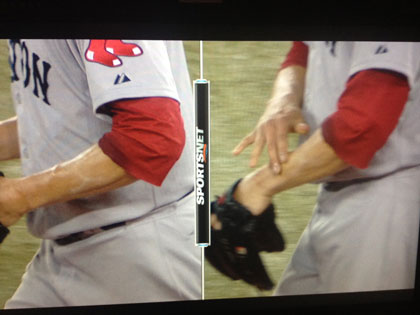
Sportsnet’s Buchholz graphic

It started last week when Dirk Hayhurst—ex-pitcher, sometimes author and current broadcast analyst for the Toronto Blue Jays—unleashed some damning suspicions on Twitter about Boston pitcher Clay Buchholz, who’s currently setting the American League afire with a 6-0 record and 1.01 ERA:

Forget the hair, I just saw video of Buchholz loading the ball with some Eddie Harris worthy slick’em painted up his left forearm. Wow.

It continued when Hayhurst’s colleague, ex-Tigers great and current Blue Jays broadcaster Jack Morris, piled on, telling ESPN Boston that “it was all over his forearm, all over the lower part of his T-shirt, it’s all in his hair,” while in the next breath stipulating that he has no actual proof of impropriety.

It really picked up steam when the video crew at the Rogers’ Centre unleashed some video from Wednesday’s Jays-Sox game, in which the right-hander allowed only two hits to Toronto over seven shutout innings, of Buchholz’s left (non-throwing) arm, glistening with what appears to be something other than sweat. (Hayhurst went on to say that it might be sunscreen mixed with rosin. The Jays’ crew added some talk about Red Sox reliever Junichi Tazawa possibly doing something similar.)

To be expected, Buchholz subsequently denied everything (“Definitely no foreign substances on my arm,” he told MassLive.com), as did Red Sox catcher David Ross (“I know when a pitcher is messing with the ball, he said. “He’s not putting anything on it”).

People came out for Buchholz. Dennis Eckersley told Morris to “zip it,” and Jerry Remy defended him on the air. Cliff Lee discussed his own innocent accumulation of sweat and rosin. Tim Hudson had some fun with the situation.

People came out against Buchholz. Sports Illustrated’s Tom Verducci discussed details about what he feels is a fishy situation, and ESPN’s David Schoenfield compared the break on Buchholz’s pitches to those on offerings nearly 30 years ago from notorious ball scuffer Mike Scott. (He also quoted from The Baseball Codes, so credit to him on that one.)

What does it all mean? Nothing, almost literally. The Blue Jays haven’t accused Buchholz of impropriety. Neither has any other team. Umpires have yet to check him. The accusations are based on TV footage that can be realistically explained any number of ways.

It appears to be a Kenny RogersTony La Russa-type situation. When  the Fox TV crew spotted Rogers with an unusual brown spot on his palm during his start in the 2006 World Series, it became national fodder—especially when video evidence showed the same brown spot during his previous postseason appearances. Instead of having the umpires check Rogers, however (knowing that if they found a foreign substance, he’d be ejected and likely suspended), Cardinals manager La Russa merely asked them to make sure he washed his hands. From The Baseball Codes:

In the face of this World Series controversy, the Gam­bler did the only thing he could reasonably do—he cleaned his hand and continued to pitch well. Fifteen postseason shutout innings with an obvi­ous foreign substance were followed by seven shutout innings without it. Alleged pine tar or no alleged pine tar, the Cardinals, who scratched out only two hits against Rogers in eight innings, fared no better than the Yan­kees or the A’s had in earlier rounds.

The primary question was, why did La Russa not come down harder? A variety of theories surfaced, one of which gained particular traction: Pitchers cheat in Major League Baseball. Not all of them, but enough to touch every clubhouse in some way. La Russa’s own pitcher, Julian Tavarez, had been busted for using pine tar only two seasons earlier, and suspended for 10 days. La Russa called it “an example of bullshit baseball.”

La Russa, the theory held, had kept quiet because he was reluctant to travel this particular road on behalf of his own pitchers, who would undoubtedly come under increased scrutiny. No less an authority than Buchholz accuser Jack Morris weighed in, telling the Detroit Free Press that “Tony’s been through a lot himself, so I don’t think he wanted to push that enve­lope.” (An entire chapter was devoted to this particular situation in The Baseball Codes.)

So even if the Blue Jays did recognize something askew about Buchholz on the mound, they may well have opted (and continue to opt) to keep it to themselves. This could be equally true for every other team in the league, regarding every other pitcher in the league. Rare is the guy like Davey Johnson, who just doesn’t give a crap.

Chances are that Buchholz will dial back whatever it is he’s doing (even if it’s legal, he’ll likely strive to make it less suspicious), and that the entire situation will blow over within the week, assuming he does not get uncharacteristically blown out of his next start.

Which is as it should be. Most folks around the big leagues view cheating as largely acceptable, so long as the cheaters knock it off (at least for a while) once they’re caught. Buchholz’s arm butter, legal or otherwise, is no exception.

Drew Hutchison, Kevin Youkilis, Retaliation

The Professor is In: Youkilis Offers Impromptu Code Lecture at Home Plate for Toronto Rookie

When it comes to the unwritten rules, the primary takeaway from Sunday’s game between the Red Sox and Toronto was not Boston starter Daniel Bard hitting two members of the Blue Jays within the span of three batters, nor Toronto pitcher Drew Hutchison drilling two Boston hitters, ostensibly in response.

Those were noteworthy events, sure, but Toronto’s 5-1 victory anointed a new king of the Code—a guy who not only knows how things are supposed to work and is willing to abide by the rules even when it’s his own hide on the line, but has the presence of mind and the strength of character to give impromptu instruction, on the field, to his opponent.

Ladies and gentlemen, Kevin Youkilis.

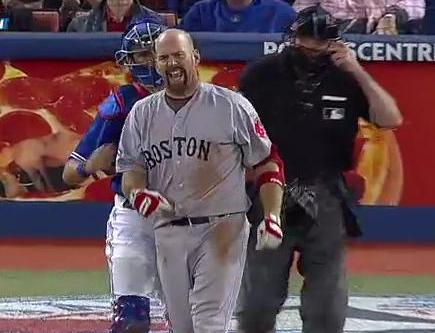
The third baseman was hit high on the shoulder during his sixth-inning at-bat, and if he didn’t know it was coming, he was at least ready for the possibility. Based on his reaction, he took no umbrage with getting drilled, but was irate over the pitch’s location, too near his head.

Youkilis spun toward the mound, pointed toward his hip, and yelled at Hutchison to “keep it down.” He then gathered his batting helmet and made his way to first base. The closest he came to rubbing the spot was when he pointed to it in response to the Boston trainer’s question about where he had been hit. (Watch it here.)

That Hutchison had a mandate to retaliate in the first place was questionable—though well within the boundaries of reason—given that Bard had never been more wild. The first batter he hit, Yunel Escobar, loaded the bases; the second, Edwin Encarnacion, drove in a run. Bard also issued five bases on balls over the course of one-and-two-thirds innings, along with five earned runs on just one hit. He managed to throw all of six fastballs for strikes. The guy was obviously not making any kind of statement short of the fact that he may well prefer working out of the bullpen, but Encarnacion was sufficiently hurt after being hit on the hand to be pulled from the game before his next turn at bat.

Hutchison saw fit to stand up for his mates—an impressive display for a guywho six weeks ago was working in Double-A. Things could have ended after he hit Kelly Shoppach—Boston’s first hitter after the dual drillings in the third. It’s likely that when Encarnacion left the game in the fifth that further action appeared merited to the pitcher.

“I was trying to go away,’’ Hutchison said after the game, denying intent. “I tried to put a little bit extra on it and I just missed. That’s it.’’

Where this all ends up is Daniel Bard. Because Youkilis expected his drilling, he no doubt pins its point of origin squarely on his teammate. Hutchison’s message was on point—Don’t hit our batters, and we won’t hit yours—and Boston heard it loud and clear. Ten more Blue Jays came to the plate after Youkilis was drilled, and they all emerged unscathed.

As if Bard wasn’t feeling enough pressure to perform, he now has this to chew on, as well.