Don't Call out Opponents in the Press

Rays, Red Sox Bring Battle Online

Red Sox-RaysIn June, the Red Sox and Rays got into it when John Lackey drilled Matt Joyce.

Last year they got into it when Franklin Morales drilled Luke Scott (among multiple confrontations during a long Memorial Day weekend).

During the decade spanning 2000 to 2010, they were involved in a series of skirmishes significant enough to merit an entire section in The Baseball Codes.

At least yesterday the hostilities were limited to Twitter.

It started with a blown call—Daniel Nava appeared to score what would have been the tying run on a sacrifice fly with two outs in the eighth, but was called out at the plate by umpire Jerry Meals—a decision that helped Tampa Bay to a 2-1 victory over the Red Sox in Boston. The win pushed the Rays into first place by half a game.

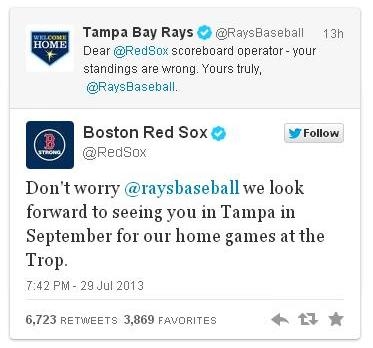
Afterward, the team’s official Twitter feed got into the action.

Rays tweet

Not willing to be outdone, the Red Sox shot right back.

Red Sox tweet

Welcome to retaliation in the digital age.

Update (7-31): Reader RoadDogRuss alerts me that this wasn’t the first digital tweaking between the teams.  (The tweet, of course, refers to this incident.)

(H/T Bleacher Report)

Bat tossing, Rookie Etiquette, Wil Myers

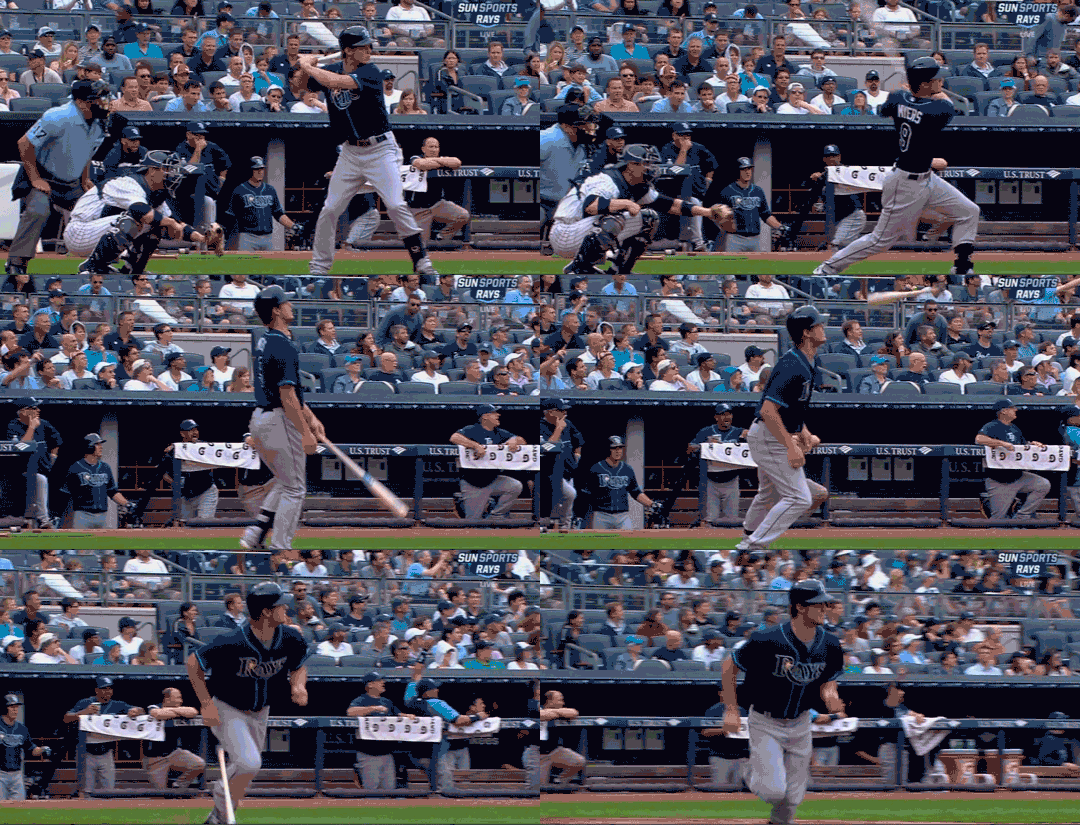
Flipping Out: Myers Makes the Most of His Sixth Career Homer

Myers flip
Click image for GIF.

From The Baseball Codes:

When Phillies rookie Jimmy Rollins flipped his bat after hitting a home run off St. Louis reliever Steve Kline in 2001, the Cardinals pitcher went ballis­tic, screaming as he followed Rollins around the bases. “I called him every name in the book, tried to get him to fight,” said Kline. The pitcher stopped only upon reaching Philadelphia third baseman Scott Rolen, who was moving into the on-deck circle and alleviated the situation by assuring him that members of the Phillies would take care of it internally.

I bring this up because of Wil Myers’ reaction to the first of two home runs he hit Sunday against Yankees starter Phil Hughes. There’s no mistaking the rookie’s bravado, and the fact that he did it against a seven-year vet struggling to find his way in the game certainly didn’t help matters. (It’s also not the first time for him.)

The Yankees opted against making it a public issue, but place Kline’s commentary after Rollins’ blast—which was only the third of his career—within the mainstream:

“That’s fucking Little League shit. If you’re going to flip the bat, I’m going to flip your helmet next time. You’re a rookie, you respect this game for a while. . . . There’s a code. He should know better than that.”

Kline never responded from the mound, because he faced Rollins only five more times over the course of his career, all with the game on the line. The Yankees visit Tampa Bay in late August. The convictions of New York’s pitching staff will be made apparent then.

Myers flip II

Don't Showboat

Today’s Lesson in Minor League Etiquette: Don’t Pimp if You Play for the Twins

Miguel Sano
Miguel Sano

Regardless of how you feel about baseball’s unwritten rules—and there are many who decry the eye-for-an-eye mentality of retaliatory HBPs—it is difficult to quibble with the sentiment at their core: enforcement of respect on a baseball diamond. Respect for one’s opponents. Respect for one’s teammates. Respect for the game.

In this regard, the Twins are proving to be an exemplary organization.

Big league ballclubs tolerate flashy displays by their players all the time, because picking one’s battles becomes an increasingly relevant pursuit when it comes to emotionally fragile superstars who are locked into multiyear deals. This leaves it up to the opposition to settle the score. Hence, the aforementioned retaliatory HBPs.

The period before these players reach multimillionaire status, however, presents a fertile time during which to instill appropriate work habits. Which the Twins appear to be doing.

On Tuesday, for example, Miguel Sano, playing for the team’s Double-A club in New Britain, hit a long home run, then watched it, then settled into a glacial home run trot that saw him take 29 seconds to round the bases. He did it against a Portland pitcher, Bobby Lanigan, who had until only recently been his teammate.

It was not the first time that Sano, the third-ranked overall prospect in the minor leagues according to the St. Paul Pioneer Press, has encountered such trouble. In April, he hit a grand slam while playing for Single-A Fort Meyers, then overtly flipped his bat. Later in the game, the opposing pitcher threw a fastball at his head in response. Sano reacted to that message with more of the same, homering during the at-bat, then pumping his fist and shouting toward his team’s dugout.

It seems that the Twins have seen enough. Sano was pulled from the game following his display against Portland, and has not seen the field since.

“Just a normal player-development decision,” said Twins farm director Brad Steil in the Pioneer Press. “We have discipline for all sorts of things that we do. This is one of them. He’s not going to play for a few games.”

Critics can decry the concept of retaliatory pitches ad nauseum, but if every organization approached things as proactively as the Twins have handled this situation, there would be far less call for them in the first place.

Update (7/28): After four games, he’s back.

(H/T Hardball Talk.)

Hidden Ball Trick

Now You See It, Now You Don’t: On Making Baseballs Disappear

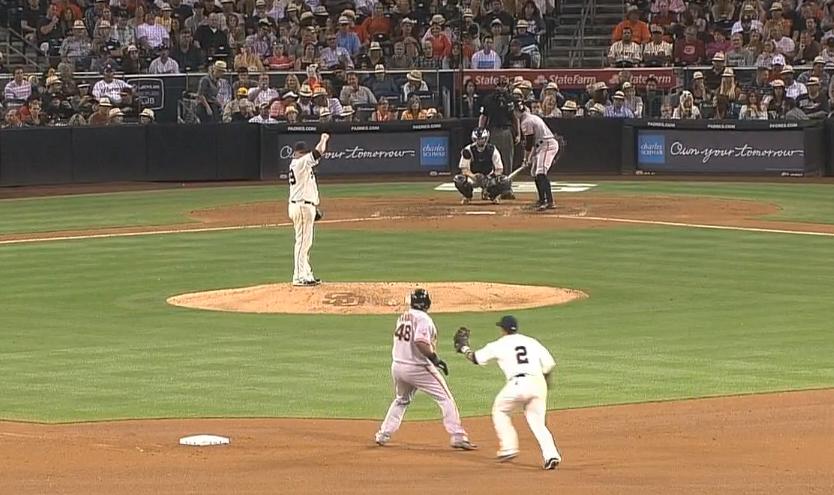
hidden ballTim Lincecum no-hit the Padres on Saturday, but a day earlier the same teams showed us something that might be even more rare.

After Pablo Sandoval doubled with two outs in the top of the fifth, Padres shortstop Evreth Cabrera ended up with the ball, and while nobody was watching, tucked it away in his glove. Sandoval, preparing for the ensuing pitch, took his lead off second—and Cabrera pounced.

Hidden-ball trick!

Cabrera did everything right, catching Sandoval completely unawares. Problem was, second-base ump Laz Diaz had allowed a timeout request, so the ball was not actually in play. Also, because pitcher Sean O’Sullivan was standing on the mound at the time, the play would have been rendered illegal even had time not been called. Sandoval was allowed to remain at second.

Still, one can hardly fault Cabrera for his effort. “I’m trying to do something to get out of the inning, something different,” he said in an MLB.com report.

Said longtime big leaguer Rex Hudler: “The hidden ball trick is not against the unwritten rules. You’re trying to get an out. I never did pull it off in the big leagues, although I wanted to a few times.”

Cabrera’s effort called to mind a similar effort by Philadelphia shortstop Steve Jeltz in 1986. He had the ball, showed it to the nearest infield umpire, and picked the runner, Curt Ford of the St. Louis Cardinals, cleanly off second base. The only problem was that Phillies catcher John Russell, unaware of what was going on across the diamond, requested time out, which plate ump John McSherry granted just as the infielder was racing to apply the tag. Because the ball was no longer in play by the time Jeltz reached Ford, the runner, like Sandoval, was allowed to return to second.

In 1968, umpire Emmitt Ashford inserted himself even more firmly into a would-be play, obliviously calling time—of his own accord, not because anybody requested it—just as Baltimore first baseman Boog Powell was about to catch Yankee Joe Pepitone off the bag. When questioned by the upset Orioles about his motivation, he said, “Boog’s got the ball and he forgot to call time. I’m just trying to be helpful.”

More on the topic from The Baseball Codes:

“A lot of people thought the hidden ball trick was kind of a chickenshit play,” said longtime big leaguer Steve Lyons, “but my feeling always was, Pay attention.” Lyons’s favorite situa­tion in which to utilize the strategy was on tight double plays, when all eyes were on the first-base umpire to see whether he’d call the runner safe or out. Because many first basemen naturally hop off the bag toward the pitcher, said Lyons, “all you have to do is take three more steps, give [the pitcher] a little nod, hang on to the ball, turn around, and come back to first base. Guys get off the base too early all the time.”

Third baseman Matt Williams was one of his era’s foremost practition­ers of the trick, going so far as to induce runners off the base. With the Giants in 1994, Williams pretended to give the ball to pitcher Dave Burba, then returned to his position and asked the runner, Dodgers rookie Rafael Bournigal, if he “could clean the bag off.” The runner gra­ciously stepped aside, which Williams immediately made him regret. “The intent was not to embarrass anybody or to pick on anybody,” he said after pulling the trick against Royals rookie Jed Hansen three years later. “But you want to win, and we needed to win that game.”

At least he got that much out of it. Lyons said that in the minor leagues he once pulled off the play at first base on consecutive days, against the same baserunner, Carlos Martinez. “He was probably pissed off, but the embarrassment when you actually get caught overrules everything,” he said. “You get caught, you’re embarrassed, you start walking back to the dugout. He was big enough to pinch my head off if he wanted to.”

Lyons once hid the ball so well that baserunner Scott Fletcher wasn’t the only one completely snookered—so was the umpire, who called the runner safe on the play. “I got in a pretty good argument over that one,” said Lyons. “I said, ‘Do you think I’m stupid enough to pull the hidden-ball trick, have everybody in the entire ballpark not know that I have the ball, fool every player on both my team and their team, fool the guy who’s on first base, and then tag him before he’s off the bag? Do you think I’m that dumb?’ And what I didn’t realize until that point was that I didn’t really give the umpire a shot to know I had the ball. In fact, I fooled every­body. It’s a little unfair to have him make the right call on that play if he doesn’t know I have the ball, so after that I tried to make sure that they did. It’s pretty hard to try to hide the ball from everybody in the world and still show it to the umpire and say, hey, I’ve got it here, keep your eyes open—but that’s what I tried to do.”
Rookie Hazing, Umpire Relations

Rookie Tossed, Manager Tight, Tradition the Same as it Ever Was

Matheny tossedMike Matheny is apparently not a fan of rookie treatment, at least when it comes to umpires. On Thursday, St. Louis’ first-year first baseman Matt Adams struck out in the ninth inning, on what he considered to be a high, inside pitch. He questioned plate ump Dan Belino, then, on his way back to the dugout, turned around and questioned him again.

Belino shooed him away. The gesture was more than Matheny was willing to tolerate. Once closer Kevin Gregg had sealed the Cubs’ 3-0 victory moments later, Matheny raced toward Belino, to the point of necessitating restraint from the rest of the umpiring crew. (Watch it here.)

His frustration, he told reporters after the game, had less to do with the strike call than “with the umpire and how he mistreated one of our players, Adams.”

“It’s ridiculous,” Matheny said. “You can’t take your mask off and motion somebody away. We had not had any trouble. We hadn’t been complaining all game long. He wanted to be seen, so now he’s going to be seen.”

There is, however, something else at play: If the unwritten rule that labels such a display disrespectful constitutes one side of the coin, the other side is covered by the notion that rookies must earn their place in the game. This is true within clubhouse hierarchies, and it is true when it comes to umpires. Although it is generally less prevalent now than in past generations, umpires throughout the game’s history have taken the position that young players must earn their respect, and will test them accordingly to push the issue.

Last year Bryce Harper felt it with Angel Hernandez’s strike zone. If it was a test, Harper failed, badly.

A similar story comes to us courtesy of Hall of Famer Catfish Hunter. In his autobiography, Catfish: My Life in Baseball, he described a confrontation during his rookie season in 1965:

One of the biggest lessons I learned came courtesy of senior umpire Ed Runge. “You’ll like this guy, Cat,” my teammates told me the first time Runge was behind the plate. “He gives you everything.”

Great. A friend in high places. I fired my first pitch, a fastball, right down the middle.

“Ball,” screamed Runge, yanking off his mask like someone had just yelled “Fire!” He stared out at the mound, begging me to argue. I didn’t say a word.

Another pitch. Another fastball right down Main Street.

“Ball two!”

Same yank. Same look. Still I don’t say boo.

We play the same game a couple of more times—me throwing strikes, Runge playing hard to please—and still I don’t let out a peep. A few weeks later Runge is set to go behind the plate again. Before the game, we happened to meet.

He gives me a quick once-over. “I see you don’t argue with umpires, kid.”

“No, sir,” I said.

A smile. “It’s a good thing.”

From then on I was a card-carrying member of the Ed Runge Club. Anything close was a strike. I’d passed the test.

Credit Matheny for protecting his players, but if Belino was hoping to see from Adams something similar to the deference that Runge got from Hunter, he’s going to have to wait a while.

Homer Bailey, No-Hitter Etiquette

What Jinx? Bailey Throws Into Doubt How Much the Baseball Gods Actually Care About Such Things

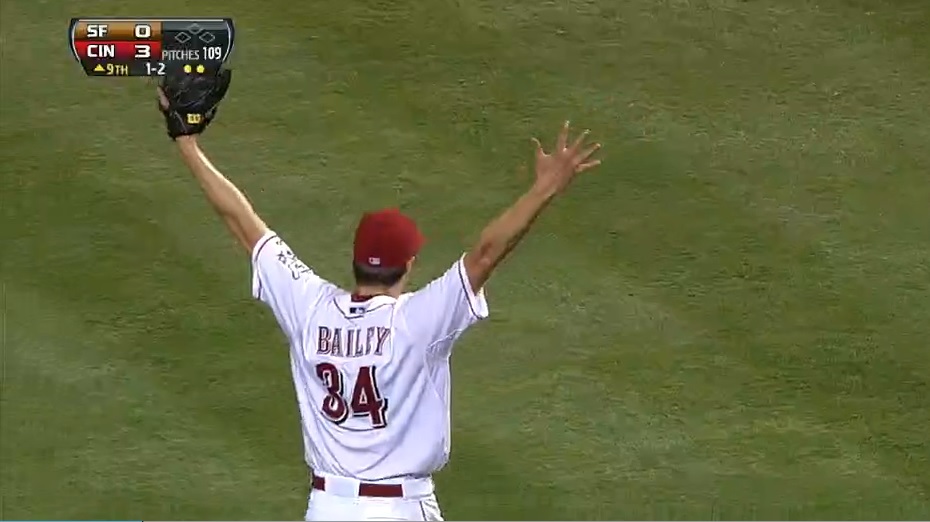
The official Cincinnati Reds Twitter feed mentioned Homer Bailey‘s no-hitter 12 times before he completed it, not to mention a steady stream of references during the telecast by broadcaster Thom Brenneman. It was the second straight no-no in which Bailey was karmically messed with.

Somehow, he completed it, anyway. Go figure.

Bailey nono

Intimidation, Retaliation

Inside the Mind of Miggy – Cabrera Buzzed, then Fanned, then Steams

Cabrera unhappyIt was a classic misdirection. With an 0-2 count on Miguel Cabrera to open the 10th inning on Saturday, Fernando Rodney sent a 100-mph pitch so outside the strike zone that catcher Jose Molina could not get a glove on it. Wildness thus established, he followed it up with a pitch near Cabrera’s head.

In many respects, the pitch was perfectly placed. It tailed in at the last moment, but was easily trackable by the batter and was never in danger of hitting him. Cabrera leaned back to avoid it, but it would not have made contact even had he remained still.

The strategy was also sound. The previous day, Cabrera had homered twice (and didn’t help matters by celebrating that game’s final out by performing what appeared to be an imitation of Rodney’s archer pose, which the closer strikes following saves). Cabrera leads the major leagues in batting average, RBIs and OPS, and is second in home runs. It was without doubt in Rodney’s best interest to make him as uncomfortable at the plate as possible.

And it worked. Cabrera flailed at the next pitch, a down-and-in changeup, for strike three.

Perhaps Cabrera’s displeasure was compounded by the result of his at-bat, but upon reaching the dugout he spent a considerable amount of time gesturing toward, and yelling at, Rodney. (Watch it all here.)

The pitcher was obviously not trying to hit Cabrera during extra innings of a 3-3 game. Even if he was, it is given wisdom that such a strike is far easier to execute when aiming at the torso than at the head, which is a smaller and more maneuverable target. Much more likely was that Rodney wanted to crimp Cabrera’s style—get him out of the dangerous space in which he’s resided all season—and either A) misjudged the height of his inside pitch, or B) didn’t care.

Cabrera didn’t comment afterward, but his manager, Jim Leyland, did.

“I don’t care about throwing inside but I don’t like it up there,” Leyland said in an MLB.com report, referring to Cabrera’s head. “We will not tolerate that. You can take that to the bank. We won’t tolerate that up to the head to anybody. … That will cause a lot of problems for people.”

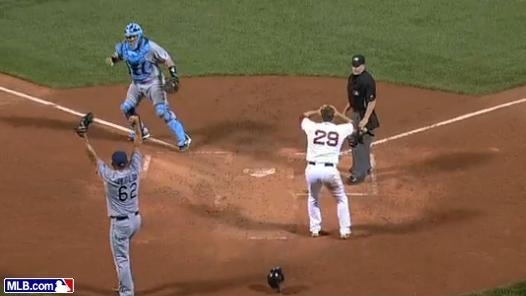
It caused problems for Ben Zobrist on Sunday, when, with two outs and nobody on base in the first inning, Tigers starter Rick Porcello drilled him in the back with a 94-mph fastball. It was intentional and it was expected. Plate ump Vic Carapazza quickly warned both benches.

Cabrera got his own measure of revenge three innings later, when he crushed a homer into the Rays Touch Tank—only the second such blast in the ballpark’s history.

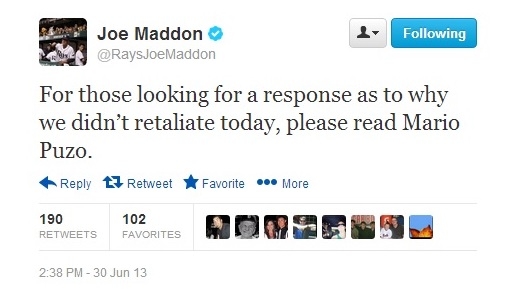
Despite Cabrera being “a little sensitive,” according to Zobrist, the Rays left it at that. Except of course, for the final explanation offered by Maddon for their lack of further response. Via Twitter:

Maddon tweetTo gauge it by the wisdom of the author of The Godfather, the Rays, apparently, will not forget this slight. Considering that they won’t face Detroit until next season (or in the playoffs), however, their memories will have to hold for a while.