Showing Players Up

How To Piss Off A Yankee In Two Easy Steps

Jimenez stomps

Given that the unwritten rules are all about respect, and given that bat flips have now passed from the realm of disrespectful and into “just something ballplayers do” …

… we must look elsewhere to find signs of insouciance on a ballfield vibrant enough to piss fellow players off.

Ladies and gentlemen, we bring you Joe Jimenez, Detroit’s resident fat fucking fuck.

In the eighth inning of last night’s game against the Yankees, Jimenez hit Luke Voit on the hand—a clearly unintentional act during a 1-1 game that nonetheless served to fire up New York’s first baseman. Voit was mad in part because he’s already been drilled in the elbow once this young season. He was mad because, with 10 players on the injured list (including Giancarlo Stanton, Luis Severino, Aaron Hicks, Miguel Andujar, Dellin Betances and CC Sebathia), the Yankees’ roster already resembles a ward at Bellevue Hospital. He was mad because getting hit hurts and hands are easy to break and he didn’t want to become No. 11.

So, okay, Voit took his base and seemed content to serve as his team’s lead run.

Until the next batter, Gleyber Torres, lined one to the mound. Voit was so far off the bag when Jimenez caught it on the fly that the pitcher was able to run it to first base himself to complete the inning-ending double-play … which he emphasized with a two-footed stomp on the bag, the likes of which we ordinarily see at the plate as a winning run scores.

Voit was displeased. Lip-readers on Twitter assure me that in the aftermath he called the pitcher a “fat fucking fuck.”

The point here being that if bat flips and fist pumps are no longer sufficient to annoy anybody this side of Madison Bumgarner (who himself paused in the box after homering against the Dodgers yesterday), players are gonna have to get creative.

Joe Jimenez might not have meant to rile his opponent—it was a big play in a tight game, offering plenty of reason for excitement—but that’s precisely what he did. It’s not the kind of thing that should get anybody drilled, even by the most red-assed Yankee, but it’ll certainly be remembered the next time these teams face each other … which, wouldn’t you know it, is this very afternoon.
Retaliation

Timing Matters When It Comes To HBPs, As The Guy Hitting After Bryce Harper Can Attest

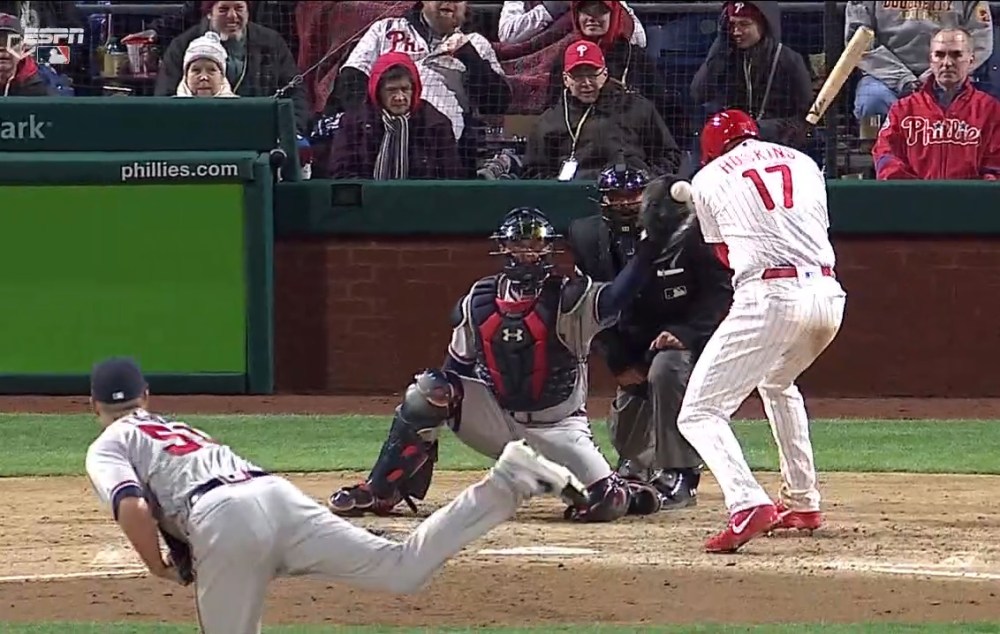
Hoskins drilled

Baseballs slip from pitchers’ hands all the time, inadvertently contacting batters as a matter of accident. When it’s cold and windy and grip is poor, this is especially true. It was certainly true Sunday night in Philadelphia, as the Phillies and Braves combined for 15 walks and three hit batters.

When the timing of one of those hit batters is questionable, however, every mitigating factor flies out the window. Which is why the Phillies were so angry at Braves reliever Shane Carle.

When Carle drilled Rhys Hoskins in the seventh inning, it followed a Bryce Harper and subsequent celebration with his teammates just outside the dugout. It might have been that Harper’s homer put the Braves into a 4-1 hole after they’d already lost the first two games of the series while giving up 18 runs. Nobody could blame them for frustration.

The other source of Philadelphia’s ire was that the pitch came in nearly head-high, eventually striking Hoskins on the shoulder.

The rest is details.

Never mind that Harper and Phillies starter Jake Arietta said that they didn’t think it was intentional, sentiments echoed by Braves manager Brian Snitcher and catcher Brian McCann. Carle had drilled Philadelphia’s cleanup guy right after being taken deep.

Hoskins got up yelling, clearly furious. It was the third time in two games against Atlanta that pitches had come close or actually hit him. Plate ump Rob Drake agreed, ejecting Carle.

After the game, Phillies manager Gabe Kapler unloaded.

“It really pisses me off when balls go underneath Rhys Hoskins’ chin,” he told the media, referencing the fact that Hoskins wears a C-flap on his helmet after having his jaw broken by a fouled bunt attempt last season. “It really bugs me. … He’s one of our leaders. He is, in many ways, the heartbeat of our club. It really bothers me when it happens.”

This matters less in a one-game sample than it does when considering that these teams—each of them hoping for full resurgence after long fallow periods—play each other 16 more times this season. Should Braves pitchers take liberties with the inside corner against Philadelphia, even without trying to hit anyone, they have to know that they’re playing with fire. The same can likely be said for members of the Phillies staff.

Here’s hoping that nothing comes of it, but boy it’s gonna be fun to watch.

They Bled Blue

They Bled Blue Gaining Momentum

LA TimesSo the Los Angeles Times brought up They Bled Blue in a compendium of new and upcoming baseball books. None of the nine books mentioned got more than a couple paragraphs, but the crux of the TBB section was this:

“Turbow admits ‘it might not benefit my credibility as the author of this book to admit that I am a lifelong Giants partisan, but it’s true.’ Which explains why the first line from the first chapter reads: ‘Tommy Lasorda was always a shill.’ ”

Please. The former sentiment (from the acknowledgements section, after the story had wrapped up) has nothing to do with the latter. This isn’t some fan blog. Authentic reporting is essential to doing my job well. Jerry Reuss’ comment on the book—”Hands down the most accurate portrayal of events and personalities of the 1981 Dodgers that I’ve seen”—supports the point.

Never mind that the quote about Lasorda makes it sound like I’m slagging the guy. In fact, the opposite is true. Here’s the entire paragraph from which the sentence was culled:

“Tommy Lasorda was always a shill. Long before he became a fount of managerial enthusiasm and brand fealty, he was a shill. Back when he was a career minor league pitcher, and then a scout, and then off to manage in remote minor league outposts like Pocatello and Ogden, in the employ of the Dodgers nearly every step of the way, even then he was a shill. The guy loved his team and wasn’t shy about letting the world know it.”

The point was that Lasorda never stopped promoting the Dodgers, for virtuous reasons. That was the first paragraph of the book’s first chapter, the rest of which builds on supporting that thesis.

Book reviews aren’t easy, and it’s not fair to expect a reporter to give cover-to-cover treatment to all nine books in a column. I just want to make sure that Dodgers fans out there know they’re getting an even shake from me. This was a team worth reading about.