For those decrying baseball’s unwritten rules in the wake of last week’s debacle over bunting in Baltimore comes a pleasant measure of where such things actually sit in the modern game. Before going into it, allow me, please, to paint a picture.
The hypothetical year is 1965. Bob Gibson has just given up a home run to Frank Robinson, and is stunned when, after crossing the plate, Robinson turns toward the St. Louis dugout and whistles in delight. Such a display of arrogance and disrespect is all but foreign to a major league ballfield, let alone Gibson’s ballfield.
There’s no way that Robinson avoids Gibson’s fastball in an ensuing at-bat.
Sure, Bob Gibson was one of the most intimidating pitchers ever to play the game, so maybe he’s not a great example. It could have been Mike Caldwell in 1982, or Preacher Roe in 1952, or Wes Ferrell in 1930—three guys picked more or less at random, who combined to pitch 812 innings in the years in question without hitting a single batter. Even then the hitter in question, should he have whistled in such a manner, would have invariably been knocked down, or drilled later by one of the pitcher’s teammates.
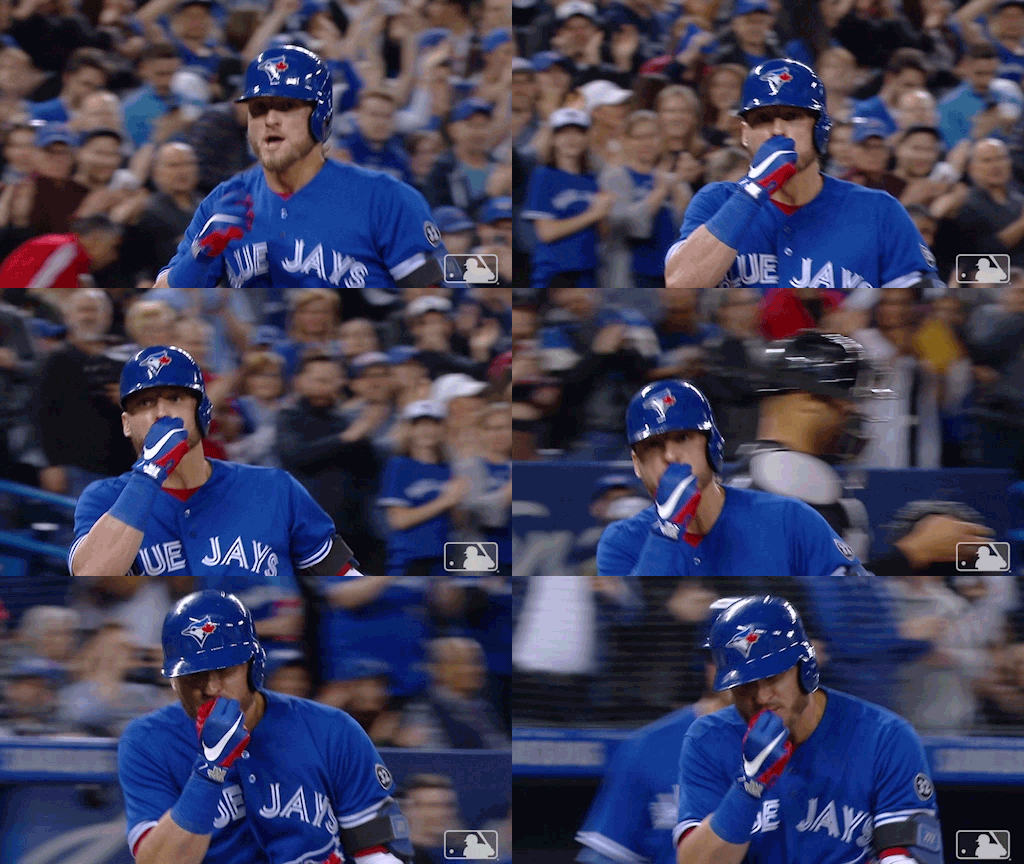
Why is this noteworthy? On April 2, Toronto’s Josh Donaldson played the role of Frank Robinson against the White Sox, homering against Reynaldo Lopez, then miming a whistle at the Chicago dugout while hopping back to his dugout. The most noteworthy part about it: The White Sox didn’t care.
There is, of course, some backstory.
White Sox first base coach Daryl Boston has for several years used an actual whistle to get the attention of his outfielders when he wants to reposition them from the dugout. He also toots it to celebrate good plays, behavior that has not gone unnoticed around the league. Before the game, Donaldson was talking to White Sox hitting coaches Todd Steverson and Greg Sparks, for whom he played in the A’s system, and mentioned that he’s not a particular fan of Boston’s whistle.
Of course, this information was relayed to the coach, and of course the coach responded via whistle—“a little peep-peep” is how Boston put it in a SportsNet report—at Donaldson when he stepped into the on-deck circle during the game.
So, after homering, Donaldson felt free to do what he did. And Boston loved it.
“I got a kick out it because I didn’t find it disrespectful at all,” the coach said. “The downside of it is I may have got caught on video laughing after us giving up a home run. That’s the one thing I felt bad about. But other than that, it’s all in fun.”
The following day, Donaldson used Too$hort’s “Blow the Whistle” as his walk-up song.
All in fun, indeed. There is still a place for players who hew to the serious business of respecting each other, but there are moments in the modern game like never before, when one can cut loose and simply have fun without fear of thin skin or repercussions. The Puerto Rico team showed us that implicitly in last year’s World Baseball Classic, and MLB appears to be following right along, to varying degrees.
Look no farther than Donaldson for evidence. “The whole time I was [blowing the whistle] to [Boston] he had the biggest smile on his face,” he said. “It was good and I’m glad—you always hear about these unwritten rules of baseball and all that jazz—well, I think you’re starting to see some of that change in a positive manner. Not to where I’m trying to disrespect them or they’re trying to disrespect me. We’re out there having fun and competing against each other.”
If there’s an actual quibble here, it’s with Boston, not Donaldson. Various members of the Kansas City Royals have already taken issue with his whistle practice, and it’s not beyond the pale to think that other opponents might also consider celebratory whistling to be juvenile and rude. Even in the modern embrace-the-celebration landscape, a coach with a whistle does seem a bit odd. Mostly, though, it serves to recall a story from The Baseball Codes, concerning the ability of former New York Yankees pitcher Bob Turley to quickly decipher an opposing catcher’s signs while stationed in the first-base coach’s box:
Turley’s relay system was simple—he’d whistle whenever a pitch was different from the last one. Hitters would start every at-bat looking for a curveball, and if a fastball was coming, so was Turley’s whistle. He’d then stay silent until something else was called. The pitcher was so good that when he went on the disabled list in 1961, manager Ralph Houk wouldn’t let him go home, instead keeping him with the team to decipher pitches. (Roger Maris, in fact, hit his sixty-first home run of 1961 on a pitch he knew was coming because third-base coach Frank Crosetti, doing his best Turley imitation after watching the pitcher for years, whistled in advance of a fastball.)
Eventually, people began to catch on. Among them was Detroit Tigers ace Jim Bunning, who grew increasingly angry as Turley whistled and the Yankees teed off during one of his starts. Finally, with Mickey Mantle at bat, Bunning turned to Turley in the first-base coach’s box and told him that another whistle would result in a potentially painful consequence for the hitter. Sure enough, Turley whistled on Bunning’s first pitch, a fastball at which Mantle declined to swing. With his second offering, Bunning knocked Mantle down. The on-deck hitter, Yogi Berra, could only watch in horror. When it was his turn to bat, Berra turned toward the mound, cupped his hands around his mouth, and shouted, “Jim, he’s whistling, but I ain’t listening.”


 Tyler Austin should have known better.