Swinging 3-0, The Baseball Codes

Wayback Machine: Dealing With Code Violations in a Bygone Era

Darrel ThomasIn researching a project unrelated to baseball’s unwritten rules, I came across an item that was too good to not share.

May 25, 1979: In the sixth inning of a game against the Reds, Dodgers second baseman Davey Lopes drilled a three-run homer. Trouble was, the Dodgers led by 12 runs at the time, and he swung at a 3-0 pitch to hit it. The blast gave Los Angeles a 17-2 lead.

This, of course, was a clear violation of the unwritten rules. From The Baseball Codes:

The last thing a pitcher wants to do with his team down by a wide margin late in the game is walk batters, which not only suggests unnecessary nibbling but extends a game that players want to end quickly. When a count gets to 3-0 … it’s a near-certainty that the ensuing pitch will be a fastball down the middle. The unwritten rulebook does not equivocate at this moment, prohibit­ing hitters in such situations not just from swinging hard, but from swing­ing at all.

There’s also the factor of rubbing it in while running up the score. In the modern game, of course, such actions are no longer universally seen as an unequivocal sign of disrespect. Baseball is entertainment, the thinking goes, and nothing is more entertaining than a well-struck ball. The rule still exists, but more players than ever opt out of recognizing it.

In 1979, however, such was not the case. Two innings after Lopes’ homer, Cincinnati reliever Dave Tomlin fed him four straight inside pitches. None of them connected, but after the fourth, Lopes, irate, threw his bat into the air and hollered toward the mound.

It was enough to draw players from both dugouts, even as Lopes angrily stalked toward first base. No fight appeared forthcoming until Dodgers utilityman Derrel Thomas—a perpetual wild card when it came to baseball propriety—decided to take a swing at Cincinnati’s Rick Auerbach, spurring numerous scuffles. This, far more than Lopes’ action, spurred the Reds to action.

Before the next day’s game, Cincinnati players decided to draw names of the Dodgers out of a hat, representing their assignments in the eventuality of another fight.

Every slip of paper said the same thing: Derrel Thomas.

(Thomas started the following day in center field, without incident.)


The Baseball Codes, Unwritten-Rules

Partly Cloudy with a Chance of Bluster: The Unwritten Rules Debate Rages On

Talk

Man, those Bryce Harper comments have stirred things up something fierce. Over the last week, Baseball’s unwritten rules have become downright Trumpian—people are either for or against them, always with passion and frequently for reasons they don’t seem to fully understand.

Take a pair of newspaper accounts, both out of Texas, as a representative sample.

In the Fort Worth Star-Telegram, writer Mac Engel argued that minority representation has fueled baseball’s recent surge in emotional displays, and that instead of trying to corral the new wave, the sport needs to better embrace it. To further his point, he wrote, “The code needs to be less white.”

In the San Antonio Express-News, Roy Bragg countered that celebrations should be left to other sports, and pitchers controlling behavior via “a fastball in the ear” is a tenable solution for countering excessive displays.

The arguments run directly counter to each other, but they have something important in common: They’re both ludicrous.

Culturally speaking, Engel is correct. An all-time high percentage of players from Latin America, 29.3, were on opening day rosters last year, and their presence—fueled by the less-strict atmosphere in which they learned the game—has substantially impacted MLB mores.

Less conclusive to his point is that the runner-up season for Latin representation was 2005 (29.2 percent), during which time there was comparatively little uproar over a player’s right to flip his bat.

The argument would work better had Engel claimed that baseball needs to be less North American, but to demarcate it along racial lines is to dilute the point. Back in the Code’s heyday, its most prominent practitioner was Bob Gibson. Two decades later, Pedro Martinez was as close to Gibson’s attitudinal heir as baseball had. Neither, of course, was white. (Meanwhile, one of Engel’s own examples of a guy who deserves emulation in this regard is Rangers pitcher Derek Holland, perhaps the whitest man in the league.)

On the other side of the ledger, Bragg’s point that celebrations should be limited to games of merit—say, playoff victories versus midweek contests in April—is worthy of discussion, but entirely lost amid bluster like this: “Let the young players act out. That next fastball will say everything that needs to be said.”

Neither writer seems to fully accepting the fact that baseball grows organically, and that values shift over time. Accrediting on-field celebrations as non-white activity shortchanges a shift in perception among a mainstream that is primarily white. On Bragg’s part, to threaten physical harm against those who resist is about the most backward argument one can make in the modern game. Both are polarizing statements, for utterly different reason.

Times are changing, fellas, just like they always have. Engel’s arguement that we should let the games be more fun would be a lot easier to carry out if people didn’t try to rationalize things so damn hard.

Bryce Harper, New York Yankees, San Francisco Giants, The Baseball Codes, Unwritten-Rules, Washington Nationals

Bryce Harper and Sergio Romo: Secretly Simpatico?

Keep calm

For a while, it seemed like yesterday would belong to Bryce Harper’s views about baseball’s unwritten rules.

Then Goose Gossage opened his mouth. In what appears to be coincidental timing, the Hall of Fame reliever unloaded to ESPN about noted bat-flipper Jose Bautista being “a fucking disgrace to the game,” among other choice sentiments that ran directly counter to Harper. Gossage, of course, is his generation’s It-Was-Better-When-I-Played standard-bearer, the guy to turn to for strident opinions.

His comments came in response to a benign question about new Yankees reliever Aroldis Chapman, and quickly veered not only to slamming Bautista, but to complaints about how “fucking nerds” who “don’t know shit” are ruining the game from front-office positions, that “fucking steroid user” Ryan Braun gets ovations in Milwaukee, and that modern relievers are too focused on pitch counts and not enough on the game itself.

Gossage, a world-class griper, was simply doing what he does best.

He would have been easier to dismiss had not Giants reliever Sergio Romo—one of the game’s free spirits, a guy loose enough to rock this t-shirt at the Giants’ 2012 victory parade—himself dismissed Harper later in the day.

“Don’t put your foot in your mouth when you’re the face of the game and you just won the MVP,” Romo said about Harper in a San Jose Mercury News report. “I’m sorry, but just shut up.”

In response to Harper’s comment that baseball “is a tired sport, because you can’t express yourself,” the reliever offered a succinct takedown.

“I’m pretty sure if someone has enough money,” he responded, “he can find another job if this is really tired.”

Thing is, Romo and Harper actually seem to agree about most of what they said. Romo is himself demonstrative on the mound, showing more emotion while pitching than perhaps anybody in Giants history. He took care to note, however, the difference between excitement and impudence.

“As emotional and as fiery as I am, I do my best not to look to the other dugout,” he said. “I look to the ground, I look to my dugout, to the sky, to the stands. It’s warranted to be excited. But there is a way to go about it to not show disrespect, not only to the other team but the game itself.”

With those four sentences, Romo cut to the heart of the issue. Contrary to those trying to position this as a cross-coast battle of wills, Harper did not say much to contradict that sentiment.

Baseball’s unwritten rules have changed markedly over the last decade. There is more acceptance of showmanship now than at any point in the sport’s history, and scattershot blasts from the likes of Goose Gossage will not slow that momentum. Because the Code has changed, however, does not mean that it is failing.

The real power of the unwritten rules lies in the maintenance of respect—between teams, within clubhouses and, as Romo went out of his way to note, for the game itself. This core value has not eroded at all.

What has changed over time is ballplayers’ ability to distinguish displays of emotion from displays of disrespect. When the mainstream decides  that bat flips are an acceptable form of self-expression, they no longer have the power to offend.

The reason this hasn’t already gained universal acceptance is that not all bat flips (used here as a proxy for any number of emotional displays) are equal. Bautista’s display during last season’s playoffs was magnificent. Some bats are flipped, however, not with celebration in mind, but in an effort to denigrate the opposition. It might, as Romo noted, include a staredown of the pitcher (as Harper himself has been known to do). It might be some extra lingering around the box, or a glacial trot around the bases. At that point, the method of the opposition’s response—which includes the option of not responding at all—becomes a valid concern.

Romo talked about this distinction, and its importance to the game. Surprisingly, so did Harper.

The MVP noted that Jose Fernandez “will strike you out and stare you down into the dugout and pump his fist.” Because Harper doesn’t take it as a sign of disrespect, Harper doesn’t care. And if Fernandez does not intend it as such, nobody else should, either. (Worth noting is that Fernandez learned an important lesson in this regard early in his career.)

The main fault with Romo’s diatribe was that he inadvertently piggybacked it atop Gossage’s inane old-man ramblings. Still, he lent some nuance to a discourse which sorely needs it, and perhaps inadvertently pointed out that he and Harper have more in common than either of them might otherwise believe.

Ultimately, the question seems to be less “Can’t we all just get along?” than “Why haven’t we figured out that we’re getting along already?”

Passing Rules Down, Rookie Etiquette, The Baseball Codes

Archer Sets Tone in Rays Camp

Those who thought that the Chris Archer’s outstanding 2015 season—in which he made the All-Star team and finished fifth in the American League Cy Young voting—might be taken as an excuse to ease off the gas pedal are sorely mistaken.

On the very first day of workouts in Port Charlotte, Fla., Archer pulled aside two young pitchers, Jacob Faria and Blake Snell, for showing up late to a team meeting. How late were they? It was 8:28 a.m. The meeting started at 9.

For Archer, it was all about tone.

“You guys are the last two pitchers here,” he scolded in front of reporters, according to a Tampa Bay Times report. “You guys have zero service time. You got no right to be coming in after me, really. I get here super early. I wouldn’t expect you to be here at 6:30, but 8:30?”

With that gesture, Archer provided a baseline expectation about accountability—an especially important measure considering the youth of Tampa Bay’s staff. This is the basis for winning clubhouse atmospheres.

Dusty Baker tells a story about showing up one minute late to the hotel lobby during his rookie season, to catch a ride to the ballpark with some teammates. It was 4:01 p.m., and he had been in his room, catching the end of Gunsmoke on TV. The group he was to meet waited for him to arrive, and as soon as he saw them sped off. “I had to run behind the truck all the way to the ballpark,” Baker said. Lesson learned. The incident helped to inform an approach to the game that he carries with him to this day.

“What you learn in this game is not yours to pos­sess, but yours to pass on,” Baker said in The Baseball Codes. “I believe that, whether it’s equipment, knowledge, or philosophy, that’s the only way the game shall carry on. I believe that you have to talk, communicate, and pass on what was given to you. You can’t harbor it. You can’t run off to the woods and keep it for yourself, because it isn’t yours to keep. And what you teach other guys is the torch you pass. I don’t make this up—it was passed to me.”

Archer seems to be right on board. “I remember being in some of these younger guys’ shoes,” he said in the Rays spring training clubhouse last week. “Hopefully I can have the same impact that James Shields and D.P. [David Price] had on me.”

If his recent actions are any indication, the Rays are in good shape in that regard.

The Baseball Codes

Spring is for Lovers: David Price rolls in to Red Sox Camp

The Red Sox have a storied history of hating the Rays, and vice versa. We know this by now. How we know that much of it isn’t personal, however—that it’s pretty much been a loathing of laundry—is when a member of one team joins the other.

Welcome, David Price, to the welcoming arms of the Fens.


A couple of years ago saw a different tenor. During the 2013 ALCS, David Ortiz homered twice against Price, and failed to run the second one out to the pitcher’s satisfaction. (Had Price paid any attention to Ortiz’s career, he would know that, too, was not personal.) Price responded the following May with a fastball spree against Boston, drilling Ortiz as the opening salvo of what became an increasingly contentious game.

Afterward, Ortiz referred to his rivalry with Price as “a war.”

“It’s on,” he said in a Tampa Bay Times report. “This guy that hit me better bring the gloves on. I have no respect for him no more.”

Oh, how things change. In December, Boston signed Price to a seven-year deal worth $217 million. Turns out that money goes a long way toward letting bygones be bygones. “I needed that,” Price said of his welcome, in an ESPN.com report.

There is copious precedent for this type of thing. In but one example, in 1976, Cubs third baseman Bill Madlock responded to a knockdown pitch from Giants starter Jim Barr (who hadn’t even knocked down Madlock, but the preceding hitter, Jose Cardenal) by letting go his bat on a follow-through, and sending it flying toward the mound.

Barr, among the game’s most noteworthy red-asses, drilled Madlock almost immediately.

Matthews-Mitterwald
Via the Chicago Tribune.

The hitter, furious, ended up reaching over plate umpire Paul Runge to punch at the pitcher, setting off a 20-minute melee highlighted by Gary Matthews’ blind-side attack on George Mitterwald, which bloodied the Chicago utilityman’s nose and cut his cheek. After the game, a posse of Cubs, led by outfielder Champ Summers, waited in the clubhouse runway for Matthews. A full-scale riot was averted only by an alert Wrigley Field security detail.

Nine months later, Madlock was traded to the Giants. He precluded potential tension shortly after the deal by proclaiming that he was looking forward to becoming friends with Barr. It was enough to soften the pitcher, who welcomed him warmly to spring training.

“[Madlock] came over to me and said, ‘We friends now?’ ” said Barr. “I said, ‘You bet.’ There was no animosity after that. We were friends for the three years that he played for us.”

Hopefully things work out as well for Price and Ortiz.

The Baseball Codes

Jinx This: Gift of Gab No Match For the Power of a No-No

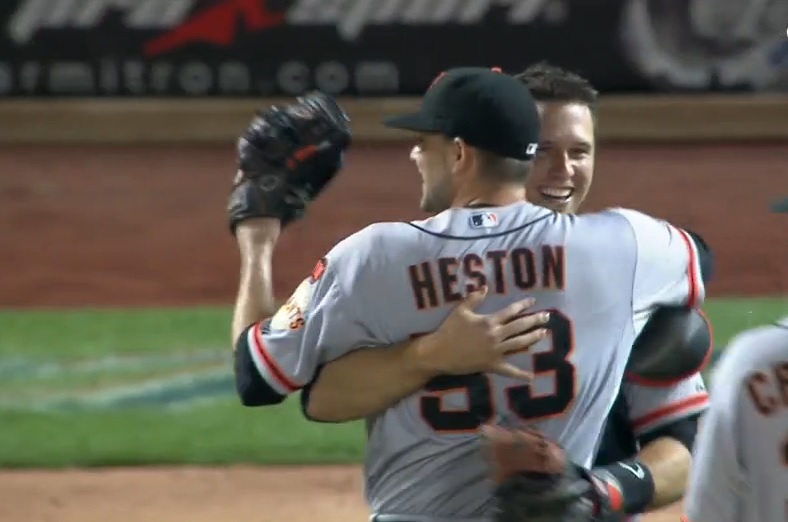
Heston no-no

In the supremely superstitious sport of baseball, nowhere is superstition more prevalent than in the midst of a no-hitter. The inner sanctum of said superstition involves never talking to the pitcher doing the deed. Don’t sit near him. Don’t acknowledge him in any way. Steer the hell clear.

This is how Giants third baseman Matt Duffy came to be so freaked out in the top of the ninth inning when he was approached from behind in the Giants dugout. The approacher: Chris Heston, moments away from sealing his no-hitter against the Mets. (Watch the final pitch here.)

In the eighth, Heston lost track of the outs—he thought there were two, but there was only one—and was doubled off of second base on Nori Aoki’s fly ball. It wiped a run off the board, as Duffy would have otherwise been able to tag up from third. This is how he came to approach Duffy in the dugout, to apologize for his unnecessarily reduced stat line.

“After the sixth, I didn’t want to go anywhere within five feet of him,” Duffy said in a San Jose Mercury News report. “We were in the dugout right before the ninth and he said, ‘Hey man, I’m sorry about that.’ I said, ‘Dude, uh, don’t worry about it. Don’t focus on that. It’s fine.’

“I was like, ‘Go talk to Nori.’ ”

Whether he talked to Nori was unclear. The move, however, proved jinx-proof.

Don't Play Aggressively with a Big Lead, The Baseball Codes

The Air is Hot, Smart or Not, Deep in the Heart of Texas

Lewis shoutsSo this is what the ruination of baseball’s unwritten rules looks like. People keep marginalizing them, shunting them to the corner, labeling those who play by their merits as kooks and haters of fun. What we’re left with, at least in part, is this: Ballplayers, both red-assed and traditionalist, playing less by moral imperative than by half-formed opinions based on a system they don’t appear to fully understand.

Case in point: Rangers starter Colby Lewis, who on Saturday lit into Toronto’s Colby Rasmus (in the rare and wondrous Battle of the Colbys) for daring to lay down a bunt late in the game while the Blue Jays sat on a huge lead.

Except that it was only the fifth inning. And the score was 2-0. Oh, Colby Lewis.

The section of the unwritten rulebook that Lewis was attempting to channel was the one that dictates avoidance of running up the score late in games. It’s a simple matter of respecting one’s opponent enough to keep from embarrassing him … but that doesn’t have much relevance to whatever happened in Toronto. Just as Astros manager Bo Porter was ludicrous when he exploded over a first-inning Jed Lowrie bunt back in April, Lewis is ludicrous now.

Rasmus bunted because—here’s the pertinent part—his run mattered. Lewis was upset that Rasmus had taken advantage of a defensive shift designed to stop him from hitting. Now that such shifts are gaining traction even as the Code is losing it, we’re faced with an awkward intersection: Is there a moral component to playing straight-up against the shift with the fact that it presents an obvious weakness (nobody playing down the third base line) to exploit? The closest example I can conjure is the first baseman who plays off the bag despite a runner being on base late in a blowout game, with the expectation that the runner will hold anyway. He wants the defensive advantage of playing in the hole, and expects that his opposition will not take similar advantages of their own.

But those who think that situation is reasonable do so because of the lopsided score. In a close game, if a defense wants to gain the advantage of an extra defender on the right side of the infield, it has no business taking exception should a batter exploit that weakness. Which is not only what Rasmus did, but which is what every hitter with speed should do, at least on occasion.

Lewis had words for Rasmus on the field (watch it here) and after the game explained just what was going on. “I told [Rasmus] I didn’t appreciate it,” Lewis said in an MLB.com report. “You’re up by two runs with two outs and you lay down a bunt. I don’t think that’s the way the game should be played. I felt like you have a situation where there is two outs, you’re up two runs, you have gotten a hit earlier in the game off me, we are playing the shift, and he laid down a bunt basically simply for average.”

Lewis’ criteria for judgment was that once Rasmus reached base, he didn’t try to steal and get himself into scoring position. “That tells me he is solely looking out for himself, and looking out for batting average, and I didn’t appreciate it,” he said, digging himself into a dangerous rabbit hole of inanity. Left unexplained: If in Lewis’ mind the game situation dictated that Rasmus wasn’t allowed to bunt, the question isn’t whether the pitcher’s head would have exploded had Rasums stolen a base, but how violently.

Hell, Curt Schilling didn’t take offense when Ben Davis bunted against him to ruin his perfect game in 2001. That’s because, like the game in Toronto, the score was 2-0 and a baserunner could have made a difference.

Or one could look in another direction: When Jarrod Saltalamacchia bunted to break up a perfect game against Oakland’s A.J. Griffin in 2012, he was barely faulted for it by Oakland manager Bob Melvin, not because the score was close but because Melvin had put on a shift similar to the one Texas used on Saturday. “I probably should have had the third baseman in,” said Melvin at the time.

Ultimately it’s up to players to recognize what is and isn’t appropriate, and to be damn sure they’ve been aggrieved should they get their jocks in a bunch over a given play. The Code is a powerful part of baseball’s social fabric, but only when it’s leveraged properly. Because the facts of the matter don’t back him up, all Colby Lewis is left with is a bunch of hot, angry air.

Jonathan Sanchez, Retaliation, The Baseball Codes, Umpire Warnings, Umpires Knowing the Code

Toss Him Out! Let Him Play! The Importance of Understanding that not Every Situation is Exactly the Same

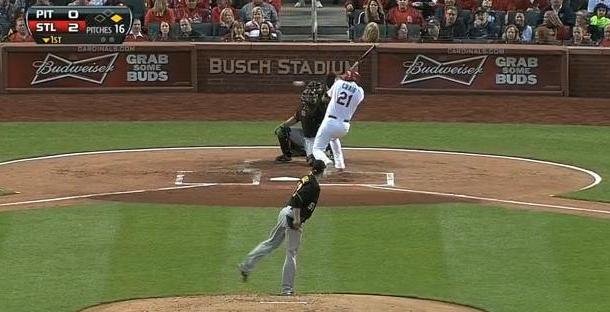
rsz_jonathan_sanchez (1)Jonathan Sanchez insists that the fastball he threw Friday—which nearly hit Cardinals first baseman Allen Craig in the head—was accidental. Sanchez was pitching inside, he said, quoting verbatim from the unofficial handbook of pitcher denials. The ball rose, he said. That was all.

Of course, given the pitcher’s recent struggles, not to mention his history with hot-headedness, questions abound. MLB certainly thought so, suspending him for six games on Saturday.

Sanchez opened Friday’s game against St. Louis by giving up back-to-back home runs to Matt Carpenter and Carlos Beltran, followed by a single by Matt Holliday. Sanchez sent his next pitch—apparently out of frustration—toward Craig’s head. (The ball ended up connecting with the spinning hitter’s shoulder.) Plate ump Tim Timmons didn’t hesitate, ejecting Sanchez without so much as a warning.

It was an abhorrent string of hitters in an abhorrent season of starts for Sanchez, who has thrown a total of only 11.3 innings over four outings, with a 12.71 ERA. Twenty-one hits and eight walks. He’s made it to the fifth inning only once. Well, of course he’s frustrated.

“You’ve got two home runs, and then you’ve got a line-drive single up the middle, and then the very first pitch is up around the shoulder and head area,” Timmons told a pool reporter at Busch Stadium. “He threw intentionally at him, and in that area I deemed that intentional, and he’s done. Very dangerous.”

“It surprised me,” Sanchez said in a Pittsburgh Tribune-Review report. “(Timmons) said it was obvious I wanted to hit him. I said no, I just missed my spot.”

Pirates manager Clint Hurdle was outraged at the quick hook, arguing vociferously enough to get tossed himself. After the game he said he was bringing his complaints to the commissioner’s office, although Sanchez’s ensuing suspension gave a pretty good indication about how much attention the commissioner was paying.

Any umpire who feels that a pitcher is intentionally head-hunting is justified in leveling ejections, with or without prior warnings. Timmons earned extra credit by keeping quiet after Cardinals pitcher Lance Lynn later hit Pirates outfielder Starling Marte not once but twice—each almost certainly incidental—even after warnings were issued. (One barely clipped Marte’s hand, the other sailed into his arm, just off the plate; the hitter barely tried to avoid either one.)

Lynn himself was brushed back by Pittsburgh reliever Jared Hughes in the eighth, avoiding a pitch that, because he was squatting while squared to bunt, came in head-high. Lynn ducked backward out of the way, ending up on his back in the batter’s box. Again, Timmons let it slide.

In the eighth, Cardinals pitcher Mitchell Boggs drilled Gaby Sanchez in the back. (This, too, may have been unintentional, given Boggs’s recent struggles and the fact that all three hitters he faced reached base.)

Watch a compendium of the action here. (In an unrelated Code note, watch Pirates catcher Russell Martin jump to get between batter and pitcher in the first clip, as A.J. Ellis wishes he had recently done.)

One takeaway from all this is that an umpire on top of his game can go a long way toward stemming future disturbances. Timmons and MLB seem to agree upon that even one head-hunting incident is too many, and there’s no better way to tamp down the practice than by making examples of pitchers who stray from the proscribed course.

By letting the rest of the game play out as it did—even what appeared to be an obvious message from Hughes to Lynn—Timmons further defused lingering resentment between the clubs. Neither of the weekend games between the team featured much of anything resembling Code-based drama, even with the ample opportunities presented by Pittsburgh’s 9-0 blowout on Sunday.

Ultimately, the situation appears to have been handled just right. The power of positive umpiring. 

The Baseball Codes

Weirdness at Wrigley: DeJesus hit by Pitch from Own Teammate

Pissing off an opponent badly enough to get drilled is one thing. When it’s your own team throwing baseballs at you, though, watch out.

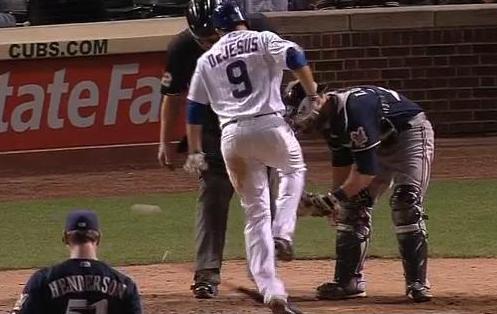
So says David DeJesus, who, barely a moment after watching ball four from Brewers pitcher Jim Henderson on Monday night, was plunked by a ball that got loose from the Cubs bullpen.

At this point, further details are extraneous. Just watch the video.

(Via Yahoo.)