Excerpts

The Week Devotes Space to the Codes

The Week magazine offers up our first excerpt this week, cobbling together assorted passages from the Cheating section of The Baseball Codes in an extensive “Last Word” column.

The editors pegged the piece as a “fresh perspective” on the steroid era, framing The Baseball Codes’ wide-angle view on gaining an illicit advantage within the context of performance-enhancing drugs. A photo of Alex Rodriguez is used for illustration. We pointed out that he’s respected for his ability to decode the opposition’s signals from the basepaths; the editors added that he’s an admitted steroid user.

As a topic, we felt that PEDs were simply too massive a topic, and far too complex to adequately tackle within what would be a small section of the book. The Week brought it around, however, in a fashion that does the subject justice.

Major-league juicers of recent vintage are less a band of cheats than products of their era; they should be viewed no more or less critically than anyone else attempting to emulate a significant percentage of their colleagues in order to gain an illicit edge. The same could be said for spitballers in the 1950s, or the shockingly high percentage of players that benefited from amphetamine use from the 1960s through the ’80s.

This wasn’t the point in drafting the chapter, but it’s a fine one to make in retrospect, via a well-spun excerpt.

– Jason

David Wright, Intimidation

Wright Learning a Powerful Lesson on Intimidation

Last August, David Wright was hit in the head by a 94-mph fastball from Matt Cain, and hospitalized with a concussion. After sitting out 17 games, he missed only one more over the season’s final month, but was never truly tested during that span

As in, no balls were intentionally thrown toward his head.

That changed Monday, when Cardinals pitcher Eduardo Sanchez sent two breaking balls toward Wright’s noggin, just to see if he’d flinch before they fell away toward the strike zone.

He did. Twice.

They might have been Sanchez’s own doing, or were perhaps ordered by Cardinals manager Tony La Russa (who, if he didn’t order the pitches directly, at least has a reputation as somebody who would). And they were not in any way out of line with baseball’s code.

A large part of professional sports is about finding weakness in the opposition, then exploiting it. Rookies are constantly probed for chinks in their armor, as are veterans returning from injury.

Look no further than Ted Williams, who as a 20-year-old rookie in 1939 was immediately tested by Browns manager Fred Haney, who knew him from their days in the Pacific Coast League. When the teams met in St. Louis, the first pitch Williams saw knocked him to the ground. It didn’t have the effect for which Haney had hoped, however, as Williams slugged the next offering off the wall in right-center field for a double. In his next at-bat, Williams was again thrown at and again hit the dirt. Again he responded, blasting a home run to right on an ensuing pitch. It wasn’t long before word circulated around the league that such tactics only made the slugger better, and pitchers quickly abandoned the strategy.

Wright was clearly upset at Sanchez’s pitches, and eventually struck out on a fastball. With that as the result, he can expect similar treatment throughout the year. It will serve as an easy way to take the Mets’ best hitter out of his game.

The only way it’ll stop, of course, is for Wright to disprove the theory. A gapper or two following a pitch similar to those from Sanchez would be a good start.

– Jason

Airwaves

On the Airwaves

Update: So it seems that I might be bumped until Monday if they can get a live remote hooked up on the Stanford campus for Tara Vanderveer. Final word will come tomorrow morning.

* * * * *

Those of you in the San Francisco Bay Area can catch me on Wednesday’s edition of the KRON-4 evening news, with Gary Radnich. The segment will start sometime between 6:45 and 6:50 p.m., or so they tell me.

Also, I spent 15 minutes with Chip Howard of ESPN Radio KZNE in College Station, TX, this afternoon, discussing various aspects of the codes. He was particularly fond of the story in which Dock Ellis goes after the Reds. (If you don’t know the details, I’ll say only that they’re worth reading. This is what we in the industry refer to as a “tease.”) I’ll embed or link to the archive as soon as they put it up.

– Jason

Review

Surface Appreciation is Still Appreciation

Kevin Lager just came out with the best review yet in the “I haven’t actually read the book” category. He admitted as much up front.

Still, it didn’t stop him from giving 5 out of 5 (stars? points?) to the cover; two thumbs up for the fact that it was a collaboration; an A+ for the title; a “perfect 10” for the subtitle (despite our clear bias against Canadians); and an “E for Excellent” on the back-of-book copy (“If you’re going to read the back of one book this spring, make it the back of The Baseball Codes”).

Lager’s summation: “You can tell The Baseball Codes is Pulitzer-material without even cracking the spine.”

Thanks, Kevin. Can’t wait to hear what you think of it once you actually open the thing.

– Jason

Chris Snyder, Cliff Lee, Retaliation

Spring is for Lovers. Also, Retaliation

Spring training is fabulous for so many reasons: symbolic renewal, new gatherings of old friends, blossoming hope for the otherwise hopeless.

Plus, message pitches.

The fact that games don’t count frees pitchers to avenge past injustices (as evidenced in the Prince Fielder vs. the Giants episode earlier this month). It also lets them loose their feelings on whoever might be bugging them at the moment. Like, say, Chris Snyder.

Snyder, the Diamondbacks catcher, got tangled up with Mariners pitcher Cliff Lee on a play at the plate Monday. (Neither was actually part of the play; Lee was backing it up and Snyder was in the on-deck circle.) This much is known: Lee was taken to the ground, likely inadvertently, and subsequently battered a bit by Arizona hitters. What’s not known: the dialog between the men as it happened.

Just more than an inning later, Lee backed Snyder up with two high, inside pitches. The second was the more important, for two reasons: it emphasized Don Drysdale’s maxim that the second brushback is vital, because it shows that the first wasn’t an accident; and it came in above shoulder level. (Watch it at ESPN.com.)

The fact that it was so high that Snyder barely needed to duck to avoid it is barely germane; pitchers who throw near a guy’s head expect a response. (One came from Arizona’s Mark Reynolds, who laid it out after the game, saying, “If you’re going to hit somebody, just stay below the waist. Don’t headhunt. Don’t do any of that. It’s a bad reputation to have. It’s bush league. Stuff like that doesn’t need to happen anytime, especially in spring training.”)

On the field, there were two responses. Snyder approached the mound for some words with the pitcher (both benches subsequently emptied, though no punches were thrown), and Lee was ejected.

Lee stuck to the Code after the game, denying all intent to reporters. “I wasn’t sending a message pitch,” he said. “I had one more out and one more inning to go. A couple of pitches just got too far in. I don’t know what happened.”

Among the best results of the incident is that it inspired Larry Stone of the Seattle Times — for my money, the best chronicler of the unwritten rules in the newspaper business — to come out with a fine article on spring training retaliation. (Games not counting is only one part of this particular equation; that the Mariners don’t meet the D-Backs during the regular season might also have been a factor.)

Spring is here, everybody. Enjoy.

– Jason

ESPN.com

ESPN.com Digging the Codes

I spoke to Cam Martin of ESPN.com on Friday, and he turned around a piece on the unwritten rules this morning. Nice stuff, full of excerpts and a couple quotes.

Unfortunately, it came out on the morning after the NCAA’s selection Sunday, when all anybody cares about is basketball brackets, so its location on Page 2 is a bit buried.

On the plus side, a bunch of pals gave me a good-luck gift last night: a signed photo of the Nolan RyanRobin Ventura fight. (Signed by Ryan only. You can do the math on that one.)  It’s the exact image that ESPN.com used to illustrate the story.

So: kismet meets coverage. Not bad.

– Jason

Review

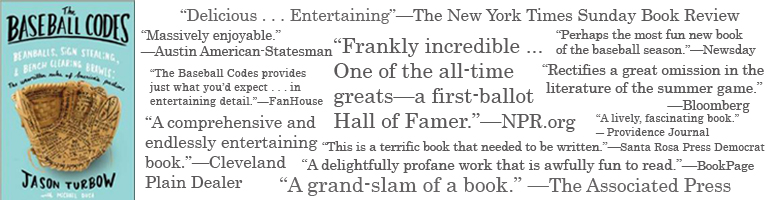
NPR: Baseball Codes ‘One of the All-Time Greats – a First-Ballot Hall of Famer’

Starting with the headline – “The Baseball Codes: Attention Baseball Fans, This Book Will Eat Your Life” – NPR’s Web site review,  which came out this morning, is, frankly, stunning.

Glenn McDonald, editor of the “Wait, Wait . . . Don’t Tell Me” daily news quiz at NPR.org, and a film critic at the Raleigh News & Observer, is appreciative of our endeavors. As are we of his. Sentiments such as:

  • “A new book hitting shelves this week had sidetracked my for the last few days to that most analog of media, the printed page. The Baseball Codes, by Bay Area sportswriters Jason Turbow and Michael Duca, is a frankly incredible book — a history and analysis of baseball’s insular culture of unwritten rules, protocols and superstitions, assembled over the course of 10 years. I’ve read a lot of baseball books in my day, including everything typically included in the unofficial canon, and I can say without hesitation that this is one of the all-time greats — a first-ballot Hall of Famer.”
  • “The book’s subtitle, Beanballs, Sign Stealing, and Bench-Clearing Brawls: The Unwritten Rules of America’s Pastime only scratches the surface. Turbow and Duca have done an incredible thing here, interviewing hundreds of baseball players, managers, coaches, trainers, owners, journalists and broadcasters to assemble a comprehensive history of baseball culture.”
  • “I can’t say enough nice things about this book, which belongs on every fan’s shelf, and I really don’t say that lightly.
  • “The 294-page book is remarkably dense, with the stories piling up, one after another, each gathered from one-on-one interviews done over the years as these two baseball writers made their way around the game. One amazing facet of the book, revealed in the acknowledgments, is that the authors used only about 25 percent of the material they collected.”
  • “The final chapters are, for baseball fans of a certain intensity, quite touching, as Turbow and Duca lament the deterioration of old-school baseball ways in the face of modernism, media and money. More and more players, as fans know, are chasing individual stats, big free-agent contracts and the SportsCenter highlight reel. But it’s like Yogi Berra said: ‘There are some people who, if they don’t already know, you can’t tell ’em.’ “Thanks, Glenn. I am honestly and earnestly delighted that you liked it as much as you did.- Jason