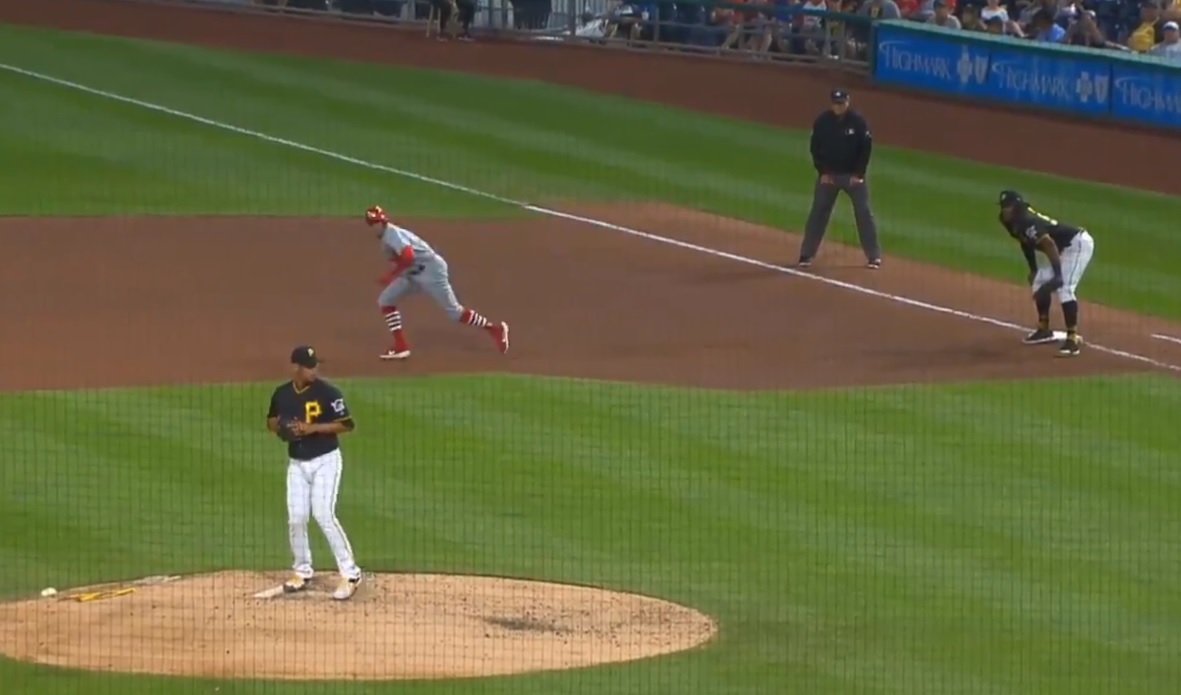
There wassomediscussion this morning about Pirates broadcasters Greg Brown and Bob Walk lambasting the Cardinals’ decision to steal two bases yesterday—both by Yairo Munoz, in the span of two pitches—while holding an 11-4 lead. Suffice it to say that the Bucs’ broadcasters were not impressed.
Brown and Walk are unequivocally old-school, going so far as to initially misidentify the ensuing boos as being directed at the Cardinals’ perceived breach of etiquette rather than at the home team’s sloppy play. Walk even alluded to retaliation, saying, “I know exactly what would happen now, in a different era.”
Holy hell, guys—it was the fourth inning. Under even the kindest reading of the code—even the code from Walk’s era (he pitched from 1980 to 1993)— that’s way too early to expect behavior modification. In The Baseball Codes, we broke the idea down via a series of quotes intended to convey the diversity of opinion on the subject about when a team should take its foot off the gas in a blowout game:
* “It used to be that [running with] anything more than a four-run lead was wrong, and you’ve got to be careful with that.”—Tony La Russa
* “When I was playing, if you had a four-run lead it was a courtesy not to run. But you can do that now.”—Ozzie Guillen
* “Once I had you by five runs and you couldn’t tie me with a grand slam, that was it.”—Sparky Anderson
* “I was always taught you shut it down at five runs after six.”—Dusty Baker
* “Five runs in the sixth, I’m not stopping there. We get into the seventh inning, then I’ll start chilling a little bit.”—Ron Washington
* “We play [to shut it down] if you’re up seven runs in the seventh inning.”—Jim Slaton
“From the seventh inning on, if one swing of the bat can tie you up, it’s game on,” said ex–first baseman Mark Grace in 2006. “If it’s 4–0, you have Jason Schmidt on the mound, and he’s only given up one hit, you still go for it if Ray Durham gets on base in the eighth inning. Now, if it’s 6–0, you’re in territory where you might get a player hit in the brain in response.”
The first three bullet points fail to mention timing, but the other four take care of that. In the homer-happy, run-barrage landscape of modern baseball, in which comebacks are more likely than ever, is it weird to think that a seven-run lead in the fourth inning is safe? Of course not. Hell, even the Pirates thought so, having first baseman Josh Bell hold Munoz on first base prior to his initial steal (despite the insistence of pitcher Luis Escobar to steadfastly ignore him).
And why wouldn’t they? It was the fourth inning for crying out loud.
Just posted at Deadspin is an excerpt from They Bled Blue, in which Reggie Smith leads the Dodgers to a near-brawl with the Pirates off the field, in the tunnels of Three Rivers Stadium.
Danny Jansen is a greedy SOB. The evidence is right there before us.
About a month ago, on June 21, the Blue Jays catcher was batting a woeful .166, with two home runs on the season. Over the next 18 games, however, 17 of which he started, he hit .355 with six homers, raising his average 50 points in the process. Sure, Jansen had gone hitless in the final two of those games, last Wednesday and Thursday, but he’d barely played in one of them and totaled only three at-bats.
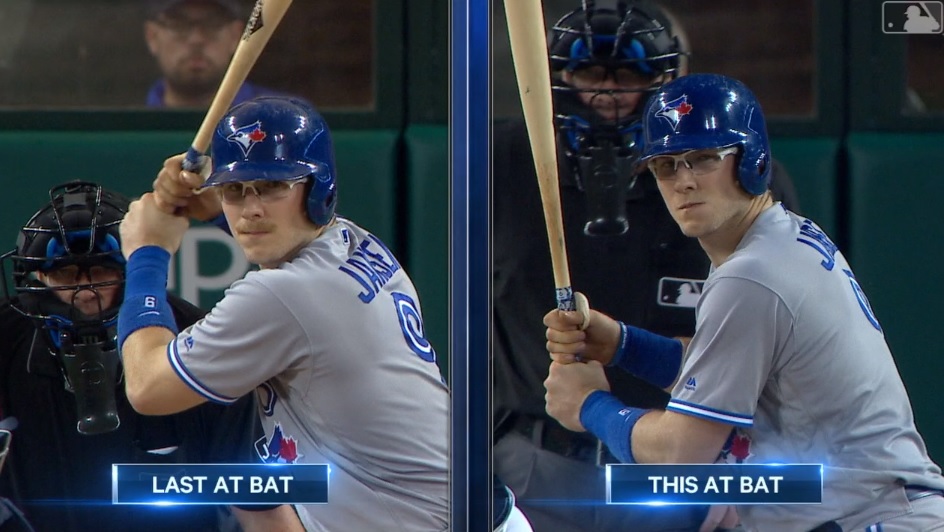
Still, the what-have-you-done-for-me-lately nature of his recent hot streak was indelibly compromised. After putting up zeroes in his first three at-bats against the Tigers on Friday—even in the face of an offensive barrage by his team, in a game the Jays would win 12-1—Jansen could take no more. He returned to the clubhouse during the late innings and shaved his mustache.
Whatever works, right? In 1977, Cincinnati’s Dave Concepcion tried breaking out of a slump—to heat up, as it were—by getting into an industrial clothes drier and having teammate Pat Zachary turn it on. Concepcion singed off much of his hair. He also got three hits against the Cubs.
That, though, was mild. In 1993, Reds pitcher Jose Rijo—who’d gone 10 starts without a win—returned to his home in the Dominican Republic during the All-Star break and sacrificed two goats to the Baseball Gods. He’d have normally killed only one, he said, according to The Cultural Encyclopedia of Baseball, but he “wanted to make sure.” Sure enough, Rijo won his first game back, and went 8-4 in the season’s second half.
Entire organizations have even been known to get in on the act. In 1951, the Indians—trying anything to beat Yankees southpaw Eddie Lopat, who boasted a 30-6 record against them over the course of his career—passed out 15,000 rabbits’ feet to fans, one of whom actually raced onto the field during the game to throw a black cat (or at least a gray kitten) at the pitcher. Cleveland put up five runs in the first inning against Lopat en route to an 8-2 victory. In Lopat’s next start against them, the Indians won, 8-0.
As for Jansen, he explained after the game that he’d done something similar last season in Triple-A. “I was DHing, and I did it,” he said in a New York Post report. “I struck out my first time, and I went in and shaved and got like a couple hits after, so I gave it another shot tonight.”
Sure enough, after going 0-for-3 to that point on the day (and
0-for-his-last-6 overall), Jansen collected a hit in his next at-bat, a seeing-eye
single to left that brought home two runs.
Blue Jays pitcher Marcus Stroman was right there with him. “Whatever
to get knocks, man,” he said. “He shaved it off, and double-RBI single. Whatever
for knocks.”
So okay, maybe totems work. Then again, Jansen has gone only 1-for-10 since that point, bringing his season average back down to .210. Maybe it’s time to grow another mustache.
Hector Neris was unable to get LA’s goat on Tuesday, so he upped his game on Thursday. Head-high beanball not enough? Okay, Dodgers, fuck you.
On Tuesday, Neris entered in the ninth inning to protect a 6-5 lead, and in the span of four batters gave up a walk, a single and a three-run homer to pinch-hitter Matt Beaty. This was especially difficult for the pitcher, given that the last time he faced the Dodgers, on June 1, he’d given up a game-winning home run to Will Smith—the first of the rookie’s career, in just his fourth big league game—during which Smith paused to admire the flight of the ball while statue-posing his outstretched bat.
That type of reaction to a game-winner no longer even registers for most pitchers, but because it was a rookie doing the showboating it may well have gotten under Neris’ skin. What is certain is that he wanted to jam it down the Dodgers’ throats the next time he saw them. Instead, he blew another lead on Tuesday, in an even more painful manner.
That was all it took: The frustrated closer followed Beaty’s homer by delivering a 95-mph four-seamer at the head of the next batter, David Freese. A shrug-and-duck move allowed Freese to deflect the ball with his shoulder, but the intent was so obvious that Neris was ejected by plate ump Chris Conroy and suspended for three games by the league.
Gabe Kapler gets ejected again after his pitcher throws at a batter after giving up the go-ahead home run, a breakdown pic.twitter.com/1lswIMgaRN
Look no further than the reaction of his catcher to judge Neris’ intent.
I love Realmuto looking at Neris like “bro wtf” after he plunked David Freese because the dodgers hit a three run bomb off of him. pic.twitter.com/OS6r9OSxVo
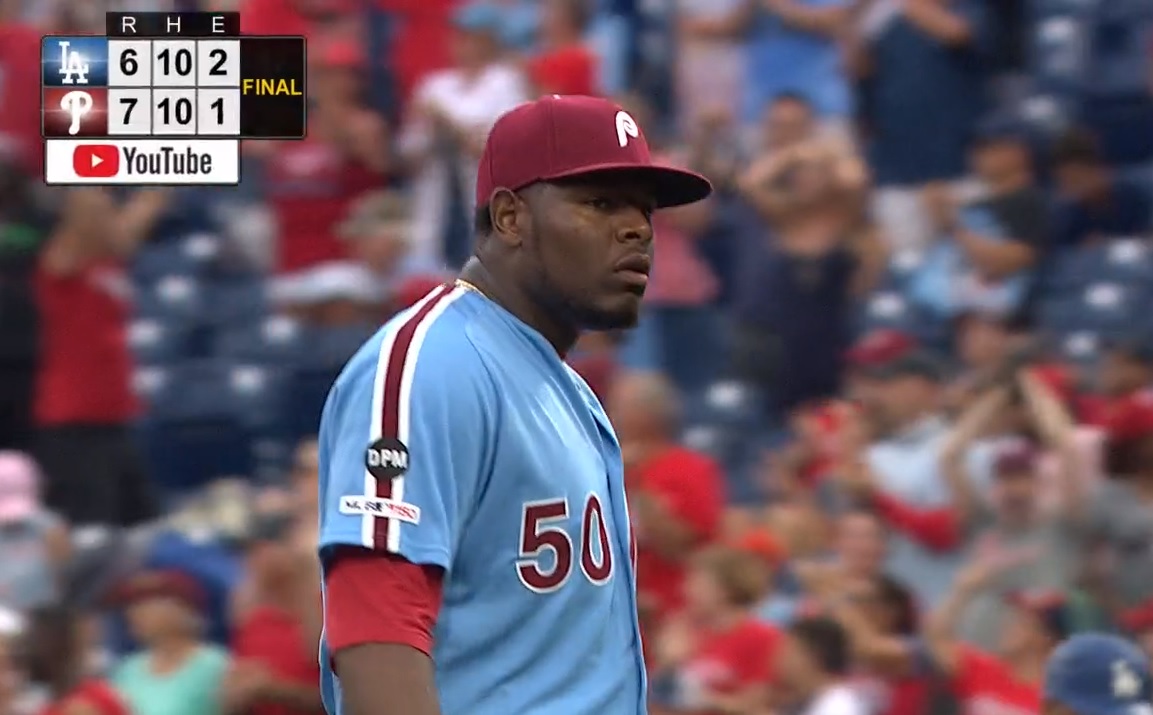
Fast forward two days. Neris is still playing while his suspension is under appeal. Called upon to protect a 7-5 lead in the ninth, he surrendered a solo homer to Alex Verdugo before nailing down the save—after which he turned to the LA dugout and screamed, “Fuck you!”
The Dodgers noticed. Justin Turner, who’d made the final out, took some time glaring in Neris’ direction. Max Muncy was poised outside the dugout, as if ready to charge. Clayton Kershaw, Russell Martin and Alex Verdugo were caught glaring toward the mound from the dugout. Martin may have challenged Neris to meet him in the tunnel under the grandstand. He also appeared to use some entirely objectionable language in describing the pitcher.
Nothing more came of it, but Dodgers manager Dave Roberts
had some choice words for the media afterward.
“We played this series the right way, played it straight,” he
told reporters after the game. “And so to look in our dugout and taunt in any
way, I think it’s unacceptable. For our guys, who just play the game to win and
play it straight and clean. Last game of the series, to look in our dugout, I
think that exceeds the emotion. Look in your own dugout. So I think our guys
took it personal. I took it personal.”
“He’s blown about eight saves against us over the last two years, so I guess he was finally excited he got one,” added Max Muncy in an MLB.com report. “Whatever.”
That’s not quite accurate, but it’s not far off. The previous time Neris pitched against the Dodgers prior to June 1 was in May of 2018; he gave up three hits and a run in one-third of an inning. In 2017, Neris yielded three straight home runs to blow a 5-2 lead. Over the course of his career the Dodgers are hitting .365 against him, better than any other team, and his ERA against them is 8.49. LA’s slugging and OPS marks against the pitcher top all National League clubs.
As evidenced by MLB’s suspension, compounded frustration is no excuse for head-hunting. Nor is it an excuse for what happened on Thursday, when back-to-back Dodgers stomped the foot of Phillies first baseman Rhys Hoskins while running out grounders—possibly in response to Neris’ shenanigans.
Unlike Neris’ beanball to Freese, it’s difficult to discern intent in the plays, and the fact that Neris appears to have acted in a vacuum when it came to his beanball might indicate that his teammates aren’t part of this particular beef. Still, such a thing happens so infrequently that to see it on consecutive grounders from a team that drew heat for a similar ploy only last season will doubtless raise some eyebrows in the Phillies clubhouse.
The teams are done with each other this season (a possible playoff meeting excepted), but so long as the principals remain where they are, there is no question that all these details will be re-litigated next year should anything questionable arise between the clubs at some point in the future.
Jake Marisnick still feels terrible. That’s the prime takeaway from Tuesday’s Astros-Angels game, which featured the culmination of a string of events in which Marisnick played the heavy. This is why, even after a retaliatory pitch to his head for which few in baseball would have begrudged him some outrage, the guy quietly took his base and then implored his teammates to pipe down.
These are the actions of a guy who wants this entire chapter to end as quickly as possible.
It began last week, when Marisnick violently collided with Angels catcher Jonathan Lucroy after altering his route to the plate. The play left Lucroy unconscious, with a concussion and a broken nose that ultimately required surgery and an extended stay on the IL. Replays looked terrible, and Marisnick spent the ensuing days apologetically trying to explain how it had been his intention to avoid Lucroy, not blow him up. There was no mistaking his emotional distress in having caused such damage. He was suspended by MLB, but is still playing while the decision is appealed.
None of this mitigated the certainty that the Angels would retaliate. It was their guy on the ground. It had been, in their eyes, a dirty play … or at least one worthy of response. And Tuesday was the first time Marisnick had faced them since it all went down.
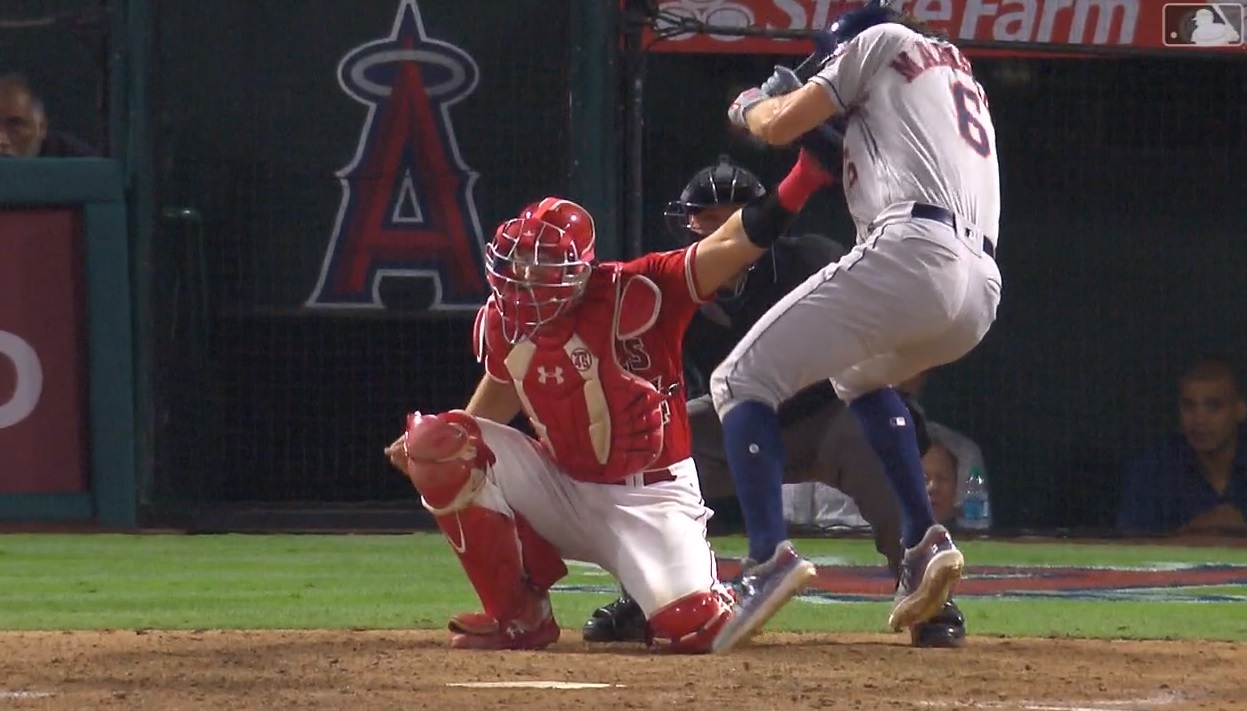
Had the Angels gone about it properly, it’s unlikely that anybody would have paid it further mind. Instead, reliever Noe Ramirez sent a fastball toward Marisnick’s earhole.
The time of reckoning was obvious even before Ramirez let loose. Marisnick’s first two at-bats came in the second and fourth innings, and even though the Angels had put up an unanswered six-spot in the first, there was still too much risk in targeting him so early. Look no further than a day earlier, when Philadelphia’s Yacksel Rios was tossed from a game for hitting Justin Turner with as unintentional a HBP as can be imagined: an offspeed pitch that broke just a little too sharply. Angels manager Brad Ausmus was unwilling to risk a similar outcome for his own starting pitcher, Andrew Heaney, so early in the game, so Marisnick was pitched to, not at. (It’s rare in the modern game for a manager to explicitly order retaliation, but they’re not shy when it comes to telling their pitchers to situationally avoid targeting a guy.)
Heaney, however, departed in the fifth, in favor of Ramirez.
With Marisnick leading off the sixth, the Angels—holding a 6-2 lead—could more
easily absorb the loss of a middle-innings reliever. The right-hander sent his first
pitch to Marisnick, a curveball, wide of the strike zone, clear subterfuge for
the up-and-in to follow. Trouble was, plate ump Stu Scheurwater called it a
strike. So Ramirez followed it with another bender, this one even further
outside.
At that point, had Ramirez opted to put a fastball into Marisnick’s backside, or even his ribcage, it’s doubtful that anyone in the Astros dugout would have reacted. But that’s not what he did. His next pitch, a 90-mph four-seamer, screamed toward Marisnick’s head, deflecting off his shoulder after a jump and a shrug.
By all rights, Marisnick should have been irate. A mound
charge, while hardly encouraged, would at least have been understandable. If
ever a pitcher should have been ejected without warning, this was the time.
None of that happened.
Instead, Marisnick calmly took his base, refusing to so much
as glare at the pitcher. That should have been the end of it. As Ron Washington
told me many years ago, describing an incident in which Frank Thomas was
drilled intentionally: “We have to wait for the reaction of the guy who it
happened to. If Frank had charged him, there would have been a fight. If Frank
had raised some hell going down to first base, we’d have raised some hell. But
Frank took it calmly and went on down there, the umpire checked everything, and
we played baseball.”
That’s not what happened on Tuesday. Marisnick’s calm did nothing to dissuade his teammates’ anger, with the Astros—notably Lance McCullers Jr.—chirping so vehemently from their dugout that Angels first baseman Albert Pujols eventually got fed up and walked over to better engage, even as Marisnick himself urged his teammates to pipe down. The video is remarkable.
Afterward, the Astros were understandably upset—not by the retaliation, but by how it was executed.
“If they felt the need to defend their guy, that’s fine,” McCullers said in a Houston Chronicle report, “but I think the way that it was done was horseshit.”
Astros manager A.J. Hinch alluded to a possible continuation of the beef should MLB fail to punish Ramirez. “It’s a confusing time,” he said after the game. “Either the players govern the players on the field like it’s always been, or we legislate it to where none of this crap happens. They got a free shot at him with no warning, no ejection. We’ll see if there’s discipline. And without discipline, there’s going to be no issue doing it the next time. So, if retaliations are in, cool. We’re well aware.”
That’s not how Marisnick feels. The incident served to distract from the fact that earlier in day, the outfielder was presented with the Astros’ Heart and Hustle Award. By all accounts, he’s a good guy with a good heart who made a questionable baseball decision that ended horrifically. And he’s still upset by it.
“There’s no need for that,” Marisnick said after the game, referencing the situation with Pujols. Then he turned the discussion to actual baseball matters, which is clearly where he’d like it to stay.
Update (7-17): Ramirez has been suspended three games for his pitch, which is one more than Marisnick got for leveling Lucroy.
So when a pitcher comes into a game with his team trailing 9-1 and immediately gives up a double, and then another double, and then a home run, and now it’s 12-1 and he still hasn’t recorded an out, and then, with his very next pitch, he drills a guy, well that’s as obviously intentional as it gets.
At least umpire Doug Eddings thought so. He tossed the pitcher on the spot, no warning necessary.
The problem was, the pitcher in question, Philadelphia’s Yacksel Rios, didn’t mean to hit Justin Turner. The pitch in question, an 84-mph slider that plunked Turner on his back knee, was so inoffensive that Turner himself argued in the pitcher’s defense. The pitch in question was so inoffensive that Phillies manager Gabe Kapler actually tried to enlist Turner to join in as he lit into Eddings.
The ump throws out Yacksel Ríos for hitting Turner with an offspeed pitch and even the Dodgers can't believe it, a breakdown pic.twitter.com/A3Hj1NFf4W
OMG. Home Plate umpire Doug Eddings just ejected #Phillies pitcher Yacksel Rios for hitting #Dodgers 3B Justin Turner with a breaking ball. Turner started appealing on behalf of Rios that he shouldn’t be ejected. Every time I think I have I seen it all…Baseball Happens!
Ultimately, Eddings thought he was doing something proper,
stemming what by most of the indicators could have been the first blow in a
tit-for-tat series of reprisals. He acted decisively and with certainty … an
instinct that, in retrospect, he’d have been better served to ignore.
As for Turner, why the hell wouldn’t he argue on behalf of keeping Rios in the game? Forget the
pitcher’s absence of malice; the guy couldn’t get anyone out. Turner just
wanted his teammates to have a taste of the good stuff that the inning’s first
four hitters had already sampled.
As it happened, the pitcher who finished the inning for Philadelphia, rookie Edgar Garcia, gave up a single, three walks (one with the bases loaded) and two more runs. The pitcher who closed things out in the ninth, Roman Quinn, is actually an outfielder, and yielded three more singles, a double and two additional runs for the Dodgers, capping a 16-2 victory.
The Dodgers will almost certainly avoid retaliation.
We’ve seen the recent implementation of pitching “openers” disrupt traditional baseball in numerous ways. Now we can add superstition to the mix.
The no-hitter jinx—banning any mention of the feat while said feat is in progress—is about as old as no-hitters themselves, but with the advent of relievers making planned appearances after only a couple of innings, it’s easier than ever to lose track of game details.
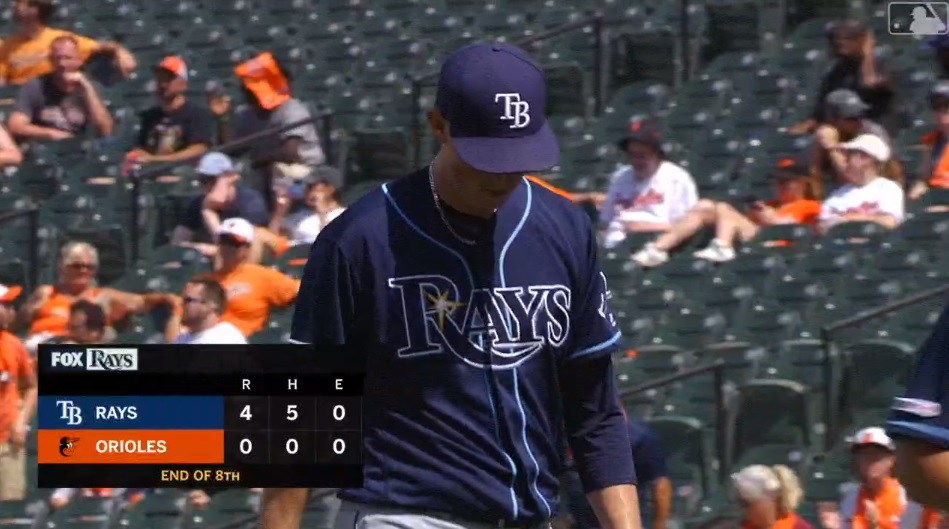
Take Tampa Bay’s Ryan Yarborough, who came into Sunday’s game against Baltimore in the third inning. As it happened, Rays opener Ryne Stanek had been perfect during his short stint, a detail that managed to escape Yarborough, who’d spent the first two innings either warming up in the bullpen or cooling down in the clubhouse tunnel. Either way, he wasn’t closely watching the game.
By the time Yarborough entered in the third, six Orioles had been retired in order. By the time Yarborough completed six innings of his own, 24 Orioles had been retired in order. Somehow, aided by the reticence of his superstition-abiding teammates when it came to mentioning anything in the dugout, the lefthander spent most of that duration with no idea that history was afoot.
He was informed of the perfect game by some Orioles fans working overtime to jinx it, who, from the grandstand, warned him against blowing it. The gambit was effective. “I’m like, wait a minute …” the pitcher said, in a Tampa Bay Times report. “I really had no clue.”
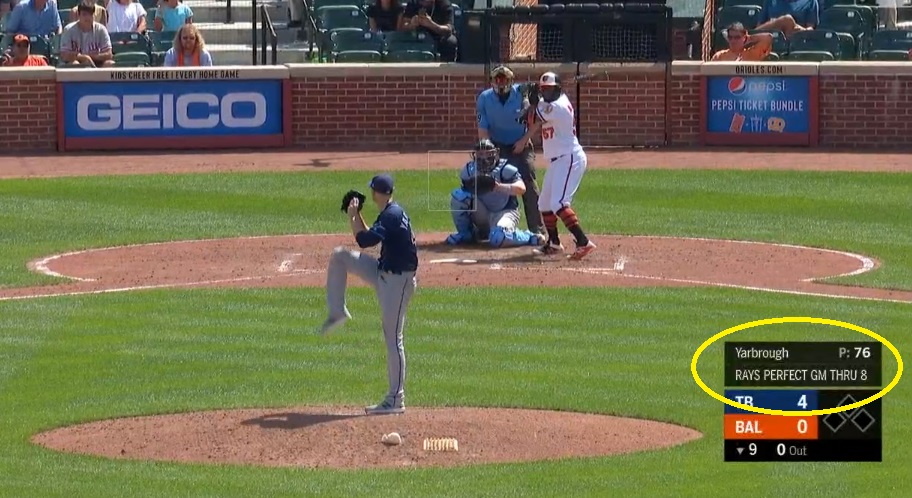
That happened just before Yarborough pitched the eighth. He responded with a three-up, three-down inning, but his proximity to immortality may have gotten to him while the Rays batted. The first batter he faced in the ninth, Hanser Alberto, hit Yarborough’s first pitch to right field for a single.
Actually, chances are slim that Yarborough out-thought himself. Alberto’s hit was little more than a soft tapper to the spot where the second baseman would have been standing had the Rays not been employing a shift. Depending on one’s reading of the situation, this might be clear evidence of the wrath of the Baseball Gods, who clearly disapprove of modern defensive strategies.
Then again, take a look at that TV chiron: “3 OUTS FROM PERFECT GAME.” The jinx wasn’t Yarborough’s, it was MASN’s … except that MASN wasn’t the only network to prematurely proclaim the possibility of perfection.
That’s in addition to the abundance of mentions on social media and radio. The lesson here is obvious: Never mess with the Baseball Gods.
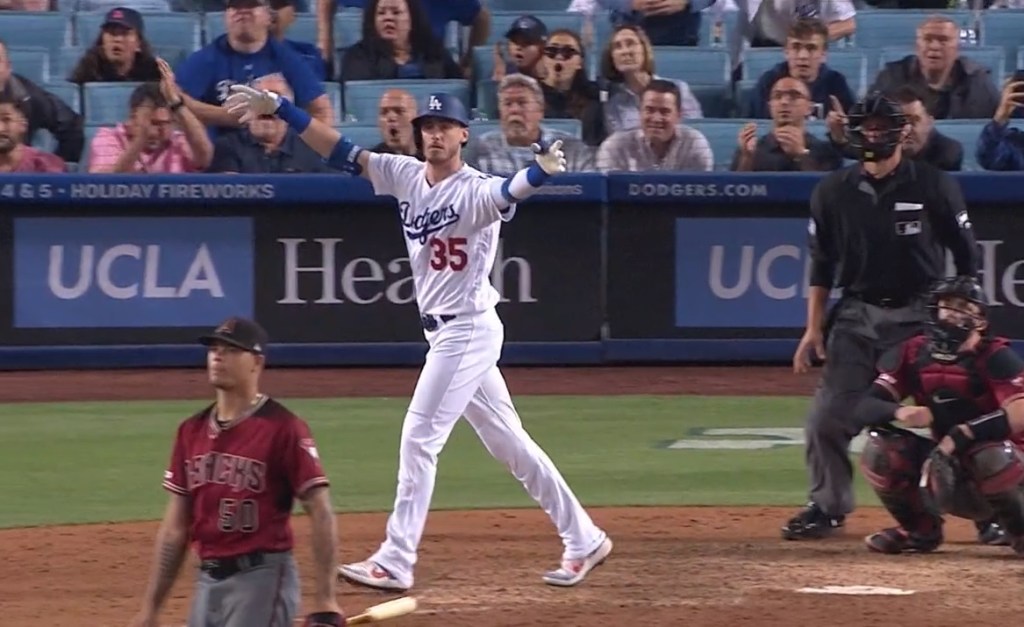
There’s nothing Cody Bellinger can’t do this year. He walks off games with walks. He walks of games with home runs. On back-to-back days, no less. Pertinent to this space, he also appears to have mastered the fine art of the subtle dig.
Travel back a week or so to June 24, with the Dodgers battling the Diamondbacks in Arizona. With the game tied, 4-4, reliever Yoan Lopez put LA down without much trouble in the eighth inning, capped by his strikeout of Joc Pederson. Lopez pounded his chest while descending the mound, then offered a little nod of superiority to Pederson en route to the dugout.
The Dodgers noticed.
So when Bellinger hit his game-winner home run off Lopez on July 3, he saw fit to notify the pitcher that the Dodgers have long memories. First came the bat toss and home-plate celebration. Then came the glare toward the mound. Then game the glare toward the visitors’ dugout. It was all prelude, of course, to a mocking chest-bang as Bellinger approached first base.
Bellinger goes deep to give the Dodgers their 5th straight walk-off at home, a breakdown pic.twitter.com/YffCbQmUMM
Much of this was lost in the ensuing mayhem. Apart from raising his arms before starting his trot—standard fare for a game-winner these days—at first blush, Bellinger’s response looked downright normal.
Still, it said everything he wanted it to. Let The Kids Play might be an official mandate, but that doesn’t mean that the kids’ opponents won’t notice. Disrespect comes in many forms, and that’s exactly how the Dodgers took Lopez’s actions toward Pederson. It was a minor affair, hardly worth a retaliatory pitch, but some of Lopez’s own medicine directed back his way?
Before we get into umpire warnings and how they might or might not be useful, let’s start with Wilmer Font.
Font is the definition of a journeyman pitcher, playing for five teams in a five-season big league career, with one Tommy John surgery and a few minor league campaigns in the middle of everything. In May, the Rays offloaded him to the Mets for next to nothing, at which point Font’s career ERA was 6.51.
Still, he throws with decent velocity, employs five different pitches and can be stretched out as a middle reliever. And in New York, things seem to have changed. Over the last month, Font has racked up a 0.69 ERA in 13 innings across seven appearances. The Mets bullpen has been in shambles, and the right-hander looked ready to pounce on the opportunity to gain some organizational trust.
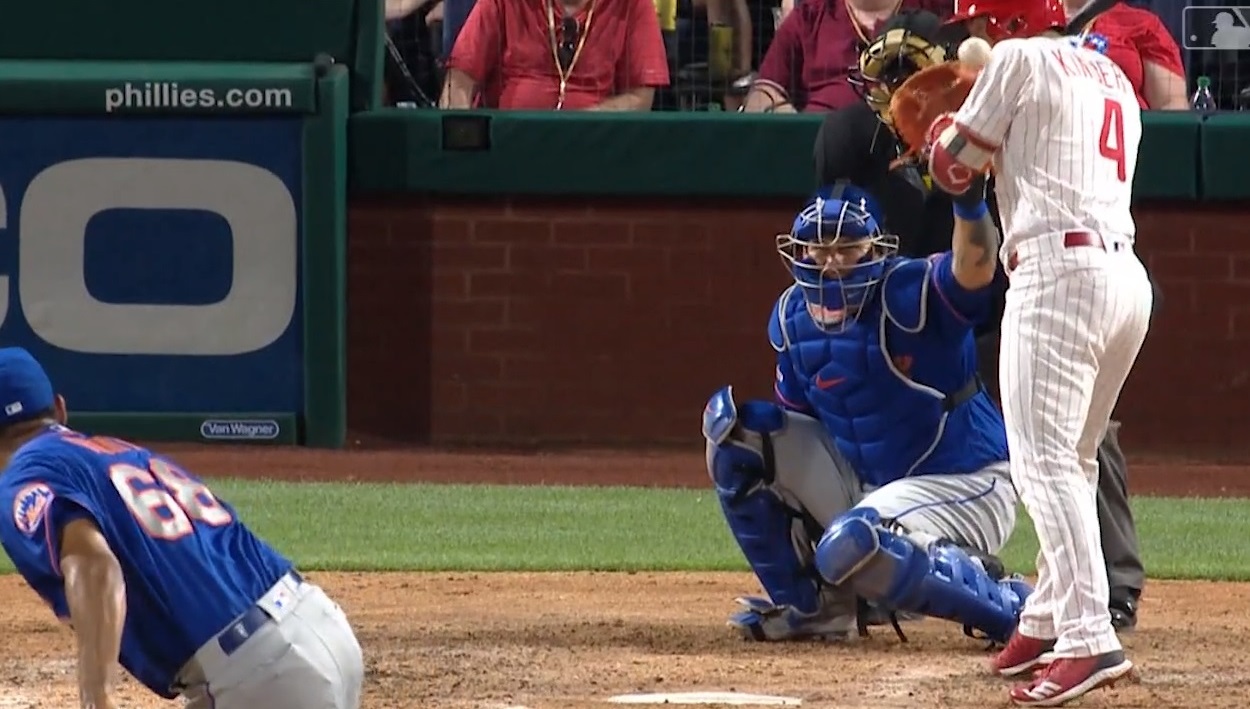
Until yesterday, anyway. Font was inserted into the sixth inning of a game against the Phillies with runners on second and third and one out, and the Mets holding a 5-2 lead. The first hitter he faced, Jay Bruce, brought home a run with a groundout. The next hitter, Cesar Hernandez, brought home another run with an infield single. The next batter, Maikel Franco, gave the Phillies the lead with a two-run homer. The next batter, Brad Miller, extended the lead with another home run, then clowned his way to first base. In the span of four batters, Font’s ERA jumped from 4.58 to 5.50.
Of course he was frustrated. Maybe that’s why he sent a fastball at Scott Kingery’s head.
Kingery’s crime, of course, was
merely hitting behind Franco and Miller. A leap and a shrug by the batter
managed to help him deflect the pitch with his shoulder, but the intent was
clear. Font put a pitch someplace that no pitcher ever should, and the Phillies
were furious.
Enter plate ump Joe West, and the discussion about umpire warnings. West saw the pitch for what it was, but instead of tossing Font he opted for warnings to both benches. The umpire no doubt knew about the recent history between the teams, notable for a game back in April in which the Mets threw at Rhys Hoskin’s head in response to an ill-considered stolen base.
Still, issuing warnings to both teams precluded any sort of response from Philadelphia for an egregious act, never mind that, apart from Miller’s antics while heading toward first base, they’d been entirely clean. Phillies skipper Gabe Kapler was commensurately upset and came out to argue. It took West literally six seconds to toss him.
As pertains to the Mets, West’s decision to warn Font rather than tossing him had no effect whatsoever on the game, given that Mickey Calloway pulled the reliever anyway. For the Phillies, however, it generated some constraints.
Never mind the idea of retaliation; with a two-run lead in the late innings, any possible head-hunting notions they may have harbored would likely have been tabled until another day anyway. The warning did, however, increase concern among Phillies hurlers about utilizing the inside corner. Kapler noted as much after the game, saying in a Philadelphia Inquirer report, “I felt like it was going to put us at a disadvantage throwing up and in.”
So what’s the right answer? Generally speaking, clued-in umpires tend to delay warnings until an aggrieved party has a chance to respond. Also generally speaking, Joe West is not always considered to be clued in. Overly quick warnings, like West’s on Tuesday, simply delay gratification for those with retaliatory tendencies. This means that instead of bad blood being contained to a single game, it spills into multiple days.
We’ll see if that’s the case with Philadelphia. Given that two Mets have thrown at the heads of their hitters so far this season, it’d be shocking if we don’t see some sort of response … maybe as soon as tonight.
A lot’s being made over Dennis Eckersley’s comments about Marcus Stroman’s on-field celebration on Sunday to close out the sixth inning against Boston, during which the broadcaster called Stroman’s actions “tired.” You know, hypocrisy and all, what with Eck having pretty much set the standard for pitcher gesticulation back in his day. Let’s let Twitter tell the tale.
That's not Dennis Eckersley calling Stroman's celebrations "tired," is it?
"He was aggressive and animated on the mound, and he was known for his intimidating stare and pumping his fist after a strikeout. "https://t.co/Cu6cA6k49A
There’s something to the fact that Stroman’s initial response appears to have been intended for the Boston dugout, but for me, there’s a different takeaway — not from the game itself, or even its aftermath, but from the Tim Anderson affair back in April, when the White Sox slugger infuriated the Royals by hurling his bat following a home run. Asked about it, Stroman was concise: “I could care less if someone pimps a homer off me. I gave it up. Showing emotion is part of the game.”
There it is. Love the guy or hate him, at least he’s consistent. The moment that Stroman takes issue with a home run pimp job, please alert Rob Friedman.



 The Baseball Codes