Showboating, Unwritten-Rules

Puerto Rico Ama A Francisco Lindor: A Celebratory Lesson

Lindor trots

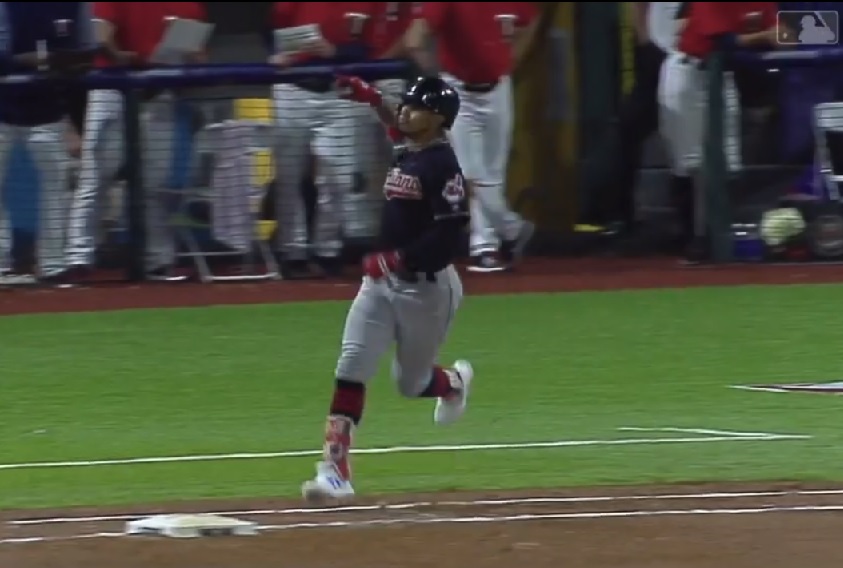
I’ve referenced 2017’s World Baseball Classic twice in posts this season, and it’s only April. Today is the third—and most pertinent. Francisco Lindor hit a home run yesterday, then effectively paraded his way around the bases, skipping, waving his arms and inciting the crowd. Afterward, he publicly apologized for potentially offensive behavior.

As with most things, details matter.

The WBC was terrific because it showed us a Puerto Rico national squad that was unafraid, within the context of the way baseball is played on the island (and throughout much of Central America), to show some emotion on the field. Though the occasional American red-assed stick-in-the-mud took issue with this, it was generally seen as a good thing.

Lindor was on that Puerto Rico team. Last night’s game was held in Puerto Rico, against the Twins at San Juan’s Hiram Bithorn Stadium.

Of course Lindor celebrated.

Such is the reach of baseball’s unwritten rules—especially the part held up by American red-assed stick-in-the-muds—that Lindor recognized after the fact that his antics might not have been appreciated by the opposing team. Thus, we got this:

That Cleveland was playing the Twins was unfortunate, given Minnesota’s collective, ludicrous, unwritten-rules-inspired groan at a perfectly reasonable bunt earlier in the season. If any team would take issue with a hometown kid playing by hometown rules after succeeding in front of his hometown fans, it’d be these guys, right?

As it turns out: not so much.

Credit to Lindor for sensitivity with this issue, and relieved acknowledgement that everybody involved seemed content to let him have this particular moment.

Update, 4-18: The Twins agree: Lindor was a-ok.

Unwritten-Rules

A Treatise On The Unwritten Rules in 14 Tweets

Former Orioles closer Gregg Olson—the 1989 American League Rookie of the Year, who saved 217 games over a 14-year career—recently gave an interesting response to somebody who Tweeted the following at him in the wake of the Twins’ annoyance that somebody bunted against their shift in the ninth inning: “Bunting down 7 = bad. Utilizing the shift up 7 = okay. Clear as mud. These ‘unwritten rules’ are so lame.”

Olson has, over the ensuing two weeks, backed up his position by listing 14 unwritten rules, all of them presented here with annotations. All are valid, though some have faded a bit since Olson’s time.


The quibble I have here is that there’s a far more prominent exception to this rule than the shift: If the score is close and a player can reach base via a bunt, all is kosher at any time. Victories trump Code, always.

Superstition will never be defeated.

Outmoded these days. While still sometimes in play, it was once unequivocally true.

Yes! When Alex Rodriguez did this to Dallas Braden back in 2010, the general response was bewilderment about why Braden was so upset. Had people spoken to more pitchers, they would have heard more responses like Olson’s.


This is true, but in my book it’s more about baseball strategy than moral standards.

This one cuts to the heart of many of the issues facing the modern game. As the Code fades and new generations of players come up with scant understanding about it, we will see increasingly more situations governed by inflamed emotions rather than reasoned responses. I’ve been discussing this with a reader over at The Baseball Codes Facebook page over the past few days, as pertains to Nolan Arenado’s recent mound charge:

Scott Ledbetter: This is MLB players taking exception to every little thing. My opinion, this is what happens when players embrace too much emotion. I agree the pitch on Margot, while injury producing, was not deliberate. I’ve seen plenty of batters get injured by a HBP that didn’t garner any retaliation, why did this one? Did anyone retaliate when Randy Johnson delivered an inside fastball to JT Snows face? Did anyone retaliate when Giancarlo Stanton took an errant pitch to his face?
The Baseball Codes: One thing worth exploring is the idea about WHY players are more sensitive now. The dissolution of the Code — the slipping grip it has over the way the game is played – – no doubt plays a part. The less clearly that players understand the scope that defines what is happening, the more likely they’ll react to it emotionally.
Scott Ledbetter: I think that’s a sign of the times… younger generations seems to be more sensitive in general, and that can carry over into all sports, not just baseball.
The Baseball Codes: I agree, but I’m talking about something different — a disconnection with the meaning behind certain established behavior, which leaves them with nothing but emotion (or, as you say, sensitivity) to govern their response.
Scott Ledbetter: I think I see what you mean. A lot of the younger players don’t seem to understand that some of the unwritten rules were responses to actual intent to harm other players, and it was the intent that determined how one responded. Nowadays, it’s seems like players feel the response is second nature because they forgot to understand the intent.
The Baseball Codes: Exactly!

Boy howdy does everyone have a different threshold. Once, a four-run lead after six was considered significant. Now, some managers consider a six-run lead in the eighth as still within striking distance.

This rule came into play with the aforementioned bunting-into-the-shift imbroglio, wherein the Twins expected Baltimore to transition into blowout mode (identified above by Olson as halting all stolen bases, but also including bunts, hit-and-runs, etc.) when they weren’t doing so themselves, defensively.


Absolutely correct, with the addendum that if you ARE caught, knock it off for a little while.


I will never question a pitcher about this one.

This rule can make it very difficult for friendly neighborhood reporters to do their job. I hate Rule #10.

This one is steadily changing—what’s considered to be showing up another team today is far less stringent than it was during Olson’s time. Only yesterday we talked about this as pertains to Javy Baez.

This makes sense. But if a pitcher gives up a hefty enough blast, he has far more important things to worry about than the fact that his outfielder made no effort to reach a ball that ended up in the third deck.

I just covered this one in March, in my Rusty Staub memorial post.

I haven’t heard too much about this one, save for the instances when substance abuse is impacting a player’s performance. Gregg, if you end up reading this, I’d love to hear a story about the response to somebody bringing a sandwich or etc. into the dugout during a game.

Seeing as his last post came only yesterday, give Olson a follow. One never knows when #15 might drop.

Update, 5-17-18: Olson’s been busy listing more rules.

Bat Flipping, Don't Call out Opponents in the Press

Hurdle Frustrated by Baez’s Frustration, Word Battle Ensues

Baez flips

And here I was, thinking that the new world order had been firmly established. The Puig-ization of baseball, wherein players can more freely express themselves on the field—usually in the form of bat flips—had already taken hold when the Puerto Rico team showed us exactly how much fun that kind of thing could be during their second-place run in last year’s World Baseball Classic.

As it happened, the second baseman for Puerto Rico, Javier Baez, also plays for the Chicago Cubs. Last week, he went a bit homer-crazy against Pittsburgh, hitting four longballs across the series’ first two games. That wasn’t what set off Pirates manager Clint Hurdle, however, so much as the second baseman’s response to popping up with a runner in scoring position—which itself included a bat flip. It was borne out of frustration, of course, after which Baez made scant effort to run toward first. (Watch what little of it was captured in the telecast here.)

Hurdle was peeved enough to address it the following day, not only as pertained to Baez, but to the Cubs organization as a whole. Among his comments, as reported by the Athletic:

“When a player does something out of line, there are one or two guys who go to him right away and say, ‘Hey, we don’t do that here. What are you thinking when you do that? Do you know what that looks like?’ ” Hurdle said. “Sometimes, guys don’t understand what it looks like. Usually, you’ve only got to show them once or twice what it looks like and they really don’t want to be that guy anymore. . . .

“Where is the respect for the game? [Baez] has hit four homers in two days. Does that mean you can take your bat and throw it 15-20 feet in the air when you pop up, like you should have hit your fifth home run? I would bet that men went over and talked to him, because I believe they’ve got a group there that speaks truth to power.” . . .

“There is entitlement all over the world. Sometimes, when you have a skill, you can feel special and you don’t get what it looks like. Most of the time here, we try to show our players what it looks that. And that’s usually enough.”

As it happened, members of the Cubs—reliever Pedro Strop, in particular—did pull Baez aside for a little dugout chat. We know this because Baez admitted to it while apologizing publicly for his actions after the game.

“You know what I really got out of today and what I learned?” he told reporters, as reported by NBC Chicago. “How ugly I looked when I got out today on that fly ball. I tossed the bat really high, I didn’t run to first base. One of my teammates came up to me, and he said it in a good way, and he said, ‘You learn from it.’ After I hit that fly ball and tossed the bat really high, I was kind of mad about it. Not because of the fly ball, just the way I looked for the kids and everybody that follows me. That’s not a good look. So I learned that from today.”

Hurdle is entitled to his opinion. He’s an old-school guy, a former catcher who learned to play the game under a structure wherein deviation from the norm constitutes something other than “the right way.” Every one of his sentiments was valid, but in making them public, the manager ignored another of baseball’s unwritten rules: Keep personal spats out of the media. Instead, Hurdle teed up Maddon for an all-time response, as part of a 17-minute media session prior to the following day’s game. The Cubs skipper, via the Athletic:

“It reveals you more than it reveals the person you’re talking about. I’ve always believed that. So whenever you want to be hypercritical of somebody, just understand you’re pretty much revealing yourself and what your beliefs are more than you are being critical or evaluating somebody. Because you have not spent one second in that person’s skin. . . .

“It’s just like people making decisions about Strop based on [the way he’s] sporting his hat, or Fernando Rodney. I think most of the time when you hear commentary—critical commentary—it’s really pretty much self-evaluation. It’s about what you believe. It’s about your judgmental component.

“I thought Javy did a great job in his response. I was very proud of him, actually. Like I said the other day, first of all, I didn’t see him throwing the bats. I missed that completely. But we’ve talked about it. His response and the fact that he owned up to it, my God, what else could you possibly want out of one of your guys?” . . .

“I did not see it coming at all. Clint and I have had a great relationship. I’ve known him for many, many years. I don’t really understand why he did what he did. You’d probably maybe want to delve into that a little bit more deeply on his side.

“But I do believe in not interfering with other groups. I’ve commented post-fights. Maybe I’ve incited a few things when it came to things I didn’t like on the field, when it came to injury or throwing at somebody. I’ve had commentary and I don’t deny that I have.

“But to try to disseminate exactly what I think about a guy on another team based on superficial reasons, I’ll never go there. I don’t know the guy enough. I’m not in the clubhouse with him. I don’t have these conversations. I don’t know what kind of a teammate he is. I don’t know any of that stuff, so I would really be hesitant.”

The modern era presents a different landscape than the one in which Hurdle rose through baseball’s ranks. Look-at-me moments across American sports began in earnest with the 24-hour news cycle, and have been driven into the relative stratosphere by a player’s ability to garner hundreds of thousands of follows and likes on social media, where it can literally pay to have a presence.

There’s also the fact that Hispanic influence in Major League Baseball is strong and getting stronger. Nothing I’ve seen has indicated bias on Hurdle’s part, but the Athletic’s Patrick Mooney made an interesting point as pertains to the Pittsburgh manager: “Let’s be honest: Anthony Rizzo and Jon Lester are great players who sometimes show bad body language and we don’t hear about how they’re not showing proper respect for the game.”

In light of Hurdle’s “entitlement all over the world” comment, this rings especially true.

So where do we go from here? Ideally, everybody learns to keep things in perspective, and move along as innocuously as possible. Javier Baez has already started to do just that.

“To be honest, I got a lot of things I can say right now,” he said via Yahoo, in response to Hurdle’s comments, “but I don’t control what’s out there, what people talk about me. I’m just gonna keep playing my game.”


Retaliation

Nolan Arenado Does Not Appreciate Your Message Pitch, Sir

Arenado charges

Remember back in 1990, when Dave Stewart threw a no-hitter—and then had it upstaged only a few hours later when Fernando Valenzuela threw a no-hitter of his own?

Wednesday was kind of like that for mound charges.

Tyler Austin’s assault on Boston pitcher Joe Kelly garnered more headlines, but Nolan Arenado’s charge of San Diego pitcher Hunter Renfro came first. Also, it was interesting.

The genesis came on Tuesday, when Rockies pitcher Scott Oberg drilled San Diego center fielder Manuel Margot in the ribs with a 95-mph fastball that pretty clearly lacked intent. (Oberg himself tried to relay as much to Padres coach Glenn Hoffman while he was still in the field.)

Still, the damage was such that Margot was placed on the 10-day disabled list. When it comes to teams harboring grudges, that kind of detail matters.

On Wednesday, the Padres drilled Trevor Story in the first inning, and the Rockies responded by drilling Hunter Renfro in the second. (Both pitches came in two-out situations that would suggest the pitchers had some inclination toward the results they achieved.)

Things came to a head in the third, when Padres right-hander Luis Perdomo ran directly counter to his team’s rock-steady plan of pitching Nolan Arenado away, instead sending a fastball directly at his ribs—as clear a response to Margot’s drilling as could be imagined. Arenado avoided the pitch, barely, then wasted no time in lighting out to get him a piece of pitcher. A backpedaling Perdomo tried to blunt the charge by tossing his glove at the furious batter, which, apart from being highly comical, sort of worked—the glove missed, but so did Arenado, and the fight ended up like so many others, with lots of shoving and not much in the way of actual brawling.

The teams meet again, also in Colorado, on April 23.


Retaliation, Slide properly

Fists Fly in Boston After Austin Powers Toward The Mound

Kelly punchesTyler Austin should have known better.

He should have known the pitch was coming as soon as he took out Red Sox shortstop Brock Holt with a questionable slide in the third inning, especially after Holt called him on it when it happened.

He should have known that leading with his foot raised several inches off the ground and well inside the bag, leaping late so that he all but landed on the fielder, would draw the opposition’s ire, even if he intended no malice.

He should have known that wearing one in that situation, even a 97-mph fastball—especially a 97-mph fastball—was his duty as the guy at the wrong end of the previous confrontation. It was on Austin to understand that his play looked bad, independent of whether he thought it actually was bad. Wear it with dignity, and everyone can go about their day.

That’s not what happened.

Boston reliever Joe Kelly held up his end of the bargain, planting a fastball into Austin’s ribcage, at which point the hitter spiked his bat and raced toward the mound. Kelly beckoned him almost gleefully, and proceeded to land multiple blows after Austin’s momentum took him to the ground. The rest of the fight— Austin punching Red Sox coach Carlos Febles by mistake while swinging at Kelly; Aaron Judge seeming to hold off half of Boston’s roster by himself—was no less fraught.

Still, there’s plenty of grey area for quibbling from both sides of the Yankees-Red Sox divide. Austin’s first at-bat following his slide came leading off the fifth, with Boston leading, 8-1. Starter Heath Hembree opted against squaring the hitter’s debt at that point, instead striking the hitter out on four pitches. It’s not incumbent upon Hembree to respond, of course, but were the Red Sox to address Austin’s slide on the field, that seemed like the obvious spot to do so.

By the time Kelly took matters into his own hands two innings later, New York had trimmed its deficit to 10-6. There’s also the fact that Kelly missed on his first attempt, Austin backing out of the way of an inside fastball two pitches prior to the one that ended up drilling him. Austin was correct in his postgame assessment when he said, “I thought it was over after that. They missed with the first one. In baseball, once it happens, it’s over after that.”

It’s important to understand, though, why Kelly did what he did. When an opponent takes liberties with a player’s on-field safety—as Austin did with Holt, independent of severity or intent—pitchers can be compelled to respond. Former Diamondbacks manager Bob Brenly elucidated the notion in The Baseball Codes, and though he was talking about it in reverse—using his baserunning to counter a HBP, not the other way around—the logic holds:

“I’ve gotten on first base when I’ve been hit by a pitch and told the first baseman, ‘If there’s a ground ball hit I’m going to fuck up one of your middle infielders, and [pointing to the mound] you can tell him that it was his fault.’ That’s a way you can get them to police themselves. A pitcher drills somebody just because he feels like it, and if one of the middle infielders gets flipped out there he’s going to tell the pitcher to knock it off. Ultimately, that’s all we want anyway—just play the game the right way.”

Tellingly, in Austin’s postgame comments, he seemed about to say, “I play the game the right way,” but caught himself. Instead the phrase he used was, “I play the game hard.”

No matter how one feels about his actions, there’s no denying that.

The Yankees and Red Sox conclude their series tonight.

Showing Players Up

Josh Donaldson Whets His Whistle In Toronto, And All Is Okay In The World

Donaldson whistles

For those decrying baseball’s unwritten rules in the wake of last week’s debacle over bunting in Baltimore comes a pleasant measure of where such things actually sit in the modern game. Before going into it, allow me, please, to paint a picture.

The hypothetical year is 1965. Bob Gibson has just given up a home run to Frank Robinson, and is stunned when, after crossing the plate, Robinson turns toward the St. Louis dugout and whistles in delight. Such a display of arrogance and disrespect is all but foreign to a major league ballfield, let alone Gibson’s ballfield.

There’s no way that Robinson avoids Gibson’s fastball in an ensuing at-bat.

Sure, Bob Gibson was one of the most intimidating pitchers ever to play the game, so maybe he’s not a great example. It could have been Mike Caldwell in 1982, or Preacher Roe in 1952, or Wes Ferrell in 1930—three guys picked more or less at random, who combined to pitch 812 innings in the years in question without hitting a single batter. Even then the hitter in question, should he have whistled in such a manner, would have invariably been knocked down, or drilled later by one of the pitcher’s teammates.

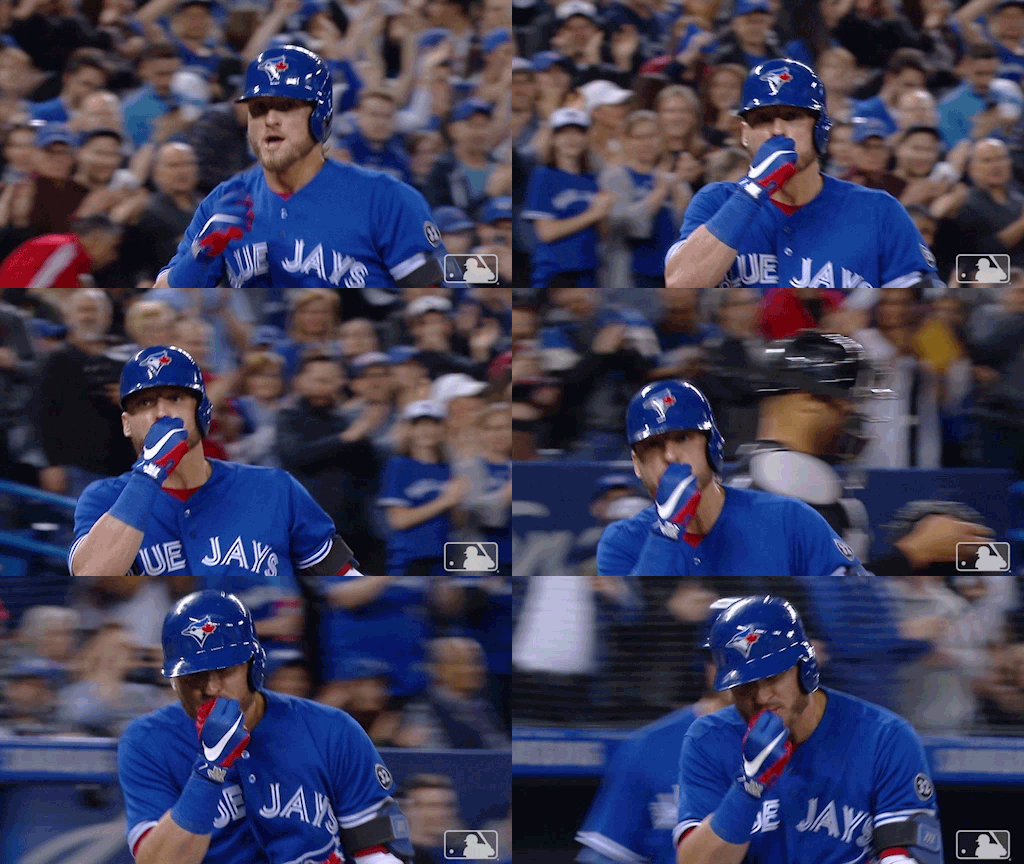
Why is this noteworthy? On April 2, Toronto’s Josh Donaldson played the role of Frank Robinson against the White Sox, homering against Reynaldo Lopez, then miming a whistle at the Chicago dugout while hopping back to his dugout. The most noteworthy part about it: The White Sox didn’t care.

There is, of course, some backstory.

White Sox first base coach Daryl Boston has for several years used an actual whistle to get the attention of his outfielders when he wants to reposition them from the dugout. He also toots it to celebrate good plays, behavior that has not gone unnoticed around the league. Before the game, Donaldson was talking to White Sox hitting coaches Todd Steverson and Greg Sparks, for whom he played in the A’s system, and mentioned that he’s not a particular fan of Boston’s whistle.

Of course, this information was relayed to the coach, and of course the coach responded via whistle—“a little peep-peep” is how Boston put it in a SportsNet report—at Donaldson when he stepped into the on-deck circle during the game.

So, after homering, Donaldson felt free to do what he did. And Boston loved it.

“I got a kick out it because I didn’t find it disrespectful at all,” the coach said. “The downside of it is I may have got caught on video laughing after us giving up a home run. That’s the one thing I felt bad about. But other than that, it’s all in fun.”

The following day, Donaldson used Too$hort’s “Blow the Whistle” as his walk-up song.

All in fun, indeed. There is still a place for players who hew to the serious business of respecting each other, but there are moments in the modern game like never before, when one can cut loose and simply have fun without fear of thin skin or repercussions. The Puerto Rico team showed us that implicitly in last year’s World Baseball Classic, and MLB appears to be following right along, to varying degrees.

Look no farther than Donaldson for evidence. “The whole time I was [blowing the whistle] to [Boston] he had the biggest smile on his face,” he said. “It was good and I’m glad—you always hear about these unwritten rules of baseball and all that jazz—well, I think you’re starting to see some of that change in a positive manner. Not to where I’m trying to disrespect them or they’re trying to disrespect me. We’re out there having fun and competing against each other.”

If there’s an actual quibble here, it’s with Boston, not Donaldson. Various members of the Kansas City Royals have already taken issue with his whistle practice, and it’s not beyond the pale to think that other opponents might also consider celebratory whistling to be juvenile and rude. Even in the modern embrace-the-celebration landscape, a coach with a whistle does seem a bit odd. Mostly, though, it serves to recall a story from The Baseball Codes, concerning the ability of former New York Yankees pitcher Bob Turley to quickly decipher an opposing catcher’s signs while stationed in the first-base coach’s box:

Turley’s relay system was simple—he’d whistle whenever a pitch was different from the last one. Hitters would start every at-bat looking for a curveball, and if a fastball was coming, so was Turley’s whistle. He’d then stay silent until something else was called. The pitcher was so good that when he went on the disabled list in 1961, manager Ralph Houk wouldn’t let him go home, instead keeping him with the team to decipher pitches. (Roger Maris, in fact, hit his sixty-first home run of 1961 on a pitch he knew was coming because third-base coach Frank Crosetti, doing his best Turley imitation after watching the pitcher for years, whistled in advance of a fastball.)

Eventually, people began to catch on. Among them was Detroit Tigers ace Jim Bunning, who grew increasingly angry as Turley whistled and the Yankees teed off during one of his starts. Finally, with Mickey Mantle at bat, Bunning turned to Turley in the first-base coach’s box and told him that another whistle would result in a potentially painful consequence for the hitter. Sure enough, Turley whistled on Bunning’s first pitch, a fast­ball at which Mantle declined to swing. With his second offering, Bun­ning knocked Mantle down. The on-deck hitter, Yogi Berra, could only watch in horror. When it was his turn to bat, Berra turned toward the mound, cupped his hands around his mouth, and shouted, “Jim, he’s whistling, but I ain’t listening.”


Bunt appropriately, Don't Bunt to Break Up a No-Hitter

In Wake Of When-To-Bunt Talk, Simmons Bunts Whenever The Hell He Feels Like It, World Continues To Turn

Simmons bunts

A week into the season and we’re neck deep in When Not to Bunt waters. Unlike Chance Sisco’s effort against the Twins on Sunday, Anaheim’s Andrelton Simmons actually dropped one down yesterday while Corey Kluber was tossing a no-hitter. Also unlike Sisco, that’s an actual violation of the unwritten rules.

Sometimes.

If a team is behind by a reasonable margin in the late innings of a no-hitter, the theory holds that it is incumbent upon them to avoid resorting to trickery to ruin a masterful effort. Fair enough.

Yesterday, however, when Simmons noted the deep positioning of third baseman Jose Ramirez, it was only the fifth inning. Even more pertinently, the Angels trailed only 2-0 at the time. By reaching base, Simmons brought the tying run to the plate in the person of Shohei Otani.

It paid off when Otani homered, tying the game and allowing LA to win it in the 13th.

To their credit, unlike various members of the Twins, Cleveland players didn’t much complain about it, probably because it was so obviously kosher. Here’s hoping whoever next encounters something similar will feel the same way.


Bunt appropriately, Don't Bunt to Break Up a No-Hitter

Dozier Doubles Down on Blowout Bunt Talk

Dozier

Brian Dozier wants to explain himself.

After invoking baseball’s unwritten rules in ridiculous ways on Sunday to defend his disenchantment with the fact that an opponent had the audacity to bunt against the Twins’ shift, he felt some clarity was in order. So he continued to talk.

It all had to do, he said on Monday, with the fact that Baltimore had, an inning earlier, failed to hold Minnesota’s Ryan LeMarre on base after he’d singled in the ninth. The game situation—a 7-0 twins lead—was nearly identical the one that Dozier found so offensive only moments later.

“When they didn’t hold our runner on, they conceded to the fact they didn’t want us to steal, so we didn’t steal,” Dozier said in a Pioneer Press report. “We could have very easily stolen and put up more runs, so therefore in return you don’t bunt. That’s what everybody is missing in this whole thing.”

It’s an interesting point. In Dozier’s reading, the Orioles tacitly approved late-game blowout tactics by not holding LeMarre close to first, thereby giving themselves a defensive advantage by positioning first baseman Chris Davis in the hole rather than tethering him to first base. Adhering to the Code, LeMarre stayed put, and did not attempt to steal.

It was a classic example of straightforward blowout tactics, fanciness stripped out in favor of straight-up baseball designed to push the pace and end things quickly. The point that Dozier seems to have missed is that Minnesota’s shift against Sisco was not that. Positioning three fielders to the right side of second base is anything but straight-up baseball, and if the Twins felt that the game situation was insufficient to dissuade them from doing so, they had no business complaining that the game situation was insufficient to dissuade Sisco from responding.

Bill James, meanwhile, made an equally ludicrous suggestion on the opposite side of the argument:

Ignore for a moment the idea of suspension for the outspoken members of the Twins, because James’ suggestion doesn’t apply here. Sisco wasn’t trying to win the game, he was trying to beat the shift, down seven runs with the bases empty and two outs to go. There’s value in that, even during a blowout. If Sisco wants to leverage the bunt as a means of getting teams to stop shifting on him, a lopsided score should not interfere with an opportunity to do so. It had little to do with winning.

As for James’ idea of MLB implementing thought police, it’s pure fantasy, and he knows it. It’s analogous to the idea of automatically suspending pitchers who throw at batters, which would lead to a number of issues, none bigger than the impossibility of determining intent. Who in baseball would want to be charged with containing that morass? With that in mind, under James’ proposed rule, what kind of comments would be okay for players to make, and who would judge the gray area, and how would a team’s fan base react to a star player being suspended for having thoughts?

In a league where good vibes rule and the commissioner would love nothing more than for every ounce of drama to be contained to the field, this suggestion would blow up in fabulous and unexpected ways. James doesn’t strike me as the type to say sensational things simply to garner attention, but this statement certainly qualifies.

Bunt appropriately, Don't Bunt to Break Up a No-Hitter

Ninth-Inning Bunt Bothers Berrios, Twins Talk Tersely About Turf Tactics

Cisco bunts II

We didn’t even make it out of the season’s opening weekend before being hit with 2018’s first Guy Who Bunted When He Shouldn’t Have Bunted controversy.

We’ve rehashed the most famous example of this, Ben Davis breaking up Curt Schilling’s perfect game in 2001, many times now. Davis was a slow-footed catcher who had no business doing what he did, save for one detail: The score was 2-0 in the eighth inning, and by reaching safely Davis brought the tying run to the plate. One dictate in baseball’s unwritten rulebook is incontrovertible: winning trumps everything, and Davis had just given his team its best chance at pulling out a W.

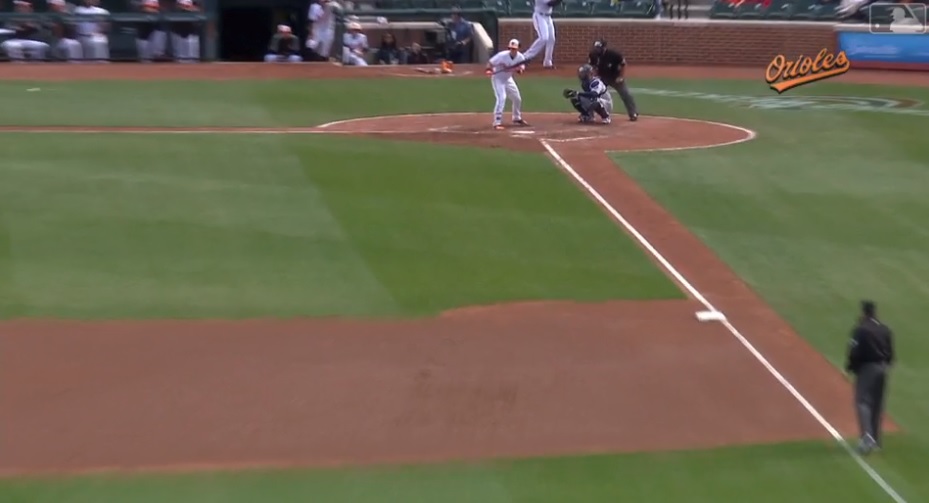
Yesterday in Baltimore, another catcher, rookie Chance Sisco, dropped down a ninth-inning bunt against Twins starter Jose Berrios, who was two outs from wrapping up not only the first shutout of his career, but the first complete game. Berrios, however, had already given up a hit—a double in the third, also to Sisco—so he should have been cool with it, right?

Right, except for this: The Twins led, 7-0, a point at which—with one out and nobody on in the ninth inning—baseball etiquette dictates that players stop trying to get cute and play simple, straight-up baseball. That means a lack of nibbling around the corners for pitchers, and nothing but hard hacks for hitters. The sooner a blowout ends, the quicker everybody can go home.

“Obviously, we’re not a fan of [Sisco’s bunt],” said Twins second baseman Brian Dozier after the game, in an MLB.com report. “He’s a young kid. I could’ve said something at second base, but they have tremendous veteran leadership over there with Chris Davis, Adam Jones and those guys. I’m sure they’ll address it and move forward. It’s all about learning up here.”

“It’s not good for baseball in that situation,” said Berrios. “That’s it.”

Okay, then. So Sisco shouldn’t have bunted. Right?

Right, except for this: Despite their lead, the Twins were employing a full shift against the rookie. Another unwritten rule says that when a defense calls off the dogs late in a blowout, the offense will not take advantage. Usually this refers to opting against holding a runner on first base, with the understanding that said runner will not attempt to steal second. Like the hard-hacks theory above, it’s aimed at more quickly reaching a conclusion that is virtually inevitable. With the game out of hand, positioning the first baseman back gives the defense a better chance to make a play.

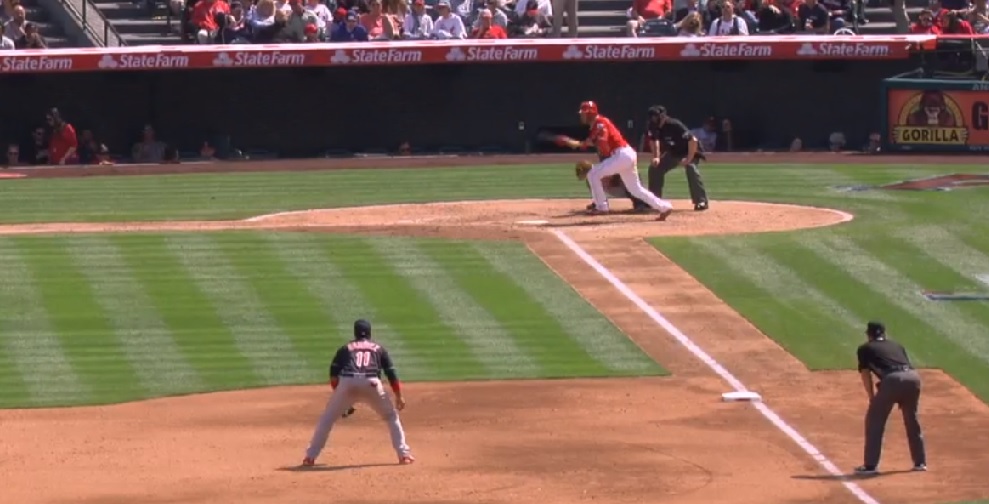
That said, there’s a difference between playing one’s first baseman back with a man aboard, and what happened yesterday. The Twins were trying to end the game quickly by deploying what they felt was their most effective defensive formation, but such extreme shifts allow opponents unfettered opportunities to bunt down the line. By exploiting such a glaring hole, Sisco did his part—as, frankly, most hitters should—to make Minnesota consider the ongoing value of shifting against him like that. It was part of a long game, and the catcher had every right to take advantage.

If the Twins want to cede the possibility of such an outcome, they shouldn’t be all too surprised when it happens. And they sure as hell shouldn’t whine about it afterward.

Cisco's field
Minnesota’s defense as Sisco’s bunt rolls. That’s a lot of line.

Related: Dozier Doubles Down on Blowout Bunt Talk (4-4-18)