Mike Matheny is apparently not a fan of rookie treatment, at least when it comes to umpires. On Thursday, St. Louis’ first-year first baseman Matt Adams struck out in the ninth inning, on what he considered to be a high, inside pitch. He questioned plate ump Dan Belino, then, on his way back to the dugout, turned around and questioned him again.
Belino shooed him away. The gesture was more than Matheny was willing to tolerate. Once closer Kevin Gregg had sealed the Cubs’ 3-0 victory moments later, Matheny raced toward Belino, to the point of necessitating restraint from the rest of the umpiring crew. (Watch it here.)
His frustration, he told reporters after the game, had less to do with the strike call than “with the umpire and how he mistreated one of our players, Adams.”
“It’s ridiculous,” Matheny said. “You can’t take your mask off and motion somebody away. We had not had any trouble. We hadn’t been complaining all game long. He wanted to be seen, so now he’s going to be seen.”
There is, however, something else at play: If the unwritten rule that labels such a display disrespectful constitutes one side of the coin, the other side is covered by the notion that rookies must earn their place in the game. This is true within clubhouse hierarchies, and it is true when it comes to umpires. Although it is generally less prevalent now than in past generations, umpires throughout the game’s history have taken the position that young players must earn their respect, and will test them accordingly to push the issue.
Last year Bryce Harper felt it with Angel Hernandez’s strike zone. If it was a test, Harper failed, badly.
A similar story comes to us courtesy of Hall of Famer Catfish Hunter. In his autobiography, Catfish: My Life in Baseball, he described a confrontation during his rookie season in 1965:
One of the biggest lessons I learned came courtesy of senior umpire Ed Runge. “You’ll like this guy, Cat,” my teammates told me the first time Runge was behind the plate. “He gives you everything.”
Great. A friend in high places. I fired my first pitch, a fastball, right down the middle.
“Ball,” screamed Runge, yanking off his mask like someone had just yelled “Fire!” He stared out at the mound, begging me to argue. I didn’t say a word.
Another pitch. Another fastball right down Main Street.
“Ball two!”
Same yank. Same look. Still I don’t say boo.
We play the same game a couple of more times—me throwing strikes, Runge playing hard to please—and still I don’t let out a peep. A few weeks later Runge is set to go behind the plate again. Before the game, we happened to meet.
He gives me a quick once-over. “I see you don’t argue with umpires, kid.”
“No, sir,” I said.
A smile. “It’s a good thing.”
From then on I was a card-carrying member of the Ed Runge Club. Anything close was a strike. I’d passed the test.
Credit Matheny for protecting his players, but if Belino was hoping to see from Adams something similar to the deference that Runge got from Hunter, he’s going to have to wait a while.
The official Cincinnati Reds Twitter feed mentioned Homer Bailey‘s no-hitter 12 times before he completed it, not to mention a steady stream of references during the telecast by broadcaster Thom Brenneman. It was the second straight no-no in which Bailey was karmically messed with.
It was a classic misdirection. With an 0-2 count on Miguel Cabrera to open the 10th inning on Saturday, Fernando Rodney sent a 100-mph pitch so outside the strike zone that catcher Jose Molina could not get a glove on it. Wildness thus established, he followed it up with a pitch near Cabrera’s head.
In many respects, the pitch was perfectly placed. It tailed in at the last moment, but was easily trackable by the batter and was never in danger of hitting him. Cabrera leaned back to avoid it, but it would not have made contact even had he remained still.
The strategy was also sound. The previous day, Cabrera had homered twice (and didn’t help matters by celebrating that game’s final out by performing what appeared to be an imitation of Rodney’s archer pose, which the closer strikes following saves). Cabrera leads the major leagues in batting average, RBIs and OPS, and is second in home runs. It was without doubt in Rodney’s best interest to make him as uncomfortable at the plate as possible.
And it worked. Cabrera flailed at the next pitch, a down-and-in changeup, for strike three.
Perhaps Cabrera’s displeasure was compounded by the result of his at-bat, but upon reaching the dugout he spent a considerable amount of time gesturing toward, and yelling at, Rodney. (Watch it all here.)
The pitcher was obviously not trying to hit Cabrera during extra innings of a 3-3 game. Even if he was, it is given wisdom that such a strike is far easier to execute when aiming at the torso than at the head, which is a smaller and more maneuverable target. Much more likely was that Rodney wanted to crimp Cabrera’s style—get him out of the dangerous space in which he’s resided all season—and either A) misjudged the height of his inside pitch, or B) didn’t care.
Cabrera didn’t comment afterward, but his manager, Jim Leyland, did.
“I don’t care about throwing inside but I don’t like it up there,” Leyland said in an MLB.com report, referring to Cabrera’s head. “We will not tolerate that. You can take that to the bank. We won’t tolerate that up to the head to anybody. … That will cause a lot of problems for people.”
It caused problems for Ben Zobrist on Sunday, when, with two outs and nobody on base in the first inning, Tigers starter Rick Porcello drilled him in the back with a 94-mph fastball. It was intentional and it was expected. Plate ump Vic Carapazza quickly warned both benches.
Cabrera got his own measure of revenge three innings later, when he crushed a homer into the Rays Touch Tank—only the second such blast in the ballpark’s history.
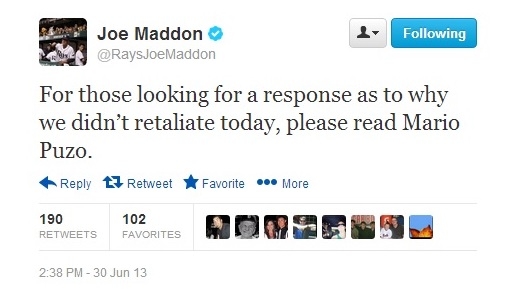
Despite Cabrera being “a little sensitive,” according to Zobrist, the Rays left it at that. Except of course, for the final explanation offered by Maddon for their lack of further response. Via Twitter:
To gauge it by the wisdom of the author of The Godfather, the Rays, apparently, will not forget this slight. Considering that they won’t face Detroit until next season (or in the playoffs), however, their memories will have to hold for a while.
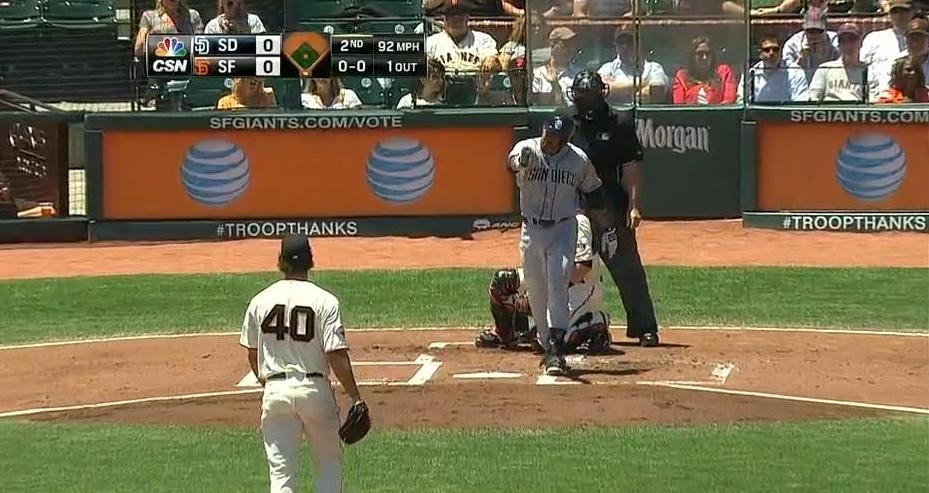
On Tuesday, Jesus Guzman belted an eighth-inning, two-run, pinch-hit homer against Giants reliever Jeremy Affeldt to give the Padres a 4-3 lead. This excited him.
He watched the blast. He walked down the line. He held his bat. Eleven steps from the plate he spun 180 degrees, still moving toward first, and, with his back to the pitcher, bellowed toward his teammates in the first-base dugout.
Clearly, the Giants were not amused. How clear became evident during Guzman’s first at-bat on Wednesday, when Madison Bumgarner threw his first pitch waist-high and behind the batter. Guzman shouted toward the mound and pointed his bat at Bumgarner, all while taking the slow steps of a man with no intention of trading punches. (Bumgarner, however, veritably tore down the mound to establish a closer confrontation, and was restrained by on-deck hitter Yasmani Grandal and plate ump Tony Randazzo.)
Although dugouts emptied, each bench was warned and order was quickly restored. (Watch it all here.)
“I was enjoying the home run with my teammates,” Guzman said of his Tuesday night blast, in an MLB.com report. “I wasn’t trying to be disrespectful of their team.”
That may well be true, but even the greenest big leaguer, let alone a guy with four years’ experience—who, by the way, came up with the Giants in 2009 and was a teammate of Affeldt’s—should realize that such a display will almost inevitably be taken poorly.
Bumgarner’s response—a warning shot across the bow, as it were—got the point across: Think for a moment before doing something like that against us again. (Bumgarner, for his part, left his postgame response to the phrase, “There’s no need to comment on that.”)
Ultimately, however, it was Guzman who held the retaliatory trump card. Leading off the seventh against Bumgarner in a 1-1 game, he crushed a home run deep down the left field line. (Watch it here.)
This time he faced the appropriate direction, and ran every step of the way.
It’s almost as if the commissioner’s office was warming up for Dodgers-Diamondbacks fallout from Tuesday night’s throwdown at Chavez Ravine.
On Wednesday baseball suspended Giants reliever George Kontos for three games, and manager Bruce Bochy for one, following an incident in Pittsburgh on Tuesday in which Kontos hit Andrew McCutchen with a pitch after benches had been warned.
With the Giants down 8-2 in the eighth inning, Kontos threw a ball behind Starling Marte. It was likely a response to an incident an inning earlier, when Marco Scutaro was knocked from the game (and, as was found out later, from the lineup for an extended period) by a Tony Watson pitch, and was enough to draw a warning from plate ump Wally Bell.
The lack of contact may not have been enough to satisfy the pitcher, who drilled McCutchen in the backside two hitters later. With warnings in effect, Bell didn’t hesitate to toss him. (Watch it here.)
It was a reasonable response by the umpire. Then again, the pitch in question was a tailing sinker that drifted right, hardly a laser-guided bullet. From MLB.com:
The genesis of McCutchen’s plunking occurred one inning earlier, when he singled leading off against Kontos.
“First pitch of the seventh inning, he put a really good swing on it,” Kontos said, “and they were hacking early and out over the plate, so I was trying to pitch inside. A sinker got away from me a little bit.”
(To add to Kontos’ woes, he was sent to Triple-A Fresno after the game; he’ll serve his suspension upon being recalled. Also, it was his 28th birthday. Still, wrote CSN Bay Area’s Andrew Baggarly, it could have been worse: Kontos tore his elbow ligament while pitching on his birthday four years ago.)
It’s difficult to fault Bell for his decision, though it’s fair to ask whether Kontos’ actions were suspension-worthy. Ultimately, it’s irrelevant: Between this incident, the one in Los Angeles on Tuesday and Monday’s Red Sox-Rays dustup, MLB must be freaking out just a little bit, and responded accordingly.
Some will blame baseball’s unwritten rules, the sport’s ingrained system of on-field justice, for last night’s disgraceful display at Chavez Ravine. They will decry the eye-for-an-eye mentality, the brutal delivery of fastballs and the ugly results of the punch-throwing scrum in the seventh-inning.
What they will not acknowledge is that baseball’s unwritten rules exist precisely to avoid this kind of confrontation. Because Tuesday night’s throwdown between the Dodgers and Diamondbacks was a study in what not do during the course of a baseball game as it pertains to baseball’s Code.
Retaliation for an incidental drilling—especially one so incidental that it required umpire intervention to confirm that it even happened—is simply not necessary. This was the state of affairs after Cody Ross was grazed by a Zack Greinke pitch in the fifth inning.
Even if what happened next was retaliation for Ross, it would at least give Ian Kennedy a reason for his actions, no matter how insufficient. In the sixth inning, the D-Backs right-hander ignored the tenet mandating that one never drill a batter intentionally above shoulder level, and hit Yasiel Puig in the nose with a 92-mph fastball. Puig remained on the ground for several minutes while trainers attended to him. (Watch it here.)
Greinke responded an inning later by hitting Miguel Montero between the numbers. Usually, when catchers are hit in a retaliatory fashion, it is because they called for the pitch that made the retaliation necessary in the first place. In Montero’s case, had Kennedy’s pitch to Puig hit the catcher’s glove it would have ended up below the knees. (Watch it here.)
Regardless, that blow should have ended hostilities. Kennedy drilled a Dodger in a wildly inappropriate manner, and Greinke responded according to the Code. It wasn’t enough to settle Kennedy down, however. In the bottom half of the seventh, he threw his first pitch to Greinke—another 92-mph fastball—directly for the head. Greinke ducked and the ball glanced off his upper shoulder.
Usually, benches clear when an aggrieved hitter—somebody who has just been hit or knocked down—takes issue with the pitcher. Ron Washington once described the situation this way, back when he was the third-base coach for the A’s and Frank Thomas, the team’s designated hitter, had been drilled by Ted Lilly. “We all saw what happened, but Frank took it calmly, so we took it calmly,” he said. “If Frank had taken it with an uproar, we’d have taken it with an uproar. We have to wait for the reaction of the guy who it happened to. If Frank had charged him, there would have been a fight. If Frank had raised some hell going down to first base, we’d have raised some hell. But Frank took it calmly and went on down there, the umpire checked everything, and we played baseball.”
On Tuesday, Greinke did take it calmly. It was his teammates—led by Puig—who escalated things from that point, racing from the dugout and quickly getting physical. (Watch it here.) The rest of the action was described succinctly by Nick Piecoro of the ArizonaRepublic:
Reliever J.P. Howell charged at Diamondbacks assistant hitting coach Turner Ward and nearly flipped him over a railing near the on-deck circle. Puig appeared to land a tomahawk swing on Diamondbacks’ bench player Eric Hinske. Dodgers hitting coach Mark McGwire looked apoplectic as he exchanged words with Diamondbacks manager Kirk Gibson and third-base coach Matt Williams. Even Dodgers manager Don Mattingly got in on the action, wrestling Diamondbacks bench coach Alan Trammell to the ground.
Only two things happened as they should have. First was Dodgers catcher Tim Federowicz jumping in between Montero and Greinke after the former was drilled in the seventh. (It was the inability of the Dodgers’ other catcher, A.J. Ellis, to do that very thing that allowed Carlos Quentin to reach the mound during the April brawl that ended with Greinke’s collarbone broken.) The other was Greinke, on first base after being drilled, responding by trying to take out Arizona shortstop Didi Gregorius with a hard slide at the front end of an attempted double-play—just like they used to do in the old days. (Greinke ended up getting a no-decision in the Dodgers’ 5-3 victory. Watch it here.) Ultimately, the primary takeaway from this unfortunate state of affairs was that Ian Kennedy threw two pitches at opponents’ heads in a two-inning span. The guy has already proven willing to harbor ill-will against the Dodgers, throwing two pitches at Clayton Kershaw last season in response to a year-old grudge. Even more pertinent is the fact that he seems to enjoy this kind of thing. Last year he led the National League with 14 hit batters, even with otherwise good control—he walked only 55 over more than 200 innings. The Dodgers will get theirs, at some point. In the interim, MLB will certainly step in and get some of its own. Had the unwritten rules worked as intended, none of it would have been necessary.
As soon as John Lackey drilled Matt Joyce in the back with a 90-mph fastball in the sixth inning of Monday night’s game, people were already speculating how far back the antagonism ran.
Did it date back to the second inning, when Joyce connected for a mammoth foul ball to right, then dropped his bat—“styled,” in the words of MassLive writer Evan Drellich—as if he’d just homered?
Did it date back to the first inning, when Joyce actually did homer?
Lackey did some yelling toward the Rays dugout after Joyce’s second-inning pimp show. After being hit, Joyce pointed toward Lackey amid a slurry of what is safe to assume was epithets, then got into a pushing match with Jarrod Saltalamacchia when the catcher cut off his path to the mound. That was when benches emptied, although no punches were thrown. (Watch it discussed on MLB Tonight, complete with clips.)
Joyce actually thought that it was none of the above.
“As far as I understood, he was pretty upset that I dropped my bat on that 3-0 swing,” Joyce said in a Tampa Tribune report, describing the count when he pulled his second-inning ball foul. There is indeed an unwritten rule about restraint from swinging at 3-0 pitches, but it only applies late in blowout games—never in the second inning.
In case there was doubt about Joyce’s personal view of possible impropriety, it was cleared up by what he said next: “I was actually pretty upset myself I had such a good pitch to hit and missed it. I usually never drop the bat.”
In a close game (the Red Sox would win, 10-8, in 14 innings), Tampa Bay settled for a low-impact response—in the seventh inning, reliever Joel Peralta threw his first pitch, to Dustin Pedroia, high and tight. (Even that is up for interpretation; it was a 79 mph curveball.)
Beyond that, Lackey denied intent and was alternately defended by one manager (his own) and criticized by the other.
While the easy answer is that hostilities started with Joyce’s second-inning swing, the reality is that whenever something happens between these teams it’s almost expected. Their relationship over the last decade-plus has been testy enough to have inspired an entire section in The Baseball Codes; between 2000 and 2008, it seemed like every one of their meetings added another chapter to their collective book of spite, and things have hardly slowed from there. A condensed excerpt:
* August 2000: Boston’s Pedro Martinez hits Gerald Williams on the hand with his fourth pitch of the game. Williams charges the mound, shoving the much smaller Martinez to the ground and lands a glancing blow to his face. Benches empty, during which Boston’s Brian Daubach dives into the scrum, where Tampa players accuse him of taking cheap shots. The commissioner’s office eventually rules that Daubach acted appropriately, but by the time the game ends, Daubach has been thrown at by a succession of Devil Rays pitchers, starting with Dave Eiland—who wants to hit him so badly that, with two on and nobody out in the third inning, he sends his first pitch spinning toward Daubach’s head. The hitter manages to avoid that one, but can’t get out of the way of Eiland’s next pitch, which drills him in the body. Shortly therafter Eiland hits Nomar Garciaparra and is tossed from the game. His replacement, Cory Lidle, is himself ejected after throwing a pitch behind Daubach. Lidle’s replacement, Tony Fiore, lasts all of two pitches before finishing the job, drilling Daubach with his third offering and spurring another confrontation between the teams.
* September 29, 2000: Tampa Bay eliminates the Red Sox from the AL East race with an 8–6 victory. From the mound, Rays closer Roberto Hernandez waves a sarcastic bye-bye to the Tropicana Field visitors’ dugout.
* 2001: Over the course of the season, Devil Rays pitchers hit eleven Boston batters; Red Sox pitchers tag nine Tampa hitters.
* May 5, 2002: Devil Rays pitcher Ryan Rupe hits both Garciaparra and Shea Hillenbrand in the first inning, a day after each was instrumental in helping Boston overcome a 5–2, ninth-inning deficit. Boston’s Trot Nixon lets go of his bat on a swing, sending it flying toward the mound. Red Sox pitcher Frank Castillo responds by hitting Tampa’s Randy Winn. Both Castillo and Nixon are suspended.
* July 18, 2002: The day after Manny Ramirez scorches the Devil Rays with a home run and a double, he’s hit by Tampa starter Tanyon Sturtze. Boston’s Frank Castillo hits Tampa Bay second baseman Brent Abernathy in the third, and reliever Tim Wakefield hits him again in the fifth. In the ninth, Devil Rays reliever Esteban Yan just misses Ramirez’s head as the slugger ducks, and the ball glances off his shoulder. “You can’t act like what happened never happened,” says Derek Lowe in the Boston Herald. He also says, “Every year, why is it always this team?”
* September 9, 2002: Lowe keeps wondering after being ejected for hitting Devil Rays shortstop Felix Escalona with a pitch. The following night, Tampa Bay reliever Lee Gardner, pitching in the eighth inning of an 11–1 Boston runaway, is ejected for hitting second baseman Lou Merloni.
* September 27, 2004: Red Sox starter Bronson Arroyo keeps relations testy by hitting both Aubrey Huff and Tino Martinez in the third inning. Devil Rays pitcher Scott Kazmir retaliates by hitting Manny Ramirez and Kevin Millar in consecutive at-bats an inning later, emptying the benches. Kazmir is ejected.
* April 22–24, 2005: Five batters are hit in the first two games of a three-game series between the teams. In the third game, Arroyo hits Huff—7-for-10 lifetime against him—for the second time in as many seasons. An inning later, Devil Rays reliever Lance Carter throws a pitch behind Ramirez’s head, eliciting warnings for both benches. One pitch later, Ramirez belts a home run. Carter then throws at the head of the next hitter, David Ortiz, who has to be restrained by catcher Toby Hall. Dugouts empty, and Carter, Trot Nixon, Tampa Bay manager Lou Piniella and pitcher Dewon Brazelton are ejected. In the seventh, Arroyo hits leadoff batter Chris Singleton on the thigh, earning his own ejection. In a radio interview on WEEI after the game, Boston pitcher Curt Schilling blames Piniella: “Players on that team are saying, ‘This is why we lose a hundred games a year, because this idiot makes us do stuff like this.’ ” A day later, also on the radio, Piniella says, “I have forgot more baseball than this guy knows.”
* March 27, 2006: After tagging out Tampa’s Joey Gathright at the plate during a spring-training game, Boston reliever Julian Tavarez stands on the baserunner’s arm, he says, so that Gathright couldn’t “throw a punch at me right away.” Tavarez then hits Gathright in the jaw while the outfielder is down on one knee. Gathright later says that Tavarez “hits like a woman.” Devil Rays outfielder Carl Crawford subsequently challenges the pitcher to a post-game fight in the parking lot.
* June 5, 2008: The highlight of five hit batters on the night is Boston outfielder Coco Crisp’s charge of the mound after being drilled by right-hander James Shields of the Rays, who by this time have dropped the “Devil” from their name if not their attitude. Shields is responding to Crisp’s hard slide into second baseman Akinori Iwamura the previous night, which was itself a response to Tampa Bay shortstop Jason Bartlett using his leg to block Crisp’s headfirst slide into second. Shields misses with a roundhouse right, and Crisp— with 17 knockouts to his credit in 17 amateur boxing matches as a youth—is able to land one shot of his own before being overwhelmed by a scrum of Rays, primary among them Crawford and Johnny Gomes, who shower blows upon him. (After the game, Crisp says that the Rays were like “little girls, trying to scratch out my eyes.” Shields had already hit Dustin Pedroia in the first inning, and Boston’s Jon Lester responds by hitting Crawford, then Iwamura. Tampa Bay reliever Al Reyes closes the festivities by drilling Kevin Youkilis in Boston’s final at-bat.
* October 10, 2008: In Game 1 of the ALCS, Rays reliever Grant Balfour sends a fastball toward the face of Boston outfielder J. D. Drew, which catches the slugger’s shoulder as he spins to avoid it. Barking ensues, and the seven-game series is so tight that even four more hit batters (two from each team) over the remaining games do little to raise the tension.
Things hardly ended there. There were the three times Tampa Bay’s Luke Scott was hit by Boston pitchers over a three-game span in 2012—the last of which ended up in a brawl. (Red Sox reliever Franklin Morales threw a fastball behind Scott’s back, then two inside, then finally drilled him in the leg. Earlier, Pedroia had been drilled, and a pitch thrown over Daniel Nava’s head.)
There were words last March, when Alfredo Aceves drilled Sean Rodriguez in the shoulder, one at-bat after he had homered.
All of which gives some context to Monday night’s dustup. Just another day at the office, it seems.
When a pitcher clearly has no intention of hitting a batter, the act is unlikely to draw much in the way of rebuke. When it happens three times in the same game, however, to the same batter, you better believe that an eyebrow will be raised.
On Tuesday, Cardinals second baseman Matt Carpenter hit the trifecta against Arizona. More appropriately, Arizona hit the trifecta against Carpenter. None of the pitches came close to looking intentional.
* First time: Seventh inning, St. Louis trailing by one run and a man on first with one out. Not a situation for a pitcher to make a statement, not to mention that the ball hit Carpenter’s hand as he was squaring to bunt.
* Second time: Ninth inning, one out in a tie game. Again, not a situation for a pitcher to make a statement.Carpenter was hit on the forearm with a pitch that darted inside at the last moment.
* Third time: This looked like the most intentional of the bunch, but drilling somebody on purpose in the 13th inning of a tie game is simply not done. (Watch them all here.)
There was no lingering disagreement between Carpenter and an angry D’Backs pitcher, because each of his HBPs came against a different guy. For each of the pitches the catcher was set up inside.
“That’s what they wanted to do to me and a couple of other left-handers,” said Carpenter, who was hit three times all last season, in the St. Louis Post-Dispatch. “I wouldn’t expect anything different. You miss in two spots. Either you miss over the plate or you miss and hit somebody. It’s just the way it is when you pitch inside.”
Still, a three-pack of HBPs is a three-pack of HBPs. The Cardinals, however, were walking a fine line when it came to payback on Wednesday. St. Louis already had a short bullpen due to a doubleheader last week; the 14 innings on Tuesday added additional strain. Also, Yadier Molinadropped his suspension appeal following his recent ump-bumping incident (itself laden with unwritten rules) and sat out Wednesday (which he would have done anyway, following Tuesday’s marathon).
All of which is to say that St. Louis, already undermanned, could hardly afford to have a pitcher or a catcher tossed in the name of fulfilling retaliatory expectations. Were there going to be payback, it had to be subtle.
And it was, right there in the first inning. When Carpenter’s second-base counterpart on the Diamondbacks, Willie Bloomquist, came up for his first at-bat on Wednesday, he was buzzed—a fastball came in just under his armpits—not drilled. The Cardinals left little doubt that they were paying attention.
Cardinals broadcasters Dan McLaughlin and Ricky Horton (a former big league pitcher himself) summed it up nicely on the telecast:
DM: There’s someone from Arizona who needs to properly, professionally get one in the ribs or the back, because Matt Carpenter was hit three times last night.
RH: I think that we just saw it.
DM: That’s not enough if I’m Matt Carpenter. What did that prove? You pitched inside. So what?
RH: Well, he came in way inside, with the idea. I think the message was sent. There was no pain to it, if that’s what you’re looking for.
DM: I want pain. [Laughs]
RH: I thought that’s where you were headed with that.
DM: Pain, Rick.
RH: Well you have the message and you have pain, Dan. You’ve sent the message and maybe you were a little light on the pain.
McLaughlin clarified that he was kidding about the pain, Horton added that a subtle message worked just fine in this situation, and everybody appeared to be happy to move on.
(St. Louis pitchers did hit Bloomquist in the seventh, and shortstop Didi Gregorius twice, but all seemed to lack intent. Gregorius was hit by a 74 mph slider with a runner on second and nobody out in a one-run game, Bloomquist was hit later that inning with two men on in a tie game, and Gregorius was hit again in the eighth with a splitter.)
Questions about delayed payback were answered on Thursday, when the Cardinals faced a 12-2 deficit in the sixth, and opted not to drill any Arizona hitters.
It all adds up to a lot of thought devoted to a series of unintentional events, but that’s the way the game is played.
Serious thanks to Cards fan Chris C. for the heads-up and broadcast transcription.
When Orioles starter Jason Hammel drilled Detroit’s Matt Tuiasosopo on Saturday, nobody on either team felt strongly that he did it on purpose. The fact that there is no such thing as an 82-mph purpose pitch—which is where Hammel’s fateful offering clocked in—did not dissuade plate ump Hunter Wendelstedt from ejecting the right-hander on the spot.
It being the first pitch after back-to-back-to-back home runs, not to mention its location up near the batter’s head, will put a ballpark in that kind of mindframe. After all, the reasoning goes, even if Hammel didn’t meanto drill Tuiasosopo, perhaps he should have—especially after Victor Martinez, Jhonny Peralta and Alex Avila just went deep. When one’s strategy as a pitcher isn’t working out quite as one had hoped—and make no mistake, three straight bombs under any circumstance will make a pitcher question his strategy—the only prudent plan is to change things up.
Put another way: If a team is getting far too comfortable at the plate, make them less comfortable. Starting immediately. (Watch the drilling here. Watch the homers here.)
So when Hammel’s actions followed the script—even if, in retrospect, his intention appears to have been elsewhere—an umpire can hardly be faulted for ignoring the finer points of the situation. After all, there is plenty of historical precedent on which to build. A small sampling, culled from a long-ago post detailing four straight homers hit by the Diamondbacks (which focused more on the outdated unwritten rule of restraint from swinging at the first pitch after back-to-back—or more—home runs):
In 1944 Cardinals Walker Cooper, Whitey Kurowski and Marty Marion hit consecutive homers against Reds pitcher Clyde Shoun. The next hitter, Marty Marion, was knocked down.
In 1991,Angels pitcher Scott Bailes hit Randy Velarde of the Yankees after giving up consecutive home runs.
In 1996, after the Red Sox connected for three home runs against the Angels, reliever Shawn Boskie threw a pitch behind Jose Canseco’s back.
In 2003, Astros pitcher Shane Reynolds gave up three home runs to the Pirates, then put a pitch under the chin of Brian Giles.
Mike Hegan, addressing the mindframe if not the actual scenario: “In April of 1974, I hit behind Graig Nettles the whole month. Graig hit 11 home runs, and I was on my back 11 times. That’s the kind of thing that happened.”
Former reliever and longtime pitching coach Bob McClure put it this way, in an interview for The Baseball Codes:
We were in Yankee Stadium one time, and I gave up back-to-back home runs to two left-handers. I’d given up back-to-back home runs before, but not to two lefties. Dave Kingman was up next, and I remember [catcher] Charlie Moore calling for a fastball away. He knew better—he was just going through them all. He called fastball away. No. Curveball. No. Changeup. No. Fastball in. No. And then he goes [flip sign—thumb swiped upward across index finger, indicating a knockdown] and I nod. So I threw it and it was one of those real good ones—it went right underneath him and almost flipped him.
He was all dusty and his helmet was over here and his bat was over there and he grabbed them and got right back in there. I threw him a changeup and he popped up to first base. And as he made the out, he rounds first and is coming toward the mound, and I’m trying to get my glove off because I’m figuring to myself, if I’m going to die, I’m getting the first punch in. [Kingman, one of the game’s premier power hitters, stood 6-foot-6, 210 pounds. McClure was 5-foot-10, 170.]
He came right up to the dirt, then went around it, pointed at me and said, “There’ll be another day, young man.” And he just kept on going. I saw him about 10 or 12 years later and asked him if he remembered that incident. He looked me right in the eye and said, no. Just like that.
All of which is a long way of saying that back then, we were taught the 0-2 up and in. Home run, next guy: boom! Knock him down.
All of which goes toward the near certainty that Wendelstedt knew what he was going to do with Hammels in the case of a hit batter before the ball even left the pitcher’s hand.
“[Hammel] had probably 10 to 12 balls slip out of his hand today,” said Orioles manager Buck Showalter, defending his pitcher in the Baltimore Sun. [With a] breaking ball, it’s tough on umpires trying to judge intent, but they get a lot of pressure from the major league offices. … I understand what the umpire’s trying to do, but it’s very tough for them to judge intent.”
“They claim there was no intent,” responded crew chief Jerry Layne. “Three home runs and a guy gets hit. You’re an umpire, what do you do?”
In many ways, the Code is not nearly as prevalent as it once was. But there are times when people—sometimes even against their better intentions—make sure that it stays at the forefront of people’s minds. Welcome to the milieu, Jason Hammels, even if you didn’t mean to be here.
I’ve spent the past couple days discussing head-high fastballs served up by Reds pitchers, and their opponents’ various responses. Before letting go of the topic, however, it’s worth one more post to point out the excellent take of Cincinnati Enquirer writer C. Trent Rosecrans.
For all the attention paid to Johnny Cueto and Aroldis Chapman, Rosecrans took the time to compare the reactions of the aggrieved—those players whose heads were at the wrong end of said pitchers’ respective fastballs—and what it says about them as players.
On one hand are the Cubs: pitcher Matt Garza (who started opposite Cueto on Sunday), as well as David DeJesus (who had to duck under a Cueto fastball) and Alfonso Soriano (who chimed in later).
On the other are Nick Swisher (who had to avoid a Champman fastball on Monday) and Jason Giambi (who stood up for Swisher afterward).
Measure Garza’s reaction and grandstanding to how Swisher and Giambi handled the situation. Let’s just say there’s a reason Garza has the reputation he has and Giambi and Swisher are nearly universally respected.
Also see how the Cubs’ David DeJesus and Alfonso Soriano responded on Monday. Both took the high road while still backing their own guy. There’s a lot to be learned there about how you react and what you do in public.
As for [Dusty] Baker, well, he successfully took the spotlight off of Cueto and put it on himself — that’s something that gets respect from players. … I wouldn’t be surprised if Giambi and Swisher talked to Joey Votto or Jay Bruce today, or maybe even Chapman. They won’t make a show of it, they’ll do it properly, out of sight and out of the media eye. That’s the way the unwritten rules are passed along, as they should be.
Which cuts exactly to the point. The basis of the Code is not grandstanding or violence or intimidation. It’s respect, earned through one’s actions. Handle your business properly, and good things will follow.
 Mike Matheny is apparently not a fan of rookie treatment, at least when it comes to umpires. On Thursday, St. Louis’ first-year first baseman Matt Adams struck out in the ninth inning, on what he considered to be a high, inside pitch. He questioned plate ump Dan Belino, then, on his way back to the dugout, turned around and questioned him again.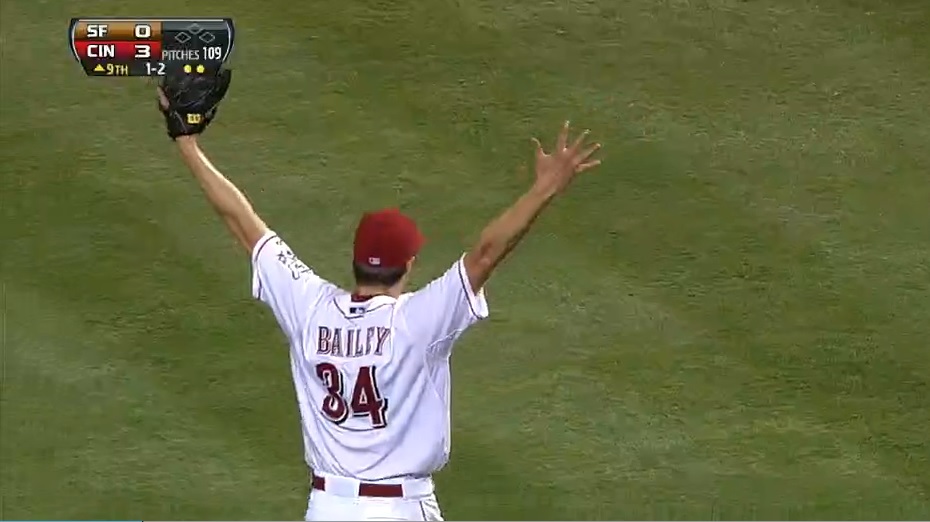





 The Baseball Codes