Intimidation, Retaliation

Chapman Goes Top Shelf, Twice; Cleveland Not Intimidated

Nick Swisher
Nick Swisher: Not delighted.

Head-high fastballs from Cincinnati pitchers were the order of the holiday weekend. First came Johnny Cueto on Sunday, riling up Chicago’s David DeJesus. A day later, Aroldis Chapman sent a 100 mph offering past—and well above—Nick Swisher, all the way to the screen. He followed that with an equally hot pitch that ran considerably closer to Swisher’s noggin.

Swisher can be seen on the telecast repeating the phrase, “Don’t do that” to the pitcher. After he flied out to left field, Swisher and Chapman exchanged words as he passed by the mound on his way back to the dugout. (Watch it all here.)

“The first one I saw go by and I was like, ‘Wow, that was pretty quick,'” Swisher said in a USA Today report. “And then that second one was a little too close for comfort—100 mph at someone’s head? Let’s be honest. That’s not exactly the best thing.”

Reds manager Dusty Baker wrote it off to wildness—“Is that the first time you’ve seen Aroldis throw one to the screen?” he asked—but it’s also plausible that it was Chapman’s version of strategic intimidation. (Last season Chapman struck out 122 while walking 23. Wildness does not appear to be an integral part of his makeup.)

Yes, even guys with 100-mph fastballs like to give themselves an extracurricular edge now and again. Just ask Nolan Ryan.

The first game in which Bobby Grich ever faced the flame-throwing strikeout king, in 1973, he laced a ball down the right-field line and made the mistake of verbally urging it to stay fair. The ball went foul, however, and Ryan ensured that Grich remembered the at-bat by putting his next pitch, a Chapman-esque fastball, up near his head. “I got the message,” Grich said.

During his rookie season, B.J. Surhoff took a big swing against Ryan, and ended up on his back as a result of the right-hander’s next offering. Mike Devereaux, same thing. Mike Aldrete bunted against him and was subsequently knocked down on consecutive pitches. Milt Thompson bunted and was hit in the ribs. Doug Jennings faked a bunt and was drilled. After avoiding an inside pitch, Bert Campaneris motioned for the pitcher to throw it over the plate, and was rewarded by being hit in the knee. The list goes on and on.

The purpose, primarily, was to keep the opposition uncomfortably on its toes. “The intimidation factor,” said Chris Speier, who wracked up 45 plate appearances against Ryan over the years, “was so high.”

“Quite honestly, there were a lot of guys who wouldn’t even play against [Ryan],” said Jerry Remy. “They’d just bail out. It was funny when you saw the lineups—there were a couple guys who, when he was pitching, you knew would not be in that lineup. They’d come down with a mysterious illness. I think because he was the most intimidating pitcher in the league.”

Dusty Baker not only acknowledged that syndrome, but labeled it: “Ryanitis.” It’s still unclear whether his closer is trying to foster his own brand of Chapmanitis, but it’s as good an explanation as any.

The modern game, however, holds far less tolerance for those willing to place a ball near a hitter’s head than it did during Ryan’s era.

Swisher handled things well, not even moving his feet before re-setting after the first wild pitch, then responding to the second one by putting good wood on a ball that was ultimately caught at the wall. The Indians as a team comported themselves accordingly when interviewed after Monday’s game, and on Tuesday responded on the field, with starter Zach McAllister drilling Brandon Phillips in the ribs in the fifth inning, an apparent response to Chapman’s antics.

Intimidation, after all, is in the eye of the beholder.

“You’re only intimidated if you allow yourself to be,” said Andy Van Slyke, about his showdowns with Ryan. “It’s really that simple. If he hit me, I’d go take first base and steal second base and tell him to go fuck himself. That’s how you’ve got to play this game.”
Fights, Johnny Cueto, Retaliation

Hot-Headed Ways For Hot-Headed Men to Behave Like Hotheads

Cueto-DeJesusJohnny Cueto believes in responding should an opposing player disrespect him.

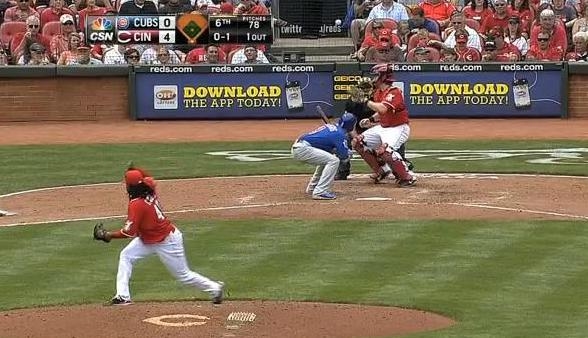
The guy also possesses the unfortunate combination of thin skin and anger-management issues. The same man who kicked Jason LaRue into retirement with a ridiculous display during a fight in 2010 was at it again on Sunday. Apparently irked in the first inning by David DeJesus’ decision to step out of the batter’s box during an at-bat, Cueto responded by flinging a fastball over the outfielder’s head—like, three feet over his head—when he came to the plate five frames later. (Watch it here.)

Plate ump Bob Davidson quickly warned both benches, curtailing retaliatory activity for the rest of the game, but the discussion was just getting started. And most of it centered on baseball’s unwritten rules.

Start with Cubs pitcher Matt Garza, who lasted just four innings. His postgame diatribe to reporters was long and pointed. Excerpts, from a CSNChicago report:

  • “I think that’s kind of immature on his part and totally uncalled for. He’s lucky that retaliation isn’t in our vocabulary here.”
  • “That’s kind of BS on his part. Just totally immature. If he has something to say about it, he knows where to find my locker and definitely I’ll find his.”
  • “If Cueto has any problem, he can throw at me and I’ll definitely return the favor. I didn’t like that one bit.”
  • “I hope he hears this, because I really don’t care. If we want to retaliate, we could have and lost a bullpen guy, but we don’t need that. We play the game the right way.”
  • “He needs to cut it out, because I’ll stop it.”

This from a guy who claims to have no personal history with Cueto. The message was, essentially, play the game the right way, or we’ll take care of it—the right way, via the Code. Problem was, Garza’s use of the media to address Cueto was itself against the Code, and served to puzzle one of the unwritten rules’ greatest practitioners, Cueto’s manager on the Reds, Dusty Baker.

Cueto hasn’t spoken to reporters since the incident, but Baker quickly picked up the slack. Rather than limit the scope of his conversation to on-field retaliation (perhaps spurred by Garza’s “find my locker” comment), he took things straight to the back alley.

“Take care of it then,” he said in an MLB.com report. “I mean, [Cueto] couldn’t hit Wilt Chamberlain with that pitch. … You got something to say, you go over there and tell him. Johnny ain’t running. Know what I mean? A guy can say what he wants to say, but it’s better if you go over and say it to his face.”

The most interesting part of the situation was when Baker recalled how, during his own playing days, situations were resolved a bit more directly.

“I just wish, just put them in a room, let them box and let it be over with, know what I mean?” he said. “I always said this. Let it be like hockey. Let them fight, somebody hits the ground and then it’ll be over with. I’m serious about that. I come from a different school. Guys didn’t talk as much. You just did it.”

He wasn’t just talking, either. As a player, was at the center of just such a situation. During a game against Pittsburgh in 1981, his Dodgers teammate, Reggie Smith, grew increasingly riled over the inside pitching of rookie Pascual Perez (despite the fact that Smith wasn’t even playing, due to a shoulder injury). When Perez hit Bill Russell with a pitch in the sixth inning, then hit Baker four batters later, Smith really started barking.

Pirates third baseman Bill Madlock motioned to Smith as if to say that he’d have to get through him to reach the pitcher, but Perez was not looking for protection. After striking out Steve Garvey to end the inning, Perez pointed first at Smith, then toward the grandstand. The two quickly retreated to the tunnels of Three Rivers Stadium to settle things, followed closely by teammates and managers.

As the 16,000 fans in attendance watched a vacant ballfield, puzzled, and umpires raced in an effort to intervene, a baseball fight broke out. Which is to say that, for all the dramatic build-up, tempers quickly cooled and peacemakers in the crowd broke it up before a punch, apparently, could be thrown.

The ultimate point, however, said Pirates manager Chuck Tanner, was that there was no carry-over. “It was taken care of,” he said.

If that incident somehow did not meet Baker’s criteria of guys not talking as much, another of his teams was involved in an off-field fight—this one in which fighting actually occurred, with punches and everything. Except instead of involving opposing teams, it featured only participants from his own roster. It was 1973, and Baker played for the Atlanta Braves, under manager Eddie Matthews. From The Baseball Codes:

The way Davey Johnson, then a star second baseman for the Braves, tells it, after an initial verbal disagreement with Matthews, the manager invited him into his room and challenged him to a fight. Johnson, reluctant at first, changed his mind when Matthews wound up for a roundhouse punch, then knocked the older man down. Matthews charged back, and as the sounds of the scrape flooded the hallway, players converged on the scene. In the process of breaking things up, several peacemakers were soon bearing welts of their own.

“The next day at the ballpark we looked like we had just returned from the Revolutionary War,” wrote Tom House (a member of the team, who, true to the code of silence, left all names out of his published account). “Every­body had at least one black eye, puffed-up lips, scraped elbows, and sore hands. It had been a real knockdown battle.”

This was something that couldn’t be hidden from the press. Matthews called the team together, and as a unit they came up with a story about a game that got carried away, in which guys took good-natured beatings. Flimsy? Maybe. Accepted? Absolutely.

“You can ask Hank Aaron and others on that team,” Johnson said, laughing. “Eddie said his biggest regret [in his baseball career] was not having it out with me again. That one never got out. It never made the papers.”

The Cueto-Garza-DeJesus situation will probably never come close to that. But that’s kind of the point. The call-and-response nature of baseball’s unwritten rules—taking care of things on the field, as it were—exists to prevent this sort of thing. And, save for the occasional below-decks brawl every few decades or so, it works pretty well in that regard.

Don't Showboat, Jordany Valdespin

Valde-spun: Mets Players Fed Up With Hothead Teammate

Valdespin IVWhen Jordany Valdespin went full pimp after hitting a meaningless late-game homer last week that served merely to pull the Mets to within a 7-2 deficit of Pittsburgh, it was clear that the Pirates were not pleased—as evidenced by Bryan Morris drilling Valdespin the following day.

Turns out his his own teammates didn’t much care for it, either.

“I couldn’t believe he did that,” Mets reliever LaTroy Hawkins told USA Today’s Bob Nightengale. “We were all dumbfounded. It was a bonehead thing to do. And to do that against [pitcher] Jose Contreras? [Contreras] is old enough to be his father, and one of the nicest guys in the world.”

This, it seems, was only the beginning of the problem. As was quickly evidenced by the ensuing firestorm of Valdespin’s angry tweets and Mets fans wondering why New York pitchers never responded to Morris’s blow—how Valdespin’s teammates didn’t have his back, as it were—the idea of protecting a teammate who doesn’t deserve protection became all too real.

During the reporting for The Baseball Codes, current Brewers manager Ron Roenicke put it this way: “You’ve got [a guy], who is doing stuff that you are not happy about, and now he gets hit because of it. You’re sitting here going, ‘I don’t want to fight for him. He deserves what he gets.’ And I think that came into play a lot. ‘Hey, he deserves to get hit, let him handle it.’ ”

Hawkins put it similarly for the Mets, about Valdespin.

“What were we supposed to do there?” he said. “We were down six runs, he hits a home run and he acts like it’s a walk-off. This isn’t Little League. What, now we’re supposed to get into a fight for that? We’re supposed to throw at somebody because he did a bonehead thing? Now, if they throw at him for no reason, that’s a different story. We protect our team. But to do what he did put us in a bad spot, a real bad spot.”

This is a public statement made by a veteran player as a last resort, the kind of thing a guy says only after every other effort to reach his teammate has failed. It’s a measure of desperation, of being fearful that Valdespin’s actions could put an innocent Met in an opponent’s crosshairs, or put put a pitcher in the unenviable position of defending actions that deserve no defense. But Hawkins didn’t stop there.

“He showed absolutely no respect,” he went on to say. “If you’re going to pimp it, you’re going to suffer the consequences. I have no problem defending my teammates, but some things, you just can’t defend against. He’s created a lot of unnecessary tension around here.”

According to Nightengale, Hawkins wasn’t alone in his feelings.

Outfielder Marlon Byrd: “The Pirates did what you were supposed to do.”

Manager Terry Collins: “We’re getting beat 7-1 with a 12-year veteran on the mound. Come on. I don’t care what the fans think. This is the big leagues. It’s a big-man’s game. I told him, ‘Look, it’s not about you. It’s about us. It’s about the team. We’re all trying to teach you a lesson here.’

David Wright called the entire incident “stupid.”

The harshest criticism, however, came from Hawkins, a 40-year-old who over 19 big league seasons has played for 10 teams. If anybody in baseball has earned the mantle of having seen it all, he is the guy.

“Sometimes you have to look yourself in the mirror,” he said. “[Valdespin] has got to ask himself, ‘What can I do to gain the respect back from my teammates?’ And he’s got to come up with that answer on his own. For some reason, he doesn’t want to do things the right way. He wants to do it the hard way. Hopefully, he’ll figure it out, because he’s got a chance to be a damn good ballplayer.”

Operation Public Shaming is officially underway. Never has a passing down of the Code been on more blatant display.

Cheating, Spitballs

Spit Take: Marlins Hurler Opts Against Subtlety in the Subtle Art of Loading up a Baseball

Alex Sanabia

What does one do when one is a scuffling pitcher, trying desperately to hold on to one’s rotation spot on the National League’s worst team?

The answer isn’t always “load up the ball” … but in the case of Miami right-hander Alex Sanabia, how much could it hurt?

Well, there’s the aftermath. On Monday, Sanabia pitched his best game since opening day, picking up a 5-1 victory against Philadelphia while tossing six-plus innings of one-run ball. In the second inning, immediately following a Domonic Brown home run, Sanabia very clearly spit all over the next ball he was to pitch. (Watch it here.) Ever since, the Internet has been abuzz.

Seems damning, to be sure, but there’s almost undoubtedly more to the story. As evidenced by L’Affaire d’Buchholz two weeks ago, pitchers looking for viscous augmentation rarely turn to spit so much as gels and jellies like Vaseline and K-Y. Even those chewing on slippery elm (a noted saliva producer, of which Brooklyn Dodgers manager Charlie Dressen was so enamored that he would cut it into strips and hide it inside chewing gum wrappers for ready access by his pitchers) use their spit to slide the ball off their fingertips—they don’t rub it into the ball, as Sanabia did with his videotaped expectoration.

Marlins manager Mike Redmond went so far as to say that first base ump Joe West even saw Sanabia in action, and merely tossed the ball out before it was put into play. The Commissioner’s office doesn’t appear to have much interest, either.

So while some are having fun with it—Yahoo, for example, came up with 10 nicknames for the guy—we here at Global HQ will settle for offering a spitball-related excerpt from The Baseball Codes, detailing the greatest spitballer ever, Gaylord Perry. Some of the below ended up seeing print, but much was cut from the final copy.

Nineteen-eighty-two marked a watershed occasion in the annals of spitballing. It was the first (and only) time Gaylord Perry, the master, was disciplined for doing that for which he was known so well.

Perry was 43 years old, in his first season with the Seattle Mariners. Umpire Dave Phillips had already warned him about throwing illegal pitches in a game against Boston, but in the seventh inning Perry unleashed an offering that dropped dramatically. Phillips at first called the pitch—on a 1-0 count to Rick Miller—a strike, but, after thinking about it for a moment, changed it to a ball. Then, without even checking for evidence, he tossed Perry from the game. The pitcher was eventually fined $250 and suspended for 10 days—the first such suspension since Nelson Potter in 1944.

This was noteworthy because by that point Perry had for two decades been accused more consistently of doctoring his pitches than any man in baseball. This was the guy who titled his autobiography “Me and the Spitter,” and released it midway through his 22-year career. This was the guy whose North Carolina license plate read “SPITTER.” This was the guy who was so thorough that when, in 1971, a TV reporter asked his five-year-old daughter, “Does your daddy throw a grease ball?” she replied, “It’s a hard slider.”

At 6-foot-4 and 215 pounds, Perry was highly touted as a prospect in the San Francisco Giants organization, but struggled through his first two major league seasons, both of which involved stints at Triple-A Tacoma. Perry’s good fortune came before his third campaign, when the Giants traded for pitcher Bob Shaw.

Shaw was a journeyman who wouldn’t last even three seasons in San Francisco, but he knew how to throw the spitball. Under his tutelage, so soon did Perry. “Bob and I worked for hours,” he wrote in “Me and the Spitter. “I studied his every movement. I had to learn how to load it up, how big a load the ball would carry, where to drop the load, how to grip the ball, and how to release it as well as how to control it. And probably most important of all, how to hide it from four umpires, three coaches, a manager and 25 players on the field as well as spying executives up in the box seats. I spent hours in front of a mirror at home practicing decoy moves.”

Perry finished second on the team in victories that year, and two seasons later won 21 games and made his first All-Star team. From 1966-78 Perry never won fewer than 15 games, and picked up two Cy Young Awards along the way.

“I’d always have (grease) in at least two places, in case the umpires would ask me to wipe off one,” he wrote. “I never wanted to be caught out there without anything. It wouldn’t be professional.”

Perry put Vaseline or other lubricants under the bill of his cap, behind his neck and inside his belt. If he thought people were paying special attention, he’d load up his back with hot muscle balm, which would spread over his body as he started to sweat, suited his purposes for lubrication, and was virtually undetectable.

“(Perry) taught me something early that I never forgot: (Umpires) couldn’t touch your skin when they came to the mound to check you out,” said pitcher George Frazier. “They could touch your shirt or your glove or check your pockets, but no skin. Gaylord told me he used to put the stuff under his shoe tongue, ‘in case I have a long game and it runs out.’ ”

Perry was traded to the Indians after the 1971 season, at which point a member of the Giants organization said, “I don’t know what he throws, but our Vaseline bill is down.”

It didn’t take Perry long to get under the collective skin of the American League. In April 1973, Yankees outfielder Bobby Murcer exploded to the press after facing Perry in the pitcher’s second start of the season, yelling “Just about everything he throws is a spitter.”

“The only pitch he threw me that wasn’t a spitter was the first one,” he went on. “The more he knows you’re bothered by him throwing it, the better he is against you. … He’s got the stuff behind his ear and on his arm and on his chest. He puts it on each inning. I picked up the balls and they’re so greasy you can’t throw them.”

How angry was Murcer? Before the game he called commissioner Bowie Kuhn “gutless” for refusing to do anything about Perry’s proclivities, then managed to channel his aggression into a three-hit day. When confronted with Murcer’s accusations, however, Perry said the outfielder hit “fastballs and sliders,” not spitballs. (It might have been an acceptable excuse had Perry been on the same page as his catcher, Dave Duncan, who in a separate contrived denial said that Murcer had hit “off-speed stuff.”)

If further proof be needed, the New York Times hired an unnamed Yankees pitcher to chart Perry’s every pitch throughout the game, and mark those that he thought were spitballs. When the resulting pitch chart was compared to a replay of the game, the Times said that before every pitch identified by the Yankees operative as a spitter, Perry tugged at the inside of his left sleeve with his right (pitching) hand—an action he failed to repeat for the rest of his repertoire.

Second baseman Horace Clark, according to the chart, struck out on a spitter that, on replay, dropped at least a foot. In the fourth inning, Thurman Munson asked to see the ball twice during his at-bat—during which, said the chart, Perry threw four spitters.

Perry wasn’t just a practiced spitballer, however—he was also a practiced spitball deceiver. One of the strengths of the pitch, according to virtually everybody who has been suspected of throwing it, is that making a hitter believe it’s coming is nearly as valuable as actually throwing it.

“The more people talk and write about my slick pitch, the more effective I get,” wrote Perry. “I just want to lead the league in psych outs every year.” To this end, Perry turned into his era’s version of Lew Burdette, all fidgets, wipes and tugs once he got atop the mound.

“Perry’s big right hand started to move and people started to boo,” wrote the Times about its charted game. “First he touched his cap, sliding his fingers across the visor, bringing them down along the right side of his head, stopping behind his ear. Then the hand went across his uniform, touching his chest, his neck. Was all this to create a diversionary action? Was he simply having fun? … ‘I did the same things I always did,’ he said later, suppressing a smile. If people want to read things into it, so be it.’ ”

Perry admitted in his autobiography to having doctored pitches, but, along with his confession, said upon the book’s release in 1974 that he “doesn’t throw it any more.” Maybe, responded Twins manager Gene Mauch, but “he doesn’t throw it any less, either.”

In 1991, after 314 wins over 22 seasons, Perry was inducted to the Hall of Fame. It was noted that when Rod Carew was inducted, Panamanian flags flew; when Ferguson Jenkins was inducted, Canadian flags flew; and when Perry was inducted, it rained.

Unwritten-Rules

To Bunt or Not to Bunt, That is the Question—Even if it Doesn’t Make Much Sense

Kyle LohseWe may have found a new unwritten rule in Busch Stadium on Sunday. Either that, or Kyle Lohse is completely off his rocker.

Lohse allowed six singles to the first seven batters he faced in the fourth inning (including a bases-loaded squeeze beaten out by Pete Kozma), during which time he allowed four runs. That left runners at first and second, with one out, for pitcher John Gast.

Gast squared to bunt, but pulled the bat back at the last moment to swing away. This is not an unusual baseball move, especially for a pitcher, when the opposing third baseman is charging hard. Lohse, however, was irate, and threw three consecutive pitches high and inside. Gass eventually bunted into an out.

The act might have been explainable as an anti-bunt strategy had Lohse not immediately thereafter shared some heated thoughts with Cardinals third base coach Jose Oquendo, then continued the conversation with catcher Yadier Molina when he came to the plate the following inning.

“They know what I had to say,” Lohse said in an MLB.com report. “It had nothing to do with the squeeze or anything like that. It was something that happened after that. … I’ll leave it at that. They know.”

Ultimately, St. Louis Post-Dispatch columnist Bernie Miklasz may have offered the clearest-eyed viewpoint, speculating that Lohse was ticked that after five seasons in St. Louis A) the Cards didn’t keep him on their roster in favor of going with young pitchers, which B) left him first in free-agent purgatory and C) then with the last-place Brewers. There’s also D) the notion that Lohse is 1-5, despite pitching well this season, and that E) three of those losses have come at the hands of two of the young pitchers chosen by St. Louis to take his place—Shelby Miller and, last night, Gast. With that in mind, it makes sense that the pitcher’s fuse is a bit short. (Miller also did the square-to-bunt-and-pull-the-bat-back move against Lohse earlier in the season.)

On strictly baseball terms, given the information that’s currently available, Lohse doesn’t have a leg to stand on. (He also positioned himself as the anti-Nolan Ryan, who was known for drilling guys who tried to bunt on him. Lohse, it seems, was perturbed that a guy tried to not bunt on him.)

Lohse didn’t hit Gast, so no harm was actually done, but he was clearly pitching angry. It does not appear to be a retaliation-worthy offense, but stay tuned—these teams play each other nine more times this year.

(H/T Bill Ivie of I-70 Baseball.)

David Wells, No-Hitter Etiquette

Wells Was Perfect 15 Years Ago

David WellsIt’s the 15th anniversary of David Wells’ perfect game, and to celebrate, MLB has made the entire game video available on YouTube.

Seems only fitting to make some of my own copy available, as well. From The Baseball Codes, regarding that fateful day:

When David Wells was with the minor-league Syracuse Chiefs in 1987, he struck up a fifth-inning conver­sation with teammate Todd Stottlemyre, who was charting pitches on his off-day. That one of their teammates was in the process of throwing a no-hitter didn’t affect him a bit. “Hey, Stott,” he said, “how many walks does he have?” Stottlemyre replied that an opponent had yet to draw a base on balls. “Wow!” said Wells. “He’s throwing a perfect game!” Chiefs trainer Jon Woodworth recalled Stottlemyre looking “like he was going to kill” Wells. The left-hander’s defense: In his twenty-four years on the planet, five of them in professional baseball, he had somehow never before heard the rule prohibiting discussion of no-hitters. The very next inning, the Syracuse pitcher gave up a two-out bloop single.

It’s a lesson Wells didn’t need to learn twice. In fact, he went so far as to become an evangelist for the idea. In his book, Perfect I’m Not, the pitcher laid out in the starkest possible terms the rule of which he once claimed ignorance:

Rule number one in baseball is that you never, EVER mention that a guy’s throwing a perfect game or a no-hitter until it’s over. If you mention it during the game, it’s a major jinx, the ultimate whammy. The pitcher on the mound will give up a hit to the next batter, and it WILL be your fault—guaranteed.

Some people find religion; David Wells found superstition. Like Bert Blyleven before him, however, Wells held his view only in regard to other pitchers; he didn’t care a bit when it was him at the center of the mael­strom. During his perfect game in 1998, in fact, as Wells’s teammates on the Yankees edged farther away with each passing inning, he decided to take things into his own hands. Changing his undershirt in the clubhouse after the seventh inning, Wells saw David Cone, one of his best friends on the team. Highly in tune with the pressure of the moment, the left-hander approached his teammate, uncertain of what exactly he needed. “Can you believe what’s going on here?” he asked.

In retrospect, Cone feels that Wells simply wanted someone to talk to. In the moment, however, he was all too aware of the implications and at something of a loss for words—so he blurted out the first thing that came to mind, daring Wells to break out the knuckleball he liked to throw in practice but wouldn’t dare try in a game.

Wells laughed and returned to the dugout. After he finished his eighth perfect inning, Cone got on him again, this time in the dugout. “You showed me nothing,” he yelled as the nervous pitcher came off the field. “You didn’t use your knuckleball—you’ve got no guts!”

The tactic might have been taboo, but Cone knew his pal needed con­versation more than he needed tradition, and Wells went on to finish the fifteenth perfect game in big-league history. “To me, that kind of stuff is more important than some superstition that says you can’t get near the guy,” Cone said later.

(H/T Hardball Talk.)

Bat tossing, Don't Showboat

Look at Me, Bitches. Oh, Wait. Look Someplace Else. Anyplace Else. Please, for the Love of God, Look Away.

Bat flip IA good bat flip will typically raise some eyebrows in the opposing dugout, and may put the flipper on the wrong end of an angry pitcher’s crosshairs. (See Jordany Valdespin, just last week.)

Recently, however, Jeon Jun-Woo of the Korean Baseball League’s Lotte Giants gave us one more very important lesson. If you’re going to primp like an arrogant ass, you better make damn sure you have something worth primping for.

With one out in the ninth, Jeon unloaded for what he thought was a game-tying homer. He tossed his bat, with relish. He pointed, first toward the sky, then toward a dugout (though it’s not clear whether it was filled with teammates or opponents).

No matter. The ball was caught at the warning track and Jeon, visibly stunned, stumbled back to his bench. (Watch it here.)

Not sure how they handle such things in Korea, but had he been in the U.S. it’s pretty certain that the reception he received from his teammates—biting and protracted—would have been far more painful than anything an opponent could deliver.

Bat tossing, Don't Showboat, Retaliation

Valdespin Pimps, is Plunked by Pittsburgh, Pouts

Valdespin 3Jordany Valdespin likes it flashy. The guy who made waves last year for comportment unbecoming of a rookie was at it again on Friday, hitting a second-deck homer at Citi Field, watching it, watching it some more, slowly sauntering toward first while dismissively flipping his bat, and only then settling into his home run trot.

The blast came in the ninth inning and served only to bring the Mets to within a 7-2 deficit against Pittsburgh. This may not have mattered when it came to the Pirates’ disdain for Valdespin’s display … but it sure didn’t help.

“When you hit the ball, you got to enjoy your hit,” Valdespin told the New York Daily News afterward. “Every time I hit the ball, homer or something, I enjoy that. Every hit, I’m enjoying, my family’s enjoying, my friends enjoying.”

Enjoyment, of course, comes at a cost. An evening of slurping whiskey sours can lead to dry heaves the next morning. An evening of pimping one’s meaningless homer can lead to Bryan Morris throwing a 94-MPH fastball into your arm the following day. (Watch it all here.)

Prior to Saturday’s game, Mets manager Terry Collins professed no idea of what was in store for Valdespin, although he told the New York Daily News that “fifteen years ago, the answer would’ve been yes [Pittsburgh would have thrown at Valdespin in retaliation]. … A lot of teams have long memories.”

To judge by his actions, however, Collins seemed certain of Pittsburgh’s response. He  inserted the targeted 25-year-old as a pinch-hitter with two outs in the seventh inning of a game in which the Mets trailed, 10-1—almost certainly to allow the Pirates a chance to respond directly, enabling both teams to move on without this particular dark cloud overhead.

When it happened, nobody in the Mets dugout appeared to take much issue (unlike Pittsburgh’s bench, which offered Morris hearty congratulations). Valdespin himself, however, was disgusted. He loitered near the plate (though he made no semblance of a move toward the mound) and sauntered slowly toward first. Afterward, he threw a fit in the dugout, hurling his helmet into a corner.

“Whether you like it or not, it’s just the way it is now,” David Wright told the Daily News, after Valdespin’s pimp, but before Pittsburgh’s retaliation. “I’d probably prefer a different way, but each guy has their own individual thing. I’m always with the theory that you don’t want to show anyone up. With that said, it is done a lot by a lot of people, not just by one individual.”

It is safe to assume that Wright is speaking for the team on this point. Valdespin has been causing organizational headaches since he was a minor leaguer—including issues with teammates at Single-A Savannah that led to a two-month exile in extended spring training, and a benching by Binghamton manager Wally Backman for a “lack of intensity,” according to a Metro WNY report.)

It is of particular organizational concern because situations like Friday’s can put Valdespin’s teammates in the crosshairs. (Because Valdespin did not start Saturday’s game, speculation had Wright becoming Pittsburgh’s target in his absence.)

In Newsday, David Lennon wrote that “Not once Saturday did any of the Mets say they don’t like to see one of their own get hit by a pitch—on purpose, no less. The discussion mostly involved talk about lessons learned and growing pains.” Collins was quoted as saying that “if nothing else, he grew by it, and that’s the most beneficial thing that could happen.”

In the New York Post, Wright soft-pedaled the message that, for Valdespin, “toning some of it down might be appropriate.”

Many in the sports world decry this form of baseball justice as unnecessary and brutal. Many of these same voices also bemoan the modern sporting landscape as having become too ego-focused, with too many look-at-me, eye-rolling moments to palate.

No matter how one feels about it, the dance done by the Mets and Pirates over the weekend is the best hope for professional American sports in this regard, a system of players keeping each other in check—no league mandates or threatened fines involved.  The game is to be played pride and respect, and players themselves ensure that this is so.

Whether Valdespin changes his behavior going forward is no sure thing. In 2011, his manager at Triple-A Buffalo, Tim Teuffel, said this about the outfielder: “Sometimes he looks at the ball when he hits it, doesn’t run as fast as his body will allow him. But I think he’s going to learn how to play the game a little bit more up here.”

For some people, information takes time to sink in. The lesson has been delivered; what Valdespin does with it is up to him. 


Retaliation

What’s the Best Kind of Homer? A Revenge Homer, of Course

Reynolds pimps
Catcher Derek Norris watches the ball. Pitcher Jarrod Parker watches the ground. Mark Reynolds watches Jarrod Parker.

That Mark Reynolds crushed a 457-foot homer off Oakland’s Jarrod Parker Monday should not come as a surprise. The guy had already hit one that far this season, has two of the 16 longest hit this season (according to ESPN’s Home Run Tracker) and has hit eight more than 400 feet in just over a month.

This one, however, was special. It was a revenge blast.

Reynolds was unhappy after Parker had drilled him in the shoulder in the first inning, two batters after Jason Kipnis and Asdrubal Cabrera had hit back-to-back homers. The action was sufficiently questionable for plate ump Angel Hernandez to warn both dugouts.

So after Reynolds connected in the fifth, he took several slow steps to first before starting to jog, a deliberate message. (Watch it here.)

He elaborated after the game, telling the Cleveland Plain Dealer, “I normally don’t pimp anything, but he hit me near the head. I don’t mind getting hit—it helps the on-base percentage—but when you come near the head. . . . I was on a mission right there, to hit a ball as far as I could, as kind of payback for hitting me almost in the head.”

It’s not like this kind of thing is new. In 2006, Albert Pujols responded to an earlier strikeout celebration by Oliver Perez by hitting a homer, then flipping his bat.

In 2004, Ken Griffey Jr. homered off of Josh Beckett, then stared into the Marlins dugout—a message to Jack McKeon, who had been fired in Cincinnati four years earlier, and blamed Griffey for it. (Tension in the ballpark quickly rose.)

Welcome to the pantheon, Mark Reynolds. You’re in some pretty heady company.

Cheating, Clay Buchholz

Arm Butter Accusation Storm Builds in Toronto

buchholz arm
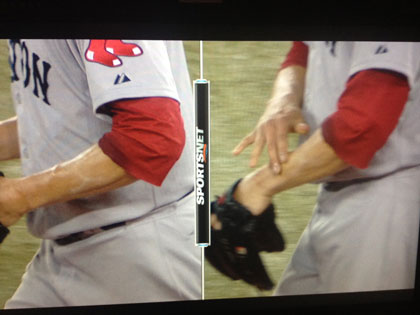
Sportsnet’s Buchholz graphic

It started last week when Dirk Hayhurst—ex-pitcher, sometimes author and current broadcast analyst for the Toronto Blue Jays—unleashed some damning suspicions on Twitter about Boston pitcher Clay Buchholz, who’s currently setting the American League afire with a 6-0 record and 1.01 ERA:

Forget the hair, I just saw video of Buchholz loading the ball with some Eddie Harris worthy slick’em painted up his left forearm. Wow.

It continued when Hayhurst’s colleague, ex-Tigers great and current Blue Jays broadcaster Jack Morris, piled on, telling ESPN Boston that “it was all over his forearm, all over the lower part of his T-shirt, it’s all in his hair,” while in the next breath stipulating that he has no actual proof of impropriety.

It really picked up steam when the video crew at the Rogers’ Centre unleashed some video from Wednesday’s Jays-Sox game, in which the right-hander allowed only two hits to Toronto over seven shutout innings, of Buchholz’s left (non-throwing) arm, glistening with what appears to be something other than sweat. (Hayhurst went on to say that it might be sunscreen mixed with rosin. The Jays’ crew added some talk about Red Sox reliever Junichi Tazawa possibly doing something similar.)

To be expected, Buchholz subsequently denied everything (“Definitely no foreign substances on my arm,” he told MassLive.com), as did Red Sox catcher David Ross (“I know when a pitcher is messing with the ball, he said. “He’s not putting anything on it”).

People came out for Buchholz. Dennis Eckersley told Morris to “zip it,” and Jerry Remy defended him on the air. Cliff Lee discussed his own innocent accumulation of sweat and rosin. Tim Hudson had some fun with the situation.

People came out against Buchholz. Sports Illustrated’s Tom Verducci discussed details about what he feels is a fishy situation, and ESPN’s David Schoenfield compared the break on Buchholz’s pitches to those on offerings nearly 30 years ago from notorious ball scuffer Mike Scott. (He also quoted from The Baseball Codes, so credit to him on that one.)

What does it all mean? Nothing, almost literally. The Blue Jays haven’t accused Buchholz of impropriety. Neither has any other team. Umpires have yet to check him. The accusations are based on TV footage that can be realistically explained any number of ways.

It appears to be a Kenny RogersTony La Russa-type situation. When  the Fox TV crew spotted Rogers with an unusual brown spot on his palm during his start in the 2006 World Series, it became national fodder—especially when video evidence showed the same brown spot during his previous postseason appearances. Instead of having the umpires check Rogers, however (knowing that if they found a foreign substance, he’d be ejected and likely suspended), Cardinals manager La Russa merely asked them to make sure he washed his hands. From The Baseball Codes:

In the face of this World Series controversy, the Gam­bler did the only thing he could reasonably do—he cleaned his hand and continued to pitch well. Fifteen postseason shutout innings with an obvi­ous foreign substance were followed by seven shutout innings without it. Alleged pine tar or no alleged pine tar, the Cardinals, who scratched out only two hits against Rogers in eight innings, fared no better than the Yan­kees or the A’s had in earlier rounds.

The primary question was, why did La Russa not come down harder? A variety of theories surfaced, one of which gained particular traction: Pitchers cheat in Major League Baseball. Not all of them, but enough to touch every clubhouse in some way. La Russa’s own pitcher, Julian Tavarez, had been busted for using pine tar only two seasons earlier, and suspended for 10 days. La Russa called it “an example of bullshit baseball.”

La Russa, the theory held, had kept quiet because he was reluctant to travel this particular road on behalf of his own pitchers, who would undoubtedly come under increased scrutiny. No less an authority than Buchholz accuser Jack Morris weighed in, telling the Detroit Free Press that “Tony’s been through a lot himself, so I don’t think he wanted to push that enve­lope.” (An entire chapter was devoted to this particular situation in The Baseball Codes.)

So even if the Blue Jays did recognize something askew about Buchholz on the mound, they may well have opted (and continue to opt) to keep it to themselves. This could be equally true for every other team in the league, regarding every other pitcher in the league. Rare is the guy like Davey Johnson, who just doesn’t give a crap.

Chances are that Buchholz will dial back whatever it is he’s doing (even if it’s legal, he’ll likely strive to make it less suspicious), and that the entire situation will blow over within the week, assuming he does not get uncharacteristically blown out of his next start.

Which is as it should be. Most folks around the big leagues view cheating as largely acceptable, so long as the cheaters knock it off (at least for a while) once they’re caught. Buchholz’s arm butter, legal or otherwise, is no exception.