Earl Weaver

Earl Weaver, RIP

Earl WeaverWith the passing of Earl Weaver on Friday, baseball lost one of its most irascible—and best—managers. Not only was he tossed from a record 91 games, but he inspired then-Yankees manager Billy Martin to threaten that “the next time one of our guys is deliberately thrown at, I’m going to deck Earl at home.”

In his memory, I offer two very brief excerpts from The Baseball Codes. The first, from the book, is about the doctoring of baseballs:

Take it from Orioles manager Earl Weaver, who, upon visiting the mound to talk to pitcher Ross Grimsley during a bases-loaded situation, offered a simple suggestion: “If you know how to cheat, this would be a good time to start.”

The second, about retaliation, was cut during the final edit.

Orioles skipper Earl Weaver was once sitting in the dugout when one of his pitchers gave up a home run. As the batter rounded third, he looked toward the Orioles bench, made eye contact with the manager and extended his middle finger. “What the hell was that?” a befuddled Weaver asked Billy Hunter, one of his coaches. Hunter knew exactly what the hell that was. “You didn’t select him for the All-Star Game,” he said.

RIP, Earl.

Matt Cain, Matt Holliday, Matt Holliday, Retaliation, Slide properly

Holliday’s Had It: Calls out Cain for ‘Less Than Tough’ Retaliation

For those who think that Matt Cain waited to long to retaliate against Matt Holliday—the outfielder’s questionable slide into Giants second baseman Marco Scutaro occurred in Game 2 of the NLCS, and he was drilled a week later, in Game 7, once the series was salted away—Holliday put that timetable to shame.

Precisely one month after his slide, and three weeks after Cain drilled him, Holliday addressed the topic in an Insidestl.com report, calling it, among other things, “less than tough”:

[The pitch] seems on purpose. I wish that if he wanted to hit me, he would’ve just done it on the first pitch in the next game he had pitched. You know, if you’re going to do it, do it, get it out of the way. But to do it, I don’t remember what the score was but it was out of hand, that’s about it. I thought the timing of it was….I don’t want to get into it. I wasn’t thrilled about it. . . .

If you’re going to do it, I think that is when you do it. I wouldn’t be happy about it anytime. I just thought that in the situation that it actually did happen it was less than tough.

It might seem odd for Holliday to express displeasure with Cain’s delay weeks after the fact, when he could have done it immediately following the game in which it happened. To be fair, he was answering a question, not promoting an agenda, and it’s not like Cardinals players had much media time once they’d packed their bags for the winter upon returning to St. Louis.

It’s unlikely that this will further ill feelings come 2013, but also serves to remind us that another incident—one of Cain’s pitches slips, perhaps, or Holliday again takes out a middle infielder—will not be easily digested by the other side.

(Via HardballTalk.)


Matt Cain, Matt Holliday, Retaliation

Holliday on Ice: Giants Finally Exact Revenge

Good things come to those who wait.

Determined to avoid compromising NLCS victory by retaliating for Matt Holliday’s Game 2 slide into Marco Scutaro—which was called everything from illegal (by Bruce Bochy) to dirty (by all manner of Giants fans)—Matt Cain waited until it would hurt the Cardinals most, and the Giants least, to respond.

St. Louis, trailing 7-0 in the sixth inning of Monday’s deciding Game 7 on an electric San Francisco night, appeared too stunned by the score to be able even to fully absorb the intent behind the pitch. Before the ball connected with Holliday’s left tricep, it had long since been assumed that the Giants would let his slide go unanswered.

Cain, we now know, has a longer memory than the Cardinals anticipated. (Watch it here.)

St. Louis players were already wearing long faces as they counted down outs toward what already appeared to be an inevitable, inexorable slide from the postseason. Before the drilling—as sure an intentional pitch as has been thrown all season—it seemed impossible that the Giants or their home crowd could be any more pumped up than they already were.

As soon as ball bounced off batter, however, it was clear that such a notion was folly. AT&T Park, we found out, does indeed go to 11—especially when the frontier justice runs in their favor.

Matt Holliday, Slide properly

Slide, Baby, Slide: Holliday Hammers Home Controversy in Game 2

The Giants said all the right things Monday about Matt Holliday’s slide. Although they universally questioned its timing, placement and function, to a man they denied feeling like Holliday intended to injure Marco Scutaro.

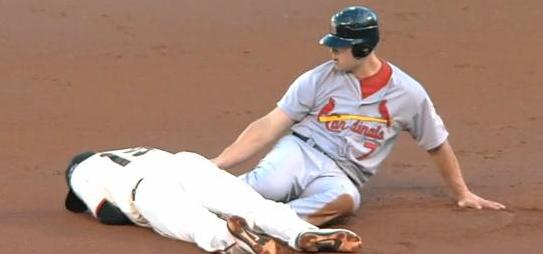
Unfortunately, he did injure Scutaro. After Holliday took San Francisco’s second baseman out, breaking up a double-play with a chop block to the knees, Scutaro responded with two hits in three at-bats before being removed from the game and taken to the hospital for tests. (Watch it here, or a gif of the play here.)

The Giants, hewing to propriety, said all the right things. Hall of Famer Craig Biggio, however, summed up the parameters fairly neatly in an interview for The Baseball Codes.

“The only time I have a problem with any opponent is if you slide on the back side of the base—if you jump over the base and then slide,” he said. “If you slide in front of the base, even you end up against the wall in left field, I could care less—as long as you start in front of that base. But if you jump slide on the back side of that base, that shows intent to separate somebody’s knees or legs, and that’s dirty play.”

Holliday’s slide met that description perfectly: He left the ground in front of the base and landed on the back side of the bag—directly into Scutaro’s legs. Bruce Bochy called the slide “illegal.”

A counter opinion comes from Mike Krukow, the ex-Giants pitcher who called Holliday’s slide as a member of the team’s broadcast crew. From The Baseball Codes:

Low barrel rolls [are] acceptable. When A-Rod took out Jeff Kent and sprained Kent’s right knee in 1998, he [low] barrel-rolled him. On TV that night, Kuip [Krukow’s broadcast partner, Duane Kuiper, a twelve-year major-league second baseman] and I said, That’s a legit play. After the game, Kent was pissed about it. He said that was a horseshit slide. No, it’s not. Basically, a low barrel roll— anything within arm’s distance of the bag—is acceptable. (Acceptable or not, the following night, Giants pitcher Orel Hershiser drilled Rodriguez in the shoulder.)

The Giants did not respond on Monday—Holliday went 0-for-3 against Ryan Vogelsong and Jeremy Affeldt the rest of the way—even with first base open in the third, and a four-run lead in the fifth and eighth. Bochy said that Scutaro is probable for tonight’s Game 3, and downplayed any talk of retaliation, but if it’s determined that Scutaro will miss time, it wouldn’t be shocking to see some fireworks. (“If one gets away,” Matt Cain told Andrew Baggarly, “one gets away.”)

Even Cardinals manager Mike Matheny seems to understand this. “We do play hard and we understand that they play hard,” he said in a San Jose Mercury News report. “That’s the way the game goes.”

For his part, Holliday responded appropriately after the fact, checking with catcher Buster Posey about Scutaro’s well being prior to his next at-bat (asked if he scolded Holliday during the exchange, Posey laughed and said no), and calling the clubhouse after the game. (Scutaro had already left to have tests done.)

Holliday has a reputation for going in hard to bases, so Monday’s slide was not out of character in that regard. Hal McRae had a similar reputation, but he took things to such an extent that legislation was enacted to counter his tactics. McRae’s takeout slide of New York’s Willie Randolph in the 1978 playoffs helped lead to the “Hal McRae rule,” stipulating that a runner must have at least a pretense of reaching the base while taking out an opposing fielder.

At least Holliday touched the bag.

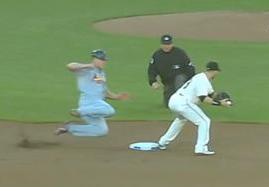
Until Game 3 tonight, settle for the below clip of Joe Morgan taking out Dick Green in the 1972 World Series (It’s the second play in the clip.), which has been making the rounds. It’s primarily valuable to help illustrate the fact that baseball has toned down its act, and that—partly thanks to things like the Hal McRae rule—significant amounts of basepath violence have been removed from the action.

Al Alburquerque, Showing Players Up

Kiss Me, Al: Tigers Pitcher Turns Baseball into Blarney Stone, Sparks Minor Uproar

A kiss is just a kiss—unless it happens in the ninth inning of a playoff game. Then, all hell breaks loose.

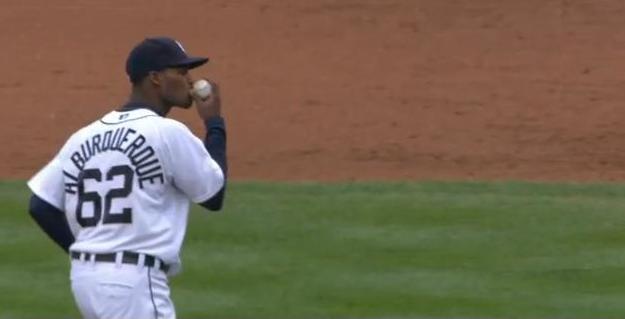
Tigers reliever Al Alburquerque put it to the test on Sunday. With the game tied, runners at the corners and two outs, the right-hander was called upon to face A’s slugger Yoenis Cespedes, who he retired on a comebacker to the mound. Before tossing the ball to first, however, Alburquerque planted a wet one on the horsehide. (Watch it here.)

“Did I see what I just saw?” Tigers catcher Gerald Laird, who had been removed for a pinch-hitter a half-inning earlier, recalled thinking. “Obviously,” he said later, “I did.”

So did the A’s. After the game, outfielder Josh Reddick told reporters that he “didn’t appreciate it,” that he “thought that was immature” and “not very professional.” Cespedes said that he may kiss his bat the next time he connects against Alburquerque.

By Monday afternoon, however, during an off-day at Oakland’s O.co Coliseum, the A’s were downplaying the incident as a non-story.

“What am I going to do, yell at them?” asked Jonny Gomes. “That doesn’t take care of anything. Bash them in the media? That doesn’t take care of anything. Just let the baseball gods take care of it. That’s why the baseball gods are there.”

For his part, Alburquerque, 26, said Monday that he intended no disrespect to Cespedes or the A’s, and that his actions were colored by “the emotion of the game.” Regardless, the second-year pitcher, a native of the Dominican Republic, was pulled aside after the game by Miguel Cabrera, Alex Avila and Octavio Dotel, who explained to him the reality of the situation.

“We just talked common sense,” said Avila. “First, you don’t want to kiss a baseball that you’re about to throw to first base, because if he does that and throws it over Prince [Fielder]’s head, it doesn’t look so good. Also, the last thing you want to do is fire the other team up.” (The rest of the Tigers later took to jibing Alburquerque fairly relentlessly, including asking the flummoxed pitcher if the ball kissed him back.)

While this particular antic isn’t exactly commonplace, it does have some historical precedent when it comes to similar showmanship. Perhaps the most prominent example occurred during Game 7 of the 1982 World Series, when St. Louis Cardinals pitcher Joaquin Andujar fielded a grounder by Milwaukee’s Jim Gantner, then held the ball while watching watch Gantner run until the final possible moment, firing the ball to first base just in time.

Gantner turned and called the pitcher a hot dog (among other things), Andujar responded with a parade of his own curse words at high volume, and the pair had to be separated.

Closer to the tenor of Alburquerque’s display was Sammy Sosa, who in a spring training game in 1999 hit two home runs against Arizona’s Todd Stottlemyre, and bowed to the crowd, Japanese-style, after each. Sosa said afterward that his intent was to show respect to the fans.  Stottlemyre didn’t buy it.

“I sure don’t remember Mickey Mantle bowing after home runs,” he told the Associated Press. “I guarantee Joe DiMaggio didn’t bow.”

In neither case did the pitcher retaliate. In fact, the most appropriate form of retaliation is the one utilized by Philadelphia in 1993 against Bryan Hickerson, after the Giants reliever snared a line drive by Wes Chamberlain to end the sixth inning and spiked the ball into the turf.

“That infuriated us,” said Phillies outfielder Milt Thompson. Dusty Baker, then the Giants manager, said that Hickerson’s display was not directed at the opposing dugout, and that if the Phillies wanted to take it personally, it was up to them. They did, and it was; Philadelphia, down 8-3 at the time, came back to win, 9-8, in 10 innings.

This is exactly the type of thing that the A’s, down two games to none, have in mind. “Our best retaliation,” said Brandon Inge,” is to win three in a row.”

Ultimately, Avila had the most concise take on the subject.

“It’s baseball, not a soap opera,” he said. “It’s probably not the best thing to do in a playoff game, but at the same time there are much more important things going on.”
Bobby Valentine, Play Your Best Lineup

Bitter Bobby: Valentine Slaps BoSox, Fans on his Way Out the Door

For anyone who might have, against all reason, been maintaining even a modicum of hope for the tenure of Bobby Valentine in Boston, the soon-to-be ex-manager effectively flipped the bird to the entire Red Sox organization on his way out of town. He used as his weapon Boston’s lineup against the Yankees:

Pedro Ciriaco, 2B; Daniel Nava LF; Cody Ross RF; Mauro Gomez 1B; Ryan Lavarnway DH; Jarrod Saltalamacchia C; Danny Valencia 3B; Che-Hsuan Lin CF; Jose Iglesias SS.

Yep, six of his nine hitters were in their first or second seasons, five of them with fewer than 150 at-bats on the year.

The pertinent unwritten rule here, of course, is that late in the season, teams with nothing to play for nonetheless offer their best effort down the stretch when facing teams still in a pennant race. And thanks to its 10-2 victory over Pawtucket North, the Yankees opened up a one-game lead over Baltimore, which lost at Tampa Bay.

That it’s New York, of course—Boston’s arch-nemesis—makes it all the more fitting for Valentine to completely throw in the towel. Why not? He has no vested interest in his team, and it’s just one more way to piss off ownership.

None of this makes him a bad manager—just a man with a mean streak and a deficiency of morals. Difficult to say which is worse.

No-Hitter Etiquette

Don’t Mess With My No-No: Speier’s Meddling Works Out in the End

Remember when A’s manager Bob Melvin put the shift on earlier this month against Jarrod Saltalamacchia as pitcher A.J. Griffin took a no-hitter into the fifth inning? How Saltalamacchia took advantage, bunting for his team’s first hit? How Melvin bore ultimate responsibility with his ill-timed strategy?

Seems that he’s not alone.

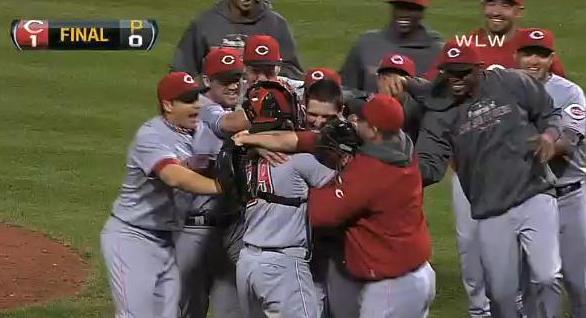
Friday, interim Reds manager Chris Speier did precisely the same thing, shifting his infield to the right for lefty hitter Pedro Alvarez in the eighth inning of Cincinnati’s game against Pittsburgh, even as pitcher Homer Bailey worked on a no-hitter.

Unlike Saltalamacchia, however, Alvarez failed to appreciate the fact that, with a simple willingness to poke a ball down the third base line, he’d not only have achieved his team’s first hit, but he’d have brought the winning run to the plate in a 1-0 game. Instead, he swung away and hit a line drive toward the shortstop position, manned by third baseman Scott Rolen.

“If [Rolen]’s not there that goes right between short and third,” said Bailey in the Pittsburgh Post-Gazette. “I thought that was it.”

Speier’s maneuver was the same as Melvin’s, save for the fact that it worked. Perhaps he had intel saying that Alvarez doesn’t bunt under any circumstances, and he took advantage. Barring that, though, it’s difficult to criticize Melvin without laying down a similar dose right here.


Don't Call out Opponents in the Press

Oakland’s One Clap is One Too Many for Some Members of the Yankees

When one plays for the Yankees, who not so long ago were cruising toward the playoffs but who suddenly find themselves desperately trying to keep the Orioles at bay, one can get touchy during the course of getting one’s butt kicked by the team with the American League’s lowest payroll.

At least Eric Chavez did. After New York’s 10-9 win in 14 innings at Yankee Stadium Saturday, he told the New York Post that, following each of Oakland’s three homers in the 13th inning, A’s players partook in some “orchestrated clapping, chanting,” which Chavez described as “high school-ish,” “pretty unprofessional” and something “that crossed the line.”

The antics were described in the San Jose Mercury News:

The routine the A’s did is based on the Randy Moss-related “One Clap” song and video clip that was all the rage on YouTube. Gomes often played that song during spring training, and he said the A’s have done the routine all season in the clubhouse and on the team bus.

Somebody yells “One Clap!” and teammates respond with a clap.

The reason it should not have troubled Chavez, said Jonny Gomes, “is it happened in our dugout. It didn’t happen between the lines.” (To judge by the TV replays, which are far from comprehensive, it’s difficult to discern anything objectionable happening in the A’s dugout on the first, second or third home runs of the inning.)

For Chavez to get riled about such a thing is a tad ironic. When he was a young player with the A’s—playing the Yankees, no less—he learned a difficult lesson about speaking out a bit too quickly about the opposing nine.

From The Baseball Codes:

Nearly as innocent were the comments made by A’s third baseman Eric Chavez before his team faced the Yankees in Game 5 of the 2000 ALDS. Responding to a press-conference question about his opponents, who had won the previous two titles, Chavez talked about how great the Yankees had been in recent years, what a terrific job they’d done, and how difficult it was to win as consistently as they had. He also added that they’d “won enough times,” and that it would be okay for somebody else to play in the World Series for a change. Chavez was twenty-two years old, wide-eyed and hopeful. There was nothing malicious in his tone.

Unfortunately for the A’s, the press conference at which Chavez was speaking was being broadcast live on the Oakland Coliseum scoreboard for early-arriving fans. Also watching were the Yankees, on the field for batting practice. “So he’s dropping the past tense on us? Did you see that?” spat third baseman Scott Brosius from the batting cage. One New York player after another—Derek Jeter, Paul O’Neill, Bernie Williams— took Chavez’s comments and blew them up further. The Yankees hardly needed additional motivation, but now they had it. Their first three hitters of the game reached base, four batters in they had the lead, and by the end of the frame it was 6–0. The A’s were in a hole from which they could not climb out before they even had a chance to bat.

How one feels about this apparently depends on the dugout in which one happens to sit. The day after Oakland’s one-clap hysteria, Nick Swisher responded by hitting a home run for New York, then lingering for a beat in the batter’s box to admire it. (Watch it here.) Asked about it in the Post, he said, “Like Jonny Gomes says, what’s the hurry?”

Don't Play Aggressively with a Big Lead

Those Pitching Changes. Oh, Those Pitching Changes

Perhaps the most obvious piece of the Code is the mandate to shut down aggressive play on offense while holding a big lead late in the game. But what about pitching?

On Wednesday, Bruce Bochy went to his bullpen three times—going righty-lefty-righty with Guillermo Mota, Javier Lopez and Sergio Romo—to face four batters in the ninth inning against the Rockies. The Giants led 8-3.

“I’ve been here a few times and I’ve seen some comebacks that are hard to stop,” Bochy said in the San Jose Mercury News. “You don’t want to get a rally started here because momentum gets going.”

There’s no indication that the Rockies were annoyed by such tactics, and perhaps they shouldn’t have been. However, were manager Jim Tracy the type to get rankled over a stolen base by a team holding a five-run, ninth inning lead, it only stands to follow that this might get under his skin, as well.


Retaliation

Delayed Gratification: Pittsburgh Strikes Back, a Month Later

The hubbub surrounding Brandon Phillipsaccusations of racism helped obscure a profound truth about baseball’s unwritten rules: Teams will wait as long as is necessary to respond to events in which they feel they’ve been significantly wronged.

Phillips getting drilled Monday was at the heart of it, but had little to do with the genesis of the situation. It began on Aug. 3, when Reds closer Aroldis Chapman drilled Andrew McCutchen with a 101-mph fastball. The following day, Reds starter Mike Leake hit Josh Harrison, then descended the mound toward him to deliver a follow-up message.

Of concern to the Pirates was the fact that umpire Brian Gorman issued warnings after the latter incident. It was, I wrote at the time, “an unfortunate development that precluded—correction, delayed—any type of Pittsburgh response.”

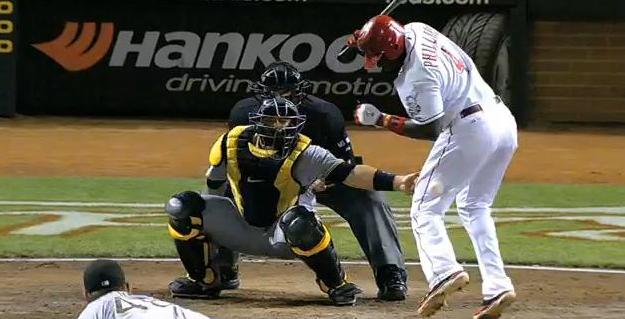
The delay is now over. In the eighth inning Monday, Pittsburgh reliever Jared Hughes placed a fastball into Phillips’ left leg. It certainly looked intentional, although the surrounding factors—a 3-3 tie with one out in the eighth is not the prototypical moment for retaliation; a hitter like Phillips, who can run, is not an ideal target, especially with Joey Votto lurking two batters later; and catcher Rod Barajas reached out as if to catch a wayward pitch—suggest otherwise.  (Watch it here.)

Phillips got in some jabs of his own, first picking up the baseball and tossing it toward Hughes—this is the act that is widely assumed to have precipitated Phillips’ post-game tweet claiming racism—then stealing second. (He did not score, and the game went 14 innings.)

As McCutchen jogged toward his dugout following the Reds’ half of the eighth, a clearly perturbed Phillips engaged him with a clear message for somebody on the Pittsburgh bench. That turned out to be Hughes, but by Tuesday the feuding participants reached an accord. Nobody was hit in last night’s game, and no fireworks are anticipated for the teams’ four meetings through the end of the season.