Don't Steal with a Big Lead, Retaliation

The Subtlest Retaliation is Sometimes the Best

Sometimes even an inconsequential on-field action can merit retaliation—which will ideally be delivered in measures commensurate with the initial transgression. Which is to say, if a team must respond to a minor Code violation, here’s hoping they do it appropriately.
On Thursday, the Diamondbacks did.

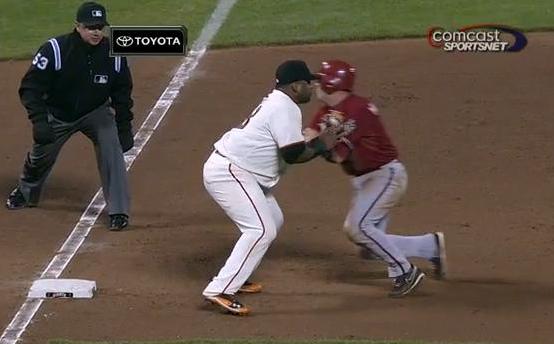
With runners at first and second and nobody out in the eighth inning of their game in San Francisco, Adam Eaton (this one, not this one) grounded a ball to first base, where Brandon Belt made a quick relay to third. The play caught Pablo Sandoval off guard; instead of backing up a step to touch the base for a force play, he turned to make a sweep tag. So too did the play surprise baserunner John McDonald, who, instead of sliding—which he almost certainly would have done had he expected it—staggered toward the base and into Sandoval.

Surprised by the contact, the husky third baseman followed McDonald into foul territory after tagging him, and was quickly restrained by umpire Greg Gibson and Arizona third base coach Matt Williams before dugouts emptied. No punches were thrown, Sandoval quickly calmed down, and everybody went back about their business. (Watch it here.)

Such a situation hardly merits a drilling (especially because umpires warned both benches immediately following the incident). More appropriate is what Arizona ended up doing: In the ninth inning, while holding a 6-2 lead, Paul Goldschmidt led off with a single and promptly stole second.

Sure, four runs in the ninth is hardly a basis for rubbing anything in, but it was clear by that point that the Giants would not be coming back: They had been no-hit into the seventh by Trevor Cahill, and Arizona had one of the league’s top closers in J.J. Putz available if needed, with only three outs to go.

The Diamondbacks made their point, and it couldn’t have been more perfect.

Don't Play Aggressively with a Big Lead, Jayson Werth, Swinging 3-0

Some Leads are Insurmountable; Others are Insurmountable Only for the Cubs

Opinions about when it is and isn’t appropriate to play aggressively—stealing bases, say, or swinging 3-0—vary widely. When you’re the Chicago Cubs and are in the midst of getting pummeled, repeatedly, by the best team in the National League, it only makes sense that sensitivities might be a bit raw.

The game in question was the capper following three straight Nationals victories over Chicago, by a cumulative score of 22-7—“one of the biggest butt-whippings” Cubs manager Dale Sveum said he’d ever received. Ultimately, it served mainly to add misery to a season which at that point had the Cubs on pace to lose 102 games.

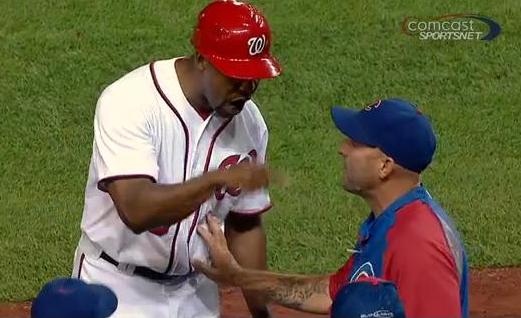
In the series’ fourth game, on Thursday, it took only four innings for Washington to build another substantial lead, 7-2, so when Jayson Werth swung at a 3-0 pitch with the bases loaded and two outs in the fifth, it was enough to officially drive Cubs bench coach Jamie Quirk into an extreme state of annoyance.

From the dugout, he started “screaming out obscenities” toward Washington third-base coach Bo Porter, according to umpire Jerry Layne in the Chicago Tribune, a situation the umpire felt “was inappropriate” and “caused everything.”

“Everything” began with Porter approaching the Chicago bench and screaming right back at Quirk. That escalated to both dugouts emptying onto the field. (Watch it here.)

“You’re up 7-2,” said Cubs catcher Steve Clevenger. “You don’t swing 3-0.”

There’s truth to the statement, but its timing is straight out of the 1960s. The last time the fifth inning was utilized as a yardstick for when to stifle an attack, it was a pitcher’s league. They were the days of Sandy Koufax and Bob Gibson, long before offenses exploded in a spate of expanded rosters and juiced balls and tiny ballparks and BALCO-fueled hitters. Today, the fifth inning sounds downright quaint.

Then again, this is the Cubs. The line for when to call off the dogs is malleable, depending on a team’s bench and bullpen, the freshness of its starting pitcher, the state of its offense. With the Cubs, for whom a two-run deficit might seem like an unbridgeable chasm, perhaps five runs, and only four innings to score them, is a  lot.

We’ve already established that their emotions are raw, which explains why reliever Lendy Castillo threw at Bryce Harper to lead off the the sixth. That set Harper off on his own shouting jag, and the dugouts emptied again. (Watch it here.)

Harper nailed it in his postgame comments, saying in the Tribune, “I’d be pretty ticked off if I was getting my teeth kicked in all week, too.”

Nationals manager Davey Johnson proved to be tone deaf earlier this season when it came to a different facet of the game’s propriety, but on this particular issue he was pretty much spot-on.

“We’re in a pennant race, we’re going to swing 3-0, we’re going to do everything,” he said in the Washington Post. “We ain’t stopping trying to score runs. Certainly a five-run lead at that time is nothing. I think it was the bench coach’s frustration in us handing it to them for a couple days. If they want to quit competing and forfeit, then fine. But we’re going to keep competing. I don’t know why they’re getting on about swinging 3-0. Their first baseman [Anthony Rizzo] swung 3-0 in the first inning. What’s the difference with the bases loaded in the fifth with only a five-run lead and two outs?”

At this point in the game’s history, not much. “Only” a five-run lead is exactly that, even against the Cubs. One would hope that next time they display a bit more pride.

Don't Bunt to Break Up a No-Hitter, Jarrod Saltalamacchia

Perfecto Broken Up by Bunt … and for Once That’s Okay

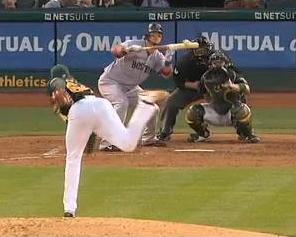
Boston, a day after getting gut-punched 20-2 by the Oakland A’s, had mustered not so much as a baserunner with two outs in the fifth inning Saturday against right-hander A.J. Griffin.

Frustration was inevitable, but was it sufficient to explain why Jarrod Saltalamacchia would bunt in the middle of a perfect game? The Red Sox catcher did, and reached base safely, which seems like a no-brainer: The guy was in clear violation of the Code. Heck, he even had a parallel with the most famous perfect game breaker-upper in history, Ben Davis—another catcher, who pulled the trick against Curt Schilling in 2001.

There was, however, a notable difference: For some unexplainable reason, A’s manager Bob Melvin had put on a defensive shift. With third baseman Adam Rosales positioned where the shortstop usually stands, Saltalamacchia was given the same kind of wide-open invitation all left-handed batters receive in that situation: an easy base hit with a well-placed bunt. Saltalamacchia, who has all of three sacrifice bunts in his career—all in 2007—took him up on the offer. (Watch it here, starting at the 1:03 mark.)

If the theory behind the governing rule is that a team’s first hit should be above board, with no gimmickry involved, then it should only follow that the defensive positioning of the pitcher’s team should follow suit. When Melvin opted not to play things straight up—despite holding a 5-0 lead—his opposition can hardly be faulted for acting similarly.

Melvin acknowledged as much after the game. “I probably should have had the third baseman in,” he told the San Francisco Chronicle.

To Griffin’s credit, the pitcher appeared to not hold any grudges. “It’s a good way to try to get momentum for your team,” he said. “There’s not anything I can do about it except try to get the next guy. Whatever.” (Bobby Valentine, who has far bigger controversies to consider than this one, added the sentiment, “Who cares?”)

There’s lots of blame to go around for Boston’s misery this season, but not on this play. If Griffin has a beef with anybody, it should be Bob Melvin.

The Baseball Codes

Weirdness at Wrigley: DeJesus hit by Pitch from Own Teammate

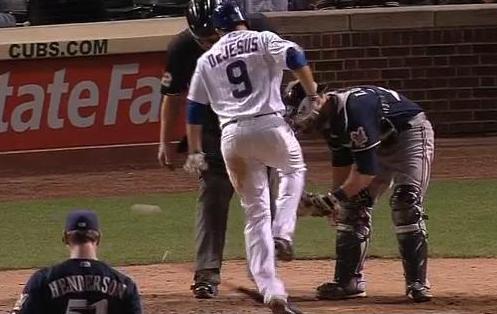
Pissing off an opponent badly enough to get drilled is one thing. When it’s your own team throwing baseballs at you, though, watch out.

So says David DeJesus, who, barely a moment after watching ball four from Brewers pitcher Jim Henderson on Monday night, was plunked by a ball that got loose from the Cubs bullpen.

At this point, further details are extraneous. Just watch the video.

(Via Yahoo.)

Josh Harrison, Running Into the Catcher

When is the Baseline Not the Baseline? When it’s Your Team’s Catcher Blocking it, Apparently

Cardinals catcher Yadier Molina understands the concept of blocking the plate. So does his manager, Mike Matheny, a big league catcher for 13 seasons. Which is what makes their professed confusion over the propriety of a play in which Molina was bowled over during Tuesday’s 9-0 loss to Pittsburgh so confusing.

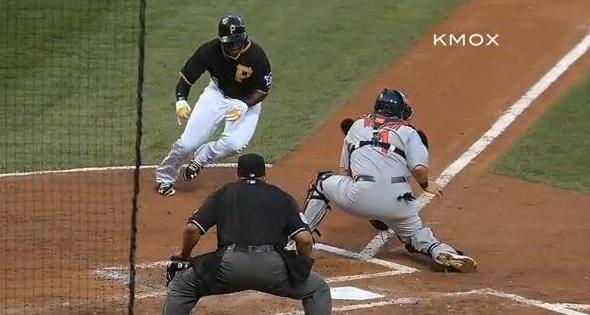
As Josh Harrison rounded third on a second-inning single by Jose Tabata, Molina positioned himself in the baseline, awaiting the throw from right fielder Carlos Beltran.

The catcher’s positioning left Harrison little choice. A slide would have put him into the catcher’s shinguards. A wide-slide-and-swipe-tag combo was also out of the question. So Harrison—only 5-foot-8, but 190 pounds—took what was clearly his best option, and lowered his shoulder.

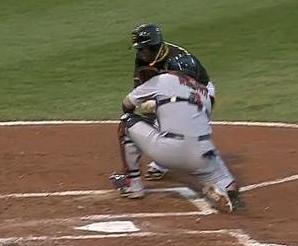
Molina held onto the throw and tagged Harrison out, but lay in the dirt for several long moments and had to leave the game. (Afterward, his back, shoulder and neck were sore, but he reported no concussion symptoms. Watch the play here.)

A clean, legal play resulted in an out on the basepaths. This didn’t stop Cardinals pitcher Jake Westbrookfrom meting out retaliation in the bottom of the fifth. A 3-0 Pirates lead coming into the frame had grown to 5-0 courtesy of four straight hits to open the inning, and Westbrook faced a first-and-third situation with Harrison at the plate. With second base open and the pitcher frustrated, he acted, drilling the batter in the leg. (Watch it here.)

Plate ump Adrian Johnson showed an unfortunately quick trigger, immediately warning both benches—a decision that elicited an anmiated conversation with infuriated Pittsburgh manager Clint Hurdle, whose team had been stripped of an opportunity to respond to what had effectively been the first shot fired.

A well-blocked plate.

“A baseball play was made at home plate,” he said after the game in the Pittsburgh Tribune-Review. “They decided to pitch Josh Harrison inside and tight. That’s a baseball play. What I was disappointed in is we didn’t have an opportunity to make a baseball play. If (Johnson) thought there was intent to hit him, throw the pitcher out and let’s move on.”

Had Molina given Harrison a lane to the plate—like the one Buster Posey gave to Scott Cousins last season when he was nonetheless knocked over and out for the year—St. Louis would have had a legitimate gripe. As it is, their confused post-game comments seemed unusually pointed. A sampling, from the St. Louis Post-Dispatch:

  • Molina: “I would love for him to slide, but this is baseball. It’s one of those things that is going to happen.”
  • Matheny, on the legitimacy of the play: “What do you mean by legitimate? Everybody has the option to slide. He had an option to slide and he didn’t.”
  • Unnamed Cardinals player: “He probably would have been safe if he had slid. That was not the play.”
  • Carlos Beltran: “A runner has a choice — to slide to home plate or hit the catcher. . . . It’s not a dirty play, but, like I say, you have the choice. Go for the base or try to hit the guy.”

Beltran made the point perfectly, only in reverse. By positioning himself where he did, Molina left Harrison no choice about what to do. The only way to get to the plate was through the catcher.

“When I was about (30 feet) from the plate, I saw him slide his feet back,” said Harrison. “The whole plate was blocked; there was no way to slide around him.”

Perhaps the Cardinals’ players were covering for Westbrook, who likely acted on his own. Maybe they really meant it. Either way, Johnson’s warning delayed until today—the final game between the teams this season—any response for which the Pirates may have opted. If matters are to be further settled, it will happen tonight.

Appropriate Retaliation, Retaliation, Scott Diamond

Head-Hunting Season in Texas Earns Immediate Consequences

Juuuuust a bit inside.

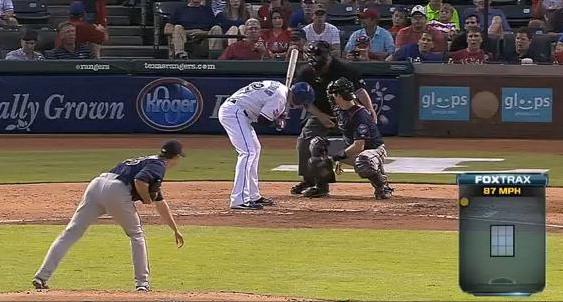
The real question after Thursday’s head-hunting and Friday’s suspension in Texas is why?

Not why Twins lefty Scott Diamond was ejected, then suspended for six games. That much was obvious: He threw at Josh Hamilton’s head. (Watch it here.)

No, the lingering uncertainty in the wake of it all concerns Roy Oswalt’s motivation for precipitating the affair with a third-inning fastball into Joe Mauer’s back. There were two outs. It was a 3-0 count. There was a runner on second. There was little question about the intent behind it.

Speculation has the runner, Ben Revere, flashing signs, which could understandably perturb Oswalt. Revere had also been on second when Mauer doubled in the first, which may have set some precedent. If nothing else, Mauer has been noted for his proclivity for this kind of activity.

It’s also possible that Oswalt was settling some unknown grudge, or that, with a base open and a 3-0 count, he was simply releasing a bit of pent-up aggression, happy to face the relatively punchless Ryan Doumit hitting next.

That last option is the least likely of the bunch, but still more plausible than Oswalt’s ultimate explanation, offered up after the game:

For some reason, I can’t keep the ball true on the left side. He’s been beating me away, away, away. I was trying to get him out in and just dropped my elbow. I don’t know the reason why the ball is coming back on the left side of the plate. I can keep it true on the right side. The left side I can’t really keep it true and I dropped my elbow and it kind of sailed on me.

A response from Diamond was expected. He probably would have gotten away with a warning had he been better about his execution. Instead of aiming for Hamilton’s hip, he sent a pitch up around the head, forcing the left-handed hitter to duck. Plate ump Wally Bell didn’t hesitate with his ejection.

“Any time in an umpire’s judgment that they go in the head area, we have to take care of business,” Bell said in a statement. “I felt at the time that he had to be ejected for it.”

Ron Gardenhire, who was also tossed, vigorously disagreed with the lack of warning, but it’s difficult to fault an umpire for tamping down immediately on what could be a very dangerous practice—let alone subsequent retaliatory shots. The league backed Bell up on Friday with its suspension.

Hamilton avoided confrontation by claiming later that he didn’t feel Diamond was throwing at him. Gardenhire said that he hopes it doesn’t carry over.

For a series of actions that made increasingly less sense, it seems a fine way to put an end to all of it. Then again two Rangers were hit in the second inning Friday by Minnesota’s Samuel Deduno in the span of four batters. They were part of six straight baserunners allowed that pushed a 1-0 Texas lead to 5-0, so it could have just been a case of wildness. Then again, Deduno walked only one batter over five innings.

Two more games this weekend. Keep your eyes peeled.

Rookie Hazing, Ryan Wheeler

One is the Loneliest Number: Arizona Offers Some Long-Lasting Ice

All alone in the dugout.

We’ve grown accustomed to rookies getting the cold shoulder in the dugout after hitting their first home run, a process of good-natured icing by their teammates that serves to remind them that, even with their deserved accolades, they’re still rookies.

On Saturday in Houston, however, the Diamondbacks took things to an extreme. After Ryan Wheeler hit his first big league jack into the left field stands, he was left to wonder . . . and wonder . . . and wonder just how long his teammates were going to maintain their charade. (Watch it here.)

As a smiling and solitary Wheeler took his seat on the bench, cameras trained in on him, waiting for the moment at which Arizona players would jump up and congratulate him. Stephen Drew, sitting next to him and unable to stifle his grin, had to pull his jersey up over his mouth.

Eventually, however, Astros pitcher Chuckie Fick threw another pitch to the next hitter, Patrick Corbin, which the telecast was obligated to show. They quickly cut back to the dugout camera, without much luck. Wheeler was still sitting, alone, when Fick delivered again. It wasn’t until Fick was winding up for the third pitch of the at-bat—a span of some 40 seconds—that Arizona players finally relented and gave the rookie his just due.

If something’s worth doing, it’s worth doing thoroughly, I guess. Don’t believe anybody who says that the Diamondbacks are not committed to their craft.

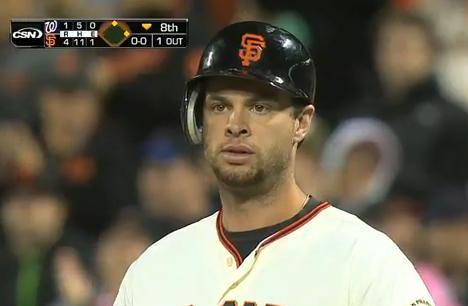
Brandon Belt, Retaliation

How You Know You’re No Longer Slumping, Lesson 129: The Other Team Wants to Drill You

Brandon Belt: Tickled to be so esteemed.

Sometimes it’s okay to be drilled.

When you’re a hitter who as recently as July 24 was batting just .229 and slugging well south of .400, it can feel good to hold target-worthy status, justification be damned.

At least it did for Brandon Belt, who was by every indication hit intentionally by Padres lefty Clayton Richard on Sunday, in response for a Ryan Vogelsong pitch that ran into Carlos Quentin two innings earlier.

After the game, Belt was sporting a sizable welt above his hip, but he didn’t mind. “It’s kind of a compliment, I guess,” Belt, by that point having raised his average to .267, told the San Jose Mercury News. “It’s okay, it’s part of baseball sometimes.”

His picher didn’t agree.

“Go look at the video,” Vogelsong said in a San Francisco Chronicle report. “It was a two-seamer that ran off the plate. That guy hammers balls over the plate, then gets pissed when you throw the ball inside. It doesn’t make sense. Every time you hit a guy in this game, they think you did it on purpose. It’s tired.”

It’s worth noting that Quentin is tied for the league lead with 14 HBPs this year, led the American League last season with 23 for Chicago, and has collected 20 in two other seasons, so it shouldn’t have come as much of a shock.

Still, for some pitchers a hit teammate is a hit teammate, intention aside. The Giants and Padres next meet on September 20, in San Francisco.

Don't Showboat, Hanley Ramirez

I See You, Too: Ramirez’s Antics Earn Notice

Thursday, the Dodgers should have known better when it came to dealing with umpires during their game against the Pirates. They didn’t, and it cost them.

In the fourth inning of that same game, Hanley Ramirez homered off of A.J. Burnett. Shortly after rounding second base, he made his by-now-patented “I See You” hand gesture—circles with the index finger and thumb of each hand, placed over his eyes like glasses—aimed at the Los Angeles dugout. (Watch it here.)

His sight line, of course, happened to pass close enough to the pitcher’s mound for one of two possibilities: Burnett misunderstood his intention and took the gesture personally, or the pitcher felt that an opposing player had no business participating in bush-league shenanigans while rounding the bases, intention be damned.

In either case, he’d have been correct.

“If you’re going to hit a homer, act like you’ve hit one before,” Burnett told reporters after the game. “The first batter, [James] Loney, hit one, was very professional about it. Ran hard the whole way.”

Ramirez concocted “I See You” as an update to the “Lo Viste” hand gesture he used in Florida, in which members of the Marlins hold a sideways V made with the index and middle fingers over their eyes (as seen here in a different environment.)

“When I got to the Dodgers, I did ‘Lo Viste’ for [former teammate Emilio] Bonifacio a couple times and it was cool,” Ramirez said in a Miami Herald report. “But then I spoke with [Dodgers shortstop]  Dee Gordon and he said, ‘Let’s do something different. You’re no longer in Miami.’ That’s when we tried to do something new and came up with this. It’s all for fun.”

At least until it ticks off a member of the opposition.

“That’s Hanley,” Ramirez’s former manager, Ozzie Guillen, said in an ESPN.com report. “[If] Hanley hit a home run down by 30 runs, he would pimp it. That’s the way he is . . . It surprised me A.J. didn’t drill him.”

Sure enough, Burnett faced Ramirez with two outs and the bases empty in the sixth, with the Pirates holding an 8-4 lead. There would not be a more opportune moment to make whatever statement he felt necessary, but he did not act.

Then again, Burnett also passed up a similar opportunity earlier this season, despite pointing toward the Reds dugout as a means of warning that just such a thing was imminent after Andrew McCutchen was drilled by Aroldis Chapman, and Josh Harrison was hit, then berated, by Mike Leake the next day.

Reaction, of course, is not the focal point of this subject. That would be “I See You,” which is cute and which keeps things loose and which builds morale on a team in a pennant race. All of this is beneficial. To break it out on the field, in game action, while facing an opposing pitcher, however, is nothing short of inane.

Ramirez left Florida in late July in dubious standing with many of his former teammates. Getting any of his new teammates drilled for an ill-considered on-field decision won’t do much to earn him new friends in Los Angeles.

Angel Campos, Matt Kemp, Umpire Relations

Know Your Umpires: Kemp Tossed Early, Dodgers Lose

Proper response to umpires is an essential component of survival as a baseball player. Some players go to lengths to learn names and details from umpires’ lives, then chat them up, as friends do, because it might buy some goodwill down the road.

Others have a more difficult time determining appropriate behavior.

That definition, of course, differs from ump to ump, and may even differ from day to day for the same guy, depending on his mood. Thursday in Pittsburgh, it appeared that plate umpire Angel Campos was a bit grumpy.

Things began in the second inning, with Matt Kemp—still upset over calls during his first-inning strikeout—chirping from the dugout toward the plate. As Andre Ethier stood in the batter’s box, Campos can be heard on the telecast saying toward the Dodgers dugout, “I don’t want to hear you again, I’m telling you that right now.” Somebody on the bench replies, “Just watch the game.”

“That’s all I’m telling you,” replies Campos.

“Just watch the game,” echoes the bench.

Talk from the dugout continued, though it can not be understood on the game audio, and a moment later Campos responded firmly, ejecting Kemp. (Watch it all here.)

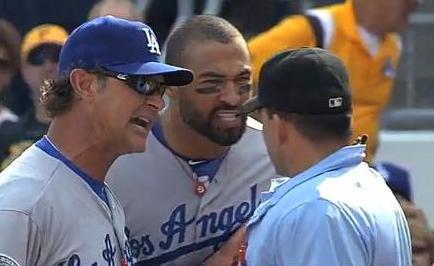
According to Kemp, the phrase he used to break the Campos’ back: “Let’s go, Dre.” Manager Don Mattingly’s swift and outraged reaction to the ejection—he was tossed as well in short order—supports the statement.

“Matt got thrown out today for cheering for Andre,” Mattingly said after the game, as reported by MLB.com. “He was barking about the pitch to Dre, the second strike, but then Angel said, ‘That’s enough. I don’t want to hear another word.’ So the next thing that came out of [Matt’s mouth]—I heard it, clear as a bell—he said—because Matt knows where to stop—and Matt said, ‘Let’s go, Dre!’ And [Campos] looked over, and he threw him out of the game. It’s unacceptable.”

We’re left with the fact that an umpire has little reason to eject anyone over a statement of teammate support that can in no way be interpreted as an attack. We’re left with the fact that ejecting a team’s best player in the second inning of a game—especially a team in the heat of a pennant race—is an action that should only be utilized as a final resort, not a first one. We’re left with an outraged roster that, short its No. 3 hitter, ultimately fell to the Pirates, 10-6.

Something trumps all of that, however—a rule about which both Kemp and Mattingly should have been glaringly aware: Know Your Umps.

Campos clearly told them to zip it, and zip it they did not. Was it justified? Probably not. But to push things in such a manner when a directive has already been issued to refrain from said pushing isn’t the world’s greatest strategy. Kemp may feel like he backed down from a potential confrontation, but he clearly didn’t back down enough.

Umps don’t have to be just or reasonable or even correct. They’re hopefully held accountable for their actions at some point during or after the season, but in the moment, the wrongest-of-the-wrong umpires still has the power to toss a player for the smallest-of-the-small reasons. Kemp should never have given him that reason.

Pitcher Joe Blanton’s ejection in the fifth was another matter entirely. As the right-hander was heading for the dugout after being pulled from the game, he stared daggers at Campos until the umpire said something, then lit off toward him to engage in heated conversation. He knew what he was doing and he knew where it would end, and all went precisely according to plan. (Watch it here.)

Kemp: Not so much. His spot in the order came up three more times with runners on base—once with the bases loaded—and even though the Dodgers got a bunt single and a hit-by-pitch from his replacements to score runs in two of those situations, there’s little question that Kemp’s presence would have offered them significantly more.

The chance to win a game trumps nearly every one of baseball’s unwritten rules. When it comes to the one about knowing how to deal with umpires, however, the two go hand in hand. The Dodgers know this as well as anybody, but on Wednesday they ignored it—and it cost them.

Update (8/18): Mattingly, not Kemp, was suspended for his actions.