Franklin Morales, Luke Scott, Retaliation

Great Scott! Red Sox, Rays Continue Decades-Long Dustup

Jeez. You go away for a long Memorial Day weekend, and all heck breaks loose. The nice thing about looking at situations like this in retrospect is the clarity afforded by the long view, in which the reactions to a given kerfluffle end up being more entertaining than the kerfluffle itself.

If there was smart money laid down on a weekend eruption, it would have been on the Rays and the Red Sox, two teams with no love lost, who just last week seized headlines when Adrian Gonzalez promised to hit a homer, and was by appearances drilled for it, by Rays rookie Matt Moore. (Retaliation was collected by Boston’s Felix Doubront, who drilled Luke Scott—a player whose name will be featured again prominently in this report, only two sentences from now.)

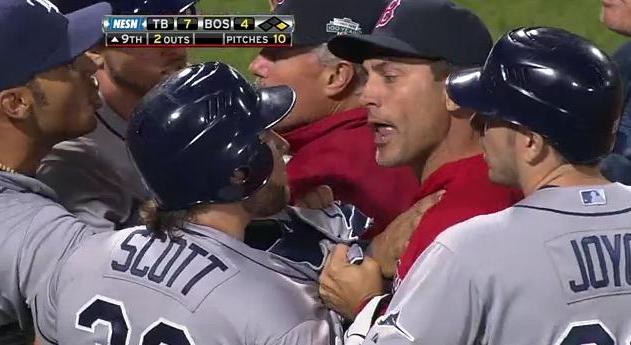
This latest round came in the sixth inning Friday, when Rays righty Burke Badenhop hit Dustin Pedroia. It was a stretch to consider it intentional, given that it brought David Ortiz to the plate as the tying run, but that didn’t keep Sox pitcher Franklin Morales from hitting Scott in the knee three innings later, two pitches after putting an offering behind his head. It might merely have been the spot in the order—Morales waited until there were two outs in the ninth, with nobody on—or it could have been Scott’s comments last month in which he called Fenway Park “a dump.” (Heck, maybe it’s that Morales, despite being from someplace other than the United States, is an Obama supporter.)

Or perhaps good fortune handed Morales the guy he wanted, precisely when he wanted him.

Players streamed from the dugouts, did a bit of shoving and tugging—Boston coaches Bob McClure and Tim Bogar, as well as manager Bobby Valentine, appeared to be more agitated than most players—and went on their ways. (Watch it here.) The Red Sox held on to win, 7-4.

Afterward, each manager had choice words for the other.

Rays skipper Joe Maddon, in addition to calling it a really weak, cowardly effort on the part of the Red Sox:

I’m kind of curious regarding who put out the hit, because I know it wasn’t one of their players. By the way their players reacted to the entire situation, I knew it did not come from them. It’s kind of incompetent behavior, it’s the kind of behavior that gets people hurt on your own side by choosing to do something so ridiculous.

Pedroia gets hit, not because we’re trying to hit him, he just got hit. We don’t want Papi coming up there with two guys on, are you kidding me? I don’t care who’s pitching for us. That’s truly somebody flexing their muscles on the other side that really needs to put them in their back pocket and understand that they can’t hurt their own team by doing something like that. . . .

To be really carelessly incompetent on their side, to truly, intentionally hit somebody, throwing behind somebody, then hitting them in the leg, for all the wrong reasons, whereas eventually they can get their own guys hurt with that kind of behavior . . .  I think it’s ridiculous, I think it’s absurd, idiotic, I’ll use all those different words.

Maddon later tweeted, “Very proud of our effort 2nite. What occurred in the 9th reeked of intent. Was ridiculous, absurd, idiotic, incompetent, cowardly behavior.’’

Valentine, in addition to suggesting the culprit to blame for Morales’ fastball was the Ghost of Fenway, guiding the ball in response to Scott’s “dump” comment:

I thought their coaches were really aggressive; as a matter of fact, I took offense to the aggressiveness of their coaches. I thought it was really unprofessional. . . . [Rays coaches] seemed very immature and out of control. Coaches are supposed to stop those things from happening and their coaches were aggravating, agitating, and instigating the situation.

Given all of this—plus the fact that Scott offered the warning, “At the end of the day, you reap what you sow”—it was a bit surprising that umpire Ed Rapuano declined to issue warnings prior to Saturday’s game. Turns out he didn’t need it; nothing incendiary happened. On Sunday, in fact, Matt Joyce wiped out Mike Aviles on a double play, and received a pat on the back for his efforts as he got up.

The Rays-Red Sox rivalry dates back to 2000, when Pedro Martinez hit Gerald Williams, and has since been fierce enough and consistent enough to merit its own section in The Baseball Codes. The teams meet again in July; we’ll see if we can’t add another chapter then.

Bryce Harper, Cole Hamels, Retaliation

All Quiet in Philly: Hamels-Harper Drama Reaches Accord

So the big showdown happened. Nearly three weeks after his drilling of Bryce Harper renewed baseball’s fascination with the unwritten rules, Cole Hamels stepped to the plate three times against Edwin Jackson, once with first base open, and didn’t even get brushed back.

People seem almost disappointed.

The Phillies, of course, got their retaliation back in the same game that Harper was first hit, when Jordan Zimmerman drilled Hamels in the leg. That effectively closed the book for both parties. There was a chance that Hamels’ after-the-fact admission could have earned him some extra attention, but that never came to pass.

Hamels said that it wasn’t “even in the back of my mind.”

Harper said everything was behind him, and that he didn’t think “anybody really cares about it anymore.”

Well, then. Movin’ on.

Retaliation

Who to Target, and Why: Showdown at Wrigley Serves as Interleague Primer

For a vast majority of baseball’s history, much was made of the difference between the National and American leagues. AL: Based on the three-run homer. NL: Prefers to sacrifice. Recently, however, decades after the adoption of the designated hitter amplified these stereotypes, uniformity slowly began to settle across baseball.

The positions of league president were discontinued after the 1999 season. League-specific umpiring crews were consolidated into a single unit, and interleague schedules devised. When Mike Scioscia led the Angels to a championship in 2002, much was made of his bringing a National League style of play to the Junior Circuit. Today, such a distinction is barely noticed.

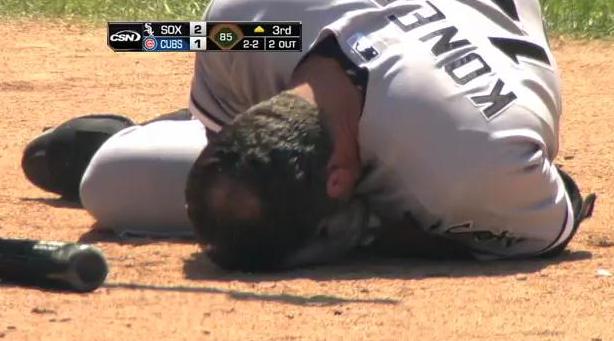
Usually. Wrigley Field and U.S. Cellular Field are located on opposite sides of Chicago, about 10 miles apart, but they may as well be on different coasts. At Wrigley on Friday, the clearest difference between the leagues was on full display, after a Jeff Samardzija fastball ricocheted off of Paul Konerko’s face, near his left eye, in the third inning. (Watch it here.)

Even though it came under suspicious circumstances—Konerko had homered in his previous at-bat—the pitch was a split-finger fastball that didn’t break, Samardzija claimed repeatedly that it was unintentional, and the White Sox believed him.

Nonetheless, there were reparations to be collected. Sox pitcher Jake Peavy put it succinctly in the Chicago Sun Times:

When our man gets hit, gets hit in the face, there’s something to be said about that. I know this is a sensitive subject with baseball, and I’m not trying to be disrespectful, but if your big guy is going down, intentional or unintentional, there’s got to be something done about it.

Something was done, and it perfectly illustrated the difference in mindset between the leagues. Samardzija expected to be targeted for retaliation, but drilling the opposing pitcher was not what Sox starter Philip Humber had in mind.

The reason is obvious. Because pitchers don’t hit in the AL, retaliatory strikes must be directed at the opposing club’s big hitters. Sure enough, the first pitch of the fourth inning sailed behind the Cubs’ biggest threat, Bryan LaHair. It was clearly intentional, and plate ump Tim Timmons quickly issued warnings to both benches. (Watch it here.)

Even if Humber intentionally missed LaHair, his choice of target was peculiar, because Samardzija had been the next Cubs batter in the bottom of the inning after Konerko went down. Not only wasn’t he targeted, but he reached base on an error by shortstop Alexei Ramirez.

Perhaps Humber failed to consider retaliation in that moment, and was reminded between frames that it might be a good idea. Or maybe he had his sights set on a bigger bat, but with a runner, Samardzija, on first and nobody out, he opted against putting anyone else on base, waiting a frame to go after LaHair.

Phil Rogers of the Chicago Tribune talked to Robin Ventura about the situation:

I asked the White Sox manager if there was a purpose to the 91-mph fastball that sailed behind LaHair’s head on its way to the Wrigley Field screen.

“No,” said Ventura, who then turned his brown eyes on me for what seemed a long time, not blinking.

I asked him if the pitch was one that just got away from Humber.

“Yeah,” he said.

Rogers also reported that Ventura said the White Sox would have hit Samardzija directly if they thought his pitch to Konerko had been intentional.

Either way, Peavy and A.J. Pierzynski were caught on camera after the fourth inning having an animated discussion in the dugout—possibly over retaliatory protocol. Peavy, of course, spent the bulk of his career in the National League; Pierzynski has spent 14 of his 15 big league seasons in the AL, and Humber has been an AL guy almost exclusively .

Did the discussion highlight differences of opinion and experience? Nobody’s talking of course, but the fact remained that at least one guy was expecting something a bit more severe.

“I was ready for it,’’ said Samardzija in the Sun Times. “No worries. Sometimes you deserve it.’’

Don't Rub

The Night the Lights Went out in Tampa: Rhymes Collapses After Drilling

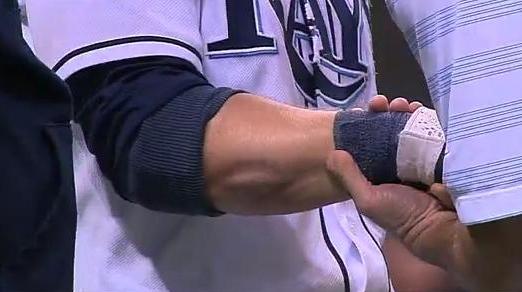
The baseball’s imprint can be clearly seen on Will Rhymes’ arm, moments after impact.

Will Rhymes was hit by a pitch Wednesday, in the forearm. Although there appears to be no lasting damage, the pain was sufficient for Rhymes to remove himself from the game while standing at first base, then pass out into the arms of first-base coach George Hendrick before he could reach the dugout. (Watch it here.)

“I got to first and started getting real dizzy, nauseous,” Rhymes said. “That’s when I started walking off. And then, apparently, I didn’t get real far.”

This is obviously a fairly unique situation, but it is a perfect entre into the unwritten rule stipulating that players who have been drilled refrain from rubbing the mark. It has nothing to do with superstition and everything to do with public displays of macho. It’s the hitter telling the pitcher, you can’t hurt me.

The prototypical player for this rule was Don Baylor, who crowded the plate to such a degree that he was hit by 267 pitches over the course of his career—and, reported the Washington Post, never once rubbed. “Of course,” the article went on to say, “several of the balls had to be hospitalized.”

The notion was summed up perfectly by Hall of Fame owner Bill Veeck, in his book, Veeck as in Wreck, published in 1962:

In baseball, let me say, there is a code that says, “Big-leaguers don’t rub.” You may have noticed that after a batter is hit by a pitch he may flex his shoulder or twist his neck a little but he will never rub the spot where he has been hit. If you ask any of them about it, they will always say, “Why should I give him the satisfaction of showing he hurt me?” This may sound rather naïve, since a pitcher who has just hit a batter behind the ear with a baseball traveling 80 mph has a mighty strong suspicion that it might have stung a little. What the players really mean is that there has somehow developed a code of honor which forbids them to make a display of any physical injury caused by an opponent. There are those, I’m sure, who would call it nothing more than the code of adolescence. I’m not among them. I would even dignify it, I think, by calling it not so much a code but a tradition—for any profession worth the name develops its own traditions. Courage and honor are not such commonplace commodities, now or ever, that they should be scorned.

Pete Rose made a habit of sprinting to first base after being hit, to show the pitcher—and everyone else in the ballpark—that he could not be slowed. In a 2006 interview, former Brewers first base coach Dave Nelson talked about a moment just days earlier, when outfielder Geoff Jenkins was drilled in the elbow, hard enough so that Nelson could clearly make out the imprint of the ball on his arm: “I said, ‘Jeff, you okay?’ He said, ‘Oh man, that hurt,’ but he never rubbed it one time. Not one time. I said, ‘Boy, you’re a better man than me.’ He never even shook out his arm.”

That said, pain levels can occasionally supersede bravado.

“What if I caught you in your neck with something—you ain’t gonna rub it?” asked Rangers manager Ron Washington. “What if I caught you right in your darn elbow? In the elbow. I ain’t talking about the fat part above or below, I’m talking about in the elbow. You telling me you’re going to walk down to first base and not touch it? No, I’m going to be all over the ground. I’m giving in to that pain. Not to you. To the pain. You catch me in the thigh, in the hip—okay, I can take that. I might just run my butt on down there. But catch me somewhere where it hurts, then I’m giving in to that pain.”

Which brings us back to Rhymes, who can hardly be faulted for a reaction over which he very clearly had no control. The lack of actual severity—the second baseman sat out Thursday’s game, but is not expected to miss much time—may open him up to some ribbing from his teammates, but it’s pretty certain that none of them will hold this against him.

After all, it could happen to anybody.

Clayton Kershaw, Ian Kennedy, Retaliation

Ask What You can Do for Your Teammates: Kennedy Avenges Parra, a Season Later

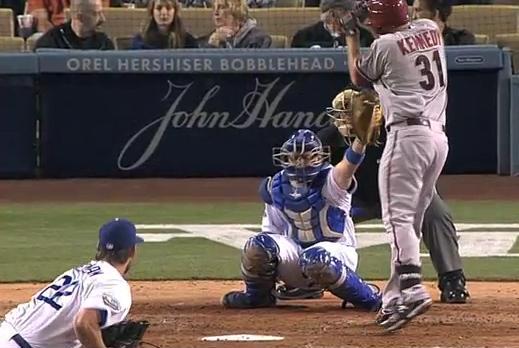
Kershaw responds.

Perhaps this is what Cole Hamels was talking about when he proclaimed his drilling of Bryce Harper last week to be “old-school baseball.”

Old-school baseball frequently involves long memories, and a willingness to respond to a situation even if it has long since passed. On Monday, Arizona’s Ian Kennedy did exactly that.

Kennedy was facing Dodgers ace Clayton Kershaw for the first time since last season, when Kershaw was unceremoniously ejected for hitting Diamondbacks outfielder Gerrardo Parra with a pitch. Parra’s drilling was itself a response to a home run he hit off Los Angeles reliever Hong-Chih Kuo, after which he loitered in the batter’s box as it left the yard. Parra’s loitering was in response to an earlier Kuo pitch that buzzed him as he was squaring around to bunt.

Cause and response. Response and cause.

Fast forward eight months, to Monday night. When Kershaw stepped to the plate to lead off the third inning, Kennedy brushed him back with a first-pitch fastball. In case the message was still unclear, three pitches later Kennedy sent one behind Kershaw’s back. Kershaw stared into the Arizona dugout in disbelief, and, wrote Nick Piecoro in the Arizona Republic, “had no problem receiving the message the Diamondbacks were sending.” (Watch it here; for a fuller examination, see the recap.)

Kershaw’s turn came in the fifth, when Kennedy stepped to the plate and was greeted with a fastball, high and inside. That was enough for plate ump Marvin Hudson to issue warnings to both benches.

Was Kennedy trying to hit Kershaw? To judge by his follow-up effort, he was, but didn’t get it done either time. Did Kershaw handle things appropriately, dishing out as good as he got without escalating matters? Absolutely.

Also, unlike Hamels, blanket denials were the order of the day.

“[Kershaw] is a good hitter, so I had to throw inside on him,” Kennedy said in the Republic. “The second one I just pulled way too much.” (D-Backs shortstop Willie Bloomquist, however, admitted that “no one was trying to hurt anyone—it was just to prove a point.”)

“It’s pretty strange that he throws two up and in like that and one at my shins,” responded Kershaw. “His catcher is saying he’s missing his spots. It’s pretty obvious what they’re doing. I don’t really understand it. I know their manager over there likes old-school baseball, but old-school baseball means you don’t carry over things from last year.”

Actually, that’s exactly what old-school baseball means. It’s easy to say that Kennedy should have left well enough alone, and that renewing old hostilities ultimately does little good for anybody involved. The only real counter to that is the tenor of the Arizona clubhouse, and the unknown conversations that may have led to Kennedy’s action, be they with Parra, manager Kirk Gibson or some other aggrieved teammates. There is a palpable charge that a pitcher faces in standing up for his teammates, and those found to be derelict in that duty are quick to lose clubhouse support.

Ultimately, of course, nobody was hit, the fact that both pitchers ended up walking in their targeted at-bats didn’t end up hurting the opposition, several messages were sent, and everybody emerged unscathed.

Old-school baseball.

Retaliation, Terry Collins

Brewers Denied Target Practice: Wright Pre-Emptively Pulled

David Wright gets riled in the dugout.

Because such thing exists as a pre-emptive strike, it goes to follow that its opposite must be pre-emptive strike avoidance. It’s a term not frequently utilized, especially in Major League Baseball, but it concisely sums up the strategy employed by Mets manager Terry Collins Tuesday at Citi Field.

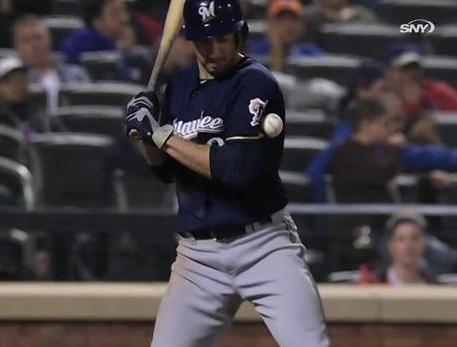
That there was anything to avoid was courtesy of relief pitcher D.J. Carrasco, who, one pitch after a seventh-inning homer by Milwaukee’s Rickie Weeks extended the Brewers’ lead to 8-0, drilled Ryan Braun. Plate ump Gary Darling ejected the right-hander on the spot. (Watch it here.)

The first thing that crossed Collins’ mind appeared to be disbelief that Carrasco, the guy he was probably counting on to eat the game’s final three innings, was gone after only three batters. Shortly thereafter, the ramifications became clear: Braun was Milwaukee’s No. 3 hitter, and his counterpart on the Mets, David Wright, was due to lead off the bottom of the inning.

Factor in that Brewers starter Zach Greinke had to that point given up only four hits over six shutout innings; that the Mets would be lucky to avoid being shut out, let alone win the game; that Brewers manager Ron Roenicke has a bit of history when it comes to Code enforcement; that Wright has his own history when it comes to being hit by pitches; that there’s no player less dispensable to New York’s lineup than the .408-hitting Wright; and that if anybody was going to wear one for the sins of his team, it would clearly be the Mets’ third baseman.

Taking all that into consideration, Collins did what he felt prudent: He removed Wright.

Ryan Braun, and the pitch that started it all.

If Greinke had feelings about seeing pinch-hitter Jordany Valdespin instead of Wright, he kept them to largely to himself after the game, telling the Milwaukee Journal-Sentinel, “I don’t know what would have happened if [Wright] stayed in. They don’t want anyone important to get hurt, just like we don’t want someone important getting hurt.”

Wright, however, was clearly agitated, shouting at Collins in the dugout before turning on his heel and stalking away from the manager. (Watch it here.) Two batters later, Collins removed David Murphy for precisely the same reason.

“In my opinion, why I took him out of the game, he wasn’t getting hurt,” Collins said in a Newsday report. “I’m not accusing anybody for the possibility of retaliation. But I don’t blame the umpires for doing what they do. I don’t blame the other team for any perception they had of what happened, but I’ve got news for you: In this game there are unwritten rules. And one of the unwritten rules, is you hit my guy, I’m hitting your guy. They are not hitting my guy tonight. I’m not exposing him to being hit.”

“Terry’s the manager and I try to go to battle for Terry every day . . .” said Wright, who added that his response looked worse than it actually was. “Whether I agree or disagree with it, he’s got to make the move he thinks is best for the team, and he obviously did that . . . I respect him. I love playing for him.”

Carrasco issued a standard denial, and Braun claimed to have no feelings one way or the other about his opponent’s intent.

As a guy with eight seasons as a big league manager and 10 years of minor league playing time under his belt, Collins probably understands the game’s unwritten rules pretty well. In this instance, however, he may have been upstaged by Wright, when the third baseman told him in the dugout, “If anybody gets hit, I want it to be me.”

“My thinking at the time was, Ryan gets hit and then I go up there and get hit and then everything is settled,” Wright said in a MLB.com report.

In that, he was exactly correct. If it wasn’t the series’ final game, or if the teams’ next scheduled meeting wasn’t four months away, or if Wright was anything but a target of circumstance—were he drilled, it would have been because of where he hit in the lineup, not anything he did on the field—he would have had an air-tight case. Waiting a day to respond to an incident like this is hardly rogue strategy, but Roenicke and his team would have to be harboring a pretty serious grudge to put a target on Wright when they next see him in September.

It will all probably pass without incident, but that may have happened anyway. One thing Collins has assured, however, is that the Mets now have 16 weeks to consider the possibilities before actually seeing the results of this particular experiment.

Update (5/17): The principals have spoken, and the matter has been “handled.”

Bryce Harper, Rookie Etiquette

Harper Homers, High-Fives, Handles History

For a young player with a history of attitude, Bryce Harper did a lot right upon hitting his first home run Monday. After crushing a slider from Padres right-hander Tim Sauffer to dead center field, well beyond the 402 marker, Harper didn’t watch the ball, didn’t pirouette in the box, didn’t skip his way toward first and didn’t toss his bat.

What he did do: He put his head down, and he ran. (Watch it here.)

Perhaps it was the excitement of his first big league homer, but according to Tater Tot Tracker, the only guy this season to circle the bases faster than Harper’s 17.07 seconds was Milwaukee’s Carlos Gomez, who ran a 16.46 primarily because he didn’t realize the ball had cleared the fence until he was already at third base.

“I don’t want to show up that pitcher,” Harper said in the Washington Post. “The only time I would do that [would be] if they were messing with my team.”

After a few moments in the dugout, Harper emerged for a curtain call. Some might take issue with a rookie taking such a liberty—especially after all of one career homer—but the crowd was clamoring and the Nationals’ broadcast crew called it “a for-sure curtain call” before Harper even made a move.

“Everyone started cheering and whatnot, and I was just standing there waiting like, should I go? Nah, I better not. Don’t do it,” said Harper in a MASNSports.com report. “Then (Jayson) Werth was like, ‘Go, get up there, kid.’ ”

All in all, well-played for the rookie, who didn’t even have to face the silent treatment in the dugout, unlike some other notable players of late. After taking the highest of high roads against Cole Hamels last week, this is another indication that, even though he’s only 19, this kid gets the game on pretty much every level.

Albert Pujols, Firsts

For Pujols, Silent Treatment Taken to New Extremes

Hey, where’d everybody go?

Albert Pujols finally hit a home run for the Angels on Sunday, 27 games and 110 at-bats into his career in Anaheim. A drought like this is noteworthy for baseball’s best hitter, let alone a guy trying desperately to justify his new $240 million contract.

It’s also noteworthy for his teammates. So noteworthy, in fact, that they took to celebration in a unique, yet very traditional, fashion.

When a player achieves a noteworthy “first”—usually the player is a rookie, and usually the event in question is his first career home run—his teammates will occasionally freeze him out, sitting on the bench as if nothing eventful has happened before leaping up en masse to congratulate him. Detroit’s Will Rhymes earned such a response after his first career round-tripper in 2010.

Pujols is hardly a rookie, but his blast was sufficient to earn special treatment from teammate Torii Hunter. While the slugger was rounding the bases before a rapturous crowd at Angel Stadium, Hunter quickly herded everybody on the bench—including teammates, manager Mike Scioscia, the trainers and the entire coaching staff—into the tunnel leading to the clubhouse. Pujols received congratulations at the plate from Mike Trout, who had been on base, and the on-deck and in-the-hole hitters, Kendrys Morales and Mark Trumbo, but when he returned to the dugout he found nothing but empty paper cups and the possible tumbleweed. (Watch it here.)

“I thought that would be cool,” said Hunter in an Associated Press report. “I always wanted to do that, and it worked. I just said, ‘Let’s get off the bench and go to the tunnel.’ He was excited about it and we were, too. We had to think fast. When I have a day off, man, I do stupid stuff.”

It worked because Pujols was delighted. It worked because the superstar made a beeline for the tunnel and jovially extracted his teammates, who proceeded to mob him. It worked because it gave the scuffling Angels a rare moment of genuine levity on the field.

If that seems like a bit much to celebrate he 446th career homer for the best player in baseball, Pujols has nothing on Don Drysdale. In 1959, the Hall of Fame pitcher was at the beginning of a long road trip with the Dodgers, in the dining room of the Chase Park-Plaza Hotel in St. Louis, when he received word of the birth of his daughter, Kelly. He took the call not far from the table he had been sharing with Pee Wee Reese, Gil Hodges and Don Zimmer, and felt certain that his teammates had overheard the good news. Yet when he went back to join them, Drysdale encountered nothing but baseball talk, nothing but Dodgers and the previous night’s box scores. Like Pujols, Drysdale was no rookie (this was his fourth season), but like Pujols it didn’t matter.

It wasn’t quite the same as hiding in a ballpark tunnel, but it worked. Before long, of course, his teammates cracked and congratulations became the order of the day.

Retaliation

North Side Slap Fight: Braves, Cubs Trade Drillings at Wrigley

David DeJesus takes some punishment.

All the people yelling about how Bryce Harper didn’t do anything to deserve his drilling from Cole Hamels on Sunday can rest a bit easier. Somebody in baseball finally merited retaliation, and retaliation was delivered.

We think.

Speculation begins in the second inning of Monday’s game between Atlanta and the Cubs, when Jason Heyward homered off Jeff Samardzija. Fast forward to the seventh, when, with one out and nobody on, Samardzija hit Heyward with a pitch. The Cubs trailed 2-1 at that point, so it makes sense that it was unintentional. Still, Heyward’s earlier homer raised some doubts, as did the fact that Cubs outfielder Reed Johnson had been hit up near the neck in the third inning by Braves starter Tommy Hanson.

“[Heyward] came out and hit a home run on a ball that was down and away,” Samardzija said in the Chicago Tribune. “[In the seventh] I just thought he was diving over the plate, and I wanted to throw one in there and go back away, but it just got in there too tight.”

No matter; in the bottom of the frame, Braves reliever Eric O’Flaherty drilled David DeJesus in the right tricep. (Watch it all here.)

Ump Chris Conroy quickly warned both benches, then tossed Fredi Gonzalez, after the Atlanta manager came out to discuss the matter.

“I just asked him for an explanation,” said Gonzalez in the Atlanta Journal-Constitution. “I asked him why would you think we’re throwing at people in a one-run game or they’re throwing at people in a one-run game, you know? It’s not like it’s a 10-run game or anything like that. It’s still a helluva game going on, and I’m talking to him like I’m talking to you, and I got thrown out of the game.”

As reasonable as Gonzalez’s explanation may be, Conroy did the right thing. Samardzija’s plunking of the seventh-place hitter in the Atlanta lineup didn’t exactly scream for vengeance, but if vengeance is the stance the Braves wanted to adopt in response, that’s their prerogative. It was indeed a one-run game, but if O’Flaherty did it on purpose, he picked just the right time—with two outs and nobody on base—and he hit DeJesus in nearly the same place as Heyward was drilled.

Ultimately, because none of the pitchers are talking (learn a lesson, Cole Hamels), it will likely end here. One shot, one response, situation over. (Sure enough, the only contentious issue in yesterday’s 3-1 Atlanta victory was between Kerry Wood and his own performance.)

Series finale today, just to make sure.

Chipper Jones, Jamie Moyer, Sign stealing

Hey Baby, What’s Your Sign? Chipper Doesn’t Take Kindly to Accusations

In The Baseball Codes, longtime Tigers catcher Bill Freehan had some advice for players looking to respond to a perceived indignity with overt action.

“You don’t want to light a guy up,” he said. “Just let a sleeping dog lie.”

At age 49, Jamie Moyer should by now have learned this commonsense maxim, which is espoused in every big league clubhouse.

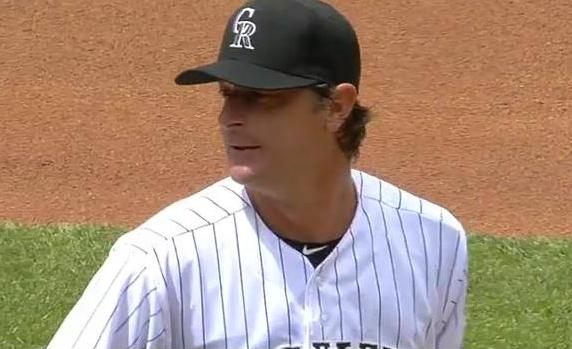
Saturday night, however, he went out and, in Freehan’s terminology, lit a guy up—and it cost him. In the fifth inning of a game Moyer’s Rockies led 6-2 against Atlanta, he thought that Chipper Jones, at second base, was relaying signs to the hitter, Brian McCann. What spurred his suspicion is unclear, but Moyer responded by turning around and tellilng the Atlanta superstar to knock it off. (Watch it here.)

Jones did not receive it well.

“He accused me of relaying a sign down 6-2 with a 3-0 count to Brian McCann,” he said after the game, in the Atlanta Journal-Constitution, referencing the fact that McCann would likely taking the next pitch, no matter what it was, thus nullifying the need to tip him off. “I have never relayed a sign to anyone while I’m on second base.”

That’s certainly possible—some players abhor the practice, for a variety of reasons—but Jones’ tenor makes it sound as if sign relaying is something done primarily by lowlifes and scoundrels. In fact, it’s so common that most pitchers won’t even retaliate should they see it happening—they’ll just have the catcher change the signs. In slightly more extreme circumstances, they’ll ask the baserunner to knock it off. (It’s not even the first time the issue has been raised this season.)

Moyer opted for the latter tack, telling Jones, “I see what you’re doing.” Unfortunately for the pitcher, circumstances do not seem to corroborate his suspicion. Jones said he was having a conversation with Rockies shortstop Troy Tulowitzki at the time—a claim that Tulowitzki confirmed, adding that Jones “wasn’t doing anything”—and was befuddled by the accusation. Actually, he was outraged. The third baseman went to some length after the game to explain precisely how neither he nor anybody on his team does anything like that—with enough specifics to make it very believable.

“I literally am standing on second base and I’m talking to [Tulowitzki], and I turn around and [Moyer] is coming set,” he said in the AJC. “So I get ready and take my lead, and [Moyer] goes, ‘I see you.’ And I go, what the [bleep] do you see? What the [bleep] are you talking about?’ I go, ‘I was [bleeping] talking to your shortstop. And he said something else with his back turned, like he yelled but didn’t face me. I go, that’s [bleeping] B.S. And I turned around to Tulo and Tulo’s like [holds hands up].”

Jones also said that the only sign stealers during his time with the Braves were Jeff Blauser and Mark Lemke—both of whom last played with the club in 1997—and that since then, “nobody’s ever done it.”

Moyer compounded matters in the bottom half of the inning, when he came to bat and informed Atlanta catcher McCann that things like sign stealing are “how people get hurt.” Jones took notice, as did several other members of the Braves. They responded in the most painful way possible: at the plate.

Colorado’s lead had extended to 8-3 by the time Moyer spoke to McCann. Atlanta’s first two hitters the following inning, Matt Diaz and Jason Heyward, then hit long home runs, followed by a single from Tyler Pastornicky. That ended Moyer’s night.

Three batters later, Jones singled off reliever Esmil Rogers to drive in two (Pastornicky’s run was charged to Moyer), and two batters after that the game was tied. Atlanta went on to win, 13-9.

“That was all on Jamie Moyer,” Jones said. “He woke a sleeping giant tonight. . . . I don’t know why he’s so paranoid. But to be honest with you, every pitch he throws is 78 [mph]. So it’s not like we really have to relay signs.”

Moyer declined to comment after the game beyond saying in the Denver Post that “whatever happens on the field stays on the field.” Unfortunately for him, that’s not the case—and the facts don’t appear to support him.

“Jamie’s been known to be a little paranoid before,” said Diaz. It’s just one of those things where it made absolutely no sense in the situation.”

(Diaz also said that he’s been trying to get the Braves to relay more signs—like, any signs—from second base, because it was practiced on the other three teams for which he’s played, but has gotten no traction. “Chip’s the reason we don’t,” he said. “He’ll say, ‘No, we don’t do that.’ So it’s funny that he got called out on it. Ironic even.”

Ultimately, Moyer’s response would have been entirely appropriate had Jones actually been stealing signs. But like the mugger who tries to roll a plainclothes policeman, it appears that in Jones, Moyer simply picked the wrong target. The facts don’t suggest that signs were being stolen, and the vehemence of the accused lends credence to his claims.

What Moyer saw to raise his hackles, we still don’t know, but it helped spur an outburst of offense against him. Next time, he should probably be certain.