Bryce Harper, Cole Hamels, Retaliation

Message Sent: Hamels Drills Harper, Floodgates Open

This is the Code, at its deepest and most ingrained levels. It is the confluence of ability and pride and hype and the concept that all men must earn their successes. It is the old guard welcoming the new—player and team alike—with an unmistakable challenge: Welcome to the big time. Let’s see if you can hack it.

It was Cole Hamels, burying a fastball into the small of Bryce Harper’s back in the first inning Sunday (watch it here), partly to warn the 19-year-old phenom that life at this level will be harder than expected, partly to provide a physical component to the opinion that the Nationals’ 18-win, 9-loss, NL East-leading start—5.5 games ahead of last-place Philadelphia—was still at least 75 victories short of actually meaning something.

Just in case there was any leeway in possible interpretations, Hamels made things clear after the game, telling the world that the pitch was laden with meaning.

“I was trying to hit him,” the left-hander said in a Philly.com report. “I mean, I’m not going to deny it. It’s something that I grew up watching. I’m just trying to continue old baseball, because I think some people get away from it. I remember when I was a rookie, the strike zone was really, really small and you didn’t say anything, because that’s the way baseball is. But I think unfortunately sometimes the league is protecting certain players and making it not as that kind of old school, prestigious way of baseball.”

Whether Hamels was annoyed by Harper’s questioning the strike zone in an earlier game—even as the Phillies pitched around him—remains unclear; the pitcher declined to discuss the point at which he decided to plunk him. Little matter—this is how veterans handled rookies for generations, and was as retro an act as could be imagined in the modern game.

Frank Robinson was hit 20 times during his rookie season—the most of his career—a result, he said in the Sporting News, of “those guys . . . trying to test me. They were trying to see what I was made of.” Don Drysdale did much the same thing when he buzzed Orlando Cepeda in the future Hall of Famer’s first major league at-bat. In 1939, Browns manager Fred Haney ordered that Ted Williams be knocked down twice in a game, after the rookie had gone 7-for-16 against St. Louis over the previous four contests. Williams got up twice, and put a stop to the tactic with a homer, a double and six RBIs.

Which, to Harper’s credit, is not dissimilar from what Washington’s rookie ended up doing on Sunday. After Harper was drilled, he didn’t hesitate in taking third when the next batter, Jayson Werth, singled to left. The moment Hamels threw to first to keep Werth close, Harper broke for the plate, sliding in easily under the tag of Carlos Ruiz. (Watch it here.)

Harper’s skills have never been questioned. With displays like Sunday’s, his mental toughness will probably soon reach that point as well (if it hasn’t already). “If he continues to do that, he’s going to make a really good name for himself,” Hamels said afterward, admiringly.

The circle was closed in the top of the third, when Washington starter Jordan Zimmerman responded by hitting Hamels in the leg. (Unlike Hamels, Zimmerman denied intent. Also unlike Hamels, nobody believed him.) For his part, Hamels considered it an appropriate response.

“That’s the way it should work,” he said.

Hamels lost the battle but won the war. Harper aside, the Phillies’ left-hander shut down the Nationals over eight innings, allowing just five hits and Harper’s stolen run in a 9-3 victory. With as clear a message as Hamels delivered to the rookie, there appeared to be just as much intent toward an increasingly confident Nationals team that, Hunter Pence said in the Washington Post, was playing like they had “a chip on their shoulder.”

Which brings up one more possibility when dissecting Hamels’ mindset. The act brings to mind the time in 1974 when Dock Ellis tried to knock the swagger out of the upstart Cincinnati Reds, using the revolutionary tactic of hitting every batter he faced. Ellis opened the game by drilling Pete Rose, Joe Morgan and Dan Driessen in succession, then walked Tony Perez on four pitches after the first baseman—in clear recognition of imminent danger—bailed out as soon as each pitch was released. The right-hander was removed by befuddled Pirates manager Danny Murtaugh after going 2-0 on the next hitter, Johnny Bench, but by that point it didn’t matter—Ellis’ message had been sent. And here’s the key point: The most important recipients weren’t even members of the Reds, but Ellis’ own Pittsburgh teammates. Intimidating Cincinnati was an obvious bonus, but the pitcher’s primary goal was to jolt what he increasingly viewed as a complacent Pirates clubhouse.

It worked. Having won only six of 18 before the game, Pittsburgh went 82-62 the rest of the way and won the National League East for the fourth time in five years.

The Phillies, by contrast, have won the National League East five years running. Hamels hasn’t shared his views on his team’s toughness (or lack thereof), but as one of only two pitchers remaining from the beginning of that run (Kyle Kendrick is the other), it would not be surprising if Hamels wanted to send a message to a club struggling to maintain its position atop the National League’s pecking order.

Hamels’ act has drawn scorn from various circles, not least of them Washington’s front office. “I’ve never seen a more classless, gutless chickenshit act in my 30 years in baseball,” said Nationals General Manager Mike Rizzo in the Washington Post. “[Hamels] is the polar opposite of old school. He’s fake tough.”

Rizzo continued: “He thinks he’s going to intimidate us after hitting our 19-year rookie who’s eight games into the big leagues? He doesn’t know who he’s dealing with.”

In one capacity, at least, Rizzo is dead wrong. Hamels knows a lot about the guys he’s dealing with. At least the ones he’s dressing next to each day.

The pitcher’s message couldn’t have been more clear. Now it’s up to the rest of us to figure out its intended recipients.


Note: A version of this post just went up at Sports Illustrated.com.

Update (5/07): Hamels was just suspended for five games—a predictable result after his admission. He won’t appeal, which essentially just pushes him back a day, for a Sunday start.

Update II (5/07): Phils manager Charlie Manuel put into words what we all already knew (at least as it relates to punishment from the league): If nothing else, Hamels should have kept his mouth shut.

Update II (5/08): Jim Leyland has weighed in, and feels that Hamels’ suspension was too light. In a burst of counter-intuitive blogging, I tend to agree with him. The fact that he admitted it gave MLB little choice but to punish him. A five-game suspension for a starting pitcher, however, has negligible effect—especially when it comes, as it did for Hamels, immediately following a start. Specifics of this case aside, forcing a pitcher to miss action, rather than simply delaying his start by a day or two, would hold far more weight.

Update III (5/09): Apparently Hamels isn’t the only one who talks too much. Rizzo has picked up a fine for his comments.
Chris Perez, Showing Players Up

Celebrate Good Times, Come On!, Chris Perez Edition

Old school, meet new school. On-field celebrations in baseball have become commonplace, mostly in the form of home plate scrums around a guy who has just scored the winning run. It’s gone from unheard of to accepted with the span of just a few years, and, Kendrys Morales aside, nobody has much of a problem with it.

The primary factor in this recent acceptance is that it’s celebration of a victory. (Such a display mid-game would be taken very differently.) It’s also why the one position that can get away with comparable shenanigans is a closer, following the final out of a win. Think Dennis Eckersley’s six-shooters, or Brian Wilson’s crossed-arm salute.

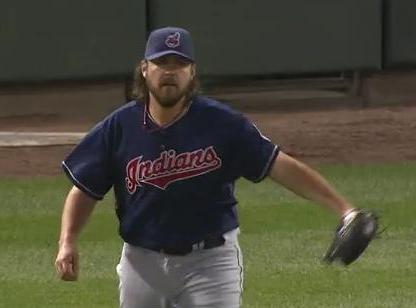
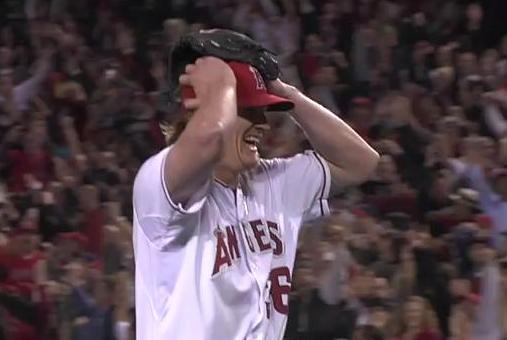
In that regard, Cleveland closer Chris Perez isn’t so unique, freely exuberating on the mound following a job well done.

Well, he did his job on Thursday, and Alex Rios didn’t appreciate it. Perhaps it was because Rios had just made the final out of the game, grounding to shortstop Asdrubal Cabrera to close Cleveland’s 7-5 victory over the White Sox. Perhaps it was because Perez was not just gesticulating, but yelling in celebration. Maybe it was because the pitcher had also snuck in a self-congratulatory fist pump after striking out A.J. Pierzynski a batter earlier.

No matter, Rios barked at Perez as he returned to the Chicago dugout in a clear display of displeasure and frustration. (Watch it here.)

“Well, I don’t know what was wrong with [Perez],” said Rios after the game, in an MLB.com report. “He just started yelling for no reason. I don’t know why he started yelling, and that’s it. When I hit that ground ball, he was yelling when [Cabrera] was throwing to first. He was yelling the whole way. I couldn’t tell what he was saying. He was just staring and saying something.”

Because Perez does this kind of thing frequently, it’s unlikely that his comments were directed toward Rios or the White Sox. According to Rios, that hardly matters. “If he was celebrating, that was not the right way to do it,” he said.

Which is what makes this juncture in baseball history so interesting. A generation ago, Rios’ sentiment would have been gospel. Eckersley and a few rogue pitchers aside, players generally had better control of their celebratory quirks. Today, with enforcers like Nolan Ryan—who would voice his displeasure through any number of fastballs thrown at an opponent who had just shown him up—increasingly rare, acts like Perez’s are common.

It’s the game as we now know it. Seems like it’d behoove Alex Rios to come to grips with it.

(Via Hardball Talk.)

Jered Weaver, No-Hitter Etiquette

Jered Weaver Didn’t Need Relief Last Night … Until he Did

From the don’t change anything file: While players typically opt for keeping the same spot on the bench throughout a no-hitter, Jered Weaver willingly gave his up in the eighth inning yesterday, three outs from no-hitting the Twins.

“I had to pee so bad it was unbelievable,” he told the MLB Network after the game. “I didn’t know whether to sit down or go do it or what, but I had to go relieve myself.”

(Broadcaster and former pitcher Mitch Williams, in response: “My pants would have been wet, because I ain’t changing a thing in that spot.”)

Not quite Michael Bourne, but it’ll do.

Clubhouse meetings

Albert’s Clubhouse, Albert’s Way: Pujols Calls Out Hatcher

The first rule of clubhouse meetings: Do not talk about clubhouse meetings. This is the sanctity of the clubhouse at its most pervasive, where players—unburdened by the presence of media and sometimes their own coaches—are allowed to speak freely in an effort to right a reeling ship. Things can be said, tempers can flare, fists can fly; none of it matters beyond the clubhouse walls, because the doors are closed.

So when Angels hitting coach Mickey Hatcher talked about Albert Pujols’ sentiments at a recent such meeting with his teammates—saying that he “essentially stood up and told his teammates that he won’t be flailing as he is all season,” according to CBS Sports’ Scott Miller—it rubbed Pujols the wrong way.

“Mickey should have never told you guys that,” Pujols said, after finding out about it. “That stuff needs to be private. He should have never told the media. What we talked about at the meeting, not disrespecting Mickey, but that stuff should stay behind closed doors.”

Never mind that everything Hatcher relayed was positive. (Pujols reportedly also talked about how he’s been on clubs that have overcome slumps and losing streaks, and affirmed that it can be done.) Pujols’ public messaging should be up to him. If he wanted to say that to the press, he easily could have.

Hatcher played in the big leagues for 12 years. Was a World Series hero. (Hell, he should know these things as well as anyone, having had his Dodgers team spurred into action in the 1988 NLCS by a glorious, bile-filled, closed-door rant from Tommy Lasorda, in which the Dodgers manager ripped David Cone for saying that pitcher Jay Howell reminded him of a high school pitcher, even though that hadn’t quite been the case. L.A.went on to dispatch the favored Mets in seven games.)

To this point in his career, Pujols has known nothing but Tony La Russa’s brand of baseball operations, and is clearly getting used to having things run a little bit differently. He’s scuffling right now, and is apparently very sensitive. He’s also entitled to his privacy—at least in matters that unfold under private circumstances.

For good or for bad, this is now Albert’s clubhouse. And he’s letting everybody know how he wants it to run.

(Via Hardball Talk.)

Pickoff Throws

Moderation is a Virtue, Right? Or: Did Bruce Chen Really Throw to First 10 Straight Times?

Yesterday, Bruce Chen threw to first 10 consecutive times in an effort to keep Minnesota’s Denard Span close to the bag. (Watch them all here.) Span never ended up taking off, and Yahoo’s Kevin Kaduk wondered whether there might be an unwritten rule to cover situations like this.

The short answer: Not that I know of. Winning is paramount, and if it makes sense to a pitcher to go nutty in his efforts to keep a runner from stealing, he’s entitled to it. Had it happened in the middle of a blowout, of course—as opposed to the first inning of a scoreless game, as was the case for Chen—then the pitcher would have to field angry questions from his own dugout, as well as that of the opposition.

Because we’re on the topic, here are some unwritten rule incidents involving pickoff throws, which have nothing to do with the frequency of attempts.

  • Former Giants manager Roger Craig would occasionally order an abundance of pickoff attempts to give guys on his bench additional opportunities to decode the other team’s signs. “I had pitchers shake off pickoff moves,” said catcher Bob Brenly, in the Fort Lauderdale Sun-Sentinel. “I had to give [pitchers] the ‘thumb’ sign—Roger called it—to get them to throw the ball over there.”
  • In a 1997 game, the Mets called for extra pickoff attempts when Roger Clemens, then with the Blue Jays, was on second. Their strategy: wear him out on the basepath. Clemens didn’t take long to figure it out, and warned shortstop Rey Ordonez that the next throw to second would put a target on a New York hitter in the ensuing inning.
  • While pickoffs are generally verboten late in blowout games, Dave Righetti felt justified in picking off Brett Butler in the ninth inning of a game in which the Dodgers led the Giants, 12-1. It was the final day of the 1993 season, and although San Francisco had won 103 games, they needed one more win to tie Atlanta atop the NL West. By the ninth inning, it was clear they weren’t going to get it. So when Butler led off the frame with a single, then took an enormous lead, Righetti was particularly sensitive, reading it as an indicator that the runner was about to take off. “A guy has no business running at that point in a game like that, and it ticked me off that he was even thinking about it,” said Righetti. “Well, his lead was so big that I picked him off—but if he had tried to steal second, I would have gone out there and we would have brawled.”  

Fight pre-emption via Code violation. Seems like as good a reason as any.

Don't Call Out Teammates in the Press, Teammate Relations

Angels Sink Lower, Take Verbal Swipes at Each Other, Meet to Clear Things Up, Lose Again

Remember how last week Bobby Valentine declared, for no apparent reason and on TV, no less, that Kevin Youkilis was not “as physically or emotionally into the game as he has been in the past”? One of my ensuing conclusions was that, had Valentine seen said comment as his final line of recourse in reaching a problematic Youkilis, it would have been entirely justified.

It wasn’t, of course. Youkilis appears merely to be scuffling, not mentally checked out, and Valentine was just popping off, as he’s known to do.

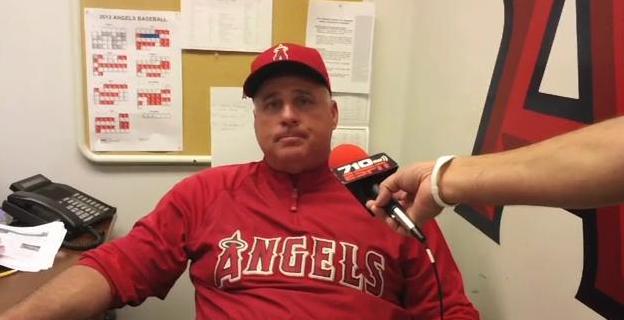
Still, the sentiment holds. Yesterday, it might have held in the visitors’ clubhouse at Tropicana Field, where Torii Hunter alluded to the press that some people may have some problems with Angels manager Mike Scioscia.

With Los Angeles in last place, having just lost their third in a row and sixth of their last eight, Hunter handed a barely veiled reference to the Los Angeles Times. “I don’t think we believe we’re trying that hard,” he said. “We’re just going through the motions. We have to do what we’re capable of doing. That’s everybody, not just the players.”

Scioscia is a pretty clear target for the phrase, “not just the players.” What did Hunter mean? The Times’ Mike DiGiovanna led his story with it:

Not only are the Angels not hitting, they’re not stealing bases, bunting, executing hit-and-run plays and pushing the envelope offensively, all trademarks of Mike Scioscia-managed teams.

They’re not scratching and clawing or sacrificing themselves enough for the team, and those deficiencies, as well as an inability to hit in the clutch, were evident again Wednesday night . . .

DiGiovanna’s guess was that Hunter was referring specifically to Sciocia’s failure to have Macier Izturis bunt Hunter and Vernon Wells over, after they led off the second with singles. Izturis ended up flying to left, and both runners were eventually stranded.

Asked if the game could have changed with some early execution, Hunter said, “You mean if we bunted in the second? What can we do? All we do is play the game.”

The Angels held a pre-game, players-only meeting today, following a previous meeting eight days ago, in which Scioscia apparently told his charges they had to “grind it out.” The wagons are officially being circled.

Whatever was said by Angels players today, one thing is clear: By this point in his career, Scioscia has earned the right to be above public scrutiny by his players, frustrated as they may be. Hunter is one of the few in the game who can get away with something like that, owing to his own reputation and veteran status. Still, it speaks to some serious fractures among the ranks, which is just what today’s meeting was designed to address.

Such is the nature of this kind of thing that it did not present early returns. The Angels scored only three runs against Tampa Bay Thursday, and lost, 4-3,  on a game-ending, two-run homer by Brandon Allen.

(DiGiovanna weighed in on Sciocia’s in-game machinations with a ninth-inning tweet —”Unconventional move by #Angels MRG… and I like it. For a change”—after reliever Scott Downs opened the frame instead of closer Jordan Walden, with the Angels holding a one-run lead. Walden came in after Downs retired Matt Joyce. Two batters later, the game was over.)

These are the kinds of things that happen on losing ballclubs—especially those predicted by many to reach the World Series. Still, it’s only April, and nobody knows how much time is left in the season better than a roster full of veterans. Now we’ll see how much longer they can keep their mouths shut.

(Via Hardball Talk.)

Buster Posey, Retaliation, Sam LeCure

A Time and a Place for Everything, or: What Was it You Were Retaliating for, Again?

Buster's revenge: Posey takes Sam LeCure deep in the ninth.

In baseball, it’s not difficult to determine what constitutes a retaliation-worthy offense, and what does not. Intent behind that HBP? Retaliate away. Nobody should say a word.

On Tuesday, however, Reds reliever Sam LeCure apparently didn’t care for the fact that Joey Votto was drilled in the backside by San Francisco’s Dan Otero during what would become a six-run inning. What he failed to consider: Otero is a rookie with all of 6.2 innings to his name this season, and was in the midst of a full-throated meltdown—all six runs were his, in fewer than two innings—that saw his ERA rise from 2.70 to 8.64. The guy was clearly not hitting his marks.

Which didn’t keep LeCure from putting a ball behind Buster Posey’s knee in the ninth.

Giants manager Bruce Bochy was seen to mouth the words, “That’s fucking bullshit” in the dugout, and was more than happy to expound on that theme after the game.

“The kid (Otero) has got two weeks in the big-leagues,” he told the press. “He’s trying to get through an inning. He’s trying to survive. He’s not trying to hit anybody. He was scuffling out there. I’m sure he was nervous. . . . That’s how people get hurt. Here’s a guy (Posey) we lost for a long time last year and he gets a ball thrown at his kneecap.”

Henry Schulman of the San Francisco Chronicle had an interesting take on LeCure’s rationale, going back to Daniel Hudson’s preseason proclamation that Arizona pitchers would no longer tolerate shots at their teammates:

During spring training, Arizonastarter Daniel Hudson articulated a warning to all the pitchers in the National League. Justin Upton is the Diamondbacks’ best player and he was hit by 19 pitches last year, most in the National League. So Hudson made it clear that if Upton continued to get hit, the Diamondbacks would retaliate.

I get that. I also get that sometimes it’s OK for a team to retaliate for a hit batter even if it was accidental, if it keeps happening over and over. At some point, the batter’s team needs to show it will not let opponents continue to use a guy as a dartboard, and there will be consequences.

Thus, when Reds reliever Sam LeCure threw behind Buster Posey in the ninth inning of tonight’s 9-2 Reds win, in obvious retaliation for Dan Otero’s equally obvious accidental drilling of Joey Votto in the seventh, I initially thought it was OK. I figured Votto had been a target lately and LeCure was just doing with the baseball what Hudson did with his language in spring training. So I grabbed the stat sheet to see how many times Votto had been hit this season.

Zero.

The part that makes the least sense is that the Giants’ leadoff batter the following inning was none other than Dan Otero (who was left in to mop up what was by then a hopeless game). Holding an eight-run lead, Reds reliever Jose Arredondo proceeded to strike him out. That was Cincinnati’s best—and some would say, only, as far as justification is concerned—shot at retaliation. That it took another inning and a different pitcher to get it done speaks to darker things. There’s a chance that Arredondo was influenced by Reds starter Matt Latos—so outspoken in his dislike of the Giants that before the game he handed a ball to the Cincinnati broadcasters inscribed with the phrase, “I hate the Giants.” (Latos and San Francisco built up no shortage of animosity in 2010, when the right-hander pitched for San Diego.)

The dugouts were warned, after which Posey got the best kind of revenge: He hit a two-run homer that ended Cincinnati’s bid for a shutout.

Teams play again today. Stay tuned.

No-Hitter Etiquette, Philip Humber

Man, There are a Lot of Things One is Supposed to do During the Course of a No-Hitter

In the wake of Philip Humber’s perfect game on Saturday, the Code-chronicling community (we’re small, but mighty) was left to look for peculiarities in the action. While there have so far been no earth-shattering revelations, assorted items have been mentioned in passing in various accounts of the action:

  • White Sox players did indeed give the pitcher some space on the bench as the game unfolded, moving “farther and farther away from Humber as he approached history, leaving him alone,” according to the Associated Press.
  • Some on the bench, however, did mention the deed, though not to Humber directly. From the Chicago Sun-Times: After the eighth inning, A.J. Pierzynski turned to Sox pitcher Jake Peavy and said, ‘Man, I’m nervous.’ ” (The man already had some history with no-hitter etiquette.)
  • Humber’s not one to buy into the silence-is-golden rule. From his post-game press conference: “I don’t believe in superstitions or anything like that, so when guys were getting hits or scoring runs, I was shaking their hands, and when they’d make plays in the field I was telling them, great job. I don’t like to be isolated like that. I like to stay in the game, and be relaxed, and be a teammate.”
  • White Sox manager Robin Ventura does not necessarily agree. Also from the post-game presser: “I still haven’t talked to him—I still have that superstition. I was staying away from him.”
  • Which doesn’t mean that superstition rules all of Ventura’s decisions. While some feel that nothing should be changed during the course of a no-hitter, Ventura inserted Brent Lillibridge in left field in the bottom of the eighth as a defensive replacement for Dayan Viciedo. With one out, Kyle Seager laced a drive down the line, which Lillibridge—significantly speedier than Viciedo—caught up to without much effort.
  • At which point it should be noted that the White Sox’s previous perfecto—tossed by Mark Buehrle in 2009—was saved by a ninth-inning circus catch by Dewayne Wise against the center field wall. Wise had been inserted for defensive purposes in the top of the inning.
  • Munenori Kawasaki tried to bunt his way on with two outs in the sixth and a 3-0 score. Kawasaki is in his first season in the big leagues after a lengthy career in Japan. I am unclear about how this type of thing is viewed over there.
  • Finally, Mariners broadcaster Dave Sims was hardly shy about mentioning the words “no-hitter” and “perfect game” through the later innings. Granted, Sims doesn’t work for the White Sox, but he has precedent on his side when it comes to his stance in such situations. (Funny how broadcasters take heat if a pitcher blows a no-hitter after they’ve talked about it, but the broadcast jinx is rarely mentioned if the pitcher completes his gem under similar circumstances.)

If more arises from this in coming days, I’ll tack it on here.

Update (4-24): Larry Stone has a column up over at the Seattle Times, in which he speaks with five people who were at the game. No real new information, just another measure of awe from one of the best in the business.

Matt Moore, Pitch Tipping

Big Tipper: Rays Worry About Moore Giving Away Too Much Information

In Tampa, hopes are high for pitcher Matt Moore. The 22-year-old is one of the top prospects in all of baseball, and a rotation anchor—they hope—for years to come.

Which is why when things started to go wrong for him early this season, especially after Sunday’s 6-4 loss to Boston, in which Moore gave up six runs and eight hits in 6.1 innings. Even as that game unfolded, team brass tried to figure out what was going wrong.

Their first thought: Tipping. As in, Moore was telegraphing the type of pitch he was about to throw, just before he threw it. From the Tampa Bay Times:

In acknowledging how “locked-in” [the Red Sox] were, Rays manager Joe Maddon mentioned, open-endedly, that “it’s like they know what’s coming almost.” He noted how “they’re on everything right now,” no matter what type of pitch it was, and how they were “spitting on”—taking—certain borderline pitches.

What raised the specific pitch-tipping concerns about Moore were the aggressive swings the Red Sox were taking, particularly unexpected given their limited previous exposure to him.

By the fifth inning, pitching coach Jim Hickey was meeting with Moore and catcher Chris Gimenez to try to figure things out. Gimenez said they thought that Moore might be “tapping his glove on his fastball.”

To guard against the possibility that it was something else entirely—like Boston hitters peeking at signs—Gimenez began setting up as late as possible, just before Moore was ready to pitch.

Their concerns were assuaged after reviewing video of the game, which showed that the hammered pitches were all out over the plate—hittable because they were bad, not tipped. Moore seemed all too relieved to eliminate tipping as a cause of his woes.

“Maybe [I tipped some pitches] years ago when I was in rookie ball or something like that,” he said in the Times. “But not as far as I can remember.”

The thing is, such frailties can manifest even in veteran pitchers with no such history. In the last couple of seasons alone, we’ve seen similar issues with Tim Lincecum (who quickly corrected things), Johan Santana and Ben Sheets. From The Baseball Codes:

Tells can be as simple as a pitcher keeping his glove snapped tight when throwing a fastball but flaring it out for a breaking ball, or coming set with his glove at his belt for one type of pitch but at his chest for another. Matt Morris, for example, was lit up by the Braves during his rookie season in St. Louis after they noticed that the exposed index finger on his glove hand pointed upward whenever he threw a fastball, but lay flat for curves. Once he pinpointed the trouble, Morris quickly fixed it by attaching a flap to his glove that covered the finger.

Examples like this litter the game’s history. When Babe Ruth first came to the American League as a pitcher with the Red Sox, he curled his tongue in the corner of his mouth whenever he threw a curveball—a habit he was forced to break once enough hitters became aware of it. Kansas City’s Mark Gubicza was cured of his tendency to stick out his tongue when throwing a breaking ball under similar circumstances. Ty Cobb reg­ularly stole bases against Cy Young, abetted, said the outfielder, by the fact that Young’s arms drifted away from his body when he came set before throwing to first; when he was preparing to pitch, he pulled his arms in.

Pitcher Todd Jones dished similar dirt on several competitors in an article he wrote for Sporting News in 2004: “When Andy Benes pitched, he always would grind his teeth when throwing a slider. In Hideo Nomo’s first stint inL.A., he’d grip his split-finger fastball differently than his fastball. Randy Johnson would angle his glove differently on his slider than on his fastball. I’ve been guilty of looking at the third-base coach as I come set when gripping my curveball. When hitters see this, word gets around the league. In fact, my old teammate Larry Walker was the one who told me what I was doing. He said he could call my pitches from the outfield.”

We’ll see tonight if all this deliberation has made a difference, when Moore makes his first start since Boston, against the Twins.

Deke Appropriately, Jimmy Rollins

The Power of Suggestion: How to Clear the Bases with a Wave of the Hand

Josh Thole in the midst of disbelieving that he's actually been snookered quite as badly as he actually was.

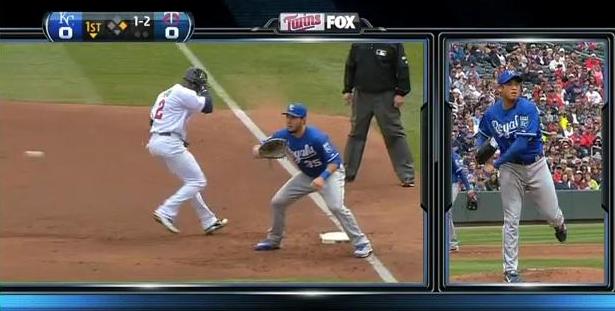
When Jimmy Rollins held up his hand toward Mets baserunner Josh Thole last week, it meant by every indication that the ball was no longer in play–in this case, a bunt gone foul. Thole, who had steamed into second base on R.A. Dickey‘s sacrifice attempt, started jogging back to first.

The problem, at least as far as Thole was concerned, was that Dickey’s ball was still live, having been laid down perfectly inside the line. Cliff Lee threw the ball to Rollins, who relayed it to first baseman Jim Thome just ahead of a desperately diving baserunner. (Watch it here.)

“Jimmy put his hands up, like ‘Come in easy. You can come in easy,’ ” said Thole after the game in the Newark Star-Ledger. He later continued: “I looked at the umpire, and got a weird stare from him, and then I looked back and the ball was on his way to first. I didn’t know what else to do. I just kept running.”

If Rollins’ gesture was intentional (and with the shortstop failing to address the issue after the game, there is little reason to think that it wasn’t; see a screen grab at Philly.com), he added an entry to a sizeable section of Code dealing with gamesmanship. At its core: Get every advantage you can, in any way possible. Such plays are known as dekes (short for “decoy”), and although Rollins’ example wasn’t typical of the genre, it wasn’t quite original, either. From TheBaseball Codes:

In a 1972 game between the Giants and Padres, Johnny Jeter stole a base so easily that there was no throw. He dived headfirst into the base anyway, a clear sign that he hadn’t looked in to follow the action. See­ing this, San Francisco shortstop Chris Speier pounced. “Hold up, hold up—foul ball,” he said nonchalantly. Astonishingly, the ploy worked. Jeter started back to first base, Giants catcher Dave Rader fired the ball to second, and Jeter was tagged out. “Oh shit, was he pissed,” said Speier, grinning at the thought more than three decades later.

This gets to the heart of the issue. Had Jeter—or Thole, 40 years later—been paying attention, neither would have gotten snookered.

“I don’t think any baserunner should fall for a deke,” said Rangers manager Ron Washington. “There are things I’m supposed to be doing when a ball is put in play, so how can you deke me? A ball is hit, and I’m supposed to know where that ball is at all times. And if I run blind and get deked out, whose fault is that? Is that the infielder who deked me out, or is that my fault for not knowing what’s going on?”

The problem for Thole was that he had been paying attention.

“I knew the ball was fair,” he said in the Star-Ledger. “I even looked down. You can go watch the video. I checked in. The ball was on the floor. I just took off running back to first. I’ve got no other explanation . . . I don’t know what I was thinking.”