Dealing With Slumps, Mark Kotsay

There’s More Than One Way to Bust a Slump

Kevin Youkilis' energy drink.

Baseball is a game of failure. Those who explain it to the uninitiated frequently cite the fact that even the best hitters falter seven out of every 10 trips to the plate. Even then, these great players—the .300 hitters and 40-homer swatters—suffer through extended periods during which their established standards of success are nowhere to be found.

These are the days of the slump, and hitters will do virtually anything to avoid them.

Individual superstitions include such tactics as refusing  to change underwear and switching up ordinary routines in extraordinary ways. Dave Concepcion once crawled into a Wrigley Field industrial clothes dryer in an effort to heat up, then collected three hits against the Cubs. Others attempt to bed unattractive women. (“The bigger, the fatter, the uglier, the better,” said ex-pitcher Bob McClure, describing the concept while stopping short of admitting to his own practice of it. “It never failed,” he said. “Either the team went on a winning streak or the guy came out of the slump. It was automatic.”)

More interesting are team-wide solutions. When Frank Robinson managed the Indians, he grew so desperate to jump-start Cleveland’s offense that for one game he had members of the starting lineup draw their positions in the batting order from a hat. (This led to Boog Powell, 6-foot-4 and 265 pounds, batting leadoff for the first time in his career.)

Duane Kuiper was also a member of that team (he batted fourth that day, despite having so little power that he hit but a single homer over the course of his 12-year career). Years later he sought motivation for his struggling Giants by bringing the loudest alarm clock he could find into the dugout, in an effort to wake his teammates’ slumbering bats. Bill Caudill once dressed up like Sherlock Holmes, to better find Toronto’s missing offense.

On Tuesday, the White Sox did some slump-busting of their own.

Outfielder Mark Kotsay is batting just .221, and even the balls he’s hit hard recently have turned into outs—including having a home run taken away by an over-the-wall grab by Ichiro on Monday. So his teammates decided to mix things up for him.

Before a game against Seattle, Mark Teahen absconded with two of Kotsay’s bats, and during team stretch set them on fire.

“There are quirky things like changing your uniform or your undershirt or your shoes, but (I’ve never heard of) burning bats,” said Kotsay in the Chicago Tribune.

It’s too soon to tell if it worked, but it’s not the first time players have resorted to fire in an effort to staunch a slump.

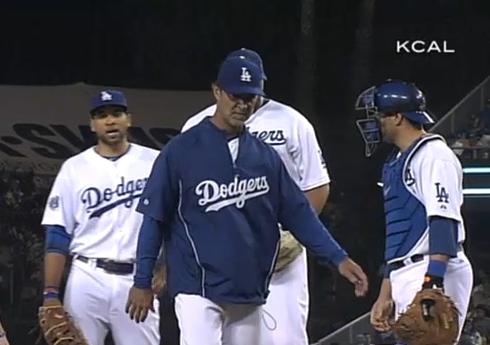
In 1999, the Dodgers held a ceremonial cap burning in their bullpen—which wasn’t enough, as they went on to lose their sixth straight and finished the season at 77-85.

Even more pronounced was the bonfire set in the Rangers’ dugout in 1994, in the middle of a game against the Angels.

It was started by players Chris James and Gary Redus, who for kindling used the ratty, red high-top cleats Jose Canseco had been wearing since spring training. Canseco’s reluctance to upgrade his footwear had so offended the sensibilities of his teammates that James hid the shoes before the game, forcing Canseco to don a new pair. When the slugger responded by hitting two home runs in the first three innings, the decision was made to ensure he’d never his old shoes back. There was no time to wait. A bottle of rubbing alcohol was procured from the trainer’s room, somebody found a match and the immolation began.

As the flames grew, members of the Rangers bench started dancing around the pyre.

“I looked over there from first base and said, ‘What the hell’s going on?’ ” said Texas first baseman Will Clark. “Then I heard what they had done. I couldn’t see, I was laughing so hard.”

The catch: His teammates might not have realized it, but Rangers pitcher Kenny Rogers was in the middle of throwing a perfect game at the time.

Rogers, however, was so focused that he never noticed the plume of smoke emerging from the dugout, and remained oblivious until he was told what happened once the game was over. “I like that,” he said. “We’ll burn the rest of his shoes if that’s what it takes.”

– Jason

Doug Harvey, Joe Torre, Umpire Relations

Torre Served as Bookend for Harvey’s Career; Not Everyone Got off So Easy

As umpire Doug Harvey prepared for induction into the Hall of Fame last weekend, an old story arose about his proclivity for ejecting Joe Torre at the most opportune moments.

In 1962, Torre was in his second season as a catcher with the Braves, and his resume flashed two primary distinctions: a runner-up finish in the ’61 NL Rookie of the Year voting, and designation as the first player Harvey ever ejected from a game.

They say that players have long memories, but those players have nothing on Doug Harvey. Thirty-one years after that initial ejection, as the umpire took a final spin around the league before retiring, he pulled Torre—who by that point was managing the St. Louis Cardinals—aside.

“He said you were the first one, and I’d like you to be the last one,” Torre recounted in the Los Angeles Times. “And I said, ‘OK, we’ll figure it out.'”

About a month later, in September, the Cardinals visited Shea Stadium, and jumped out to a big lead in the late innings.

“About the seventh inning, I yell out about a pitch,” Torre said. “I figure I may not get a better shot at this. He came over to me and I had to explain what I was doing. It wasn’t foremost on his mind.

“I started arguing with him, and I say, ‘This is it.’ And he says, ‘What do you mean this is it?'”

“And I said, ‘Remember, you wanted me to be the last guy you threw out.’ And he started smiling and said, ‘Get out of here.'”

It was as cordial an ejection as has ever been seen on a ball field.

That type of interaction does have an antitheses, however—the antagonistic non-ejection. These often take place on exceptionally hot days, when managers looking for a reprieve in the air-conditioned clubhouse try to bait an umpire into tossing them out. Umpires, however, frequently recognize the tactic, and exhibit significantly more restraint than usual.

Jose Rijo took things a step further.

With a large lead in the seventh inning of a game in which Frank Pulli was serving as plate umpire, Rijo, with a stout bullpen behind him, made an unusual request about the possibility of drawing an early thumb.

“I said, ‘Frank, I want to stay, but I can’t—I have a date tonight.’ ” Rijo said.

Pulli’s reply: “You leave this game now, I’ll never call another strike for you. If I have to stay, you do, too.”

“So,” said Rijo, “I stayed.”

– Jason

The Baseball Codes

R.A. Dickey Loves to Battle. Jerry Manuel Doesn’t Care

Reluctance to be pulled from a game is the hallmark of any quality starting pitcher, no matter how he’s actually feeling. If he’s tired, or if his stuff isn’t popping like he feels it should, he’s forced to walk the fine line between becoming a detriment to his team and essentially giving up.

Few in baseball want to see perceived cowardice in action from their teammates, even if it’s ultimately for the collective good. Said David Cone about being in that situation: “If you don’t say the right thing, it’s perceived as a lack of heart.”

Mets fans have a lot to grumble about this season, but a lack of heart from R.A. Dickey isn’t part of it. He made that much clear on Sunday.

Having shut out the Dodgers on two hits through five innings, Dickey injured his leg on a follow-through while pitching to the first hitter of the sixth, Russell Martin. (He claimed it was because he landed awkwardly in a hole created by Dodgers starter Clayton Kershaw.)

Dickey stayed in the game to retire Martin and the next hitter, Kershaw, both on comebackers to the mound. At that point, however, Mets manager Jerry Manuel opted for caution, and removed the pitcher, mid-frame.

That much is standard procedure. An injury to one of their better pitchers would be devastating to the Mets, and watching Dickey pounce off the mound to field consecutive grounders undoubtedly left Manuel’s head spinning.

It’s how Dickey responded that stood out. In a discussion that lasted the better part of two minutes, the pitcher vociferously lobbied Manuel to stay in the game. When that failed to take, he turned his efforts toward trainer Mike Herbst. (Watch the entire affair here.)

Here’s what Dickey knew: the Mets had used seven pitchers in Saturday’s 13-inning loss to Los Angeles, and another seven in Wednesday’s 14-inning loss to Arizona, and he wanted to protect the bullpen.

Here’s what Dickey didn’t know: Manuel had already made the call for a reliever by the time the pitcher turned to plate umpire Dana DeMuth and said, according to the New York Times, “I’m not going anywhere.”

“It’s frustrating because I felt I let my team down,” said Dickey afterward, in the New York Post.

Manuel’s reply: “He was adamant about staying in the game, but I didn’t feel we could risk a guy like that going down.”

The episode calls to mind a conversation held during Game 4 of the 1977 World Series, when Dodgers manager Tommy Lasorda went to the mound to remove his starter, Doug Rau. It’s memorable (and available) because Lasorda was wearing a microphone for the TV broadcast. Also, as Lasorda admitted to one of his coaches in the dugout, his goal was to stall for time and allow reliever Rick Rhoden additional warm-up tosses.

Lasorda made the decision to remove Rau before he even left the bench, but the pitcher, not privy to his manager’s thinking, lobbied to remain in the game—which was exactly what Lasorda didn’t want to hear. (Warning: baseball language—in no way family appropriate—ensues.)

Rau: I feel good, Tommy.

Lasorda: I don’t give a shit you feel good. There’s four motherfucking hits up there. [There were actually only three.]

Rau: They were all fuckin’ hit the opposite way. . . .

Lasorda: I don’t give a fuck.

Rau: Tommy, we got a left-handed hitter. I can strike this mother¬fucker out.

Lasorda: I don’t give a shit, Dougie.

Rau: I want to get out of this myself.

Lasorda: I may be wrong, but that’s my goddamn job.

Rau: I ain’t fuckin’ hurtin’.

Lasorda: I’ll make the fuckin’ decisions here, okay?

Rau: [Tommy John] gave up three runs on the fuckin’ board yesterday.

Lasorda: I don’t give a fuck! Don’t give me any shit, goddamn it! I make the fuckin’ decisions. Keep your fucking mouth shut—I told you.

Second baseman Davey Lopes, interjecting on behalf of the sport’s image: “Hey, hey, hey. This looks bad up here. Just back off the mound. You want to talk about it, talk about it inside.”

Lasorda: We’ll talk about it in my fucking office.

Rau: If I felt bad, then I wouldn’t say nothing.

Lopes: I’m just saying, talk about it inside. This is not the place to be talking about it, okay? That’s all I’m trying to say. I’m just trying to avoid a fucking scene out here, that’s all.

Lasorda: That’s right. It’s fucking great for you to be out here talking to me like that.

Rau: If I didn’t feel good, I wouldn’t say nothing.

Lasorda: I don’t give a shit, Doug. I’m the fucking manager of the fucking team. I gotta make the fucking decisions. And I’ll make them to the fucking best of my ability. They may be the fucking wrong decisions, but I’ll make it. Don’t worry about it. I’ll make the fucking decisions. I gave you the fucking chance to walk out here. I can’t fuck around—we’re down two games to one. If it was yesterday, it’s a different fucking story.

Rau: We got a left-handed hitter coming up, why—

Lasorda: I don’t give a shit! You got three left-handed hitters and they all got hits on you. Rivers, Jackson, and that fucking other guy. That guy who just hit the ball was a left-hander, wasn’t he? [Chris Chambliss, who had doubled, was indeed left-handed.]

Rau: I jammed him. I pitched it on the inside part of the plate. . . .

Lasorda: I don’t give a shit whether you jammed him or not—he didn’t get out. I can’t let you out there in a fucking game like this—I’ve got a fucking job to do. What’s the matter with you?

For what it’s worth, Rau’s tenacity helped earn him an increased role in the Dodgers rotation the following year.

As for R.A. Dickey, his own determination will do doubt help endear him to hard-to-please Mets fans. Still, it should be noted that Hall of Fame manager Sparky Anderson had a rule with his pitchers. “I don’t want to hear you,” he said. “Just give me the ball. I have no desire to hear a pitcher’s feelings, because if something goes wrong I’m the one who’s going to get fired, not the pitcher.”

– Jason

Deke Appropriately, Johnny Damon, Nelson Cruz

Damon Deked; Rangers Win

Baseball’s unwritten rules have an entire section on the propriety of deking, or making phantom (or decoy) plays to confuse baserunners into thinking the ball is somewhere it’s not.

At issue: an infielder who puts down a late tag can cause an unsuspecting runner into a late and awkward slide, which can lead to injury. We covered this a couple weeks ago when discussing Robinson Cano’s deke of David Wright in the All-Star Game.

(Not only did Cano do nothing wrong, he executed the play to perfection. His goal was not to get Wright to slide—Wright was in the process of doing that, anyway—but to delay his realization that the ball had actually been thrown into center field.)

When it comes to outfielders, however, pretty much anything goes. There’s nothing they can do, after all, to put a baserunner in any sort of peril.

Like Nelson Cruz, for example, who last week in Detroit acted as if he was about to catch a ball that landed well in front of him. It wasn’t a particularly graceful deke—little more than a quick stab skyward with his glove—but it was enough to keep Johnny Damon, who otherwise should have scored easily, at third base. (Watch it here.)

It’s hardly a new concept. From The Baseball Codes:

Jim Rice made a habit of treating many balls hit over his head at Fenway Park as if they would end up clearing the Green Monster by a mile, gazing up with detachment as the hitter started into his home-run trot . . . before racing to the carom and firing the ball in to second. “You could make a great video of all the shocked faces of baserunners who were cut down at second because they fell for this trick,” said outfielder Doug Glanville.

Ironically, one of the most noteworthy instances of an outfield deke involved Rice’s Red Sox—with Boston cast as the victim. It happened in 1978, during the one-game playoff between the Red Sox and the Yankees to determine who went to the American League Championship Series. Boston, trailing 5–4 in the bottom of the ninth at Fenway Park, had a runner, Jerry Remy, on first base with one out. Things appeared promising when Rick Burleson hit a fly ball that Yankees right fielder Lou Piniella lost almost immediately in a patch of sunlight. But Piniella never hesitated, casually acting from the outset as if he were going to make the catch. Remy, who should have made it to third base without issue, was forced to stay near first until he saw that the ball wouldn’t be caught, at which point he could advance no farther than second. When Rice followed with a deep fly ball that would have easily scored the tying run from third, the Red Sox sensed an incredible opportunity wasted. Boston’s final batter, Carl Yastrzemski, popped out to end the game.

Like Remy, Damon saw only a flash of what he thought was a developing play. It didn’t stop him entirely, but in a sport where runners are safe or out based on fractions of a second, it was enough to keep the run off the board. Considering that the Tigers and Rangers were tied 6-6 in the 11th inning, and a run would have ended it on the spot, it was a game-saver.

Cruz upped his performance even more in the 14th, hitting a home run that won it for Texas, 8-6.

Behold, the power of the deke.

– Jason

Clayton Kershaw, Don Mattingly, Mound Conference Etiquette, Retaliation, Unwritten-Rules

Kershaw Upholds Unwritten Rule While Mattingly Breaks Written One

A nearly unprecedented comingling of rules both written and unwritten descended upon Dodger Stadium on Tuesday, as inside pitches inspired retaliatory strikes, one pitcher was ejected for drilling an opponent and another was tossed because his manager mucked up the rulebook.

It all might have started in April, at least according to Dodgers manager Joe Torre. That was when Los Angeles head-hunter Vicente Padilla broke Aaron Rowand’s cheek with a fastball, knocking him out of action for more than two weeks.

Thus, when Tim Lincecum knocked Matt Kemp down with an inside pitch on Tuesday, and followed that up by drilling him, it was easy to draw conclusions about retaliation. (Kemp certainly did, taking several steps toward the mound before being redirected by umpire Adrian Johnson.)

Never mind that Lincecum had a chance to respond as the Giants starter the day after Padilla’s deed, more than three months ago, or that the Giants have faced the Dodgers six times since the incident without drilling anybody.

There’s also the fact that Lincecum was unusually terrible, lasting just 4 2/3 innings, missing the strike zone on seven of his first eight pitches, giving up five runs and throwing about the worst pitch humanly possible.

Still, when Giants reliever Denny Bautista twice came well inside to Russell Martin in the sixth, the Dodgers took it extremely personally. (Bench coach Bob Schaefer was ejected for the vociferous nature of his protestations.)

Despite a warning leveled by Johnson after Lincecum plunked Kemp, Dodgers starter Clayton Kershaw drilled the next batter he faced, Rowand, in the hip, earning ejections for himself and Torre. (Watch the chain of events here.)

“When Kemp took a few steps toward Timmy, that made no sense because obviously Tim was struggling and wasn’t trying to hit him,” wrote Giants outfielder Aubrey Huff on his blog. “We were all a little jumpy right there, waiting to see what was going to happen. And Bautista definitely wasn’t trying to hit Russell Martin. . . . Now, I imagine, it’s all over and done with. They got their retaliation shot in, and that’s it.”

(Kershaw received a five-game suspension for his actions, while Torre and Schaefer were docked a game each.)

This left Dodgers coach Don Mattingly in charge of the team.

Los Angeles closer Jonathan Broxton came on in the ninth to protect a 5-4 lead, and promptly loaded the bases with one out. Mattingly visited the mound to inform members of the infield where he wanted them positioned. After he turned to leave, however, first baseman James Loney asked another question. Mattingly returned to address it, before heading to the dugout. (Watch it here.)

The issue: This constituted two visits, something not allowed in the same inning under rule 8.06 of the Official Baseball Rules, which stipulates that a mound visit begins when a manager or coach crosses the foul line, and ends when he departs from the 18-foot diameter of the mound.

“I really just went out to let the infield know we were going to play back,” said Mattingly in the Los Angeles Times. “[Hitter Andres] Torres could run. And the corners were basically pretty much going home. After I did that, I turned to walk away and James [Loney] said something, and I kind of turned around. I didn’t realize I was even off the dirt, but obviously I was.’’

Umpire Johnson shouted, “No, no, no. You can’t go back,” and Giants manager Bruce Bochy pounced. The umpires informed Mattingly that according to the rulebook, Broxton would have to leave the game. That left George Sherrill, having not received adequate time to warm up, to enter the game virtually cold.

He promptly gave up a two-run double to Torres that proved to be the difference in the game.

The umpires could have afforded Sherrill as many warm-up tosses as he wanted, but had the power to cut him off after eight—which they did. It was a detrimental decision from the Dodgers’ point of view, but at least it hewed to the rulebook.

Ejecting Broxton: not so much.

Rule 8.06 was codified in 1967, in an effort to minimize mound visits and speed up games. Because relief pitchers must face at least one hitter per appearance, an adjunct to the rule keeps managers from circumventing it by using back-to-back mound visits to remove a pitcher and improve matchup possibilities. It does this by stating that the manager will be ejected for the action, as will the pitcher, but only after he faces the guy at the plate.

(The umps should not even have ejected Mattingly, writes Henry Schulman of the San Francisco Chronicle, because they didn’t adequately warn him against a second visit, as stipulated by the rules.)

Bochy knew about all of this, having invoked the rule in 2006 as manager of the Padres (also against Los Angeles). That time it was properly carried out, with Dodgers pitcher Brad Penny remaining in the game to face the hitter.

“I think that’s the craziest win we’ve had all season,” said Giants reliever Jeremy Affeldt, who picked up the save, in the San Francisco Chronicle. “I’m sure we’ll put our heads on our pillows and smile.”

As will those of us who pay attention to this kind of thing. The written rules managed to bite the Dodgers on Tuesday; the teams next meet in San Francisco on July 30, at which point we’ll see if there’s a need for rules of the unwritten variety.

– Jason

No-Hitter Etiquette

Don’t Change Anything During a No-Hitter–Especially the Pitcher

In this, the year of the no-hitter (and the perfect game that wasn’t) it seems only fitting to mark the anniversary of another gem that got away due to forces entirely beyond the reach of the pitcher at the center of it all.

Forty years ago today, Padres pitcher Clay Kirby took a no-hitter into the eighth inning against the Mets. Unlike Armando Galarraga, who was robbed by a bad call, Kirby was robbed by a questionable decision—by his own manager.

Baseball etiquette mandates that nothing change in a team’s dugout during a no-hitter: seating arrangements, nervous tics (which is to say, if you’re doing something when the no-no becomes apparent, keep doing it) and, especially, the lineup. Defensive substitutions are frowned upon as a matter of course (although they do sometimes work, as in the case of the game-saving catch by Dewayne Wise during Mark Buehrle’s 2009 perfect game), and the notion of having relievers warm up in the bullpen is virtually unheard of.

(“We were asking ourselves on the bench, should we get somebody up in the bullpen, just playing catch?” said Bob Brenly, the manager of the Diamondbacks in 2001, during Randy Johnson‘s perfect game. “In case he gives up that first hit we want somebody ready to go, so that by the time he gives up the second hit, we can go to the bullpen if we need to. But we didn’t want Randy to turn around and see a relief pitcher warming up in the bullpen. What should have been one of the easiest games to manage, I was losing my hair. . . . I didn’t want to do anything to screw up a perfect game.)

In 1970, the Padres were managed by Preston Gomez, who shared none of Brenly’s sentiments.

As Kirby, just 22, spun his no-hitter through eight, Gomez had another matter to consider: a walk, two stolen bases and a fielder’s choice had deeded the Mets a first-inning run, and the Padres trailed 1-0.

When, with two outs and nobody on, Kirby’s turn to bat came up in the bottom of the eighth, Gomez didn’t hesitate. His team needed to score.

“(Ed) Spiezio and (Bob) Barton were ahead of (Kirby),” said Gomez in the Los Angeles Times. “If Spiezio hits a home run or if one of them gets on and I can bunt with Kirby, then he stays in. But my mind was made up to hit for him if neither one of them got on.”

This didn’t keep the 10,373 fans at San Diego Stadium from booing at the site of pinch-hitter Cito Gaston, who, hitting in Kirby’s place, struck out. (The North County Times offers a robust retrospective on the affair.)

“My father was there,” said Kirby in the St. Petersburg Times. “It was the first game he’d ever seen me pitch in San Diego. He was madder than I was.”

A shouting match erupted in the dugout between pitcher and manager, and Kirby stormed to the clubhouse before Gaston even got to the plate. Jack Baldschun replaced Kirby in the ninth, and on his fourth pitch did what Kirby had spent eight innings not doing—giving up a hit, when Mets shortstop Bud Harrelson singled to left. That was followed by a sacrifice, a walk and two singles. The Mets won 3-0, and Kirby’s record fell to 5-12.

“It’s not that I’m bitter,” Kirby told the Times, 20 years after the fact. “But with a chance to do it again, I’d like to look back and say a baseball I pitched is in the Hall of Fame. When I try to look back at the logic behind it, I don’t see it. We were 20 or 30 games behind and we needed something to drum up interest in the ballclub. A no-hitter would have given the franchise a much bigger boost than one more victory. If it had been the seventh game of the World Series, I could understand it, I guess. But we were in last place.”

As if to prove it wasn’t a strategic fluke, Gomez did the same thing four years later while managing the Houston Astros, pulling Don Wilson after eight no-hit innings for a pinch-hitter with his team trailing the Reds, 2–1. (The reliever he inserted, Mike Cosgrove, gave up a leadoff single.)

Never has a man been more inclined to prove the theorem that winning takes precedent over the Code, even for a team that would lose 99 games, as the Padres did that year.

– Jason

Unwritten-Rules

Tour de France Brings Unwritten Rules into the International Spotlight

Today’s primary unwritten rules-related chatter comes to us from the Continent, where defending champion Alberto Contador did the ungentlemanly thing in the Tour de France by pressing ahead after stage leader Andy Schleck’s chain popped off.

Bicycling’s code mandates that a rider slows to wait should a rival be beset by technical misfortune.

Contador’s maneuver allowed him to gain 39 seconds—enough to surpass Schleck for the overall lead, but at considerable cost to his good P.R. Like baseball’s unwritten rules, however, prominent names defend both sides of every argument.

“You can’t say to Contador, ‘Hey, wait for Andy,’ ” said Lance Armstrong’s team director Johan Bruyneel in the Christian Science Monitor. “There’s no gifts in this race.”

Also quoted in the Monitor was Cervelo TestTeam owner Gerard Vroomen, who tweeted the opposite sentiment: “Contador just gained a great chance to win, but he lost the chance to win greatly.”

The fact that Contador and Schleck are good friends only leads to the intrigue.

“I would not like to take the yellow like that,” said Schleck in the Wall Street Journal. “I will take my revenge.”

There are subtleties here about which a bicycle-racing neophyte like myself has little idea, including the notion (according to Vroomen, anyway) that Contador’s action might have itself been revenge for an earlier slight by Schleck.

However this threatened revenge plays out, however, it’s a fair certainty that it won’t come via an inside fastball.

– Jason

Jonny Vetters, Prince Fielder, Retaliation

Commissioner’s Office: Retaliation Still Matters

After years spent methodically legislating retaliatory pitches out of the prominence they once held within baseball, the Commissioner’s office proved yesterday that it’s willing to recognize the unwritten rules regarding retaliation.

Braves reliever Jonny Venters was suspended for four games (his manager, Bobby Cox, was tagged for one) for drilling Prince Fielder on Saturday.

The Brewers pitchers who responded on Fielder’s behalf—David Riske and Manny Parra (who retaliated by hitting Troy Glaus and Jason Heyward, respectively, on Sunday): No punishment forthcoming.

Before we get into consequences, however, let’s start at the beginning. There is some doubt, after all, about whether Venters even intended to go after Fielder, despite the certainty espoused in Milwaukee’s clubhouse.

It started on Friday, when Fielder was hit in the leg by Braves starter Tommy Hanson, two pitches after a third-inning homer by Ryan Braun.

On Saturday, Fielder homered against Tim Hudson, leading to a five-run seventh inning. Venters opened the eighth with a first-pitch breaking ball that sailed over Fielder’s head and went to the backstop.

A message? Neither Braun nor Fielder appeared to have showed up the Braves during the course of their home runs, and though recent Brewers teams have earned a reputation for an array of showboat maneuvers—untucking shirts when celebrating homers, and last year’s bowling-pin celebration with Fielder at its core come to mind—this year they’ve been relatively clean in that regard. (Several members of the Brewers, however, did untuck their shirts after Saturday’s victory.)

When it comes to purpose pitches, many hitters insist on their ability to unfailingly distinguish intent from mistake.

That doesn’t make it so. In 1999, for example, St. Louis’s Shawon Dunston body-slammed Dodgers rookie Jamie Arnold atop the mound after being hit by a pitch. That he was able to get in such a blow was due largely to the fact that Arnold was gazing at his own shoetops, berating himself for missing his spot. “The only reason I knew he was coming [to the mound] was because I heard the crowd’s reaction,” Arnold said in the Los Angeles Times.

Add to that the fact that Arnold had recently been promoted from Double-A; that in his 18 innings’ worth of big league experience he had walked more hitters than he had struck out; and that he was the Dodgers’ sixth pitcher of the game, and trying merely to stay with the team.

“I didn’t go after him,” said Arnold. “He went after me.”

Even more oblivious was Reggie Sanders, who charged the mound in 1994 after being hit by Pedro Martinez. That the pitcher was trying to protect a 2–0 lead in the eighth inning was one clue it was unintentional; that it was an 0-2 count was another. That Martinez was in the middle of throwing a perfect game should have put to rest any lingering doubts. Without a shred of hyperbole, Sanders was the most obviously unintentionally hit batsman in the history of the game.

When it comes to the Brewers, retaliation in response to success is rare in the modern game, but it does exist. Plate umpire Angel Hernandez recognized the possibility on Saturday, issuing a warning to the Braves bench following Venters’ wild first pitch to Fielder.

When Venters’ next offering ended up in the middle of Fielder’s back, the evidence seemed incontrovertible. Fielder spiked his bat and stalked to first base. Venters and Cox were ejected.

“I don’t know what’s going on there . . .” said Brewers manager Ken Macha in the Milwaukee Journal Sentinel. “Braun hits a home run, they drill (Fielder). He hits a home run, his next at-bat they drill him. That’s evidence enough for me.”

Still, things might not be that clear-cut. The most notable factor was the absence of notable factors, as far as possible motivation was concerned.

When Fielder was drilled on Saturday, it was a three-run game, and on Sunday, Venters was wild from the get-go. (“Anyone watching Venters last night knows he was all over the place with his pitches, even in warmups,” wrote David O’Brien of the Atlanta Journal Constitution.

Above all is Fielder’s proclivity for crowding the plate in a effort to drive the ball to the opposite field. The best protection a pitcher can employ against that is to back Fielder up; there’s a reason only two National Leaguers have been hit more frequently this season.

Braves outfielder Matt Diaz offered this opinion: “I played against Prince in the minor leagues He loves to get his arms extended. So people pitch him in, and he gets hit, and he doesn’t like it. . . . I don’t think there’s any bad blood or anything like that [between the teams]. Just a case of, we’re going to keep going in and try to beat you in. You might get hit every now and then. Unfortunately for him, he has. We’re down by three there, we’re in the ballgame. We’re not trying to put the leadoff hitter on at all.”

Venters denied intent, as did Cox, who, while admitting that the pitch looked intentional, insisted that it was anything but. Cox even went so far as to meet with Macha for 15 minutes before Sunday’s game to clear the air.

It didn’t appear to have much effect.

For the Brewers, Venters’ intent (or lack thereof) ultimately didn’t matter; he came at their big gun, twice—actions that merited response.

For the league office, it was a positive sign that appropriate retaliation will be tolerated. Were the Brewers somehow denied their opportunity (or if the response they took on Sunday was met with punishment), they could well have carried a grudge into next season, owing to the fact that they don’t face the Braves again this year.

Macha has developed a reputation as a dispassionate manager, to the detriment of his club’s credibily when it comes to this sort of matter. Sunday’s response will help change that.

On both counts, it’s a step in the right direction.

Update (8-1-10): MLB rescinded Venters’ suspension, deciding in retrospect that he did not throw at Fielder intentionally … or at least intentionally enough to prosecute.

– Jason

Marlon Byrd, Retaliation, Vicente Padilla

Padilla’s Lesson: Selfish Retaliation Doesn’t Make Friends

The ability to appropriately retaliate is a vital part of a pitcher’s resume, giving his teammates confidence that not only will he offer support should they be thrown at, but that he’ll do his darndest to make sure it doesn’t happen again.

While this is generally considered a positive attribute, last year we learned that in this regard, there can be too much of a good thing.

Vicente Padilla has long been considered baseball’s loosest cannon when it comes to hit batsmen. He drills hitters at will; that he appears to use raw emotion rather than baseball’s Code as his source of motivation makes this a dangerous tack to take.

Padilla spent most of the last four years with the Texas Rangers, where he was an unquestionably valuable member of the rotation, leading the team’s starting pitchers in either wins or winning percentage in two of his three full seasons with the team.

He also led the league in hit batsmen once, and drilled guys with such frequency that his teammates developed a distaste for the practice; Padilla’s recklessness was continually putting them in the crosshairs of retaliatory strikes.

It came to a head for him during a game in June 2009, when he hit Mark Teixeira of the New York Yankees twice. New York’s A.J. Burnett threw a response pitch that nearly hit Nelson Cruz in the head, and Padilla was placed on waivers the following day. It was a clear message; while Padilla wasn’t kicked off the team outright, the process to trade or release him had been initiated. Were he to stay with the Rangers, he needed to change his ways.

On Aug. 5, however, Padilla imploded, in typical fashion. After giving up a two-run homer to A’s outfielder Scott Hairston in the first inning, he drilled Kurt Suzuki two batters later. Sure enough, the A’s retaliated by hitting Michael Young.

“I have a lot of good friends on the Yankees, and they were like, ‘One of you guys is going to get hurt one day,’ ” Young said in the Dallas Morning News after the Teixeira incident. “No one wants to see that happen, obviously, but it’s the nature of the game. A lot of time times we felt like we had a bull’s-eye on our back.”

Three days after the A’s incident, the Rangers designated Padilla for assignment.

The pitcher had apparently burned so many bridges within his own clubhouse that his dismissal led to widespread celebration. General manger Jon Daniels portrayed Padilla as a bad teammate, and received handshakes and congratulations from relieved members of the Rangers when they heard the news. (Among those celebrating was Ian Kinsler, who had been targeted for retaliation in 2006 after Padilla hit White Sox second baseman Alex Cintron.)

The player to offer the greatest level of detail to the press was outfielder Marlon Byrd, who had also played with Padilla in Philadelphia.

“About time,” he said in the Morning News. “It’s absolutely a positive for this team. We have to get rid of the negatives to make a positive, and I believe this is a huge positive for this team. . . . You have to be a good teammate. You have to help teach younger guys the right things. He wasn’t a positive influence on the young guys. You started questioning his character and about how much he cared.”

The primary problem with being publicly frank about a head-hunting former teammate, of course, is the possibility that you’ll end up hitting against him someday.

Just over a week ago, on July 10, Padilla, now with the Dodgers, faced Byrd, now with the Cubs, for the first time since leaving Texas. Needless to say, he drilled him in the back.

This led to another retaliatory cycle, the type of which helped lead to Padilla’s banishment from Texas. Cubs pitcher Andrew Cashner responded by drilling Los Angeles second baseman Blake DeWitt an inning later, and subsequently received high-fives in the dugout, and congratulations in the clubhouse after the game (despite the fact that the Cubs lost, 7-0).

(Afterward, Cashner upheld the Code, claiming in the Chicago Tribune that the pitch to DeWitt “slipped.” Byrd’s praise of Cashner’s “pinpoint accuracy,” however, seems to counteract that.)

It’s a complex tale of intertwined codes, which go to show how one rule can affect another, and another and another.

Primary among them, of course, being to avoid angering pitchers who will be only too delighted to respond.

Update: He wasn’t ejected from the game, but Cashner was eventually fined by the commissioner’s office for his action.

– Jason

Appearances

Midwest: Hot but Fruitful

My mini Midwest swing is coming to a close, and it’s been a bit of a whirlwind.

In St. Louis on Wednesday I did morning TV (they wanted to discuss Steinbrenner), late-morning phone-in radio (to Tennessee), in-person radio on KTRS (the Cardinals flagship), phone-in radio (to Milwaukee), in-person radio (KMOX) and a reading at Left Bank books.

It’s enough to tire a guy out. (Also that day, the Richmond Virginian-Pilot’s Style Weekly published a lovely review of The Baseball Codes. It all set the stage for Baseball Digest’s launch of I-70 Baseball, focusing exclusively on the Cardinals and Royals.)

Milwaukee was beautiful (great reading at Boswell Books), Detroit was hopping (on Fox there, as well; also took in the Motown Museum), and Des Moines (in studio at KXNO-AM, and on both Fox and NBC TV), and packed the house at Beaverdale Books.

Thanks to all of you who came out. I’ll be heading to Boston and New York at the end of the month. More details soon.

– Jason