 It’s difficult to say for sure, but it appears as if John Tesh (or at least one of his interns) likes The Baseball Codes.
The guy wrote the theme song for the NBA on NBC. Perhaps he’s branching out.
– Jason
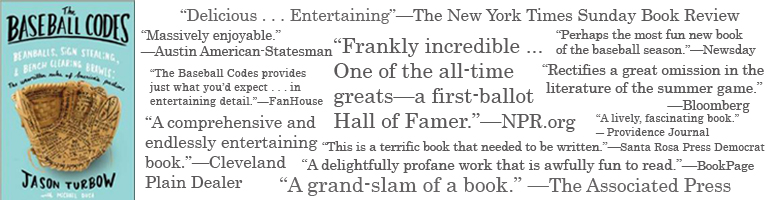
It’s difficult to say for sure, but it appears as if John Tesh (or at least one of his interns) likes The Baseball Codes.
The guy wrote the theme song for the NBA on NBC. Perhaps he’s branching out.
– Jason
 When a young player runs afoul of the unwritten rules, he’ll likely be taken aside by his manager or a veteran teammate for an explanation of proper behavior.
Should that fail, they bring in the big guns.
In the case of the Florida Marlins and Hanley Ramirez, that means Andre Dawson and Tony Perez, both of whom serve as special assistants to the club.
According to the Miami Herald, Dawson, an eight-time All Star and the NL MVP in 1987, began by telling Ramirez that “it’s time to get your act together,” calling him “immature” and adding that the player owes his teammates an apology.”
Perez, a Hall of Famer, followed with a similar message, this time in Spanish.
It worked.
In the clubhouse before the team’s game in St. Louis, Ramirez circulated among the players and offered apologies both for the play that got him into hot water in the first place, and his follow-up comments, which were less than kind to both teammates and manager Fredi Gonzalez.
In this case, an apology—about which Wes Helms said in the Fort Lauderdale Sun Sentinel, “He felt bad and you could tell”—is not so different than a retaliatory fastball. The latter is a tool used to settle an on-field score, allowing both teams to close the book on a bad situation and move forward, fresh. The former is its verbal equivalent, albeit from a conciliatory perspective.
For an example of what can happen should an apology fail to arrive after such a situation, look back to the Yankees in 1977, when Reggie Jackson announced his arrival in New York by proclaiming in Sport magazine that “I’m the straw that stirs the drink,” and that team captain Thurman Munson “can only stir it bad.”
“I don’t think some of the guys have forgiven him for that to this day,” wrote reliever Sparky Lyle in The Bronx Zoo. “Why did he have to do it? . . . If he had kept his mouth shut, he could have done everything he had wanted to do. . . . When he tried to nail Thurman, that was going too far.”
Jackson never apologized—not publicly, anyway—and it ended up costing him in myriad ways. “It was every moment of every day,” he told Sports Illustrated in 1980. “It was a coldness in the clubhouse, a coldness on the field, a coldness from the stands. Every day. Every day. I don’t want it on my mind; I don’t want those scars.”
With a single step, Ramirez was able to avoid all that.
“It means a lot to do what he did, because now we can lay it down,” said Helms. “That’s always going to be on your mind unless it’s taken care of. He did the right thing.”
– Jason
Gamesmanship is always fun. When it happens between the Yankees and the Red Sox, it can get downright giddy.
Last night, Josh Beckett gave Boston his latest in a string of terrible starts. When Robinson Cano smoked a two-run double to make the score 5-0 in the fifth, Beckett was removed. The reason: tightness in his back.
This was important, because had Beckett been pulled for reasons of ineffectiveness, reliever Manny Delcarmen would have had to come into the game cold. Following an injury, however, relievers are afforded all the warm-up time they need.
Was the injury real? To be fair, Beckett missed his previous start because of back spasms, and it was a cold, wet night in New York. Still, say skeptics, he did not appear to be injured before that point, and himself said later that the injury wasn’t serious.
On one hand, it could be gamesmanship by the Red Sox, using the system to their advantage.
On the other hand, Yankees manager Joe Girardi did what he had to do, playing the game under protest following the umpire’s decision to allow Delcarmen unlimited warm-up tosses.
“To me, he shouldn’t get all his pitches there,” Girardi said in an ESPN.com report. “In my eyes it was not done in the right way. Anytime a guy is in trouble, you signal to the bullpen and say, ‘Oh, he’s hurt.’ That’s a huge advantage.”
It’s all covered under the Code. Get away with whatever you can.
Update (May 20): Either the Red Sox are heavy into subterfuge, or Beckett was legitimately injured.
Update (May 21): New York’s protest was denied.
– Jason
As if booting the ball, then loafing after it wasn’t bad enough. As if being pulled from the game and publicly chastised by your manager wasn’t enough. As if your own teammates piling on, saying that they need to see more from you wasn’t enough.
Apparently, Hanley Ramirez wants more.
Baseball has a Code to enforce respect. Publicly, this happens almost exclusively between opposing teams. Not this time.
After pulling Ramirez from a game for egregiously loafing after a ball, Marlins manager Fredi Gonzalez went against the grain in calling out his star player in the press—although it’s easy to suspect that was one of his final options, not his first.
At that point, to use a baseball term, Ramirez blew the save.
Tuesday, he became a verbal pyromaniac, throwing incendiary quote atop incendiary quote. A sampling, taken from the Palm Beach Post:
Various teammates, most notably Wes Helms, have spoken about the need for Ramirez to step it up at this time. The sheer amount of insider comments of the type that are almost universally kept behind closed clubhouse doors is astounding. It’s a public intervention.
For his part, Gonzalez continued to push the impression that messages sent through the media are the only ones Ramirez receives.
“I think he needs to talk to his teammates a little bit,” he told the Post. “Whatever feelings he has for me are fine and dandy. We don’t have to get along but I think he needs to get along with the 24 other guys on his team and when that happens we’ll run him back in there. If he sets his ego aside, I think it will be good.”
One can only hope.
Update: Ramirez apologizes, the Marlins move on.
– Jason
 If you’re in the Bay Area, I’ll be doing a reading with Dan Fost, author of Giants Past & Present, Wednesday, May 19, at Books Inc. in Palo Alto. (7 p.m.; Town & Country Village, 855 El Camino Real) Come join the festivities.
Those who can’t make it can hear me online 10 hours earlier, at Baseball Digest’s BD Live program with Jay Ferraro, starting at 8:50 a.m. PST. Judging by the fact that they’re giving out a phone number (646-727-2874), we might even be taking calls.
– Jason
 Is he or isn’t he injured? Does he or doesn’t he care? The questions rage in South Florida after Marlins shortstop Hanley Ramirez accidentally kicked a baseball 100 feet into the left-field corner yesterday, then lazed after it while two runners scored.
Ramirez had fouled a ball off his left ankle an inning earlier, which may have hindered his efforts .
His manager, Fredi Gonzalez, didn’t buy it. “Whether he’s hurt or not hurt or whatever it was, we felt the effort wasn’t there that we wanted,” he told the Palm Beach Post. “There are 24 guys out there, busting their butts. (Watch the replay here.)
The only appearance the concept of hustling makes in the unwritten rulebook is that it’s always expected, although players can earn a variety of Code-based exemptions, most of which have to do with star treatment. (The number of times Barry Bonds humped it down to first on a ground ball over the final five years of his career can probably be counted on one hand.)
More pertinent to the Code is something Gonzalez followed closely—the rule mandating that, with the exception of pitchers or in the case of injury or a double-switch, a player should never be removed from a game in the middle of an inning.
Gonzalez waited until Ramirez returned to the dugout after the frame. With just a few words of discussion, he then sent him to the clubhouse, inserting Brian Barden in his place.
Ramirez insisted that he was slowed by the injury, not a lack of effort. “That was,” he said in an MLB.com report, “the hardest I could go after the ball.”
Had Gonzalez opted to act sooner, he wouldn’t have set precedent. In 1969, Mets manager Gil Hodges pulled left fielder Cleon Jones in the middle of an inning after a lackadaisical effort, not unlike that from Ramirez.
In the Mets’ case, however, there were other mitigating factors. Jones had been playing on a sore hamstring on a muddy field; his entire team was likely beaten down by the fact that to that point in the day—late in the second game of a double-header—New York had been outscored by the Astros, 24-3. The play in question came on Houston’s sixth hit of the inning, in addition to two walks.
When Hodges emerged from the dugout, however—hands in pockets, head down—he first appeared to be headed toward the mound. Then he veered toward shortstop, then toward Jones in left. (This led to speculation that he merely got lost on his way to speak to pitcher Nolan Ryan.) Upon reaching Jones, Hodges put his arm around the left fielder, and they returned to the dugout together.
Although Hodges clearly violated an unwritten rule with the move, he upheld another one after the game, pinning his decision on Jones’ injury and saving personal blame for a closed-door meeting with the player.
Forty-one years later, Gonzalez did not follow suit. He had a message for Ramirez, and he delivered it through the media. A sampling of his comments, taken from the Post:
In case that wasn’t enough, Gonzalez held up as paragons two members of the team whose efforts he felt were exemplary:
This sort of verbal sortie is not undertaken by a manager noticing for the first time that his best player has failed to give a sufficient effort. This is a tactic taken by a manger who, having tried (and apparently failed) to reinforce this value with said star player, has given up the ghost and opened up whatever avenues of attack he finds at his disposal.
(Gonzalez’s opinion was backed up, albeit more tactfully, by veteran Wes Helms, who told MLB.com, “A lot of guys, coaches, staff have told Hanley. With his talent, he definitely needs to be the leader of this team. Mentally. Vocally. Everything. For me, to be a leader of the team, you have to lead by example. . . . It’s the way you handle yourself. That’s the way a true leader is. He definitely has the play to be a leader, but you want him to lead by example.” Translation: Step it up, Hanley.)
Gonzalez was clearly frustrated. He was also wrong. Now he has a disgruntled superstar on his hands, and a roster full of players who might be wondering whether he might do the same to them should things turn sour.
While Gonzalez is a capable manger, it didn’t take long for Ramirez to home in on his primary weakness in regard to player relations: “He doesn’t understand (playing hurt)—he never played in the big leagues,” Ramirez, who is signed through 2014, told the Post.
Ramirez also refused to apologize, saying, “We got a lot of people dogging it after ground balls. They don’t apologize.”
Perhaps it would have come to this anyway, even without Gonzalez’s public displays of frustration. Media scrutiny, however, rarely improves caustic situations.
After Hodges publicly backed Jones after the incident in ’69, the Mets went 45-19 through the end of the season, and won the World Series.
The Marlins, on the other hand, are officially on the cusp of team-wide disruption. Expect a closed-door meeting soon.
Update: Ramirez didn’t do much to help his cause with his comments the next day.
Update II: Ramirez apologizes, the Marlins move on.
– Jason
The A’s left town for a week an hour after Dallas Braden’s perfect game on Mother’s Day, leaving many questions about no-hitter etiquette to wait for their return.
I tracked Braden down this afternoon before the A’s hosted Seattle, to pick up some of the particulars. The most controversial play of the game was Evan Longoria’s fifth-inning bunt attempt that ultimately rolled foul. It would have been easy to condemn the strategy had it come later in the game or with a more lopsided score, but even Braden conceded that Longoria was well within his rights.
“It was early in the game, and he was trying to get some things going for his offense,” he said. “Later in the game, maybe with multiple outs, it might be a different story. But I respect what he did. That’s him understanding something has to happen right now, and it has to be sooner rather than later, and he didn’t want to wait around for someone else to get it going. It actually speaks to what kind of a leader he’s trying to become. He’s very savvy, a good player, and he wants to get something going. From a competitor’s standpoint, you have to respect that.”
Longoria’s bunt might have been the most prominent Code-related play, but it had already received considerable attention through the ensuing week. Much less discussed was the no-hitter etiquette observed in the A’s dugout.
Because Braden’s not chatty on days he pitches, especially during the game, it was hardly surprising to find out that his teammates didn’t come anywhere near him as the innings whiled by. (“I did notice that nobody was even looking at me,” he said. “I didn’t make eye contact with one person.”)
He did, however, drop the ball.
Before each inning, plate umpire Jim Wolf tossed a ball to Braden, who, as is his habit, caught it in front of the mound, removed his glove and rubbed it up as he ascended to the rubber.
Until the ninth inning, when he accidentally let it fall.
“(Reliever) Brad Ziegler told me in the shower that out in the bullpen, everybody went ‘Whooooooooa,’ ” Braden said. “He said, ‘I just want to let you know, I watched you drop the ball, and we all lost it out there.’ ”
“It was one of those weird things, because everything else he did that day was, well, perfect,” said reliever Michael Wuertz. “But obviously, thankfully, it didn’t have any effect.”
Even though members of the bullpen were physically separated from Braden, they maintained strict silence when it came to discussing what was happening on the field . . . until Ziegler nearly ruined it in the sixth inning, after Gabe Kapler’s epic 12-pitch at-bat.
Said Ziegler: “I looked down at (fellow reliever) Jerry Blevins and said, ‘Hey . . .’ And Blevins just started shaking his head, like he didn’t want to talk to me. Still, I said, ‘Was Kapler the guy who hit the ball that Dewayne Wise caught in the Buehrle perfect game (in 2009)?” (Kapler’s drive was indeed snared by Wise on the far side of the outfield fence, and returned to the field of play for a perfect-game-saving catch.)
Blevins didn’t respond. Luckily, he didn’t have to.
While nobody referenced the perfect game Braden was throwing, Ziegler received affirmation from the bullpen’s Killer B’s—Bailey, Blevins and Breslow—that it had indeed been Kapler who nearly ruined another perfect game.
The unwritten rule about referencing a no-hitter in progress is vague when it comes to referencing a no-hitter other than the one being thrown. Should someone want to point toward such a thing as a potential jinx, that’s their superstitious right.
In the Code vs. Brad Ziegler, however, the ruling is clearly in Ziegler’s favor. No jinxing was done, so no fingers need be pointed.
– Jason
May 10
Dallas Braden’s perfect game would have been markedly less perfect had Evan Longoria gotten his bunt down in the fifth inning. Should he have tried it in the first place?
May 11
Josh Beckett went nuts against the Yankees, throwing fastball after fastball at or near multiple players. Was it unintentional? Does it matter?
May 12
The Phillies own both a pair of binoculars and an allegedly powerful hunger to see what the other team is up to behind the plate.
May 12
Nap-gate hit the Mariners clubhouse hard. The real issue, however, isn’t Ken Griffey Jr.’s sleep habits, it’s who’s leaking sensitive information to the media.
May 13
It’s not like the Phillies haven’t been accused of sign stealing before. Like, last October, by Yankees fans.
May 14
Chris Carpenter is proving to have a weak spot when it comes to perceived disrespect. Turns out there is such thing as too much devotion to the unwritten rules.
– Jason
Random House just ordered up another batch of The Baseball Codes. To all of you who have bought a copy (and especially to those who have bought more than one): thank you.
It’s truly been overwhelming.
– Jason
 Chris Carpenter is proving to have thin skin, and it’s costing him.
In the third inning of yesterday’s game, Carlos Lee popped up a pitch to shortstop with runners at first and second base, and responded by slamming his bat to the ground and yelling at himself in frustration. It took less than two seconds, and his gaze was fixed nowhere near the mound. (Watch it here.)
Still, Carpenter took it personally.
The St. Louis pitcher started into a surprised Lee, who slowly approached the mound to continue the conversation. Benches and bullpens emptied, although nobody came close to throwing a punch.
Did Carpenter have reason to be annoyed? Absolutely.
Should he have reacted as he did? No way.
There’s such thing as overkill when it comes to the respect afforded by baseball’s unwritten rules, and Carpenter offered up a clear example. Immediately following the incident, the right-hander gave up a three-run homer to Hunter Pence, as part of a four-run inning. In the seven other frames that Carpenter completed, he gave up three hits and no runs.
St. Louis lost, 4-1.
Up to that point, Pence was 0-for-9 lifetime against Carpenter. To judge by the box score, the pitcher effectively psyched himself out.
(St. Louis manager Tony La Russa did have Carpenter’s back, saying, “Routinely now, hitters pop up a pitch they think they should do [something] with, and they start making noises, and that really is disrespectful to the pitcher.” With any other manager, this would clearly be an effort to deflect attention from the pitcher. La Russa, however, probably believes it.)
This is the second time this season that the Cardinals might have paid a price for Carpenter’s sensitivities.
On April 21, he was hit by a pitch from Arizona’s Edwin Jackson, and then took the unusual tack of seeking retribution from the basepaths, not the mound, going out of his way to take out second baseman Kelly Johnson on an ensuing double-play grounder. (He ultimately rattled cages but did no damage, and after the game called it “an unprofessional move.” “I shouldn’t have done it . . .” he said. “I was in a position where I didn’t control my emotions enough to not do something stupid.”)
Carpenter threw shutout ball that day, save for the two runs he gave up two innings after his basepath meltdown. It’s impossible to say that one led to the other, but the possibility exists.
Carpenter, of course, is hardly alone in demonstrating the downside to being a stickler for the unwritten rules. Take an example from 2006, in which Toronto’s Ted Lilly hit A’s DH Frank Thomas in retaliation for Oakland pitcher Joe Blanton’s plunking of Troy Glaus an inning earlier.
Lilly got Thomas with the first pitch, his intentions clear. And Thomas took it like a pro, trotting to first base without emotion, as if he’d merely drawn a walk.
Lilly, however, was thrown off his game. Six of the next eleven batters reached base, including a Jay Payton home run.
“When he hit Big Frank, he wasn’t so sure that Big Frank wasn’t coming out to get him,” said a member of the A’s. “He thinks he helped his team by hitting Big Frank, but I’ll tell you what—his heart was pumping a mile a minute until he realized that Frank was just going to take first base. And after that, Lilly couldn’t find the strike zone. He was all over the place.”
A pitcher as good as Chris Carpenter is rarely all over the place, but the emotions that accompany perceived disrespect have managed to expose a chink in his armor.
He’d be well served to cover that up.
– Jason
 The Baseball Codes