No-Hitter Etiquette, Passing Rules Down

‘Hey, You Have a No-Hitter Going,’ or: When to Keep Your Mouth Shut

One of our abiding questions through the process of reporting this book concerned the point in their careers at which players learn the unwritten rules, or at least become cognizant of their existence. Legacy players like Ken Griffey Jr., Prince Fielder and the Hairston boys, all with big-league dads, were taught early. Others had the good fortune of playing for experienced coaches as youths. (“One of my coaches when I was 13 or 14 was an ex-major-leaguer, Mike Epstein,” Eric Chavez told me recently. “Everything we did was everything he learned as a ballplayer. Also, he majored in philosophy [at U.C. Berkeley]. There was nothing that got by him.”)

Shockingly, some players don’t learn about the Codes until they get to the big leagues.” If you don’t have veterans on your minor league clubs, which a lot of clubs don’t have, a lot of that education starts at the big league level,” said Hal McRae.

What’s very clear is that players in high school and even college are not held to the same standards. Look no further than a news account out of Arkansas published this morning, detailing a local prep’s no-hitter. Straight from the mouth of pitcher Trey Wiley, describing the moment at which he was just one out away:

“I never thought about it, not until there was two outs when (third baseman) Derek (Nation) threw me the ball after I struck the last kid out and he goes, ‘You know you’ve got a no-hitter, right?'” Wiley said. “Then after that, I was just like, ‘Uh oh, I’ve got to get this guy.'”

Had Wiley given up a hit at that point, Nation’s primary story of his time as a high school baseball player would likely have forever after spun on the question, “What if I hadn’t said anything?” But as they say, no harm, no foul. It’s not the big leagues, after all.

– Jason

Aaron Rowand, Don't Showboat, Los Angeles Dodgers, Manny Ramirez, Retaliation, San Francisco Giants, Vicente Padilla

Padilla, Ramirez, Dodgers Get off Scott-Free Against Giants

In September, Prince Fielder did his bowling-pin routine against the Giants. The next time they faced him, this spring, Fielder was drilled in response.

The Dodgers, apparently, are held to a significantly lower standard.

On Friday, Los Angeles right-hander Vicente Padilla broke Aaron Rowand‘s cheek with a pitch, sending him to the disabled list. To judge by the reaction from the Giants pitching staff—no Dodgers player was hit in response during any point of the three-game series—Fielder’s dance was the more offensive of the two items.

Two days later, in the series finale, Manny Ramirez drilled an eighth-inning, pinch-hit, two-run homer to put his team up, 2-1. The slugger then acknowledged the delirious fans with a curtain call—while Sergio Romo was in the process of pitching to the next hitter.

“Manny being Manny” is a popular refrain around baseball when attempting to describe Ramirez. It’s essentially shorthand for “the guy does what he wants,” which is itself shorthand for “the man is so totally self-absorbed that he doesn’t care how he comes across to the rest of the planet.”

Ramirez’s actions, of course, did nothing more than offend. Padilla’s recklessness cost the Giants their leadoff hitter, with the potential for much greater damage. Padilla swears it was unintentional, and by the Giants’ reaction (or lack thereof), they appear to believe it, too.

This doesn’t change the fact that Padilla is, without exception, the game’s premier head-hunter. He led the American League with 17 hit batsmen in 2006, has finished among the top five in the category four times and was in the top 10 once. He currently leads the National League with three.

(Remember Sean Tracey, the White Sox rookie who was first chewed out, then banished by manager Ozzie Guillen when he failed to drill Hank Blalock in 2006? That Blalock was targeted in the first place was because Padilla [then with the Rangers] had already nailed Sox catcher A.J. Pierzynski. Twice. [A week later, White Sox pitcher Jon Garland received his own tongue-lashing from Guillen when he failed to respond after a teammate was hit . . . again by Padilla.])

If Padilla has a defense, it goes like this: The guy hadn’t made it out of the fifth inning in either of his prior starts this season; drilling Rowand (itself in the fifth inning) came after Padilla had already given up three hits, a walk and two runs in the frame, and served to load the bases. If he wasn’t officially on the ropes, he couldn’t have gotten any closer.

Padilla came to bat again in the game, and wasn’t hit. Ramirez’s act Sunday came during a 2-1 game—far too close to even consider retaliation.

The Giants next play the Dodgers in late June. San Francisco will know two things going into that series: Ramirez’s act was laden with more than enough disrespect to merit retaliation. And whether or not Padilla intended to injure Rowand, he thought so little of the incident that he failed to place a call and check up on his victim—itself an unwritten rule in situations like this.

Rowand should be back on the field by then, and like it or not, his opinion will count when it comes to the Giants’ reaction. For now, we can only wait and see what that will be.

– Jason
Radio appearances

KNBR 1050 on Monday

Michael and I will be heading into KNBR’s San Francisco studio Monday afternoon to spend a half-hour with Damon Bruce, from 2:30 – 3 p.m. (If you’re in the Bay Area, head to 1050 on your AM dial for all the Code talk you can handle.)

– Jason

Unwritten-Rules

This Week in the Unwritten Rules

Welcome to our new feature: a weekly roundup of Code violations across the major leagues. Since it’s just kicking off, we’ll stretch back two weeks, which takes us back to opening day.

(If you come across any rules violations you think should be covered, please send a tip to baseballcodes@gmail.com.)

April 6
Atlanta’s Nate McLouth illustrates the art of the outfield trap. Is it cheating to act as if you’ve caught a ball you didn’t come close to catching? In the big leagues, no.

April 7
We all know that players don’t acknowledge a no-hitter as it’s being thrown. In the digital era, the same holds true for members of the blogosphere.

April 8
Kevin Youkilis gets drilled in the helmet. Derek Jeter wears one in response. This is retaliation at its easiest, as both men were able to laugh about it, even as it was happening.

April 11
Yankees manager Joe Girardi raises eyebrows when he fesses up that he would have pulled C.C. Sabathia from the game for the ninth inning, even had his no-hitter still been intact.

April 13
Francisco Rodriguez illustrated the power of intimidation, while offering a message to National League hitters: the guy doesn’t like lip.

April 14
A.J. Pierzynski shows little respect for Ricky Romero’s no-hitter, acting as if he’s been painfully hit by a ball that missed him entirely.

April 16
Blue Jays broadcaster Buck Martinez refrained from mentioning either no-hitter taken into the late innings this season by Toronto pitchers.

– Jason

Buck Martinez, No-Hitter Etiquette, Ricky Romero, Shaun Marcum

Talking About a No-Hitter, Broadcasters Edition

How players deal with a no-hitter in progress is unequivocal. Shut up, never mention it and stay the hell away from the pitcher.

Broadcasters, however, own a different set of responsibilities. It’s in their job description, after all, to tell the audience what’s happening on the field. Said ex-big-leaguer-turned-broadcaster Steve Lyons, “If you want people to stay tuned, you should probably mention, ‘Hey, hang in there, don’t go anywhere—guy’s throwing a no-hitter.’ ”

Of course, not every broadcaster feels this way.

Buck Martinez spent 17 years as a major league catcher, and managed the Blue Jays for a season-and-a-half. During that time the lessons he learned apparently became quite ingrained.

Martinez now broadcasts Blue Jays games, and so far this young season has had two opportunities to describe home-team no-hitters into the deep innings. Except that he didn’t.

From Bruce Dowbiggin’s column in the Globe and Mail:

As Shaun Marcum and Ricky Romero no-hit their opponents until late in the game, viewers discovered “no-hitter” seemed to be the hardest words to say for Martinez and analyst Pat Tabler (also a former player).

There were euphemisms about players not rounding first base successfully. Or suggestions that opponents lacked for men on base. But the no-no was a no-no between Martinez and Tabler.

“I guess I’m still a baseball player at heart,” Martinez said yesterday. “I was a little reluctant to say the words. It’s not like we’re in the dugout. But I know that players have the TV on in the clubhouse, and I’d hate for a young guy to go in there and hear me say ‘no-hitter.’ I don’t know what it might do to him. I suppose old habits die hard.”

Of course, during David Cone’s perfect game in 1999, he went to the clubhouse after every inning, where he heard Yankees broadcaster Michael Kay “say I had a perfect game from the fifth inning on.”

Things still managed to work out okay.

– Jason

Fights

Interesting Foreign Codes

Just ran across this on YouTube. Seems that in Korea they have their own methods of settling scores.

(One of the comments on the YouTube page targets this as a celebrity game, and says this was done strictly for its entertainment value. Still, might we all not have something to learn?)

– Jason

Review

Is Wall Street Primed for the Codes?

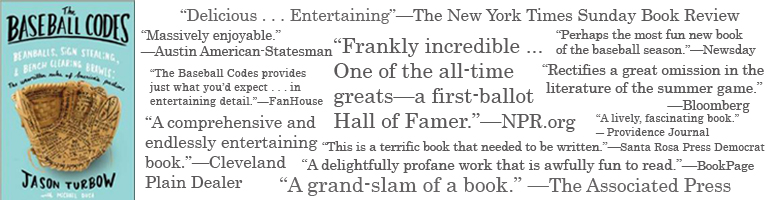
Bloomberg chose to lead off its recent compendium of new sports books with The Baseball Codes, offering up this gem: “The Baseball Codes rectifies a great omission in the literature of the summer game.”

Providing rectification on any level is usually  nice.

It’s a good review, but the fact that it came from an organization known primarily for financial reporting makes it even better. Perhaps there’s a project to pitch about the unwritten rules of derivatives markets.

(Plus, we’re all about mansions and Benzes here at Baseball Codes World Headquarters, and appreciate anyone who shares our taste for the scrilla.)

Update: It should also be mentioned that Bloomberg has paired with MLB.com to comprehensive analytical stats with an eye toward fantasy leagues, and seems to have a thing for baseball. Really, who can blame ’em?

– Jason

A.J. Pierzynski, No-Hitter Etiquette, Ricky Romero

When Bad Things (Pierzynski) Happen to Good Pitchers (Romero)

In the late innings of a no-hitter, certain etiquette is expected from batters. A.J. Pierzynski has never been much for etiquette.

Toronto’s Ricky Romero held the White Sox hitless for seven full innings yesterday, but leading off the eighth, Pierzynski watched a sinking pitch bounce into the dirt near his foot without hitting him, then proceeded to wince, hop and hobble to first.

The fact that the umpires didn’t challenge the masquerade is far less relevant to this conversation than the Chicago catcher’s level of respect for what was happening on the field.

Pierzynski loves to get into the heads of the opposition, and this play was no different. Sure enough, he managed to distract Romero enough for the pitcher to groove one to the next hitter, Alex Rios, who pounded it over the left-field wall for a two-run homer.

Was Pierzynski’s act acceptable?

Pro: Romero had already walked two hitters, so Pierzynski’s acting didn’t destroy a perfect game. With the score 4-0, Pierzynski did manage to become only his team’s third baserunner.

Con: He didn’t even bring the tying run to the plate, let alone the winning run. And while in-game scams are a forte for Pierzynski, the notion prevails that hitters are expected to give their best efforts in situations like this. (The argument that his weasel act is Pierzynski’s best effort, while comical, doesn’t fly.)

It doesn’t take a great pitcher to throw a no-hitter (Greg Maddux didn’t; Bud Smith did), but it does take a combination of a perfect night, a bit of luck and just a touch of magic—a rare set of circumstances that presents us with baseball at its best.

For that combination to be ruined by trickery or deceit does injustice to the game, the fans and the pitcher in question.

Perhaps one day Pierzynski will learn. (But don’t count on it.)

– Jason

Francisco Rodriguez, Intimidation, Willie Harris

Minor Dustup Refreshes Code Tenets (or, Don’t Mess with K-Rod)

So Francisco Rodriguez hit Willie Harris on the arm, an act for which Harris didn’t much care. The Nationals outfielder spouted some choice words on his way to first, offering a brief glance toward the mound en route.

That was all it took to elicit K-Rod’s full attention. The reliever strode with purpose toward first base, apparently ready to settle whatever grudge Harris may have been fostering.

(For what it’s worth, the pitch did not appear to be thrown with intention—Harris said as much later—and the hitter barely moved to avoid it.  Watch the video here.)

The unwritten rules involved here are subtle, but readily apparent:

  • If you have something to say to a member of the opposing team, come out and say it. It’s not so different than a spousal relationship; indignancies muttered under one’s breath are often more inflammatory than venom spewed at top volume. (This is really more an unwritten rule of life than of baseball.)
  • If you don’t make an effort to get out of the way of a pitch, you don’t have much to complain about.
  • Intimidation is everything. While Harris said all the right things after the game—“I ain’t no little boy or no punk, either,” he told reporters after the game. “I’m a man just like he is, I ain’t scared of him”—his reaction on the field as Rodriguez approached looked to be anything but aggressive. If one of them is to devote extra consideration to the possibilities of another showdown the next time they face each other, the smart money’s on Harris.

    The nature of Rodriguez’s job description means that he’s almost exclusively used in tight games, so the chances of him exacting further retribution this season are slim. And considering that Mets pitchers have yet to do anything about the parade of inside fastballs sent toward David Wright leads one to believe that they’re not going to pick up the torch on behalf of their closer, either.

    Stay tuned.

    – Jason