Advertising

Pulling Out All the Stops

Random House has come up with terrific ad for the book that will run during assorted broadcasts of Major League and college baseball games.

Heck, it makes me want to find out what all the buzz is about, and I already have a pretty good idea.

<object style=”height: 344px; width: 425px”><param name=”movie” value=”http://www.youtube.com/v/nh4qaSfMroQ”><param name=”allowFullScreen” value=”true”><param name=”allowScriptAccess” value=”always”><embed src=”http://www.youtube.com/v/nh4qaSfMroQ&#8221; type=”application/x-shockwave-flash” allowfullscreen=”true” allowScriptAccess=”always” width=”425″ height=”344″></object>

(More cowbell. I gotta have more cowbell.)

– Jason

C.C. Sabathia, Clay Kirby, Don Wilson, Joe Girardi, No-Hitter Etiquette, Preston Gomez

Thinking About Pulling Your Pitcher During His Own No-Hitter? It’s Been Done Before

An interesting side-note from C.C. Sabathia’s near-no hitter yesterday was that, even had Tampa Bay’s Kelly Shoppach failed to record his team’s first hit with two outs in the eighth inning, Yankees manager Joe Girardi was ready to pull Sabathia anyway.

The decision was all about pitch count; Shoppach’s single came on Sabathia’s 111th pitch of the night. Despite Sabathia’s established reputation for extraordinary stamina, Girardi wanted to take no chances this early in the season.

Had he pulled his pitcher in the middle of a no-hitter, it wouldn’t have been the first time it’s happened.

When Preston Gomez was managing the Padres in 1970, he yanked starter Clay Kirby, not due to fear of overload, but because a series of first-inning walks and stolen bases by the Mets gave them a 1-0 lead. Despite his eight no-hit innings, he was pulled for a pinch-hitter in the bottom of the frame.

In ’74, Gomez did it again as manager of the Astros, pulling Don Wilson after eight no-hit innings, while trailing 2-1.

While that technically qualifies as precedent for Girardi, Gomez’s career winning percentage was .395, and his teams finished somewhere other than last place only once in seven years.

That certainly had more to do with talent-free rosters than stirring up bad baseball juju, but it’s still something that Mr. Girardi might want to consider should a similar situation arise in the future.

– Jason

Unwritten-Rules

Newspaper Comes Up with the Next 10 Codes on the List

It took four years to come up with enough unwritten rules (and examples to illustrate them) to fill a book.

Writing about The Baseball Codes, Robert Rubino of the Santa Rosa Press Democrat just wrote Vol. 2 for us before the paper went to press yesterday, with a column featuring “the top 10 unwritten rules that didn’t make it into the book.”

In inverse order, they include:

10. Spit like a man.

9. The rebellious third-base coach (who habitually and exclusively stands outside the coach’s box).

8. Arguing with umpires. Rubino only devotes a paragraph to the topic, but he’s actually on to something here. The initial draft of the book contained a section about proper methods for effectively arguing with arbiters (for example, attack the call, not the umpire), but it was cut for space considerations.

7. Closers’ fashion and histrionics. “Facial hair, earrings and necklaces are pretty much trademarks of ninth-inning relief pitchers,” he writes. Again, he’s on to something . . .  sort of. The initial draft contained an entire chapter on facial hair, which may yet see the light of publication one day.

6. The etiquette of post-game interviews.

5. Outfielders should slide whenever possible while making catches, the better to make highlight reels.

4. Refrain from picking your nose. Not good on TV.

3. Bullpen residents must perfect “the look of unendurable boredom with a clearly discernible sliver of mindless mischief.” For more on this topic, see one of the books we used as a primary reference, Pen Men, by Bob Cairns. It’s an excellent read.

2. Middle infielders should always use the phantom tag.

1. Appropriate cup adjustment. “Be proud,” writes Rubino. “Be bold.”

It’s a fun list that’s obviously not meant to be taken too seriously. Rubino, however—possibly despite himself—actually scratched the surface of a few interesting topics that are legitimately Code-worthy. It just goes to illustrate that there will be a lot of blogging to do this season.

– Jason

Radio appearances

KNBR and the Unwritten Rules

KNBR’s Mychael Urban (who also reports for Comcast SportsNet Bay Area) will be introducing to his Giants pre-game show a segment on the unwritten rules, using for inspiration The Baseball Codes. The show is on the air right now; the segment will begin at about 5:30 p.m., and will reference the book with copious regularity.

I’ll be on the show before the game tomorrow, at about 11:30 a.m., 680 on your Bay Area AM radio dial.

– Jason

Radio appearances

KTCT Today

If you’re in the Bay Area and interested in such things, I’ll be on KTCT (1050 on your AM dial) with Damon Bruce today, at or about 12:30 p.m., from AT&T Park in advance of the Giants home opener.

– Jason

Andy Pettitte, John Lackey, Kevin Youkilis, Retaliation

Yankees, Red Sox Exchange Hit Batsmen; Jeter, Youkilis Share a Laugh

If only it ended so well every time a guy took a fastball off his batting helmet.

It began in the fifth inning of the Yankees-Red Sox game at Fenway Park last night, when an Andy Pettitte fastball skipped off the helmet of Kevin Youkilis. It was only a glancing blow, not enough even to knock the Boston slugger off his feet. It was also clearly unintentional; rare is the pitcher willing to settle a grudge with a fastball above the shoulders, and Pettitte in particular is known for his abhorrence of  hitting batters.

As Youkilis made his way to first, he looked across the diamond at Derek Jeter and playfully told his ex-Team USA teammate that he was next in line.

Sure enough, a half-inning later, John Lackey drilled Jeter (well below shoulder level, as the Code dictates). It would have been expected from any pitcher, but the fact that Lackey is new to the Red Sox made it all the more pressing for him to quickly gain the respect of his teammates.

Jeter knew it was coming, and not only took his base without incident, but ended up laughing with Youkilis on the field over the first baseman’s prediction.

“(Youkilis) was just joking that we’re the two that always get hit, so that’s why we were laughing,” Jeter was quoted as saying in the New York Daily News. “I didn’t think (Lackey) was throwing at me, not in a one-run game . . . I didn’t think twice about it really.”

Tit for tat, situation finished. That’s the Code at work.

– Jason

John Lott, Jordan Bastian, No-Hitter Etiquette, Richard Griffin

No-Hitter Code Reaches the Blogosphere

That one doesn’t talk about a no-hitter in progress is widely known. Players are not only religious in their restraint from discussing the topic (save for the rare instance of the pitcher himself trying to relieve pressure by bringing it up and subsequently freaking out all his teammates), but will physically move as far away from the pitcher as possible over the course of the game. (“You start to see the guys easing away,” said Oscar Gamble. “When they get that no-hitter, you start to notice a little bench space on both sides of the pitcher getting bigger and bigger.”)

One of the big topics of the unwritten rules as a whole is how they change over the years, and this particular slice of the Code is no exception—sort of. This is one of the rare rules rooted not in respect, but superstition. In that regard, the rule is the same as ever; only the medium has changed.

Once, it was only players who were able to lay down a jinx. With the advent of radio and television, broadcasters were kissed into the unofficial contract. (Phillies broadcaster Scott Graham, talking to his wife off the air during Kevin Millwood’s no-hitter in 2003, couldn’t even bring up the specific reason he didn’t want her to take their increasingly antsy young children home. “Listen to me,” he said, pointing to the scoreboard. “You can’t leave here until that number under the ‘H’ changes.”)

Today, we have bloggers and tweeters.

This last point became especially salient during the course of opening day, when Toronto’s Shaun Marcum held Texas without a hit into the seventh inning. Apparently, people on the Interwebs don’t have quite the same standards as those on the bench.

Take a message board at the Baltimore sun, where a user started a mid-game thread to discuss the no-hitter.

no hitter thru 6 innings

Lind and Wells with HRs.

No way the O’s are better than Toronto…. last place is ours and ours alone!!!

Of course, a few posts later, came this response:

BBOnly a moron would start a thread like this.

Seems like somebody has ALOT to learn about baseball.

Rangers 5
Blue Jays 4

FINAL

Because this is just a fan dabbling in some heavy ju-ju, a degree of leeway seems fair. Of course, even the pros felt similarly few compunctions when it came to restraint from staying overly on-point. Traditionally, beat writers have been exempt from this piece of code, since their copy is filed after the game ends. Now that they live-blog, however, everything’s changed.

Toronto Star columnist Richard Griffin did just that during Marcum’s game, interacting both with fans and the Star’s message-board moderator via his newspaper’s blog. A sampling of the exchanges:

Richard Griffin: With a no-hitter going on, the old-school baseball scoring credo is that the first hit needs to be clean and inarguable. As such, when Young slammed a hard topspin three-hopper just to Encarnacion’s right, he took one step, went to one knee on the backhand, clanked it to the dirt, picked it up barehanded and two-hopped a throw to first that Overbay couldn’t handle. It looked like an error, it smelled like an error and this time even in the other team’s ballpark it was called an error.

Guest: Rich, you already mentioned ‘youknowwhat’ when referring to EE’s error. I was quite taken aback that you would mention it so frivolously.

TorontoStar: That was the moderator, Guest, and I was referring to the thing that must not be mentioned when it happens in baseball. Youknowwhat. look at the hits line. that’s all I’ll say.

Richard Griffin: I am not one of those believers in the power of the spoken word when it comes to breaking up “you-know-whats” from afar. I don’t think Marcum can hear me from where I’m sitting.

Richard Griffin: I am being chastised by my own moderator. What’s next?

When the medium shifts to Twitter, not much changes. John Lott, a baseball reporter for the National Post, offered this string of clearly remorseless tweets:

Marcum has a no-hitter through 6. Two more Ks in that inning.
12:33 PM Apr 5th via TweetDeck

Marcum pitched six scoreless innings to start a game eight times in ’07 and eight times in ’08. Hold your breath …
12:39 PM Apr 5th via TweetDeck

Vlaid breaks up no-no with clean 1B to right.
12:47 PM Apr 5th via TweetDeck

Just now getting the chance to review all the tweets from folks blaming me for jinxing Marcum. You’re right. What was I thinking … (more)
2:49 PM Apr 5th via TweetDeck

That weakling Guerrero would have fanned for sure if not for me. And I willed Cruz to reach down with one arm and hit one up into the wind.
2:50 PM Apr 5th via TweetDeck

These are the powerful demons I must constantly fight. I will endeavour to rally against them.
2:53 PM Apr 5th via TweetDeck

There’s no real way to pin Marcum’s failure on Lott, if only because Lott wasn’t even the only person talking about it on Twitter. Here’s a string from Toronto’s MLB.com reporter Jordan Bastian (whose game account is referenced above):

Marcum dealing through four innings: 0 R, 0 H, 0 BB, 4 K.
12:08 PM Apr 5th via TweetDeck

Blame this person when it doesn’t happen Jays fans —-> RT @rrwillerton: @MLBastian no hitter no hitter no hitter
12:20 PM Apr 5th via TweetDeck

Dave Stieb’s no-hitter came during a 3-0 win for the Blue Jays… Umm, Toronto is up 3-0 right now…
12:32 PM Apr 5th via TweetDeck

Why am I getting so many angry replies? Because I said Shaun Marcum was throwing a no-hitter? A no-hitter thru six innings?
12:35 PM Apr 5th via TweetDeck

(After Marcum gave up both hits and runs)

I hardly think my tweeting has any influence on the game below. Everyone… deep breaths.
12:53 PM Apr 5th via TweetDeck

This rule clearly elicits more passionate responses than virtually any other section of the Code (a tall order, considering how inherently silly it is). Now that we have so many more ways to communicate with each other, it’ll be interesting to see how closely policed these loose-lipped tweeters and bloggers will actually be.

– Jason
Readings

Bay Area Appearances

Michael and I will make our first joint public appearance in support of the book on April 25, at the Public House restaurant inside AT&T Park, immediately following the Giants-Cardinals game.

On Wednesday, May 5, we’ll be reading at Books Inc. in Alameda (1344 Park Street; map), at 7:30 p.m.

If you’ve had a long-burning need to discuss things like the intricacies of whether and when to take a 2-0 pitch, now’s the time.

– Jason

Sales

Back to the Presses

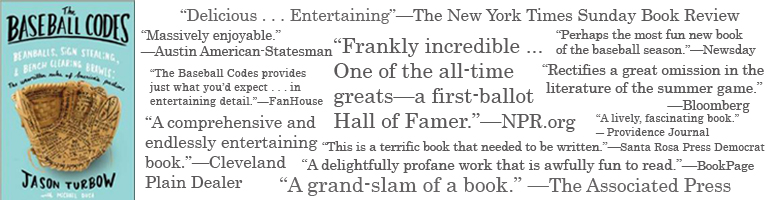
It’s kind of unbelievable, but we’re now two days into the baseball season and Random House just ordered a fourth print run for the book. I’m no expert on the business of publishing, but I’m pretty sure this is a good thing.

Thanks again to everyone for the continued support.

– Jason

Gamesmanship

The Art of the Outfield Trap

Nate McLouth

It took all of six innings into the Braves-Cubs season opener for the unwritten rules to crop up.

In the top of the frame, Chicago’s Aramis Ramirez, on first base, saw Braves center fielder Nate McLouth clearly trap a fly ball hit by Marlon Byrd, and trotted to second. According to the umpires, however, McLouth made the catch, and the Braves doubled up Ramirez at first. Instead of two on and nobody out, the Cubs inexplicably had nobody on and two outs. (See the video here.)

While McLouth wasn’t guilty of the hey-I-caught-it gesture of displaying ball in glove for the world to see, typical among outfield trappers, neither did he make any effort to correct the record with the umpires.

Nor should he have.

Trapping the ball falls into the Code’s category of “gamesmanship,” with the understanding that while honesty might be the best policy in society, doing what it takes to win a game is the best policy in big-league baseball. It’s a pantomime act that is not only accepted by other ballplayers, but expected.

– Jason