Retaliation

North Side Slap Fight: Braves, Cubs Trade Drillings at Wrigley

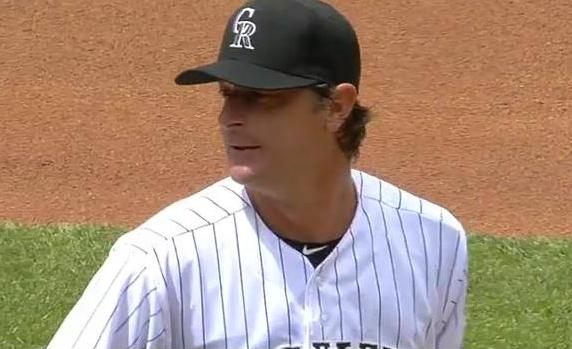
David DeJesus takes some punishment.

All the people yelling about how Bryce Harper didn’t do anything to deserve his drilling from Cole Hamels on Sunday can rest a bit easier. Somebody in baseball finally merited retaliation, and retaliation was delivered.

We think.

Speculation begins in the second inning of Monday’s game between Atlanta and the Cubs, when Jason Heyward homered off Jeff Samardzija. Fast forward to the seventh, when, with one out and nobody on, Samardzija hit Heyward with a pitch. The Cubs trailed 2-1 at that point, so it makes sense that it was unintentional. Still, Heyward’s earlier homer raised some doubts, as did the fact that Cubs outfielder Reed Johnson had been hit up near the neck in the third inning by Braves starter Tommy Hanson.

“[Heyward] came out and hit a home run on a ball that was down and away,” Samardzija said in the Chicago Tribune. “[In the seventh] I just thought he was diving over the plate, and I wanted to throw one in there and go back away, but it just got in there too tight.”

No matter; in the bottom of the frame, Braves reliever Eric O’Flaherty drilled David DeJesus in the right tricep. (Watch it all here.)

Ump Chris Conroy quickly warned both benches, then tossed Fredi Gonzalez, after the Atlanta manager came out to discuss the matter.

“I just asked him for an explanation,” said Gonzalez in the Atlanta Journal-Constitution. “I asked him why would you think we’re throwing at people in a one-run game or they’re throwing at people in a one-run game, you know? It’s not like it’s a 10-run game or anything like that. It’s still a helluva game going on, and I’m talking to him like I’m talking to you, and I got thrown out of the game.”

As reasonable as Gonzalez’s explanation may be, Conroy did the right thing. Samardzija’s plunking of the seventh-place hitter in the Atlanta lineup didn’t exactly scream for vengeance, but if vengeance is the stance the Braves wanted to adopt in response, that’s their prerogative. It was indeed a one-run game, but if O’Flaherty did it on purpose, he picked just the right time—with two outs and nobody on base—and he hit DeJesus in nearly the same place as Heyward was drilled.

Ultimately, because none of the pitchers are talking (learn a lesson, Cole Hamels), it will likely end here. One shot, one response, situation over. (Sure enough, the only contentious issue in yesterday’s 3-1 Atlanta victory was between Kerry Wood and his own performance.)

Series finale today, just to make sure.

Chipper Jones, Jamie Moyer, Sign stealing

Hey Baby, What’s Your Sign? Chipper Doesn’t Take Kindly to Accusations

In The Baseball Codes, longtime Tigers catcher Bill Freehan had some advice for players looking to respond to a perceived indignity with overt action.

“You don’t want to light a guy up,” he said. “Just let a sleeping dog lie.”

At age 49, Jamie Moyer should by now have learned this commonsense maxim, which is espoused in every big league clubhouse.

Saturday night, however, he went out and, in Freehan’s terminology, lit a guy up—and it cost him. In the fifth inning of a game Moyer’s Rockies led 6-2 against Atlanta, he thought that Chipper Jones, at second base, was relaying signs to the hitter, Brian McCann. What spurred his suspicion is unclear, but Moyer responded by turning around and tellilng the Atlanta superstar to knock it off. (Watch it here.)

Jones did not receive it well.

“He accused me of relaying a sign down 6-2 with a 3-0 count to Brian McCann,” he said after the game, in the Atlanta Journal-Constitution, referencing the fact that McCann would likely taking the next pitch, no matter what it was, thus nullifying the need to tip him off. “I have never relayed a sign to anyone while I’m on second base.”

That’s certainly possible—some players abhor the practice, for a variety of reasons—but Jones’ tenor makes it sound as if sign relaying is something done primarily by lowlifes and scoundrels. In fact, it’s so common that most pitchers won’t even retaliate should they see it happening—they’ll just have the catcher change the signs. In slightly more extreme circumstances, they’ll ask the baserunner to knock it off. (It’s not even the first time the issue has been raised this season.)

Moyer opted for the latter tack, telling Jones, “I see what you’re doing.” Unfortunately for the pitcher, circumstances do not seem to corroborate his suspicion. Jones said he was having a conversation with Rockies shortstop Troy Tulowitzki at the time—a claim that Tulowitzki confirmed, adding that Jones “wasn’t doing anything”—and was befuddled by the accusation. Actually, he was outraged. The third baseman went to some length after the game to explain precisely how neither he nor anybody on his team does anything like that—with enough specifics to make it very believable.

“I literally am standing on second base and I’m talking to [Tulowitzki], and I turn around and [Moyer] is coming set,” he said in the AJC. “So I get ready and take my lead, and [Moyer] goes, ‘I see you.’ And I go, what the [bleep] do you see? What the [bleep] are you talking about?’ I go, ‘I was [bleeping] talking to your shortstop. And he said something else with his back turned, like he yelled but didn’t face me. I go, that’s [bleeping] B.S. And I turned around to Tulo and Tulo’s like [holds hands up].”

Jones also said that the only sign stealers during his time with the Braves were Jeff Blauser and Mark Lemke—both of whom last played with the club in 1997—and that since then, “nobody’s ever done it.”

Moyer compounded matters in the bottom half of the inning, when he came to bat and informed Atlanta catcher McCann that things like sign stealing are “how people get hurt.” Jones took notice, as did several other members of the Braves. They responded in the most painful way possible: at the plate.

Colorado’s lead had extended to 8-3 by the time Moyer spoke to McCann. Atlanta’s first two hitters the following inning, Matt Diaz and Jason Heyward, then hit long home runs, followed by a single from Tyler Pastornicky. That ended Moyer’s night.

Three batters later, Jones singled off reliever Esmil Rogers to drive in two (Pastornicky’s run was charged to Moyer), and two batters after that the game was tied. Atlanta went on to win, 13-9.

“That was all on Jamie Moyer,” Jones said. “He woke a sleeping giant tonight. . . . I don’t know why he’s so paranoid. But to be honest with you, every pitch he throws is 78 [mph]. So it’s not like we really have to relay signs.”

Moyer declined to comment after the game beyond saying in the Denver Post that “whatever happens on the field stays on the field.” Unfortunately for him, that’s not the case—and the facts don’t appear to support him.

“Jamie’s been known to be a little paranoid before,” said Diaz. It’s just one of those things where it made absolutely no sense in the situation.”

(Diaz also said that he’s been trying to get the Braves to relay more signs—like, any signs—from second base, because it was practiced on the other three teams for which he’s played, but has gotten no traction. “Chip’s the reason we don’t,” he said. “He’ll say, ‘No, we don’t do that.’ So it’s funny that he got called out on it. Ironic even.”

Ultimately, Moyer’s response would have been entirely appropriate had Jones actually been stealing signs. But like the mugger who tries to roll a plainclothes policeman, it appears that in Jones, Moyer simply picked the wrong target. The facts don’t suggest that signs were being stolen, and the vehemence of the accused lends credence to his claims.

What Moyer saw to raise his hackles, we still don’t know, but it helped spur an outburst of offense against him. Next time, he should probably be certain.

Clubhouse meetings

When Teams Meet to Beat the Heat

We’ve reached the point in the season at which good teams are looking toward the playoffs—and, to their horror, find themselves imagining some combination of absence or failure. Which is why managers have recently taken to the time-tested strategy of the closed-door meeting.

Last week it was the NL East’s turn. Monday afternoon, Braves skipper Freddi Gonzalez insisted that his team merited no such tactic, despite losing three in a row and 11 of 17. That very night, however, after watching his players go 3-for-20 with runners in scoring position during a 12-inning loss to Florida, he about-faced, closing the doors after batting practice on Tuesday, and gave his team a talking to.

The question, of course, is whether this type of thing has any affect. Overall, the results are decidedly mixed, but the tactic seems to be effective for Atlanta.

According to the Atlanta Journal Constitution, the Braves last met after a loss to the Mets on June 5, then won six in a row.

“It’s almost like therapy,” said Chipper Jones in the AJC. “You knew what was going to be said, but it still helps to hear it, to say it, to look in your teammates’ eyes and let them see your conviction and know that you can’t help what happens next year. This might be your only opportunity.”

For a historical reference, take the 1980 Philadelphia Phillies, who had an August loaded with meetings. After a 7-1 loss to the Pirates in the first game of a doubleheader that Aug. 10, manager Dallas Green tore into his players with such fury that reliever Ron Reed had to be restrained from going after him.

“What Dallas was saying went right to the core,” wrote Tug McGraw in Ya Gotta Believe. “Sometimes it’s not what’s being said as much as it is who’s saying it and when they’re saying it. By this time of the year, Dallas had earned a lot of respect. We all knew he was real and wasn’t just a blowhard. So after the meeting, we went out and won eight of nine, including five in a row from the pitiful Mets.”

Less than two weeks later, however, the team lost the final two games of a series at San Diego, earning another dressing-down—this time by general manager Paul Owens, who singled out Larry Bowa and Garry Maddox for their poor play. Rather than let a player come after him, Owens got proactive, offering to fight whoever was up for the challenge. Philadelphia, 5-7 since that Mets series, went 23-11 to close the season (including 12 one-run victories) and went on to win its first World Series in nearly 100 years of existence.

This year’s version of the Phillies has recently had its own challenges. The same night Gonzalez addressed the Braves, Phillies skipper Charlie Manuel “had a little talk” with his players following a poorly played 5-2 loss to the Astros, Philadelphia’s second straight defeat.

Manuel downplayed the incident afterward, but according to Comcast SportsNet Philadelphia, “he rattled some cages pretty soundly.”

Not that it did much good. Nearly every Phillies player who took the field the following day was utterly ineffective, as they managed just four hits against Houston starter Bud Norris and two relievers. Luckily for Manuel and the good people of Philadelphia, one guy rose to the occasion: Roy Halladay, who spun a complete-game shutout.

It’s not like this is a new tactic; May alone saw at least four such meetings. (Only one of them was unusual, when the Mets closed the clubhouse doors to discuss the inflammatory comments made by owner Fred Wilpon in a New Yorker profile.)

On May 16, Cubs manager Mike Quade lectured his team after Carlos Zambrano blew a four-run, sixth-inning lead in a loss to the Reds. (The message delivered, according to Quade, via the Chicago Tribune: “That was embarrassing. That (stuff) has got to stop. And it’s everybody that was in that room for that meeting. Myself, the players and the coaching staff. It’s just not going to cut it right now.”)

The Cubs lost their next game. After going 6-and-6 over the next two weeks, they then lost eight in a row.

On May 16, Rockies manager Jim Tracy tried to end a 4-11 streak by addressing his club. (The message delivered, according to Tracy, via the Denver Post: “We need to get back to playing the game the way we did in spring training and the early part of the season.”)

The Rockies won their next two games, then went 3-11 over the following two weeks.

On May 22, Padres manager Bud Black called a meeting after his team was swept by Seattle. (The message delivered, according to Heath Bell, via the San Diego Union-Tribune: “We’re major league ballplayers. That no matter who we’re facing, we need to have a chip on our shoulders to go out there and win every single day.”)

San Diego lost three of its next four.

Heck, Mariners manager Eric Wedge closed his clubhouse doors on April 16—two weeks into the season—to berate his hapless club, which had just gone 0-for-9 with runners in scoring position against the Royals to drop its 11th game in 13 contests. (The message delivered, according to Wedge, via the Seattle Times: “I want them to have the mindset that’s aggressive and such to where we’re up there ready for anything.”)

Unlike the above teams, the Mariners actually responded, splitting their next eight games before winning five in a row on the road against Detroit and Boston.

* * *

It goes without saying that struggling teams call such meetings with significantly more frequency than those that are winning. One trick to a successful meeting, according to the New York Daily News, is to “always hold your clubhouse meetings the day before your best pitcher is pitching.” That was written in 2000, in response to Mets manager Bobby Valentine, who aired out his team after a 12-4 loss to the Braves—one day before Al Leiter took the hill. (Sure enough, Leiter was perfect into the sixth, and the Mets beat Atlanta, 6-3, making Valentine look like a genius.)

Of course, not all such meetings are simply about playing better. They also serve as a forum for players to air out grievances. (In a 1990 meeting, San Diego’s Jack Clark, Mike Pagliarulo and Garry Templeton verbally ganged up on Tony Gwynn, accusing the star outfielder of caring more about his own statistics than the team. In 1997, Dodgers Eric Karros and Ismael Valdez had to be separated after Karros criticized the pitcher during a meeting.)

Occasionally, management will get involved. (During a meeting in 2006, for example, Blue Jays skipper John Gibbons challenged Shea Hillenbrand to a fight after the third baseman allegedly wrote “This is a sinking ship” on a clubhouse whiteboard.)

In 1983, Yankees manager Billy Martin called a team meeting—reporters included—so he could chew out New York Post writer Henry Hecht with extremely lively language for what he felt was inflammatory reporting. (In Martin’s defense, he was correct in his assessment.) The manager threatened to dump Hecht in the whirlpool if he so much as stepped foot in the manager’s office again.

“It was probably the best clubhouse meeting we ever had,” wrote Graig Nettles in Balls.

In 1971, Cubs manager Leo Durocher called a closed-door meeting in which he encouraged players to open up about what they thought was going wrong with the season. As it turned out, many of them thought the answer was Durocher himself; Ron Santo, Joe Pepitone and Ken Holtzman all criticized Durocher’s managerial style. Things got so heated that Santo had to be restrained by Billy Williams and Jim Hickman from going after the skipper. Team owner Phillip Wrigley responded by taking out a full-page ad in all four of Chicago’s daily papers, saying that it was Durocher’s team, and that anybody who didn’t like it could be moved in the off-season. He ended with the statement, “If only we could find more players like Ernie Banks.”

Durocher was fired midway through the following season.

Still, not all such gatherings are so morose. When Frank Robinson managed the Giants in 1984, he responded to an early-May slump by gathering the team for a talking to by “Dr. Johnson,” a local psychologist, with the message that “she will give you a good pep talk.”

When the “doctor” began to peel off her business suit in time to music pouring from a boombox in her briefcase, the skipper’s true intention became very clear.

“We still went out and lost that night,” said pitcher Mark Grant, “but we certainly had more fun.”

– Jason

Matt Diaz, Showing Players Up

When Bad Things Happen to Good Players

Chalk one up for the good guys.

Matt Diaz hit a game-tying, two-run homer for the Braves on Sunday, then flipped his bat in celebration. In cases like this, players are usually granted a degree of leeway, for celebratory purposes.

A degree.

It wasn’t until he rounded the bases and took a gander at exactly how far he’d flipped it, however, that Diaz realized his actions might have been a bit too enthusiastic.

“Coming around third you see the dugout and you see the bat boy picking up the bat over by the dugout, like wow, did I do that?” Diaz told the Atlanta Journal Constitution after the game. “I didn’t know how far. It was ugly. There was a Sammy Sosa hop involved, with a Bret Boone bat flip, with a Paul O’Neill head-down-not-look-at-it but then look at it later.” (Watch it here.)

It wasn’t quite an apology to the pitcher, Leo Nunez, but it was certainly an admission of guilt—which can go a long way toward mollifying sensitive feelings, especially since the teams play again this weekend.

Then again, Diaz and Nunez were once teammates in Kansas City, and Diaz thinks he has a handle on the pitcher’s state of mind.

“Leo is a high emotional pitcher anyway, and when he has a big strikeout, he’ll let you know it,” he said. “Those guys usually understand guys who get caught up in emotion and do something like I did yesterday.”

It wasn’t recognition of the Code quite along the lines exhibited by Michael Saunders earlier in the year, but the guy dropped a Paul O’Neill reference. What more can one reasonably ask?

– Jason