Adrian Beltre, Josh Beckett, Retaliation

Cleveland Retaliates, and Retaliates Again; Boston Unimpressed

Josh Beckett was a bit wild on Tuesday, or a bit intentional. Either way he drilled two members of Cleveland’s lineup—Shelley Duncan in the first inning, and Shin-Soo Choo in the third.
Predictably, the Indians targeted David Ortiz for retaliation; in the seventh inning, Justin Germano threw a ball behind him.

Should a pitcher fail to hit a batter in situations like this, where retaliation is clearly the intent, there can be only two possibilities: The near miss was intended to serve as sufficient warning, or the pitcher missed his spot.

In this case, the Red Sox clearly thought it was the latter. So when reliever Jensen Lewis kicked off the eighth with a pitch that shot behind Adrian Beltre, the Boston dugout deemed it to be overkill. Benches emptied; Beckett in particular was chock full of fury.  (Watch it here.)

“If you’re going to retaliate and you feel like you want to protect your players, we know how this game goes, and we would respect it if you’d have got the job done in the first or second attempt,” said Red Sox left fielder Bill Hall in the Boston Globe. “But five attempts is a little too much. You’ve got balls flying over people’s heads. That’s a danger to our careers. So if you’re going to do it, get the job done the right way, and get it done as quick as possible. You can’t keep trying in the same game to retaliate. Obviously we got a little fed up with that.”

Hall’s stance is firmly in the mainstream. Retaliation is often tolerated, but teams usually get only one shot. It’s what made Shawn Estes’ miss of Roger Clemens at the tail end of the Clemens-Piazza-beanball-thrown-bat imbroglio in 2002 so anticlimactic; Mets fans wanted blood, and Clemens wasn’t so much as grazed by his designated driller. Still, a message (however watered down) was sent, and both teams moved on.

Not so Tuesday. The Indians wanted a piece of somebody wearing a home uniform at Fenway Park, and overextended to get it. They took one too many shots, and justifiably pushed the Red Sox over the edge.

The Code—just like many savvy umpires—gives a team one shot at retaliation. If they fail to execute, that’s their own fault, not that of their opponents, and it’s time to let things go.

Update: Six players were disciplined following the fracas, including Dustin Pedroia, Kevin Youkilis, Mike Cameron and Jacoby Ellsbury, all of whom were on the DL and all of whom charged the field—a no-no according to league rules. But hey, everybody joins a fight.

– Jason

Retaliation

Brewers’ Batters Battered; What’s the Appropriate Response?

As mentioned in this space two weeks ago, the Brewers lead the National League by a wide margin when it comes to being hit by pitches. (As of Thursday morning, they’d been drilled 57 times—the league average is 34—with Rickie Weeks and Prince Fielder holding the top two spots in the major leagues, with 19 and 18 HBPs, respectively.)

There’s been grumbling around Milwaukee that Brewers manager Ken Macha has not taken a firm enough stance when it comes to discouraging such behavior, especially in light of the fact that his pitchers had hit only 37 batters of their own.

As an example, the Milwaukee Journal Sentinel pointed to the team’s most recent series, against the Cubs, in which four members of the Brewers were hit—including Carlos Gomez twice, once in the head (see photo above)—before a single Cub was targeted. Part of the problem was that Chicago pitchers drew warnings during each of the first two games, effectively precluding response from Milwaukee.

“It makes it tough after they issue warnings,” said Brewers pitcher David Bush in the article. “Some of them seem intentional. Some have stood out. That’s one of the players’ complaints with warnings being issued. It doesn’t always give the other team an opportunity (to retaliate). It makes things fester a little longer than they should.”

Bush is right. Umpires have been systematically ordered by MLB to issue swift warnings in an effort to stem whatever retaliatory tide might be rising. The league’s goal is clear: a reduction in the number of intentionally hit batters inevitably leads to a reduction in the number of unintentional injuries. And owners want to keep their multimillion-dollar investments as far from injury as possible.

This comes, of course, at a cost. The unwritten rules—particularly those involving retaliation—have been rendered somewhat toothless in recent years. Even if the Brewers wanted to respond along the way, they had to risk ejection to do so. And when a Milwaukee pitcher finally did hit a member of the Cubs, in the third game of the series (LaTroy Hawkins scraped Alfonzo Soriano with an inside fastball), he was tossed, even without a prior warning.

“I’ve never liked it when the umpires issue a warning, because now you’re leaving it up to their judgment, when the players know what’s going on,” said Twins manager Ron Gardenhire several years ago. “Now, an umpire has to react to it because he has been told to do this by Major League Baseball. It puts umpires in situations where they have to be the cops, and that’s tough. They have enough to worry about without having to control some of this stuff.”

“That part of the game used to be better,” said Dodgers coach Larry Bowa. “It used to be policed by the players, and no question it was better then. Now, a guy throws, and you get a warning to both teams. So, instead of evening the score, it festers, and you wait, and wait.”

Interesting that both Bowa and Bush used the word “fester,” because that’s exactly what happens.  Grudges that are not settled immediately can quickly blow up into unnecessarily problematic encounters should the players behind them be forced to wait for a significant length of time to retaliate.

(For example, in 1997 the Royals had to bide their time until the following season to exact retaliation against Phil Nevin for bowling over catcher Mike Sweeney, by which point Nevin had changed teams. Without proper understanding of what led to their new teammate’s indelicate treatment, the Angels ended up instigating a vicious on-field brawl.)

The Journal Sentinel article goes on to discuss a number of other points:

  • Albert Pujols has been hit only once this season, in part says Bush, because Cardinals manager Tony La Russa is known to retaliate for such things.
  • In light of Gomez’s injury, Macha suggested that any big league pitcher is skillful enough to keep from hitting an opponent in the head.
  • Brewers GM Doug Melvin went so far as to suggest a $25,000 fine for such an act, saying that it’s ultimately up to the players’ union to put an end to the practice.

Each of these items merits its own exploration, but all are affected by the same overarching topic: Retaliation is an essential part of the game, and by precluding its proper execution, baseball is doing itself a disservice.

Just ask a pitcher.

– Jason

Andrew McCutchen, Mike Leake, Paul Maholm, Retaliation

McCutchen Again on the Wrong Side of a Fastball; This Time Pirates React

In May, Dodgers reliever Ramon Ortiz buzzed Pittsburgh’s Andrew McCutcheon, then dropped him with a fastball aimed directly at his head.

Pirates starter Zach Duke had the chance to retaliate directly two innings later, when Ortiz came to bat, but failed to take action, striking his opponent out on four pitches—three of them curveballs. For that, he drew considerable heat from within his own clubhouse.

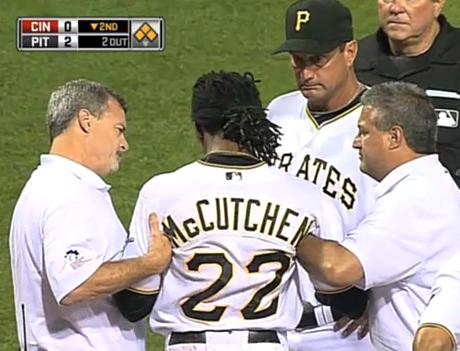
Yesterday, McCutcheon’s head was again at the wrong end of a fastball, only this time, he didn’t get out of the way. Cincinnati’s Mike Leake drilled the outfielder in the neck, just below his helmet, laying him out in the batter’s box for several minutes and knocking him out of the game. (Watch it here.)

It was almost certainly unintentional (there were two runners on base and Pittsburgh held a 2-0 lead in the second inning), and McCutcheon was ultimately found to have avoided both fractures and a concussion (he returned to action today).

None of that mattered. In addition to his pitch to McCutcheon, Leake had come up and in to Ronny Cedeno just two batters earlier, and a message needed to be sent about just how much the Pirates were willing to tolerate. After the Duke debacle earlier in the year, the answer was clear.

When Leake stepped to the plate the following inning, Pittsburgh pitcher Paul Maholm promptly drilled him in the knee with a fastball. Leake knew what it meant, and didn’t so much as look toward the mound as he took his base. (Watch it here.)

Reds manager Dusty Baker insisted that Leake was simply a wild pitcher who lost control, and not somebody with an agenda. Still, he laid out the purpose for inside pressure, and why it’s valuable.

“There was a thing when you first came up to the league: Let’s see if this kid can hit a fastball — he hit a fastball. Let’s see if he can hit a slider — he hit a slider,” he said on the Reds’ Web site. “Let’s see if he can hit a curveball — he hit a curveball. Then, they would see if he could hit it on your back — if they could intimidate you. And there have been many players that couldn’t handle that part of being knocked down.”

Got that? Intimidation: OK. Drilling a guy above the shoulders: Definitely not OK. Maholm did what he had to do, and both Baker and Leake were right on board with it.

Just like they should be.

– Jason

Articles

I’ve Been Sermonized

From the “Ways to Tell You’ve Made It” file: I don’ t know Rabbi Dan Moskovitz, and am unfamiliar with Temple Judea—which makes it all the more remarkable that he chose as a sermon topic baseball’s unwritten rules, and name dropped, of all people, me.

I’m in no position to judge anybody based only on religious beliefs, but this much is clear: the good rabbi is a man of staggering intelligence and discerning tastes.

That’s one down. Time to step up, Catholics, Buddhists and Sikhs.

– Jason

David Wright, Don't Enter the Opponent's Clubhouse, Pedro Guerrero, Willie Mays

Today’s Lesson: Never Refuse an Invitation From Willie Mays

In 1992, Pedro Guerrero spurred a battle inside the Cardinals clubhouse, when he invited Sammy Sosa inside about a half-hour after the Cubs beat St. Louis in a tense, tightly-played game. The two had pre-arranged dinner plans, but when Sosa arrived early, Guerrero instructed him to settle in and wait.

Sosa complied, spurring St. Louis players Rex Hudler and Todd Worrell to order that Guerrero remove the interloper. Within moments, Guerrero and Worrell were exchanging blows over the matter.

“I dragged them out of a locker—both of them were wrestling with each other,” said then-Cardinals mananger Joe Torre. “It was a draw, because they were both as strong as an ox.”

At issue was the unwritten rule stipulating that players not step set foot in an opponent’s clubhouse. It’s fraternization of the highest order—cordial relations with the enemy on his own turf. Guerrero might have been a 15-year veteran at that point, but even his elder-statesman status couldn’t gain him sway in this regard.

Willie Mays, however, is another story.

When the Mets visited San Francisco in July, Mays extended an impropmtu invitation for David Wright to meet him in the home clubhouse at AT&T Park, about an hour before game time.

Wright, already in full uniform, responded immediately, hustling down the hallway between the two clubhouses, skirting early-arriving fans in the process.

The two first met in 2008, during the ceremonies for the final game at Shea Stadium. In part, they talked baseball; in part, Mays recruited Wright for a charity event he was holding in Newport News, VA, about 20 miles from Wright’s hometown of Norfolk.

When they met again a few weeks ago, the agenda was similar. Again, Mays was hosting his event, and again he wanted Wright’s assistance.

In accepting Mays’ invitation, Wright didn’t come close to mingling with players—the meeting took place in the office of clubhouse manager Mike Murphy—but he had to enter the clubhouse to get there.

While the subject is hardly the taboo it once was, especially among players visiting ex-teammates after changing organizations, it still merits widespread recognition around the league. Often, players will simply send word to their pals that they’re waiting outside, and catch up in neutral territory.

Wright’s visit was benign enough to raise nary an eyebrow. The same couldn’t be said for Pedro Guerrero in ’92. Shortly after his incident with Worrell, Torre slapped down a moratorium on visiting players in the locker room, going so far as to publicly cite Mets outfielder Vince Coleman, late of the Cardinals, as a prime example of someone who had been making himself too comfortable on the wrong side of the clubhouse doors.

“I never wanted my players to fraternize,” said Torre. “I didn’t want guys visiting our clubhouse or having our guys visit their clubhouse. I thought that was a separation that had to be maintained.”

It was, and in many cases, still is. David Wright and Willie Mays excepted, of course.

– Jason

Jim Leyland, Matt Garza, No-Hitter Etiquette

How to Respect Your Local No-Hitter: A Brief Primer

On May 12 1984, with two outs in the ninth inning, the only thing that stood between Cincinnati’s Mario Soto and a no-hitter was Cardinals slugger George Hendrick. Soto’s first pitch to him was a fastball that split the plate. Hendrick watched it for strike one.

Soto’s second pitch was identical to the first. Again Hendrick watched it. Strike two.

Soto, however, inexplicably wanting something more from his experience, decided to buzz Hendrick with his 0-2 pitch, knocking him to the dirt. Hendrick took it calmly, returned to the batter’s box, and hit the next pitch for a home run. No-hitter over.

“I don’t know why he did that,” Hendrick said when he got back to the bench. “I was going to let the man have his no-hitter.”

It’s a matter of course for many in the game; no-hitter etiquette mandates a degree of respect for extraordinary feats. Hendrick might be more of an exception than a rule—hitters rarely want to stop hitting—but if a game is out of hand (as was Soto’s, with a 5-0 score), managers tend to leave the status quo alone, and let the inevitable play itself out.

This isn’t what happened on Monday, when, with two outs in the ninth inning of Matt Garza‘s no-hitter against Detroit, Tigers manager Jim Leyland called for Ramon Santiago to pinch-hit for Danny Worth. Like Soto’s gem, the score was 5-0, too steep a hill for the Tigers to realistically climb.

In Boston tonight, I talked to Leyland about his decision.

With two outs in the ninth inning of a 5-0 game, did you realistically think you had a chance to come back?

Probably not. Probably not. But that doesn’t mean that you don’t have a chance. The thing in that situation, the one big difference, is the five instead of four. If you’re down four runs, it’s okay to bunt in that situation for a hit. He gets on, someone else gets on, somebody walks, you send the tying run to the plate. With a five-run lead, not as much.

So it’s beyond the reach of a grand-slam. Knowing you’re not going to win, at what point do you let the guy have his no-hitter?

I don’t think you ever say that. I don’t ever say that.

No matter what the score, you’d send up your pinch-hitters?

Yeah, absolutely. I don’ think you ever say, “Let the guy have his no-hitter.” That’s not the way the game is played. If I’m going to say that, I might as well go home. That sends the wrong message to the people  who paid for a ticket. I learned that from my parents—you get what you earn.

We play every game and compete until the end. There are 27 outs in a game, and you try to utilize all of them. It doesn’t matter what the score is. You have to understand the situation. Even if it’s 10-1 in the ninth inning, you might send someone up there to save a guy a tough at-bat against a tough pitcher, or a bench guy might be playing in the game the next day, so you want to get him an at-bat to help him track the ball a little bit. A lot of things go into it—it’s not cut-and-dried.

At this point, Leyland launched into a mini-soliloquy that beautifully summed up his position.

We’re paid to compete until the last out, regardless. That’s what we do for a living. Garza pitched a no-hitter, and I tip my cap to him. But when Verlander pitched his no-hitter against Milwaukee, he earned it, and he was supposed to earn it. That’s just the way things go.

You don’t want a no-hitter pitched against you. Everybody’s talking about how you should just let him have it. Well, no you shouldn’t. Nobody wants to be that team. Detroit hadn’t had a no-hitter pitched against it in years. I didn’t want to be the guy from Detroit who finally got no-hit.

One of the beautiful aspects of baseball’s Code is that two people can see things from opposite perspectives, and each can make a convincing argument as to why he’s correct. I disagree with Leyland’s opinion; if a game like that is out of hand, things should be left to run their course.

Take, for example, the instance in 1932, when Detroit curveball specialist Tommy Bridges took a perfect game into the ninth inning against Washington. With two outs and facing a 13-0 deficit, Senators manager Walter Johnson sent pinch-hitter Dave Harris to the plate, primarily because Harris was an adept curveball hitter. Sure enough, he connected for a single, ruining Bridges’ feat. For his move, Johnson was roundly condemned by pundits around the country.

Bridges, however, took up a stance that would make Leyland proud. “I would rather earn it the competitive way,” he said, “than have it handed to me.”

– Jason

Dealing With Slumps, Mark Kotsay

There’s More Than One Way to Bust a Slump

Kevin Youkilis' energy drink.

Baseball is a game of failure. Those who explain it to the uninitiated frequently cite the fact that even the best hitters falter seven out of every 10 trips to the plate. Even then, these great players—the .300 hitters and 40-homer swatters—suffer through extended periods during which their established standards of success are nowhere to be found.

These are the days of the slump, and hitters will do virtually anything to avoid them.

Individual superstitions include such tactics as refusing  to change underwear and switching up ordinary routines in extraordinary ways. Dave Concepcion once crawled into a Wrigley Field industrial clothes dryer in an effort to heat up, then collected three hits against the Cubs. Others attempt to bed unattractive women. (“The bigger, the fatter, the uglier, the better,” said ex-pitcher Bob McClure, describing the concept while stopping short of admitting to his own practice of it. “It never failed,” he said. “Either the team went on a winning streak or the guy came out of the slump. It was automatic.”)

More interesting are team-wide solutions. When Frank Robinson managed the Indians, he grew so desperate to jump-start Cleveland’s offense that for one game he had members of the starting lineup draw their positions in the batting order from a hat. (This led to Boog Powell, 6-foot-4 and 265 pounds, batting leadoff for the first time in his career.)

Duane Kuiper was also a member of that team (he batted fourth that day, despite having so little power that he hit but a single homer over the course of his 12-year career). Years later he sought motivation for his struggling Giants by bringing the loudest alarm clock he could find into the dugout, in an effort to wake his teammates’ slumbering bats. Bill Caudill once dressed up like Sherlock Holmes, to better find Toronto’s missing offense.

On Tuesday, the White Sox did some slump-busting of their own.

Outfielder Mark Kotsay is batting just .221, and even the balls he’s hit hard recently have turned into outs—including having a home run taken away by an over-the-wall grab by Ichiro on Monday. So his teammates decided to mix things up for him.

Before a game against Seattle, Mark Teahen absconded with two of Kotsay’s bats, and during team stretch set them on fire.

“There are quirky things like changing your uniform or your undershirt or your shoes, but (I’ve never heard of) burning bats,” said Kotsay in the Chicago Tribune.

It’s too soon to tell if it worked, but it’s not the first time players have resorted to fire in an effort to staunch a slump.

In 1999, the Dodgers held a ceremonial cap burning in their bullpen—which wasn’t enough, as they went on to lose their sixth straight and finished the season at 77-85.

Even more pronounced was the bonfire set in the Rangers’ dugout in 1994, in the middle of a game against the Angels.

It was started by players Chris James and Gary Redus, who for kindling used the ratty, red high-top cleats Jose Canseco had been wearing since spring training. Canseco’s reluctance to upgrade his footwear had so offended the sensibilities of his teammates that James hid the shoes before the game, forcing Canseco to don a new pair. When the slugger responded by hitting two home runs in the first three innings, the decision was made to ensure he’d never his old shoes back. There was no time to wait. A bottle of rubbing alcohol was procured from the trainer’s room, somebody found a match and the immolation began.

As the flames grew, members of the Rangers bench started dancing around the pyre.

“I looked over there from first base and said, ‘What the hell’s going on?’ ” said Texas first baseman Will Clark. “Then I heard what they had done. I couldn’t see, I was laughing so hard.”

The catch: His teammates might not have realized it, but Rangers pitcher Kenny Rogers was in the middle of throwing a perfect game at the time.

Rogers, however, was so focused that he never noticed the plume of smoke emerging from the dugout, and remained oblivious until he was told what happened once the game was over. “I like that,” he said. “We’ll burn the rest of his shoes if that’s what it takes.”

– Jason

The Baseball Codes

R.A. Dickey Loves to Battle. Jerry Manuel Doesn’t Care

Reluctance to be pulled from a game is the hallmark of any quality starting pitcher, no matter how he’s actually feeling. If he’s tired, or if his stuff isn’t popping like he feels it should, he’s forced to walk the fine line between becoming a detriment to his team and essentially giving up.

Few in baseball want to see perceived cowardice in action from their teammates, even if it’s ultimately for the collective good. Said David Cone about being in that situation: “If you don’t say the right thing, it’s perceived as a lack of heart.”

Mets fans have a lot to grumble about this season, but a lack of heart from R.A. Dickey isn’t part of it. He made that much clear on Sunday.

Having shut out the Dodgers on two hits through five innings, Dickey injured his leg on a follow-through while pitching to the first hitter of the sixth, Russell Martin. (He claimed it was because he landed awkwardly in a hole created by Dodgers starter Clayton Kershaw.)

Dickey stayed in the game to retire Martin and the next hitter, Kershaw, both on comebackers to the mound. At that point, however, Mets manager Jerry Manuel opted for caution, and removed the pitcher, mid-frame.

That much is standard procedure. An injury to one of their better pitchers would be devastating to the Mets, and watching Dickey pounce off the mound to field consecutive grounders undoubtedly left Manuel’s head spinning.

It’s how Dickey responded that stood out. In a discussion that lasted the better part of two minutes, the pitcher vociferously lobbied Manuel to stay in the game. When that failed to take, he turned his efforts toward trainer Mike Herbst. (Watch the entire affair here.)

Here’s what Dickey knew: the Mets had used seven pitchers in Saturday’s 13-inning loss to Los Angeles, and another seven in Wednesday’s 14-inning loss to Arizona, and he wanted to protect the bullpen.

Here’s what Dickey didn’t know: Manuel had already made the call for a reliever by the time the pitcher turned to plate umpire Dana DeMuth and said, according to the New York Times, “I’m not going anywhere.”

“It’s frustrating because I felt I let my team down,” said Dickey afterward, in the New York Post.

Manuel’s reply: “He was adamant about staying in the game, but I didn’t feel we could risk a guy like that going down.”

The episode calls to mind a conversation held during Game 4 of the 1977 World Series, when Dodgers manager Tommy Lasorda went to the mound to remove his starter, Doug Rau. It’s memorable (and available) because Lasorda was wearing a microphone for the TV broadcast. Also, as Lasorda admitted to one of his coaches in the dugout, his goal was to stall for time and allow reliever Rick Rhoden additional warm-up tosses.

Lasorda made the decision to remove Rau before he even left the bench, but the pitcher, not privy to his manager’s thinking, lobbied to remain in the game—which was exactly what Lasorda didn’t want to hear. (Warning: baseball language—in no way family appropriate—ensues.)

Rau: I feel good, Tommy.

Lasorda: I don’t give a shit you feel good. There’s four motherfucking hits up there. [There were actually only three.]

Rau: They were all fuckin’ hit the opposite way. . . .

Lasorda: I don’t give a fuck.

Rau: Tommy, we got a left-handed hitter. I can strike this mother¬fucker out.

Lasorda: I don’t give a shit, Dougie.

Rau: I want to get out of this myself.

Lasorda: I may be wrong, but that’s my goddamn job.

Rau: I ain’t fuckin’ hurtin’.

Lasorda: I’ll make the fuckin’ decisions here, okay?

Rau: [Tommy John] gave up three runs on the fuckin’ board yesterday.

Lasorda: I don’t give a fuck! Don’t give me any shit, goddamn it! I make the fuckin’ decisions. Keep your fucking mouth shut—I told you.

Second baseman Davey Lopes, interjecting on behalf of the sport’s image: “Hey, hey, hey. This looks bad up here. Just back off the mound. You want to talk about it, talk about it inside.”

Lasorda: We’ll talk about it in my fucking office.

Rau: If I felt bad, then I wouldn’t say nothing.

Lopes: I’m just saying, talk about it inside. This is not the place to be talking about it, okay? That’s all I’m trying to say. I’m just trying to avoid a fucking scene out here, that’s all.

Lasorda: That’s right. It’s fucking great for you to be out here talking to me like that.

Rau: If I didn’t feel good, I wouldn’t say nothing.

Lasorda: I don’t give a shit, Doug. I’m the fucking manager of the fucking team. I gotta make the fucking decisions. And I’ll make them to the fucking best of my ability. They may be the fucking wrong decisions, but I’ll make it. Don’t worry about it. I’ll make the fucking decisions. I gave you the fucking chance to walk out here. I can’t fuck around—we’re down two games to one. If it was yesterday, it’s a different fucking story.

Rau: We got a left-handed hitter coming up, why—

Lasorda: I don’t give a shit! You got three left-handed hitters and they all got hits on you. Rivers, Jackson, and that fucking other guy. That guy who just hit the ball was a left-hander, wasn’t he? [Chris Chambliss, who had doubled, was indeed left-handed.]

Rau: I jammed him. I pitched it on the inside part of the plate. . . .

Lasorda: I don’t give a shit whether you jammed him or not—he didn’t get out. I can’t let you out there in a fucking game like this—I’ve got a fucking job to do. What’s the matter with you?

For what it’s worth, Rau’s tenacity helped earn him an increased role in the Dodgers rotation the following year.

As for R.A. Dickey, his own determination will do doubt help endear him to hard-to-please Mets fans. Still, it should be noted that Hall of Fame manager Sparky Anderson had a rule with his pitchers. “I don’t want to hear you,” he said. “Just give me the ball. I have no desire to hear a pitcher’s feelings, because if something goes wrong I’m the one who’s going to get fired, not the pitcher.”

– Jason

Deke Appropriately, Johnny Damon, Nelson Cruz

Damon Deked; Rangers Win

Baseball’s unwritten rules have an entire section on the propriety of deking, or making phantom (or decoy) plays to confuse baserunners into thinking the ball is somewhere it’s not.

At issue: an infielder who puts down a late tag can cause an unsuspecting runner into a late and awkward slide, which can lead to injury. We covered this a couple weeks ago when discussing Robinson Cano’s deke of David Wright in the All-Star Game.

(Not only did Cano do nothing wrong, he executed the play to perfection. His goal was not to get Wright to slide—Wright was in the process of doing that, anyway—but to delay his realization that the ball had actually been thrown into center field.)

When it comes to outfielders, however, pretty much anything goes. There’s nothing they can do, after all, to put a baserunner in any sort of peril.

Like Nelson Cruz, for example, who last week in Detroit acted as if he was about to catch a ball that landed well in front of him. It wasn’t a particularly graceful deke—little more than a quick stab skyward with his glove—but it was enough to keep Johnny Damon, who otherwise should have scored easily, at third base. (Watch it here.)

It’s hardly a new concept. From The Baseball Codes:

Jim Rice made a habit of treating many balls hit over his head at Fenway Park as if they would end up clearing the Green Monster by a mile, gazing up with detachment as the hitter started into his home-run trot . . . before racing to the carom and firing the ball in to second. “You could make a great video of all the shocked faces of baserunners who were cut down at second because they fell for this trick,” said outfielder Doug Glanville.

Ironically, one of the most noteworthy instances of an outfield deke involved Rice’s Red Sox—with Boston cast as the victim. It happened in 1978, during the one-game playoff between the Red Sox and the Yankees to determine who went to the American League Championship Series. Boston, trailing 5–4 in the bottom of the ninth at Fenway Park, had a runner, Jerry Remy, on first base with one out. Things appeared promising when Rick Burleson hit a fly ball that Yankees right fielder Lou Piniella lost almost immediately in a patch of sunlight. But Piniella never hesitated, casually acting from the outset as if he were going to make the catch. Remy, who should have made it to third base without issue, was forced to stay near first until he saw that the ball wouldn’t be caught, at which point he could advance no farther than second. When Rice followed with a deep fly ball that would have easily scored the tying run from third, the Red Sox sensed an incredible opportunity wasted. Boston’s final batter, Carl Yastrzemski, popped out to end the game.

Like Remy, Damon saw only a flash of what he thought was a developing play. It didn’t stop him entirely, but in a sport where runners are safe or out based on fractions of a second, it was enough to keep the run off the board. Considering that the Tigers and Rangers were tied 6-6 in the 11th inning, and a run would have ended it on the spot, it was a game-saver.

Cruz upped his performance even more in the 14th, hitting a home run that won it for Texas, 8-6.

Behold, the power of the deke.

– Jason

Clayton Kershaw, Don Mattingly, Mound Conference Etiquette, Retaliation, Unwritten-Rules

Kershaw Upholds Unwritten Rule While Mattingly Breaks Written One

A nearly unprecedented comingling of rules both written and unwritten descended upon Dodger Stadium on Tuesday, as inside pitches inspired retaliatory strikes, one pitcher was ejected for drilling an opponent and another was tossed because his manager mucked up the rulebook.

It all might have started in April, at least according to Dodgers manager Joe Torre. That was when Los Angeles head-hunter Vicente Padilla broke Aaron Rowand’s cheek with a fastball, knocking him out of action for more than two weeks.

Thus, when Tim Lincecum knocked Matt Kemp down with an inside pitch on Tuesday, and followed that up by drilling him, it was easy to draw conclusions about retaliation. (Kemp certainly did, taking several steps toward the mound before being redirected by umpire Adrian Johnson.)

Never mind that Lincecum had a chance to respond as the Giants starter the day after Padilla’s deed, more than three months ago, or that the Giants have faced the Dodgers six times since the incident without drilling anybody.

There’s also the fact that Lincecum was unusually terrible, lasting just 4 2/3 innings, missing the strike zone on seven of his first eight pitches, giving up five runs and throwing about the worst pitch humanly possible.

Still, when Giants reliever Denny Bautista twice came well inside to Russell Martin in the sixth, the Dodgers took it extremely personally. (Bench coach Bob Schaefer was ejected for the vociferous nature of his protestations.)

Despite a warning leveled by Johnson after Lincecum plunked Kemp, Dodgers starter Clayton Kershaw drilled the next batter he faced, Rowand, in the hip, earning ejections for himself and Torre. (Watch the chain of events here.)

“When Kemp took a few steps toward Timmy, that made no sense because obviously Tim was struggling and wasn’t trying to hit him,” wrote Giants outfielder Aubrey Huff on his blog. “We were all a little jumpy right there, waiting to see what was going to happen. And Bautista definitely wasn’t trying to hit Russell Martin. . . . Now, I imagine, it’s all over and done with. They got their retaliation shot in, and that’s it.”

(Kershaw received a five-game suspension for his actions, while Torre and Schaefer were docked a game each.)

This left Dodgers coach Don Mattingly in charge of the team.

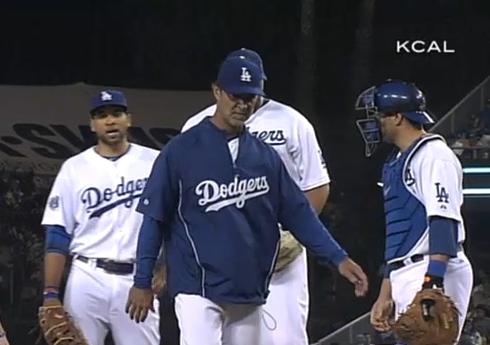
Los Angeles closer Jonathan Broxton came on in the ninth to protect a 5-4 lead, and promptly loaded the bases with one out. Mattingly visited the mound to inform members of the infield where he wanted them positioned. After he turned to leave, however, first baseman James Loney asked another question. Mattingly returned to address it, before heading to the dugout. (Watch it here.)

The issue: This constituted two visits, something not allowed in the same inning under rule 8.06 of the Official Baseball Rules, which stipulates that a mound visit begins when a manager or coach crosses the foul line, and ends when he departs from the 18-foot diameter of the mound.

“I really just went out to let the infield know we were going to play back,” said Mattingly in the Los Angeles Times. “[Hitter Andres] Torres could run. And the corners were basically pretty much going home. After I did that, I turned to walk away and James [Loney] said something, and I kind of turned around. I didn’t realize I was even off the dirt, but obviously I was.’’

Umpire Johnson shouted, “No, no, no. You can’t go back,” and Giants manager Bruce Bochy pounced. The umpires informed Mattingly that according to the rulebook, Broxton would have to leave the game. That left George Sherrill, having not received adequate time to warm up, to enter the game virtually cold.

He promptly gave up a two-run double to Torres that proved to be the difference in the game.

The umpires could have afforded Sherrill as many warm-up tosses as he wanted, but had the power to cut him off after eight—which they did. It was a detrimental decision from the Dodgers’ point of view, but at least it hewed to the rulebook.

Ejecting Broxton: not so much.

Rule 8.06 was codified in 1967, in an effort to minimize mound visits and speed up games. Because relief pitchers must face at least one hitter per appearance, an adjunct to the rule keeps managers from circumventing it by using back-to-back mound visits to remove a pitcher and improve matchup possibilities. It does this by stating that the manager will be ejected for the action, as will the pitcher, but only after he faces the guy at the plate.

(The umps should not even have ejected Mattingly, writes Henry Schulman of the San Francisco Chronicle, because they didn’t adequately warn him against a second visit, as stipulated by the rules.)

Bochy knew about all of this, having invoked the rule in 2006 as manager of the Padres (also against Los Angeles). That time it was properly carried out, with Dodgers pitcher Brad Penny remaining in the game to face the hitter.

“I think that’s the craziest win we’ve had all season,” said Giants reliever Jeremy Affeldt, who picked up the save, in the San Francisco Chronicle. “I’m sure we’ll put our heads on our pillows and smile.”

As will those of us who pay attention to this kind of thing. The written rules managed to bite the Dodgers on Tuesday; the teams next meet in San Francisco on July 30, at which point we’ll see if there’s a need for rules of the unwritten variety.

– Jason